By:-
Mitul K. Desai – 23
 This model was first described by Barry Boehm in his 1986 paper
"A Spiral Model of Software Development and Enhancement".
 Boehm describes the spiral model as a "process model generator“.
 Here choices were based on project risk.
 The Spiral Development ( or Lifecycle) Model is a systems
development method used in information technology.
 It combines the features of the prototyping model and the waterfall
model.
 It is favored for large, expensive, and complicated models.
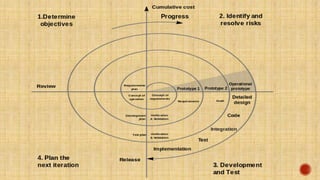
 Consider the win conditions of all success-critical stakeholders.
 Identify and evaluate alternative approaches for satisfying the win
conditions.
 Identify and resolve risks that stem from the selected approach(es).
 Obtain approval from all success-critical stakeholders, plus
commitment to pursue the next cycle.
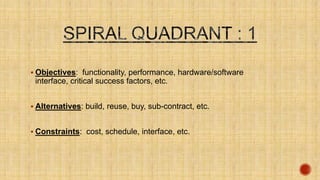
 Objectives: functionality, performance, hardware/software interface,
critical success factors, etc.
 Alternatives: build, reuse, buy, sub-contract, etc.
 Constraints: cost, schedule, interface, etc.
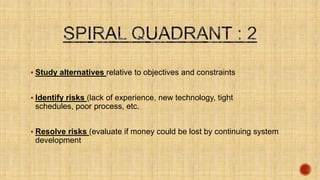
 Study alternatives relative to objectives and constraints
 Identify risks (lack of experience, new technology, tight schedules,
poor process, etc.
 Resolve risks (evaluate if money could be lost by continuing system
development
 Typical activities:
 Create a design
 Review design
 Develop code
 Inspect code
 Test product
 Typical activities:
 Develop project plan
 Develop configuration management plan
 Develop a test plan
 Develop an installation plan
 Estimates of the budget and schedule become more realistic as work
progresses because of the questions that have been raised
 Easier to cope with the changes inherent to software development
 Software engineers can start working on the project earlier rather
than wading through a lengthy early design process.
 Time spent for evaluating risks too large for small or low-risk projects.
 Time spent planning, resetting objectives, doing risk analysis and
prototyping may be excessive.
 The model is complex.
 Risk assessment expertise is required.
 Long-term project commitment unwise because of potential changes to
economic priorities.
 Users are unsure of their needs.
 Requirements are complex.
 New product line .
 Significant changes are expected (research and exploration).
 http://www.princeton.edu/~achaney/tmve/wiki100k/docs/Spiral_model.html
 http://csse.usc.edu/csse/TECHRPTS/1988/usccse88-500/usccse88-500.pdf
 http://en.wikipedia.org/wiki/File:Spiral_model_(Boehm,_1988).svg

Spiral model : System analysis and design

  • 1.
  • 2.
     This modelwas first described by Barry Boehm in his 1986 paper "A Spiral Model of Software Development and Enhancement".  Boehm describes the spiral model as a "process model generator“.  Here choices were based on project risk.
  • 3.
     The SpiralDevelopment ( or Lifecycle) Model is a systems development method used in information technology.  It combines the features of the prototyping model and the waterfall model.  It is favored for large, expensive, and complicated models.
  • 4.
     Consider thewin conditions of all success-critical stakeholders.  Identify and evaluate alternative approaches for satisfying the win conditions.  Identify and resolve risks that stem from the selected approach(es).  Obtain approval from all success-critical stakeholders, plus commitment to pursue the next cycle.
  • 6.
     Objectives: functionality,performance, hardware/software interface, critical success factors, etc.  Alternatives: build, reuse, buy, sub-contract, etc.  Constraints: cost, schedule, interface, etc.
  • 7.
     Study alternativesrelative to objectives and constraints  Identify risks (lack of experience, new technology, tight schedules, poor process, etc.  Resolve risks (evaluate if money could be lost by continuing system development
  • 8.
     Typical activities: Create a design  Review design  Develop code  Inspect code  Test product
  • 9.
     Typical activities: Develop project plan  Develop configuration management plan  Develop a test plan  Develop an installation plan
  • 10.
     Estimates ofthe budget and schedule become more realistic as work progresses because of the questions that have been raised  Easier to cope with the changes inherent to software development  Software engineers can start working on the project earlier rather than wading through a lengthy early design process.
  • 11.
     Time spentfor evaluating risks too large for small or low-risk projects.  Time spent planning, resetting objectives, doing risk analysis and prototyping may be excessive.  The model is complex.  Risk assessment expertise is required.
  • 12.
     Long-term projectcommitment unwise because of potential changes to economic priorities.  Users are unsure of their needs.  Requirements are complex.  New product line .  Significant changes are expected (research and exploration).
  • 13.