Software Engineering: 7
Prototype Model
Prof Neeraj Bhargava
Vaibhav Khanna
Department of Computer Science
School of Engineering and Systems Sciences
Maharshi Dayanand Saraswati University Ajmer
Prototyping
• Prototyping is defined as the process of
developing a working replication of a product
or system that has to be engineered.
• It offers a small scale facsimile of the end
product and is used for obtaining customer
feedback
• The prototyping modelsuggests building a
working Prototype of the system, before the
development of the actual software.
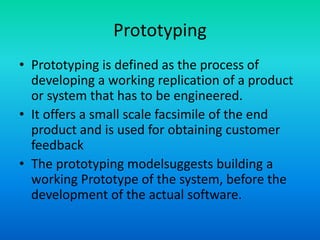
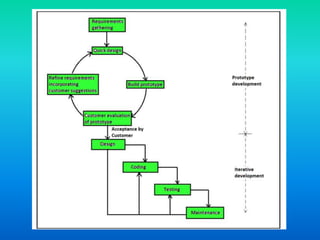
Schematic Diagram of prototype
model
The Prototyping Model
• The Prototyping Model is one of the most
popularly used Software Development Life Cycle
Models (SDLC models).
• This model is used when the customers do not
know the exact project requirements beforehand.
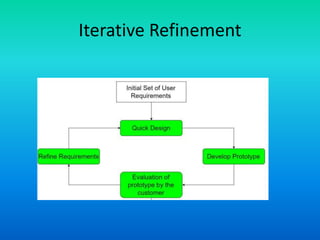
• In this model, a prototype of the end product is
first developed, tested and refined as per
customer feedback repeatedly till a final
acceptable prototype is achieved.
• The final prototype forms the basis for
developing the final product.
Methodology
• In this process model, the system is partially
implemented before or during the analysis phase
thereby giving the customers an opportunity to see the
product early in the life cycle.
• The process starts by interviewing the customers and
developing the incomplete high-level paper model.
• This document is used to build the initial prototype
supporting only the basic functionality as desired by
the customer.
• Once the customer figures out the problems, the
prototype is further refined to eliminate them.
Iterative Refinement
Advantages
• The customers get to see the partial product early in
the life cycle. This ensures a greater level of customer
satisfaction and comfort.
• New requirements can be easily accommodated as
there is scope for refinement.
• Missing functionalities can be easily figured out.
• Errors can be detected much earlier thereby saving a
lot of effort and cost, besides enhancing the quality of
the software.
• The developed prototype can be reused by the
developer for more complicated projects in the future.
• Flexibility in design.
Disadvantages
• Costly w.r.t time as well as money.
• There may be too much variation in requirements each
time the prototype is evaluated by the customer.
• Poor Documentation due to continuously changing
customer requirements.
• It is very difficult for the developers to accommodate
all the changes demanded by the customer.
• There is uncertainty in determining the number of
iterations that would be required before the prototype
is finally accepted by the customer.
Disadvantages
• After seeing an early prototype, the customers
sometimes demand the actual product to be
delivered soon.
• Developers in a hurry to build prototypes may
end up with sub-optimal solutions.
• The customer might lose interest in the
product if he/she is not satisfied with the
initial prototype.
Suitability of use
• The Prototyping Model should be used when the
requirements of the product are not clearly
understood or are unstable.
• It can also be used if requirements are changing
quickly.
• This model can be successfully used for
developing user interfaces, high technology
software-intensive systems, and systems with
complex algorithms and interfaces.
• It is also a very good choice to demonstrate the
technical feasibility of the product.
Suitability of use
• It is advantageous to develop the Graphical User Interface
(GUI) part of a software using the Prototyping Model.
Through prototype, the user can experiment with a working
user interface and they can suggest any change if needed.
• A prototype can help the developers in critically examining
the technical issues associated with the product
development.
• The lack of familiarity with a required development
technology is a technical risk.
• This can be resolved by developing a prototype to
understand the issues and accommodate the changes in
the next iteration.
Assignment
• 1. Discuss in detail the concept, advantages
and disadvantages of prototype model.
• Thank You

Software engineering 7 prototype model

  • 1.
    Software Engineering: 7 PrototypeModel Prof Neeraj Bhargava Vaibhav Khanna Department of Computer Science School of Engineering and Systems Sciences Maharshi Dayanand Saraswati University Ajmer
  • 2.
    Prototyping • Prototyping isdefined as the process of developing a working replication of a product or system that has to be engineered. • It offers a small scale facsimile of the end product and is used for obtaining customer feedback • The prototyping modelsuggests building a working Prototype of the system, before the development of the actual software.
  • 3.
    Schematic Diagram ofprototype model
  • 4.
    The Prototyping Model •The Prototyping Model is one of the most popularly used Software Development Life Cycle Models (SDLC models). • This model is used when the customers do not know the exact project requirements beforehand. • In this model, a prototype of the end product is first developed, tested and refined as per customer feedback repeatedly till a final acceptable prototype is achieved. • The final prototype forms the basis for developing the final product.
  • 5.
    Methodology • In thisprocess model, the system is partially implemented before or during the analysis phase thereby giving the customers an opportunity to see the product early in the life cycle. • The process starts by interviewing the customers and developing the incomplete high-level paper model. • This document is used to build the initial prototype supporting only the basic functionality as desired by the customer. • Once the customer figures out the problems, the prototype is further refined to eliminate them.
  • 6.
  • 7.
    Advantages • The customersget to see the partial product early in the life cycle. This ensures a greater level of customer satisfaction and comfort. • New requirements can be easily accommodated as there is scope for refinement. • Missing functionalities can be easily figured out. • Errors can be detected much earlier thereby saving a lot of effort and cost, besides enhancing the quality of the software. • The developed prototype can be reused by the developer for more complicated projects in the future. • Flexibility in design.
  • 8.
    Disadvantages • Costly w.r.ttime as well as money. • There may be too much variation in requirements each time the prototype is evaluated by the customer. • Poor Documentation due to continuously changing customer requirements. • It is very difficult for the developers to accommodate all the changes demanded by the customer. • There is uncertainty in determining the number of iterations that would be required before the prototype is finally accepted by the customer.
  • 9.
    Disadvantages • After seeingan early prototype, the customers sometimes demand the actual product to be delivered soon. • Developers in a hurry to build prototypes may end up with sub-optimal solutions. • The customer might lose interest in the product if he/she is not satisfied with the initial prototype.
  • 10.
    Suitability of use •The Prototyping Model should be used when the requirements of the product are not clearly understood or are unstable. • It can also be used if requirements are changing quickly. • This model can be successfully used for developing user interfaces, high technology software-intensive systems, and systems with complex algorithms and interfaces. • It is also a very good choice to demonstrate the technical feasibility of the product.
  • 11.
    Suitability of use •It is advantageous to develop the Graphical User Interface (GUI) part of a software using the Prototyping Model. Through prototype, the user can experiment with a working user interface and they can suggest any change if needed. • A prototype can help the developers in critically examining the technical issues associated with the product development. • The lack of familiarity with a required development technology is a technical risk. • This can be resolved by developing a prototype to understand the issues and accommodate the changes in the next iteration.
  • 13.
    Assignment • 1. Discussin detail the concept, advantages and disadvantages of prototype model. • Thank You