PROTOTYPE MODEL
Team Members
Sukaina Maryam M - 811720243047
Abinaya M - 811720243002
Thejaswini S- 811720243051
-
Agenda
* Overview
* Why we go for Prototype Model?
* Prototype Model
* Phases / Steps for Prototype model
* Advantages of Prototype Model
* Disadvantages of Prototype Model
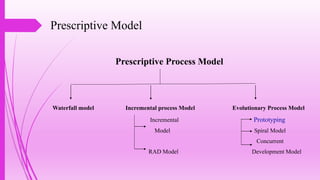
Prescriptive Model
Prescriptive Process Model
Waterfall model Incremental process Model Evolutionary Process Model
Incremental Prototyping
Model Spiral Model
Concurrent
RAD Model Development Model
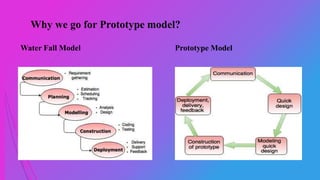
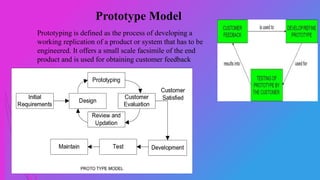
Why we go for Prototype model?
Water Fall Model Prototype Model
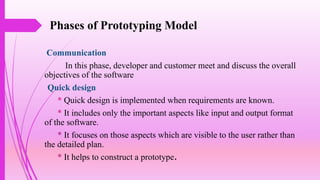
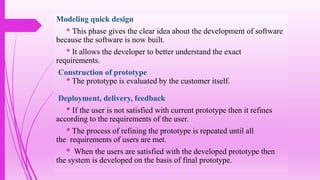
Prototype Model
 Prototyping is defined as the process of developing a
working replication of a product or system that has to be
engineered. It offers a small scale facsimile of the end
product and is used for obtaining customer feedback
Phases of Prototyping Model
Communication
In this phase, developer and customer meet and discuss the overall
objectives of the software
Quick design
* Quick design is implemented when requirements are known.
* It includes only the important aspects like input and output format
of the software.
* It focuses on those aspects which are visible to the user rather than
the detailed plan.
* It helps to construct a prototype.
Modeling quick design
* This phase gives the clear idea about the development of software
because the software is now built.
* It allows the developer to better understand the exact
requirements.
Construction of prototype
* The prototype is evaluated by the customer itself.
Deployment, delivery, feedback
* If the user is not satisfied with current prototype then it refines
according to the requirements of the user.
* The process of refining the prototype is repeated until all
the requirements of users are met.
* When the users are satisfied with the developed prototype then
the system is developed on the basis of final prototype.
Advantages of Prototyping Model
* Provides better understandability about the customer needs.
* It reduces risk of failure.
* In the development process of this model users are actively involved.
* Errors are detected much earlier.
* Gives quick user feedback for better solutions.
* It identifies the missing functionality easily.
Disadvantages of Prototyping Model
* Prototyping tools are Expensive.
* Difficult to know how long the project will last.
* It is a slow process because it takes more time for development.
* It is a thrown away prototype when the users are confused with
it.
* The customer might lose interest in the product if he/she is not
satisfied with the initial prototype.
 PROTOTYPE MODEL

PROTOTYPE MODEL

  • 1.
    PROTOTYPE MODEL Team Members SukainaMaryam M - 811720243047 Abinaya M - 811720243002 Thejaswini S- 811720243051 -
  • 2.
    Agenda * Overview * Whywe go for Prototype Model? * Prototype Model * Phases / Steps for Prototype model * Advantages of Prototype Model * Disadvantages of Prototype Model
  • 3.
    Prescriptive Model Prescriptive ProcessModel Waterfall model Incremental process Model Evolutionary Process Model Incremental Prototyping Model Spiral Model Concurrent RAD Model Development Model
  • 4.
    Why we gofor Prototype model? Water Fall Model Prototype Model
  • 5.
    Prototype Model  Prototypingis defined as the process of developing a working replication of a product or system that has to be engineered. It offers a small scale facsimile of the end product and is used for obtaining customer feedback
  • 6.
    Phases of PrototypingModel Communication In this phase, developer and customer meet and discuss the overall objectives of the software Quick design * Quick design is implemented when requirements are known. * It includes only the important aspects like input and output format of the software. * It focuses on those aspects which are visible to the user rather than the detailed plan. * It helps to construct a prototype.
  • 7.
    Modeling quick design *This phase gives the clear idea about the development of software because the software is now built. * It allows the developer to better understand the exact requirements. Construction of prototype * The prototype is evaluated by the customer itself. Deployment, delivery, feedback * If the user is not satisfied with current prototype then it refines according to the requirements of the user. * The process of refining the prototype is repeated until all the requirements of users are met. * When the users are satisfied with the developed prototype then the system is developed on the basis of final prototype.
  • 8.
    Advantages of PrototypingModel * Provides better understandability about the customer needs. * It reduces risk of failure. * In the development process of this model users are actively involved. * Errors are detected much earlier. * Gives quick user feedback for better solutions. * It identifies the missing functionality easily.
  • 9.
    Disadvantages of PrototypingModel * Prototyping tools are Expensive. * Difficult to know how long the project will last. * It is a slow process because it takes more time for development. * It is a thrown away prototype when the users are confused with it. * The customer might lose interest in the product if he/she is not satisfied with the initial prototype.