SOFTWARE
ENGINEERING
ASIF IDRISI
18018
RAKESH PENTA 18027
TOPIC
RAD MODEL
&
PROTOTYPING
RAD MODEL
WHAT IS RAD ???
 RAD model is Rapid Application Development model.
 It is a type of Incremental model.
 In RAD the Components are developed in
parallel Manner.
 It is a faster software development process.
RAD MODEL
PHASES IN RAD
 Requirements Planning phase
 User design phase
 Construction phase
 Cutover phase
RAD MODEL
1. Requirements Planning phase
 Users, managers, and IT staff members discuss on
Business needs.
 They discuss on System requirements.
 They also discuss on Project scope
 It decide who will generate software.
 It tells what software will do.
2. User design phase
RAD MODEL
 It is also called as Modeling phase.
 User Design phase is a continuous interactive process.
 During this phase, users interact with software model.
 It allows users to understand, modify the System.
 It approve a working model of the system that meets
their needs.
RAD MODEL
3. Construction phase
 Focuses on program and application development task.
 Tasks are
* Programming and application development,
* Coding,
* Unit-integration and
* System testing.
RAD MODEL
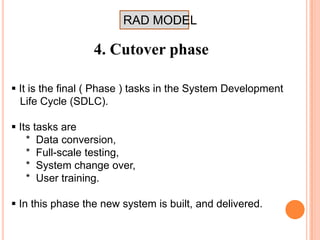
4. Cutover phase
 It is the final ( Phase ) tasks in the System Development
Life Cycle (SDLC).
 Its tasks are
* Data conversion,
* Full-scale testing,
* System change over,
* User training.
 In this phase the new system is built, and delivered.
RAD MODEL
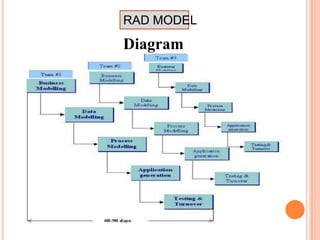
Diagram
RAD MODEL
Advantages
 RAD reduces the development time.
 Increases reusability of components.
 Greater Customer Satisfaction.
 Faster Delivery Time.
 Simple and Better Quality.
RAD MODEL
Disadvantages
 Requires highly skilled developers/designers.
 RAD is not appropriate when technical risk are high.
 Cant use for small projects.
 Absence of reusable component can lead to failure
of the project.
PROTOTYPING
PROTOTYPI
NG
 A prototype is the sample implementation of the real system.
 A prototype is a toy implementation of the system.
 It shows limited and main functional capabilities of the
proposed system.
 The customer provides suggestion and improvements on the
prototype.
 A prototype is a model or a program which is not based on
strict planning.
PROTOTYPI
NG
 After a prototype is built, it is delivered to the customer
for the evaluation.
 It helps the customer determine how the feature will
function in the final software.
 It is a very useful technique to obtain accurate
requirements of the system.
PROTOTYPI
NG
TYPES OF PROTOTYPE
1 Throwaway prototypes
2 Evolutionary Prototypes
PROTOTYPI
NG
Throwaway Prototypes
 Prototype developed as part of a throw-away approach.
 It will not form part of the final solution.
 It is a useful way of exploring ideas, and gaining
feedback from user.
PROTOTYPI
NG
Evolutionary Prototypes
 It is initial prototype is presented to user.
 They Provide feedback and suggestion for improvement.
 Each stage of this prototype evolves toward the final
system hence it is called as Evolutionary Prototype
PROTOTYPI
NG
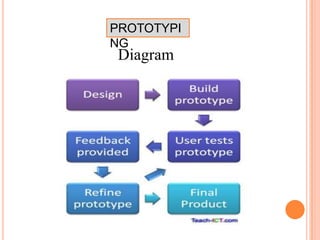
Diagram
PROTOTYPI
NG
Advantage
 Users are actively involved in the development.
 Errors can be detected much earlier.
 Missing functionality can be identified easily.
 It reduces risk of failure.
PROTOTYPI
NG
Disadvantage
 It is a slow process.
 It is not complete model.
 It is time consuming model.
 It should be developed or built on company's cost.
RAD Model & Prototyping Of Software Engineering

RAD Model & Prototyping Of Software Engineering

  • 1.
  • 2.
  • 3.
    RAD MODEL WHAT ISRAD ???  RAD model is Rapid Application Development model.  It is a type of Incremental model.  In RAD the Components are developed in parallel Manner.  It is a faster software development process.
  • 4.
    RAD MODEL PHASES INRAD  Requirements Planning phase  User design phase  Construction phase  Cutover phase
  • 5.
    RAD MODEL 1. RequirementsPlanning phase  Users, managers, and IT staff members discuss on Business needs.  They discuss on System requirements.  They also discuss on Project scope  It decide who will generate software.  It tells what software will do.
  • 6.
    2. User designphase RAD MODEL  It is also called as Modeling phase.  User Design phase is a continuous interactive process.  During this phase, users interact with software model.  It allows users to understand, modify the System.  It approve a working model of the system that meets their needs.
  • 7.
    RAD MODEL 3. Constructionphase  Focuses on program and application development task.  Tasks are * Programming and application development, * Coding, * Unit-integration and * System testing.
  • 8.
    RAD MODEL 4. Cutoverphase  It is the final ( Phase ) tasks in the System Development Life Cycle (SDLC).  Its tasks are * Data conversion, * Full-scale testing, * System change over, * User training.  In this phase the new system is built, and delivered.
  • 9.
  • 10.
    RAD MODEL Advantages  RADreduces the development time.  Increases reusability of components.  Greater Customer Satisfaction.  Faster Delivery Time.  Simple and Better Quality.
  • 11.
    RAD MODEL Disadvantages  Requireshighly skilled developers/designers.  RAD is not appropriate when technical risk are high.  Cant use for small projects.  Absence of reusable component can lead to failure of the project.
  • 12.
  • 13.
    PROTOTYPI NG  A prototypeis the sample implementation of the real system.  A prototype is a toy implementation of the system.  It shows limited and main functional capabilities of the proposed system.  The customer provides suggestion and improvements on the prototype.  A prototype is a model or a program which is not based on strict planning.
  • 14.
    PROTOTYPI NG  After aprototype is built, it is delivered to the customer for the evaluation.  It helps the customer determine how the feature will function in the final software.  It is a very useful technique to obtain accurate requirements of the system.
  • 15.
    PROTOTYPI NG TYPES OF PROTOTYPE 1Throwaway prototypes 2 Evolutionary Prototypes
  • 16.
    PROTOTYPI NG Throwaway Prototypes  Prototypedeveloped as part of a throw-away approach.  It will not form part of the final solution.  It is a useful way of exploring ideas, and gaining feedback from user.
  • 17.
    PROTOTYPI NG Evolutionary Prototypes  Itis initial prototype is presented to user.  They Provide feedback and suggestion for improvement.  Each stage of this prototype evolves toward the final system hence it is called as Evolutionary Prototype
  • 18.
  • 19.
    PROTOTYPI NG Advantage  Users areactively involved in the development.  Errors can be detected much earlier.  Missing functionality can be identified easily.  It reduces risk of failure.
  • 20.
    PROTOTYPI NG Disadvantage  It isa slow process.  It is not complete model.  It is time consuming model.  It should be developed or built on company's cost.