RAJESH KAVATHEKAR
MBA-1
ROLL NO-15
 Define Prototyping
 Prototyping Objectives
 The Prototyping Process
 Advantages of prototyping
 Disadvantages of prototyping
Prototyping is the process of quickly putting
together a working model (a prototype) in order to
test various aspects of a design, illustrate ideas or
features and gather early user feedback.-
Kendall & KendallCopyright © 2002 by Prentice Hall, Inc. 8-4
 Prototyping is an information-gathering
technique
 Prototypes are useful in seeking user
reactions, suggestions, innovations, and
revision plans
 Prototyping may be used as an alternative to
the systems development life cycle
 The objective of evolutionary prototyping is
to deliver a working system to end-users
 The development starts with those
requirements which are best understood.
 The objective of throw-away prototyping is
to validate or derive the system
requirements
 The prototyping process starts with those
requirements which are poorly understood
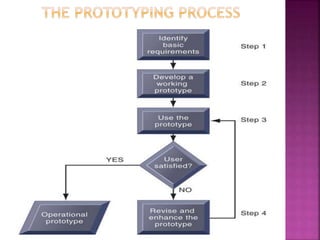
Outline of the prototyping process
1. Identify basic requirements
 Determine basic requirements including the input and
output information desired. Details, such as security, can
typically be ignored.
2. Develop Initial Prototype
 The initial prototype is developed that includes only user
interfaces.
3. Review
 The customers, including end-users, examine the
prototype and provide feedback on additions or changes.
4. Revise and Enhance the Prototype
 Using the feedback both the specifications and the
prototype can be improved. Negotiation about what is
within the scope of the contract/product may be
necessary.
Note:
If changes are introduced then a repeat of steps #3 and
#4 may be needed.
 Reduces development time.
 Reduces development costs.
 Requires user involvement.
 Developers receive quantifiable user feedback.
 Facilitates system implementation since users know
what to expect.
 Results in higher user satisfaction.
 Exposes developers to potential future system
enhancements.
 This method can be used to avoid documenting the
requirements of the system.
 Management is required
 Long term maintenance can be expensive
 Uncertain design idea’s
 Information can be lost through so many improvement
changes
PROTOTYPING

PROTOTYPING

  • 1.
  • 2.
     Define Prototyping Prototyping Objectives  The Prototyping Process  Advantages of prototyping  Disadvantages of prototyping
  • 3.
    Prototyping is theprocess of quickly putting together a working model (a prototype) in order to test various aspects of a design, illustrate ideas or features and gather early user feedback.-
  • 4.
    Kendall & KendallCopyright© 2002 by Prentice Hall, Inc. 8-4  Prototyping is an information-gathering technique  Prototypes are useful in seeking user reactions, suggestions, innovations, and revision plans  Prototyping may be used as an alternative to the systems development life cycle
  • 5.
     The objectiveof evolutionary prototyping is to deliver a working system to end-users  The development starts with those requirements which are best understood.  The objective of throw-away prototyping is to validate or derive the system requirements  The prototyping process starts with those requirements which are poorly understood
  • 6.
    Outline of theprototyping process 1. Identify basic requirements  Determine basic requirements including the input and output information desired. Details, such as security, can typically be ignored. 2. Develop Initial Prototype  The initial prototype is developed that includes only user interfaces.
  • 7.
    3. Review  Thecustomers, including end-users, examine the prototype and provide feedback on additions or changes. 4. Revise and Enhance the Prototype  Using the feedback both the specifications and the prototype can be improved. Negotiation about what is within the scope of the contract/product may be necessary.
  • 8.
    Note: If changes areintroduced then a repeat of steps #3 and #4 may be needed.
  • 10.
     Reduces developmenttime.  Reduces development costs.  Requires user involvement.  Developers receive quantifiable user feedback.  Facilitates system implementation since users know what to expect.  Results in higher user satisfaction.  Exposes developers to potential future system enhancements.
  • 11.
     This methodcan be used to avoid documenting the requirements of the system.  Management is required  Long term maintenance can be expensive  Uncertain design idea’s  Information can be lost through so many improvement changes