
Monopoly is a form of market structure in
which a single seller or firm has control
over the entire market supply.

Meaning:

Monopoly is a market situation in which
there is only one seller of a product with
barriers to entry of others. The product has
no close substitutes.
 Here,

no other firms produce
a similar product.
 Monopolistic can sell his
commodity at any price he
likes.
 He has control over price.
 The sole seller in the market
is called “monopolist”
Definition:
 Acc

to Kautsoyiannis – “Monopoly is
a market situation in which there is a
single seller. There are no close
substitutes of the commodity it
produces, there are barriers to entry.”
 Ferguson – “A pure monopoly exists
when there is only one producer in
the market. There are no direct
competitions.”
Single producer and large number of
buyers.
• No close substitutes.
• Barriers to entry.
• Full control over price.
• Price discrimination.
• No competition.
• No distinction between firm and
industry.
•





Legal Restrictions or barriers to entry of new
firms
Sole control over the supply of scarce and
key raw materials
Efficiency in production
Economies of scale
Natural monopoly
It arises because of natural factors
like
soil, rainfall etc
 Social monopoly
It is in the hands of the government.
In
certain fields, competition is not
desirable.




Legal monopoly
it is created by the law of the country.
Voluntary monopoly
It arises due to voluntary factors.


Output and price determination under
monopoly in short-run and long-run
The monopolist maximises his short run
profit, when he produces that level of
output at which.
•

•

The short run marginal cost is equal to
the short run marginal revenue (SMC =
SMR)
The marginal cost is rising


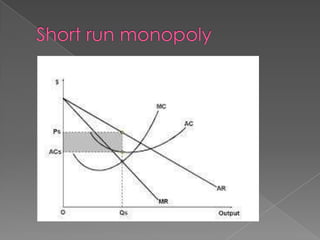
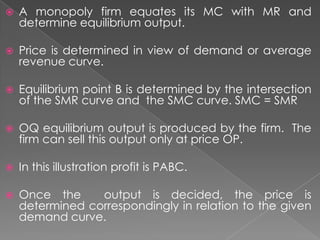
A monopoly firm equates its MC with MR and
determine equilibrium output.



Price is determined in view of demand or average
revenue curve.



Equilibrium point B is determined by the intersection
of the SMR curve and the SMC curve. SMC = SMR



OQ equilibrium output is produced by the firm. The
firm can sell this output only at price OP.



In this illustration profit is PABC.



Once the
output is decided, the price is
determined correspondingly in relation to the given
demand curve.


Though pure monopolist has full control over the
market supply, he can not determine price
independently in market.



when equilibrium output is decided at the point
of equality between MR and MC the price is
automatically determined in relation to the
demand of product.



Equilibrium output is determined at falling path
of AC curve. Which means the monopolist
restrict output before producing it at the
optimum level in order to maximise his profit.
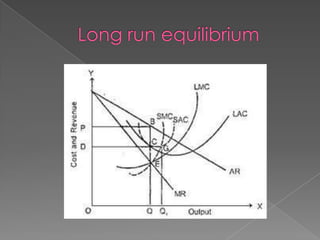
Long run equilibrium, determined by the
equality of long run marginal cost (LMC)
and the marginal revenue (LMR), so that
profit is maximised.
 If the firm is earning some profit in short
run it has to determined the most
profitable long run plant size and
corresponding price and output.

Curve D is the demand curve/ average
revenue curve.
 LAC and LMC are the long run average
and marginal cost curves.
 LAC is envelope to various SAC curves.
 LMC and LMR intersect with the point E
where is having optimum level of output.

THANK YOU

Monopoly

  • 2.
    Monopoly is aform of market structure in which a single seller or firm has control over the entire market supply. Meaning: Monopoly is a market situation in which there is only one seller of a product with barriers to entry of others. The product has no close substitutes.
  • 3.
     Here, no otherfirms produce a similar product.  Monopolistic can sell his commodity at any price he likes.  He has control over price.  The sole seller in the market is called “monopolist”
  • 4.
    Definition:  Acc to Kautsoyiannis– “Monopoly is a market situation in which there is a single seller. There are no close substitutes of the commodity it produces, there are barriers to entry.”  Ferguson – “A pure monopoly exists when there is only one producer in the market. There are no direct competitions.”
  • 5.
    Single producer andlarge number of buyers. • No close substitutes. • Barriers to entry. • Full control over price. • Price discrimination. • No competition. • No distinction between firm and industry. •
  • 6.
        Legal Restrictions orbarriers to entry of new firms Sole control over the supply of scarce and key raw materials Efficiency in production Economies of scale
  • 7.
    Natural monopoly It arisesbecause of natural factors like soil, rainfall etc  Social monopoly It is in the hands of the government. In certain fields, competition is not desirable. 
  • 8.
      Legal monopoly it iscreated by the law of the country. Voluntary monopoly It arises due to voluntary factors.
  • 9.
     Output and pricedetermination under monopoly in short-run and long-run
  • 10.
    The monopolist maximiseshis short run profit, when he produces that level of output at which. • • The short run marginal cost is equal to the short run marginal revenue (SMC = SMR) The marginal cost is rising
  • 12.
     A monopoly firmequates its MC with MR and determine equilibrium output.  Price is determined in view of demand or average revenue curve.  Equilibrium point B is determined by the intersection of the SMR curve and the SMC curve. SMC = SMR  OQ equilibrium output is produced by the firm. The firm can sell this output only at price OP.  In this illustration profit is PABC.  Once the output is decided, the price is determined correspondingly in relation to the given demand curve.
  • 13.
     Though pure monopolisthas full control over the market supply, he can not determine price independently in market.  when equilibrium output is decided at the point of equality between MR and MC the price is automatically determined in relation to the demand of product.  Equilibrium output is determined at falling path of AC curve. Which means the monopolist restrict output before producing it at the optimum level in order to maximise his profit.
  • 14.
    Long run equilibrium,determined by the equality of long run marginal cost (LMC) and the marginal revenue (LMR), so that profit is maximised.  If the firm is earning some profit in short run it has to determined the most profitable long run plant size and corresponding price and output. 
  • 16.
    Curve D isthe demand curve/ average revenue curve.  LAC and LMC are the long run average and marginal cost curves.  LAC is envelope to various SAC curves.  LMC and LMR intersect with the point E where is having optimum level of output. 
  • 17.