PROTOTYPE MODEL
By Kumar Sethi
Need of Prototype Model
• Even a small change in any previous stage can cause big problem
for subsequent phases as all phases are dependent on each-other.
• Real projects rarely follow the sequential flow.
• Poor model for long and ongoing projects. WHY?
As we freeze software and hardware in this model, but technology
changes rapidly, such freezing is not advisable for long term
projects.
• Not a good model for complex and object-oriented projects.
• Not suitable for the projects where requirements are at a moderate
to high risk of changing.
• It is difficult to measure progress within stages.
Based on the previous model disadvantages :-
Prototype Model
• This model requires before carrying out the development of the
actual software, a working prototype of the system should be built.
• A prototype acts as a sample to test the process. From this sample
we learn and try to build a better final product.
• A prototype is a model or a program which is not based on strict
planning, but is an early approximation of the final product or
software system.
• This type of System Development Method is employed when it is
very difficult to obtain exact requirements from the customer (unlike
waterfall model, where requirements are clear).
• While making the model, user keeps giving feedbacks from time to
time and based on it, a prototype is made.
• Completely built sample model is shown to user and based on his
feedback, the SRS (System Requirements Specifications) document
is prepared.
Prototype Model
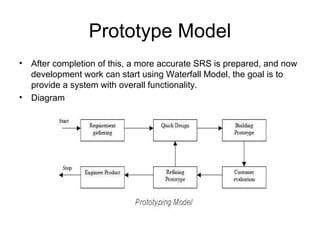
• After completion of this, a more accurate SRS is prepared, and now
development work can start using Waterfall Model, the goal is to
provide a system with overall functionality.
• Diagram
Advantages
• Users are actively involved in the development
• Since in this methodology a working model of the system
is provided, the users get a better understanding of the
system being developed.
• Errors can be detected much earlier.
• Quicker user feedback is available leading to better
solutions.
• Missing functionality can be identified easily
• Time required to complete the project after getting final
the SRS reduces, since the developer has a better idea
about how he should approach the project.
Disadvantages
• It is a slow process.
• Too much involvement of client, is not always preferred by the
developer.
• Too many changes can disturb the rhythm of the development team.
• Practically, this methodology may increase the complexity of the
system as scope of the system may expand beyond original plans.
• If client is not satisfied with the developed prototype, new prototype
should be made, this may lead to be expensive.
Regards

Prototype model of SDLC

  • 1.
  • 2.
    Need of PrototypeModel • Even a small change in any previous stage can cause big problem for subsequent phases as all phases are dependent on each-other. • Real projects rarely follow the sequential flow. • Poor model for long and ongoing projects. WHY? As we freeze software and hardware in this model, but technology changes rapidly, such freezing is not advisable for long term projects. • Not a good model for complex and object-oriented projects. • Not suitable for the projects where requirements are at a moderate to high risk of changing. • It is difficult to measure progress within stages. Based on the previous model disadvantages :-
  • 3.
    Prototype Model • Thismodel requires before carrying out the development of the actual software, a working prototype of the system should be built. • A prototype acts as a sample to test the process. From this sample we learn and try to build a better final product. • A prototype is a model or a program which is not based on strict planning, but is an early approximation of the final product or software system. • This type of System Development Method is employed when it is very difficult to obtain exact requirements from the customer (unlike waterfall model, where requirements are clear). • While making the model, user keeps giving feedbacks from time to time and based on it, a prototype is made. • Completely built sample model is shown to user and based on his feedback, the SRS (System Requirements Specifications) document is prepared.
  • 4.
    Prototype Model • Aftercompletion of this, a more accurate SRS is prepared, and now development work can start using Waterfall Model, the goal is to provide a system with overall functionality. • Diagram
  • 5.
    Advantages • Users areactively involved in the development • Since in this methodology a working model of the system is provided, the users get a better understanding of the system being developed. • Errors can be detected much earlier. • Quicker user feedback is available leading to better solutions. • Missing functionality can be identified easily • Time required to complete the project after getting final the SRS reduces, since the developer has a better idea about how he should approach the project.
  • 6.
    Disadvantages • It isa slow process. • Too much involvement of client, is not always preferred by the developer. • Too many changes can disturb the rhythm of the development team. • Practically, this methodology may increase the complexity of the system as scope of the system may expand beyond original plans. • If client is not satisfied with the developed prototype, new prototype should be made, this may lead to be expensive.
  • 7.