Eukaryotes - Protists
BIOL 1307
Ebeling
Learning Objectives
1. Describe the characteristics common to all protists
2. Explain how endosymbiosis is involved with the evolution of
multicellular eukaryotic organisms from prokaryotic
ancestors
3. Understand why the protists are the most diverse eukaryotic
kingdom
4. Describe the criteria used to classify protists
What is a “protist”
1.
2.
3.
Origins of eukaryotes:
division of labor
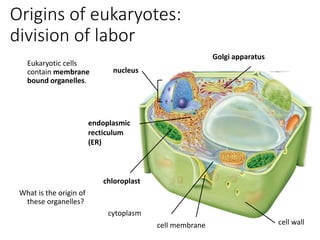
Eukaryotic cells
contain membrane
bound organelles.
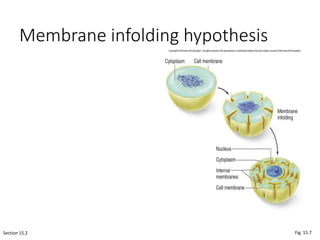
What is the origin of
these organelles?
Golgi apparatus
cell membrane
cytoplasm
endoplasmic
recticulum
(ER)
nucleus
cell wall
chloroplast
Membrane infolding hypothesis
Section 15.2 Fig. 15.7
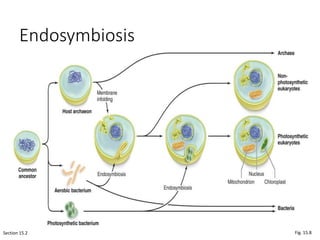
Endosymbiosis
Section 15.2 Fig. 15.8
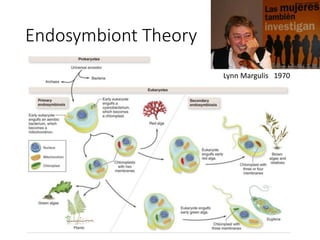
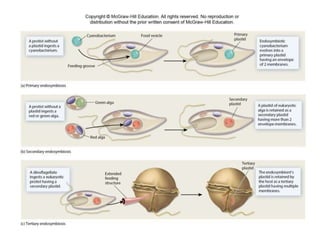
Endosymbiont Theory
Lynn Margulis 1970
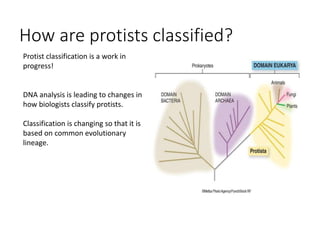
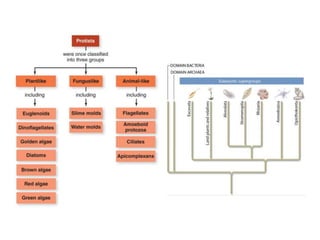
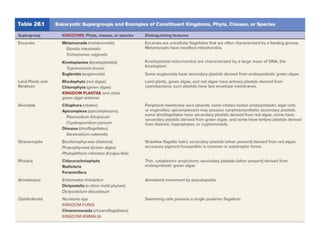
How are protists classified?
Protist classification is a work in
progress!
DNA analysis is leading to changes in
how biologists classify protists.
Classification is changing so that it is
based on common evolutionary
lineage.
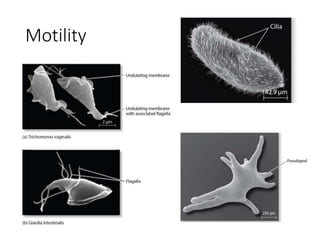
Motility
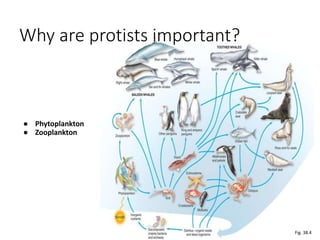
Why are protists important?
● Phytoplankton
● Zooplankton
Fig. 38.4
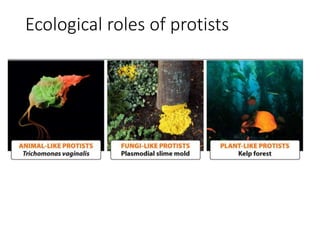
Ecological roles of protists
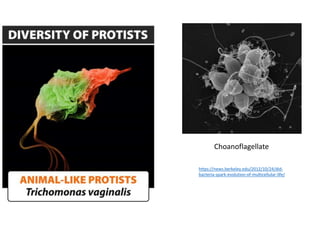
https://news.berkeley.edu/2012/10/24/did-
bacteria-spark-evolution-of-multicellular-life/
Choanoflagellate
http://www.youtube.com/watch?v=
GY_uMH8Xpy0
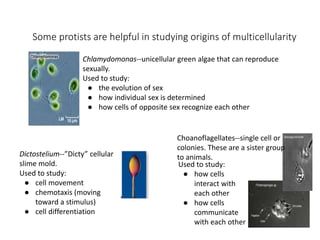
Some protists are helpful in studying origins of multicellularity
Chlamydomonas--unicellular green algae that can reproduce
sexually.
Used to study:
● the evolution of sex
● how individual sex is determined
● how cells of opposite sex recognize each other
Choanoflagellates--single cell or
colonies. These are a sister group
to animals.
Used to study:
● how cells
interact with
each other
● how cells
communicate
with each other
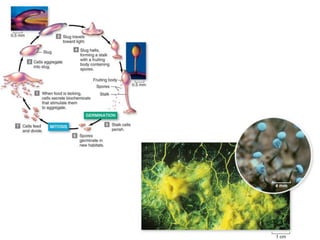
Dictostelium--”Dicty” cellular
slime mold.
Used to study:
● cell movement
● chemotaxis (moving
toward a stimulus)
● cell differentiation

Protista blank f2019