© McGraw-Hill Education
Communities and Ecosystems
1
© McGraw-Hill Education
Learning Objectives:
1. Explain measures of diversity in biological communities.
2. Compare and contrast primary and secondary succession.
3. Compare and contrast nutrient cycling and energy flow through an
ecosystem.
4. Distinguish between primary producers, primary consumers,
secondary consumers, tertiary consumers, and decomposers in an
ecosystem.
5. Explain the roles of each trophic level in an ecosystem.
6. List and describe the types of ecological pyramids.
7. Describe and give examples of the importance of a keystone species.
8. Explain why the number of trophic levels in a community is limited.
2
© McGraw-Hill Education 3
Mount St. Helens
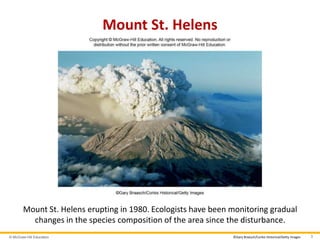
Mount St. Helens erupting in 1980. Ecologists have been monitoring gradual
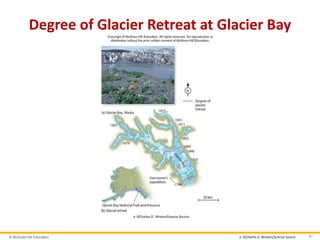
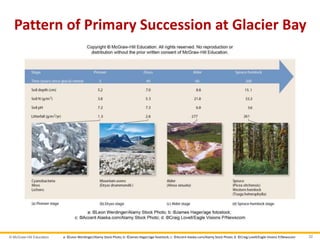
changes in the species composition of the area since the disturbance.
©Gary Braasch/Corbis Historical/Getty Images
© McGraw-Hill Education 4
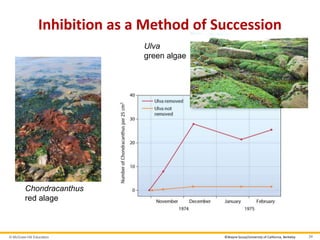
Chapter Outline
58.1 Patterns of Species Richness and Species Diversity
58.2 Species Diversity and Community Stability
58.3 Succession: Community Change
58.4 Island Biogeography
58.5 Food Webs and Energy Flow
58.6 Biomass Production in Ecosystems
© McGraw-Hill Education 5
Community Ecology
Community – assemblage of many populations that live
in the same place at the same time
Can occur on a wide variety of scales and
can be nested
Community ecology – studies the factors that influence
the number and abundance of species in a community
© McGraw-Hill Education 6
Ecosystem Ecology
Ecosystem– system formed by the interaction between
a community of organisms and its physical environment
Ecosystem ecology – studies the flow of energy and the
production of biomass (the total mass of living matter
in a given area)
© McGraw-Hill Education 7
Patterns of Species Richness
and Species Diversity
Species riches – number of species in each community
Number of species of most taxa varies according to
geographic range
• Increasing from polar to temperate to maximum
in tropical areas
• Increases by topographical variation
• Reduced by peninsular effect
© McGraw-Hill Education 8
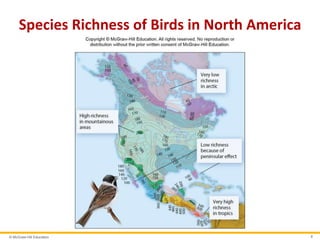
Species Richness of Birds in North America
© McGraw-Hill Education 9
Four hypotheses for latitudinal gradient
Species-Time Hypothesis
• Communities diversify, or gain species, with time
• Temperate regions have less rich communities than
tropical ones because they are younger and have only
more recently recovered from glaciation
• Support – more worms in comparable unglaciated lakes
than glaciated
• Drawback – limited applicability to marine organisms
© McGraw-Hill Education 10
Species-Area Hypothesis
• Larger areas have more species because they can support
larger populations and a greater range of habitats
• Support – significant relationship between insect diversity
and host tree range (species area effect)
• Problem – there are not more species in Asia, tundra is
largest biome but low richness, open ocean with largest
volume has fewer species than tropical surface waters
© McGraw-Hill Education 11
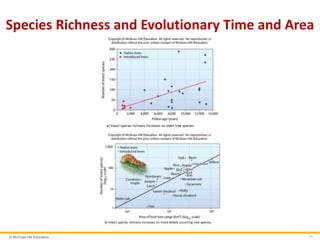
Species Richness and Evolutionary Time and Area
a) Insect species richness increases on older tree species.
b) Insect species richness increases on more widely occurring tree species.
© McGraw-Hill Education 12
Species-Productivity
Species-Productivity Hypothesis
• Greater production of plants results in greater overall
species richness
• Can be represented by evapotranspiration rate
• Support – plants grow better where it is warm and wet and
species richness in trees can be predicted by the
evapotranspiration rate
• Problems – some tropical seas have low productivity but
high richness, sub-Antarctic Ocean has high productivity
but low species richness
© McGraw-Hill Education 13
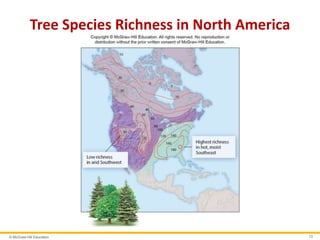
Tree Species Richness in North America
© McGraw-Hill Education 14
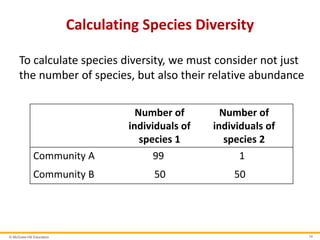
Calculating Species Diversity
To calculate species diversity, we must consider not just
the number of species, but also their relative abundance
Number of
individuals of
species 1
Number of
individuals of
species 2
Community A 99 1
Community B 50 50
© McGraw-Hill Education 15
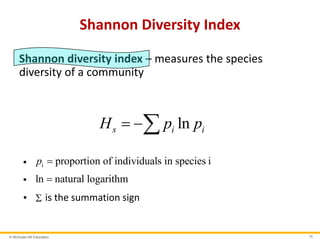
Shannon Diversity Index
Shannon diversity index – measures the species
diversity of a community
lns i iH p p 
• i proportion of individuals in species ip 
• natural logaln rithm
•  is the summation sign
© McGraw-Hill Education 16
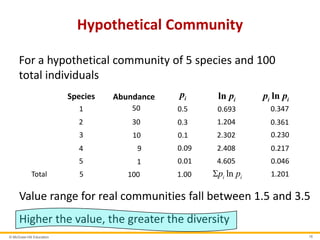
Hypothetical Community
For a hypothetical community of 5 species and 100
total individuals
Species Abundance ip ln ip lni ip p
1 50 0.5 0.693 0.347
2 30 0.3 1.204 0.361
3 10 0.1 2.302 0.230
4 9 0.09 2.408 0.217
5 1 0.01 4.605 0.046
Total 5 100 1.00 lni ip p 1.201
Value range for real communities fall between 1.5 and 3.5
Higher the value, the greater the diversity
© McGraw-Hill Education 17
Copyright © McGraw-Hill Education. All rights reserved. No reproduction or
distribution without the prior written consent of McGraw-Hill Education.
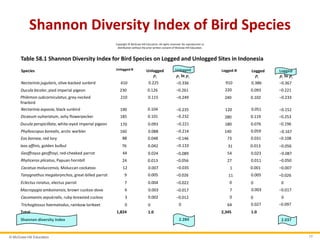
Shannon Diversity Index of Bird Species
Table 58.1 Shannon Diversity Index for Bird Species on Logged and Unlogged Sites in Indonesia
Species Unlogged N Unlogged
ip
Unlogged
lni ip p
Logged N Logged
ip
Logged
lni ip p
Nectarinia jugularis, olive-backed sunbird 410 0.225 −0.336 910 0.386 −0.367
Ducula bicolor, pied imperial pigeon 230 0.126 −0.261 220 0.093 −0.221
Philemon subcorniculatus, grey-necked
friarbird
210 0.115 −0.249 240 0.102 −0.233
Nectarinia aspasia, black sunbird 190 0.104 −0.235 120 0.051 −0.152
Dicaeum vulneratum, ashy flowerpecker 185 0.101 −0.232 280 0.119 −0.253
Ducula perspicillata, white-eyed imperial pigeon 170 0.093 −0.221 180 0.076 −0.196
Phylloscopus borealis, arctic warbler 160 0.088 −0.214 140 0.059 −0.167
Eos bornea, red lory 88 0.048 −0.146 73 0.031 −0.108
Ixos affinis, golden bulbul 76 0.042 −0.133 31 0.013 −0.056
Geoffroyus geoffroyi, red-cheeked parrot 44 0.024 −0.089 54 0.023 −0.087
Rhyticeros plicatus, Papuan hornbill 24 0.013 −0.056 27 0.011 −0.050
Cacatua moluccensis, Moluccan cockatoo 12 0.007 −0.035 1 0.001 −0.007
Tanygnathus megalorynchos, great-billed parrot 9 0.005 −0.026 11 0.005 −0.026
Eclectus roratus, electus parrot 7 0.004 −0.022 0 0 0
Macropygia amboinensis, brown cuckoo-dove 6 0.003 −0.017 7 0.003 −0.017
Cacomantis sepulcralis, ruby-breasted cuckoo 3 0.002 −0.012 0 0 0
Trichoglossus haematodus, rainbow lorikeet 0 0 0 64 0.027 −0.097
Total 1,824 1.0 2,345 1.0
Shannon diversity index 2.284 2.037
© McGraw-Hill Education 18
Succession: Community Change
Gradual and continuous change in species composition
and community structure over time
Primary succession – on newly exposed site not
previously occupied by soil and vegetation
Secondary succession – on a site that already supported
life but has undergone a disturbance, such as a fire,
tornado, hurricane, or flood
© McGraw-Hill Education 19
Successional theory
Frederic Clements emphasized that succession has a
distinct end point – the climax community
Disturbance might set the community back to an
earlier stage
• It then proceeds again toward climax community
Each colonizing species makes the environment a little
different
Facilitation – colonizing species change the environment
so that it becomes more suitable for the next species
© McGraw-Hill Education 20
Succession in Glacier Bay
Glacier Bay used facilitation as a mechanism of succession
Over the past 200 years, glaciers have retreated 100
kilometers
Succession has followed a distinct pattern of vegetation
© McGraw-Hill Education 21
Degree of Glacier Retreat at Glacier Bay
a: ©Charles D. Winters/Science Source
© McGraw-Hill Education 22
Pattern of Primary Succession at Glacier Bay
a: ©Leon Werdinger/Alamy Stock Photo; b: ©James Hager/age footstock; c: ©Accent Alaska.com/Alamy Stock Photo; d: ©Craig Lovell/Eagle Visions P/Newscom
© McGraw-Hill Education 23
Alternative hypotheses to facilitation
Inhibition – early colonists may exclude subsequent
colonists
• What gets there first determines subsequent community
structure
• Primary method of succession in marine intertidal zone –
early successional species at a great advantage in
maintaining possession of valuable space
• By removing the early colonist Ulva, the red alga
Chondracanthus was able to colonize more quickly
© McGraw-Hill Education 24
Inhibition as a Method of Succession
©Wayne Sousa/University of California, Berkeley
Ulva
green algae
Chondracanthus
red alage
© McGraw-Hill Education 25
Tolerance
Tolerance – any species can start the succession, but
the eventual climax community is reached in a
somewhat orderly fashion
• Species that establish and remain do not change the
environment in ways that either facilitate or inhibit
subsequent colonists
• Competition-intolerant species more successful at first
• Competition-tolerant species appear later and at climax
© McGraw-Hill Education 26
Progression of Succession
Key distinction between three models is in the manner
succession proceeds
• Facilitation – species replacement facilitated by previous
colonists
• Inhibition – species replacement is inhibited by previous
colonists
• Tolerance – species replacement is unaffected by previous
colonists
Other factors may also influence succession
© McGraw-Hill Education 27
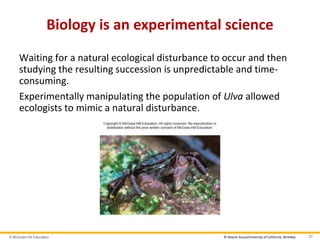
Biology is an experimental science
Waiting for a natural ecological disturbance to occur and then
studying the resulting succession is unpredictable and time-
consuming.
Experimentally manipulating the population of Ulva allowed
ecologists to mimic a natural disturbance.
© Wayne Sousa/University of California, Berkeley
© McGraw-Hill Education 28
Food Webs and Energy Flow
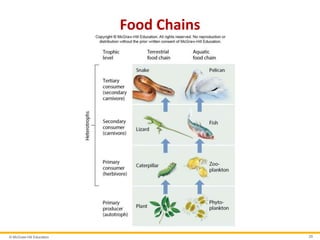
Food chain – linear depiction of energy flow
Each feeding level in a chain is a trophic level
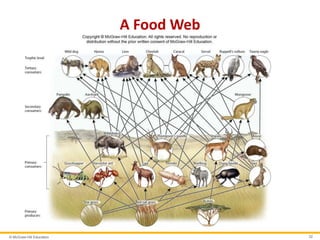
More complex models have interconnected food
chains – food web
© McGraw-Hill Education 29
Food Chains
© McGraw-Hill Education 30
Autotrophs
Autotrophs – harvest light or chemical energy and
store it in carbon bonds
• Primary producers form the base of the food chain
• Chemoautotroph – oxidize inorganic compounds
© McGraw-Hill Education 31
Heterotrophs
Heterotrophs – eat other organisms
• Primary consumers eat primary producers
• Herbivores
• Secondary consumers eat primary consumers
• Carnivores
• Detritivores or decomposers eat detritus – unconsumed
plants, animal remains, and waste products
© McGraw-Hill Education 32
A Food Web
© McGraw-Hill Education 33
Food webs
Chain lengths are short in most food webs
• Chain length refers to the number of links between the
trophic levels involved
• Usually less than 6 levels
• Based on laws of physics and chemistry
Second law of thermodynamics – energy conversions
are not 100% efficient and that, in any transfer process,
some energy is lost
© McGraw-Hill Education 34
Ecological pyramids
Ecological pyramids show distributions between
trophic levels
Different factors
• Pyramid of numbers
• Pyramid of biomass
• Pyramid of energy
© McGraw-Hill Education 35
Pyramid of Numbers
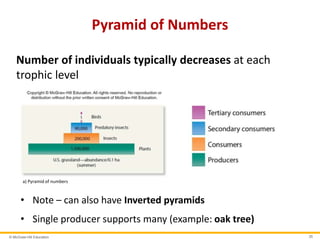
Number of individuals typically decreases at each
trophic level
a) Pyramid of numbers
• Note – can also have Inverted pyramids
• Single producer supports many (example: oak tree)
© McGraw-Hill Education 36
Pyramid of biomass
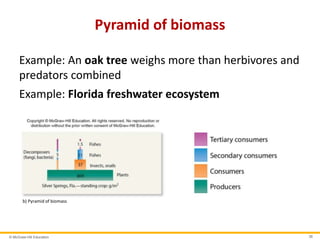
Example: An oak tree weighs more than herbivores and
predators combined
Example: Florida freshwater ecosystem
b) Pyramid of biomass
© McGraw-Hill Education 37
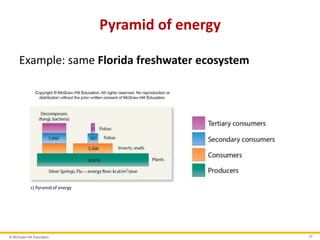
Pyramid of energy
Example: same Florida freshwater ecosystem
c) Pyramid of energy
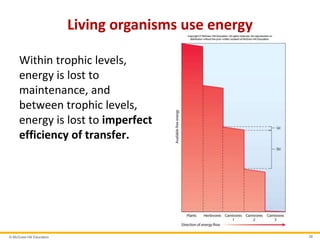
© McGraw-Hill Education 38
Living organisms use energy
Within trophic levels,
energy is lost to
maintenance, and
between trophic levels,
energy is lost to imperfect
efficiency of transfer.
© McGraw-Hill Education 39
Biomass Production in Ecosystems
Gross primary productivity (GPP) = carbon fixed
during photosynthesis
R = energy lost in plant cellular respiration
Net primary productivity = GPP − R
• Amount of energy available to primary consumers
• Measured in calories
• Use dry weight to avoid fluctuating water contents
Secondary production – gain in the biomass of
heterotrophs and decomposers
© McGraw-Hill Education 40
Influences on primary production
In terrestrial systems, linear relationship with annual
precipitation
Temperatures
• Evapotranspiration rate can predict aboveground primary
production
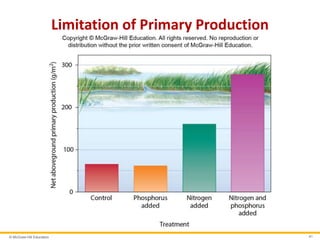
Nutrients (nitrogen and phosphorus)
• Can be limiting factor
• Liebig’s law of the minimum – species biomass or
abundance is limited by the scarcest factor
© McGraw-Hill Education 41
Limitation of Primary Production
© McGraw-Hill Education 42
Aquatic ecosystems
Primary productivity limited mainly by light and
nutrient availability
Water absorbs light
• At 1 meter more than half the solar radiation absorbed
• Limits depth of algal growth
Nitrogen and phosphorus occur in very low
concentrations
• Algal blooms result naturally from upwellings
© McGraw-Hill Education 43
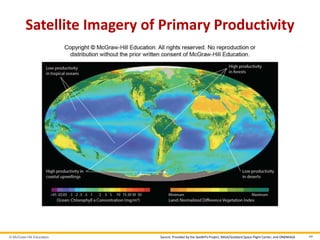
Primary productivity varies
Highest in tropical rainforests
Decreases progressively toward the poles
May cause the latitudinal gradient of species richness
Greatest marine production occurs on coral reefs
where temperature and light are high
© McGraw-Hill Education 44
Satellite Imagery of Primary Productivity
Source: Provided by the SeaWiFS Project, NASA/Goddard Space Flight Center, and ORBIMAGE
© McGraw-Hill Education 45
Energy Flow Exemplified
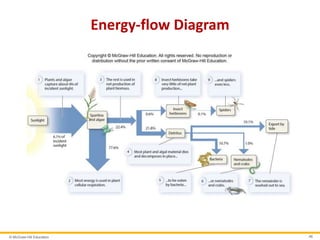
Example: Georgia salt marsh
• Among the most productive habitats on Earth in terms of the
amount of vegetation
• Most of the energy of the sun goes to Spartina plants and
marine algae
• Fix about 6% of incident sunlight
• 77.6% of plant energy used for cellular respiration
• Of the energy in biomass, most dies and rots
• Bacteria are the major decomposer
• Herbivores take only a small proportion plant production of
the Spartina and none of the algae
© McGraw-Hill Education 46
Energy-flow Diagram

Communities and ecosystems

  • 1.
  • 2.
    © McGraw-Hill Education LearningObjectives: 1. Explain measures of diversity in biological communities. 2. Compare and contrast primary and secondary succession. 3. Compare and contrast nutrient cycling and energy flow through an ecosystem. 4. Distinguish between primary producers, primary consumers, secondary consumers, tertiary consumers, and decomposers in an ecosystem. 5. Explain the roles of each trophic level in an ecosystem. 6. List and describe the types of ecological pyramids. 7. Describe and give examples of the importance of a keystone species. 8. Explain why the number of trophic levels in a community is limited. 2
  • 3.
    © McGraw-Hill Education3 Mount St. Helens Mount St. Helens erupting in 1980. Ecologists have been monitoring gradual changes in the species composition of the area since the disturbance. ©Gary Braasch/Corbis Historical/Getty Images
  • 4.
    © McGraw-Hill Education4 Chapter Outline 58.1 Patterns of Species Richness and Species Diversity 58.2 Species Diversity and Community Stability 58.3 Succession: Community Change 58.4 Island Biogeography 58.5 Food Webs and Energy Flow 58.6 Biomass Production in Ecosystems
  • 5.
    © McGraw-Hill Education5 Community Ecology Community – assemblage of many populations that live in the same place at the same time Can occur on a wide variety of scales and can be nested Community ecology – studies the factors that influence the number and abundance of species in a community
  • 6.
    © McGraw-Hill Education6 Ecosystem Ecology Ecosystem– system formed by the interaction between a community of organisms and its physical environment Ecosystem ecology – studies the flow of energy and the production of biomass (the total mass of living matter in a given area)
  • 7.
    © McGraw-Hill Education7 Patterns of Species Richness and Species Diversity Species riches – number of species in each community Number of species of most taxa varies according to geographic range • Increasing from polar to temperate to maximum in tropical areas • Increases by topographical variation • Reduced by peninsular effect
  • 8.
    © McGraw-Hill Education8 Species Richness of Birds in North America
  • 9.
    © McGraw-Hill Education9 Four hypotheses for latitudinal gradient Species-Time Hypothesis • Communities diversify, or gain species, with time • Temperate regions have less rich communities than tropical ones because they are younger and have only more recently recovered from glaciation • Support – more worms in comparable unglaciated lakes than glaciated • Drawback – limited applicability to marine organisms
  • 10.
    © McGraw-Hill Education10 Species-Area Hypothesis Species-Area Hypothesis • Larger areas have more species because they can support larger populations and a greater range of habitats • Support – significant relationship between insect diversity and host tree range (species area effect) • Problem – there are not more species in Asia, tundra is largest biome but low richness, open ocean with largest volume has fewer species than tropical surface waters
  • 11.
    © McGraw-Hill Education11 Species Richness and Evolutionary Time and Area a) Insect species richness increases on older tree species. b) Insect species richness increases on more widely occurring tree species.
  • 12.
    © McGraw-Hill Education12 Species-Productivity Species-Productivity Hypothesis • Greater production of plants results in greater overall species richness • Can be represented by evapotranspiration rate • Support – plants grow better where it is warm and wet and species richness in trees can be predicted by the evapotranspiration rate • Problems – some tropical seas have low productivity but high richness, sub-Antarctic Ocean has high productivity but low species richness
  • 13.
    © McGraw-Hill Education13 Tree Species Richness in North America
  • 14.
    © McGraw-Hill Education14 Calculating Species Diversity To calculate species diversity, we must consider not just the number of species, but also their relative abundance Number of individuals of species 1 Number of individuals of species 2 Community A 99 1 Community B 50 50
  • 15.
    © McGraw-Hill Education15 Shannon Diversity Index Shannon diversity index – measures the species diversity of a community lns i iH p p  • i proportion of individuals in species ip  • natural logaln rithm •  is the summation sign
  • 16.
    © McGraw-Hill Education16 Hypothetical Community For a hypothetical community of 5 species and 100 total individuals Species Abundance ip ln ip lni ip p 1 50 0.5 0.693 0.347 2 30 0.3 1.204 0.361 3 10 0.1 2.302 0.230 4 9 0.09 2.408 0.217 5 1 0.01 4.605 0.046 Total 5 100 1.00 lni ip p 1.201 Value range for real communities fall between 1.5 and 3.5 Higher the value, the greater the diversity
  • 17.
    © McGraw-Hill Education17 Copyright © McGraw-Hill Education. All rights reserved. No reproduction or distribution without the prior written consent of McGraw-Hill Education. Shannon Diversity Index of Bird Species Table 58.1 Shannon Diversity Index for Bird Species on Logged and Unlogged Sites in Indonesia Species Unlogged N Unlogged ip Unlogged lni ip p Logged N Logged ip Logged lni ip p Nectarinia jugularis, olive-backed sunbird 410 0.225 −0.336 910 0.386 −0.367 Ducula bicolor, pied imperial pigeon 230 0.126 −0.261 220 0.093 −0.221 Philemon subcorniculatus, grey-necked friarbird 210 0.115 −0.249 240 0.102 −0.233 Nectarinia aspasia, black sunbird 190 0.104 −0.235 120 0.051 −0.152 Dicaeum vulneratum, ashy flowerpecker 185 0.101 −0.232 280 0.119 −0.253 Ducula perspicillata, white-eyed imperial pigeon 170 0.093 −0.221 180 0.076 −0.196 Phylloscopus borealis, arctic warbler 160 0.088 −0.214 140 0.059 −0.167 Eos bornea, red lory 88 0.048 −0.146 73 0.031 −0.108 Ixos affinis, golden bulbul 76 0.042 −0.133 31 0.013 −0.056 Geoffroyus geoffroyi, red-cheeked parrot 44 0.024 −0.089 54 0.023 −0.087 Rhyticeros plicatus, Papuan hornbill 24 0.013 −0.056 27 0.011 −0.050 Cacatua moluccensis, Moluccan cockatoo 12 0.007 −0.035 1 0.001 −0.007 Tanygnathus megalorynchos, great-billed parrot 9 0.005 −0.026 11 0.005 −0.026 Eclectus roratus, electus parrot 7 0.004 −0.022 0 0 0 Macropygia amboinensis, brown cuckoo-dove 6 0.003 −0.017 7 0.003 −0.017 Cacomantis sepulcralis, ruby-breasted cuckoo 3 0.002 −0.012 0 0 0 Trichoglossus haematodus, rainbow lorikeet 0 0 0 64 0.027 −0.097 Total 1,824 1.0 2,345 1.0 Shannon diversity index 2.284 2.037
  • 18.
    © McGraw-Hill Education18 Succession: Community Change Gradual and continuous change in species composition and community structure over time Primary succession – on newly exposed site not previously occupied by soil and vegetation Secondary succession – on a site that already supported life but has undergone a disturbance, such as a fire, tornado, hurricane, or flood
  • 19.
    © McGraw-Hill Education19 Successional theory Frederic Clements emphasized that succession has a distinct end point – the climax community Disturbance might set the community back to an earlier stage • It then proceeds again toward climax community Each colonizing species makes the environment a little different Facilitation – colonizing species change the environment so that it becomes more suitable for the next species
  • 20.
    © McGraw-Hill Education20 Succession in Glacier Bay Glacier Bay used facilitation as a mechanism of succession Over the past 200 years, glaciers have retreated 100 kilometers Succession has followed a distinct pattern of vegetation
  • 21.
    © McGraw-Hill Education21 Degree of Glacier Retreat at Glacier Bay a: ©Charles D. Winters/Science Source
  • 22.
    © McGraw-Hill Education22 Pattern of Primary Succession at Glacier Bay a: ©Leon Werdinger/Alamy Stock Photo; b: ©James Hager/age footstock; c: ©Accent Alaska.com/Alamy Stock Photo; d: ©Craig Lovell/Eagle Visions P/Newscom
  • 23.
    © McGraw-Hill Education23 Alternative hypotheses to facilitation Inhibition – early colonists may exclude subsequent colonists • What gets there first determines subsequent community structure • Primary method of succession in marine intertidal zone – early successional species at a great advantage in maintaining possession of valuable space • By removing the early colonist Ulva, the red alga Chondracanthus was able to colonize more quickly
  • 24.
    © McGraw-Hill Education24 Inhibition as a Method of Succession ©Wayne Sousa/University of California, Berkeley Ulva green algae Chondracanthus red alage
  • 25.
    © McGraw-Hill Education25 Tolerance Tolerance – any species can start the succession, but the eventual climax community is reached in a somewhat orderly fashion • Species that establish and remain do not change the environment in ways that either facilitate or inhibit subsequent colonists • Competition-intolerant species more successful at first • Competition-tolerant species appear later and at climax
  • 26.
    © McGraw-Hill Education26 Progression of Succession Key distinction between three models is in the manner succession proceeds • Facilitation – species replacement facilitated by previous colonists • Inhibition – species replacement is inhibited by previous colonists • Tolerance – species replacement is unaffected by previous colonists Other factors may also influence succession
  • 27.
    © McGraw-Hill Education27 Biology is an experimental science Waiting for a natural ecological disturbance to occur and then studying the resulting succession is unpredictable and time- consuming. Experimentally manipulating the population of Ulva allowed ecologists to mimic a natural disturbance. © Wayne Sousa/University of California, Berkeley
  • 28.
    © McGraw-Hill Education28 Food Webs and Energy Flow Food chain – linear depiction of energy flow Each feeding level in a chain is a trophic level More complex models have interconnected food chains – food web
  • 29.
  • 30.
    © McGraw-Hill Education30 Autotrophs Autotrophs – harvest light or chemical energy and store it in carbon bonds • Primary producers form the base of the food chain • Chemoautotroph – oxidize inorganic compounds
  • 31.
    © McGraw-Hill Education31 Heterotrophs Heterotrophs – eat other organisms • Primary consumers eat primary producers • Herbivores • Secondary consumers eat primary consumers • Carnivores • Detritivores or decomposers eat detritus – unconsumed plants, animal remains, and waste products
  • 32.
  • 33.
    © McGraw-Hill Education33 Food webs Chain lengths are short in most food webs • Chain length refers to the number of links between the trophic levels involved • Usually less than 6 levels • Based on laws of physics and chemistry Second law of thermodynamics – energy conversions are not 100% efficient and that, in any transfer process, some energy is lost
  • 34.
    © McGraw-Hill Education34 Ecological pyramids Ecological pyramids show distributions between trophic levels Different factors • Pyramid of numbers • Pyramid of biomass • Pyramid of energy
  • 35.
    © McGraw-Hill Education35 Pyramid of Numbers Number of individuals typically decreases at each trophic level a) Pyramid of numbers • Note – can also have Inverted pyramids • Single producer supports many (example: oak tree)
  • 36.
    © McGraw-Hill Education36 Pyramid of biomass Example: An oak tree weighs more than herbivores and predators combined Example: Florida freshwater ecosystem b) Pyramid of biomass
  • 37.
    © McGraw-Hill Education37 Pyramid of energy Example: same Florida freshwater ecosystem c) Pyramid of energy
  • 38.
    © McGraw-Hill Education38 Living organisms use energy Within trophic levels, energy is lost to maintenance, and between trophic levels, energy is lost to imperfect efficiency of transfer.
  • 39.
    © McGraw-Hill Education39 Biomass Production in Ecosystems Gross primary productivity (GPP) = carbon fixed during photosynthesis R = energy lost in plant cellular respiration Net primary productivity = GPP − R • Amount of energy available to primary consumers • Measured in calories • Use dry weight to avoid fluctuating water contents Secondary production – gain in the biomass of heterotrophs and decomposers
  • 40.
    © McGraw-Hill Education40 Influences on primary production In terrestrial systems, linear relationship with annual precipitation Temperatures • Evapotranspiration rate can predict aboveground primary production Nutrients (nitrogen and phosphorus) • Can be limiting factor • Liebig’s law of the minimum – species biomass or abundance is limited by the scarcest factor
  • 41.
    © McGraw-Hill Education41 Limitation of Primary Production
  • 42.
    © McGraw-Hill Education42 Aquatic ecosystems Primary productivity limited mainly by light and nutrient availability Water absorbs light • At 1 meter more than half the solar radiation absorbed • Limits depth of algal growth Nitrogen and phosphorus occur in very low concentrations • Algal blooms result naturally from upwellings
  • 43.
    © McGraw-Hill Education43 Primary productivity varies Highest in tropical rainforests Decreases progressively toward the poles May cause the latitudinal gradient of species richness Greatest marine production occurs on coral reefs where temperature and light are high
  • 44.
    © McGraw-Hill Education44 Satellite Imagery of Primary Productivity Source: Provided by the SeaWiFS Project, NASA/Goddard Space Flight Center, and ORBIMAGE
  • 45.
    © McGraw-Hill Education45 Energy Flow Exemplified Example: Georgia salt marsh • Among the most productive habitats on Earth in terms of the amount of vegetation • Most of the energy of the sun goes to Spartina plants and marine algae • Fix about 6% of incident sunlight • 77.6% of plant energy used for cellular respiration • Of the energy in biomass, most dies and rots • Bacteria are the major decomposer • Herbivores take only a small proportion plant production of the Spartina and none of the algae
  • 46.
    © McGraw-Hill Education46 Energy-flow Diagram

Editor's Notes

  • #9 Contour lines are used to show equal numbers of species. The arctic has very low species richness, while the tropics have very high species richness. There is high richness in the mountainous areas of the west, and low richness because of the peninsular effect in the west and in Florida.
  • #12 The greatest number of insect species are found on the oldest tree species, and the lowest number of species are found on the youngest tree species. This supports the species-age hypothesis. There is also a positive correlation between insect species richness and the area of the host tree's range. Holm oak has the smallest range and the smallest number of species, and the willow has the greatest range and also the greatest number of species. This supports the species-area hypothesis.
  • #14 As species richness increases, biomass decreases. Where a best fit line shows approximately 55 as a coefficient of variation for plant community biomass when average plant species richness is 2, the coefficient falls to approximately 39 when plant species riches is approximately 11.
  • #22 The bare rock and soil that are evident at the edges of a retreating glacier are also shown as a site for primary succession.
  • #25 When the green algae Ulva is removed from the environment, Chondracanthus increase significantly in abundance. When Ulva is not removed, Chondracanthus hovers around zero individuals per 25 cm squared
  • #30 The trophic level of primary producer (autotroph) is at the base of the terrestrial food chain, while phytoplankton occupies this level in the aquatic food chain. The level of primary consumer (herbivore) is occupied by a caterpillar in the terrestrial chain, and in the aquatic chain is zooplankton. The level of secondary consumer (carnivore) is shown with a lizard in the terrestrial chain and a fish in the aquatic chain. The tertiary consumer (secondary carnivore) is represented by a snake in the terrestrial chain and by a pelican in the aquatic chain.
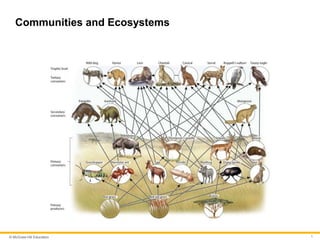
  • #33 Primary producers in this sample ecosystem are Star grass, Red oat grass, and Acacia. Primary consumers include grasshoppers, Harvester ants, Topi, termites, warthogs, dung beetles, hares, wildebeest, Thompson's gazelle, impala, and mice. Secondary consumers include the pangolin, aardvark, and mongoose. Tertiary consumers include wild dogs, hyena, lions, cheetahs, caracals, servals, Ruppell's vulture, and the tawny eagle.
  • #37 Plants form the base, with insects/snails, fishes, and predatory fishes at higher levels. Decomposers occur at all levels.
  • #38 A sample pyramid of energy from Silver Spring, Florida. Plants form the substantial base of producers, with energy transfers to insects and snails as consumers, then to fishes, then to predatory fishes or tertiary consumers. There is an additional large energy transfer of decomposers, despite their small biomass.
  • #39 Plants have the greatest available free energy. Energy flow proceeds through each trophic level. Next are the herbivores, who have less free available energy. First carnivores have less available energy than herbivores, and second carnivores have less energy than first carnivores. Third carnivores have the least available free energy.
  • #42 The control treatment had a net aboveground primary production of approximately 60 grams per square meter. A phosphorus treatment had slightly lower net aboveground primary production. When nitrogen was added, production increased to approximately 160. When nitrogen and phosphorus were combined as a treatment, production rose to approximately 270.
  • #47 Plants and algae capture about 6% of incident sunlight. Most energy is used in plant cellular respiration. The rest is used in net production of plant biomass. Most plant and algal material dies and decomposes in place to be eaten by bacteria or nematodes and crabs. The remainder is washed out to sea. Insect herbivores take very little of net plant production and spiders even less.