Bacteria19-1
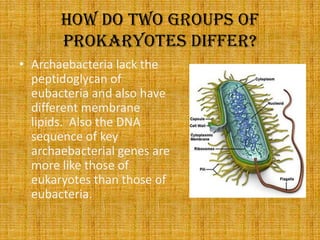
How do two groups of prokaryotes differ?Archaebacteria lack the peptidoglycan of eubacteria and also have different membrane lipids.  Also the DNA sequence of key archaebacterial genes are more like those of eukaryotes than those of eubacteria.
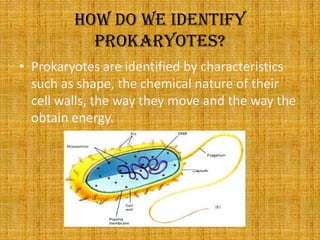
How do we identify prokaryotes?Prokaryotes are identified by characteristics such as shape, the chemical nature of their cell walls, the way they move and the way the obtain energy.
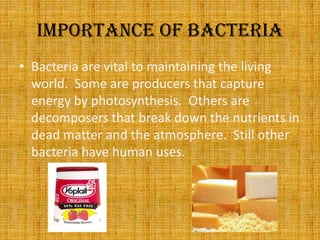
Importance of BacteriaBacteria are vital to maintaining the living world.  Some are producers that capture energy by photosynthesis.  Others are decomposers that break down the nutrients in dead matter and the atmosphere.  Still other bacteria have human uses.
Prokaryote-bacilliusThe smallest and most common microorganisms are prokaryotes.  You can find them even in a single drop of pond water.They are unicellular organisms  that lack a nucleus.Rod shaped prokaryotes are called bacillus.
Coccus-spirillumSpherical prokaryotes are called coccus.Spiral and corkscrewed shaped prokaryotes are called spirillum.
chemoheterotrophsMost heterotrophic prokaryotes must take in organic molecules for both energy and a supply of carbon.  These prokaryotes are called chemoheterotrophs.Most animals, including humans are chemoheterotrophs.
photoheterotrophsA smaller group of heterotrophic prokaryotes are called photoheterotrophs.These organisms are photosynthetic, using sunlight for energy, but they also need to take in organic compounds as a carbon source.
photoautotrophsSome autotrophs, the photoautotrophs, use light energy to convert carbon dioxide and water to carbon compounds and oxygen in a process similar to that used by green plants.
chemoautotrophsProkaryotes that can perform chemosynthesis and are called chemoautotrophs.  They make organic carbon molecules from carbon dioxide.  They do not require light as a source of energy.
Obligate aerobesOrganisms that require a constant supply of oxygen in order to live are called obligate aerobes.  The bacterium that causes tuberculosis is an obligate aerobe.
Obligate anaerobesThese are bacteria that do not require energy and in fact can be killed by it, so they must live in the absence of oxygen.
Facultative anaerobesThis kind of bacteria kind survive with or without oxygen.Their ability to switch between the process of cellular respiration and fermentation means that they are able to live just about anywhere.
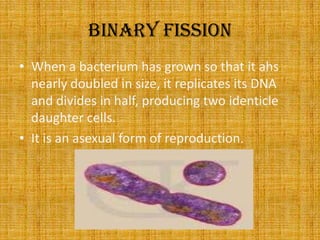
Binary fissionWhen a bacterium has grown so that it ahs nearly doubled in size, it replicates its DNA and divides in half, producing two identicle daughter cells.It is an asexual form of reproduction.
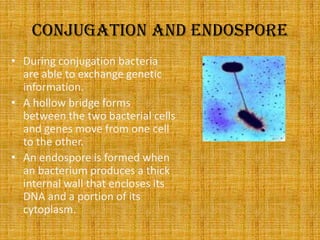
Conjugation and endosporeDuring conjugation bacteria are able to exchange genetic information.A hollow bridge forms between the two bacterial cells and genes move from one cell to the other.An endospore is formed when an bacterium produces a thick internal wall that encloses its DNA and a portion of its cytoplasm.
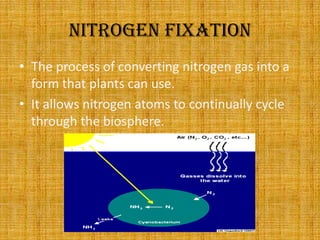
Nitrogen fixationThe process of converting nitrogen gas into a form that plants can use.It allows nitrogen atoms to continually cycle through the biosphere.

Bacteria 19 1

  • 1.
  • 2.
    How do twogroups of prokaryotes differ?Archaebacteria lack the peptidoglycan of eubacteria and also have different membrane lipids. Also the DNA sequence of key archaebacterial genes are more like those of eukaryotes than those of eubacteria.
  • 3.
    How do weidentify prokaryotes?Prokaryotes are identified by characteristics such as shape, the chemical nature of their cell walls, the way they move and the way the obtain energy.
  • 4.
    Importance of BacteriaBacteriaare vital to maintaining the living world. Some are producers that capture energy by photosynthesis. Others are decomposers that break down the nutrients in dead matter and the atmosphere. Still other bacteria have human uses.
  • 5.
    Prokaryote-bacilliusThe smallest andmost common microorganisms are prokaryotes. You can find them even in a single drop of pond water.They are unicellular organisms that lack a nucleus.Rod shaped prokaryotes are called bacillus.
  • 6.
    Coccus-spirillumSpherical prokaryotes arecalled coccus.Spiral and corkscrewed shaped prokaryotes are called spirillum.
  • 7.
    chemoheterotrophsMost heterotrophic prokaryotesmust take in organic molecules for both energy and a supply of carbon. These prokaryotes are called chemoheterotrophs.Most animals, including humans are chemoheterotrophs.
  • 8.
    photoheterotrophsA smaller groupof heterotrophic prokaryotes are called photoheterotrophs.These organisms are photosynthetic, using sunlight for energy, but they also need to take in organic compounds as a carbon source.
  • 9.
    photoautotrophsSome autotrophs, thephotoautotrophs, use light energy to convert carbon dioxide and water to carbon compounds and oxygen in a process similar to that used by green plants.
  • 10.
    chemoautotrophsProkaryotes that canperform chemosynthesis and are called chemoautotrophs. They make organic carbon molecules from carbon dioxide. They do not require light as a source of energy.
  • 11.
    Obligate aerobesOrganisms thatrequire a constant supply of oxygen in order to live are called obligate aerobes. The bacterium that causes tuberculosis is an obligate aerobe.
  • 12.
    Obligate anaerobesThese arebacteria that do not require energy and in fact can be killed by it, so they must live in the absence of oxygen.
  • 13.
    Facultative anaerobesThis kindof bacteria kind survive with or without oxygen.Their ability to switch between the process of cellular respiration and fermentation means that they are able to live just about anywhere.
  • 14.
    Binary fissionWhen abacterium has grown so that it ahs nearly doubled in size, it replicates its DNA and divides in half, producing two identicle daughter cells.It is an asexual form of reproduction.
  • 15.
    Conjugation and endosporeDuringconjugation bacteria are able to exchange genetic information.A hollow bridge forms between the two bacterial cells and genes move from one cell to the other.An endospore is formed when an bacterium produces a thick internal wall that encloses its DNA and a portion of its cytoplasm.
  • 16.
    Nitrogen fixationThe processof converting nitrogen gas into a form that plants can use.It allows nitrogen atoms to continually cycle through the biosphere.