Population Genetics
BIOL 1307
Ebeling
1Laura B. Scheinfeldt et al. PNAS 2010;107:Supplement 2:8931-8938
Learning Objectives
1. Define: allele frequency, genotype frequency, phenotype, genotype.
2. Define fitness in terms of reproductive success.
3. Explain how natural selection can affect allele frequencies in populations and contribute to
evolution.
4. Compare and contrast: artificial selection, natural selection, sexual selection, and Lamarck’s
idea of Acquired Characteristics.
5. Compare and contrast directional, stabilizing, and disruptive selection.
6. Compare and contrast how biological mechanisms other than Natural Selection (mutation,
genetic drift, non-random mating, gene flow, and population size) can affect allele
frequencies in populations and contribute to evolution.
7. Use the Hardy-Weinberg Equations to calculate allele and genotype frequencies in a given
population.
8. List the conditions that must be met for a population to be in Hardy-Weinberg Equilibrium.
9. Differentiate between survival and fitness.
10.Give an example of how natural selection can allow the persistence of harmful alleles in a
population.
11.Explain how sexual selection can promote traits that decrease survival.
2
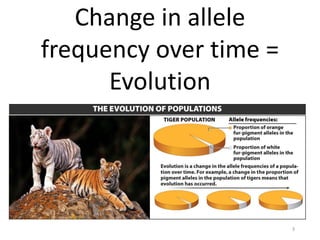
Change in allele
frequency over time =
Evolution
3
4
Hardy-Weinberg
Equilibrium
5
Conditions of Hardy-Weinberg
Equilibrium
1. The population size is infinite (or VERY large)
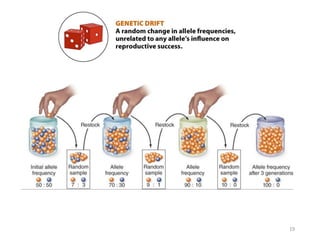
• Small populations are subject to Genetic Drift
• Bottleneck Effect
• Founder Effect
2. Mating within the population is random.
• No mating preference for any specific phenotype over
another
3. No mutation occurring in the population
4. No immigration or emigration with other populations
(no gene flow)
5. No selection for one phenotype over another
7
8
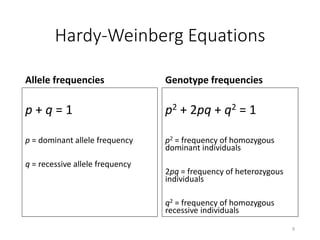
Hardy-Weinberg Equations
Allele frequencies
p + q = 1
p = dominant allele frequency
q = recessive allele frequency
Genotype frequencies
p2 + 2pq + q2 = 1
p2 = frequency of homozygous
dominant individuals
2pq = frequency of heterozygous
individuals
q2 = frequency of homozygous
recessive individuals
9
HWE Practice
10
Population (Time 1)
Blue is dominant to Purple
Hardy-Weinberg Equations
p + q = 1
q2 =
q =
p =
p2 =
2pq =
p2 + 2pq + q2 = 1
11
HWE Practice
12
Population (Time 1)
Blue is dominant to Purple
How many individuals
are heterozygous?
HWE Practice
13
Population (Time 2)
Blue is dominant to Purple
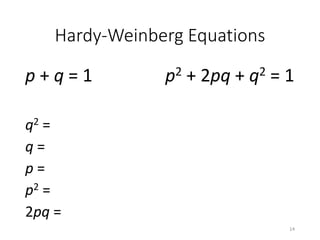
Hardy-Weinberg Equations
p + q = 1
q2 =
q =
p =
p2 =
2pq =
p2 + 2pq + q2 = 1
14
Is the population at Hardy-
Weinberg Equilibrium?
Time 1
q2 =
q =
p =
p2 =
2pq =
Time 2
q2 =
q =
p =
p2 =
2pq =
15
HWE Practice
16
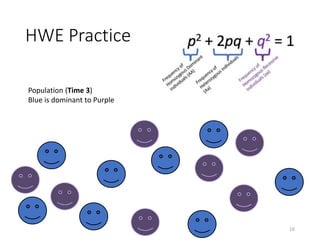
Population (Time 3)
Blue is dominant to Purple
Hardy-Weinberg Equations
p + q = 1
q2 =
q =
p =
p2 =
2pq =
p2 + 2pq + q2 = 1
17
Is the population at Hardy-
Weinberg Equilibrium?
Time 2
q2 =
q =
p =
p2 =
2pq =
Time 3
q2 =
q =
p =
p2 =
2pq =
18
19
Figure 23.12
Figure 23.13
Figure 23.3
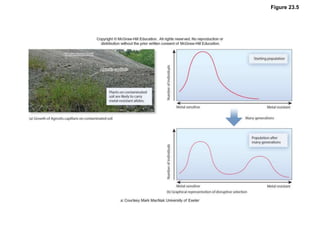
Figure 23.5
Figure 23.6
Hardy-Weinberg Equations
p + q = 1
q2 =
q =
p =
p2 =
2pq =
p2 + 2pq + q2 = 1
25

1307 Population genetics

  • 1.
    Population Genetics BIOL 1307 Ebeling 1LauraB. Scheinfeldt et al. PNAS 2010;107:Supplement 2:8931-8938
  • 2.
    Learning Objectives 1. Define:allele frequency, genotype frequency, phenotype, genotype. 2. Define fitness in terms of reproductive success. 3. Explain how natural selection can affect allele frequencies in populations and contribute to evolution. 4. Compare and contrast: artificial selection, natural selection, sexual selection, and Lamarck’s idea of Acquired Characteristics. 5. Compare and contrast directional, stabilizing, and disruptive selection. 6. Compare and contrast how biological mechanisms other than Natural Selection (mutation, genetic drift, non-random mating, gene flow, and population size) can affect allele frequencies in populations and contribute to evolution. 7. Use the Hardy-Weinberg Equations to calculate allele and genotype frequencies in a given population. 8. List the conditions that must be met for a population to be in Hardy-Weinberg Equilibrium. 9. Differentiate between survival and fitness. 10.Give an example of how natural selection can allow the persistence of harmful alleles in a population. 11.Explain how sexual selection can promote traits that decrease survival. 2
  • 3.
    Change in allele frequencyover time = Evolution 3
  • 4.
  • 5.
  • 6.
    Conditions of Hardy-Weinberg Equilibrium 1.The population size is infinite (or VERY large) • Small populations are subject to Genetic Drift • Bottleneck Effect • Founder Effect 2. Mating within the population is random. • No mating preference for any specific phenotype over another 3. No mutation occurring in the population 4. No immigration or emigration with other populations (no gene flow) 5. No selection for one phenotype over another
  • 7.
  • 8.
  • 9.
    Hardy-Weinberg Equations Allele frequencies p+ q = 1 p = dominant allele frequency q = recessive allele frequency Genotype frequencies p2 + 2pq + q2 = 1 p2 = frequency of homozygous dominant individuals 2pq = frequency of heterozygous individuals q2 = frequency of homozygous recessive individuals 9
  • 10.
    HWE Practice 10 Population (Time1) Blue is dominant to Purple
  • 11.
    Hardy-Weinberg Equations p +q = 1 q2 = q = p = p2 = 2pq = p2 + 2pq + q2 = 1 11
  • 12.
    HWE Practice 12 Population (Time1) Blue is dominant to Purple How many individuals are heterozygous?
  • 13.
    HWE Practice 13 Population (Time2) Blue is dominant to Purple
  • 14.
    Hardy-Weinberg Equations p +q = 1 q2 = q = p = p2 = 2pq = p2 + 2pq + q2 = 1 14
  • 15.
    Is the populationat Hardy- Weinberg Equilibrium? Time 1 q2 = q = p = p2 = 2pq = Time 2 q2 = q = p = p2 = 2pq = 15
  • 16.
    HWE Practice 16 Population (Time3) Blue is dominant to Purple
  • 17.
    Hardy-Weinberg Equations p +q = 1 q2 = q = p = p2 = 2pq = p2 + 2pq + q2 = 1 17
  • 18.
    Is the populationat Hardy- Weinberg Equilibrium? Time 2 q2 = q = p = p2 = 2pq = Time 3 q2 = q = p = p2 = 2pq = 18
  • 19.
  • 20.
  • 21.
  • 22.
  • 23.
  • 24.
  • 25.
    Hardy-Weinberg Equations p +q = 1 q2 = q = p = p2 = 2pq = p2 + 2pq + q2 = 1 25