Evolution
BIOL 1307
Ebeling
1
Learning Objectives
1. Define: allele frequency, genotype frequency, phenotype.
2. Define fitness in terms of reproductive success.
3. Explain how natural selection can affect allele frequencies in populations and contribute
to evolution.
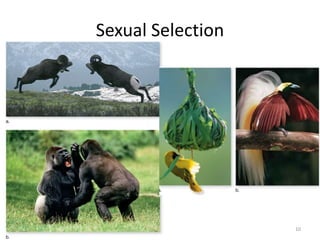
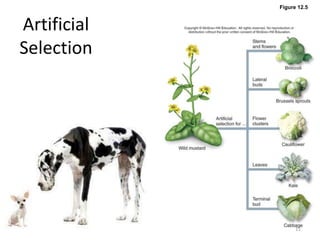
4. Compare and contrast: artificial selection, natural selection, sexual selection, and
Lamarck’s idea of Acquired Characteristics.
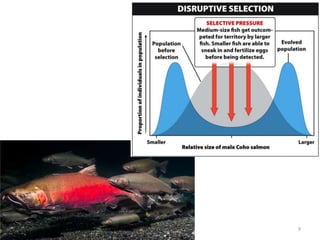
5. Compare and contrast directional, stabilizing, and disruptive selection.
6. Compare and contrast how biological mechanisms other than Natural Selection (mutation,
genetic drift, non-random mating, gene flow, and population size) can affect allele
frequencies in populations and contribute to evolution.
7. Use the Hardy-Weinberg Equations to calculate allele and genotype frequencies in a given
population.
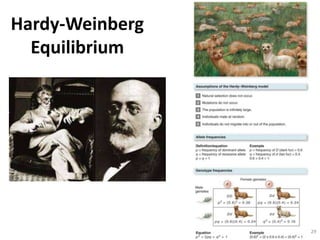
8. List the conditions that must be met for a population to be in Hardy-Weinberg
Equilibrium.
9. Differentiate between survival and fitness.
10. Give an example of how natural selection can allow the persistence of harmful alleles in a
population.
11. Explain how sexual selection can promote traits that decrease survival.
2
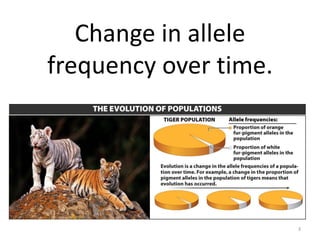
Change in allele
frequency over time.
3
4
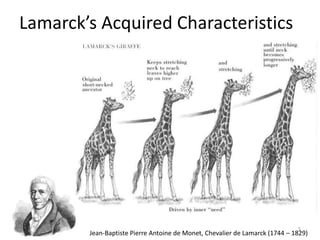
Lamarck’s Acquired Characteristics
Jean-Baptiste Pierre Antoine de Monet, Chevalier de Lamarck (1744 – 1829)
5
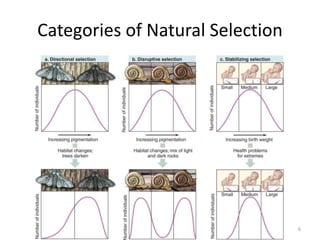
Categories of Natural Selection
6
7
8
9
Sexual Selection
10
Figure 12.5
Artificial
Selection
11
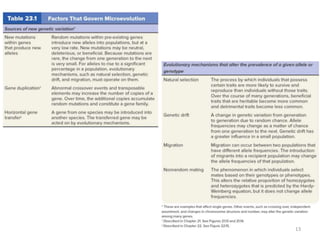
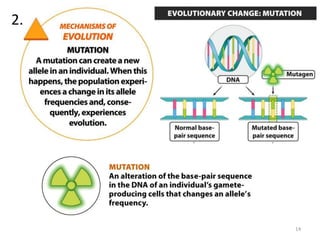
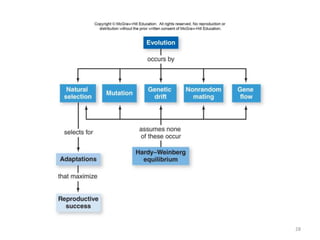
Mechanisms of Evolution
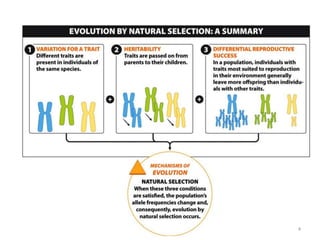
1. Natural Selection
2.
3.
4.
5.
12
13
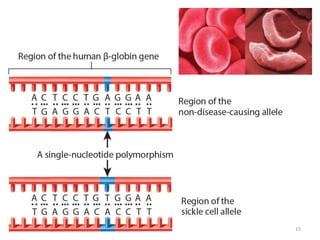
2.
14
15
Figure 2 Map of the estimated numbers of births with sickle cell anaemia
Kato, G. J. et al. (2018) Sickle cell disease
Nat. Rev. Dis. Primers doi:10.1038/nrdp.2018.10
16
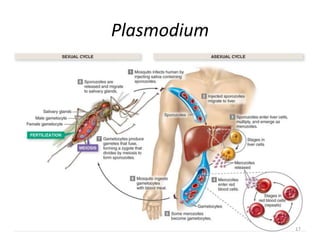
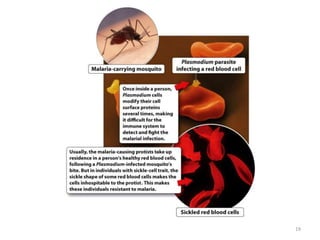
Plasmodium
17
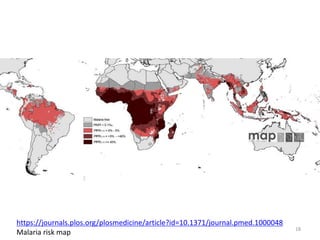
https://journals.plos.org/plosmedicine/article?id=10.1371/journal.pmed.1000048
Malaria risk map
18
19
3.
20
21
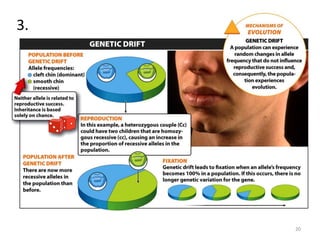
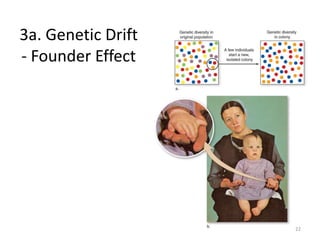
3a. Genetic Drift
- Founder Effect
22
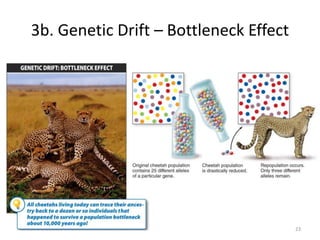
3b. Genetic Drift – Bottleneck Effect
23
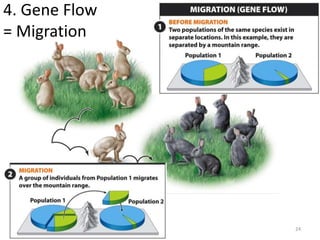
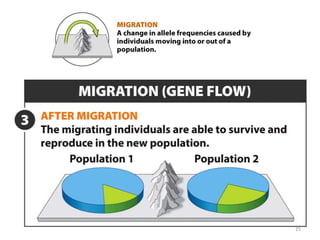
4. Gene Flow
= Migration
24
25
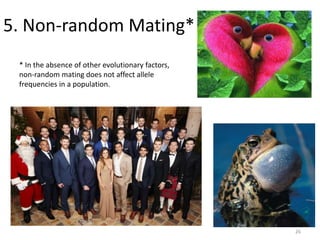
5. Non-random Mating*
* In the absence of other evolutionary factors,
non-random mating does not affect allele
frequencies in a population.
26
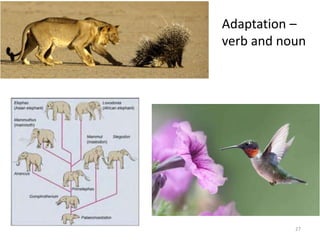
Adaptation –
verb and noun
27
28
Hardy-Weinberg
Equilibrium
29

1307 evolution