Structure of Protein
Dr.Sujit Ghosh
J K College
Purulia
New research by scientists at the MRC Laboratory of Molecular Biology in the United Kingdom and
Indiana University School of Medicine gives the most detailed view yet of tau protein structures found
in Alzheimer's disease.
The team of the MRC scientists -- led by Michel Goedert, MD, PhD, and Sjors Scheres, PhD -- along
with IU Distinguished Professor Bernardino Ghetti, MD, and Assistant Research Professor Holly
Garringer, PhD, of the IU School of Medicine Department of Pathology and Laboratory Medicine, are
the first to present high-resolution structures of tau filaments from the brain of a patient with a
confirmed diagnosis of Alzheimer's disease.
Dr. Ghetti said their findings, published online July 5 in Nature, represent one of the major discoveries
of the past 25 years in the field of Alzheimer's disease research.
"This is a tremendous step forward," Dr. Ghetti said. "It's clear that tau is extremely important to the
progression of Alzheimer's disease and certain forms of dementia. In terms of designing therapeutic
agents, the possibilities are now enormous."
Tau proteins are a stabilizing element in healthy brains, but when they become defective, the proteins
can form bundles of filaments -- or tangles -- known as the primary markers of Alzheimer's and other
neurodegenerative diseases. But tau filaments are invisible at the light microscope, Dr. Ghetti said, and
without high-resolution images showing their atomic structure, it has been difficult to decipher their
role in the development of these diseases.
Protein – Derived from Greek word proteios meaning “of the first rank” in 1838
by Jöns J. Berzelius.
Crucial in all biological processes, such as Enzymatic catalysis, transport and
storage, immune protection……
Functions depend on structures --- structure can help us to understand function
Building blocks
• Amino acid
Hydrophobic: AVLIFPM
Charged residues: DEKR
Polar: STCNQHYW
Special : G
• Polypeptide chain
Extend from its amino terminus to its
carboxy terminus
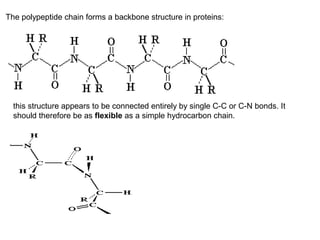
The polypeptide chain forms a backbone structure in proteins:
this structure appears to be connected entirely by single C-C or C-N bonds. It
should therefore be as flexible as a simple hydrocarbon chain.
By measuring bond lengths, Pauling first deduced that the peptide bond had double
bond character, due to the second resonance form of the amide.
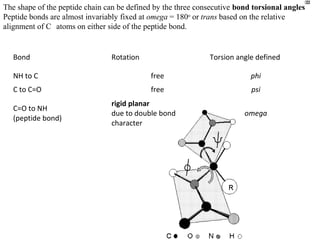
The double bond fixes the six atoms shown above into a rigid plane.
In the figure below, the rigid plane of each peptide bond is indicated by the
lightly shaded rectangle.
typical single C-N bond: 1.47 Å
typical double C=N bond: 1.27 Å
peptide bond C=O to NH: 1.33 Å
Bond Rotation
Torsion
angle
defined
NH to C free phi
C to C=O free psi
C=O to NH
(peptide
bond)
rigid planar
due to
double bond
character
omega
Bond Rotation Torsion angle defined
NH to C free phi
C to C=O free psi
C=O to NH
(peptide bond)
rigid planar
due to double bond
character
omega
The shape of the peptide chain can be defined by the three consecutive bond torsional angles
Peptide bonds are almost invariably fixed at omega = 180o
or trans based on the relative
alignment of C atoms on either side of the peptide bond.
Secondary Structure : Alpha Helix
hydrogen bonds between n
and n+i (i=3,4,5)
Note that flexing in a covalent structure does not occur by bending bonds, and the
normal tetrahedral or trigonal planar bond angles are maintained. Instead, different
shapes are obtained by torsional rotationabout the axis of the bonds:
Orderly arrangements of the polypeptide backbone were first studied by
examining fibrous proteins called keratins:
alpha-keratin - protein of hair, skin and wool;
beta-keratin or fibroin - spider and silkmoth silk
The keratins were studied by X-ray fiber diffraction, a technique in which
X-rays are reflected off a regular repetitive macromolecule array in the
protein fiber, forming a characteristic pattern if the repeat spacing of the
sample is comparable to X-ray wavelengths. If the X-ray wavelength is
known, the size of the repeat pattern in the protein can be calculated.
For alpha-keratin, periodic repeat distances were 1.5 and 5.4 angstroms.
The diffraction patterns also showed characteristic missing reflections that
suggested a helical structure.
For fibroin or beta keratin, periodic repeats were 3.5 and 7.0 angstroms.
The structures having these repeat distances were solved by Linus Pauling.
Pauling understood the importance of knowing exact atomic radii, bond
lengths and angles and used these to create exact scale models of
possible structures.
However, the simple single-bonded peptide chain was so flexible that it was
not initially apparent why specific structures would form.
Secondary Structure : Beta Sheet
Parallel Beta SheetAntiparallel Beta Sheet
We can also have mix.
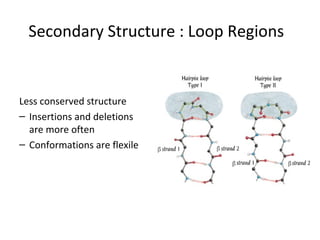
Secondary Structure : Loop Regions
Less conserved structure
– Insertions and deletions
are more often
– Conformations are flexile
Phi – N - bond
Psi – -C’ bond
Tertiary Structure
αC
αC
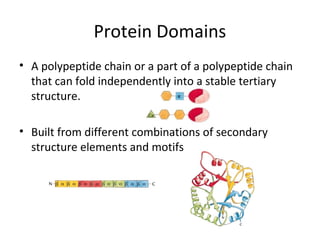
Protein Domains
• A polypeptide chain or a part of a polypeptide chain
that can fold independently into a stable tertiary
structure.
• Built from different combinations of secondary
structure elements and motifs
Three Main Classes of Domain Structures
• During the evolution, the structural core tends
to be conserved
• Alpha domains : The core is build up
exclusively from alpha helices
• Beta domains : The core comprises anti-
parallel beta sheets packed against each other
• Alpha/Beta domains : a predominantly parallel
Beta sheet surrounded by alpha helices
Alpha-Domain Structures
• It’s coiled coil structure
• The most common one is four-helix bundle but
we can have large and complex ones.
Alpha-Domain Structures
• Knobs in holes
• Ridges in grooves
Alpha-Domain Structures
• Knobs in holes
• Ridges in grooves
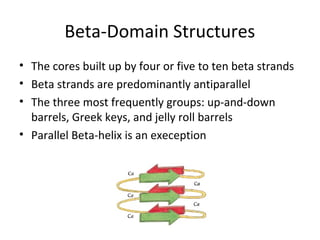
Beta-Domain Structures
• The cores built up by four or five to ten beta strands
• Beta strands are predominantly antiparallel
• The three most frequently groups: up-and-down
barrels, Greek keys, and jelly roll barrels
• Parallel Beta-helix is an exeception
Beta-Domain Structures
Greek key Jelly rollUp-and-down
barrels
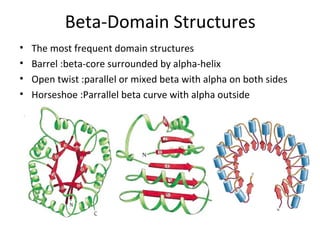
Beta-Domain Structures
• The most frequent domain structures
• Barrel :beta-core surrounded by alpha-helix
• Open twist :parallel or mixed beta with alpha on both sides
• Horseshoe :Parrallel beta curve with alpha outside
Determination of Protein Structures
• X-ray crystallography
The interaction of x-rays with electrons arranged in a crystal
can produce electron-density map, which can be interpreted
to an atomic model. Crystal is very hard to grow.
• Nuclear magnetic resonance (NMR)
Some atomic nuclei have a magnetic spin. Probed the
molecule by radio frequency and get the distances between
atoms. Only applicable to small molecules.

Protein structure

  • 1.
    Structure of Protein Dr.SujitGhosh J K College Purulia
  • 2.
    New research byscientists at the MRC Laboratory of Molecular Biology in the United Kingdom and Indiana University School of Medicine gives the most detailed view yet of tau protein structures found in Alzheimer's disease. The team of the MRC scientists -- led by Michel Goedert, MD, PhD, and Sjors Scheres, PhD -- along with IU Distinguished Professor Bernardino Ghetti, MD, and Assistant Research Professor Holly Garringer, PhD, of the IU School of Medicine Department of Pathology and Laboratory Medicine, are the first to present high-resolution structures of tau filaments from the brain of a patient with a confirmed diagnosis of Alzheimer's disease. Dr. Ghetti said their findings, published online July 5 in Nature, represent one of the major discoveries of the past 25 years in the field of Alzheimer's disease research. "This is a tremendous step forward," Dr. Ghetti said. "It's clear that tau is extremely important to the progression of Alzheimer's disease and certain forms of dementia. In terms of designing therapeutic agents, the possibilities are now enormous." Tau proteins are a stabilizing element in healthy brains, but when they become defective, the proteins can form bundles of filaments -- or tangles -- known as the primary markers of Alzheimer's and other neurodegenerative diseases. But tau filaments are invisible at the light microscope, Dr. Ghetti said, and without high-resolution images showing their atomic structure, it has been difficult to decipher their role in the development of these diseases.
  • 4.
    Protein – Derivedfrom Greek word proteios meaning “of the first rank” in 1838 by Jöns J. Berzelius. Crucial in all biological processes, such as Enzymatic catalysis, transport and storage, immune protection…… Functions depend on structures --- structure can help us to understand function Building blocks • Amino acid Hydrophobic: AVLIFPM Charged residues: DEKR Polar: STCNQHYW Special : G • Polypeptide chain Extend from its amino terminus to its carboxy terminus
  • 8.
    The polypeptide chainforms a backbone structure in proteins: this structure appears to be connected entirely by single C-C or C-N bonds. It should therefore be as flexible as a simple hydrocarbon chain.
  • 9.
    By measuring bondlengths, Pauling first deduced that the peptide bond had double bond character, due to the second resonance form of the amide. The double bond fixes the six atoms shown above into a rigid plane. In the figure below, the rigid plane of each peptide bond is indicated by the lightly shaded rectangle. typical single C-N bond: 1.47 Å typical double C=N bond: 1.27 Å peptide bond C=O to NH: 1.33 Å Bond Rotation Torsion angle defined NH to C free phi C to C=O free psi C=O to NH (peptide bond) rigid planar due to double bond character omega
  • 10.
    Bond Rotation Torsionangle defined NH to C free phi C to C=O free psi C=O to NH (peptide bond) rigid planar due to double bond character omega The shape of the peptide chain can be defined by the three consecutive bond torsional angles Peptide bonds are almost invariably fixed at omega = 180o or trans based on the relative alignment of C atoms on either side of the peptide bond.
  • 11.
    Secondary Structure :Alpha Helix hydrogen bonds between n and n+i (i=3,4,5)
  • 15.
    Note that flexingin a covalent structure does not occur by bending bonds, and the normal tetrahedral or trigonal planar bond angles are maintained. Instead, different shapes are obtained by torsional rotationabout the axis of the bonds:
  • 16.
    Orderly arrangements ofthe polypeptide backbone were first studied by examining fibrous proteins called keratins: alpha-keratin - protein of hair, skin and wool; beta-keratin or fibroin - spider and silkmoth silk The keratins were studied by X-ray fiber diffraction, a technique in which X-rays are reflected off a regular repetitive macromolecule array in the protein fiber, forming a characteristic pattern if the repeat spacing of the sample is comparable to X-ray wavelengths. If the X-ray wavelength is known, the size of the repeat pattern in the protein can be calculated. For alpha-keratin, periodic repeat distances were 1.5 and 5.4 angstroms. The diffraction patterns also showed characteristic missing reflections that suggested a helical structure. For fibroin or beta keratin, periodic repeats were 3.5 and 7.0 angstroms. The structures having these repeat distances were solved by Linus Pauling. Pauling understood the importance of knowing exact atomic radii, bond lengths and angles and used these to create exact scale models of possible structures. However, the simple single-bonded peptide chain was so flexible that it was not initially apparent why specific structures would form.
  • 17.
    Secondary Structure :Beta Sheet Parallel Beta SheetAntiparallel Beta Sheet We can also have mix.
  • 18.
    Secondary Structure :Loop Regions Less conserved structure – Insertions and deletions are more often – Conformations are flexile
  • 19.
    Phi – N- bond Psi – -C’ bond Tertiary Structure αC αC
  • 20.
    Protein Domains • Apolypeptide chain or a part of a polypeptide chain that can fold independently into a stable tertiary structure. • Built from different combinations of secondary structure elements and motifs
  • 21.
    Three Main Classesof Domain Structures • During the evolution, the structural core tends to be conserved • Alpha domains : The core is build up exclusively from alpha helices • Beta domains : The core comprises anti- parallel beta sheets packed against each other • Alpha/Beta domains : a predominantly parallel Beta sheet surrounded by alpha helices
  • 22.
    Alpha-Domain Structures • It’scoiled coil structure • The most common one is four-helix bundle but we can have large and complex ones.
  • 23.
    Alpha-Domain Structures • Knobsin holes • Ridges in grooves
  • 24.
    Alpha-Domain Structures • Knobsin holes • Ridges in grooves
  • 25.
    Beta-Domain Structures • Thecores built up by four or five to ten beta strands • Beta strands are predominantly antiparallel • The three most frequently groups: up-and-down barrels, Greek keys, and jelly roll barrels • Parallel Beta-helix is an exeception
  • 26.
    Beta-Domain Structures Greek keyJelly rollUp-and-down barrels
  • 27.
    Beta-Domain Structures • Themost frequent domain structures • Barrel :beta-core surrounded by alpha-helix • Open twist :parallel or mixed beta with alpha on both sides • Horseshoe :Parrallel beta curve with alpha outside
  • 28.
    Determination of ProteinStructures • X-ray crystallography The interaction of x-rays with electrons arranged in a crystal can produce electron-density map, which can be interpreted to an atomic model. Crystal is very hard to grow. • Nuclear magnetic resonance (NMR) Some atomic nuclei have a magnetic spin. Probed the molecule by radio frequency and get the distances between atoms. Only applicable to small molecules.