
PROTEIN 3-
DIMENSIONAL
STRUCTURE AND
FUNCTION
By- Dr. Armaan Singh
TERMINOLOGY
 Conformation – spatial arrangement of atoms in a protein
 Native conformation – conformation of functional protein
PROTEIN CLASSIFICATION
 Simple – composed only of amino acid residues
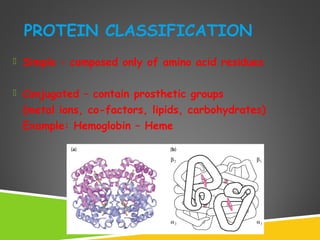
 Conjugated – contain prosthetic groups
(metal ions, co-factors, lipids, carbohydrates)
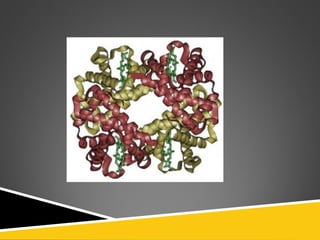
Example: Hemoglobin – Heme
PROTEIN CLASSIFICATION
• One polypeptide chain - monomeric protein
• More than one - multimeric protein
• Homomultimer - one kind of chain
• Heteromultimer - two or more different
chains
(e.g. Hemoglobin is a heterotetramer. It has
two alpha chains and two beta chains.)
PROTEIN CLASSIFICATION
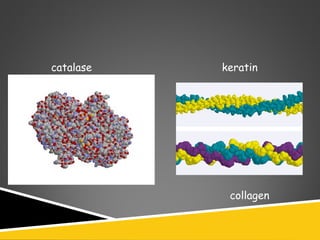
Fibrous –
1) polypeptides arranged in long strands or sheets
2) water insoluble (lots of hydrophobic AA’s)
3) strong but flexible
4) Structural (keratin, collagen)
Globular –
1) polypeptide chains folded into spherical or globular
form
2) water soluble
3) contain several types of secondary structure
4) diverse functions (enzymes, regulatory proteins)
keratin
collagen
catalase
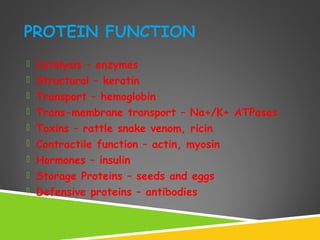
PROTEIN FUNCTION
 Catalysis – enzymes
 Structural – keratin
 Transport – hemoglobin
 Trans-membrane transport – Na+/K+ ATPases
 Toxins – rattle snake venom, ricin
 Contractile function – actin, myosin
 Hormones – insulin
 Storage Proteins – seeds and eggs
 Defensive proteins – antibodies
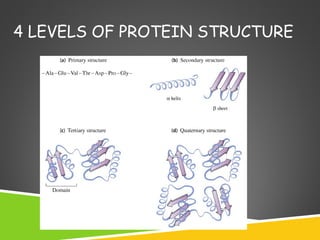
4 LEVELS OF PROTEIN STRUCTURE
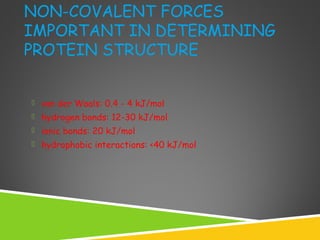
NON-COVALENT FORCES
IMPORTANT IN DETERMINING
PROTEIN STRUCTURE
 van der Waals: 0.4 - 4 kJ/mol
 hydrogen bonds: 12-30 kJ/mol
 ionic bonds: 20 kJ/mol
 hydrophobic interactions: <40 kJ/mol
1O
STRUCTURE DETERMINES 2O
, 3O
, 4O
STRUCTURE
 Sickle Cell Anemia – single amino acid change in hemoglobin
related to disease
 Osteoarthritis – single amino acid change in collagen
protein causes joint damage
CLASSES OF 2O
STRUCTURE
 Alpha helix
 B-sheet
 Loops and turns
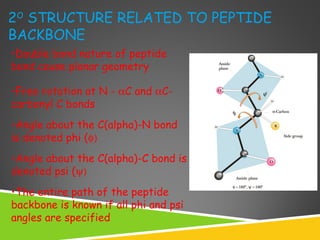
2O
STRUCTURE RELATED TO PEPTIDE
BACKBONE
•Double bond nature of peptide
bond cause planar geometry
•Free rotation at N - αC and αC-
carbonyl C bonds
•Angle about the C(alpha)-N bond
is denoted phi (φ)
•Angle about the C(alpha)-C bond is
denoted psi (ψ)
•The entire path of the peptide
backbone is known if all phi and psi
angles are specified
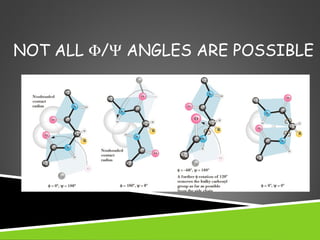
NOT ALL Φ/Ψ ANGLES ARE POSSIBLE
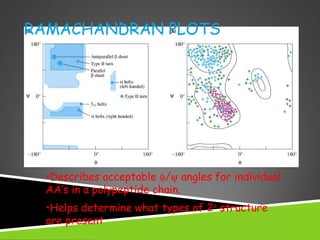
RAMACHANDRAN PLOTS
•Describes acceptable φ/ψ angles for individual
AA’s in a polypeptide chain.
•Helps determine what types of 2o
structure
are present
ALPHA-HELIX
• First proposed by Linus Pauling and
Robert Corey in 1951
• Identified in keratin by Max Perutz
• A ubiquitous component of proteins
• Stabilized by H-bonds
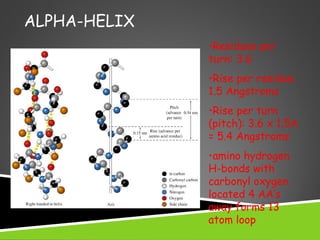
ALPHA-HELIX
•Residues per
turn: 3.6
•Rise per residue:
1.5 Angstroms
•Rise per turn
(pitch): 3.6 x 1.5A
= 5.4 Angstroms
•amino hydrogen
H-bonds with
carbonyl oxygen
located 4 AA’s
away forms 13
atom loop
Right handed
helix
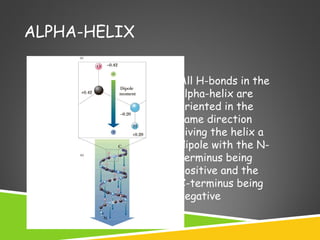
ALPHA-HELIX
All H-bonds in the
alpha-helix are
oriented in the
same direction
giving the helix a
dipole with the N-
terminus being
positive and the
C-terminus being
negative
ALPHA-HELIX
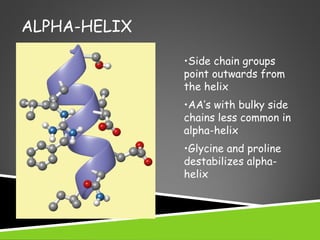
•Side chain groups
point outwards from
the helix
•AA’s with bulky side
chains less common in
alpha-helix
•Glycine and proline
destabilizes alpha-
helix
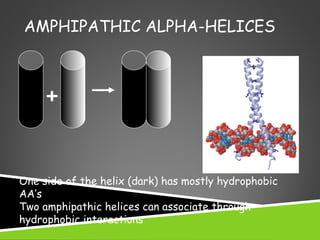
AMPHIPATHIC ALPHA-HELICES
+
One side of the helix (dark) has mostly hydrophobic
AA’s
Two amphipathic helices can associate through
hydrophobic interactions
BETA-STRANDS AND BETA-
SHEETS Also first postulated by Pauling and
Corey, 1951
 Strands may be parallel or antiparallel
 Rise per residue:
 3.47 Angstroms for antiparallel strands
 3.25 Angstroms for parallel strands
 Each strand of a beta sheet may be pictured as a helix with two
residues per turn
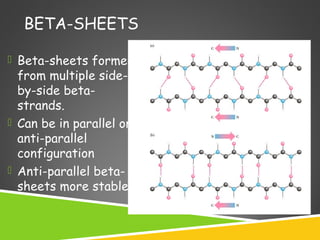
BETA-SHEETS
 Beta-sheets formed
from multiple side-
by-side beta-
strands.
 Can be in parallel or
anti-parallel
configuration
 Anti-parallel beta-
sheets more stable
BETA-SHEETS
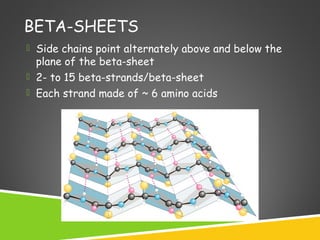
 Side chains point alternately above and below the
plane of the beta-sheet
 2- to 15 beta-strands/beta-sheet
 Each strand made of ~ 6 amino acids
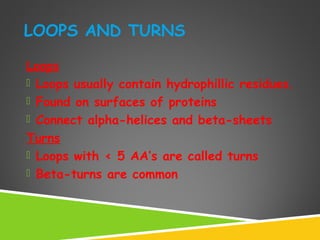
LOOPS AND TURNS
Loops
 Loops usually contain hydrophillic residues.
 Found on surfaces of proteins
 Connect alpha-helices and beta-sheets
Turns
 Loops with < 5 AA’s are called turns
 Beta-turns are common
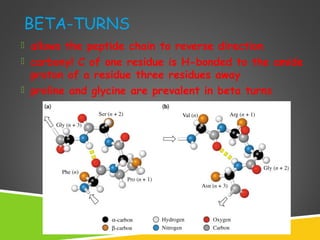
BETA-TURNS
 allows the peptide chain to reverse direction
 carbonyl C of one residue is H-bonded to the amide
proton of a residue three residues away
 proline and glycine are prevalent in beta turns

Protein 3 dimensional structure and function

  • 1.
  • 2.
    TERMINOLOGY  Conformation –spatial arrangement of atoms in a protein  Native conformation – conformation of functional protein
  • 6.
    PROTEIN CLASSIFICATION  Simple– composed only of amino acid residues  Conjugated – contain prosthetic groups (metal ions, co-factors, lipids, carbohydrates) Example: Hemoglobin – Heme
  • 7.
    PROTEIN CLASSIFICATION • Onepolypeptide chain - monomeric protein • More than one - multimeric protein • Homomultimer - one kind of chain • Heteromultimer - two or more different chains (e.g. Hemoglobin is a heterotetramer. It has two alpha chains and two beta chains.)
  • 8.
    PROTEIN CLASSIFICATION Fibrous – 1)polypeptides arranged in long strands or sheets 2) water insoluble (lots of hydrophobic AA’s) 3) strong but flexible 4) Structural (keratin, collagen) Globular – 1) polypeptide chains folded into spherical or globular form 2) water soluble 3) contain several types of secondary structure 4) diverse functions (enzymes, regulatory proteins)
  • 9.
  • 10.
    PROTEIN FUNCTION  Catalysis– enzymes  Structural – keratin  Transport – hemoglobin  Trans-membrane transport – Na+/K+ ATPases  Toxins – rattle snake venom, ricin  Contractile function – actin, myosin  Hormones – insulin  Storage Proteins – seeds and eggs  Defensive proteins – antibodies
  • 11.
    4 LEVELS OFPROTEIN STRUCTURE
  • 12.
    NON-COVALENT FORCES IMPORTANT INDETERMINING PROTEIN STRUCTURE  van der Waals: 0.4 - 4 kJ/mol  hydrogen bonds: 12-30 kJ/mol  ionic bonds: 20 kJ/mol  hydrophobic interactions: <40 kJ/mol
  • 13.
    1O STRUCTURE DETERMINES 2O ,3O , 4O STRUCTURE  Sickle Cell Anemia – single amino acid change in hemoglobin related to disease  Osteoarthritis – single amino acid change in collagen protein causes joint damage
  • 14.
    CLASSES OF 2O STRUCTURE Alpha helix  B-sheet  Loops and turns
  • 15.
    2O STRUCTURE RELATED TOPEPTIDE BACKBONE •Double bond nature of peptide bond cause planar geometry •Free rotation at N - αC and αC- carbonyl C bonds •Angle about the C(alpha)-N bond is denoted phi (φ) •Angle about the C(alpha)-C bond is denoted psi (ψ) •The entire path of the peptide backbone is known if all phi and psi angles are specified
  • 16.
    NOT ALL Φ/ΨANGLES ARE POSSIBLE
  • 17.
    RAMACHANDRAN PLOTS •Describes acceptableφ/ψ angles for individual AA’s in a polypeptide chain. •Helps determine what types of 2o structure are present
  • 18.
    ALPHA-HELIX • First proposedby Linus Pauling and Robert Corey in 1951 • Identified in keratin by Max Perutz • A ubiquitous component of proteins • Stabilized by H-bonds
  • 19.
    ALPHA-HELIX •Residues per turn: 3.6 •Riseper residue: 1.5 Angstroms •Rise per turn (pitch): 3.6 x 1.5A = 5.4 Angstroms •amino hydrogen H-bonds with carbonyl oxygen located 4 AA’s away forms 13 atom loop Right handed helix
  • 20.
    ALPHA-HELIX All H-bonds inthe alpha-helix are oriented in the same direction giving the helix a dipole with the N- terminus being positive and the C-terminus being negative
  • 21.
    ALPHA-HELIX •Side chain groups pointoutwards from the helix •AA’s with bulky side chains less common in alpha-helix •Glycine and proline destabilizes alpha- helix
  • 22.
    AMPHIPATHIC ALPHA-HELICES + One sideof the helix (dark) has mostly hydrophobic AA’s Two amphipathic helices can associate through hydrophobic interactions
  • 23.
    BETA-STRANDS AND BETA- SHEETSAlso first postulated by Pauling and Corey, 1951  Strands may be parallel or antiparallel  Rise per residue:  3.47 Angstroms for antiparallel strands  3.25 Angstroms for parallel strands  Each strand of a beta sheet may be pictured as a helix with two residues per turn
  • 24.
    BETA-SHEETS  Beta-sheets formed frommultiple side- by-side beta- strands.  Can be in parallel or anti-parallel configuration  Anti-parallel beta- sheets more stable
  • 25.
    BETA-SHEETS  Side chainspoint alternately above and below the plane of the beta-sheet  2- to 15 beta-strands/beta-sheet  Each strand made of ~ 6 amino acids
  • 26.
    LOOPS AND TURNS Loops Loops usually contain hydrophillic residues.  Found on surfaces of proteins  Connect alpha-helices and beta-sheets Turns  Loops with < 5 AA’s are called turns  Beta-turns are common
  • 27.
    BETA-TURNS  allows thepeptide chain to reverse direction  carbonyl C of one residue is H-bonded to the amide proton of a residue three residues away  proline and glycine are prevalent in beta turns