SOFTVISION COLLEGE,INDORE
Department of Bio-Sciences
2018-19
Presentator-
Lubaina Kaba
Sarvesh Seth
Msc.
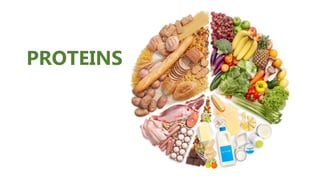
PROTEINS
STRUCTURES OF
PROTEIN
DEFINITION
It is referred as any class of complex organic nitrogenous
substance found in the cell of living being.
They are MACRO-MOLECULES.
First described - Dutch chemist Gerardus Johannes Mulder.
Named -Swedish chemist Jons Jacob Berzelius ( 1838)
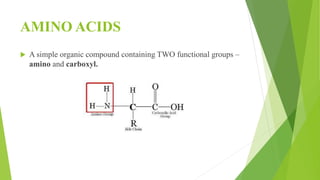
AMINO ACIDS
 A simple organic compound containing TWO functional groups –
amino and carboxyl.
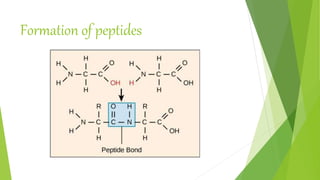
Formation of peptides
STRUCTURE OF PROTEINS
 Primary Structure
 Secondary Structure
 Tertiary Structure
 Quaternary Structure
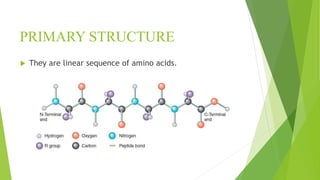
PRIMARY STRUCTURE
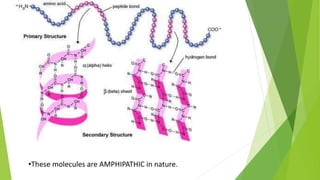
 They are linear sequence of amino acids.
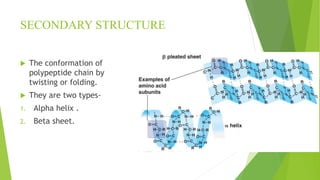
SECONDARY STRUCTURE
 The conformation of
polypeptide chain by
twisting or folding.
 They are two types-
1. Alpha helix .
2. Beta sheet.
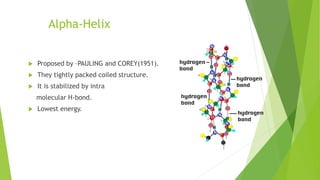
Alpha-Helix
 Proposed by –PAULING and COREY(1951).
 They tightly packed coiled structure.
 It is stabilized by intra
molecular H-bond.
 Lowest energy.
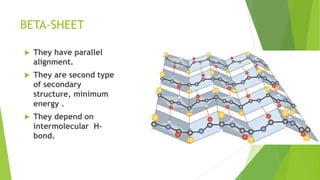
BETA-SHEET
 They have parallel
alignment.
 They are second type
of secondary
structure, minimum
energy .
 They depend on
intermolecular H-
bond.
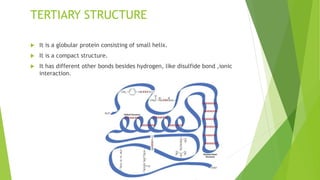
TERTIARY STRUCTURE
 It is a globular protein consisting of small helix.
 It is a compact structure.
 It has different other bonds besides hydrogen, like disulfide bond ,ionic
interaction.
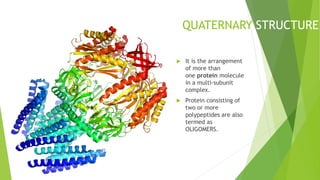
QUATERNARY STRUCTURE
 It is the arrangement
of more than
one protein molecule
in a multi-subunit
complex.
 Protein consisting of
two or more
polypeptides are also
termed as
OLIGOMERS.
FUNCTIONS
 1. They serve as body building units, e.g., muscle proteins.
 2. They provide support and protection to various tissues, e.g., collagen and
keratin.
 3. All chemical reactions in the body are catalysed by enzymes, e.g., trypsin.
 4. They transport various molecules and ions from one organ to the other,
e.g., hemoglobin, serum albumin.
 5. They store and provide nutrients, e.g., milk casein,.
 6. They defend the body from harmful foreign organisms, e.g.,
immunoglobulin’s, fibrinogen.
 7. They help to regulate cellular or physiological activity, e.g., hormones,
viz., insulin, GH.
PROPERTIES
1. Denaturation:
 Partial or complete unfolding of the native (natural) conformation of
the polypeptide chain is known as denaturation. This is caused by
heat, acids, alkalies, alcohol, acetone, urea, beta- mercaptoethanol.
2. Coagulation:
 When proteins are denatured by heat, they form insoluble aggregates
known as coagulum. All the proteins are not heat coagulable, only a
few like the albumins, globulins are heat coagulable.
3.Isoelectric pH (pH1):
 The pH at which a protein has equal number of positive
and negative charges is known as isoelectric pH. When
subjected to an electric field the proteins do not move
either towards anode or cathode, hence this property is
used to isolate proteins
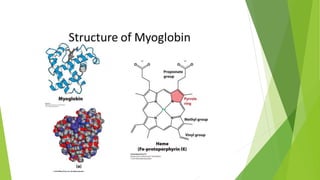
MYOGLOBIN
 Myoglobin is an iron- and oxygen-binding protein found in
the muscle tissue .
 Myoglobin is the primary oxygen-carrying pigment of
muscle tissues.
 Myoglobin is composed of a single polypeptide chain of
153 amino acid residues.
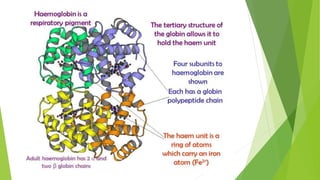
HEMOGLOBIN
Hemoglobin is a protein in your red blood
cells that carries oxygen to your body's organs
and tissues and transports carbon dioxide from
your organs and tissues back to your lungs.
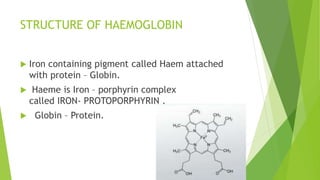
STRUCTURE OF HAEMOGLOBIN
 Iron containing pigment called Haem attached
with protein – Globin.
 Haeme is Iron – porphyrin complex
called IRON- PROTOPORPHYRIN .
 Globin – Protein.
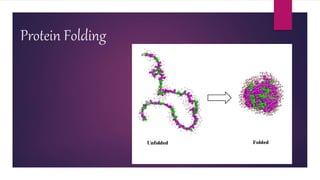
Protein Folding
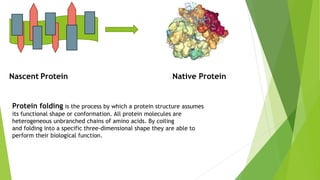
Nascent Protein Native Protein
Protein folding is the process by which a protein structure assumes
its functional shape or conformation. All protein molecules are
heterogeneous unbranched chains of amino acids. By coiling
and folding into a specific three-dimensional shape they are able to
perform their biological function.
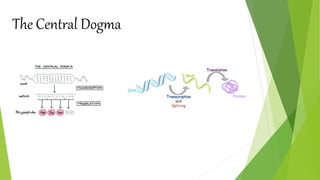
The Central Dogma
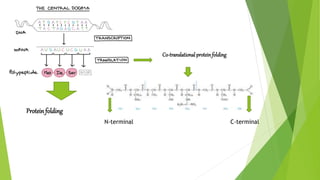
Co-translationalproteinfolding
Protein folding
C-terminalN-terminal
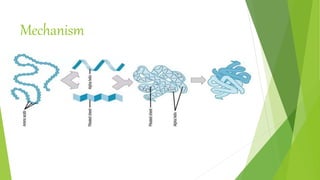
Mechanism
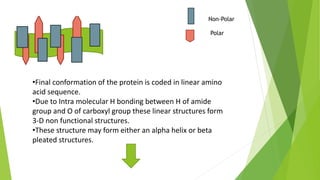
Non-Polar
Polar
•Final conformation of the protein is coded in linear amino
acid sequence.
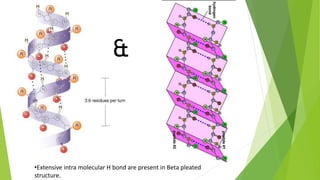
•Due to Intra molecular H bonding between H of amide
group and O of carboxyl group these linear structures form
3-D non functional structures.
•These structure may form either an alpha helix or beta
pleated structures.
•Extensive intra molecular H bond are present in Beta pleated
structure.
&
•These molecules are AMPHIPATHIC in nature.
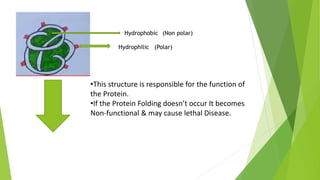
Hydrophobic
Hydrophilic
•This structure is responsible for the function of
the Protein.
•If the Protein Folding doesn’t occur It becomes
Non-functional & may cause lethal Disease.
(Polar)
(Non polar)
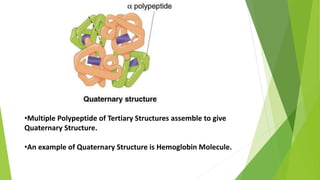
•Multiple Polypeptide of Tertiary Structures assemble to give
Quaternary Structure.
•An example of Quaternary Structure is Hemoglobin Molecule.
Chaperons
 They are group of proteins that provides assistance to the proteins.
 They keep the protein on right path during folding.
 HSP proteins and Chaperonins are class of molecules that assist Protein
Folding.
 Several heat shock proteins function as intra-
cellular chaperones for other proteins.
 They play an important role in establishment of proper
protein conformation (shape) and prevention of unwanted
protein aggregation.
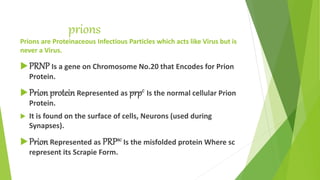
Assistance of enzymes
1. Protein Disulphide Isomerase (pdi)
2. Peptidyl prolyl isomerase (ppi)
 Pdi promotes the formation and stability of Disulphide bonds
between Cysteine residues.
 PPI Interconvert the cis and trans isomers of peptide bonds
with the amino acid Prolin.
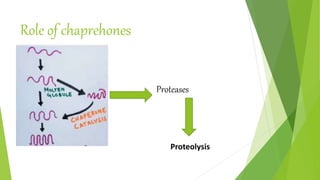
Role of chaprehones
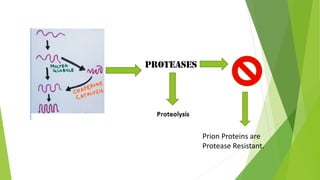
Proteases
Proteolysis
prions
Prions are Proteinaceous Infectious Particles which acts like Virus but is
never a Virus.
PRNP Is a gene on Chromosome No.20 that Encodes for Prion
Protein.
Prion protein Represented as prpc Is the normal cellular Prion
Protein.
 It is found on the surface of cells, Neurons (used during
Synapses).
Prion Represented as PRPsc Is the misfolded protein Where sc
represent its Scrapie Form.
Prion Proteins are
Protease Resistant.
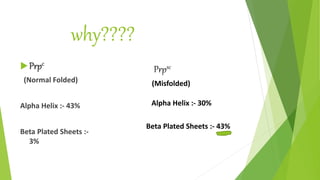
why????
Prpc
(Normal Folded)
Alpha Helix :- 43%
Beta Plated Sheets :-
3%
Prpsc
(Misfolded)
Alpha Helix :- 30%
Beta Plated Sheets :- 43%
Proteopathy
Proteopathy refers to the class of Disease which occurs due to
Misfolding of Proteins,
 Some of it’s diseases are KURU, SCRAPIE DISEASE & ALZIEMERS’S
DISEASE.
 KURU is a neurodegenerative disorder which leads to Tremors,
loss of co-ordination etc.
 SCRAPIE is a fatal, degenerative disease that affects the nervous
system of Sheeps.
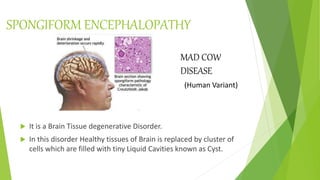
SPONGIFORM ENCEPHALOPATHY
 It is a Brain Tissue degenerative Disorder.
 In this disorder Healthy tissues of Brain is replaced by cluster of
cells which are filled with tiny Liquid Cavities known as Cyst.
MAD COW
DISEASE
(Human Variant)
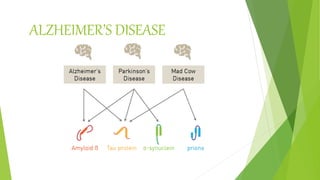
ALZHEIMER’S DISEASE
Tau Proteins are the main cause of Alzheimer's disease.
Amyloid formation are also one of the causes of this disease.
conclusion
Protein Folding is an Important Phenomenon of all the
Biological Process.
Misfolding of Proteins cause lethal diseases.
Almost all the disease caused by Protein misfolding are
incurable.
Protein misfolding is a common and intrinsic propensity
of proteins that occurscontinuously
Misfolding Is influenced by the amino acid composition, and
certain mutations are known to accelerate the process.
Certain Researches are going on misfoldings and disease caused
by it.
But There is no sufficient cure available for these disease.
THANK YOU.

Protein folding

  • 2.
    SOFTVISION COLLEGE,INDORE Department ofBio-Sciences 2018-19 Presentator- Lubaina Kaba Sarvesh Seth Msc.
  • 3.
  • 4.
  • 5.
    DEFINITION It is referredas any class of complex organic nitrogenous substance found in the cell of living being. They are MACRO-MOLECULES. First described - Dutch chemist Gerardus Johannes Mulder. Named -Swedish chemist Jons Jacob Berzelius ( 1838)
  • 6.
    AMINO ACIDS  Asimple organic compound containing TWO functional groups – amino and carboxyl.
  • 7.
  • 8.
    STRUCTURE OF PROTEINS Primary Structure  Secondary Structure  Tertiary Structure  Quaternary Structure
  • 9.
    PRIMARY STRUCTURE  Theyare linear sequence of amino acids.
  • 10.
    SECONDARY STRUCTURE  Theconformation of polypeptide chain by twisting or folding.  They are two types- 1. Alpha helix . 2. Beta sheet.
  • 11.
    Alpha-Helix  Proposed by–PAULING and COREY(1951).  They tightly packed coiled structure.  It is stabilized by intra molecular H-bond.  Lowest energy.
  • 12.
    BETA-SHEET  They haveparallel alignment.  They are second type of secondary structure, minimum energy .  They depend on intermolecular H- bond.
  • 13.
    TERTIARY STRUCTURE  Itis a globular protein consisting of small helix.  It is a compact structure.  It has different other bonds besides hydrogen, like disulfide bond ,ionic interaction.
  • 14.
    QUATERNARY STRUCTURE  Itis the arrangement of more than one protein molecule in a multi-subunit complex.  Protein consisting of two or more polypeptides are also termed as OLIGOMERS.
  • 15.
    FUNCTIONS  1. Theyserve as body building units, e.g., muscle proteins.  2. They provide support and protection to various tissues, e.g., collagen and keratin.  3. All chemical reactions in the body are catalysed by enzymes, e.g., trypsin.  4. They transport various molecules and ions from one organ to the other, e.g., hemoglobin, serum albumin.  5. They store and provide nutrients, e.g., milk casein,.  6. They defend the body from harmful foreign organisms, e.g., immunoglobulin’s, fibrinogen.  7. They help to regulate cellular or physiological activity, e.g., hormones, viz., insulin, GH.
  • 16.
    PROPERTIES 1. Denaturation:  Partialor complete unfolding of the native (natural) conformation of the polypeptide chain is known as denaturation. This is caused by heat, acids, alkalies, alcohol, acetone, urea, beta- mercaptoethanol. 2. Coagulation:  When proteins are denatured by heat, they form insoluble aggregates known as coagulum. All the proteins are not heat coagulable, only a few like the albumins, globulins are heat coagulable.
  • 17.
    3.Isoelectric pH (pH1): The pH at which a protein has equal number of positive and negative charges is known as isoelectric pH. When subjected to an electric field the proteins do not move either towards anode or cathode, hence this property is used to isolate proteins
  • 18.
    MYOGLOBIN  Myoglobin isan iron- and oxygen-binding protein found in the muscle tissue .  Myoglobin is the primary oxygen-carrying pigment of muscle tissues.  Myoglobin is composed of a single polypeptide chain of 153 amino acid residues.
  • 20.
    HEMOGLOBIN Hemoglobin is aprotein in your red blood cells that carries oxygen to your body's organs and tissues and transports carbon dioxide from your organs and tissues back to your lungs.
  • 21.
    STRUCTURE OF HAEMOGLOBIN Iron containing pigment called Haem attached with protein – Globin.  Haeme is Iron – porphyrin complex called IRON- PROTOPORPHYRIN .  Globin – Protein.
  • 23.
  • 24.
    Nascent Protein NativeProtein Protein folding is the process by which a protein structure assumes its functional shape or conformation. All protein molecules are heterogeneous unbranched chains of amino acids. By coiling and folding into a specific three-dimensional shape they are able to perform their biological function.
  • 25.
  • 26.
  • 27.
  • 28.
    Non-Polar Polar •Final conformation ofthe protein is coded in linear amino acid sequence. •Due to Intra molecular H bonding between H of amide group and O of carboxyl group these linear structures form 3-D non functional structures. •These structure may form either an alpha helix or beta pleated structures.
  • 29.
    •Extensive intra molecularH bond are present in Beta pleated structure. &
  • 30.
    •These molecules areAMPHIPATHIC in nature.
  • 31.
    Hydrophobic Hydrophilic •This structure isresponsible for the function of the Protein. •If the Protein Folding doesn’t occur It becomes Non-functional & may cause lethal Disease. (Polar) (Non polar)
  • 32.
    •Multiple Polypeptide ofTertiary Structures assemble to give Quaternary Structure. •An example of Quaternary Structure is Hemoglobin Molecule.
  • 33.
    Chaperons  They aregroup of proteins that provides assistance to the proteins.  They keep the protein on right path during folding.  HSP proteins and Chaperonins are class of molecules that assist Protein Folding.  Several heat shock proteins function as intra- cellular chaperones for other proteins.  They play an important role in establishment of proper protein conformation (shape) and prevention of unwanted protein aggregation.
  • 34.
    Assistance of enzymes 1.Protein Disulphide Isomerase (pdi) 2. Peptidyl prolyl isomerase (ppi)  Pdi promotes the formation and stability of Disulphide bonds between Cysteine residues.  PPI Interconvert the cis and trans isomers of peptide bonds with the amino acid Prolin.
  • 35.
  • 36.
    prions Prions are ProteinaceousInfectious Particles which acts like Virus but is never a Virus. PRNP Is a gene on Chromosome No.20 that Encodes for Prion Protein. Prion protein Represented as prpc Is the normal cellular Prion Protein.  It is found on the surface of cells, Neurons (used during Synapses). Prion Represented as PRPsc Is the misfolded protein Where sc represent its Scrapie Form.
  • 37.
  • 38.
    why???? Prpc (Normal Folded) Alpha Helix:- 43% Beta Plated Sheets :- 3% Prpsc (Misfolded) Alpha Helix :- 30% Beta Plated Sheets :- 43%
  • 39.
    Proteopathy Proteopathy refers tothe class of Disease which occurs due to Misfolding of Proteins,  Some of it’s diseases are KURU, SCRAPIE DISEASE & ALZIEMERS’S DISEASE.  KURU is a neurodegenerative disorder which leads to Tremors, loss of co-ordination etc.  SCRAPIE is a fatal, degenerative disease that affects the nervous system of Sheeps.
  • 40.
    SPONGIFORM ENCEPHALOPATHY  Itis a Brain Tissue degenerative Disorder.  In this disorder Healthy tissues of Brain is replaced by cluster of cells which are filled with tiny Liquid Cavities known as Cyst. MAD COW DISEASE (Human Variant)
  • 41.
  • 42.
    Tau Proteins arethe main cause of Alzheimer's disease. Amyloid formation are also one of the causes of this disease.
  • 43.
    conclusion Protein Folding isan Important Phenomenon of all the Biological Process. Misfolding of Proteins cause lethal diseases. Almost all the disease caused by Protein misfolding are incurable. Protein misfolding is a common and intrinsic propensity of proteins that occurscontinuously
  • 44.
    Misfolding Is influencedby the amino acid composition, and certain mutations are known to accelerate the process. Certain Researches are going on misfoldings and disease caused by it. But There is no sufficient cure available for these disease.
  • 45.