Fundamentals of Protein Structure
The Three Dimensional
Structure of Proteins
Levels of Protein Structure
Primary structure = order of amino
acids in the protein chain
Chemistry of peptide bond formation
- a-carboxyl of one amino acid is joined to a-amino of a second
amino acid (with removal of water)
- only a-carboxyl and a-amino groups are used, not R-group
carboxyl or amino groups
Properties of Peptide Bond
• Bond Length: 1.32A (Double bond:1.21A, Single bond: 1.47A) due
to resonance or partial sharing of electrons.
* Resonance: sate of adjustment that produces resonance in a system
•Planar: On one side of the Plane.
•Rigid: not able to move or orient itself (due to planner
Hence, it posses 40% double bond characters
Conformation of Polypeptide Chain is defined by:
2 Torsion Angle/Dihedral angles: Angles between two planes
1.Φ (phi): rotation around alpha carbon and nitrogen
2.Ψ (psi): rotation around alpha carbon and carbon
•Ψ and φ angles will cause the hydrogen and oxygen and other
residue to collide
•Main chain rotations are restricted to f and y.
•This restricts the number of conformations in proteins
• Many angles of rotation are possible only a few are energetically
favorable
• By convention Ψ and φ are 180° (or –180°) when the first and
fourth atoms are farthest apart and the peptide is fully extended.
• In a protein, some of the conformations shown here (e.g., 0°)
are prohibited by steric overlap of atoms.
• Every amino acid has its own set of angles
defining direction of possible rotation
within the molecule.
Ramachandran plots
•Ramachandran plot shows the distribution of f and y dihedral angles that
are found in a protein
•Some Ψ and φ combinations are very unfavorable because of steric crowding of
backbone atoms with other atoms in the backbone or side-chains.
•Some Ψ and φ combinations are more favorable because of chance to form
favorable H-bonding interactions along the backbone (Blue-shaded areas).
•shows the common secondary structure elements reveals regions with unusual
backbone structure
Secondary Structure: = local folding of residues into regular patterns
•The chains of amino acids fold or turn upon themselves
•Held together by hydrogen bonds between (non-adjacent) amine
(N-H) and carboxylic (C-O) groups
•H-bonds provide a level of structural stability Secondary structure
•For example Fibrous proteins
3 Major Types
•α-Helix
•β-Conformation or Sheets
•β-Turns
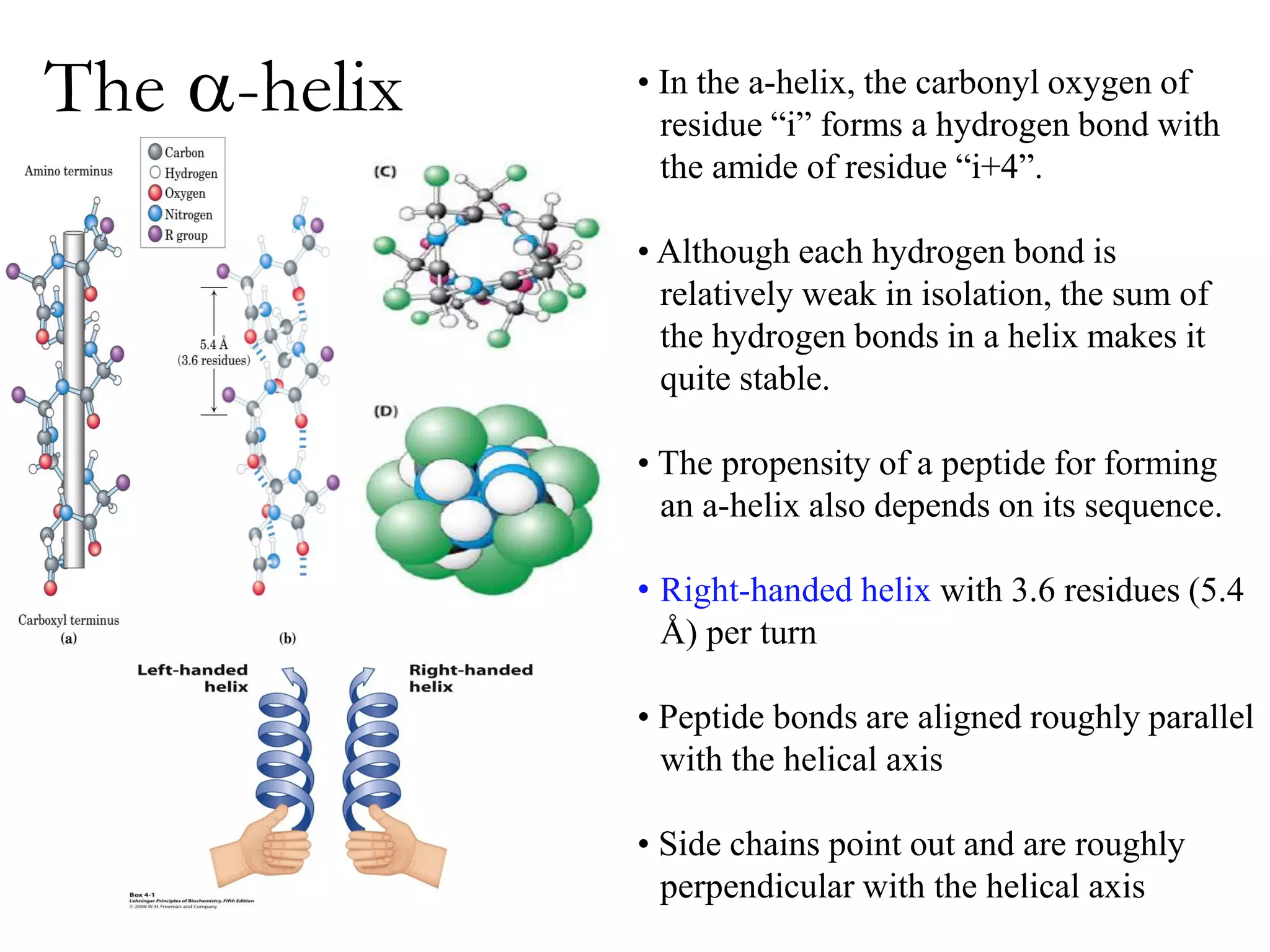
The a-helix • In the a-helix, the carbonyl oxygen of
residue “i” forms a hydrogen bond with
the amide of residue “i+4”.
• Although each hydrogen bond is
relatively weak in isolation, the sum of
the hydrogen bonds in a helix makes it
quite stable.
• The propensity of a peptide for forming
an a-helix also depends on its sequence.
• Right-handed helix with 3.6 residues (5.4
Å) per turn
• Peptide bonds are aligned roughly parallel
with the helical axis
• Side chains point out and are roughly
perpendicular with the helical axis
• Not all polypeptide sequences adopt a helical structures
• Small hydrophobic residues such as Ala and Leu are strong helix formers
• Pro acts as a helix breaker because the rotation around the N-Ca bond is
impossible
• Gly acts as a helix breaker because the tiny R group supports other conformations
The b-sheet
• The backbone is more extended, the planarity of the peptide
bond and tetrahedral geometry of the a-carbon create a pleated
sheetlike structure
• Sheet-like arrangement of backbone is held together by
hydrogen bonds between the more distal backbone amides and
carbonyl oxygen.
• Side chains protrude from the sheet alternating in up and down
direction
Parallel or antiparallel orientation
of two chains within a sheet are
possible
• In parallel b sheets the H-bonded
strands run in the same direction
• In antiparallel b sheets the H-
bonded strands run in opposite
directions
Beta strand is an extended
structure 3.5A between R groups
in sheet
compared to 1.5 in alpha helix
• The propensity of a peptide for
forming b-sheet also depends on
its sequence.
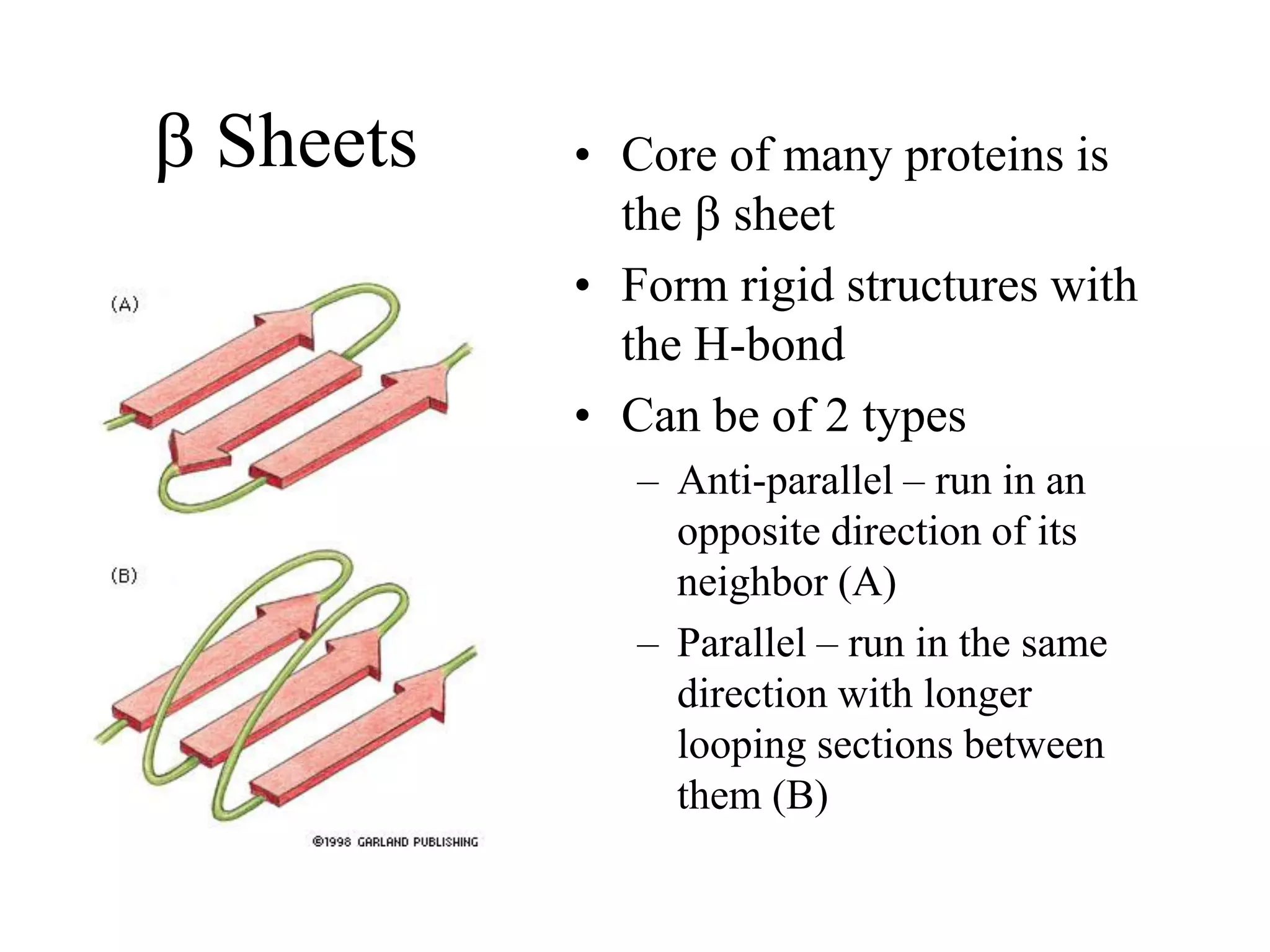
b Sheets • Core of many proteins is
the b sheet
• Form rigid structures with
the H-bond
• Can be of 2 types
– Anti-parallel – run in an
opposite direction of its
neighbor (A)
– Parallel – run in the same
direction with longer
looping sections between
them (B)
b turns
• b -turns occur frequently whenever strands in b sheets change the
direction
• The 180° turn is accomplished over four amino acids
• The turn is stabilized by a hydrogen bond from a carbonyl oxygen to
amide proton three residues down the sequence
• Proline in position 2 or glycine in position 3 are common in b-turns
b-turns allow the protein backbone to make abrupt turns.
• Again, the propensity of a peptide for forming b-turns depends on its
sequence.
Protein Structure
Tertiary structure = global folding of a protein chain
• The polypeptide folds and coils to form a complex 3D shape
• Caused by interactions between R groups (H-bonds, disulphide bridges, ionic
bonds and hydrophilic / hydrophobic interactions)
• Tertiary structure may be important for the function (e.g. specificity of active
site in enzymes)
1. Fibrous proteins: typically insoluble; made from a single secondary structure
2. Globular proteins: water-soluble globular proteins, multiple secondary
structure are involved
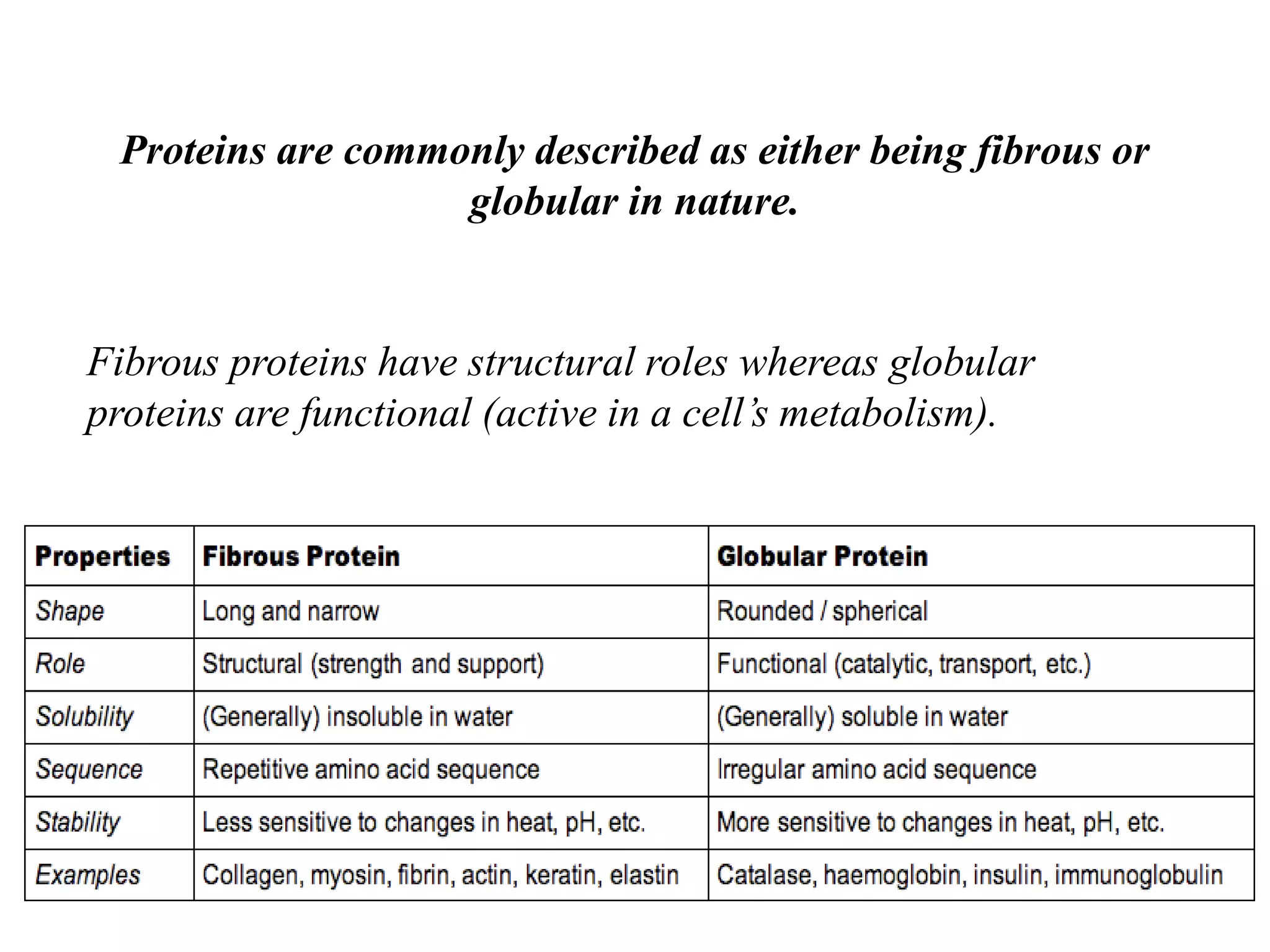
Proteins are commonly described as either being fibrous or
globular in nature.
Fibrous proteins have structural roles whereas globular
proteins are functional (active in a cell’s metabolism).
Protein Folding
• The peptide bond allows for rotation around it
and therefore the protein can fold and orient the R
groups in favorable positions
• Weak non-covalent interactions will hold the
protein in its functional shape – these are weak
and will take many to hold the shape
• Cross linkages can be between 2 parts of a
protein or between 2 subunits
• Disulfide bonds (S-S) form between adjacent -SH
groups on the amino acid cysteine
Quaternary structure = Higher-order assembly of proteins
• Quaternary structure is formed by spontaneous assembly of individual
polypeptides into a larger functional cluster
• Oligomeric Subunits (protomers) are arranged in Symmetric Patterns
* protomer is the structural unit of an oligomeric protein.
• The interaction between multiple polypeptides or prosthetic groups
• A prosthetic group is an inorganic compound involved in a protein (e.g.
the heme group in haemoglobin)
Examples of other quaternary structures
Tetramer Hexamer Filament
SSB DNA helicase Recombinase
Allows coordinated Allows coordinated DNA binding Allows complete
DNA binding and ATP hydrolysis coverage of an
extended molecule
• Myoglobin is an iron- and oxygen-
binding protein found in the muscle
tissue .
• It is distantly related to hemoglobin
which is the iron- and oxygen-binding
protein in blood, specifically in the red
blood cells
• Å single subunit 153 amino acid residues
• 121 residues are in an a helix. Helices
are named A, B, C, …F. The heme
pocket is surrounded by E and F but not
B, C, G, also H is near the heme.
• Non-polar R-groups tend to be buried in
Blue = non-polar R-group
Red = Heme
Myoglobin
Myoglobin facilitates rapidly respiring
muscle tissue
The rate of O2 diffusion from capillaries to tissue is
slow because of the solubility of oxygen.
Myoglobin increases the solubility of oxygen.
Myoglobin facilitates oxygen diffusion.
Oxygen storage is also a function because
Myoglobin concentrations are 10-fold greater in
whales and seals than in land mammals
Hemoglobin
– Different Subunit Proteins (heteromeric)
– 2 a globin subunits
– 2 b globin subunits
Composed of four subunits, each containing a heme group: a ring-like
structure with a central iron atom that binds oxygen
Extensive interactions between
unlike subunits a2-b2 or a1-b1
interface has 35 residues while a1-b2
and a2-b1 have 19 residue contact.
Oxygenation causes a considerable
structural conformational change
Hemoglobin function
a2,b2 dimer which are structurally similar to myoglobin
•Transports oxygen from lungs to tissues.
•O2 diffusion alone is too poor for transport in larger animals.
•Solubility of O2 is low in plasma i.e. 10-4 M.
•But bound to hemoglobin, [O2] = 0.01 M or that of air
•Two alternative O2 transporters are;
•Hemocyanin, a Cu containing protein.
•Hemoerythrin , a non-heme containing protein.
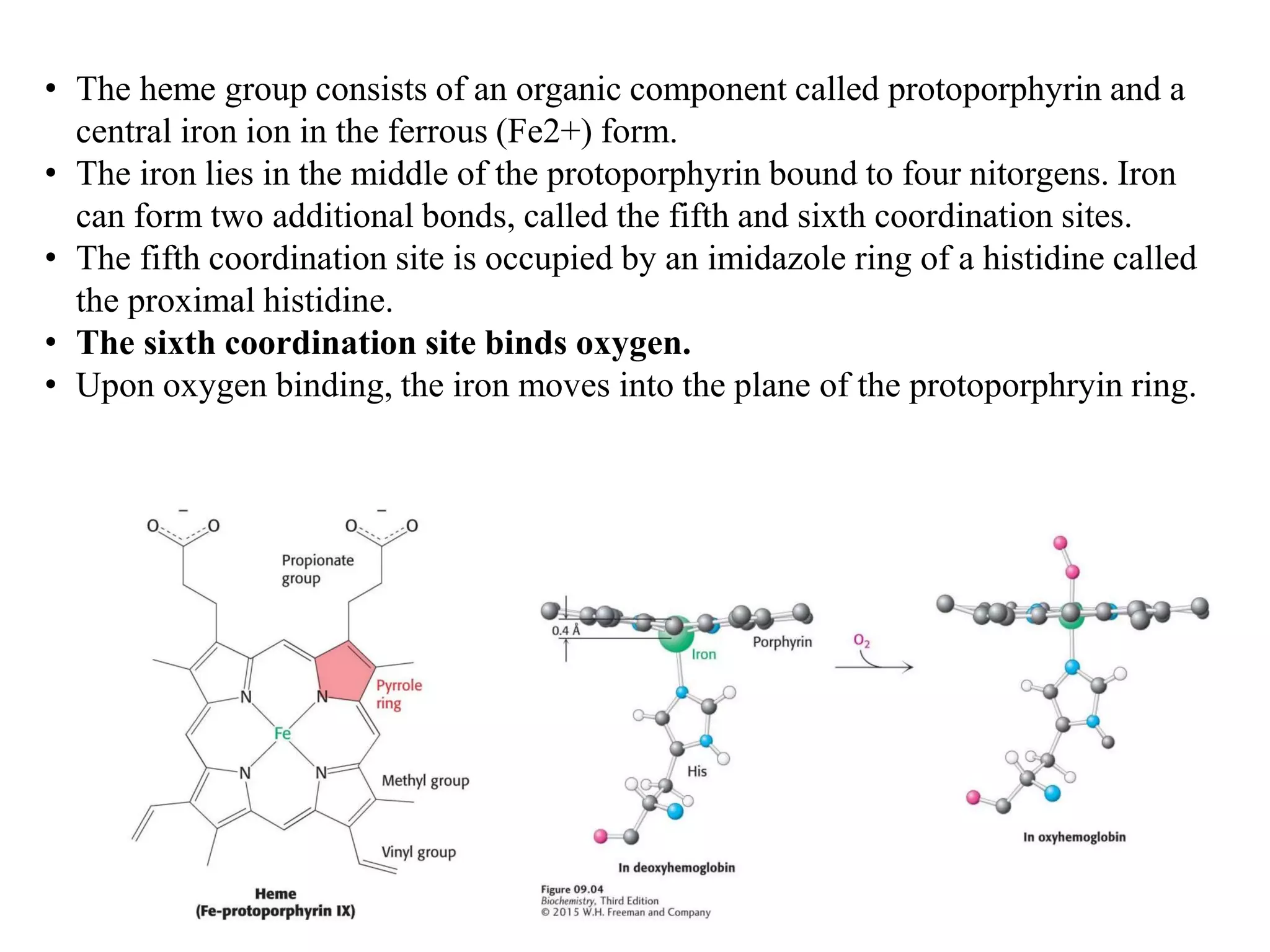
• The heme group consists of an organic component called protoporphyrin and a
central iron ion in the ferrous (Fe2+) form.
• The iron lies in the middle of the protoporphyrin bound to four nitorgens. Iron
can form two additional bonds, called the fifth and sixth coordination sites.
• The fifth coordination site is occupied by an imidazole ring of a histidine called
the proximal histidine.
• The sixth coordination site binds oxygen.
• Upon oxygen binding, the iron moves into the plane of the protoporphryin ring.
• X-ray analysis has revealed two major conformations of hemoglobin: the R state and
the T state denoted "tense" and "relaxed," respectively.
• When oxygen is absent experimentally, the T state is more stable and is thus the
predominant conformation of deoxyhemoglobin
• The binding of O2 to a hemoglobin subunit in the T state triggers a change in
conformation to the R state. When the entire protein undergoes this transition, the
structures of the individual subunits change little, the subunit slide to each other and
rotate, narrowing the pocket between the subunits.
• Oxygen binds to hemoglobin in either state, it has a significantly higher affinity for
hemoglobin in the R state. Oxygen binding stabilizes the R state.
Hemoglobin function
Cooperative Binding of Oxygen to Haemoglobin
•Oxygen binding to hemoglobin changes the structure of hemoglobin (T to R
state) and that make it easier for oxygen to bind.
•Additional oxygen binding further increase the affinity, resulting in the third and
then fourth oxygen molecule binding.
•As a result of cooperative binding, almost all of the hemoglobin is saturated with
oxygen.
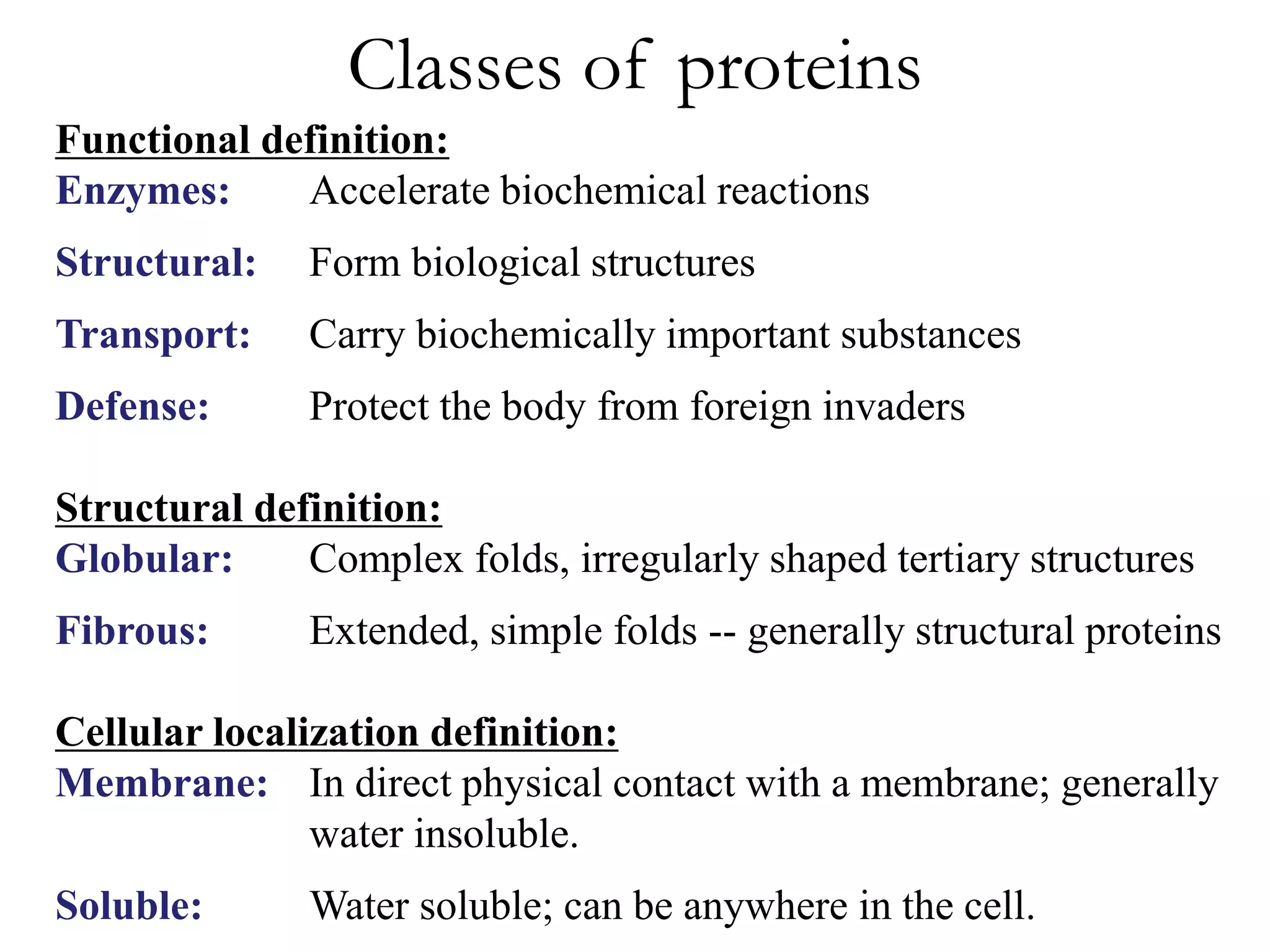
Classes of proteins
Functional definition:
Enzymes: Accelerate biochemical reactions
Structural: Form biological structures
Transport: Carry biochemically important substances
Defense: Protect the body from foreign invaders
Structural definition:
Globular: Complex folds, irregularly shaped tertiary structures
Fibrous: Extended, simple folds -- generally structural proteins
Cellular localization definition:
Membrane: In direct physical contact with a membrane; generally
water insoluble.
Soluble: Water soluble; can be anywhere in the cell.
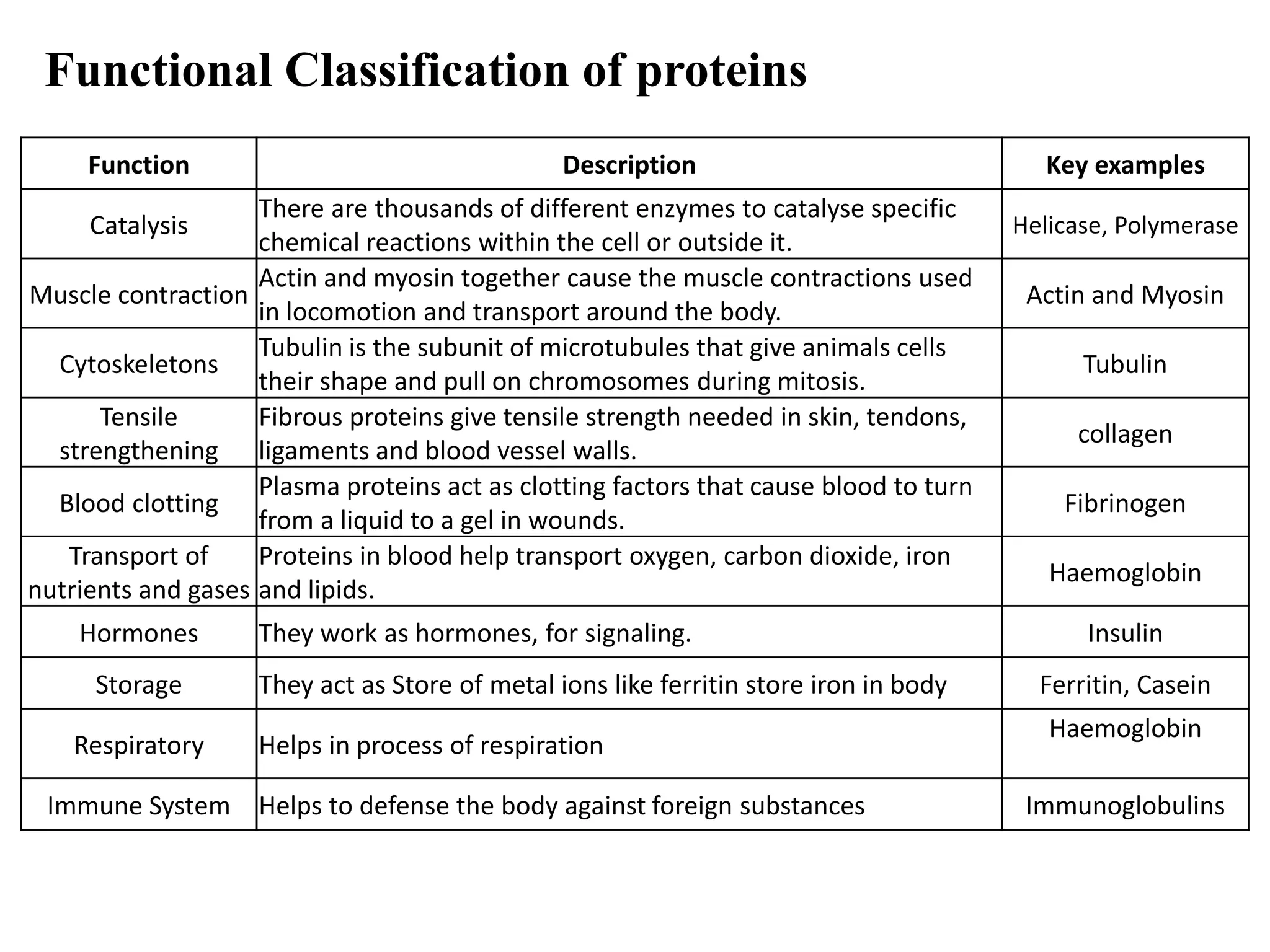
Function Description Key examples
Catalysis
There are thousands of different enzymes to catalyse specific
chemical reactions within the cell or outside it.
Helicase, Polymerase
Muscle contraction
Actin and myosin together cause the muscle contractions used
in locomotion and transport around the body.
Actin and Myosin
Cytoskeletons
Tubulin is the subunit of microtubules that give animals cells
their shape and pull on chromosomes during mitosis.
Tubulin
Tensile
strengthening
Fibrous proteins give tensile strength needed in skin, tendons,
ligaments and blood vessel walls.
collagen
Blood clotting
Plasma proteins act as clotting factors that cause blood to turn
from a liquid to a gel in wounds.
Fibrinogen
Transport of
nutrients and gases
Proteins in blood help transport oxygen, carbon dioxide, iron
and lipids.
Haemoglobin
Hormones They work as hormones, for signaling. Insulin
Storage They act as Store of metal ions like ferritin store iron in body Ferritin, Casein
Respiratory Helps in process of respiration
Haemoglobin
Immune System Helps to defense the body against foreign substances Immunoglobulins
Functional Classification of proteins

protein

  • 1.
    Fundamentals of ProteinStructure The Three Dimensional Structure of Proteins Levels of Protein Structure
  • 2.
    Primary structure =order of amino acids in the protein chain
  • 3.
    Chemistry of peptidebond formation - a-carboxyl of one amino acid is joined to a-amino of a second amino acid (with removal of water) - only a-carboxyl and a-amino groups are used, not R-group carboxyl or amino groups
  • 4.
    Properties of PeptideBond • Bond Length: 1.32A (Double bond:1.21A, Single bond: 1.47A) due to resonance or partial sharing of electrons. * Resonance: sate of adjustment that produces resonance in a system •Planar: On one side of the Plane. •Rigid: not able to move or orient itself (due to planner Hence, it posses 40% double bond characters
  • 5.
    Conformation of PolypeptideChain is defined by: 2 Torsion Angle/Dihedral angles: Angles between two planes 1.Φ (phi): rotation around alpha carbon and nitrogen 2.Ψ (psi): rotation around alpha carbon and carbon •Ψ and φ angles will cause the hydrogen and oxygen and other residue to collide •Main chain rotations are restricted to f and y. •This restricts the number of conformations in proteins
  • 6.
    • Many anglesof rotation are possible only a few are energetically favorable • By convention Ψ and φ are 180° (or –180°) when the first and fourth atoms are farthest apart and the peptide is fully extended. • In a protein, some of the conformations shown here (e.g., 0°) are prohibited by steric overlap of atoms.
  • 7.
    • Every aminoacid has its own set of angles defining direction of possible rotation within the molecule. Ramachandran plots •Ramachandran plot shows the distribution of f and y dihedral angles that are found in a protein •Some Ψ and φ combinations are very unfavorable because of steric crowding of backbone atoms with other atoms in the backbone or side-chains. •Some Ψ and φ combinations are more favorable because of chance to form favorable H-bonding interactions along the backbone (Blue-shaded areas). •shows the common secondary structure elements reveals regions with unusual backbone structure
  • 8.
    Secondary Structure: =local folding of residues into regular patterns •The chains of amino acids fold or turn upon themselves •Held together by hydrogen bonds between (non-adjacent) amine (N-H) and carboxylic (C-O) groups •H-bonds provide a level of structural stability Secondary structure •For example Fibrous proteins 3 Major Types •α-Helix •β-Conformation or Sheets •β-Turns
  • 9.
    The a-helix •In the a-helix, the carbonyl oxygen of residue “i” forms a hydrogen bond with the amide of residue “i+4”. • Although each hydrogen bond is relatively weak in isolation, the sum of the hydrogen bonds in a helix makes it quite stable. • The propensity of a peptide for forming an a-helix also depends on its sequence. • Right-handed helix with 3.6 residues (5.4 Å) per turn • Peptide bonds are aligned roughly parallel with the helical axis • Side chains point out and are roughly perpendicular with the helical axis
  • 10.
    • Not allpolypeptide sequences adopt a helical structures • Small hydrophobic residues such as Ala and Leu are strong helix formers • Pro acts as a helix breaker because the rotation around the N-Ca bond is impossible • Gly acts as a helix breaker because the tiny R group supports other conformations
  • 11.
    The b-sheet • Thebackbone is more extended, the planarity of the peptide bond and tetrahedral geometry of the a-carbon create a pleated sheetlike structure • Sheet-like arrangement of backbone is held together by hydrogen bonds between the more distal backbone amides and carbonyl oxygen. • Side chains protrude from the sheet alternating in up and down direction
  • 12.
    Parallel or antiparallelorientation of two chains within a sheet are possible • In parallel b sheets the H-bonded strands run in the same direction • In antiparallel b sheets the H- bonded strands run in opposite directions Beta strand is an extended structure 3.5A between R groups in sheet compared to 1.5 in alpha helix • The propensity of a peptide for forming b-sheet also depends on its sequence.
  • 13.
    b Sheets •Core of many proteins is the b sheet • Form rigid structures with the H-bond • Can be of 2 types – Anti-parallel – run in an opposite direction of its neighbor (A) – Parallel – run in the same direction with longer looping sections between them (B)
  • 14.
    b turns • b-turns occur frequently whenever strands in b sheets change the direction • The 180° turn is accomplished over four amino acids • The turn is stabilized by a hydrogen bond from a carbonyl oxygen to amide proton three residues down the sequence • Proline in position 2 or glycine in position 3 are common in b-turns b-turns allow the protein backbone to make abrupt turns. • Again, the propensity of a peptide for forming b-turns depends on its sequence.
  • 15.
  • 16.
    Tertiary structure =global folding of a protein chain • The polypeptide folds and coils to form a complex 3D shape • Caused by interactions between R groups (H-bonds, disulphide bridges, ionic bonds and hydrophilic / hydrophobic interactions) • Tertiary structure may be important for the function (e.g. specificity of active site in enzymes) 1. Fibrous proteins: typically insoluble; made from a single secondary structure 2. Globular proteins: water-soluble globular proteins, multiple secondary structure are involved
  • 17.
    Proteins are commonlydescribed as either being fibrous or globular in nature. Fibrous proteins have structural roles whereas globular proteins are functional (active in a cell’s metabolism).
  • 19.
    Protein Folding • Thepeptide bond allows for rotation around it and therefore the protein can fold and orient the R groups in favorable positions • Weak non-covalent interactions will hold the protein in its functional shape – these are weak and will take many to hold the shape • Cross linkages can be between 2 parts of a protein or between 2 subunits • Disulfide bonds (S-S) form between adjacent -SH groups on the amino acid cysteine
  • 20.
    Quaternary structure =Higher-order assembly of proteins • Quaternary structure is formed by spontaneous assembly of individual polypeptides into a larger functional cluster • Oligomeric Subunits (protomers) are arranged in Symmetric Patterns * protomer is the structural unit of an oligomeric protein. • The interaction between multiple polypeptides or prosthetic groups • A prosthetic group is an inorganic compound involved in a protein (e.g. the heme group in haemoglobin)
  • 21.
    Examples of otherquaternary structures Tetramer Hexamer Filament SSB DNA helicase Recombinase Allows coordinated Allows coordinated DNA binding Allows complete DNA binding and ATP hydrolysis coverage of an extended molecule
  • 22.
    • Myoglobin isan iron- and oxygen- binding protein found in the muscle tissue . • It is distantly related to hemoglobin which is the iron- and oxygen-binding protein in blood, specifically in the red blood cells • Å single subunit 153 amino acid residues • 121 residues are in an a helix. Helices are named A, B, C, …F. The heme pocket is surrounded by E and F but not B, C, G, also H is near the heme. • Non-polar R-groups tend to be buried in Blue = non-polar R-group Red = Heme Myoglobin
  • 23.
    Myoglobin facilitates rapidlyrespiring muscle tissue The rate of O2 diffusion from capillaries to tissue is slow because of the solubility of oxygen. Myoglobin increases the solubility of oxygen. Myoglobin facilitates oxygen diffusion. Oxygen storage is also a function because Myoglobin concentrations are 10-fold greater in whales and seals than in land mammals
  • 24.
    Hemoglobin – Different SubunitProteins (heteromeric) – 2 a globin subunits – 2 b globin subunits Composed of four subunits, each containing a heme group: a ring-like structure with a central iron atom that binds oxygen Extensive interactions between unlike subunits a2-b2 or a1-b1 interface has 35 residues while a1-b2 and a2-b1 have 19 residue contact. Oxygenation causes a considerable structural conformational change
  • 25.
    Hemoglobin function a2,b2 dimerwhich are structurally similar to myoglobin •Transports oxygen from lungs to tissues. •O2 diffusion alone is too poor for transport in larger animals. •Solubility of O2 is low in plasma i.e. 10-4 M. •But bound to hemoglobin, [O2] = 0.01 M or that of air •Two alternative O2 transporters are; •Hemocyanin, a Cu containing protein. •Hemoerythrin , a non-heme containing protein.
  • 26.
    • The hemegroup consists of an organic component called protoporphyrin and a central iron ion in the ferrous (Fe2+) form. • The iron lies in the middle of the protoporphyrin bound to four nitorgens. Iron can form two additional bonds, called the fifth and sixth coordination sites. • The fifth coordination site is occupied by an imidazole ring of a histidine called the proximal histidine. • The sixth coordination site binds oxygen. • Upon oxygen binding, the iron moves into the plane of the protoporphryin ring.
  • 27.
    • X-ray analysishas revealed two major conformations of hemoglobin: the R state and the T state denoted "tense" and "relaxed," respectively. • When oxygen is absent experimentally, the T state is more stable and is thus the predominant conformation of deoxyhemoglobin • The binding of O2 to a hemoglobin subunit in the T state triggers a change in conformation to the R state. When the entire protein undergoes this transition, the structures of the individual subunits change little, the subunit slide to each other and rotate, narrowing the pocket between the subunits. • Oxygen binds to hemoglobin in either state, it has a significantly higher affinity for hemoglobin in the R state. Oxygen binding stabilizes the R state. Hemoglobin function
  • 28.
    Cooperative Binding ofOxygen to Haemoglobin •Oxygen binding to hemoglobin changes the structure of hemoglobin (T to R state) and that make it easier for oxygen to bind. •Additional oxygen binding further increase the affinity, resulting in the third and then fourth oxygen molecule binding. •As a result of cooperative binding, almost all of the hemoglobin is saturated with oxygen.
  • 29.
    Classes of proteins Functionaldefinition: Enzymes: Accelerate biochemical reactions Structural: Form biological structures Transport: Carry biochemically important substances Defense: Protect the body from foreign invaders Structural definition: Globular: Complex folds, irregularly shaped tertiary structures Fibrous: Extended, simple folds -- generally structural proteins Cellular localization definition: Membrane: In direct physical contact with a membrane; generally water insoluble. Soluble: Water soluble; can be anywhere in the cell.
  • 30.
    Function Description Keyexamples Catalysis There are thousands of different enzymes to catalyse specific chemical reactions within the cell or outside it. Helicase, Polymerase Muscle contraction Actin and myosin together cause the muscle contractions used in locomotion and transport around the body. Actin and Myosin Cytoskeletons Tubulin is the subunit of microtubules that give animals cells their shape and pull on chromosomes during mitosis. Tubulin Tensile strengthening Fibrous proteins give tensile strength needed in skin, tendons, ligaments and blood vessel walls. collagen Blood clotting Plasma proteins act as clotting factors that cause blood to turn from a liquid to a gel in wounds. Fibrinogen Transport of nutrients and gases Proteins in blood help transport oxygen, carbon dioxide, iron and lipids. Haemoglobin Hormones They work as hormones, for signaling. Insulin Storage They act as Store of metal ions like ferritin store iron in body Ferritin, Casein Respiratory Helps in process of respiration Haemoglobin Immune System Helps to defense the body against foreign substances Immunoglobulins Functional Classification of proteins