Soldering
Prayers
Our father
Our Father, Who art in Heaven, hallowed be Thy
name; Thy Kingdom come, Thy will be done on
earth as it is in Heaven. Give us this day our daily
bread; and forgive us our trespasses as we forgive
those who trespass against us; and lead us not into
temptation, but deliver us from evil. Amen.
Team Work
Explanation about soldering
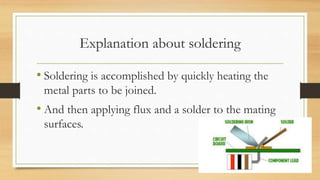
• Soldering is accomplished by quickly heating the
metal parts to be joined.
• And then applying flux and a solder to the mating
surfaces.
Explanation about soldering
• The finished solder joint metallurgically bonds the
parts forming an excellent electrical connection
between wires and a strong mechanical joint
between the metal parts.
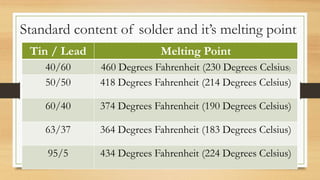
Standard content of solder and it’s melting point
Tin / Lead Melting Point
40/60 460 Degrees Fahrenheit (230 Degrees Celsius)
50/50 418 Degrees Fahrenheit (214 Degrees Celsius)
60/40 374 Degrees Fahrenheit (190 Degrees Celsius)
63/37 364 Degrees Fahrenheit (183 Degrees Celsius)
95/5 434 Degrees Fahrenheit (224 Degrees Celsius)
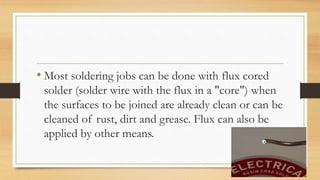
• Most soldering jobs can be done with flux cored
solder (solder wire with the flux in a "core") when
the surfaces to be joined are already clean or can be
cleaned of rust, dirt and grease. Flux can also be
applied by other means.
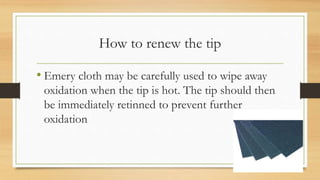
How to renew the tip
• Emery cloth may be carefully used to wipe away
oxidation when the tip is hot. The tip should then
be immediately retinned to prevent further
oxidation
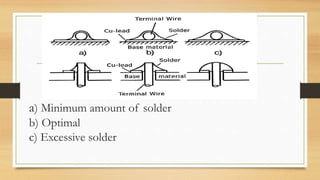
a) Minimum amount of solder
b) Optimal
c) Excessive solder
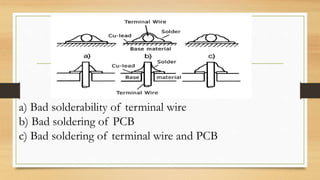
a) Bad solderability of terminal wire
b) Bad soldering of PCB
c) Bad soldering of terminal wire and PCB
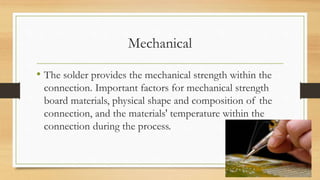
Mechanical
• The solder provides the mechanical strength within the
connection. Important factors for mechanical strength
board materials, physical shape and composition of the
connection, and the materials' temperature within the
connection during the process.
• The connection temperature should not be too
high, causing embrittlement, or too low.
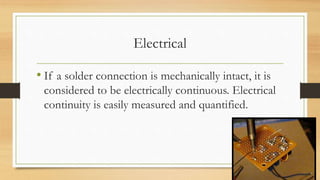
Electrical
• If a solder connection is mechanically intact, it is
considered to be electrically continuous. Electrical
continuity is easily measured and quantified.
The Reliable Solder Connection
• Two connection elements must properly function for a
solder joint to be reliable. The solder within the
connection must mechanically bond the component to
the PCB. The connection must also provide electrical
continuity between the device and board. The proper
intermetallic layer assures both.
Key Points to Remember
• Always keep the tip coated with a thin layer of solder.
• Use fluxes that are as mild as possible but still provide a
strong solder joint.
• Keep temperature as low as possible while maintaining
enough temperature to quickly solder a joint (2 to 3
seconds maximum for electronic soldering).
• Match the tips size to the work.

Proper Soldering process

  • 1.
  • 2.
  • 3.
    Our father Our Father,Who art in Heaven, hallowed be Thy name; Thy Kingdom come, Thy will be done on earth as it is in Heaven. Give us this day our daily bread; and forgive us our trespasses as we forgive those who trespass against us; and lead us not into temptation, but deliver us from evil. Amen.
  • 4.
  • 5.
    Explanation about soldering •Soldering is accomplished by quickly heating the metal parts to be joined. • And then applying flux and a solder to the mating surfaces.
  • 6.
    Explanation about soldering •The finished solder joint metallurgically bonds the parts forming an excellent electrical connection between wires and a strong mechanical joint between the metal parts.
  • 7.
    Standard content ofsolder and it’s melting point Tin / Lead Melting Point 40/60 460 Degrees Fahrenheit (230 Degrees Celsius) 50/50 418 Degrees Fahrenheit (214 Degrees Celsius) 60/40 374 Degrees Fahrenheit (190 Degrees Celsius) 63/37 364 Degrees Fahrenheit (183 Degrees Celsius) 95/5 434 Degrees Fahrenheit (224 Degrees Celsius)
  • 8.
    • Most solderingjobs can be done with flux cored solder (solder wire with the flux in a "core") when the surfaces to be joined are already clean or can be cleaned of rust, dirt and grease. Flux can also be applied by other means.
  • 9.
    How to renewthe tip • Emery cloth may be carefully used to wipe away oxidation when the tip is hot. The tip should then be immediately retinned to prevent further oxidation
  • 10.
    a) Minimum amountof solder b) Optimal c) Excessive solder
  • 11.
    a) Bad solderabilityof terminal wire b) Bad soldering of PCB c) Bad soldering of terminal wire and PCB
  • 12.
    Mechanical • The solderprovides the mechanical strength within the connection. Important factors for mechanical strength board materials, physical shape and composition of the connection, and the materials' temperature within the connection during the process.
  • 13.
    • The connectiontemperature should not be too high, causing embrittlement, or too low.
  • 14.
    Electrical • If asolder connection is mechanically intact, it is considered to be electrically continuous. Electrical continuity is easily measured and quantified.
  • 15.
    The Reliable SolderConnection • Two connection elements must properly function for a solder joint to be reliable. The solder within the connection must mechanically bond the component to the PCB. The connection must also provide electrical continuity between the device and board. The proper intermetallic layer assures both.
  • 16.
    Key Points toRemember • Always keep the tip coated with a thin layer of solder. • Use fluxes that are as mild as possible but still provide a strong solder joint. • Keep temperature as low as possible while maintaining enough temperature to quickly solder a joint (2 to 3 seconds maximum for electronic soldering). • Match the tips size to the work.