Abdulrahman Aziz AlAnazi 
Saud Ghanem AlAnazi 
Dr. Mahmoud Tash
Introduction 
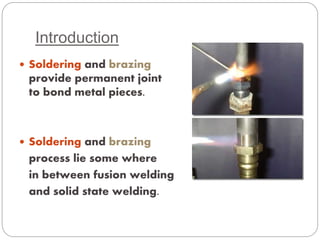
 Soldering and brazing 
provide permanent joint 
to bond metal pieces. 
 Soldering and brazing 
process lie some where 
in between fusion welding 
and solid state welding.
Brazing 
 In case of brazing joining of metal pieces is 
done with the help of filler metal. 
 Filler metal is melted and distributed by 
capillary action between the faying surfaces 
of the metallic parts being joined.
Brazing 
 In this case only filler metal melts, there is no 
melting of workpiece metal. 
 The melting point of filler metal should be 
more than 450oC.
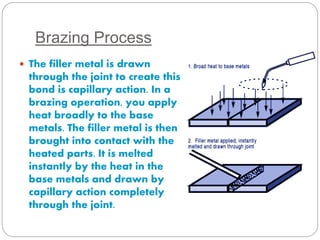
Brazing Process 
 The filler metal is drawn 
through the joint to create this 
bond is capillary action. In a 
brazing operation, you apply 
heat broadly to the base 
metals. The filler metal is then 
brought into contact with the 
heated parts. It is melted 
instantly by the heat in the 
base metals and drawn by 
capillary action completely 
through the joint.
Brazing Methods 
 Torch brazing - flux is applied to the part 
surfaces and a torch is used to focus flame 
against the work at the joint. A reducing flame 
is used to prevent the oxidation. 
 Furnace brazing - used to heat the workpieces 
to be joined by brazing operation. The 
component parts and brazing metal are 
loaded into a furnace, heated to brazing 
temperature, and then cooled and removed.
Brazing Methods 
 Dip brazing - assembled parts are typically 
dipped in a heated chemical bath which serve 
as both fluxing agent and heat source to melt 
pre-applied filler material. 
 Induction brazing – a process that uses 
electrical resistance of workpiece and high 
frequency current induced into the same as a 
source of heat generation. The parts are pre-loaded 
with filler metal and placed in a high 
frequency AC field.
Soldering 
 Soldering is very much similar to brazing. 
 The major difference lies with the filler metal, 
the filler metal used in case of soldering 
should have the melting temperature lower 
than 450oC.
Soldering 
 Soldering is normally done by melting the solder 
with a soldering iron and applying it to the two 
metals that are going to be joined together. 
 The filler metal used in the process is called solder, 
which distributes between the closely fitted 
surfaces.
Soldering Methods 
 Iron soldering - The oldest and simplest 
soldering method and is still widely used 
today. Soldering irons have copper tips which 
easily stores and transfers heat to the joint. 
 Wave soldering -A specific method used in the 
fabrication of electronic components and 
printed circuit boards (PCB). In this method, 
continually circulating fountains or waves of 
solder are lifted into contact with the joints.
Filler Metals 
 Brazing : Aluminum-silicon ,Copper, Copper-phosphorus, 
Magnesium, Silver, Nickel alloys. 
 Soldering : combinations of tin-lead, tin-silver-lead, 
tin-zinc, silver-copper-zinc and zinc-aluminum 
alloys.
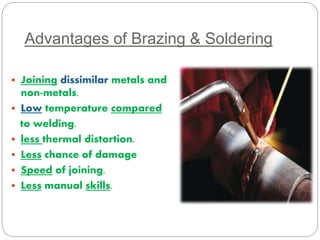
Advantages of Brazing & Soldering 
 Joining dissimilar metals and 
non-metals. 
 Low temperature compared 
to welding. 
 less thermal distortion. 
 Less chance of damage 
 Speed of joining. 
 Less manual skills.
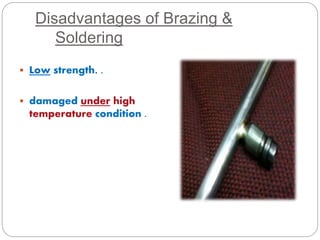
Disadvantages of Brazing & 
Soldering 
 Low strength. . 
 damaged under high 
temperature condition .
Summary 
Brazing and soldering are process that have many 
great advantages that are often overlooked. 
They are an excellent process for portable 
applications and the versatility makes them great 
choices for many jobs. 
Their ability to join may different materials with a 
limited variety of fluxes and filler metals reduces 
the need for a large inventory of materials.
Brazing and soldering

Brazing and soldering

  • 1.
    Abdulrahman Aziz AlAnazi Saud Ghanem AlAnazi Dr. Mahmoud Tash
  • 2.
    Introduction  Solderingand brazing provide permanent joint to bond metal pieces.  Soldering and brazing process lie some where in between fusion welding and solid state welding.
  • 3.
    Brazing  Incase of brazing joining of metal pieces is done with the help of filler metal.  Filler metal is melted and distributed by capillary action between the faying surfaces of the metallic parts being joined.
  • 4.
    Brazing  Inthis case only filler metal melts, there is no melting of workpiece metal.  The melting point of filler metal should be more than 450oC.
  • 5.
    Brazing Process The filler metal is drawn through the joint to create this bond is capillary action. In a brazing operation, you apply heat broadly to the base metals. The filler metal is then brought into contact with the heated parts. It is melted instantly by the heat in the base metals and drawn by capillary action completely through the joint.
  • 6.
    Brazing Methods Torch brazing - flux is applied to the part surfaces and a torch is used to focus flame against the work at the joint. A reducing flame is used to prevent the oxidation.  Furnace brazing - used to heat the workpieces to be joined by brazing operation. The component parts and brazing metal are loaded into a furnace, heated to brazing temperature, and then cooled and removed.
  • 7.
    Brazing Methods Dip brazing - assembled parts are typically dipped in a heated chemical bath which serve as both fluxing agent and heat source to melt pre-applied filler material.  Induction brazing – a process that uses electrical resistance of workpiece and high frequency current induced into the same as a source of heat generation. The parts are pre-loaded with filler metal and placed in a high frequency AC field.
  • 8.
    Soldering  Solderingis very much similar to brazing.  The major difference lies with the filler metal, the filler metal used in case of soldering should have the melting temperature lower than 450oC.
  • 9.
    Soldering  Solderingis normally done by melting the solder with a soldering iron and applying it to the two metals that are going to be joined together.  The filler metal used in the process is called solder, which distributes between the closely fitted surfaces.
  • 10.
    Soldering Methods Iron soldering - The oldest and simplest soldering method and is still widely used today. Soldering irons have copper tips which easily stores and transfers heat to the joint.  Wave soldering -A specific method used in the fabrication of electronic components and printed circuit boards (PCB). In this method, continually circulating fountains or waves of solder are lifted into contact with the joints.
  • 11.
    Filler Metals Brazing : Aluminum-silicon ,Copper, Copper-phosphorus, Magnesium, Silver, Nickel alloys.  Soldering : combinations of tin-lead, tin-silver-lead, tin-zinc, silver-copper-zinc and zinc-aluminum alloys.
  • 12.
    Advantages of Brazing& Soldering  Joining dissimilar metals and non-metals.  Low temperature compared to welding.  less thermal distortion.  Less chance of damage  Speed of joining.  Less manual skills.
  • 13.
    Disadvantages of Brazing& Soldering  Low strength. .  damaged under high temperature condition .
  • 14.
    Summary Brazing andsoldering are process that have many great advantages that are often overlooked. They are an excellent process for portable applications and the versatility makes them great choices for many jobs. Their ability to join may different materials with a limited variety of fluxes and filler metals reduces the need for a large inventory of materials.