1
2
Contents
1. What is soldering?
2. Electronic Component
3. Flux
4. Solder Wire
5. Soldering Iron
6. Soldering Process
7. Precautions during Soldering
8. Inspection + Handling
9. Important Soldering tips
10. Precautions
11. Summary
3
1 What is soldering?
Formation of “metal to metal” joint using solder.
Pembentukan "logam ke logam" bersama menggunakan
solder.
The joint is made by alloy formation of base metal and
solder.
Sambungan dibuat oleh pembentukan aloi asas logam
dan solder.
In soldering, there are four key elements: Iron, Solder, Flux,
And Component; they all are important.
Flux cored solder wire is used for hand soldering
4
2. Electronic Component
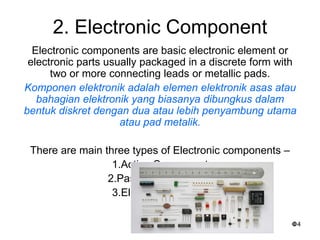
Electronic components are basic electronic element or
electronic parts usually packaged in a discrete form with
two or more connecting leads or metallic pads.
Komponen elektronik adalah elemen elektronik asas atau
bahagian elektronik yang biasanya dibungkus dalam
bentuk diskret dengan dua atau lebih penyambung utama
atau pad metalik.
There are main three types of Electronic components –
1.Active Component
2.Passive Component
3.Electromechanical
5
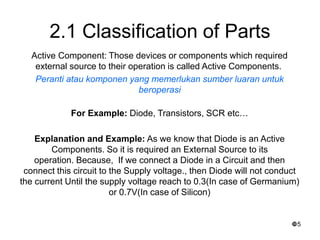
2.1 Classification of Parts
Active Component: Those devices or components which required
external source to their operation is called Active Components.
Peranti atau komponen yang memerlukan sumber luaran untuk
beroperasi
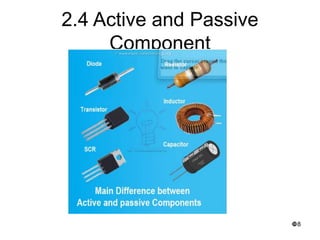
For Example: Diode, Transistors, SCR etc…
Explanation and Example: As we know that Diode is an Active
Components. So it is required an External Source to its
operation. Because, If we connect a Diode in a Circuit and then
connect this circuit to the Supply voltage., then Diode will not conduct
the current Until the supply voltage reach to 0.3(In case of Germanium)
or 0.7V(In case of Silicon)
6
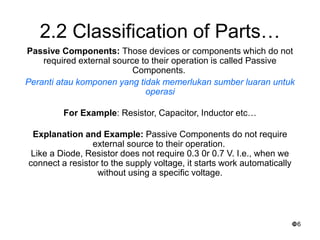
2.2 Classification of Parts…
Passive Components: Those devices or components which do not
required external source to their operation is called Passive
Components.
Peranti atau komponen yang tidak memerlukan sumber luaran untuk
operasi
For Example: Resistor, Capacitor, Inductor etc…
Explanation and Example: Passive Components do not require
external source to their operation.
Like a Diode, Resistor does not require 0.3 0r 0.7 V. I.e., when we
connect a resistor to the supply voltage, it starts work automatically
without using a specific voltage.
7
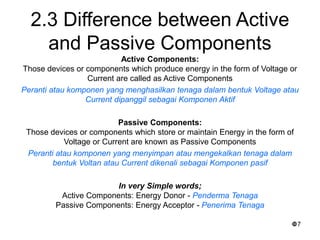
2.3 Difference between Active
and Passive Components
Active Components:
Those devices or components which produce energy in the form of Voltage or
Current are called as Active Components
Peranti atau komponen yang menghasilkan tenaga dalam bentuk Voltage atau
Current dipanggil sebagai Komponen Aktif
Passive Components:
Those devices or components which store or maintain Energy in the form of
Voltage or Current are known as Passive Components
Peranti atau komponen yang menyimpan atau mengekalkan tenaga dalam
bentuk Voltan atau Current dikenali sebagai Komponen pasif
In very Simple words;
Active Components: Energy Donor - Penderma Tenaga
Passive Components: Energy Acceptor - Penerima Tenaga
8
2.4 Active and Passive
Component
9
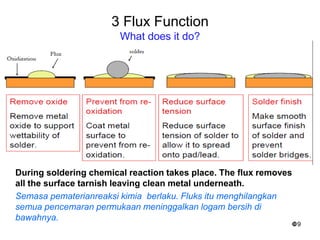
3 Flux Function
What does it do?
During soldering chemical reaction takes place. The flux removes
all the surface tarnish leaving clean metal underneath.
Semasa pematerianreaksi kimia berlaku. Fluks itu menghilangkan
semua pencemaran permukaan meninggalkan logam bersih di
bawahnya.
10
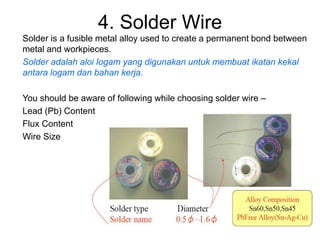
4. Solder Wire
Solder is a fusible metal alloy used to create a permanent bond between
metal and workpieces.
Solder adalah aloi logam yang digunakan untuk membuat ikatan kekal
antara logam dan bahan kerja.
You should be aware of following while choosing solder wire –
Lead (Pb) Content
Flux Content
Wire Size
11
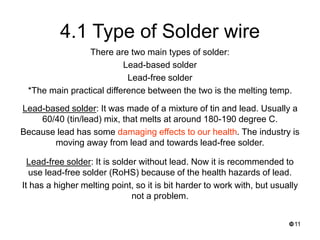
4.1 Type of Solder wire
There are two main types of solder:
Lead-based solder
Lead-free solder
*The main practical difference between the two is the melting temp.
Lead-based solder: It was made of a mixture of tin and lead. Usually a
60/40 (tin/lead) mix, that melts at around 180-190 degree C.
Because lead has some damaging effects to our health. The industry is
moving away from lead and towards lead-free solder.
Lead-free solder: It is solder without lead. Now it is recommended to
use lead-free solder (RoHS) because of the health hazards of lead.
It has a higher melting point, so it is bit harder to work with, but usually
not a problem.
12
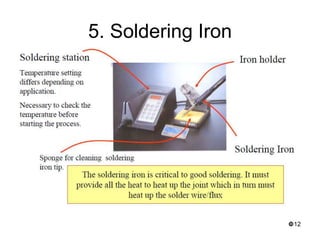
5. Soldering Iron
13
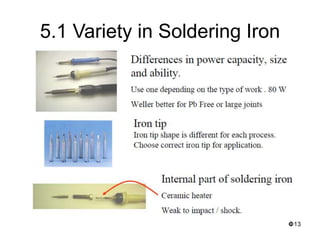
5.1 Variety in Soldering Iron
14
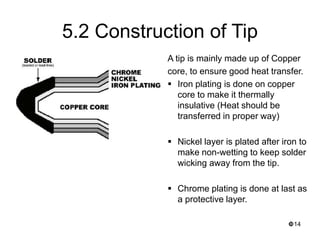
5.2 Construction of Tip
A tip is mainly made up of Copper
core, to ensure good heat transfer.
 Iron plating is done on copper
core to make it thermally
insulative (Heat should be
transferred in proper way)
 Nickel layer is plated after iron to
make non-wetting to keep solder
wicking away from the tip.
 Chrome plating is done at last as
a protective layer.
15
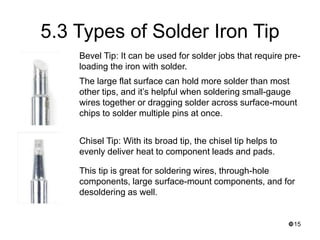
5.3 Types of Solder Iron Tip
Bevel Tip: It can be used for solder jobs that require pre-
loading the iron with solder.
The large flat surface can hold more solder than most
other tips, and it’s helpful when soldering small-gauge
wires together or dragging solder across surface-mount
chips to solder multiple pins at once.
Chisel Tip: With its broad tip, the chisel tip helps to
evenly deliver heat to component leads and pads.
This tip is great for soldering wires, through-hole
components, large surface-mount components, and for
desoldering as well.
16
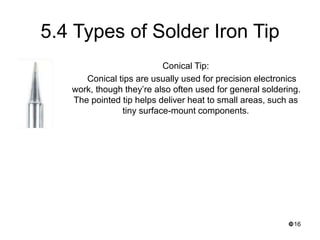
5.4 Types of Solder Iron Tip
Conical Tip:
Conical tips are usually used for precision electronics
work, though they’re also often used for general soldering.
The pointed tip helps deliver heat to small areas, such as
tiny surface-mount components.
17
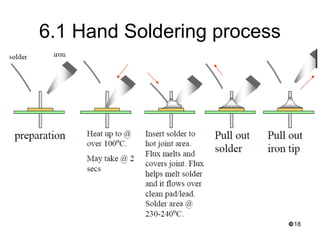
6. Hand Soldering Process
18
6.1 Hand Soldering process
19
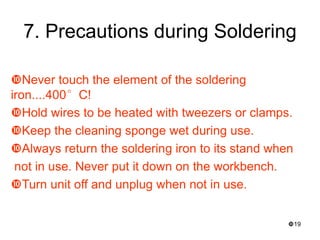
7. Precautions during Soldering
Never touch the element of the soldering
iron....400°C!
Hold wires to be heated with tweezers or clamps.
Keep the cleaning sponge wet during use.
Always return the soldering iron to its stand when
not in use. Never put it down on the workbench.
Turn unit off and unplug when not in use.
20
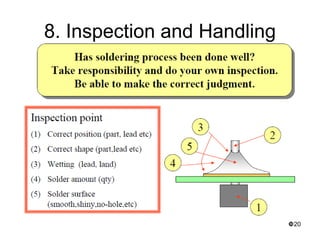
8. Inspection and Handling
21
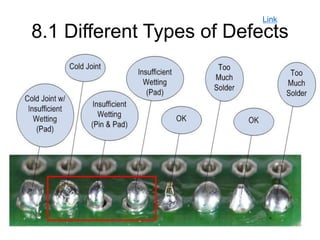
8.1 Different Types of Defects
Link
22
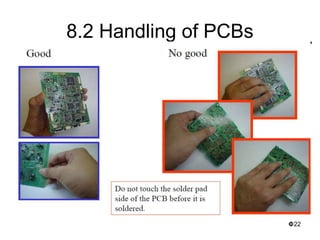
8.2 Handling of PCBs
9. Important Soldering Tips
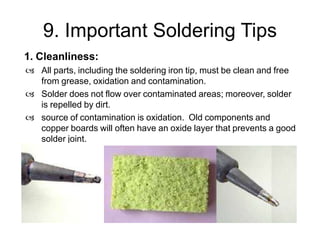
1. Cleanliness:
 All parts, including the soldering iron tip, must be clean and free
from grease, oxidation and contamination.
 Solder does not flow over contaminated areas; moreover, solder
is repelled by dirt.
 source of contamination is oxidation. Old components and
copper boards will often have an oxide layer that prevents a good
solder joint.
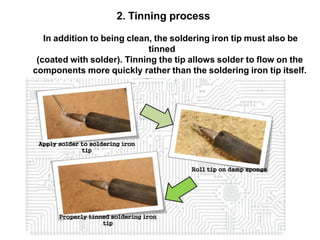
2. Tinning process
In addition to being clean, the soldering iron tip must also be
tinned
(coated with solder). Tinning the tip allows solder to flow on the
components more quickly rather than the soldering iron tip itself.
- It is important to realize that higher wattage does not necessarily mean
hotter soldering iron. Higher wattage irons just have more power
available to cope with bigger joints. A low wattage iron may not keep its
temperature on a big joint, as it can loose heat faster than it can reheat
itself.
- Smaller joints such as circuit boards require a lesser wattage iron -
around 15- 30 watts will be fine.
3. Wattage
4. Voltage
- Most soldering irons are electrically powered, and are either 110/230v
AC, or benchtop soldering stations which transform down to low voltage
DC.
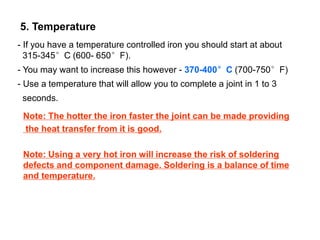
5. Temperature
- If you have a temperature controlled iron you should start at about
315-345°C (600- 650°F).
- You may want to increase this however - 370-400°C (700-750°F)
- Use a temperature that will allow you to complete a joint in 1 to 3
seconds.
Note: The hotter the iron faster the joint can be made providing
the heat transfer from it is good.
Note: Using a very hot iron will increase the risk of soldering
defects and component damage. Soldering is a balance of time
and temperature.
27
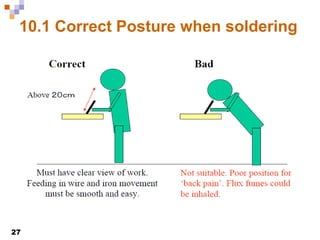
10.1 Correct Posture when soldering
28
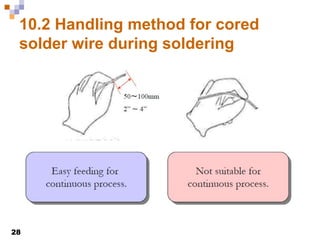
10.2 Handling method for cored
solder wire during soldering
29
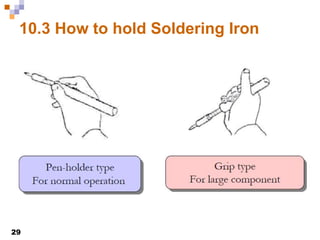
10.3 How to hold Soldering Iron
30
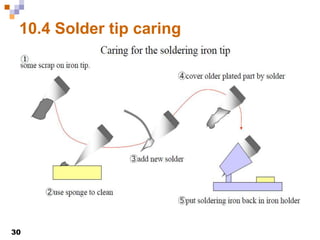
10.4 Solder tip caring
31
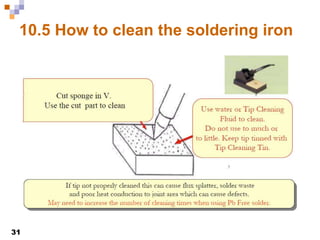
10.5 How to clean the soldering iron
32
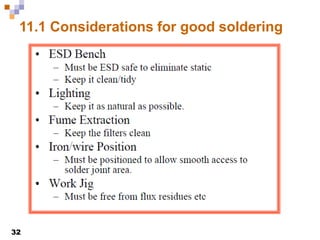
11.1 Considerations for good soldering
33
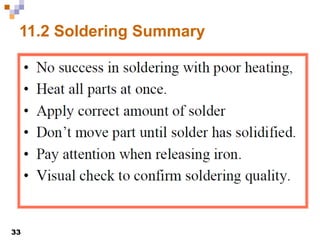
11.2 Soldering Summary
35

Basic Soldering Techniques

  • 1.
  • 2.
    2 Contents 1. What issoldering? 2. Electronic Component 3. Flux 4. Solder Wire 5. Soldering Iron 6. Soldering Process 7. Precautions during Soldering 8. Inspection + Handling 9. Important Soldering tips 10. Precautions 11. Summary
  • 3.
    3 1 What issoldering? Formation of “metal to metal” joint using solder. Pembentukan "logam ke logam" bersama menggunakan solder. The joint is made by alloy formation of base metal and solder. Sambungan dibuat oleh pembentukan aloi asas logam dan solder. In soldering, there are four key elements: Iron, Solder, Flux, And Component; they all are important. Flux cored solder wire is used for hand soldering
  • 4.
    4 2. Electronic Component Electroniccomponents are basic electronic element or electronic parts usually packaged in a discrete form with two or more connecting leads or metallic pads. Komponen elektronik adalah elemen elektronik asas atau bahagian elektronik yang biasanya dibungkus dalam bentuk diskret dengan dua atau lebih penyambung utama atau pad metalik. There are main three types of Electronic components – 1.Active Component 2.Passive Component 3.Electromechanical
  • 5.
    5 2.1 Classification ofParts Active Component: Those devices or components which required external source to their operation is called Active Components. Peranti atau komponen yang memerlukan sumber luaran untuk beroperasi For Example: Diode, Transistors, SCR etc… Explanation and Example: As we know that Diode is an Active Components. So it is required an External Source to its operation. Because, If we connect a Diode in a Circuit and then connect this circuit to the Supply voltage., then Diode will not conduct the current Until the supply voltage reach to 0.3(In case of Germanium) or 0.7V(In case of Silicon)
  • 6.
    6 2.2 Classification ofParts… Passive Components: Those devices or components which do not required external source to their operation is called Passive Components. Peranti atau komponen yang tidak memerlukan sumber luaran untuk operasi For Example: Resistor, Capacitor, Inductor etc… Explanation and Example: Passive Components do not require external source to their operation. Like a Diode, Resistor does not require 0.3 0r 0.7 V. I.e., when we connect a resistor to the supply voltage, it starts work automatically without using a specific voltage.
  • 7.
    7 2.3 Difference betweenActive and Passive Components Active Components: Those devices or components which produce energy in the form of Voltage or Current are called as Active Components Peranti atau komponen yang menghasilkan tenaga dalam bentuk Voltage atau Current dipanggil sebagai Komponen Aktif Passive Components: Those devices or components which store or maintain Energy in the form of Voltage or Current are known as Passive Components Peranti atau komponen yang menyimpan atau mengekalkan tenaga dalam bentuk Voltan atau Current dikenali sebagai Komponen pasif In very Simple words; Active Components: Energy Donor - Penderma Tenaga Passive Components: Energy Acceptor - Penerima Tenaga
  • 8.
    8 2.4 Active andPassive Component
  • 9.
    9 3 Flux Function Whatdoes it do? During soldering chemical reaction takes place. The flux removes all the surface tarnish leaving clean metal underneath. Semasa pematerianreaksi kimia berlaku. Fluks itu menghilangkan semua pencemaran permukaan meninggalkan logam bersih di bawahnya.
  • 10.
    10 4. Solder Wire Solderis a fusible metal alloy used to create a permanent bond between metal and workpieces. Solder adalah aloi logam yang digunakan untuk membuat ikatan kekal antara logam dan bahan kerja. You should be aware of following while choosing solder wire – Lead (Pb) Content Flux Content Wire Size
  • 11.
    11 4.1 Type ofSolder wire There are two main types of solder: Lead-based solder Lead-free solder *The main practical difference between the two is the melting temp. Lead-based solder: It was made of a mixture of tin and lead. Usually a 60/40 (tin/lead) mix, that melts at around 180-190 degree C. Because lead has some damaging effects to our health. The industry is moving away from lead and towards lead-free solder. Lead-free solder: It is solder without lead. Now it is recommended to use lead-free solder (RoHS) because of the health hazards of lead. It has a higher melting point, so it is bit harder to work with, but usually not a problem.
  • 12.
  • 13.
    13 5.1 Variety inSoldering Iron
  • 14.
    14 5.2 Construction ofTip A tip is mainly made up of Copper core, to ensure good heat transfer.  Iron plating is done on copper core to make it thermally insulative (Heat should be transferred in proper way)  Nickel layer is plated after iron to make non-wetting to keep solder wicking away from the tip.  Chrome plating is done at last as a protective layer.
  • 15.
    15 5.3 Types ofSolder Iron Tip Bevel Tip: It can be used for solder jobs that require pre- loading the iron with solder. The large flat surface can hold more solder than most other tips, and it’s helpful when soldering small-gauge wires together or dragging solder across surface-mount chips to solder multiple pins at once. Chisel Tip: With its broad tip, the chisel tip helps to evenly deliver heat to component leads and pads. This tip is great for soldering wires, through-hole components, large surface-mount components, and for desoldering as well.
  • 16.
    16 5.4 Types ofSolder Iron Tip Conical Tip: Conical tips are usually used for precision electronics work, though they’re also often used for general soldering. The pointed tip helps deliver heat to small areas, such as tiny surface-mount components.
  • 17.
  • 18.
  • 19.
    19 7. Precautions duringSoldering Never touch the element of the soldering iron....400°C! Hold wires to be heated with tweezers or clamps. Keep the cleaning sponge wet during use. Always return the soldering iron to its stand when not in use. Never put it down on the workbench. Turn unit off and unplug when not in use.
  • 20.
  • 21.
  • 22.
  • 23.
    9. Important SolderingTips 1. Cleanliness:  All parts, including the soldering iron tip, must be clean and free from grease, oxidation and contamination.  Solder does not flow over contaminated areas; moreover, solder is repelled by dirt.  source of contamination is oxidation. Old components and copper boards will often have an oxide layer that prevents a good solder joint.
  • 24.
    2. Tinning process Inaddition to being clean, the soldering iron tip must also be tinned (coated with solder). Tinning the tip allows solder to flow on the components more quickly rather than the soldering iron tip itself.
  • 25.
    - It isimportant to realize that higher wattage does not necessarily mean hotter soldering iron. Higher wattage irons just have more power available to cope with bigger joints. A low wattage iron may not keep its temperature on a big joint, as it can loose heat faster than it can reheat itself. - Smaller joints such as circuit boards require a lesser wattage iron - around 15- 30 watts will be fine. 3. Wattage 4. Voltage - Most soldering irons are electrically powered, and are either 110/230v AC, or benchtop soldering stations which transform down to low voltage DC.
  • 26.
    5. Temperature - Ifyou have a temperature controlled iron you should start at about 315-345°C (600- 650°F). - You may want to increase this however - 370-400°C (700-750°F) - Use a temperature that will allow you to complete a joint in 1 to 3 seconds. Note: The hotter the iron faster the joint can be made providing the heat transfer from it is good. Note: Using a very hot iron will increase the risk of soldering defects and component damage. Soldering is a balance of time and temperature.
  • 27.
  • 28.
    28 10.2 Handling methodfor cored solder wire during soldering
  • 29.
    29 10.3 How tohold Soldering Iron
  • 30.
  • 31.
    31 10.5 How toclean the soldering iron
  • 32.
  • 33.
  • 35.