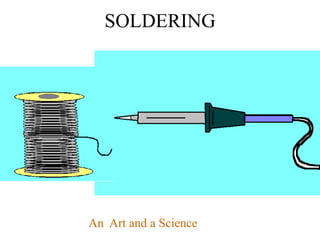
SOLDERING
An Art and a Science
SOLDER
Solder is an ALLOY of 60% TIN & 40% LEAD
SOLDERING IRON
A very simple device with no moving parts
The soldering iron gets hot when electricity
flows through a coil of wire.
Uses of Soldering
Splicing wires
Circuit Boards
Tinning a wire
Tinning means to put solder on the wire.
Your first Soldering Job
Tinning a wire
Preparing the Soldering Iron
Cleaning the soldering iron
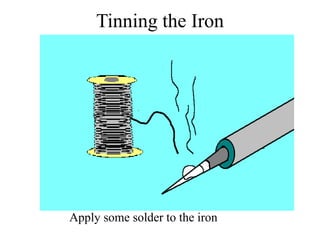
Tinning the Iron
Apply some solder to the iron
The Heat Bridge
Applying solder to the Wire
Feed in the Solder
The hot wire will melt the solder
Capillary Action
Wicking action draws solder into wire strands
Tinned Wire
All wire strands are coated with solder
Good Job !
The solder has coated the strands but has not traveled under
the insulation.
Solder follows heat
If the heat is allowed to travel down the wire, the solder will
follow.
Splicing
Simple twisted splice
The easiest type of splice
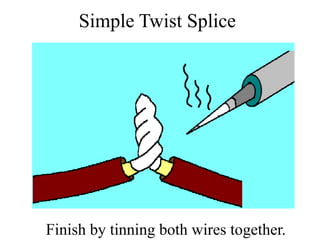
Simple twist splice
Strip two wires & twist together
Simple Twist Splice
Finish by tinning both wires together.
Side by side splice
Bonding two tinned wires
Requires two steps
Side by side splice
Step one: Tin two stripped wires.
Side by side splice
Step Two: Bond wires with a heat bridge.
Side by side splice
Correctly bonded splice
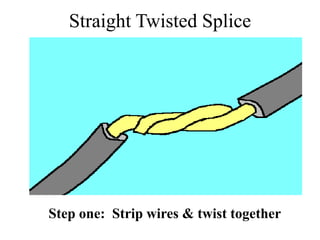
Straight Twisted Splice
Step one: Strip wires & twist together
Straight twisted splice
Step Two: Tin both wires at once.
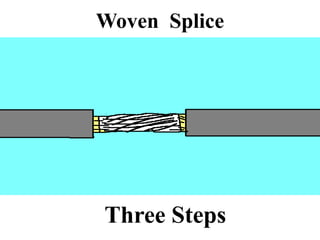
Woven Splice
Three Steps
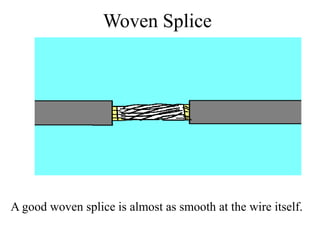
Woven Splice
Step One: Push two stripped wire strands together.
Woven Splice
The wire strands are intertwined & twisted
before tinning
Woven Splice
Bond the intertwined strands together
Woven Splice
A good woven splice is almost as smooth at the wire itself.
PC board Soldering
Mounting Components
Multiple steps.
Prepare the component lead
2.
1.
Capacitor leads
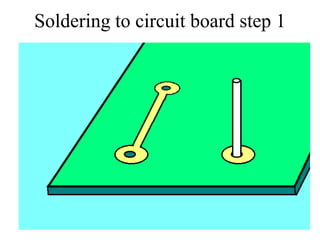
Soldering to circuit board step 1
Attaching the lead
Apply solder to both the solder pad and the component lead
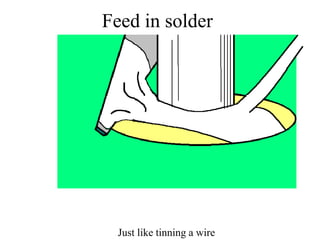
Feed in solder
Just like tinning a wire
The right amount of solder
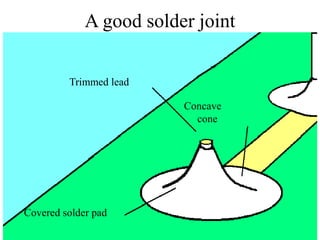
Concave shaped solder joint
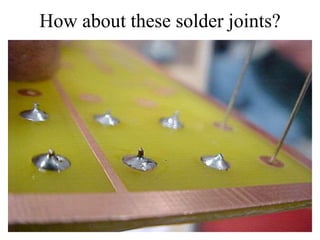
Poor Solder solder joints
These are not concave shaped solder joints
cold
lopsided convex No bonding
How are these?
Cold Solder Joint
No bonding between solder pad and the lead.
A good solder joint
Concave cone
Covered pad
Trimmed leadTrimmed lead
Covered solder pad
Concave
cone
Misaligned resistor shorted to solder joint
in a new walkie-talkie
How about these solder joints?
Align all the parts correctly.
Review
1. Alloy 2. Flux
3. Simple twist splice 4. Side by side splice
5. Straight twist splice 6. Woven splice
7. PC Board soldering 8. Concave solder joint
9. Cold solder joint 10. Solder pad coverage
11. Tinning 12. Heat bridge
13. Capillary Action
Quiz
1. What was this presentation about ?
2. What is solder made of?
3. What is the solder compound termed?
4. How many moving parts does the soldering
iron have ?
5. How does the soldering iron get hot ?
Quiz Continued
6. What is the term for applying solder to a wire?
7. How is heat transferred from the soldering iron
to the material being soldered ?
8. How does the solder get on the inner strands
of the wire ?
9. Does the solder flow away from, or toward
the heat ?
10. What is the easiest splice to do?
Quiz continued
11. What is the smoothest splice to do ?
12. When tinning a wire, should the solder
reach under the insulation ?
13. What shape should a PC board solder
joint be ?
14. What is a cold solder joint ?
15. Should the PC board component track
be soldered ?
Quiz Answers
1. This presentation was about SOLDERING !
2. Solder is a mixture of Tin & lead
3. Compound is termed ALLOY
4. No moving parts in a soldering iron
5. The coil of wire gets hot when electricity flows
through it.
Quiz Answers
6. “Tinning” is process of applying solder to
material
7. Heat Bridge transfers heat to material
8. CAPILLARY ACTION
9. Solder flows TOWARD heat.
10. Simple Twist Splice is easiest to do.
Quiz Answers
11. Woven Splice is the smoothest
12. NO. solder should not reach under
the insulation.
13. Good PC board solder joints are
CONCAVE
14. A cold solder joint is not smoothly
bonded between lead and pad
15. The PC board component track should
NOT be soldered.

Soldering