Lecture on Wire Splicing and
Termination
Prepared by
Amit Kumer Podder
Khulna University of Engineering &Technology (KUET)
Wire Splicing
A wire spice is when two pieces of electrical wire are taken and join
them together with a crimp, butt-splice, or heat shrink to make a
complete electrical connection.
Importance of Wire Splicing
 The Splicing or jointing is required since the wires are manufactured in 100
metres lengths and the total length of wire used for house wiring may be
more than 100 metres.
 The jointing conductors and wires should always be carried out at outlets
i.e. in switches,ceiling roses using the looping in system or in junction
boxes.
 Splicing should never be done in conduit runs but sometimes necessary
when repairing old works.
Various Kinds of Splicing Techniques
Western Union Splice orTwist Splice
Married Joint
Single Branch Splice orATap Joint
Double Branch Splice
Flexible Cord Splicing
Pigtail Joint
Pigtail Joint of a Solid Conductor and A FlexibleWire
Western Union Splice orTwist Splice
It can be completed in four steps--
1. Removing Insulation
2. Mechanically jointing the conductors
3. Soldering the joint
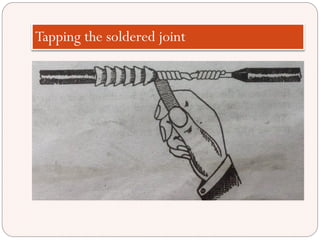
4. Tapping the soldered joint
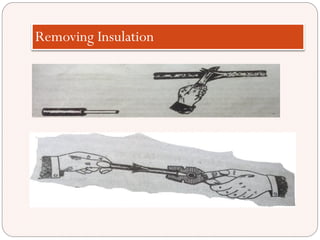
Removing Insulation
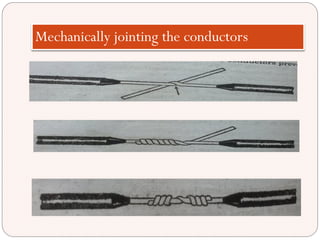
Mechanically jointing the conductors
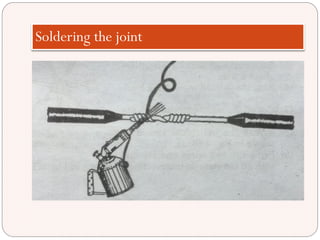
Soldering the joint
Tapping the soldered joint
Married joint
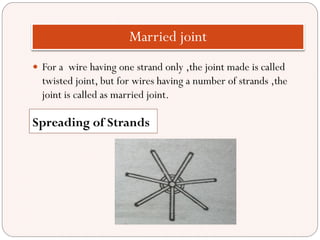
 For a wire having one strand only ,the joint made is called
twisted joint, but for wires having a number of strands ,the
joint is called as married joint.
Spreading of Strands
Married joint
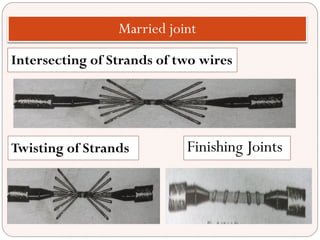
Intersecting of Strands of two wires
Twisting of Strands Finishing Joints
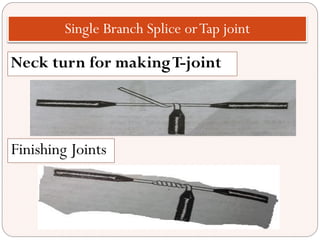
Single Branch Splice orTap joint
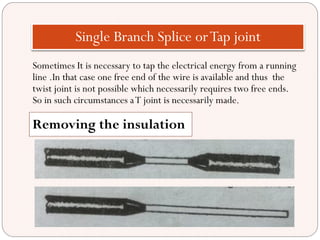
Sometimes It is necessary to tap the electrical energy from a running
line .In that case one free end of the wire is available and thus the
twist joint is not possible which necessarily requires two free ends.
So in such circumstances aT joint is necessarily made.
Removing the insulation
Single Branch Splice orTap joint
Neck turn for makingT-joint
Finishing Joints
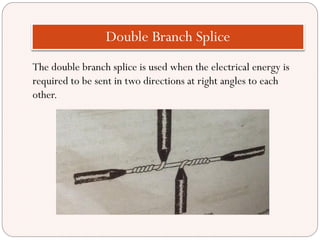
Double Branch Splice
The double branch splice is used when the electrical energy is
required to be sent in two directions at right angles to each
other.
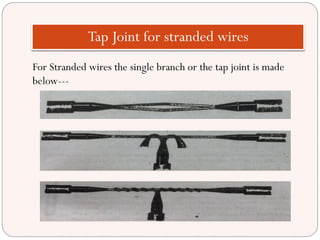
Tap Joint for stranded wires
For Stranded wires the single branch or the tap joint is made
below---
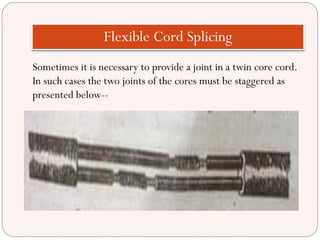
Flexible Cord Splicing
Sometimes it is necessary to provide a joint in a twin core cord.
In such cases the two joints of the cores must be staggered as
presented below--
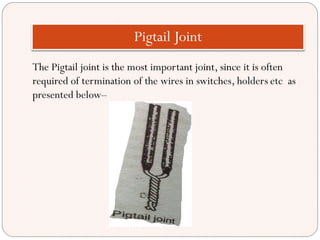
Pigtail Joint
The Pigtail joint is the most important joint, since it is often
required of termination of the wires in switches, holders etc as
presented below–
Pigtail Joint of a Solid Conductor and a
flexible wire
Such a joint is made in a manner similar to that of an ordinary
pigtail joint ,except that after wrapping the stranded wire round
the solid conductor for a length of 2.5 cm as presented below–
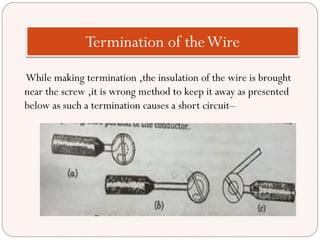
Termination of theWire
While making termination ,the insulation of the wire is brought
near the screw ,it is wrong method to keep it away as presented
below as such a termination causes a short circuit–
Lecture on wire splicing and termination

Lecture on wire splicing and termination

  • 1.
    Lecture on WireSplicing and Termination Prepared by Amit Kumer Podder Khulna University of Engineering &Technology (KUET)
  • 2.
    Wire Splicing A wirespice is when two pieces of electrical wire are taken and join them together with a crimp, butt-splice, or heat shrink to make a complete electrical connection. Importance of Wire Splicing  The Splicing or jointing is required since the wires are manufactured in 100 metres lengths and the total length of wire used for house wiring may be more than 100 metres.  The jointing conductors and wires should always be carried out at outlets i.e. in switches,ceiling roses using the looping in system or in junction boxes.  Splicing should never be done in conduit runs but sometimes necessary when repairing old works.
  • 3.
    Various Kinds ofSplicing Techniques Western Union Splice orTwist Splice Married Joint Single Branch Splice orATap Joint Double Branch Splice Flexible Cord Splicing Pigtail Joint Pigtail Joint of a Solid Conductor and A FlexibleWire
  • 4.
    Western Union SpliceorTwist Splice It can be completed in four steps-- 1. Removing Insulation 2. Mechanically jointing the conductors 3. Soldering the joint 4. Tapping the soldered joint
  • 5.
  • 6.
  • 7.
  • 8.
  • 9.
    Married joint  Fora wire having one strand only ,the joint made is called twisted joint, but for wires having a number of strands ,the joint is called as married joint. Spreading of Strands
  • 10.
    Married joint Intersecting ofStrands of two wires Twisting of Strands Finishing Joints
  • 11.
    Single Branch SpliceorTap joint Sometimes It is necessary to tap the electrical energy from a running line .In that case one free end of the wire is available and thus the twist joint is not possible which necessarily requires two free ends. So in such circumstances aT joint is necessarily made. Removing the insulation
  • 12.
    Single Branch SpliceorTap joint Neck turn for makingT-joint Finishing Joints
  • 13.
    Double Branch Splice Thedouble branch splice is used when the electrical energy is required to be sent in two directions at right angles to each other.
  • 14.
    Tap Joint forstranded wires For Stranded wires the single branch or the tap joint is made below---
  • 15.
    Flexible Cord Splicing Sometimesit is necessary to provide a joint in a twin core cord. In such cases the two joints of the cores must be staggered as presented below--
  • 16.
    Pigtail Joint The Pigtailjoint is the most important joint, since it is often required of termination of the wires in switches, holders etc as presented below–
  • 17.
    Pigtail Joint ofa Solid Conductor and a flexible wire Such a joint is made in a manner similar to that of an ordinary pigtail joint ,except that after wrapping the stranded wire round the solid conductor for a length of 2.5 cm as presented below–
  • 18.
    Termination of theWire Whilemaking termination ,the insulation of the wire is brought near the screw ,it is wrong method to keep it away as presented below as such a termination causes a short circuit–