“Whenever you are
in doubt, or when
the self becomes too
much with you, …
recall the face of the
poorest and the
weakest person
whom you may have
seen, and ask
yourself, if the step
you contemplate is
going to be of any
use to it.”
GOOD
MORNING
AND
WELCOME
Welcome
Project Cycle
Assessment
Design
Implementation
MonitoringEvaluation
Redesign
Transition
Problem
Identification
Project Rollout
Project
Appraisal
Restructuring &
Implementation
Phasing out
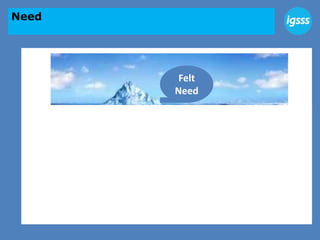
Felt
Need
Real
Need
Need
• Project identification
• Stakeholder analysis
• Problem analysis
• Problem Identification
o Root Causes
o Problem Tree
• Objectives
Project Identification Tools
What to assess?
School enrollment
rates
Improve literacy
Number of schools
built; textbooks, etc.
Building of schools
Distribution of
textbooks, etc.
Spending on primary
education
Indicative Example:
Access to, use of, and
satisfaction with services
Effects on dimensions of
well-being
Goods and services
produced
Tasks undertaken to
transform inputs to
outputs
Financial, human and
material resources
Outcomes
Impact
Outputs
Activities
Inputs
Results Chain
Project Identification Tools
• Preliminary stakeholder analysis
• Problem analysis
• Setting of objectives
• Analysis of alternatives
• Accountability analysis
• Logical framework thinking
• Analysis of assumptions and associated risks
• Progress indicator definition
• Stakeholder review
Project Identification
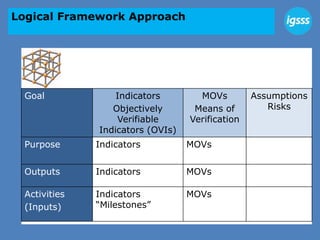
Logical Framework Approach
Goal Indicators
Objectively
Verifiable
Indicators (OVIs)
MOVs
Means of
Verification
Assumptions
Risks
Purpose Indicators MOVs
Outputs Indicators MOVs
Activities
(Inputs)
Indicators
“Milestones”
MOVs
Logical Framework Approach
Description of the action. Objectively verifiable
indicators of achievement
Source and means of
verification
Assumptions
1 Overall objectives (Goal)
What are the overall broader
objectives to which the action will
contribute?
8 What are the key indicators
related to the overall
objectives?
9 What are the sources of
information for these
indicators?
2 Specific objectives
What specific objjective is the
action intended to achieve to
contribute to the overall objectives?
10 Which indicators clearly
show that the objective of
the action has been
achieved?
11 What are the sources of
information that exist or
can be collected? What are
the methods requred to get
this information?
7 Which factors and conditions
outside of Beneficiary’s
responsibility are necessary
to achieve that objective?
(external coditions) Which
risks should be taken into
consideration?
3 Expected results
The results are the output
envisaged to achieve the specific
objective. What are the expected
results? Enumerate them
12 What are the indicators to
measure whether and to
what extent the action
achieves the expected
results?
13 What are the sources of
information about action
progress?
6 What external conditions
must be met to obtain
expected results on
schedule?
4 Activities
What are the key activities to be
carried on and in what sequence
in order to produce the expected
results? (group the activities by
result)
14 Means
What are the means
required to implement these
activities, e.g. personnel,
equipment, training, studies,
supplies, operational
facilities, etc.
15 Costs
What are the action costs?
How are they classified?
(breakdown in the Budget
for the action)
5 What pre-conditions are
required before the action
starts? What conditions
outside the Beneficiary’s
direct control have to be met
for the implementation of the
planned activities?
Project Proposal
Project Appraisal
• What (Definition)
Appraising a project means performing a process of reviewing
evaluating this project and its content for feasibility and cost-
effectiveness to approve or reject the project concept.
• Why (Purpose)
The purpose is to analyze the proposed project to determine
whether the concept really offers an effective solution that
addresses the identified problem.
• When (Phase)
The appraising process is carried out during the pre-planning or
initiation phase.
• How (Action Items)
The step by step process appraising the project
Project Appraisal
How (Action Items)
• Concept Analysis:
it aims to define concept of the proposed project and determine what
problem to solve and in which way (solution).
• Concept Brief:
it is to describe the concept through defining the goals, objectives, scope,
costs, time-limits and business drivers of the proposed project.
• Project Organization:
it is focused on describing the roles and responsibilities of project
personnel through developing an organizational chart.
• Project Proposal:
it summarizes all the previous steps to develop the Project Proposal and
submit it for review and approval to the senior stakeholders.
Project Appraisal
Concept Analysis
• Problem-Solution Analysis (Needs
Assessment)
• Feasibility and Alternatives Analysis
• Stakeholder Analysis
• Decision Package
Project Appraisal
Concept Brief
• Project Statement
• Background and strategic context
• Vision
• Goals Statement
• Objectives
• Broad Scope
• Boundaries
• Assumptions and constraints
• High-level deliverables
• Requirements
• Time Estimation
• Cost Projection
Project Appraisal
Project Organization
• Governance Structure
• Performance Measures
Project Proposal
• Proposal
• Approval and Signoff
Project Financing
• Grant Money
Apply (RPF/ EOI)
Concept Note Submission/ Marketing
• Crowd Funding
• Donations
• Corpus Funding
• Loan
• Sponsoring
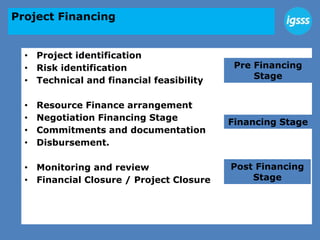
Project Financing
• Project identification
• Risk identification
• Technical and financial feasibility
• Resource Finance arrangement
• Negotiation Financing Stage
• Commitments and documentation
• Disbursement.
• Monitoring and review
• Financial Closure / Project Closure
Pre Financing
Stage
Financing Stage
Post Financing
Stage
Project Cost System
• Cost Estimation
• Budgeting
• Project performance measuring
• Easy reporting
• User-friendly interface
• Affordability
Project Cost System
• Fixed Costs (FC)
The costs which don’t vary with changing output. Fixed costs might include the cost of building a
factory, insurance and legal bills. Even if your output changes or you don’t produce anything, your
fixed costs stay the same.
• Variable Costs (VC).
Labour might be a semi-variable cost. If you produce more cars, you need to employ more workers;
this is a variable cost. However, even if you didn’t produce any cars, you may still need some workers
to look after empty factory. Costs which depend on the output produced. For example, if you produce
more cars, you have to use more raw materials such as metal
• Semi-Variable Cost.
Labour might be a semi-variable cost. If you produce more cars, you need to employ more workers;
this is a variable cost. However, even if you didn’t produce any cars, you may still need some workers
to look after empty factory.
• Total Costs (TC) – Fixed + Variable Costs
• Marginal Costs
Marginal cost is the cost of producing an extra unit. If the total cost of 3 units is 1550, and the total
cost of 4 units is 1900. The marginal cost of the 4th unit is 350.
• Opportunity Cost –
Opportunity cost is the next best alternative foregone. If you invest £1million in developing a cure for
pancreatic cancer, the opportunity cost is that you can’t use that money to invest in developing a cure
for skin cancer.
Project Cost System
• Economic Cost.
Economic cost includes both the actual direct costs (accounting costs) plus the opportunity cost. For
example, if you take time off work to a training scheme. You may lose a weeks pay of 350, plus also
have to pay the direct cost of 200. Thus the total economic cost = 550.
• Accounting Costs
This is the monetary outlay for producing a certain good. Accounting costs will include your variable
and fixed costs you have to pay.
• Sunk Costs.
These are costs that have been incurred and cannot be recouped. If you left the industry, you could
not reclaim sunk costs. For example, if you spend money on advertising to enter an industry, you can
never claim these costs back. If you buy a machine, you might be able to sell if you leave the industry.
See: Sunk cost fallacy
• Avoidable Costs.
Costs that can be avoided. If you stop producing cars, you don’t have to pay for extra raw materials
and electricity. Sometimes known as an escapable cost.
PERT (Project Evaluation and Review
Technique)
• Event
o Predecessor event: an event that immediately precedes some other event without any other
events intervening. An event can have multiple predecessor events and can be the predecessor of
multiple events.
o Successor event: an event that immediately follows some other event without any other
intervening events. An event can have multiple successor events and can be the successor of
multiple events.
• Activity
o Main Activity
o Sub Activity
• Time
o Optimistic time: the minimum possible time required to accomplish an activity (o) or a path (O),
assuming everything proceeds better than is normally expected
o Pessimistic time: the maximum possible time required to accomplish an activity (p) or a path
(P), assuming everything goes wrong (but excluding major catastrophes).
o Most likely time: the best estimate of the time required to accomplish an activity (m) or a path
(M), assuming everything proceeds as normal.
o Expected time: the best estimate of the time required to accomplish an activity (te) or a path
(TE),
• Critical Path
PERT (Project Evaluation and Review
Technique)
PERT planning involves the following steps:
• Identify the specific activities and
milestones.
• Determine the proper sequence of the
activities.
• Construct a network diagram.
• Estimate the time required for each activity.
• Determine the critical path.
• Update the PERT chart as the project
progresses.
PERT (Project Evaluation and Review
Technique)
A PERT network chart for a seven-month project with five milestones (Nodes: 10
through 50) and six activities (Arrows: A through F)
10 30 50
40
20

Project proposal

  • 1.
    “Whenever you are indoubt, or when the self becomes too much with you, … recall the face of the poorest and the weakest person whom you may have seen, and ask yourself, if the step you contemplate is going to be of any use to it.” GOOD MORNING AND WELCOME Welcome
  • 2.
  • 3.
  • 4.
    • Project identification •Stakeholder analysis • Problem analysis • Problem Identification o Root Causes o Problem Tree • Objectives Project Identification Tools
  • 5.
    What to assess? Schoolenrollment rates Improve literacy Number of schools built; textbooks, etc. Building of schools Distribution of textbooks, etc. Spending on primary education Indicative Example: Access to, use of, and satisfaction with services Effects on dimensions of well-being Goods and services produced Tasks undertaken to transform inputs to outputs Financial, human and material resources Outcomes Impact Outputs Activities Inputs Results Chain
  • 6.
    Project Identification Tools •Preliminary stakeholder analysis • Problem analysis • Setting of objectives • Analysis of alternatives • Accountability analysis • Logical framework thinking • Analysis of assumptions and associated risks • Progress indicator definition • Stakeholder review Project Identification
  • 7.
    Logical Framework Approach GoalIndicators Objectively Verifiable Indicators (OVIs) MOVs Means of Verification Assumptions Risks Purpose Indicators MOVs Outputs Indicators MOVs Activities (Inputs) Indicators “Milestones” MOVs
  • 8.
    Logical Framework Approach Descriptionof the action. Objectively verifiable indicators of achievement Source and means of verification Assumptions 1 Overall objectives (Goal) What are the overall broader objectives to which the action will contribute? 8 What are the key indicators related to the overall objectives? 9 What are the sources of information for these indicators? 2 Specific objectives What specific objjective is the action intended to achieve to contribute to the overall objectives? 10 Which indicators clearly show that the objective of the action has been achieved? 11 What are the sources of information that exist or can be collected? What are the methods requred to get this information? 7 Which factors and conditions outside of Beneficiary’s responsibility are necessary to achieve that objective? (external coditions) Which risks should be taken into consideration? 3 Expected results The results are the output envisaged to achieve the specific objective. What are the expected results? Enumerate them 12 What are the indicators to measure whether and to what extent the action achieves the expected results? 13 What are the sources of information about action progress? 6 What external conditions must be met to obtain expected results on schedule? 4 Activities What are the key activities to be carried on and in what sequence in order to produce the expected results? (group the activities by result) 14 Means What are the means required to implement these activities, e.g. personnel, equipment, training, studies, supplies, operational facilities, etc. 15 Costs What are the action costs? How are they classified? (breakdown in the Budget for the action) 5 What pre-conditions are required before the action starts? What conditions outside the Beneficiary’s direct control have to be met for the implementation of the planned activities?
  • 9.
  • 10.
    Project Appraisal • What(Definition) Appraising a project means performing a process of reviewing evaluating this project and its content for feasibility and cost- effectiveness to approve or reject the project concept. • Why (Purpose) The purpose is to analyze the proposed project to determine whether the concept really offers an effective solution that addresses the identified problem. • When (Phase) The appraising process is carried out during the pre-planning or initiation phase. • How (Action Items) The step by step process appraising the project
  • 11.
    Project Appraisal How (ActionItems) • Concept Analysis: it aims to define concept of the proposed project and determine what problem to solve and in which way (solution). • Concept Brief: it is to describe the concept through defining the goals, objectives, scope, costs, time-limits and business drivers of the proposed project. • Project Organization: it is focused on describing the roles and responsibilities of project personnel through developing an organizational chart. • Project Proposal: it summarizes all the previous steps to develop the Project Proposal and submit it for review and approval to the senior stakeholders.
  • 12.
    Project Appraisal Concept Analysis •Problem-Solution Analysis (Needs Assessment) • Feasibility and Alternatives Analysis • Stakeholder Analysis • Decision Package
  • 13.
    Project Appraisal Concept Brief •Project Statement • Background and strategic context • Vision • Goals Statement • Objectives • Broad Scope • Boundaries • Assumptions and constraints • High-level deliverables • Requirements • Time Estimation • Cost Projection
  • 14.
    Project Appraisal Project Organization •Governance Structure • Performance Measures Project Proposal • Proposal • Approval and Signoff
  • 15.
    Project Financing • GrantMoney Apply (RPF/ EOI) Concept Note Submission/ Marketing • Crowd Funding • Donations • Corpus Funding • Loan • Sponsoring
  • 16.
    Project Financing • Projectidentification • Risk identification • Technical and financial feasibility • Resource Finance arrangement • Negotiation Financing Stage • Commitments and documentation • Disbursement. • Monitoring and review • Financial Closure / Project Closure Pre Financing Stage Financing Stage Post Financing Stage
  • 17.
    Project Cost System •Cost Estimation • Budgeting • Project performance measuring • Easy reporting • User-friendly interface • Affordability
  • 18.
    Project Cost System •Fixed Costs (FC) The costs which don’t vary with changing output. Fixed costs might include the cost of building a factory, insurance and legal bills. Even if your output changes or you don’t produce anything, your fixed costs stay the same. • Variable Costs (VC). Labour might be a semi-variable cost. If you produce more cars, you need to employ more workers; this is a variable cost. However, even if you didn’t produce any cars, you may still need some workers to look after empty factory. Costs which depend on the output produced. For example, if you produce more cars, you have to use more raw materials such as metal • Semi-Variable Cost. Labour might be a semi-variable cost. If you produce more cars, you need to employ more workers; this is a variable cost. However, even if you didn’t produce any cars, you may still need some workers to look after empty factory. • Total Costs (TC) – Fixed + Variable Costs • Marginal Costs Marginal cost is the cost of producing an extra unit. If the total cost of 3 units is 1550, and the total cost of 4 units is 1900. The marginal cost of the 4th unit is 350. • Opportunity Cost – Opportunity cost is the next best alternative foregone. If you invest £1million in developing a cure for pancreatic cancer, the opportunity cost is that you can’t use that money to invest in developing a cure for skin cancer.
  • 19.
    Project Cost System •Economic Cost. Economic cost includes both the actual direct costs (accounting costs) plus the opportunity cost. For example, if you take time off work to a training scheme. You may lose a weeks pay of 350, plus also have to pay the direct cost of 200. Thus the total economic cost = 550. • Accounting Costs This is the monetary outlay for producing a certain good. Accounting costs will include your variable and fixed costs you have to pay. • Sunk Costs. These are costs that have been incurred and cannot be recouped. If you left the industry, you could not reclaim sunk costs. For example, if you spend money on advertising to enter an industry, you can never claim these costs back. If you buy a machine, you might be able to sell if you leave the industry. See: Sunk cost fallacy • Avoidable Costs. Costs that can be avoided. If you stop producing cars, you don’t have to pay for extra raw materials and electricity. Sometimes known as an escapable cost.
  • 20.
    PERT (Project Evaluationand Review Technique) • Event o Predecessor event: an event that immediately precedes some other event without any other events intervening. An event can have multiple predecessor events and can be the predecessor of multiple events. o Successor event: an event that immediately follows some other event without any other intervening events. An event can have multiple successor events and can be the successor of multiple events. • Activity o Main Activity o Sub Activity • Time o Optimistic time: the minimum possible time required to accomplish an activity (o) or a path (O), assuming everything proceeds better than is normally expected o Pessimistic time: the maximum possible time required to accomplish an activity (p) or a path (P), assuming everything goes wrong (but excluding major catastrophes). o Most likely time: the best estimate of the time required to accomplish an activity (m) or a path (M), assuming everything proceeds as normal. o Expected time: the best estimate of the time required to accomplish an activity (te) or a path (TE), • Critical Path
  • 21.
    PERT (Project Evaluationand Review Technique) PERT planning involves the following steps: • Identify the specific activities and milestones. • Determine the proper sequence of the activities. • Construct a network diagram. • Estimate the time required for each activity. • Determine the critical path. • Update the PERT chart as the project progresses.
  • 22.
    PERT (Project Evaluationand Review Technique) A PERT network chart for a seven-month project with five milestones (Nodes: 10 through 50) and six activities (Arrows: A through F) 10 30 50 40 20