Program Management


                Dr. Kannan Srinivasan
                 Associate Professor
 Achutha Menon Centre for Health Science Studies
Sree Chitra Tirunal Institute for Medical Sciences and
                       Technology
                 Thiruvanthapuram
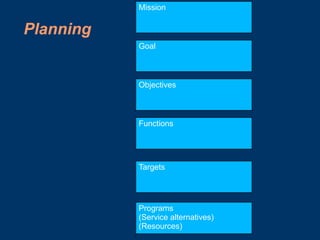
Mission


Planning
           Goal


           Objectives


           Functions


           Targets


           Programs
           (Service alternatives)
           (Resources)
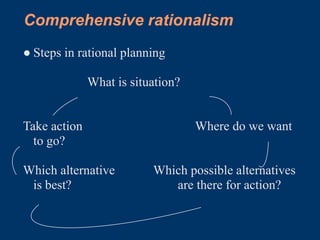
Comprehensive rationalism
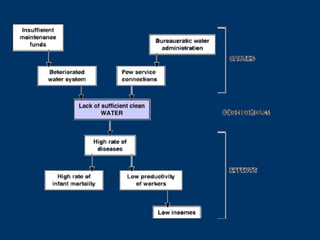
● Steps in rational planning

              What is situation?


Take action                        Where do we want
  to go?

Which alternative         Which possible alternatives
 is best?                    are there for action?
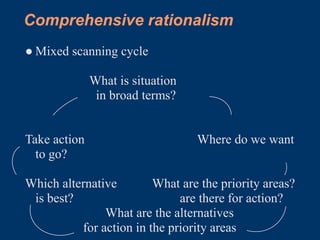
Comprehensive rationalism
● Mixed scanning cycle

              What is situation
               in broad terms?


Take action                       Where do we want
  to go?

Which alternative        What are the priority areas?
 is best?                     are there for action?
               What are the alternatives
          for action in the priority areas
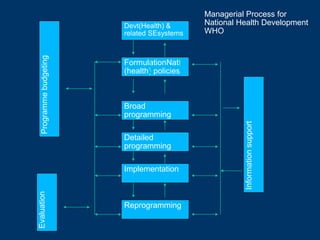
Managerial Process for
                         Devt(Health) &      National Health Development
                         related SEsystems   WHO
   Programme budgeting

                         FormulationNatl
                         (health) policies


                         Broad
                         programming


                                                       Information support
                         Detailed
                         programming

                         Implementation
Evaluation


                         Reprogramming
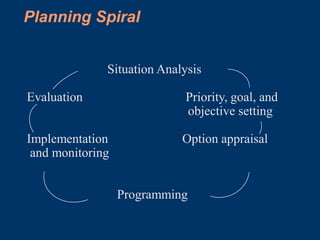
Planning Spiral


              Situation Analysis

Evaluation                  Priority, goal, and
                            objective setting

Implementation              Option appraisal
 and monitoring


                  Programming
Situational analysis


● Current projected situation
  –   Demographic pattern, future needs(development needs)
● Socio-economy and provision of non-development
  services and infrastructure
● Infrastructure of the development sector and the
  pattern of services provided
  –   facilities, utilization, organisational structure,
      interrelationships, current and future resources of the
      sector-financial and real resources- personnel,
      equipment, buildings
● Environment- political and policy environment
● SWOT
Priority Setting


● The determination of the goals and targets of an
  organization
  –   What it wants to achieve
  –   Influenced by the situational analysis,
      development(education, health) needs and broad policy
      objectives of the organization or state
  –   Whether priorities are feasible within politico-social
      climate and within the context of available resources
  –   Clear criteria for the selection of priority problems
      needed
  –   Political feasibility
Rationale for planning
• Inevitable shortfall between available
  resources and the competing uses to which
  those resources could be put
• How decisions as to the use of such resources
  should be made
• Or
• How priorities should be set
Approaches
• For allocation
• Demand based market mechanism
• Need-based planning approach
• One major function of the planning process is
  to determine major needs, to devise suitable
  programs for meeting them and allocate
  resources accordingly
• Not much resources to meet all sector(health)
  needs
• Which one to meet and which have to be left
• Economic development will not remove the
  need for priority setting but alter pattern
Setting Priorities
• Different approaches lead to different results

The Class discuss on
• Who should set priorities?
• How one should set priorities?
• The underlying factors and attitudes towards
  priorities
Logical Framework Analysis
• A designing approach that can be used for
  planning, designing, implementing and
  evaluating projects or programs
• Steps in LFA
• Situational Analysis
• Strategy Analysis
• Project Planning matrix
• Implementation
Situation Analysis
• Stakeholder Analysis
• Problem Analysis
• Objective Analysis
Stakeholder Analysis
• Stakeholder Analysis
    – Who are the stakeholders involved in the project
      and how are they affected?
• Who will be involved?
• Where ?
• Who will facilitate the development?
• What background materials, documents, and
  expertise needed?
• What materials and logistics required?
Analysis of Problems
Which are the problems the project is
 addressing?
What are the root causes of the those
 problems?
What is the larger picture in which those
 problems and their root causes exist?
What are the linkages between problems?
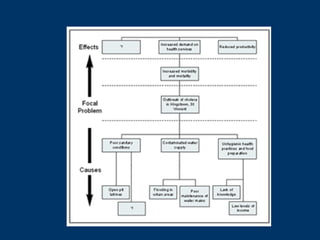
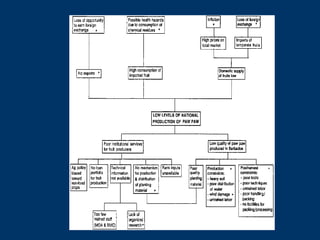
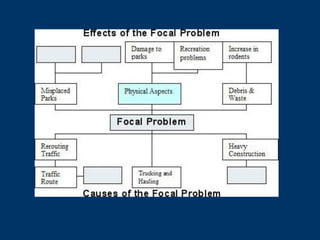
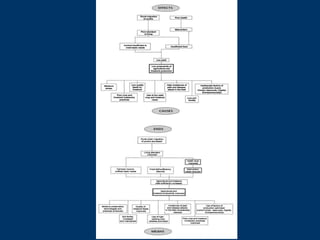
Problem Tree
• Brainstorming techniques can be used to identify
  the main problems
• Problems may be displayed and they should then
  be clustered into groups of similar issues
• Problem tree is developed
• Moving problems from the clusters of problems
• Adding new problems that emerge
• Problems can be moved up or down the tree as
  required
Objective Analysis
•   identify
•   Categorize
•   Specify
•   balancing out
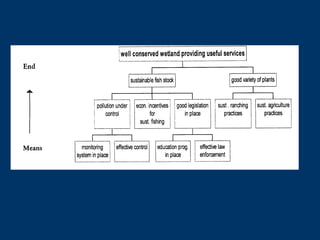
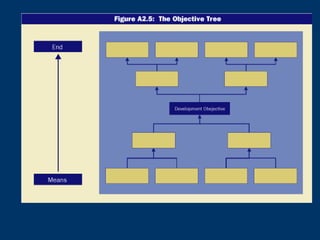
•   Objective Tree
•   Problems restated as objectives
•   Positive mirror image of the problem tree
Strategy Analysis
• Ordering sequence of the problem and
  objective trees
• Clustering objectives
• Feasibility of different interventions
• Continuous task in project management
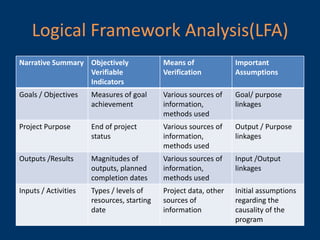
Logical Framework Analysis(LFA)
Narrative Summary Objectively               Means of              Important
                  Verifiable                Verification          Assumptions
                  Indicators
Goals / Objectives    Measures of goal      Various sources of    Goal/ purpose
                      achievement           information,          linkages
                                            methods used
Project Purpose       End of project        Various sources of    Output / Purpose
                      status                information,          linkages
                                            methods used
Outputs /Results      Magnitudes of         Various sources of    Input /Output
                      outputs, planned      information,          linkages
                      completion dates      methods used
Inputs / Activities   Types / levels of     Project data, other   Initial assumptions
                      resources, starting   sources of            regarding the
                      date                  information           causality of the
                                                                  program
Project location and intervention design
• Choose project sites based on market surveys - assess
  demand
• Ensure target audiences, scope, objectives, etc. of project
  are clearly spelt out before implementation
• The importance of building trust and confidence at the
  initiating stage is critical
• It is a challenge to keep up with actual policy processes
  and make the research relevant to governance realities
• Projects are most successful when there is full
  involvement and cooperation by stakeholders
• The success of information system implementation is
  dependent on the institution’s organizational readiness
• Human resources, workflow environment and policy
  should be considered throughout system development
  and implementation
Partnerships and management
• Pay due attention to selection of appropriate partner
• Ensure terms of reference with partner organizations are in
  place before the proposal submission stage itself and begin
  community-based work only after the committed grant
  amount is transferred into the project account
• Consider use of a MoU between implementing partners to
  define a clear program of work and scope of responsibilities
• Project should be prepared to respond to unforeseen political
  developments and transitions in government
• Projects need advice on Intellectual Property Rights issues and
  making the agreement more detailed
• Public-private partnerships with governments and NGOs help
  to improve the quality of services being offered and increase
  acceptance
The unforeseen event
• Increased controls on NGOs and tightening of rules for
  accepting foreign donations
• Premature staff departures
• Delays in obtaining necessary licenses – in this case to
  broadcast using wireless technologies
• The project found employers were reluctant to allow them to
  conduct interviews with employees
• Unexpected technical limitations - in this case, Open Type Font
  specifications
• Project work hampered by political events and technical
  problems that were beyond its control
• Unexpected restrictions imposed on the project team due to
  unforeseen events, thereby seriously hampering progress and
  resulting in a loss of momentum for the project
• Unexpected technical bugs and premature staff departures
Planning for success
• Service providers are not always the best people to develop the kind of online
  services most relevant to rural communities. It is vital to perform a market
  survey before starting such a project and then bring in partners such as
  government institutions, private companies and content providers who will
  back the content and services
• Social preparation programs, awareness workshops and training are
  indispensable components in operating telecentres, especially in rural areas
  where people are not comfortable or familiar with technology
• It is crucial to identify a local champion who is dedicated to using ICT as a tool
  for development, improving the telecentre to make it relevant to the
  community’s context, and making its operation sustainable
• In rural communities, a combination of ICTs with motivated individuals is
  most effective in combating social problems
• Overall impact of the project can be realized fully only with a significant
  outreach program to train the end-users
• For optimum utilization of the end product/service, advertising the
  product/service and training end-users is critical
• Since data-sharing culture is still conservative in the region, a proactive role in
  convincing partners to actively participate is necessary
Participatory processes
• The project team developed a participatory
  model that empowered those involved, built
  capacity and democratized knowledge.
• People in rural areas are ready and capable
  to successfully adopt these new skills and
  technologies not only for education, but also
  to improve themselves and their communities
• The project performed a participatory needs assessment to determine the
  information requirements and the capacity of the users. The results of the
  assessment formed the basis for the preliminary system design .
• It is critical to build trust and confidence at the initiating stages of any
  community-based work.
• The project stresses the value social intermediaries play in bridging the
  information divide. Institutions such as schools, the workplace, and NGOs
  offer important access points for individuals. Informal networks of friends
  and family also play an important role in building awareness and distributing
  knowledge.
• An Internet Exchange can only be successful with the full cooperation of the
  ISPs.
• Educating the ISPs about how to set up the networks is more valuable in the
  long run than having experts do it for them.
• In implementing the project, the project saw that it was critical to establish
  control at the local level through a local coordinator and cooperation units .
• The project worked in close cooperation with local government health
  institutions and personnel who are the primary users of the system .
Adaptive research
•    Following the analysis of the telecentre after one year of operation, the project defined

    three additional research principles to improve its model .
•    Technology is merely a tool; without efforts in marketing, product improvement and
    other non-ICT related capacity development training, the technology usage will not be
    maximized
•    To prevent information and knowledge gaps from widening, the project suggests
    integrating traditional models of communication such as community radio, church bells
    and two-way radios with more modern ICTs .
•    Through interaction with editors of journals and participants of the workshop, the
    project identified several features to improve its system.
•    The rule-based approach was selected over a more sophisticated method because a
    sufficiently large parallel text corpus for the English-Nepali language pair was not
    available.
•    With deeper analysis and understanding of the needs and requirements of end-users,
    one is able to ensure that technology serves the genuine needs of communities and
    does not become an end in itself .
•    By paying close attention to health centre events and culture and by employing
    purposeful immersion in the end-user’s way of life, the researchers were able to gain
    immense insight into their needs and requirements and apply these insights into
    software code, a process they call evolutionary software development .
•   The project was extended by six months to allow for a longer period of data collection
    and validation, which will ensure proper analysis and interpretation .
Common organizational models and
             patterns
• l Provide relevant services by partnering with other providers and make
  each service independently sustainable. Partner with local organizations
  that can train operators and spread awareness of computers and the
  Internet .
• l The project began with a call for participation and selected three partners
  based on the criteria of technical capability and geographic representation .
• l Deploying IPv6 has been enhanced through collaboration with schools and
  universities, ISPs, telecommunications companies and other IPv6
  stakeholders .
• l The Free and Open Source Localization Toolkit is further developing and
  testing its documentation through a south-south collaboration
  (Cambodia/South Africa) project called WordForge .
• l The team has noted the importance of creating public-private partnerships
  with governments, NGOs and health institutions for remote health delivery
  to rural areas.
• They see that such partnerships can improve the quality of services being
  offered and increase acceptance of it by villagers
Financial stability
•    Services offered by the centre generate enough revenue to cover costs; the project team has
    identified new services to serve the local community.
•    The application delivered has quite a high maintenance cost that has obvious implications for
    the project’s sustainability .
•    To be a viable business, build wide area networks to connect a larger number of potential users
    over sparsely populated areas .
•    The key to creating demand and financial viability of the telecentre is to provide information
    and content that is relevant to the local community. Complementing this is the need to provide
    programmes aimed at building relevant ICT skills, particularly in rural areas where people are
    not comfortable or familiar with technology .
•    To cover its costs and to ensure its financial viability, the centre must charge fees for training
    programmes, and even when these fees remain low, many people in the area still cannot afford
    the services
•    Preliminary research found that most initiatives are planned with a pilot-based approach.
•   In many cases, these rely on funding and subsidies to make the model a success. None of the
    initiatives studied were economically sustainable through private enterprise on a large scale
•    The project team notes that obtaining the license or acquiring the software from a
    commercially available GIS is prohibitively expensive. Using free and open source technologies
    allows users greater access to the significant benefits of powerful GIS applications
Lasting impact, continuity and scaling-up
•   Since wireless networking eliminates the process of laying cables to connect villages, the design provides a viable and
    effective means of bridging the digital divide and bringing low-cost communication to the most needy
•    Sustainability of the telecentre requires community participation in telecentre operation and management
•    The research findings contributed to the development of a national IT curriculum and the development of e-
    government
•    Those who attend ICT learning programmes further spread the message through word of mouth and other informal
    channels, creating a ripple effect that is difficult to quantify
•    Once the systems have been tested and firmly established in one federation, the project will document its learning and
    expand the implementation to cover three other federations in the region (see project 18). l While ICTs enable the
    creation of new kinds of jobs, they also undermine the need for other kinds of jobs. The net effect depends upon the
    nature of labour market institutions that facilitate labour to move from vanishing jobs to new ones
•   The results are anticipated to be used in the development of a continuing education programme focusing on ICT-
    assisted reporting techniques for local journalists .
•    The project built capacity at the Centre and enabled it to develop a partnership with PAN Localization and Microsoft’s
    Language Interface Pack for Urdu
•    The project foresees that once the most challenging aspects of the project development process are completed, the
    infrastructure framework can then be used to build many different kinds of resource sharing systems
•   Once project team reaches its desired result, it is planning discussions with the Ministry of Education and Culture to
    investigate further cooperation in distributing the text-to-speech system .
•    The forest fire forecasting system can be adopted and replicated in other geographical areas with necessary
    modifications in the ranks and weights, based on the specific characteristics of the local area
•    Additional research activities evolved from this project .
•   The project has seen a number of opportunities for further development and replication .
•   M-DOK is designed to be easily scalable and low-maintenance. The application is expected to be most useful for
    countries where SMS messaging is prevalent
Tttikm1
Tttikm1

Tttikm1

  • 1.
    Program Management Dr. Kannan Srinivasan Associate Professor Achutha Menon Centre for Health Science Studies Sree Chitra Tirunal Institute for Medical Sciences and Technology Thiruvanthapuram
  • 2.
    Mission Planning Goal Objectives Functions Targets Programs (Service alternatives) (Resources)
  • 3.
    Comprehensive rationalism ● Stepsin rational planning What is situation? Take action Where do we want to go? Which alternative Which possible alternatives is best? are there for action?
  • 4.
    Comprehensive rationalism ● Mixedscanning cycle What is situation in broad terms? Take action Where do we want to go? Which alternative What are the priority areas? is best? are there for action? What are the alternatives for action in the priority areas
  • 5.
    Managerial Process for Devt(Health) & National Health Development related SEsystems WHO Programme budgeting FormulationNatl (health) policies Broad programming Information support Detailed programming Implementation Evaluation Reprogramming
  • 6.
    Planning Spiral Situation Analysis Evaluation Priority, goal, and objective setting Implementation Option appraisal and monitoring Programming
  • 7.
    Situational analysis ● Currentprojected situation – Demographic pattern, future needs(development needs) ● Socio-economy and provision of non-development services and infrastructure ● Infrastructure of the development sector and the pattern of services provided – facilities, utilization, organisational structure, interrelationships, current and future resources of the sector-financial and real resources- personnel, equipment, buildings ● Environment- political and policy environment ● SWOT
  • 8.
    Priority Setting ● Thedetermination of the goals and targets of an organization – What it wants to achieve – Influenced by the situational analysis, development(education, health) needs and broad policy objectives of the organization or state – Whether priorities are feasible within politico-social climate and within the context of available resources – Clear criteria for the selection of priority problems needed – Political feasibility
  • 9.
    Rationale for planning •Inevitable shortfall between available resources and the competing uses to which those resources could be put • How decisions as to the use of such resources should be made • Or • How priorities should be set
  • 10.
    Approaches • For allocation •Demand based market mechanism • Need-based planning approach
  • 11.
    • One majorfunction of the planning process is to determine major needs, to devise suitable programs for meeting them and allocate resources accordingly • Not much resources to meet all sector(health) needs • Which one to meet and which have to be left • Economic development will not remove the need for priority setting but alter pattern
  • 12.
    Setting Priorities • Differentapproaches lead to different results The Class discuss on • Who should set priorities? • How one should set priorities? • The underlying factors and attitudes towards priorities
  • 13.
    Logical Framework Analysis •A designing approach that can be used for planning, designing, implementing and evaluating projects or programs • Steps in LFA • Situational Analysis • Strategy Analysis • Project Planning matrix • Implementation
  • 14.
    Situation Analysis • StakeholderAnalysis • Problem Analysis • Objective Analysis
  • 15.
    Stakeholder Analysis • StakeholderAnalysis – Who are the stakeholders involved in the project and how are they affected? • Who will be involved? • Where ? • Who will facilitate the development? • What background materials, documents, and expertise needed? • What materials and logistics required?
  • 16.
    Analysis of Problems Whichare the problems the project is addressing? What are the root causes of the those problems? What is the larger picture in which those problems and their root causes exist? What are the linkages between problems?
  • 17.
    Problem Tree • Brainstormingtechniques can be used to identify the main problems • Problems may be displayed and they should then be clustered into groups of similar issues • Problem tree is developed • Moving problems from the clusters of problems • Adding new problems that emerge • Problems can be moved up or down the tree as required
  • 23.
    Objective Analysis • identify • Categorize • Specify • balancing out • Objective Tree • Problems restated as objectives • Positive mirror image of the problem tree
  • 26.
    Strategy Analysis • Orderingsequence of the problem and objective trees • Clustering objectives • Feasibility of different interventions • Continuous task in project management
  • 27.
    Logical Framework Analysis(LFA) NarrativeSummary Objectively Means of Important Verifiable Verification Assumptions Indicators Goals / Objectives Measures of goal Various sources of Goal/ purpose achievement information, linkages methods used Project Purpose End of project Various sources of Output / Purpose status information, linkages methods used Outputs /Results Magnitudes of Various sources of Input /Output outputs, planned information, linkages completion dates methods used Inputs / Activities Types / levels of Project data, other Initial assumptions resources, starting sources of regarding the date information causality of the program
  • 28.
    Project location andintervention design • Choose project sites based on market surveys - assess demand • Ensure target audiences, scope, objectives, etc. of project are clearly spelt out before implementation • The importance of building trust and confidence at the initiating stage is critical • It is a challenge to keep up with actual policy processes and make the research relevant to governance realities • Projects are most successful when there is full involvement and cooperation by stakeholders • The success of information system implementation is dependent on the institution’s organizational readiness • Human resources, workflow environment and policy should be considered throughout system development and implementation
  • 29.
    Partnerships and management •Pay due attention to selection of appropriate partner • Ensure terms of reference with partner organizations are in place before the proposal submission stage itself and begin community-based work only after the committed grant amount is transferred into the project account • Consider use of a MoU between implementing partners to define a clear program of work and scope of responsibilities • Project should be prepared to respond to unforeseen political developments and transitions in government • Projects need advice on Intellectual Property Rights issues and making the agreement more detailed • Public-private partnerships with governments and NGOs help to improve the quality of services being offered and increase acceptance
  • 30.
    The unforeseen event •Increased controls on NGOs and tightening of rules for accepting foreign donations • Premature staff departures • Delays in obtaining necessary licenses – in this case to broadcast using wireless technologies • The project found employers were reluctant to allow them to conduct interviews with employees • Unexpected technical limitations - in this case, Open Type Font specifications • Project work hampered by political events and technical problems that were beyond its control • Unexpected restrictions imposed on the project team due to unforeseen events, thereby seriously hampering progress and resulting in a loss of momentum for the project • Unexpected technical bugs and premature staff departures
  • 31.
    Planning for success •Service providers are not always the best people to develop the kind of online services most relevant to rural communities. It is vital to perform a market survey before starting such a project and then bring in partners such as government institutions, private companies and content providers who will back the content and services • Social preparation programs, awareness workshops and training are indispensable components in operating telecentres, especially in rural areas where people are not comfortable or familiar with technology • It is crucial to identify a local champion who is dedicated to using ICT as a tool for development, improving the telecentre to make it relevant to the community’s context, and making its operation sustainable • In rural communities, a combination of ICTs with motivated individuals is most effective in combating social problems • Overall impact of the project can be realized fully only with a significant outreach program to train the end-users • For optimum utilization of the end product/service, advertising the product/service and training end-users is critical • Since data-sharing culture is still conservative in the region, a proactive role in convincing partners to actively participate is necessary
  • 32.
    Participatory processes • Theproject team developed a participatory model that empowered those involved, built capacity and democratized knowledge. • People in rural areas are ready and capable to successfully adopt these new skills and technologies not only for education, but also to improve themselves and their communities
  • 33.
    • The projectperformed a participatory needs assessment to determine the information requirements and the capacity of the users. The results of the assessment formed the basis for the preliminary system design . • It is critical to build trust and confidence at the initiating stages of any community-based work. • The project stresses the value social intermediaries play in bridging the information divide. Institutions such as schools, the workplace, and NGOs offer important access points for individuals. Informal networks of friends and family also play an important role in building awareness and distributing knowledge. • An Internet Exchange can only be successful with the full cooperation of the ISPs. • Educating the ISPs about how to set up the networks is more valuable in the long run than having experts do it for them. • In implementing the project, the project saw that it was critical to establish control at the local level through a local coordinator and cooperation units . • The project worked in close cooperation with local government health institutions and personnel who are the primary users of the system .
  • 34.
    Adaptive research • Following the analysis of the telecentre after one year of operation, the project defined three additional research principles to improve its model . • Technology is merely a tool; without efforts in marketing, product improvement and other non-ICT related capacity development training, the technology usage will not be maximized • To prevent information and knowledge gaps from widening, the project suggests integrating traditional models of communication such as community radio, church bells and two-way radios with more modern ICTs . • Through interaction with editors of journals and participants of the workshop, the project identified several features to improve its system. • The rule-based approach was selected over a more sophisticated method because a sufficiently large parallel text corpus for the English-Nepali language pair was not available. • With deeper analysis and understanding of the needs and requirements of end-users, one is able to ensure that technology serves the genuine needs of communities and does not become an end in itself . • By paying close attention to health centre events and culture and by employing purposeful immersion in the end-user’s way of life, the researchers were able to gain immense insight into their needs and requirements and apply these insights into software code, a process they call evolutionary software development . • The project was extended by six months to allow for a longer period of data collection and validation, which will ensure proper analysis and interpretation .
  • 35.
    Common organizational modelsand patterns • l Provide relevant services by partnering with other providers and make each service independently sustainable. Partner with local organizations that can train operators and spread awareness of computers and the Internet . • l The project began with a call for participation and selected three partners based on the criteria of technical capability and geographic representation . • l Deploying IPv6 has been enhanced through collaboration with schools and universities, ISPs, telecommunications companies and other IPv6 stakeholders . • l The Free and Open Source Localization Toolkit is further developing and testing its documentation through a south-south collaboration (Cambodia/South Africa) project called WordForge . • l The team has noted the importance of creating public-private partnerships with governments, NGOs and health institutions for remote health delivery to rural areas. • They see that such partnerships can improve the quality of services being offered and increase acceptance of it by villagers
  • 36.
    Financial stability • Services offered by the centre generate enough revenue to cover costs; the project team has identified new services to serve the local community. • The application delivered has quite a high maintenance cost that has obvious implications for the project’s sustainability . • To be a viable business, build wide area networks to connect a larger number of potential users over sparsely populated areas . • The key to creating demand and financial viability of the telecentre is to provide information and content that is relevant to the local community. Complementing this is the need to provide programmes aimed at building relevant ICT skills, particularly in rural areas where people are not comfortable or familiar with technology . • To cover its costs and to ensure its financial viability, the centre must charge fees for training programmes, and even when these fees remain low, many people in the area still cannot afford the services • Preliminary research found that most initiatives are planned with a pilot-based approach. • In many cases, these rely on funding and subsidies to make the model a success. None of the initiatives studied were economically sustainable through private enterprise on a large scale • The project team notes that obtaining the license or acquiring the software from a commercially available GIS is prohibitively expensive. Using free and open source technologies allows users greater access to the significant benefits of powerful GIS applications
  • 37.
    Lasting impact, continuityand scaling-up • Since wireless networking eliminates the process of laying cables to connect villages, the design provides a viable and effective means of bridging the digital divide and bringing low-cost communication to the most needy • Sustainability of the telecentre requires community participation in telecentre operation and management • The research findings contributed to the development of a national IT curriculum and the development of e- government • Those who attend ICT learning programmes further spread the message through word of mouth and other informal channels, creating a ripple effect that is difficult to quantify • Once the systems have been tested and firmly established in one federation, the project will document its learning and expand the implementation to cover three other federations in the region (see project 18). l While ICTs enable the creation of new kinds of jobs, they also undermine the need for other kinds of jobs. The net effect depends upon the nature of labour market institutions that facilitate labour to move from vanishing jobs to new ones • The results are anticipated to be used in the development of a continuing education programme focusing on ICT- assisted reporting techniques for local journalists . • The project built capacity at the Centre and enabled it to develop a partnership with PAN Localization and Microsoft’s Language Interface Pack for Urdu • The project foresees that once the most challenging aspects of the project development process are completed, the infrastructure framework can then be used to build many different kinds of resource sharing systems • Once project team reaches its desired result, it is planning discussions with the Ministry of Education and Culture to investigate further cooperation in distributing the text-to-speech system . • The forest fire forecasting system can be adopted and replicated in other geographical areas with necessary modifications in the ranks and weights, based on the specific characteristics of the local area • Additional research activities evolved from this project . • The project has seen a number of opportunities for further development and replication . • M-DOK is designed to be easily scalable and low-maintenance. The application is expected to be most useful for countries where SMS messaging is prevalent