PROJECT MANAGEMENT (PM)
Ismael Torres-Pizarro, PhD PE Esq.
1
What is a Project?
• A plan, a proposal, a scheme
– An undertaking requiring coordinate effort
– A set of activities aimed to achieve a specific
objective with a clear start, middle and end.
2
PMI Defines a “Project” as
• A temporary group activity designed to produce a
unique product, service or result.
– temporary: it has a defined beginning and end in time, and
therefore defined scope and resources.
– Unique: it is not a routine operation, but a specific set of
operations designed to accomplish a singular goal. So a
project team often includes people who don’t usually work
together – sometimes from different organizations and
across multiple geographies.
• The development of software for an improved business process,
the construction of a building or bridge, the relief effort after a
natural disaster, the expansion of sales into a new geographic
market — all are projects.
– And all must be expertly managed to deliver the on-time, on-budget
results, learning and integration that organizations need.
3
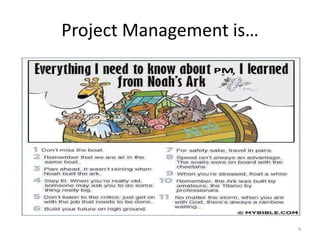
Project Management is…
4
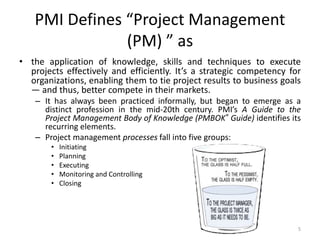
PMI Defines “Project Management
(PM) ” as
• the application of knowledge, skills and techniques to execute
projects effectively and efficiently. It’s a strategic competency for
organizations, enabling them to tie project results to business goals
— and thus, better compete in their markets.
– It has always been practiced informally, but began to emerge as a
distinct profession in the mid-20th century. PMI’s A Guide to the
Project Management Body of Knowledge (PMBOK® Guide) identifies its
recurring elements.
– Project management processes fall into five groups:
• Initiating
• Planning
• Executing
• Monitoring and Controlling
• Closing
5
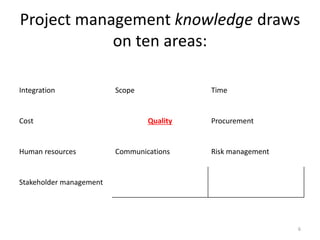
Project management knowledge draws
on ten areas:
Integration Scope Time
Cost Quality Procurement
Human resources Communications Risk management
Stakeholder management
6
PMI Defines “Project Quality
Management (PM) ” as
• The processes and activities of the performing
organization that determine quality policies,
objectives, and responsibilities so that the project
will satisfy the needs for which it was undertaken.
– Uses policies and procedures to implement, within the
project’s context, the organization’s quality
management system and, as appropriate, it supports
continuous process improvement activities as
undertaken on behalf of the performing organization.
– Works to ensure that the project requirements,
including product requirements, are met and
validated.
7
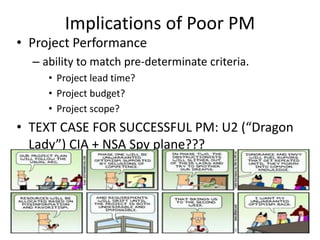
Implications of Poor PM
• Project Performance
– ability to match pre-determinate criteria.
• Project lead time?
• Project budget?
• Project scope?
• TEXT CASE FOR SUCCESSFUL PM: U2 (“Dragon
Lady”) CIA + NSA Spy plane???
8
9
Organizations related to PM Quality
• ASQ
• https://www.facebook.com/ASQ
– Puerto Rico chapter
• https://www.facebook.com/groups/9311093119/
• PMI
– https://www.facebook.com/PMInstitute
• Puerto Rico chapter
– http://www.pmipr.org/
10
CIAPR
• http://myemail.constantcontact.com/Agile-
project-management-course--CIAPR-Special-
Offer--
.html?soid=1104332901906&aid=KJbUgH4qdS
g
• http://ciapr.org/mayaguez/images/stories/Jos
e/Seminarios/Flyer%20PMP%20Seminar%20CI
APR%20May%20Oct-19%20rev1.0.pdf
11
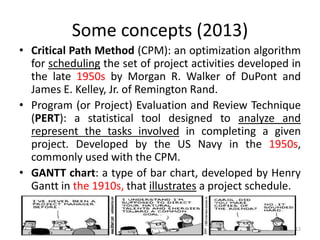
Some concepts (2013)
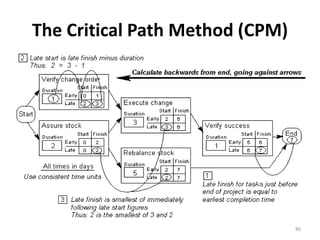
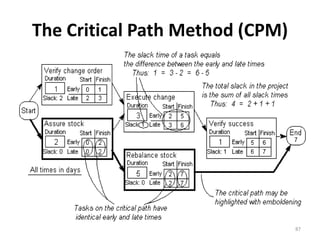
• Critical Path Method (CPM): an optimization algorithm
for scheduling the set of project activities developed in
the late 1950s by Morgan R. Walker of DuPont and
James E. Kelley, Jr. of Remington Rand.
• Program (or Project) Evaluation and Review Technique
(PERT): a statistical tool designed to analyze and
represent the tasks involved in completing a given
project. Developed by the US Navy in the 1950s,
commonly used with the CPM.
• GANTT chart: a type of bar chart, developed by Henry
Gantt in the 1910s, that illustrates a project schedule.
12
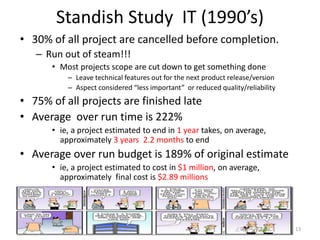
Standish Study IT (1990’s)
• 30% of all project are cancelled before completion.
– Run out of steam!!!
• Most projects scope are cut down to get something done
– Leave technical features out for the next product release/version
– Aspect considered “less important” or reduced quality/reliability
• 75% of all projects are finished late
• Average over run time is 222%
• ie, a project estimated to end in 1 year takes, on average,
approximately 3 years 2.2 months to end
• Average over run budget is 189% of original estimate
• ie, a project estimated to cost in $1 million, on average,
approximately final cost is $2.89 millions
13
14
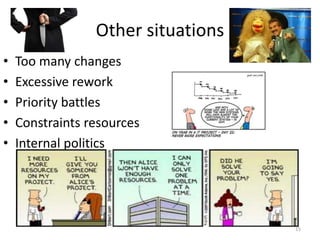
Other situations
• Too many changes
• Excessive rework
• Priority battles
• Constraints resources
• Internal politics
15
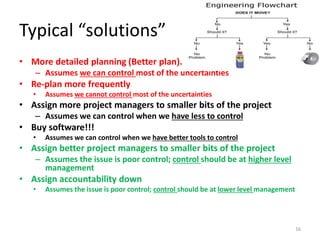
Typical “solutions”
• More detailed planning (Better plan).
– Assumes we can control most of the uncertainties
• Re-plan more frequently
• Assumes we cannot control most of the uncertainties
• Assign more project managers to smaller bits of the project
– Assumes we can control when we have less to control
• Buy software!!!
• Assumes we can control when we have better tools to control
• Assign better project managers to smaller bits of the project
– Assumes the issue is poor control; control should be at higher level
management
• Assign accountability down
• Assumes the issue is poor control; control should be at lower level management
16
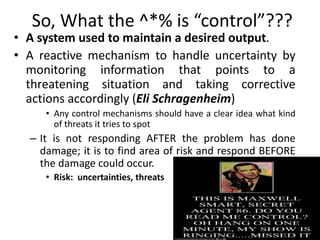
So, What the ^*% is “control”???
• A system used to maintain a desired output.
• A reactive mechanism to handle uncertainty by
monitoring information that points to a
threatening situation and taking corrective
actions accordingly (Eli Schragenheim)
• Any control mechanisms should have a clear idea what kind
of threats it tries to spot
– It is not responding AFTER the problem has done
damage; it is to find area of risk and respond BEFORE
the damage could occur.
• Risk: uncertainties, threats
17
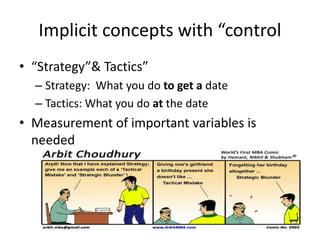
Implicit concepts with “control
• “Strategy”& Tactics”
– Strategy: What you do to get a date
– Tactics: What you do at the date
• Measurement of important variables is
needed
18
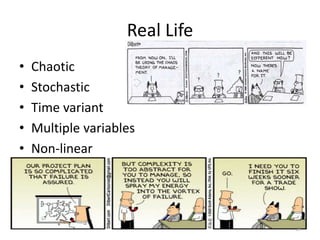
Real Life
• Chaotic
• Stochastic
• Time variant
• Multiple variables
• Non-linear
19
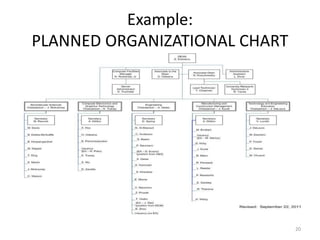
Example:
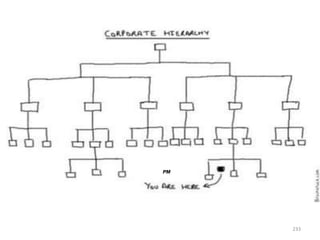
PLANNED ORGANIZATIONAL CHART
20
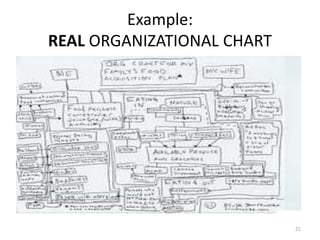
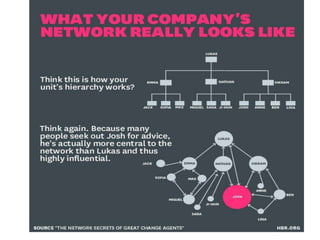
Example:
REAL ORGANIZATIONAL CHART
21
No plan survives contact with the
enemy…Gen. Von Moltke
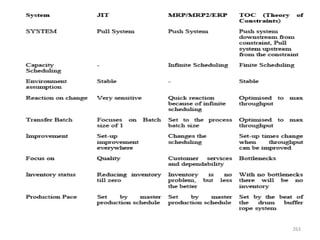
• Theory of Constraints (TOC)
– a management approach that views system as
being limited in achieving its goals by a very small
number of constraints.
• There is always at least one constraint, and TOC uses a
focusing process to identify the constraint and
restructure the rest of the organization around it.
"a chain is no stronger than its weakest link".
22
TOC
• Introduced by Dr. Eliyahu M. Goldratt in his
1984 book titled The Goal, geared to help
organizations continually achieve their goal.
– Goldratt adapted the concept to PM with his book
Critical Chain, 1997.
23
The Five Focusing Steps
• Theory of constraints is based on the premise that the
rate of goal achievement by a goal-oriented system
(i.e., the system's throughput) is limited by at least one
constraint.
– The argument by reductio ad absurdum is as follows: If
there was nothing preventing a system from achieving
higher throughput (i.e., more goal units in a unit of time),
its throughput would be infinite — which is impossible in a
real-life system.
• Only by increasing flow through the constraint can
overall throughput be increased.
– A constraint is anything that prevents the system from
achieving more of its goal.
24
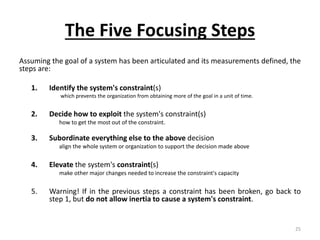
The Five Focusing Steps
Assuming the goal of a system has been articulated and its measurements defined, the
steps are:
1. Identify the system's constraint(s)
which prevents the organization from obtaining more of the goal in a unit of time.
2. Decide how to exploit the system's constraint(s)
how to get the most out of the constraint.
3. Subordinate everything else to the above decision
align the whole system or organization to support the decision made above
4. Elevate the system's constraint(s)
make other major changes needed to increase the constraint's capacity
5. Warning! If in the previous steps a constraint has been broken, go back to
step 1, but do not allow inertia to cause a system's constraint.
25
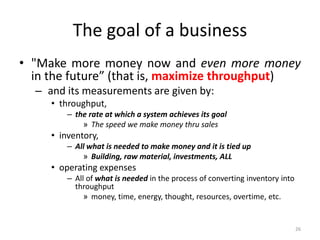
The goal of a business
• "Make more money now and even more money
in the future” (that is, maximize throughput)
– and its measurements are given by:
• throughput,
– the rate at which a system achieves its goal
» The speed we make money thru sales
• inventory,
– All what is needed to make money and it is tied up
» Building, raw material, investments, ALL
• operating expenses
– All of what is needed in the process of converting inventory into
throughput
» money, time, energy, thought, resources, overtime, etc.
26
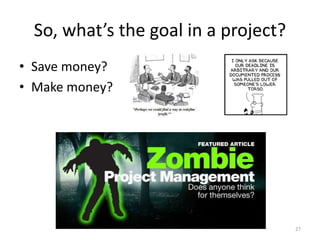
So, what’s the goal in a project?
• Save money?
• Make money?
27
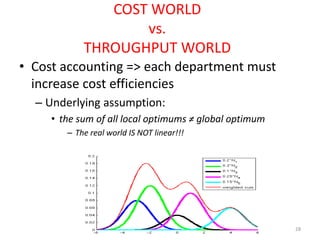
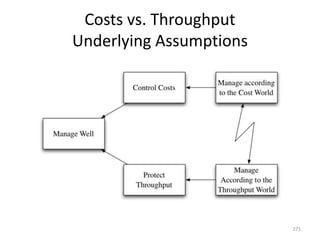
COST WORLD
vs.
THROUGHPUT WORLD
• Cost accounting => each department must
increase cost efficiencies
– Underlying assumption:
• the sum of all local optimums ≠ global optimum
– The real world IS NOT linear!!!
28
• We are saying that many local improvements
DO NOT necessarily add up to the GLOBAL
IMPROVEMENTS.
– That is, almost ALL we knew is just wrong!!!
• Reason been we think the world is linear, which it is not
29
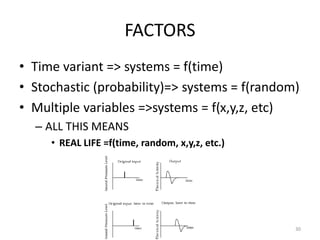
FACTORS
• Time variant => systems = f(time)
• Stochastic (probability)=> systems = f(random)
• Multiple variables =>systems = f(x,y,z, etc)
– ALL THIS MEANS
• REAL LIFE =f(time, random, x,y,z, etc.)
30
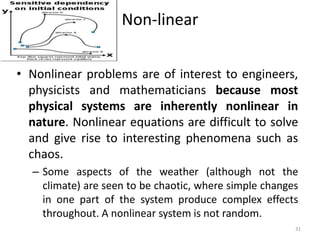
Non-linear
• Nonlinear problems are of interest to engineers,
physicists and mathematicians because most
physical systems are inherently nonlinear in
nature. Nonlinear equations are difficult to solve
and give rise to interesting phenomena such as
chaos.
– Some aspects of the weather (although not the
climate) are seen to be chaotic, where simple changes
in one part of the system produce complex effects
throughout. A nonlinear system is not random.
31
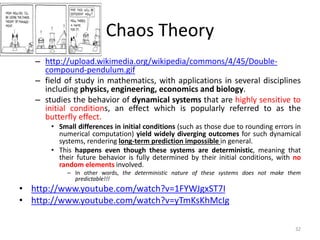
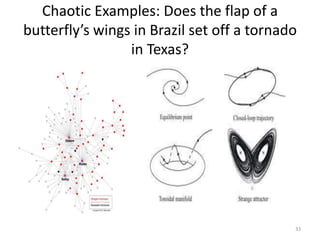
Chaos Theory
– http://upload.wikimedia.org/wikipedia/commons/4/45/Double-
compound-pendulum.gif
– field of study in mathematics, with applications in several disciplines
including physics, engineering, economics and biology.
– studies the behavior of dynamical systems that are highly sensitive to
initial conditions, an effect which is popularly referred to as the
butterfly effect.
• Small differences in initial conditions (such as those due to rounding errors in
numerical computation) yield widely diverging outcomes for such dynamical
systems, rendering long-term prediction impossible in general.
• This happens even though these systems are deterministic, meaning that
their future behavior is fully determined by their initial conditions, with no
random elements involved.
– In other words, the deterministic nature of these systems does not make them
predictable!!!
• http://www.youtube.com/watch?v=1FYWJgxST7I
• http://www.youtube.com/watch?v=yTmKsKhMcIg
32
Chaotic Examples: Does the flap of a
butterfly’s wings in Brazil set off a tornado
in Texas?
33
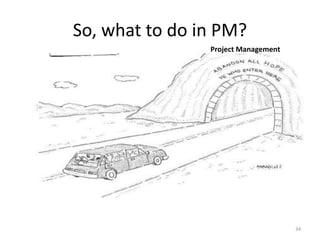
So, what to do in PM?
34
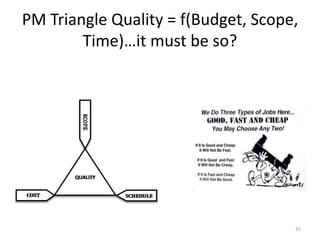
Project Management
PM Triangle Quality = f(Budget, Scope,
Time)…it must be so?
35
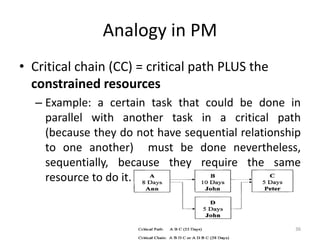
Analogy in PM
• Critical chain (CC) = critical path PLUS the
constrained resources
– Example: a certain task that could be done in
parallel with another task in a critical path
(because they do not have sequential relationship
to one another) must be done nevertheless,
sequentially, because they require the same
resource to do it.
36
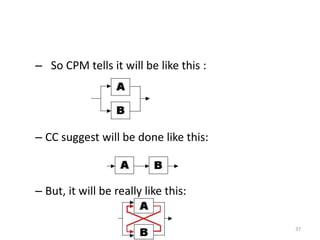
– So CPM tells it will be like this :
– CC suggest will be done like this:
– But, it will be really like this:
37
38
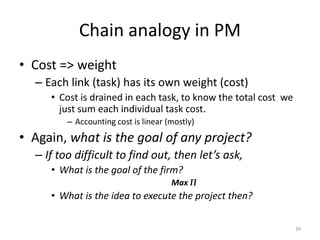
Chain analogy in PM
• Cost => weight
– Each link (task) has its own weight (cost)
• Cost is drained in each task, to know the total cost we
just sum each individual task cost.
– Accounting cost is linear (mostly)
• Again, what is the goal of any project?
– If too difficult to find out, then let’s ask,
• What is the goal of the firm?
Max Π
• What is the idea to execute the project then?
39
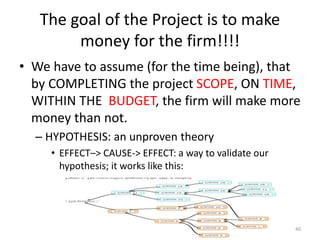
The goal of the Project is to make
money for the firm!!!!
• We have to assume (for the time being), that
by COMPLETING the project SCOPE, ON TIME,
WITHIN THE BUDGET, the firm will make more
money than not.
– HYPOTHESIS: an unproven theory
• EFFECT–> CAUSE-> EFFECT: a way to validate our
hypothesis; it works like this:
40
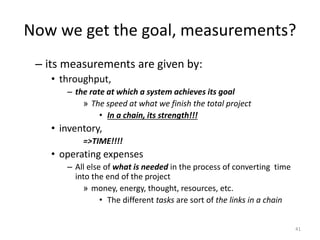
Now we get the goal, measurements?
– its measurements are given by:
• throughput,
– the rate at which a system achieves its goal
» The speed at what we finish the total project
• In a chain, its strength!!!
• inventory,
=>TIME!!!!
• operating expenses
– All else of what is needed in the process of converting time
into the end of the project
» money, energy, thought, resources, etc.
• The different tasks are sort of the links in a chain
41
42
Cost vs. Throughput
• It is posed that once a project starts, the
budget fixation (Cost world) primes the time
(Throughput).
– Arguably one of the causes the PM looses focus
• A correct financial system must include the economic
losses that losing throughput (time) implies.
– It has been argued that financially speaking running late is
more costly than being over budget
» The project budget is not geared toward the “economic
loss”, cost of opportunities (being late in the market,
interest paid for money invested with no returns, etc.)
43
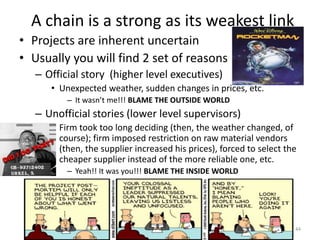
A chain is a strong as its weakest link
• Projects are inherent uncertain
• Usually you will find 2 set of reasons
– Official story (higher level executives)
• Unexpected weather, sudden changes in prices, etc.
– It wasn’t me!!! BLAME THE OUTSIDE WORLD
– Unofficial stories (lower level supervisors)
• Firm took too long deciding (then, the weather changed, of
course); firm imposed restriction on raw material vendors
(then, the supplier increased his prices), forced to select the
cheaper supplier instead of the more reliable one, etc.
– Yeah!! It was you!!! BLAME THE INSIDE WORLD
44
Leader=>Knows-why!!!
45
Manager=>Knows-how;
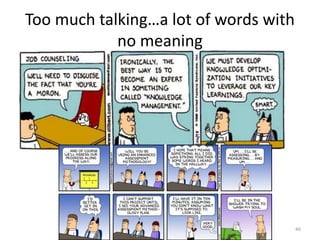
Too much talking…a lot of words with
no meaning
46
Individual tasks
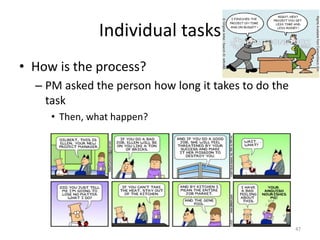
• How is the process?
– PM asked the person how long it takes to do the
task
• Then, what happen?
47
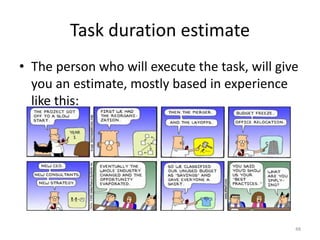
Task duration estimate
• The person who will execute the task, will give
you an estimate, mostly based in experience
like this:
48
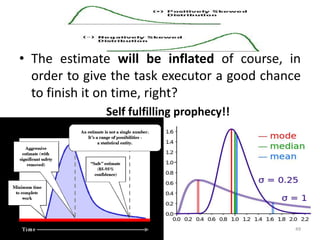
• The estimate will be inflated of course, in
order to give the task executor a good chance
to finish it on time, right?
Self fulfilling prophecy!!
49
“Realistic” estimate which it isn’t
• It is heavily skewed, mostly based on the worst case
scenario (MURPHY LAW) and,
– A lot of time IT IS NOT A REAL TIME DURATION FOR THE
TASK but the TIME WHEN THE EXECUTOR thinks will be
able to complete the task!!!!
• PM: Give an estimate of how long task X will take
• ME: mmm… 2 weeks (it actually takes 2 days, but I have a meeting
on Friday, I want Monday off to get some stuff for my party, I have
to finish project Zombie on Tuesday….so, I could start this task on
Wednesday morning and have done by Friday afternoon easily)
– Some authors claim that estimates are inflated as to get no less than
90% chance of completion
– You ask for the duration of the activity (how long does it
takes) but the answer is a DUE DATE!! (when I think it
will be done)
50
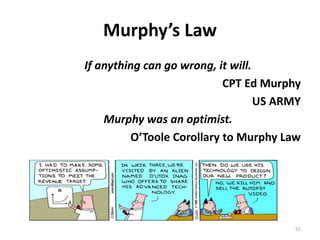
Murphy’s Law
If anything can go wrong, it will.
CPT Ed Murphy
US ARMY
Murphy was an optimist.
O’Toole Corollary to Murphy Law
51
52
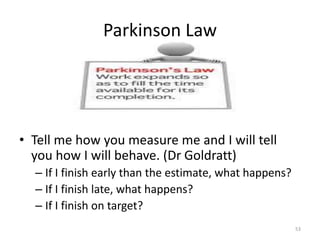
Parkinson Law
53
• Tell me how you measure me and I will tell
you how I will behave. (Dr Goldratt)
– If I finish early than the estimate, what happens?
– If I finish late, what happens?
– If I finish on target?
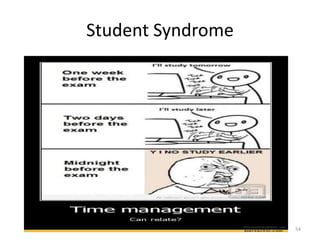
Student Syndrome
54
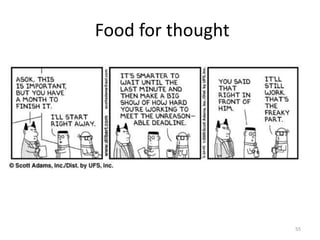
Food for thought
55
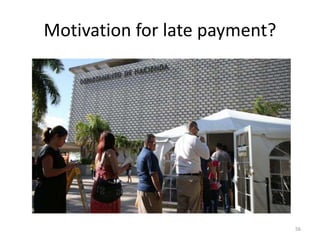
Motivation for late payment?
56
Laziness?
• Not in the case of Hacienda; if you will have to pay, it is
optimum to pay as late as possible, since the money
will be in your account gaining interest for you and you
wont pay any penalty.
• However, you could have completed your tax forms
earlier and then, just need to handed it in, why
expecting to the last day to fill it then?
– Maybe because to pay (and knowing we have to pay) it is a
thing we just don’t like to do?
– Could be anything similar explains the student syndrome?
• What if the task assigned is not fun, maybe it is hard, boring and
totally uncool or unrelated to my own work, motivations, etc?
– It is likely that a tasked assignment in a project you are not vested in
any way, you would delay it until you know you cant procrastinaste it
no more (because then, the penalty of failure will be too high)
57
STOP!!!!
• Let’s recap on what we are learned so far
58
59
PROJECT MANAGEMENT… IS MADE
OUT OF PEOPLE!!!
• Organizations and project teams are people. I
think we forget this….Yet managers often
focus on everything…. but people. Lewis, J.
(text author)
• http://www.youtube.com/watch?v=8Sp-VFBbjpE
60
61
Socratic method:
• form of inquiry and debate between
individuals with opposing viewpoints based on
asking and answering questions to stimulate
critical thinking and to illuminate ideas.
– widely used in contemporary legal education by
most law schools in the United States.
• http://www.youtube.com/watch?v=pZIonnMTLUA
62
Earned Value Analysis (Management)
• Purpose is to ensure that value and expenditure
stay approximately the same during the project
execution.
– Early users included the US Department of Defense
– to ensure that the project expenditure is in line with
the value of the deliverables
• very relevant for expensive projects running over several
years
– Deliverables become available only towards the end of the
project
– The entire investment is always at risk because
something might happen to prevent the project
completing.
63
• Expenditure is what we have spent, in other
words, the actual costs.
– They should be as planned but real life =>Price
changes, Extra costs (overtime, expedite deliveries
etc.),
• Value is what something is worth
64
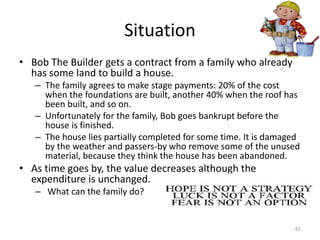
Situation
• Bob The Builder gets a contract from a family who already
has some land to build a house.
– The family agrees to make stage payments: 20% of the cost
when the foundations are built, another 40% when the roof has
been built, and so on.
– Unfortunately for the family, Bob goes bankrupt before the
house is finished.
– The house lies partially completed for some time. It is damaged
by the weather and passers-by who remove some of the unused
material, because they think the house has been abandoned.
• As time goes by, the value decreases although the
expenditure is unchanged.
– What can the family do?
65
• All projects are like this:
– During the project and before the deliverables are
handed over to the project customer, the Work in
Progress is analogue to what is built of the house. Its
Value is likely to be less than the Expenditure.
• This is not very comforting for the project sponsor, (house
owners) who has to provide the budget.
• As general rule, the market for “half” completed projects is
not good. This means that until a project is finished, or at
least some usable work packages have been completed, the
company’s investment in the project is at risk.
66
1st of 2 Possibilities (may be others)
• Can we phase our projects in such a way that
the value is delivered as early as possible?
– This would be much better than getting it all at
the very end.
• depends on the particular project.
• Example: building a small but self sufficient
supermarket first, then expand it by phases.
67
2nd of 2
• Can we somehow track the value of a project
without selling it (as the economists would
tell us) to check the real value? This is the
thinking behind Earned Value Management,
EVM.
68
Build a garden fence project numerical
example
• Owner tell me to use 20 high quality wooden posts, and
that she will give me a budget of $20 for each post.
– All the other costs are too small to be counted (for example the
wires between the posts) or my labor (which is free of charge).
• As project manager, I point out that I am only free for this
heavy work during weekends, provided that there is no rain
or snow and that I am not too tired.
• I expect to mount 3 posts per week, including buying the
materials, digging and making a concrete foot for each
post.
• Each week the project sponsor (owner) comes into the
garden to check progress.
– What information does she look for?
69
• $20 per post for 20 posts, a total of $400. In other
words, if she sees 3 posts fully mounted, she says they
are worth $60, whatever they actually cost.
• Now, reality kick in:
• What actually happens the first weekend is that some
material gets damaged, which the PM had to replace
out of the project budget. PM also spent some of the
materials budget on beer, when he met a friend at the
building materials supplier.
– PM actually mounted the 3 posts but spent$90
70
• To control costs, we now need to introduce a new
parameter to relate costs to the Value of the
work that has actually been done.
– Unfortunately, without selling the partially built fence
there is no accurate way to estimate value.
– So the owner decides to see how much spending she
has planned, in this case $60, and decides that this is
good enough to use as a substitute (proxy) for an
estimate of value.
• It is not the value, but a “convenient” substitute.
– This is a budget amount related to when it should have been
spent, but the method calls it “value”.
71
Work Performance Measurements:
Cost tracking
• Cost Variance, CV: This terminology comes
from accounting practice and means how
different the costs are (how much they vary)
from the plan.
• Cost Performance Index, CPI: This is a
normalized indicator of cost performance.
– Normalization means that the scale of values
expected is the same for all projects.
72
• According to the owner’s original plan, 3 completed
posts should have cost 3 x $20 = $ 60.
– Earned Value, EV = $60
– Actual Cost, AC =$90
• Cost Variance, CV = EV - AC;
– in this case $60 - $90 =-$30
• Cost Performance Index, CPI = EV/AC= 60/90≈ 0.67
• If the CPI (0.67) <1 I am over budget; my costs are
higher than planned.
• IF CPI= 1 my costs are as planned, I’m right on budget
– if CPI > 1 ….=>lying weasel warning!!!!
73
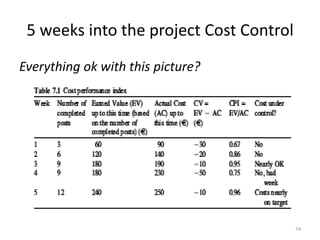
5 weeks into the project Cost Control
Everything ok with this picture?
74
To-Complete Performance Index, TCPI
• Budget at Completion, BAC: This is just the
total budget amount. ($400 in the example).
– TCPI=(BAC-EV)/(BAC-AC)
– (400-60)/(400-90) = 340/310 ≈ 1.097
• If EV=AC, TCPI =1 (everything under control)
• If EV >AC, TCPI <1 (lying weasel alarm!!!)
• If EV <AC, TCPI>1
– http://www.youtube.com/watch?v=yd1uEvyzCmM
75
• Of course, if a project has poor cost performance
earlier on, then this needs to get dramatically
better towards the end of the project to complete
on time and within budget.
• However if nothing changes, except the demands
of management, then the chances of the TCPI
improving dramatically are near zero.
• In other words, unless the costs are in control
from very early on, it is IMPOSSIBLE to catch up,
unless changes to the project constraints are
agreed. This is called “re-planning”.
76
EVM Schedule Control
• Planned Value, PV: makes the same assumption
as before: The approved budget ($20 per post) is
a good way of linking value and schedule (when it
should be achieved).
• Compares EV (as a substitute for the value
estimate of the work that has been done) with an
estimate of the value that was planned for
completion by each inspection day.
– IF {the real value of the completed work}
• IS EQUAL TO {the budget for the work that was planned to
be completed now (the PV)}
– THEN the work is on schedule
77
Schedule Performance Index, SPI
• An indication of schedule, a time parameter,
even though is derived using amounts of money
– SPI =EV/ PV
• SPI =1.0, then the progress is on track
• SPI<1, we are behind schedule
• Compare against CC, where time (fb) are used
to control schedule
78
Schedule Variance, SV:
• SV = EV – PV
• Again, we are using MONEY amounts to track
SCHEDULE or TIME progress.
79
80
Some definitions
• Estimate (of costs) at Completion, EAC: the
total by how much do you think you spend at
the end of the project.
– Everything we have spent until now (Actual Costs,
AC) + our Estimate [of the remaining costs] to
Complete the project, ETC
• Variance at Completion, VAC= BAC –EAC
– by how much do you think you will be over or
under budget at the end of the project
81
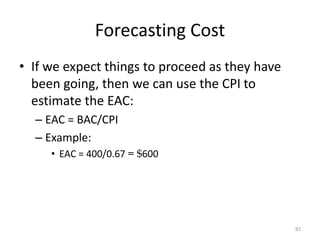
Forecasting Cost
• If we expect things to proceed as they have
been going, then we can use the CPI to
estimate the EAC:
– EAC = BAC/CPI
– Example:
• EAC = 400/0.67 = $600
82
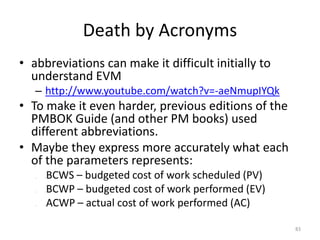
Death by Acronyms
• abbreviations can make it difficult initially to
understand EVM
– http://www.youtube.com/watch?v=-aeNmupIYQk
• To make it even harder, previous editions of the
PMBOK Guide (and other PM books) used
different abbreviations.
• Maybe they express more accurately what each
of the parameters represents:
– l BCWS – budgeted cost of work scheduled (PV)
– l BCWP – budgeted cost of work performed (EV)
– l ACWP – actual cost of work performed (AC)
83
Critical Path/Chain Again
• Earlier vs. late start
– What would happen if we start EVERYTHING
early? Everything late?
• Task in the CC?
• Task no in the CC?
– Investment?
– Focus?
84
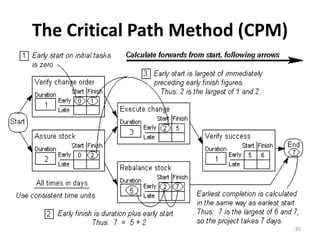
The Critical Path Method (CPM)
85
The Critical Path Method (CPM)
86
The Critical Path Method (CPM)
87
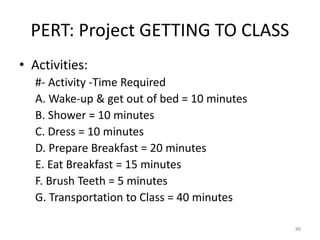
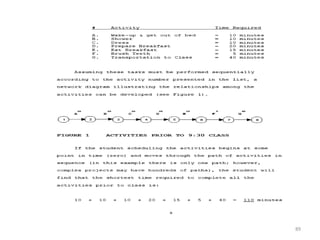
PERT: Project GETTING TO CLASS
• Activities:
#- Activity -Time Required
A. Wake-up & get out of bed = 10 minutes
B. Shower = 10 minutes
C. Dress = 10 minutes
D. Prepare Breakfast = 20 minutes
E. Eat Breakfast = 15 minutes
F. Brush Teeth = 5 minutes
G. Transportation to Class = 40 minutes
88
89
90
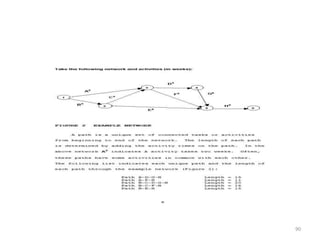
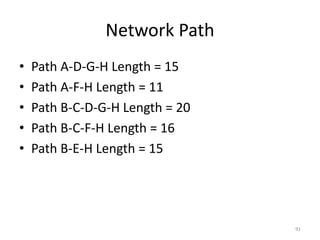
Network Path
• Path A-D-G-H Length = 15
• Path A-F-H Length = 11
• Path B-C-D-G-H Length = 20
• Path B-C-F-H Length = 16
• Path B-E-H Length = 15
91
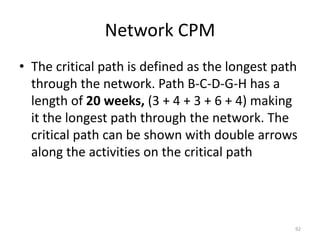
Network CPM
• The critical path is defined as the longest path
through the network. Path B-C-D-G-H has a
length of 20 weeks, (3 + 4 + 3 + 6 + 4) making
it the longest path through the network. The
critical path can be shown with double arrows
along the activities on the critical path
92
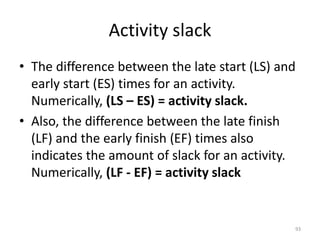
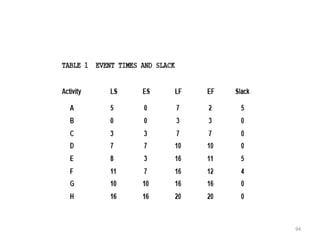
Activity slack
• The difference between the late start (LS) and
early start (ES) times for an activity.
Numerically, (LS – ES) = activity slack.
• Also, the difference between the late finish
(LF) and the early finish (EF) times also
indicates the amount of slack for an activity.
Numerically, (LF - EF) = activity slack
93
94
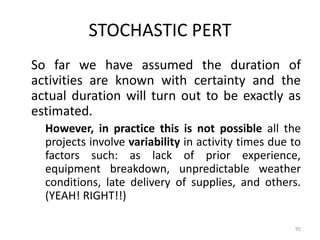
STOCHASTIC PERT
So far we have assumed the duration of
activities are known with certainty and the
actual duration will turn out to be exactly as
estimated.
However, in practice this is not possible all the
projects involve variability in activity times due to
factors such: as lack of prior experience,
equipment breakdown, unpredictable weather
conditions, late delivery of supplies, and others.
(YEAH! RIGHT!!)
95
STOCHASTIC PERT
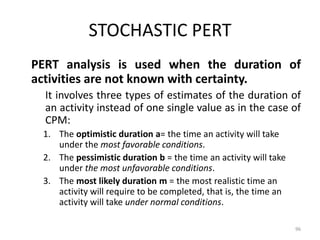
PERT analysis is used when the duration of
activities are not known with certainty.
It involves three types of estimates of the duration of
an activity instead of one single value as in the case of
CPM:
1. The optimistic duration a= the time an activity will take
under the most favorable conditions.
2. The pessimistic duration b = the time an activity will take
under the most unfavorable conditions.
3. The most likely duration m = the most realistic time an
activity will require to be completed, that is, the time an
activity will take under normal conditions.
96
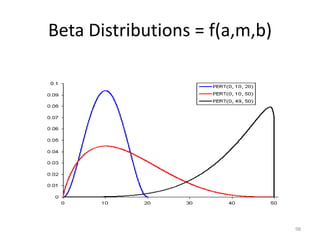
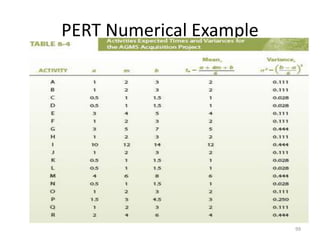
The duration of an activity is therefore
assumed to have a beta probability
distribution in PERT analysis. Following this
distribution, the expected activity time, te =
(a+4m+b)/6, and the variance of the activity
completion time, σ2 =[(b-a)/6]2 can be
obtained.
97
Beta Distributions = f(a,m,b)
98
PERT Numerical Example
99
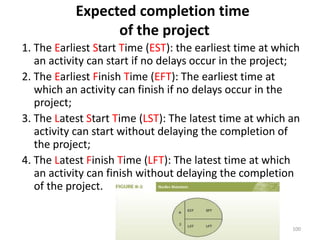
Expected completion time
of the project
1. The Earliest Start Time (EST): the earliest time at which
an activity can start if no delays occur in the project;
2. The Earliest Finish Time (EFT): The earliest time at
which an activity can finish if no delays occur in the
project;
3. The Latest Start Time (LST): The latest time at which an
activity can start without delaying the completion of
the project;
4. The Latest Finish Time (LFT): The latest time at which
an activity can finish without delaying the completion
of the project.
100
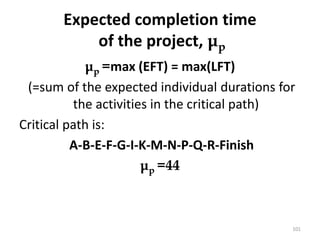
Expected completion time
of the project, μp
μp =max (EFT) = max(LFT)
(=sum of the expected individual durations for
the activities in the critical path)
Critical path is:
A-B-E-F-G-I-K-M-N-P-Q-R-Finish
μp =44
101
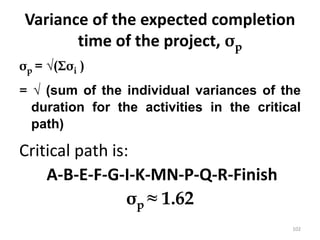
Variance of the expected completion
time of the project, σp
σp = √(Σσi )
= √ (sum of the individual variances of the
duration for the activities in the critical
path)
Critical path is:
A-B-E-F-G-I-K-MN-P-Q-R-Finish
σp ≈ 1.62
102
So, I will ask again, would you still
EARLY START tomorrow?♫
• It was posed that EARLY START ALL ACTIVITIES
(including those not in the Critical chain) will
imply the PM will loose focus, ergo, LATE FINISH
FOR THE WHOLE PROJECT!!!
– It is been established that most of the tasks/activities
really have a lot of safety buffers already in, so why it
is the project always late???
• It goes like this:
» People give an estimate, people starts at the latest time
possible (specially activities that are in the critical chain),
then the project goes late, we beat people up…what do you
will happened when we ask for estimates, next project?
103
Control & Focus??
• If one link break, the whole chain breaks
– We need to focus in the weakest link!!!
• The longest task in the longest path (critical chain)
– If physical, it is called a bottleneck; it might also be a
policy/rule/regulation/law, etc. (a non logical way to do business most
likely)
– subordinate to physical constraints but we elevate (eliminate) non-
physical ones.
» Examples of physicals constraints (linked to capacity)
» Examples of policies constraints (linked to policy and/or behaviors)
• enabling the correct verbalization, in a precisely defined
linguistic context, of the “assumptions” we make about the
situation we are analyzing. These assumptions, generally
speaking, reflect mental models and limiting beliefs that
“constrain” our mind in the search for a solution
104
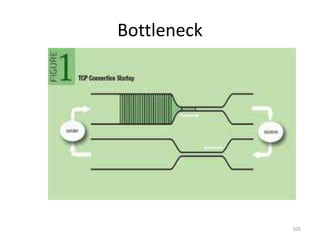
Bottleneck
105
Identify the system's constraint(s)
• What prevents the organization from
obtaining more of the goal in a unit of time.
– ie, where’s the bottleneck?
• In a project, it is the critical chain.
– Here’s where our focus should be.
106
Early start vs. late start
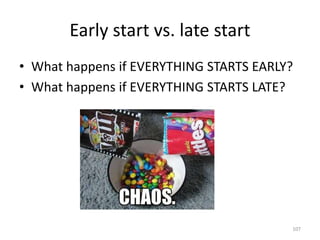
• What happens if EVERYTHING STARTS EARLY?
• What happens if EVERYTHING STARTS LATE?
107
CONTROL
• Start ALL earlier => LATE FINISH
• Start ALL later => LATE FINISH
– Only those tasks in the critical chain must start as
earliest as possible.
• The critical chain determines the time it will take to
finish the project
– But, when do we start everything else????
108
An Optimization Problem? A control
system problem?
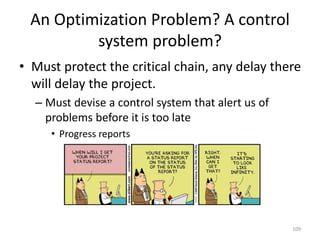
• Must protect the critical chain, any delay there
will delay the project.
– Must devise a control system that alert us of
problems before it is too late
• Progress reports
109
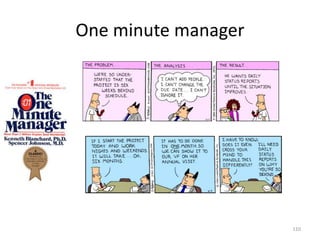
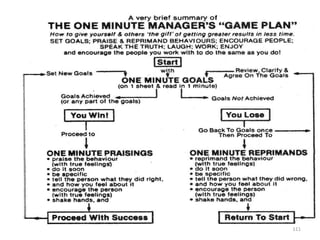
One minute manager
110
111
Progress Reports
• 90% of the work is done in just one Year
– The remaining 10% takes another year to
complete!!!
• Possible due to changing path when a block to work
flow is found?
– Our current system of measurement and control percentage
of job completed) actually encourages us to change the path
(so it looks as we are “moving forward”) but…
» Who cares how much we going forward if it is not in the
critical chain??
» And it is not, how long will it take for that block become a
critical path?
112
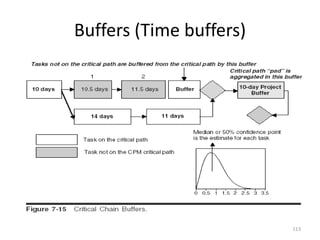
Buffers (Time buffers)
113
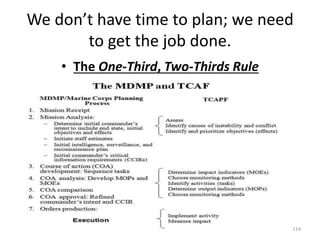
We don’t have time to plan; we need
to get the job done.
• The One-Third, Two-Thirds Rule
114
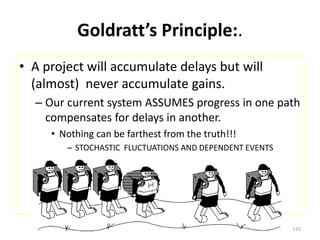
Goldratt’s Principle:.
• A project will accumulate delays but will
(almost) never accumulate gains.
– Our current system ASSUMES progress in one path
compensates for delays in another.
• Nothing can be farthest from the truth!!!
– STOCHASTIC FLUCTUATIONS AND DEPENDENT EVENTS
115
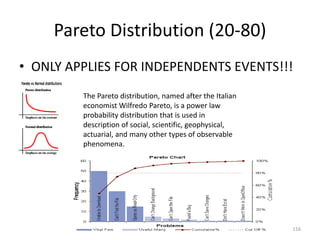
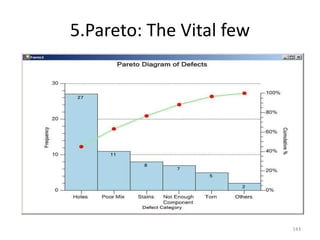
Pareto Distribution (20-80)
• ONLY APPLIES FOR INDEPENDENTS EVENTS!!!
116
The Pareto distribution, named after the Italian
economist Wilfredo Pareto, is a power law
probability distribution that is used in
description of social, scientific, geophysical,
actuarial, and many other types of observable
phenomena.
Pareto
• Cost (linear) thinking assume we can limit our
attention to separate links (departments,
tasks, etc) and we can optimize the total
system by focusing only on the “vital few”
– Throughput (the real world) tells us we cant do
that because links are dependent unto each other,
e need to focus on the total systems and its
interconnections
• Second and thirds effects
117
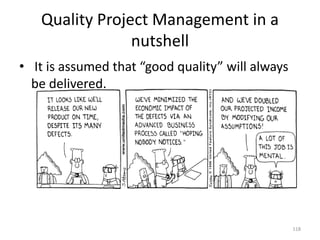
Quality Project Management in a
nutshell
• It is assumed that “good quality” will always
be delivered.
118
Six Sigma (black belts, etc), Total
Quality Management etc. etc.,
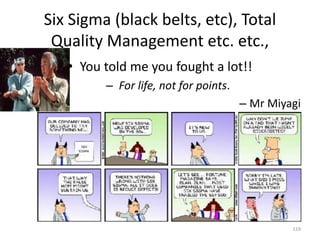
• You told me you fought a lot!!
– For life, not for points.
– Mr Miyagi
119
PMBOK® Guide
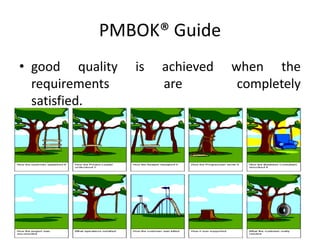
• good quality is achieved when the
requirements are completely
satisfied.
120
So?
121
• This means that the project manager is
responsible for identifying, together with the
project customers (sponsor, stakeholders), the
requirements and then delivering only that!!!
• It seems the PMBOK thinks that delivering more
than agreed is not good;
– reason being that it diverts resources, however
moderate, from delivering what was agreed.
– My own definition of quality is…. delighting the
customer!!!!
• Implies a surprise, something extra, etc.
• Some sections of the PMBOK Guide are
universal and some vary depending on legal
and social environments.
• The section on quality lies between these two
extremes.
– This is also true for Procurement, where
contractual issues are directly affected by both
practice and the legal environment
122
Three processes
• Planning, Executing and Monitoring & Controlling
– Quality Planning does just what it says.
• Like anything else in life, if there is no plan to implement, it
will not happen.
– Quality Assurance. This is seen as a management
responsibility and means making sure that the quality
processes are being properly implemented.
• Instrument calibration is an example, because it requires
management authority to establish such a program.
– Quality Control is seen as a technical responsibility,
actually carrying out the measurements, recording
parameters and recommending changes if needed
123
Foundations of Quality
• Customer Satisfaction, based on Fitness for Use and
managing expectations.
• Prevention vs. Inspection, in other words, you do not
achieve quality merely by eliminating the sub-standard
products from the customer delivery.
• Continuous Improvement, in the sense of making
relatively small improvements all the time. Building up
a big list of improvements for implementation every
couple of years is comparatively less effective. This
philosophy (Kaizen) was brought to the western world
by Japanese car manufacturers.
124
• Management Responsibility for quality, because they control the
resources required for implementing the quality system.
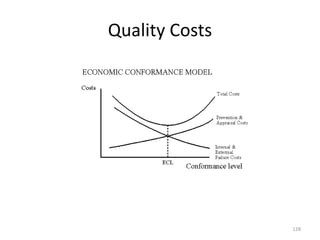
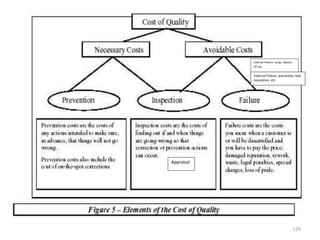
• Cost of Quality: the costs of everything that is done (PREVENTION COSTS)
to achieve quality as well as the costs caused by poor quality.
– This includes not just the cost of inspection but also, for example, of
calibration or training for the quality team, product returns, warranty claims
etc.
• Grade is a product categorization. For example, photocopier paper is
available in two weights, 80 g/m and 100 g/m. These are two grades.
– The heavier paper (informally we might call this “better” paper) may cause the
photocopier to jam or block. In this case it is not “high quality photocopier
paper” because it does not meet the requirements for working in a
photocopier.
125
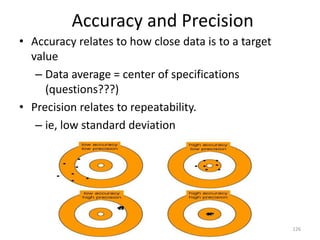
Accuracy and Precision
• Accuracy relates to how close data is to a target
value
– Data average = center of specifications
(questions???)
• Precision relates to repeatability.
– ie, low standard deviation
126
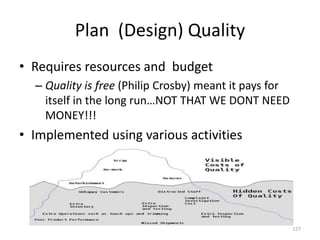
Plan (Design) Quality
• Requires resources and budget
– Quality is free (Philip Crosby) meant it pays for
itself in the long run…NOT THAT WE DONT NEED
MONEY!!!
• Implemented using various activities
127
Quality Costs
128
129
Appraisal
Internal Failure: scrap, rework,
OT,etc.
External Failure: warranties, bad
reputation, etc
Input to Quality Planning
• Scope Baseline.
– what is in the scope statement and the WBS
• Cost Performance Baseline.
• Stakeholders
• Schedule Baseline
• Risk Factors
• Enterprise Environmental Factors
• Organizational Process Assets
130
Cost-Benefit Analysis
• Decide where to strike the balance between
quality measures and their cost.
– In theory, “infinite” quality can be achieved at
“infinite” cost but this is not very realistic in most
commercial situations.
• It is better to find out (analyze) which quality
can be achieved and at what cost. A decision
about which measures to apply is then made
based on this information.
131
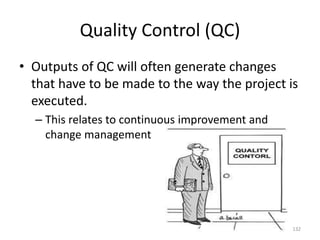
Quality Control (QC)
• Outputs of QC will often generate changes
that have to be made to the way the project is
executed.
– This relates to continuous improvement and
change management
132
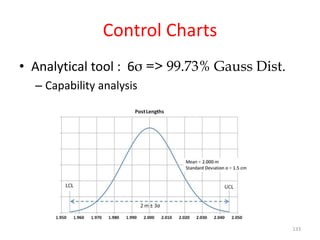
Control Charts
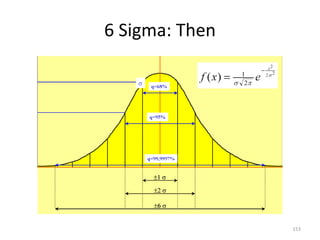
• Analytical tool : 6σ => 99.73% Gauss Dist.
– Capability analysis
133
ASQ
• http://asq.org/index.aspx
– http://prdweb.asq.org/certification/control/index
• http://www.icontact-archive.com/QkQ6e9vuzWA-
twxqLCbCGxmWmEWv_uzh?w=2
• http://www.youtube.com/watch?v=zamE9cvC6u0
• You told me you fought a lot!!
– For life, not for points.
– Mr Miyagi
134
The 7 Magnificent quality Tools
1. Cause-and-effect diagram
(aka, "fishbone" or Ishikawa diagram)
2. Stratification (alternately, flow chart or run
chart)
3. Control chart
4. Histogram
5. Pareto chart
6. Scatter diagram
7. Check sheet
135
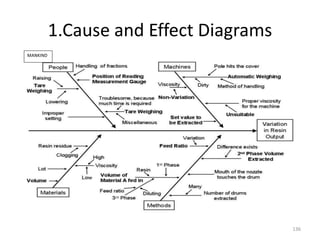
1.Cause and Effect Diagrams
136
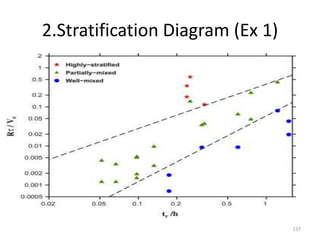
MANKIND
2.Stratification Diagram (Ex 1)
137
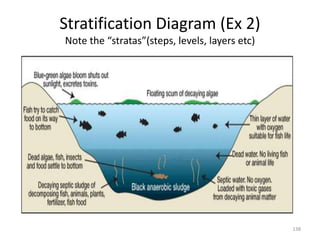
Stratification Diagram (Ex 2)
Note the “stratas”(steps, levels, layers etc)
138
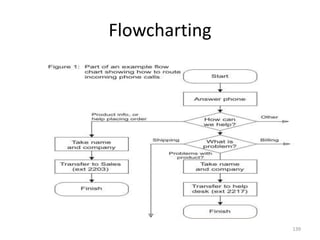
Flowcharting
139
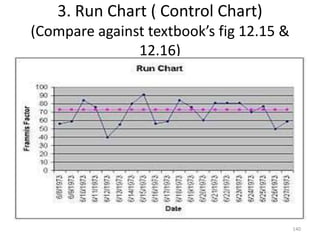
3. Run Chart ( Control Chart)
(Compare against textbook’s fig 12.15 &
12.16)
140
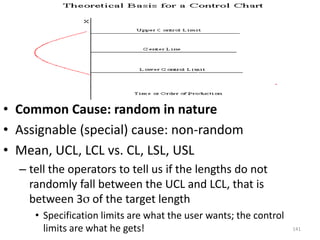
• Common Cause: random in nature
• Assignable (special) cause: non-random
• Mean, UCL, LCL vs. CL, LSL, USL
– tell the operators to tell us if the lengths do not
randomly fall between the UCL and LCL, that is
between 3σ of the target length
• Specification limits are what the user wants; the control
limits are what he gets! 141
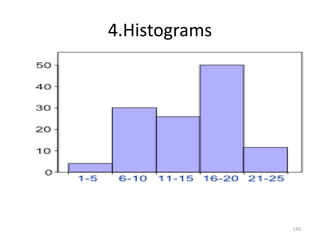
4.Histograms
142
5.Pareto: The Vital few
143
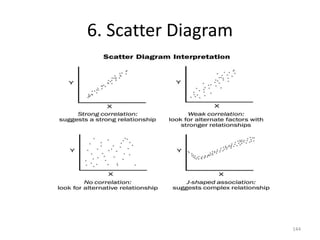
6. Scatter Diagram
144
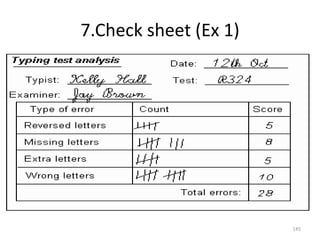
7.Check sheet (Ex 1)
145
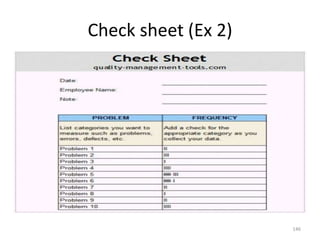
Check sheet (Ex 2)
146
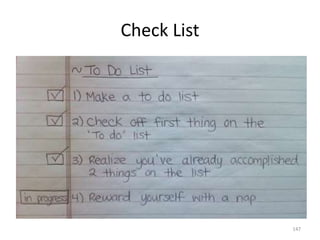
Check List
147
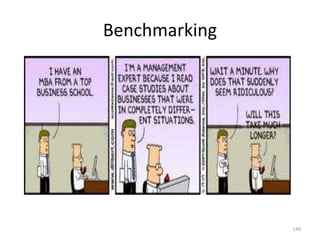
Benchmarking
148
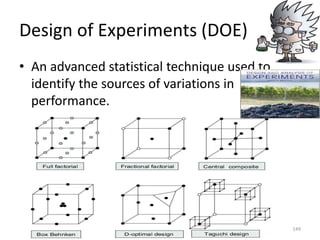
Design of Experiments (DOE)
• An advanced statistical technique used to
identify the sources of variations in
performance.
149
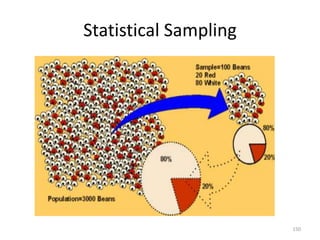
Statistical Sampling
150
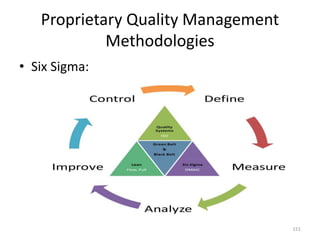
Proprietary Quality Management
Methodologies
• Six Sigma:
151
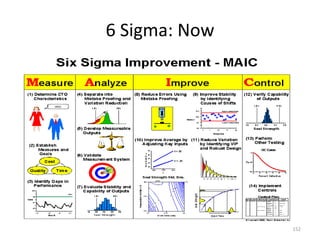
6 Sigma: Now
152
6 Sigma: Then
153
154
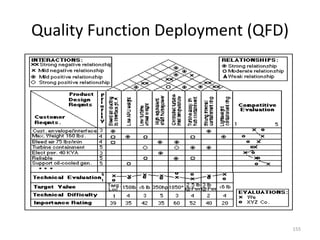
Quality Function Deployment (QFD)
155
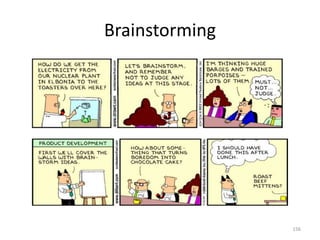
Brainstorming
156
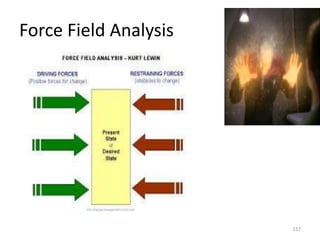
Force Field Analysis
157
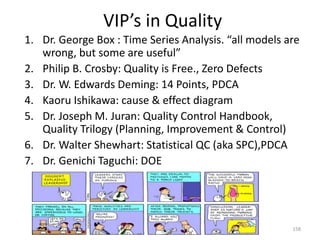
VIP’s in Quality
1. Dr. George Box : Time Series Analysis. “all models are
wrong, but some are useful”
2. Philip B. Crosby: Quality is Free., Zero Defects
3. Dr. W. Edwards Deming: 14 Points, PDCA
4. Kaoru Ishikawa: cause & effect diagram
5. Dr. Joseph M. Juran: Quality Control Handbook,
Quality Trilogy (Planning, Improvement & Control)
6. Dr. Walter Shewhart: Statistical QC (aka SPC),PDCA
7. Dr. Genichi Taguchi: DOE
158
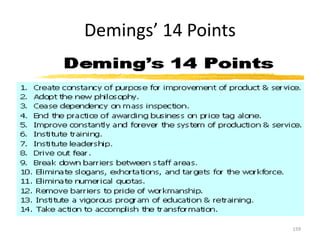
Demings’ 14 Points
159
Projects Outputs
• Quality Management Plan: Main interest
– how we are going to manage the quality within the project
• It is part of the Project Management Plan.
• includes the strategy , responsibilities and documentation
standards etc.
– Quality Metrics: documents the actual measurement values we expect to
get after performing quality control
– Quality Checklists: very powerful tool, systemic way to check a particular
domain or field.
» No checklist is perfect but if we keep updating it when we find
problems, our experience will become more valuable
– Process Improvement Plan: identifies which processes need to be
audited and the targets to achieve
– Project Document Updates: as we check the quality issues in our project,
we are very likely to find details that have to be changed and
documented
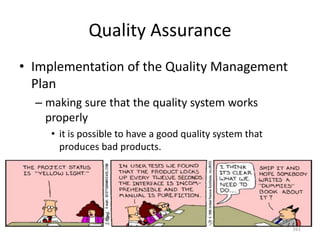
160
Quality Assurance
• Implementation of the Quality Management
Plan
– making sure that the quality system works
properly
• it is possible to have a good quality system that
produces bad products.
161
Quality Audits
• a check in which the person doing it has the authority to
ask any questions.
• Very powerful because the auditors may look at the issue
from a completely different viewpoint compared with the
rest of the team
• Audits can discover aspects that would otherwise be
missed.
• It is a really valuable way of ensuring that the quality
assurance and control are good. Of course, it is difficult to
get acceptance if the auditors appear to be the “quality
police”.
– So for best results, the company should have an open culture
that allows critical viewpoints
162
Quality Control
• Quality Control Measurements
– It is an output of QC
• Attribute Sampling: discrete variables
• Variables Sampling: continuous variables
• Tolerances: indicate if results will be accepted,
provided that they lie within the Control
Limits
163
Inspection
• audits or peer reviews
– means carrying out a review with the help of
others from your working environment
164
CC and Quality
• Critical Chain Approach is a way to manage all
of an organization’s projects holistically
(considers all aspects of the system within
which a process)
• Critical Chain methods focus mostly on
improving project cycle time (within quality
and scope requirements).
– conscious tradeoffs are made in resource cost, in
order to generate a much higher throughput from
the project
165
• The magnitude of improvement implies that
Critical Chain is impacting the entire process of
managing projects, and not just one small part.
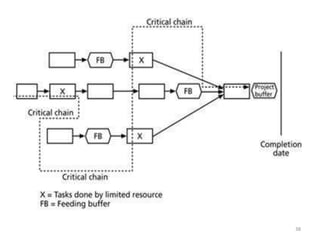
• It is an application of Theory of Constraints (TOC)
principles to project management. TOC assumes
that a system is like a chain. A chain is only as
strong as its weakest link. The links are
interdependent on each other to satisfy a need.
– A project operates the same way
166
The Goal
• Achieving the project’s goals requires the
cooperation of many different people,
departments and functions, in a series of
interdependent actions.
• The principle difference between this and the
concepts underlying the Critical Path Approach is
that the critical chain includes logically and
resource related tasks, while the critical path
includes only logically related tasks.
167
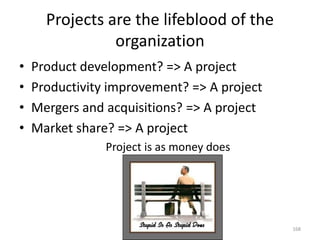
Projects are the lifeblood of the
organization
• Product development? => A project
• Productivity improvement? => A project
• Mergers and acquisitions? => A project
• Market share? => A project
Project is as money does
168
CC
• Since projects are undertaken to bring benefits to an organization,
the sooner they are completed, the sooner the benefits are
realized.
– Critical Chain focuses on the amount of time it takes to complete any
single project
• Our throughput is time
• common cause variations – Those causes of variation that are
intrinsically part of the process, even after risk mitigation actions,
and consistent over time.
– Common cause variation, handled thorough Critical Chain planning
and management, can be controlled (up to a point) and therefore
allow the project performance to be more predictable.
– Common causes must be addressed at a systemic level.
• Ultimately, buffers are established to handle the common cause variation that
is accepted for the project.
169
CC• focuses on the factor that most effects the cumulative cycle time of all the
projects. This factor is known as the organization’s strategic or critical resource,
also called the "Drum” (bottleneck).
– The factor or resource used to determine when a new project can be scheduled.
• Usually, the Drum is the critical resource. However, sometimes the Drum is a policy.
• It should be called, the DRUMMER, analogy comes from soldiers marching uniformly at the drummer’s
rate.
– She/he/it who marks the advancing rate
• Critical resource – When considering all of the projects that an organization has in
place, this is the resource that most impacts the cycle time of the combination of
projects.
– cycle time (project) – The length of time from the start of the project until its completion.
• Project duration.
• In the Theory of Constraints and Critical Chain, a constraint is the most significant
leverage point for improving a system.
– In Critical Chain, the constraint is the cycle time of projects, both individually and the
combined cycle time of the entire collection of an organization’s projects
170
Causes of long cycle times
• There is a difference between elapsed time (duration) and effort.
– Effort can be applied in a dedicated or non-dedicated way.
• For example, non-dedicated would have a resource assigned to several tasks
simultaneously, whereas a dedicated resource would be fully assigned to one
task until that task is completed. Non-dedicated effort implies extending the
duration.
• It is the amount of resource time (e.g., person hours) required for a task
• Critical Chain highlights the importance of dedicating effort to
streamline and optimize the cycle time.
• Critical Chain analysis shows that within single projects, the biggest
factor impacting cycle times is the practice of estimating tasks
according to non-dedicated elapsed time, and subsequently,
managing the execution of those tasks to a due date.
171
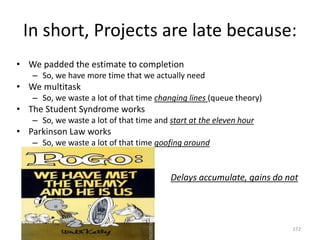
In short, Projects are late because:
• We padded the estimate to completion
– So, we have more time that we actually need
• We multitask
– So, we waste a lot of that time changing lines (queue theory)
• The Student Syndrome works
– So, we waste a lot of that time and start at the eleven hour
• Parkinson Law works
– So, we waste a lot of that time goofing around
Delays accumulate, gains do not
172
Multi-project
• An environment that exists in most organizations where
more than one project is active at any point in time, and
active projects share some common resources.
– Resources are not infinite
• Within the multi-project environment, the biggest factor
impacting cycle times is the resource bottleneck. This
factor is created by the current system of pushing work (in
the form of new projects, etc.) into the organization,
irrespective of the capacity of the most critical resource –
the one that most impacts the cycle time of all projects.
– Critical Chain addresses both the single and multi-project factors
in the reduction of duration.
The constraint controls ALL the projects
173
CC Project Quality Management
• TOC and the Critical Chain Approach are quality
improvement oriented strategies.
– Critical Chain improves the quality of project planning
and execution.
– The project plan becomes increasingly stable as the
common, recurring causes of slippage are built into it.
– Resources are focused on one task, rather than many
tasks, reducing the quality problems that are typical of
environments full of bad multitasking.
174
CC Quality Assurance
• Quality Assurance assesses and works to improve
the process by which projects are performed.
• Critical Chain highlights the need to address the
project management process at the multi-project
level as well as the individual project level.
– By identifying common causes of project slippage,
not only can their results be included in Project
buffers and task estimates, but they can be addressed
as improvements in the way the organization as a
whole addresses projects.
175
Project Dollar Days
• One of the quality tools in the multi-project environment,
suggested by Gerald Kendall, is a measurement called Project
Dollar Days.
• By measuring the number of dollars generated by the collection of
projects (at Net Present Value) divided by the number of resource
days consumed by projects, a productivity ratio is developed.
• With this measurement, if a project develops a quality problem,
two things typically occur.
– First, there is rework necessary to correct the problem, adding to the
number of resource days consumed.
– Second, the project may be delivered late, reducing the benefit and
therefore reducing the (NPV).
• Therefore, this measurement becomes a natural quality indicator that can be
used by the Project Management Office, senior management and project
teams.
176
Quality Control
• As defined in the PMBOK® Guide 2000, Quality Control is
– “the process of monitoring specific project results to
determine if they comply with relevant quality standards and
identifying ways to eliminate causes of unsatisfactory
performance.”
• Critical Chain is focused on the identification and
elimination of the causes of performance problems.
– It promotes the recognition of performance problems that
have systemic causes and highlights the need for addressing
these above the individual project level.
– If performance problems cannot be addressed at that level,
then Critical Chain recommends being realistic enough to
include their impact in project plans!!!
177
CC vs CPM
• Critical Chain assumes a good critical path
network that has been effectively resource
leveled.
– some of the actions needed to implement Critical
Chain successfully might be significant quality
changes for an organization.
178
Team members & task times
• Team members are asked to dedicate themselves to a
project task, to complete it as quickly as possible and
to periodically report how many days are remaining.
• When planning a project, task times should be
estimated much closer to how long the task will take
with dedicated resources, rather than elapsed times
assuming the organization’s current practice of
assigning resources to work on several tasks at once.
This also significantly reduces behaviors called “student
syndrome” and “Parkinson’s Law”
179
Bad multitasking is significantly
reduced, permanently.
• The behavior of people who split their time
between multiple project tasks in a way that
extends the cycle time of individual projects or
multiple projects and often results in poor
quality results.
– The reduction of bad multitasking goes hand in
hand with reducing task estimates to dedicated
elapsed times and having people complete tasks
before starting new ones, as much as possible
180
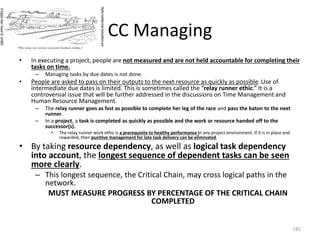
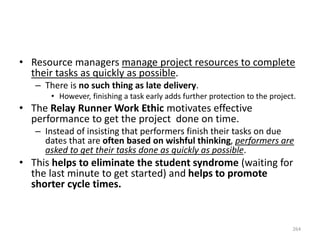
CC Managing
• In executing a project, people are not measured and are not held accountable for completing their
tasks on time.
– Managing tasks by due dates is not done.
• People are asked to pass on their outputs to the next resource as quickly as possible. Use of
intermediate due dates is limited. This is sometimes called the “relay runner ethic.” It is a
controversial issue that will be further addressed in the discussions on Time Management and
Human Resource Management.
– The relay runner goes as fast as possible to complete her leg of the race and pass the baton to the next
runner.
– In a project, a task is completed as quickly as possible and the work or resource handed off to the
successor(s).
• The relay runner work ethic is a prerequisite to healthy performance in any project environment. If it is in place and
rewarded, then punitive management for late task delivery can be eliminated.
• By taking resource dependency, as well as logical task dependency
into account, the longest sequence of dependent tasks can be seen
more clearly.
– This longest sequence, the Critical Chain, may cross logical paths in the
network.
MUST MEASURE PROGRESS BY PERCENTAGE OF THE CRITICAL CHAIN
COMPLETED
181
Buffer Burn Ratio (BBR)
• 100% of the Critical chain ahead: 100% of the
Buffer time available
– BBR= 1:1=> ok
• 80% of the Critical chain ahead: 40% of the
Buffer time available
– BBR= 8:4=> NOT ok!!!
• Tasks will consume buffer time, that’s is expected
• We need to id what tasks consume more buffer
– We need to pay attention to solve whatever is happening with
those tasks
182
Buffers
• (schedule contingency reserves) are a key part
of the schedule and how it is managed.
• The ability to increase the certainty of project
completion dates is closely related to the use of
buffers.
• The use of buffers, strategically placed in the
plan, allows the planner to clearly
accommodate all common cause variations
(variations in duration that predictably occur
because they are part of the system within
which projects are performed).
183
Buffer types
• BUFFER DEFINITION: An amount of time that represents a
schedule contingency reserve. Buffers are included at various
points in a project task network. They provide the ability to
eliminate any padding, from individual task duration
estimates and to clearly show the predicted and potential
project schedule. They are managed to assess the degree of
risk remaining for on-time project completion.
– Buffer durations are best determined through risk analysis
• Project buffers,
• Feeding buffers,
• Resource buffers,
• Drum buffers
• Strategic Resource buffers.
184
Project buffers
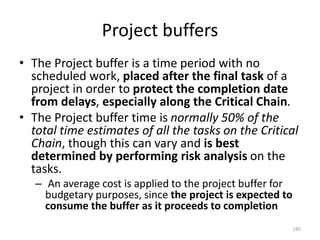
• The Project buffer is a time period with no
scheduled work, placed after the final task of a
project in order to protect the completion date
from delays, especially along the Critical Chain.
• The Project buffer time is normally 50% of the
total time estimates of all the tasks on the Critical
Chain, though this can vary and is best
determined by performing risk analysis on the
tasks.
– An average cost is applied to the project buffer for
budgetary purposes, since the project is expected to
consume the buffer as it proceeds to completion
185
Feeding buffers
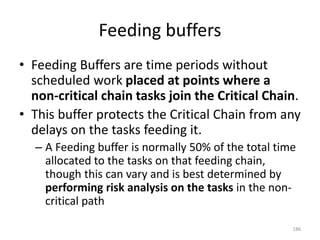
• Feeding Buffers are time periods without
scheduled work placed at points where a
non-critical chain tasks join the Critical Chain.
• This buffer protects the Critical Chain from any
delays on the tasks feeding it.
– A Feeding buffer is normally 50% of the total time
allocated to the tasks on that feeding chain,
though this can vary and is best determined by
performing risk analysis on the tasks in the non-
critical path
186
Resource buffers
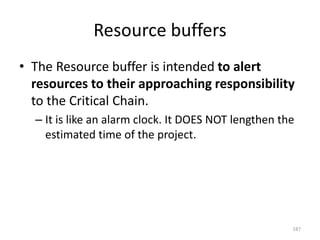
• The Resource buffer is intended to alert
resources to their approaching responsibility
to the Critical Chain.
– It is like an alarm clock. It DOES NOT lengthen the
estimated time of the project.
187
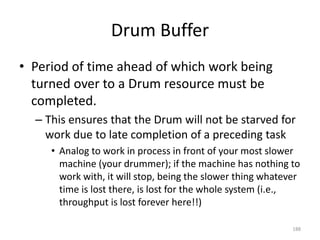
Drum Buffer
• Period of time ahead of which work being
turned over to a Drum resource must be
completed.
– This ensures that the Drum will not be starved for
work due to late completion of a preceding task
• Analog to work in process in front of your most slower
machine (your drummer); if the machine has nothing to
work with, it will stop, being the slower thing whatever
time is lost there, is lost for the whole system (i.e.,
throughput is lost forever here!!)
188
Strategic Resource buffer
• A time period during which the critical
resource will have no scheduled work. This
insulates each project that uses the strategic
resource from impacts of previous projects
and ensures that future projects will not be
impacted by uncertainty affecting the
strategic resource.
– Multi-project environment
189
Critical Path
• Uses a concept of slack time or float to determine how much
flexibility there is in non-critical path tasks.
• Critical Chain Approach groups tasks on each non-critical (or
feeding) path entering into the critical chain and “protects”
the critical chain with a Feeding Buffer.
• The feeding buffer is equivalent to a schedule contingency
reserve that is local to a part of the project.
– The Critical Chain Approach is explicit and systematic about the
use of Feeding buffers throughout the task network.
190
Buffers use
• This buffering allows for non-critical
tasks to be scheduled at their latest
possible start times to discourage costly
early investment of work in process. This
also significantly reduces behaviors
called “student syndrome” and
Parkinson’s Law”.
–Early starts are discouraged unless there
is a major strategic reason for doing so.
191
Caveat
• Often, the Critical Path changes during
execution because there is no buffer to
absorb the variation in task times.
–If implemented correctly, the Critical
Chain plan and the Critical Chain itself do
not change throughout the life of the
project, because the buffers absorb the
uncertainties in task duration.
192
Multi-Projects
• Critical Chain recognizes that there
are multi-project environments in
which projects have resource-based
interdependencies. In other words,
projects share a common resource
pool, for at least some tasks.
193
• The Critical Chain Approach
identifies the critical resource
(called a Drum Resource) across a
collection of projects.
–When overloaded or not available,
this resource is the one most likely to
impact the project cycle time of all
projects.
194
• The staggered introduction of projects into the
system is used to improve the flow of projects,
to increase the predictability in each project
outcome and to increase the effectiveness of
critical resources by minimizing the effect of bad
multitasking.
– A shorter project cycle time and an increase of the
number of projects that can be pushed through
the system without increasing resources result
from staggering the release of new projects.
195
• Similar to vertical traceability in
Critical Path, the Critical Chain
plan and detailed schedules are
linked entities.
–Any logic at the detailed levels
must be reflected in the summary
level(s).
196
The benefits of Critical Chain will be
secured permanently for the
organization with the implementation
of a performance measurement
system, policies and education that are
in keeping with the Critical Chain
Approach
 Behaviors must change
 Buffers must be monitored
197
CC AND THE PMBOK® Guide’s
9 KNOWLEDGE AREAS
• A good plan is one that must have a high probability of
being achieved.
– Good plans are predictable (Well, sort of)
1. Project Integration Management
2. Project Scope Management
3. Project Time Management
4. Project Cost Management
5. Project Quality Management
6. Project Human Resource Management
7. Project Communications Management
8. Project Risk Management
9. Project Procurement Management
198
• Critical Chain and traditional risk management both recognize that
the time required to perform any individual task is uncertain.
– In fact, some individual tasks can easily take twice as long as
estimated, and this should be considered normal.
• Therefore, to have a good plan, Critical Chain insists that the
protection from individual task variances must be accumulated
into buffers, and not managed individually.
• Goldratt suggests that to properly insulate a project from variance,
the project must have a Project buffer duration of approximately
50% of the length of the Critical Chain.
– In practice, the size of the buffer that project managers use today
depends a great deal on the environment – how risky it is, and how
variable the task durations are.
• In practice, a range of 30-50% is common.
199
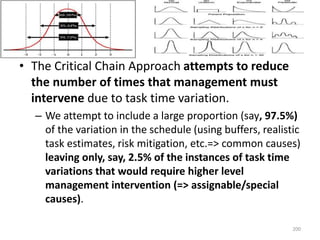
• The Critical Chain Approach attempts to reduce
the number of times that management must
intervene due to task time variation.
– We attempt to include a large proportion (say, 97.5%)
of the variation in the schedule (using buffers, realistic
task estimates, risk mitigation, etc.=> common causes)
leaving only, say, 2.5% of the instances of task time
variations that would require higher level
management intervention (=> assignable/special
causes).
200
Normal Variation
• Insulating any process from those variable things that
normally happen in projects attains predictability.
– For example, if software developers were usually late in a
particular company, then planning a project as though they
would be on time would be less than clever.
• However, it is quite possible to address the reasons for these people
being late or the extent to which they are late.
– Many times in order to do that, a systemic change must be made above and
beyond the project.
» In other words, changing the way the organization operates may
remove or reduce the cause of lateness.
• Then, adding a buffer at the end of the path handles the
amount of variation that remains in the activity or path.
– Critical Chain with risk management and quality management
can be used to address such issues.
201
• The buffers, dedicated task times, reduction
of bad multitasking, the staggering of the
release of new projects according to a
strategic resource and various risk mitigation
techniques all come together to increase the
predictability of successful project completion.
– Risk management and quality management can
be applied to reduce the size of buffers and the
overall duration of the project (the length of the
Critical Chain).
202
Critical Chain looks to shrink actual
task times in two ways.
• One way is to eliminate padding for individual tasks (if it exists) that
everyone (the team member, the resource manager, the project
manager and senior management) agrees are highly uncertain.
• What we mean by padding is time built into the task time for
protection.
– Problem being once an “estimate” is given, it become THE LAW,
written in stone, a “commitment”
– Instead of using padding, protection is accumulated in a buffer, and
not allocated to any individual task.
• The task duration that remains may have a high probability for
variance, and this is the reason that the task performer cannot be
held to hitting the task completion deadline.
– http://www.youtube.com/watch?v=Y6OvsJqimfg
203
• The biggest opportunity lies in addressing the
second way to shrink task times.
– This is addressing the difference between the
dedicated elapsed task time and the non-
dedicated elapsed task time.
204
Consider two typical examples.
• First, there is a project that requires a senior
management committee approval at a certain
point.
– The committee will hear a 60-minute presentation
and decide on certain key issues.
– These decisions drive the rest of the project.
– How long does the project allow for this one task to
occur?
• This 60-minute task is scheduled over 45 days.
• Why?
– Because the committee only meets once per month.
– The next meeting is scheduled in 15 days.
205
• We will assume that the committee won’t decide at
the first meeting, so two committee meetings, with 30
days in between, are allowed.
– This is an example of non-dedicated elapsed time.
• If the cycle time of the project is critical, why not have
the committee meet on much shorter notice or agree
to resolve the issue at the first meeting?
– It is not the efficiency of the committee that is critical,
rather it is cycle time.
– Challenging the assumptions underlying when and how
the committee meets and even whether it meets can
affect project cycle time and overall throughput.
206
• A second example is also typical.
• This is where a person, cannot devote 100% of his or her time to
the task at hand.
• The task has, for example, 10 days of dedicated time estimated.
• The person doing the task is involved in several critical projects. She
also has some regular job duties. And there are several legitimate
points, during the 10-day task, at which the person will be waiting
for input from other sources for at least several hours.
– If the person were able to dedicate herself to this task, pushing
herself, she could complete it in 10 days.
• But with the other considerations, she gave an estimate of
elapsed time of 25 days.
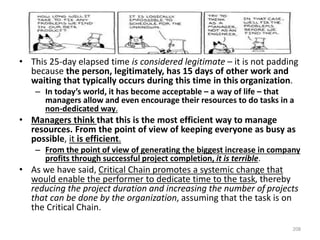
207
• This 25-day elapsed time is considered legitimate – it is not padding
because the person, legitimately, has 15 days of other work and
waiting that typically occurs during this time in this organization.
– In today’s world, it has become acceptable – a way of life – that
managers allow and even encourage their resources to do tasks in a
non-dedicated way.
• Managers think that this is the most efficient way to manage
resources. From the point of view of keeping everyone as busy as
possible, it is efficient.
– From the point of view of generating the biggest increase in company
profits through successful project completion, it is terrible.
• As we have said, Critical Chain promotes a systemic change that
would enable the performer to dedicate time to the task, thereby
reducing the project duration and increasing the number of projects
that can be done by the organization, assuming that the task is on
the Critical Chain.
208
• At the same time that Critical Chain is protecting
a project at the overall level, it demands a
dramatic change in the way that Critical Chain
project tasks are done.
• Somehow, to get an overall favorable effect on
total project duration, task times must be
reduced drastically way.
– Critical Chain assumes that “management pressure”
is no longer a valid way to shrink the actual time it
will take to complete a task.
209
Performance Measurement and the
Relay Runner Ethic
• Critical Chain recognizes that measuring people by whether they
finishing their tasks according to a due date, and including milestones in
project plans,
– causes people to NOT pass on their task completions early!!!
• Any protection that could be accumulated within a task execution is
wasted (as per Parkinson’s Law).
• The Critical Chain Approach promotes and relies on the relay runner work
ethic by which. each task is completed in the least amount of dedicated
time and successor (resource or logic) activities are alerted when an
activity might be finished in less time than originally estimated.
• As part of a Critical Chain implementation, resource managers decide
how, and to what extent, resources on the Critical Chain are flexible
enough to start work within a range of dates, rather than only on a specific
date.
– With significantly fewer projects in process in the system at any point in time,
resource managers are able to accommodate this flexibility in assigning their
people to tasks.
210
The important thing is to get the
project done on time, not to get tasks
done on time!!!!
• There is a tendency in organizations to “whack” people
when they do not comply with their task estimates.
• If they finish early, they are always expected to finish
early and if they finish late they are bad guys.
– This leads people to not deliver tasks early and to pad
their task estimates to protect themselves from being
penalized for being late.
• The relay runner ethic says that people should go as
fast as they can (in keeping with good quality) and
deliver their results as early as they can. If the
performer accepts this and is not penalized for late
delivery or early delivery she will be motivated to
perform and to estimate accurately.
211
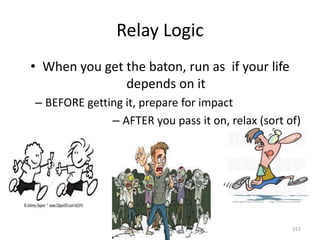
Relay Logic
• When you get the baton, run as if your life
depends on it
– BEFORE getting it, prepare for impact
– AFTER you pass it on, relax (sort of)
212
CC emphasizes these Project
Integration Management Points
Project Plan Development (Planning & Design)
• When creating a plan, list obstacles and intermediate objectives as
developed by key team members and anyone who will be
impacted by the project.
– These must include obstacles to implementing the relay runner work
ethic and the staggering of projects.
• The project planning methodology includes the Critical Chain (single
and multi-project) Approach.
• One subset of the project plan output includes the Critical Chain
plan
– The schedule that shows the Critical Chain and all feeding paths, with
all buffers inserted to protect the project.
– The individual task estimates included in the plan reflect only
dedicated effort.
• Usually, the plan is shown in Critical Path format, with the Critical Chain
highlighted across the paths.
213
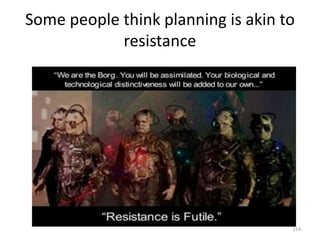
Some people think planning is akin to
resistance
214
• Intermediate date constraints are discouraged,
except when there is a strategic reason
– (e.g., customer payment hinges on it, legal
requirement, inspection).
• Scheduled task start dates may be later than
traditionally practiced, and are based upon the
placement of Feeding buffers, Project buffer,
Strategic Resource Buffer and Drum buffer.
215
Project Plan Execution
• The Critical Chain plan is one of the inputs.
• Buffer management and Critical Chain knowledge should
be considered key management skills.
• An essential output of project execution is buffer
reporting.
– Buffer reports include the key ratios comparing the percentage
of Critical Chain that is complete with the percentage of the
project buffer consumed at any particular time.
– Another key ratio is the Percentage Feeding Chain complete
compared to percentage Feeding Chain buffer consumed.
– The pace by which buffers are used is also a key indicator of the
project’s performance over time.
216
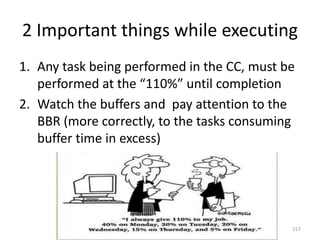
2 Important things while executing
1. Any task being performed in the CC, must be
performed at the “110%” until completion
2. Watch the buffers and pay attention to the
BBR (more correctly, to the tasks consuming
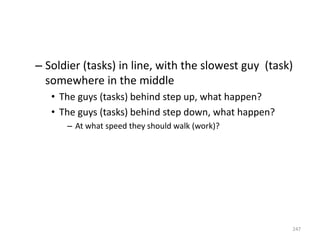
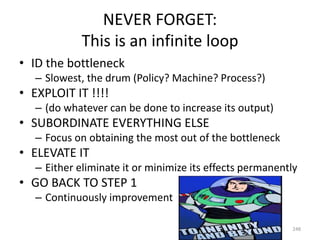
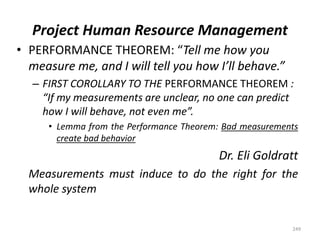
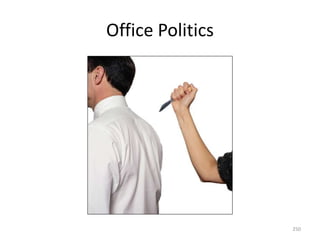
buffer time in excess)
217
Project Scope Management
• It is well known that finishing certain projects earlier has value to the organization
well out of proportion to their cost.
– For example, in the computer industry, a new generation computer chip that is introduced first
into the market generates profits that are several hundred percentage points better than its
followers.
– A new hospital wing being constructed will provide value to the community the sooner the
project is completed.
• Further, the longer the project takes, the greater the risk that some portion of the
originally defined specifications will become obsolete.
– By one estimate, changes in an IT development project might be about 1% per month.
• Therefore, Critical Chain plans recognize that doing things that use resources
inefficiently, for the sake of shorter total cycle time of the project, has value well
beyond the additional cost of the resources.
– For example, putting four people on a task, when three could do it most efficiently (as
measured by some productivity factor per person), may still be warranted in Critical Chain, if
the overall project duration shortens by a significant amount.
• Significant means that the additional cost incurred is less than the measurable benefit.
• YOU MUST EXPLAIN THAT TO PEOPLE!! (SHOW DON’T TELL!!!)
218
Initiation
• One of the outputs from project initiation must be the organization’s
expected benefit from the project.
– This means the expected Net Present Value (NPV) to be generated from this
project.
• Identification of NPV positive changes if the project is delivered earlier,
and NPV negative changes, if the project is delivered later, should also be
included.
• This input allows the team to make better decisions regarding the best
ways to plan and execute the project.
• Planners can evaluate different ways of breaking down the work and
different ways of doing the work based on a solid business case.
• The difference in Critical Chain projects is the emphasis placed on
analyzing the value of reduced cycle time.
– Managers are more focused on this analysis, because senior management has
been educated, as part of the Critical Chain implementation, on the strategic
importance of cycle time.
219
Work Breakdown Structure and Work
Assignment
• One of the inputs is the NPV analysis described above.
• The Work Breakdown Structure (WBS) analysis output
identifies which tasks are reliant on a strategic
resource (the Drum resource for the entire
organization).
• This requires a conscious effort to determine whether
some of this work could be allocated to other
resources to increase the number of projects that can
be done by the organization.
– For example, some work that might naturally or efficiently
be organized under this Drum resource might be organized
and separated as a subcontractor package.
220
• Effective decision-making requires that the planner look at the NPV
of throughput and project cost not just the cost alone, in deciding
on the most appropriate approach.
• Work Breakdown Structure analysis recognizes that some items that
are most cost efficiently done by one organization unit might be
better done by others.
– Further breakdown of activities and having the sub-activities done in
parallel by others or by assigning them to less efficient resources are
ways of hastening the project’s completion.
• For example, if a change to a Web site is required for a project it is usually
most efficient to have it made by the in-house Web specialist.
• It is a task she could do in say, half a day.
– However, if that specialist couldn’t get to the task for say, three weeks, it might be
worth the extra cost to have the task performed by an outsider group that would cost
more but would reduce the elapsed time.
221
Note on subcontrators
• Price (cost) SHOULD NOT BE THE PRIME
DIRECTIVE (alone)
• Lead time (time for full delivery) is of upmost
importance!!!
– A 3-months delay could very well ending costing
way much that whatever revenue we expected
from the project
222
Project Time Management
• The Critical Chain plan must represent every activity
but may not schedule every activity in detail in a large
project.
– In other words, the Critical Chain plan schedules
summary-level activities.
• For example, in a large project involving several thousand
activities, a few hundred high-level activities are typically
sufficient to capture the major dependencies for Critical Chain.
• In such cases, it is important that a detailed plan for
controlling the work at the detail level is linked
properly to the Critical Chain plan.
– This is called “vertical traceability” in Critical Path Method
(CPM) scheduling.
223
Example:
NEED TO CRISTAL CLEAR IN EVERY PM
• Project investment: $6 millions
– Increase production capacity to increase sales in
$2 millions revenue/month
– Net margin: 35%
• 2 million * .35 = $700K/monthly profit
– 3 month delay = lost profit of $2.1 million
» Aprox. 33% of the investment!!!!
• Probably LOST FOREVER!!!
224
Subcontrating
• Need to be aware that vendors will agree, for
a price
– Negotiate knowing your time vs. money needs
– Negotiate advanced booking of work
– Negotiate big bonuses for ending ahead (but
within scope and quality) and huge penalties fro
delays
• ALWAYS LOOK FOR WIN-WIN (More on this later, ROOT
CAUSE)
225
Activity Sequencing
• The Critical Chain method includes any
resource dependencies in activity sequencing.
– a resource-loaded and-leveled schedule is an
input to the Critical Chain method.
• The Project Network Diagram output shows both task
and resource dependencies.
226
Activity Duration Estimating
• In general, Critical Chain activity durations are
estimated assuming no bad multitasking and
resources dedicated to tasks.
– The duration is the actual time dedicated to
perform the task, or something very close to this
time.
– These assumptions are possible if the organization
makes the changes required.
227
Schedule Development
• Schedules are developed using the Critical Chain method as the
primary tool.
• Schedules include a Project buffer, Feeding buffers, Resource
buffers, Strategic Resource buffers and Drum buffers.
– Tasks normally start as late as possible.
• The objective is to minimize any work in process and to eliminate “student
syndrome” and “Parkinson’s Law”.
– In Critical Chain, early starts would represent investment that was
made too early to provide a return.
• Early starts also significantly increase the risk of bad multitasking.
– Safety is provided by the buffers and helps to avoid the need for, and
hence the practice of padding at the task level.
• Padding may occur unless the organization squeezes time from the schedule
to achieve a schedule that shows an earlier completion date.
228
• Resource leveling is greatly simplified due to the multi-
project Critical Chain practice of staggering the introduction
of projects into the system according to the availability of
the strategic resources of the organization.
– This typically results in the reduction of bad multitasking and of
the number of active projects in the entire organization at a
given point in time.
• Experience (???) shows that, because of these practices,
more projects can be delivered in the same time period
with the same resources.
– Also, the ability to use more resources on critical tasks, even
though inefficient in terms of the individual productivity of that
resource, makes it easier to compress schedules.
229
Note on Safety
• Dr Goldratt’s report the vast majority of
employees will try to get at least 80% of
chance of finishing on time NOT counting:
– Delayed by others (the precedents necessary task
are not late)
– Loaded up with others things to do
• Means, when I say 2 weeks to complete I am really
saying is:
– I will have done in 10 days from now (due date) IF:
» I start right now
» I have only this task as my priority
230
Sources of “safety”
• When given estimates at least 3 “safeties”
buffers are inserted by people
1. Based on pessimistic (worst case) experience
2. Number of management levels
3. They know you will try to cut it down
231
Note also that, every layer will add its own safety buffer
232
233
PM
234
Schedule Control
• Buffer management is the primary schedule
control mechanism, for the overall project.
– In large projects, traditional methods still apply at the
most detailed level.
• Team members are not given due dates.
– Rather, they are asked to report the days remaining
on each task.
• WIP (inventory) in front of a machine is akin to safety time
(FB) in a task , both are buffers
– But project FB are akin to perishable inventory
» Time lost is never coming back
235
Interesting possibility for research
(even doctoral dissertation topic!!!)
• Time is perishable inventory
– Use of Revenue (Yield) management techniques
in Project Management
236
Only place need to be working at 110%
(lol)
• Just before the bottleneck
– WIP in production (FB in PM)
• THE BOTTLENECK (of course, one minute lost
here is lost forever)
– The constraint cannot stop, EVER
• It must be protected from any disruptions
237
Project Cost Management
• As a general principal, the Critical Chain Approach
looks for the best impact on the organization, taking
into account throughput, operating expense and
investment (inventory) as summarized in the NPV.
– Throughput - The rate at which an organization generates
money through sales.
• Usually, this is revenue received from customers minus the cost of
raw materials (directly variable cost).
– In PM ,”Throughput” is time to project completion
– operating expense – All the money, which an organization
spends to turn inventory/investment into throughput.
238
• Many organizations have resource managers
who are measured by the “efficient” use of
their resources.
• Critical Chain strategy, using other measures,
promotes decisions that support what is best
for the project or organization as a whole.
– If it reduces the total project duration
significantly (i.e., benefits exceed added costs),
this might imply individual resource inefficiency.
239
You are in business to make money,
NOT to save money
• The usual reaction to a drop in revenue is
reducing expenses
– IT SHOULD NOT BE THE FIRST OPTION
• FIRST OPTIONS SHOULD BE THOSE ANSWERING THE
QUESTION:
– WHAT DO I NEED TO DO TO INCREASE REVENUE AGAIN?
» Rethink the “offer” to the customer (everything that
touches the customer, the complete package) ; the
product, support, delivery lead time, reliability, financial
terms, etc.
240
Resource Planning
• Resource requirement quantities are considered
in terms of the three global parameters of the
TOC – throughput, investment and operating
expense.
• The amount of labor resource in a Critical Chain
plan is typically significantly smaller than for a
traditional plan to accomplish the same work.
– This is because the labor consumed with bad
multitasking and non-dedicated task times is removed
241
Cost Budgeting:
We must control cost while protecting
throughput
• The cost baseline should include some calculated
worth of the project and Feeding buffers.
– These buffers allow for uncertainty in task estimates.
• Generally, a project’s promised delivery date is at the
end of the Project buffer.
– Therefore, the value of these buffers, perhaps computed
at some average running rate of the activities the buffer is
intended to protect, should be translated to allow a Cost
buffer as well.
• This is equivalent to the traditional project cost reserves
– REMEMBER NOT TO FOCUS ON LOCAL IMPROVEMENTS (COST WORLD)
BUT TO FOCUS ON GLOBAL (THROUGHPUT)
– A CHAIN IS AS STRING AS IT WEAKEST LINK (the bottleneck, i.e., the
critical chain) FOCUS ON IMPROVEMENTS THERE!!!
242
Cost Plus
• Bidding put downward pressure on prices
– PROFIT comes from “change orders”
• The longer the project and the more change orders, the
higher the profit
• No incentive to finish sooner
– THIS IS THE “VAMPIRE SELF-DESTRUCTION BEHAVIOR”
» http://www.youtube.com/watch?v=IGrpoxBlCNo
» What would happened if, like in some movies lore say,
every time one is bitten becomes a vampire?
• So, near the end of times,
• The few humans around, would your drain them
or farm them?
243
• So, it is in your own self benefit your “victim”
(client) is alive and well preserved
– http://www.youtube.com/watch?v=g2FqS3aKHRg
• The happy “victim” will bring more “victims” for you to
feed
• In any case, a company that delivers fast
reliable products and services can charge a
premium, even in today’s market
244
Cost Control
• The TOC suggests that a systems approach is vital, with respect to
cost control and measuring performance to budget.
– Some cost tradeoffs during a project are good, provided that the
impact on the organization’s and/or customer’s goals is significant.
• The key is to get project managers to better understand the real
cost of a late delivery, to make project cost decisions with those
figures in mind, and to keep key decision makers informed so that
there are no surprises.
– Some organizations use cost as their number one criteria for decisions.
• In Critical Chain, throughput is the number one priority, not cost
control.
– It does not mean that costs are ignored. Rather, any costs accrued
that do not contribute to throughput are considered a waste
245
BEWARE!!!!
• Imagine the following:
– Soldiers marching in line, with the slowest guy
somewhere in the middle
• The guys behind step up, what happen?
• The guys behind step down, what happen?
– At what speed they should walk?
246
– Soldier (tasks) in line, with the slowest guy (task)
somewhere in the middle
• The guys (tasks) behind step up, what happen?
• The guys (tasks) behind step down, what happen?
– At what speed they should walk (work)?
247
NEVER FORGET:
This is an infinite loop
• ID the bottleneck
– Slowest, the drum (Policy? Machine? Process?)
• EXPLOIT IT !!!!
– (do whatever can be done to increase its output)
• SUBORDINATE EVERYTHING ELSE
– Focus on obtaining the most out of the bottleneck
• ELEVATE IT
– Either eliminate it or minimize its effects permanently
• GO BACK TO STEP 1
– Continuously improvement
248
Project Human Resource Management
• PERFORMANCE THEOREM: “Tell me how you
measure me, and I will tell you how I’ll behave.”
– FIRST COROLLARY TO THE PERFORMANCE THEOREM :
“If my measurements are unclear, no one can predict
how I will behave, not even me”.
• Lemma from the Performance Theorem: Bad measurements
create bad behavior
Dr. Eli Goldratt
Measurements must induce to do the right for the
whole system
249
Office Politics
250
Effective vs. Efficient
251
Micromanaging
252
Meetings
253
IMPORTANT CHANGES
• To achieve major improvement in project delivery
times, an essential ingredient is a drastic change
in how team members’ performances are
measured on projects.
• A second major change happens at the executive
level, to eliminate the constant release of new
projects even when key resources are not,
available (which encourages bad multitasking).
• The third major change is complete Critical Chain
education for team members, project and
resource managers and executives.
254
It’s people, PM is people!!!
• http://www.youtube.com/watch?v=t1y8ESrm
E0A
255
Organizational Planning
• As discussed above, there are some major
changes to organizational practices, specifically
with regard to executives.
– Functional executives with budgetary authority often
work independently of each other, releasing projects
into the system to meet their quarterly or annual
targets.
– When resource conflicts occur, different executives
and managers make conflicting demands on resource
managers.
• The resulting compromise in most organizations is
multitasking of resources – people working on multiple
projects simultaneously.
256
Bad Measurements comes from Bad
Cultures
• An executive trained in TOC takes charge of a
whole new company in a totally unknown fro
him industry (steel)
– Prime measurement: tons/hour
• 1st question should be?
– Are you having trouble getting precise measurements of it?
» Usual answer is: yeap, no problem
– Do you really need this measurement?
» Usual answer is: we never think of that, it’s the way we
do business, etc.
257
So what happen then?
• The business was oriented to maximize ‘tons/hours” of
steel
– So, they produce steel that was sent to inventory, for
future (they hoped) sales
• Inventory levels to the roof
• Never enough material to do what the customers wanted, never
the product in stock the customer wanted either
– Real life systems has one constraints or two tops (that meant THE
SLOWEST THING, at the moment)
» Your measurement needs to address throughput thru that
constraint.
» THE ONLY PROBLEM WORTH DOING IT IS THE CORE PROBLEM
• Solving it, will solve most of the systems symptoms
258
PUSH VS PULL
• In Critical Chain, this practice is stopped, and the “push”
system is replaced by a “pull” system.
– A new project can only be released into the system when the
critical resource – the Drum resource – can be dedicated to the
project.
– The project start date is based upon the availability of the Drum
resource.
• Team members are asked to eliminate padding, from their
task estimates and are no longer expected to finish their
tasks according to a due date.
• All project resources are taught that it doesn’t necessarily
matter whether or not a task finishes on time.
– What is important is that the project finishes on time or early.
259
260
PUSH SYSTEMS
• MRP (Material Requirements Planning)
– Computer based : PP&IC
• MRP II (Manufacturing Resource Planning )
– Computer based : Includes MRP + financial+…
• ERP (Enterprise Resource Planning)
– Computer based : The whole business (internal &
suppliers + customer, etc.)
• Supply chain management, etc
261
PULL SYSTEM
• JIT
• TOC (well, sort of)
262
263
• Resource managers manage project resources to complete
their tasks as quickly as possible.
– There is no such thing as late delivery.
• However, finishing a task early adds further protection to the project.
• The Relay Runner Work Ethic motivates effective
performance to get the project done on time.
– Instead of insisting that performers finish their tasks on due
dates that are often based on wishful thinking, performers are
asked to get their tasks done as quickly as possible.
• This helps to eliminate the student syndrome (waiting for
the last minute to get started) and helps to promote
shorter cycle times.
264
Team Development
• To obtain benefits, Critical Chain training is essential for all team
members, project managers, resource managers, project office
personnel and executives.
– Team members will not respond to requests to provide estimates
that accurately reflect the amount of time it will take assuming
dedicated resources, unless they are convinced that management and
executives are 100% behind the new measurements.
• As long as people are evaluated based on their ability to hit a due
date, they will do their best to create due dates that give them a
strong possibility of succeeding.
– This generally translates into padding.
• BTW, people refuse to admit they are padding their estimates and
really believe their estimates are ‘good & realistic””
265
Selecting your team members
266
• Often organizations reduce the durations proposed by
teams, whether padded or not, in order to publish an
acceptable completion date or get a competitive bid.
– When task estimates are required that accurately reflect the
dedicated-resource time of the task without adopting the other
Critical Chain practices, performer motivation is reduced and
their respect for their management is often undermined.
• Some common thinking goes like this – “Who in their right mind
would expect that to get done in so short a time in this
environment?”
• While Critical Chain is not on the surface a team building
approach, it has the effect of improving morale and
performance efficiency by highlighting project completion
as the common focus of all members of the team, at all
levels
267
Problem “re-defined”
• TOC states a problem is “precisely defined” when
it is presented as a conflict between two
necessary conditions.
– If two different answers are given by 2 different
systems of measurement, one of them has, at least
one faulty assumption.
• We need to find the underlying assumptions leading to the
core (root) conflict (problem)
– UDE (UnDesirable Effect): the observable behavior of the system
(the symptoms)
» CRT: Current Reality Tree. A visual aid to find the core cause
(the illness)
268
269
270
Costs vs. Throughput
Underlying Assumptions
271
Exercise: Root cause & solution
272
Project Communications
Management
• In a large organization with many active
projects, resource managers must have access
to current information about all relevant
projects.
• In this environment, experience has proven
that multiuser, multi-project Critical Chain
software is an essential ingredient to make
communications work properly.
– http://www.youtube.com/watch?v=KaOC9danxNo
273
Communications Planning
• Under communications requirements, resource
managers must know the status of the Critical Chain
plan in order to make correct decisions on the priority
of resource assignments.
– One way to achieve this is through having online access to
all projects for the resource managers.
– Another way is through reporting. Such a system requires
various levels of software training for resource managers,
project managers and resources (if they will be entering
their own progress reports).
• This must be planned in advance, along with the
collaboration of the Information Technology people
and relevant software companies.
274
Information Distribution
• Critical Chain project information must be accessible,
and Critical Chain reports must be scheduled for
distribution on a timely basis.
– Decisions must be made on how project information will
be updated, and by whom.
– Also, the right of access to information by various
individuals and authority levels must be decided.
• This will not necessarily be the same for all projects.
• Resource buffers, which act as alarm clocks to alert
resources to be ready to start an activity, must be as
an integral part of the communications system.
– Resource managers must be an integral part of the
dynamic project reporting process
275
Performance Reporting
• Buffer reporting, including Buffer Penetration
reports, are key to managing the Critical Chain
project.
– Comparison of percentage of Critical Chain
completed to percentage of Project buffer consumed
provides the best estimate of project completion date.
– The rate of consumption of the buffer (either as a
percentage or expressed as days consumed per time
period) over time, is a good indicator of whether
protection of the project is increasing or decreasing
276
Project Risk Management
• Critical Chain is not a replacement for project risk management.
– The two are complementary.
• In many project management environments, the risk of finishing
projects late is very high.
• The entire Critical Chain methodology is designed to substantially
reduce risk, by minimizing current practices such as managing task
execution to due dates, and allowing tasks to be performed in a
non-dedicated way.
• Critical Chain uses pooled protection (buffers) at the right points in
a project, and between projects to reduce destabilizing the
environment.
– In effect, without buffers any significant variation today can change a
plan. The presence of buffers will stabilize the plan, acting as a
schedule contingency reserve.
277
• Risk management in planning is performed to identify, analyze and
respond to project risks.
– It results in an understanding of how much time should be allocated to
the project buffers.
• What critical chain highlights is the uncertainty found in task
estimates, and therefore project estimates that comes from the
bad multitasking, non-dedicated resources, etc.
• Once this is seen, management has the choice of accepting that
the project duration is very uncertain and that the project requires
a significant schedule contingency reserve or changing the system
within which the project is performed.
– If the system is changed, then the uncertainty may be reduced along
with the duration.
– To the degree that the system is not changed, the buffers for a given
project will be larger.
278
• Critical Chain focuses on factors that occur
frequently in organizations and cause significant
variation in task performance.
– In most environments, there is bad multitasking,
Student Syndrome and Parkinson’s Law.
• As discussed above, and in the Critical Chain
literature, some of these problems, in turn, lead
to cost overruns, poor quality and the pressure
to reduce specifications.
– In other words, they have a significant impact on the
triple constraints of project management.
• SCOPE, BUDGET & LEAD TIME
279
• Critical Chain, through the use of buffer management,
contributes to risk monitoring and control during the
project’s execution.
• It makes it easier to identify the presence of project
problems early in the project’s life, and to
differentiate between problems based on their impact
on the project end date.
• Buffer management also helps to pinpoint the cause of
project problems.
– Executives claim that this focus allows managers to put
needed attention on exceptions, without having to
reschedule the project or go off in many different
directions at once.
280
Project Procurement Management
• Critical Chain supports the sometimes
controversial notion that procurement
“subordinates itself to the project”.
– This means that the cycle time of the project is the
principal priority.
• If the organization has to spend more to get a critical
supplier to deliver earlier, and that early delivery is valued
higher than the additional procurement cost, then the
procurement will be made at the higher cost.
• Procurement must not be focused on finding the lowest
bidder or complying with policies that are in conflict with
the project time objective.
– Meeting project completion time and quality requirements are
important criteria for supplier selection. 281
Procurement Planning
• Make or buy analysis is done, not with
traditional cost accounting methods, but with
throughput accounting –
– how much is the improvement in project cycle time
worth?
• The impact of reducing the Critical Chain duration is
considered when making these decisions on those tasks that
can be contracted to outside vendors.
– Vendors are encouraged to submit alternative bids
that would show trade-offs among shorter cycle
times, cost and risk.
282
Prices Hedging/ Insurance
283
“PR Construction Law”
• We will discuss as a subrogate for “project
management law”
– Also interesting is: project financing law
284
Project finance
• Long-term financing of infrastructure and industrial
projects based upon the projected cash flows of the
project rather than the balance sheets of its sponsors.
• Usually, a project financing structure involves a number
of equity investors, known as 'sponsors', as well as a
'syndicate' of banks or other lending institutions that
provide loans to the operation.
– They are most commonly non-recourse loans, which are
secured by the project assets and paid entirely from
project cash flow, rather than from the general assets or
creditworthiness of the project sponsors, a decision in part
supported by financial modeling.
285
Project Financing
• Generally, a special purpose entity is created for each project, thereby
shielding other assets owned by a project sponsor from the detrimental
effects of a project failure.
– As a special purpose entity, the project company has no assets other than the
project. Capital contribution commitments by the owners of the project
company are sometimes necessary to ensure that the project is financially
sound or to assure the lenders or the sponsors' commitment.
• Project finance is often more complicated than alternative financing
methods.
– Traditionally, project financing has been most commonly used in the extractive
(mining), transportation, telecommunications and energy industries.
– More recently, particularly in Europe, project financing principles have been
applied to other types of public infrastructure under public–private
partnerships (PPP) or, in the UK, private finance initiative (PFI) transactions
(e.g., school facilities) as well as sports and entertainment venues.
286
Risk identification and allocation is a
key component of project finance
• A project may be subject to a number of technical,
environmental, economic and political risks, particularly in
developing countries and emerging markets.
– Financial institutions and project sponsors may conclude that
the risks inherent in project development and operation are
unacceptable (unfinanceable).
• To cope with these risks, project sponsors in these
industries (such as power plants or railway lines) are
generally completed by a number of specialist companies
operating in a contractual network with each other that
allocates risk in a way that allows financing to take place.
287
• Several long-term contracts such as construction,
supply, off-take and concession agreements, along with
a variety of joint-ownership structures are used to align
incentives and deter opportunistic behavior by any
party involved in the project.
• The patterns of implementation are sometimes
referred to as "project delivery methods." The
financing of these projects must be distributed among
multiple parties, so as to distribute the risk associated
with the project while simultaneously ensuring profits
for each party involved.
288
• A riskier or more expensive project may require
limited recourse financing secured by a surety
from sponsors. A complex project finance
structure may incorporate corporate finance,
securitization, options (derivatives), insurance
provisions or other types of collateral
enhancement to mitigate unallocated risk.
• Project finance shares many characteristics with
maritime finance and aircraft finance; however,
the latter two are more specialized fields within
the area of asset finance.
289
Fear
http://www.youtube.com/watch?v=xk-xI_nY2Co
290
Project Financial Failure
• Bankruptcy!!!
• The tie that binds the stakeholders :
– the contract
• Construction contract as proxy fro project contracts
• Very limited attention by PR Supreme Court
– Its decisions have caused even more confusion!!!!
» Constructora Bauza vs García López. 129 DPR 579 (1991)
• http://viciosdeconstruccion.blogspot.com/2007/08/el-
vicio-aparente-y-la-aceptacin-de-la.html
291
Certifications
292
PMI
• http://www.pmi.org/Certification.aspx
– Certified Associate in Project Management (CAPM)®
– Project Management Professional (PMP)®
– Program Management Professional (PgMP)®
– Portfolio Management Professional (PfMP)SM
– PMI Agile Certified Practitioner (PMI-ACP)®
– PMI Professional in Business Analysis (PMI-PBA)SM
– PMI Risk Management Professional
(PMI-RMP)®
– PMI Scheduling Professional (PMI-SP)®
– OPM3® Professional Certification
293
ASQ
294
• ASQ offers 17 certifications (!!!!!)
1. Biomedical Auditor
2. Calibration Technician
3. HACCP Auditor
4. Lean Certification (AME/SME/Shingo
Prize/ASQ Partnership
5. Manager of Quality/
Organizational Excellence
6. Master Black Belt
7. Pharmaceutical GMP Professional
8. Quality Auditor
9. Quality Engineer
10.Quality Improvement Associate
11.Quality Inspector
295
12.Quality Process Analyst
13.Quality Technician
14.Reliability Engineer
15.Six Sigma Black Belt
16.Six Sigma Green Belt
17.Software Quality Engineer
296

My MBA Course on Project Quality Management

  • 1.
    PROJECT MANAGEMENT (PM) IsmaelTorres-Pizarro, PhD PE Esq. 1
  • 2.
    What is aProject? • A plan, a proposal, a scheme – An undertaking requiring coordinate effort – A set of activities aimed to achieve a specific objective with a clear start, middle and end. 2
  • 3.
    PMI Defines a“Project” as • A temporary group activity designed to produce a unique product, service or result. – temporary: it has a defined beginning and end in time, and therefore defined scope and resources. – Unique: it is not a routine operation, but a specific set of operations designed to accomplish a singular goal. So a project team often includes people who don’t usually work together – sometimes from different organizations and across multiple geographies. • The development of software for an improved business process, the construction of a building or bridge, the relief effort after a natural disaster, the expansion of sales into a new geographic market — all are projects. – And all must be expertly managed to deliver the on-time, on-budget results, learning and integration that organizations need. 3
  • 4.
  • 5.
    PMI Defines “ProjectManagement (PM) ” as • the application of knowledge, skills and techniques to execute projects effectively and efficiently. It’s a strategic competency for organizations, enabling them to tie project results to business goals — and thus, better compete in their markets. – It has always been practiced informally, but began to emerge as a distinct profession in the mid-20th century. PMI’s A Guide to the Project Management Body of Knowledge (PMBOK® Guide) identifies its recurring elements. – Project management processes fall into five groups: • Initiating • Planning • Executing • Monitoring and Controlling • Closing 5
  • 6.
    Project management knowledgedraws on ten areas: Integration Scope Time Cost Quality Procurement Human resources Communications Risk management Stakeholder management 6
  • 7.
    PMI Defines “ProjectQuality Management (PM) ” as • The processes and activities of the performing organization that determine quality policies, objectives, and responsibilities so that the project will satisfy the needs for which it was undertaken. – Uses policies and procedures to implement, within the project’s context, the organization’s quality management system and, as appropriate, it supports continuous process improvement activities as undertaken on behalf of the performing organization. – Works to ensure that the project requirements, including product requirements, are met and validated. 7
  • 8.
    Implications of PoorPM • Project Performance – ability to match pre-determinate criteria. • Project lead time? • Project budget? • Project scope? • TEXT CASE FOR SUCCESSFUL PM: U2 (“Dragon Lady”) CIA + NSA Spy plane??? 8
  • 9.
  • 10.
    Organizations related toPM Quality • ASQ • https://www.facebook.com/ASQ – Puerto Rico chapter • https://www.facebook.com/groups/9311093119/ • PMI – https://www.facebook.com/PMInstitute • Puerto Rico chapter – http://www.pmipr.org/ 10
  • 11.
  • 12.
    Some concepts (2013) •Critical Path Method (CPM): an optimization algorithm for scheduling the set of project activities developed in the late 1950s by Morgan R. Walker of DuPont and James E. Kelley, Jr. of Remington Rand. • Program (or Project) Evaluation and Review Technique (PERT): a statistical tool designed to analyze and represent the tasks involved in completing a given project. Developed by the US Navy in the 1950s, commonly used with the CPM. • GANTT chart: a type of bar chart, developed by Henry Gantt in the 1910s, that illustrates a project schedule. 12
  • 13.
    Standish Study IT(1990’s) • 30% of all project are cancelled before completion. – Run out of steam!!! • Most projects scope are cut down to get something done – Leave technical features out for the next product release/version – Aspect considered “less important” or reduced quality/reliability • 75% of all projects are finished late • Average over run time is 222% • ie, a project estimated to end in 1 year takes, on average, approximately 3 years 2.2 months to end • Average over run budget is 189% of original estimate • ie, a project estimated to cost in $1 million, on average, approximately final cost is $2.89 millions 13
  • 14.
  • 15.
    Other situations • Toomany changes • Excessive rework • Priority battles • Constraints resources • Internal politics 15
  • 16.
    Typical “solutions” • Moredetailed planning (Better plan). – Assumes we can control most of the uncertainties • Re-plan more frequently • Assumes we cannot control most of the uncertainties • Assign more project managers to smaller bits of the project – Assumes we can control when we have less to control • Buy software!!! • Assumes we can control when we have better tools to control • Assign better project managers to smaller bits of the project – Assumes the issue is poor control; control should be at higher level management • Assign accountability down • Assumes the issue is poor control; control should be at lower level management 16
  • 17.
    So, What the^*% is “control”??? • A system used to maintain a desired output. • A reactive mechanism to handle uncertainty by monitoring information that points to a threatening situation and taking corrective actions accordingly (Eli Schragenheim) • Any control mechanisms should have a clear idea what kind of threats it tries to spot – It is not responding AFTER the problem has done damage; it is to find area of risk and respond BEFORE the damage could occur. • Risk: uncertainties, threats 17
  • 18.
    Implicit concepts with“control • “Strategy”& Tactics” – Strategy: What you do to get a date – Tactics: What you do at the date • Measurement of important variables is needed 18
  • 19.
    Real Life • Chaotic •Stochastic • Time variant • Multiple variables • Non-linear 19
  • 20.
  • 21.
  • 22.
    No plan survivescontact with the enemy…Gen. Von Moltke • Theory of Constraints (TOC) – a management approach that views system as being limited in achieving its goals by a very small number of constraints. • There is always at least one constraint, and TOC uses a focusing process to identify the constraint and restructure the rest of the organization around it. "a chain is no stronger than its weakest link". 22
  • 23.
    TOC • Introduced byDr. Eliyahu M. Goldratt in his 1984 book titled The Goal, geared to help organizations continually achieve their goal. – Goldratt adapted the concept to PM with his book Critical Chain, 1997. 23
  • 24.
    The Five FocusingSteps • Theory of constraints is based on the premise that the rate of goal achievement by a goal-oriented system (i.e., the system's throughput) is limited by at least one constraint. – The argument by reductio ad absurdum is as follows: If there was nothing preventing a system from achieving higher throughput (i.e., more goal units in a unit of time), its throughput would be infinite — which is impossible in a real-life system. • Only by increasing flow through the constraint can overall throughput be increased. – A constraint is anything that prevents the system from achieving more of its goal. 24
  • 25.
    The Five FocusingSteps Assuming the goal of a system has been articulated and its measurements defined, the steps are: 1. Identify the system's constraint(s) which prevents the organization from obtaining more of the goal in a unit of time. 2. Decide how to exploit the system's constraint(s) how to get the most out of the constraint. 3. Subordinate everything else to the above decision align the whole system or organization to support the decision made above 4. Elevate the system's constraint(s) make other major changes needed to increase the constraint's capacity 5. Warning! If in the previous steps a constraint has been broken, go back to step 1, but do not allow inertia to cause a system's constraint. 25
  • 26.
    The goal ofa business • "Make more money now and even more money in the future” (that is, maximize throughput) – and its measurements are given by: • throughput, – the rate at which a system achieves its goal » The speed we make money thru sales • inventory, – All what is needed to make money and it is tied up » Building, raw material, investments, ALL • operating expenses – All of what is needed in the process of converting inventory into throughput » money, time, energy, thought, resources, overtime, etc. 26
  • 27.
    So, what’s thegoal in a project? • Save money? • Make money? 27
  • 28.
    COST WORLD vs. THROUGHPUT WORLD •Cost accounting => each department must increase cost efficiencies – Underlying assumption: • the sum of all local optimums ≠ global optimum – The real world IS NOT linear!!! 28
  • 29.
    • We aresaying that many local improvements DO NOT necessarily add up to the GLOBAL IMPROVEMENTS. – That is, almost ALL we knew is just wrong!!! • Reason been we think the world is linear, which it is not 29
  • 30.
    FACTORS • Time variant=> systems = f(time) • Stochastic (probability)=> systems = f(random) • Multiple variables =>systems = f(x,y,z, etc) – ALL THIS MEANS • REAL LIFE =f(time, random, x,y,z, etc.) 30
  • 31.
    Non-linear • Nonlinear problemsare of interest to engineers, physicists and mathematicians because most physical systems are inherently nonlinear in nature. Nonlinear equations are difficult to solve and give rise to interesting phenomena such as chaos. – Some aspects of the weather (although not the climate) are seen to be chaotic, where simple changes in one part of the system produce complex effects throughout. A nonlinear system is not random. 31
  • 32.
    Chaos Theory – http://upload.wikimedia.org/wikipedia/commons/4/45/Double- compound-pendulum.gif –field of study in mathematics, with applications in several disciplines including physics, engineering, economics and biology. – studies the behavior of dynamical systems that are highly sensitive to initial conditions, an effect which is popularly referred to as the butterfly effect. • Small differences in initial conditions (such as those due to rounding errors in numerical computation) yield widely diverging outcomes for such dynamical systems, rendering long-term prediction impossible in general. • This happens even though these systems are deterministic, meaning that their future behavior is fully determined by their initial conditions, with no random elements involved. – In other words, the deterministic nature of these systems does not make them predictable!!! • http://www.youtube.com/watch?v=1FYWJgxST7I • http://www.youtube.com/watch?v=yTmKsKhMcIg 32
  • 33.
    Chaotic Examples: Doesthe flap of a butterfly’s wings in Brazil set off a tornado in Texas? 33
  • 34.
    So, what todo in PM? 34 Project Management
  • 35.
    PM Triangle Quality= f(Budget, Scope, Time)…it must be so? 35
  • 36.
    Analogy in PM •Critical chain (CC) = critical path PLUS the constrained resources – Example: a certain task that could be done in parallel with another task in a critical path (because they do not have sequential relationship to one another) must be done nevertheless, sequentially, because they require the same resource to do it. 36
  • 37.
    – So CPMtells it will be like this : – CC suggest will be done like this: – But, it will be really like this: 37
  • 38.
  • 39.
    Chain analogy inPM • Cost => weight – Each link (task) has its own weight (cost) • Cost is drained in each task, to know the total cost we just sum each individual task cost. – Accounting cost is linear (mostly) • Again, what is the goal of any project? – If too difficult to find out, then let’s ask, • What is the goal of the firm? Max Π • What is the idea to execute the project then? 39
  • 40.
    The goal ofthe Project is to make money for the firm!!!! • We have to assume (for the time being), that by COMPLETING the project SCOPE, ON TIME, WITHIN THE BUDGET, the firm will make more money than not. – HYPOTHESIS: an unproven theory • EFFECT–> CAUSE-> EFFECT: a way to validate our hypothesis; it works like this: 40
  • 41.
    Now we getthe goal, measurements? – its measurements are given by: • throughput, – the rate at which a system achieves its goal » The speed at what we finish the total project • In a chain, its strength!!! • inventory, =>TIME!!!! • operating expenses – All else of what is needed in the process of converting time into the end of the project » money, energy, thought, resources, etc. • The different tasks are sort of the links in a chain 41
  • 42.
  • 43.
    Cost vs. Throughput •It is posed that once a project starts, the budget fixation (Cost world) primes the time (Throughput). – Arguably one of the causes the PM looses focus • A correct financial system must include the economic losses that losing throughput (time) implies. – It has been argued that financially speaking running late is more costly than being over budget » The project budget is not geared toward the “economic loss”, cost of opportunities (being late in the market, interest paid for money invested with no returns, etc.) 43
  • 44.
    A chain isa strong as its weakest link • Projects are inherent uncertain • Usually you will find 2 set of reasons – Official story (higher level executives) • Unexpected weather, sudden changes in prices, etc. – It wasn’t me!!! BLAME THE OUTSIDE WORLD – Unofficial stories (lower level supervisors) • Firm took too long deciding (then, the weather changed, of course); firm imposed restriction on raw material vendors (then, the supplier increased his prices), forced to select the cheaper supplier instead of the more reliable one, etc. – Yeah!! It was you!!! BLAME THE INSIDE WORLD 44
  • 45.
  • 46.
    Too much talking…alot of words with no meaning 46
  • 47.
    Individual tasks • Howis the process? – PM asked the person how long it takes to do the task • Then, what happen? 47
  • 48.
    Task duration estimate •The person who will execute the task, will give you an estimate, mostly based in experience like this: 48
  • 49.
    • The estimatewill be inflated of course, in order to give the task executor a good chance to finish it on time, right? Self fulfilling prophecy!! 49
  • 50.
    “Realistic” estimate whichit isn’t • It is heavily skewed, mostly based on the worst case scenario (MURPHY LAW) and, – A lot of time IT IS NOT A REAL TIME DURATION FOR THE TASK but the TIME WHEN THE EXECUTOR thinks will be able to complete the task!!!! • PM: Give an estimate of how long task X will take • ME: mmm… 2 weeks (it actually takes 2 days, but I have a meeting on Friday, I want Monday off to get some stuff for my party, I have to finish project Zombie on Tuesday….so, I could start this task on Wednesday morning and have done by Friday afternoon easily) – Some authors claim that estimates are inflated as to get no less than 90% chance of completion – You ask for the duration of the activity (how long does it takes) but the answer is a DUE DATE!! (when I think it will be done) 50
  • 51.
    Murphy’s Law If anythingcan go wrong, it will. CPT Ed Murphy US ARMY Murphy was an optimist. O’Toole Corollary to Murphy Law 51
  • 52.
  • 53.
    Parkinson Law 53 • Tellme how you measure me and I will tell you how I will behave. (Dr Goldratt) – If I finish early than the estimate, what happens? – If I finish late, what happens? – If I finish on target?
  • 54.
  • 55.
  • 56.
  • 57.
    Laziness? • Not inthe case of Hacienda; if you will have to pay, it is optimum to pay as late as possible, since the money will be in your account gaining interest for you and you wont pay any penalty. • However, you could have completed your tax forms earlier and then, just need to handed it in, why expecting to the last day to fill it then? – Maybe because to pay (and knowing we have to pay) it is a thing we just don’t like to do? – Could be anything similar explains the student syndrome? • What if the task assigned is not fun, maybe it is hard, boring and totally uncool or unrelated to my own work, motivations, etc? – It is likely that a tasked assignment in a project you are not vested in any way, you would delay it until you know you cant procrastinaste it no more (because then, the penalty of failure will be too high) 57
  • 58.
    STOP!!!! • Let’s recapon what we are learned so far 58
  • 59.
  • 60.
    PROJECT MANAGEMENT… ISMADE OUT OF PEOPLE!!! • Organizations and project teams are people. I think we forget this….Yet managers often focus on everything…. but people. Lewis, J. (text author) • http://www.youtube.com/watch?v=8Sp-VFBbjpE 60
  • 61.
  • 62.
    Socratic method: • formof inquiry and debate between individuals with opposing viewpoints based on asking and answering questions to stimulate critical thinking and to illuminate ideas. – widely used in contemporary legal education by most law schools in the United States. • http://www.youtube.com/watch?v=pZIonnMTLUA 62
  • 63.
    Earned Value Analysis(Management) • Purpose is to ensure that value and expenditure stay approximately the same during the project execution. – Early users included the US Department of Defense – to ensure that the project expenditure is in line with the value of the deliverables • very relevant for expensive projects running over several years – Deliverables become available only towards the end of the project – The entire investment is always at risk because something might happen to prevent the project completing. 63
  • 64.
    • Expenditure iswhat we have spent, in other words, the actual costs. – They should be as planned but real life =>Price changes, Extra costs (overtime, expedite deliveries etc.), • Value is what something is worth 64
  • 65.
    Situation • Bob TheBuilder gets a contract from a family who already has some land to build a house. – The family agrees to make stage payments: 20% of the cost when the foundations are built, another 40% when the roof has been built, and so on. – Unfortunately for the family, Bob goes bankrupt before the house is finished. – The house lies partially completed for some time. It is damaged by the weather and passers-by who remove some of the unused material, because they think the house has been abandoned. • As time goes by, the value decreases although the expenditure is unchanged. – What can the family do? 65
  • 66.
    • All projectsare like this: – During the project and before the deliverables are handed over to the project customer, the Work in Progress is analogue to what is built of the house. Its Value is likely to be less than the Expenditure. • This is not very comforting for the project sponsor, (house owners) who has to provide the budget. • As general rule, the market for “half” completed projects is not good. This means that until a project is finished, or at least some usable work packages have been completed, the company’s investment in the project is at risk. 66
  • 67.
    1st of 2Possibilities (may be others) • Can we phase our projects in such a way that the value is delivered as early as possible? – This would be much better than getting it all at the very end. • depends on the particular project. • Example: building a small but self sufficient supermarket first, then expand it by phases. 67
  • 68.
    2nd of 2 •Can we somehow track the value of a project without selling it (as the economists would tell us) to check the real value? This is the thinking behind Earned Value Management, EVM. 68
  • 69.
    Build a gardenfence project numerical example • Owner tell me to use 20 high quality wooden posts, and that she will give me a budget of $20 for each post. – All the other costs are too small to be counted (for example the wires between the posts) or my labor (which is free of charge). • As project manager, I point out that I am only free for this heavy work during weekends, provided that there is no rain or snow and that I am not too tired. • I expect to mount 3 posts per week, including buying the materials, digging and making a concrete foot for each post. • Each week the project sponsor (owner) comes into the garden to check progress. – What information does she look for? 69
  • 70.
    • $20 perpost for 20 posts, a total of $400. In other words, if she sees 3 posts fully mounted, she says they are worth $60, whatever they actually cost. • Now, reality kick in: • What actually happens the first weekend is that some material gets damaged, which the PM had to replace out of the project budget. PM also spent some of the materials budget on beer, when he met a friend at the building materials supplier. – PM actually mounted the 3 posts but spent$90 70
  • 71.
    • To controlcosts, we now need to introduce a new parameter to relate costs to the Value of the work that has actually been done. – Unfortunately, without selling the partially built fence there is no accurate way to estimate value. – So the owner decides to see how much spending she has planned, in this case $60, and decides that this is good enough to use as a substitute (proxy) for an estimate of value. • It is not the value, but a “convenient” substitute. – This is a budget amount related to when it should have been spent, but the method calls it “value”. 71
  • 72.
    Work Performance Measurements: Costtracking • Cost Variance, CV: This terminology comes from accounting practice and means how different the costs are (how much they vary) from the plan. • Cost Performance Index, CPI: This is a normalized indicator of cost performance. – Normalization means that the scale of values expected is the same for all projects. 72
  • 73.
    • According tothe owner’s original plan, 3 completed posts should have cost 3 x $20 = $ 60. – Earned Value, EV = $60 – Actual Cost, AC =$90 • Cost Variance, CV = EV - AC; – in this case $60 - $90 =-$30 • Cost Performance Index, CPI = EV/AC= 60/90≈ 0.67 • If the CPI (0.67) <1 I am over budget; my costs are higher than planned. • IF CPI= 1 my costs are as planned, I’m right on budget – if CPI > 1 ….=>lying weasel warning!!!! 73
  • 74.
    5 weeks intothe project Cost Control Everything ok with this picture? 74
  • 75.
    To-Complete Performance Index,TCPI • Budget at Completion, BAC: This is just the total budget amount. ($400 in the example). – TCPI=(BAC-EV)/(BAC-AC) – (400-60)/(400-90) = 340/310 ≈ 1.097 • If EV=AC, TCPI =1 (everything under control) • If EV >AC, TCPI <1 (lying weasel alarm!!!) • If EV <AC, TCPI>1 – http://www.youtube.com/watch?v=yd1uEvyzCmM 75
  • 76.
    • Of course,if a project has poor cost performance earlier on, then this needs to get dramatically better towards the end of the project to complete on time and within budget. • However if nothing changes, except the demands of management, then the chances of the TCPI improving dramatically are near zero. • In other words, unless the costs are in control from very early on, it is IMPOSSIBLE to catch up, unless changes to the project constraints are agreed. This is called “re-planning”. 76
  • 77.
    EVM Schedule Control •Planned Value, PV: makes the same assumption as before: The approved budget ($20 per post) is a good way of linking value and schedule (when it should be achieved). • Compares EV (as a substitute for the value estimate of the work that has been done) with an estimate of the value that was planned for completion by each inspection day. – IF {the real value of the completed work} • IS EQUAL TO {the budget for the work that was planned to be completed now (the PV)} – THEN the work is on schedule 77
  • 78.
    Schedule Performance Index,SPI • An indication of schedule, a time parameter, even though is derived using amounts of money – SPI =EV/ PV • SPI =1.0, then the progress is on track • SPI<1, we are behind schedule • Compare against CC, where time (fb) are used to control schedule 78
  • 79.
    Schedule Variance, SV: •SV = EV – PV • Again, we are using MONEY amounts to track SCHEDULE or TIME progress. 79
  • 80.
  • 81.
    Some definitions • Estimate(of costs) at Completion, EAC: the total by how much do you think you spend at the end of the project. – Everything we have spent until now (Actual Costs, AC) + our Estimate [of the remaining costs] to Complete the project, ETC • Variance at Completion, VAC= BAC –EAC – by how much do you think you will be over or under budget at the end of the project 81
  • 82.
    Forecasting Cost • Ifwe expect things to proceed as they have been going, then we can use the CPI to estimate the EAC: – EAC = BAC/CPI – Example: • EAC = 400/0.67 = $600 82
  • 83.
    Death by Acronyms •abbreviations can make it difficult initially to understand EVM – http://www.youtube.com/watch?v=-aeNmupIYQk • To make it even harder, previous editions of the PMBOK Guide (and other PM books) used different abbreviations. • Maybe they express more accurately what each of the parameters represents: – l BCWS – budgeted cost of work scheduled (PV) – l BCWP – budgeted cost of work performed (EV) – l ACWP – actual cost of work performed (AC) 83
  • 84.
    Critical Path/Chain Again •Earlier vs. late start – What would happen if we start EVERYTHING early? Everything late? • Task in the CC? • Task no in the CC? – Investment? – Focus? 84
  • 85.
    The Critical PathMethod (CPM) 85
  • 86.
    The Critical PathMethod (CPM) 86
  • 87.
    The Critical PathMethod (CPM) 87
  • 88.
    PERT: Project GETTINGTO CLASS • Activities: #- Activity -Time Required A. Wake-up & get out of bed = 10 minutes B. Shower = 10 minutes C. Dress = 10 minutes D. Prepare Breakfast = 20 minutes E. Eat Breakfast = 15 minutes F. Brush Teeth = 5 minutes G. Transportation to Class = 40 minutes 88
  • 89.
  • 90.
  • 91.
    Network Path • PathA-D-G-H Length = 15 • Path A-F-H Length = 11 • Path B-C-D-G-H Length = 20 • Path B-C-F-H Length = 16 • Path B-E-H Length = 15 91
  • 92.
    Network CPM • Thecritical path is defined as the longest path through the network. Path B-C-D-G-H has a length of 20 weeks, (3 + 4 + 3 + 6 + 4) making it the longest path through the network. The critical path can be shown with double arrows along the activities on the critical path 92
  • 93.
    Activity slack • Thedifference between the late start (LS) and early start (ES) times for an activity. Numerically, (LS – ES) = activity slack. • Also, the difference between the late finish (LF) and the early finish (EF) times also indicates the amount of slack for an activity. Numerically, (LF - EF) = activity slack 93
  • 94.
  • 95.
    STOCHASTIC PERT So farwe have assumed the duration of activities are known with certainty and the actual duration will turn out to be exactly as estimated. However, in practice this is not possible all the projects involve variability in activity times due to factors such: as lack of prior experience, equipment breakdown, unpredictable weather conditions, late delivery of supplies, and others. (YEAH! RIGHT!!) 95
  • 96.
    STOCHASTIC PERT PERT analysisis used when the duration of activities are not known with certainty. It involves three types of estimates of the duration of an activity instead of one single value as in the case of CPM: 1. The optimistic duration a= the time an activity will take under the most favorable conditions. 2. The pessimistic duration b = the time an activity will take under the most unfavorable conditions. 3. The most likely duration m = the most realistic time an activity will require to be completed, that is, the time an activity will take under normal conditions. 96
  • 97.
    The duration ofan activity is therefore assumed to have a beta probability distribution in PERT analysis. Following this distribution, the expected activity time, te = (a+4m+b)/6, and the variance of the activity completion time, σ2 =[(b-a)/6]2 can be obtained. 97
  • 98.
  • 99.
  • 100.
    Expected completion time ofthe project 1. The Earliest Start Time (EST): the earliest time at which an activity can start if no delays occur in the project; 2. The Earliest Finish Time (EFT): The earliest time at which an activity can finish if no delays occur in the project; 3. The Latest Start Time (LST): The latest time at which an activity can start without delaying the completion of the project; 4. The Latest Finish Time (LFT): The latest time at which an activity can finish without delaying the completion of the project. 100
  • 101.
    Expected completion time ofthe project, μp μp =max (EFT) = max(LFT) (=sum of the expected individual durations for the activities in the critical path) Critical path is: A-B-E-F-G-I-K-M-N-P-Q-R-Finish μp =44 101
  • 102.
    Variance of theexpected completion time of the project, σp σp = √(Σσi ) = √ (sum of the individual variances of the duration for the activities in the critical path) Critical path is: A-B-E-F-G-I-K-MN-P-Q-R-Finish σp ≈ 1.62 102
  • 103.
    So, I willask again, would you still EARLY START tomorrow?♫ • It was posed that EARLY START ALL ACTIVITIES (including those not in the Critical chain) will imply the PM will loose focus, ergo, LATE FINISH FOR THE WHOLE PROJECT!!! – It is been established that most of the tasks/activities really have a lot of safety buffers already in, so why it is the project always late??? • It goes like this: » People give an estimate, people starts at the latest time possible (specially activities that are in the critical chain), then the project goes late, we beat people up…what do you will happened when we ask for estimates, next project? 103
  • 104.
    Control & Focus?? •If one link break, the whole chain breaks – We need to focus in the weakest link!!! • The longest task in the longest path (critical chain) – If physical, it is called a bottleneck; it might also be a policy/rule/regulation/law, etc. (a non logical way to do business most likely) – subordinate to physical constraints but we elevate (eliminate) non- physical ones. » Examples of physicals constraints (linked to capacity) » Examples of policies constraints (linked to policy and/or behaviors) • enabling the correct verbalization, in a precisely defined linguistic context, of the “assumptions” we make about the situation we are analyzing. These assumptions, generally speaking, reflect mental models and limiting beliefs that “constrain” our mind in the search for a solution 104
  • 105.
  • 106.
    Identify the system'sconstraint(s) • What prevents the organization from obtaining more of the goal in a unit of time. – ie, where’s the bottleneck? • In a project, it is the critical chain. – Here’s where our focus should be. 106
  • 107.
    Early start vs.late start • What happens if EVERYTHING STARTS EARLY? • What happens if EVERYTHING STARTS LATE? 107
  • 108.
    CONTROL • Start ALLearlier => LATE FINISH • Start ALL later => LATE FINISH – Only those tasks in the critical chain must start as earliest as possible. • The critical chain determines the time it will take to finish the project – But, when do we start everything else???? 108
  • 109.
    An Optimization Problem?A control system problem? • Must protect the critical chain, any delay there will delay the project. – Must devise a control system that alert us of problems before it is too late • Progress reports 109
  • 110.
  • 111.
  • 112.
    Progress Reports • 90%of the work is done in just one Year – The remaining 10% takes another year to complete!!! • Possible due to changing path when a block to work flow is found? – Our current system of measurement and control percentage of job completed) actually encourages us to change the path (so it looks as we are “moving forward”) but… » Who cares how much we going forward if it is not in the critical chain?? » And it is not, how long will it take for that block become a critical path? 112
  • 113.
  • 114.
    We don’t havetime to plan; we need to get the job done. • The One-Third, Two-Thirds Rule 114
  • 115.
    Goldratt’s Principle:. • Aproject will accumulate delays but will (almost) never accumulate gains. – Our current system ASSUMES progress in one path compensates for delays in another. • Nothing can be farthest from the truth!!! – STOCHASTIC FLUCTUATIONS AND DEPENDENT EVENTS 115
  • 116.
    Pareto Distribution (20-80) •ONLY APPLIES FOR INDEPENDENTS EVENTS!!! 116 The Pareto distribution, named after the Italian economist Wilfredo Pareto, is a power law probability distribution that is used in description of social, scientific, geophysical, actuarial, and many other types of observable phenomena.
  • 117.
    Pareto • Cost (linear)thinking assume we can limit our attention to separate links (departments, tasks, etc) and we can optimize the total system by focusing only on the “vital few” – Throughput (the real world) tells us we cant do that because links are dependent unto each other, e need to focus on the total systems and its interconnections • Second and thirds effects 117
  • 118.
    Quality Project Managementin a nutshell • It is assumed that “good quality” will always be delivered. 118
  • 119.
    Six Sigma (blackbelts, etc), Total Quality Management etc. etc., • You told me you fought a lot!! – For life, not for points. – Mr Miyagi 119
  • 120.
    PMBOK® Guide • goodquality is achieved when the requirements are completely satisfied. 120
  • 121.
    So? 121 • This meansthat the project manager is responsible for identifying, together with the project customers (sponsor, stakeholders), the requirements and then delivering only that!!! • It seems the PMBOK thinks that delivering more than agreed is not good; – reason being that it diverts resources, however moderate, from delivering what was agreed. – My own definition of quality is…. delighting the customer!!!! • Implies a surprise, something extra, etc.
  • 122.
    • Some sectionsof the PMBOK Guide are universal and some vary depending on legal and social environments. • The section on quality lies between these two extremes. – This is also true for Procurement, where contractual issues are directly affected by both practice and the legal environment 122
  • 123.
    Three processes • Planning,Executing and Monitoring & Controlling – Quality Planning does just what it says. • Like anything else in life, if there is no plan to implement, it will not happen. – Quality Assurance. This is seen as a management responsibility and means making sure that the quality processes are being properly implemented. • Instrument calibration is an example, because it requires management authority to establish such a program. – Quality Control is seen as a technical responsibility, actually carrying out the measurements, recording parameters and recommending changes if needed 123
  • 124.
    Foundations of Quality •Customer Satisfaction, based on Fitness for Use and managing expectations. • Prevention vs. Inspection, in other words, you do not achieve quality merely by eliminating the sub-standard products from the customer delivery. • Continuous Improvement, in the sense of making relatively small improvements all the time. Building up a big list of improvements for implementation every couple of years is comparatively less effective. This philosophy (Kaizen) was brought to the western world by Japanese car manufacturers. 124
  • 125.
    • Management Responsibilityfor quality, because they control the resources required for implementing the quality system. • Cost of Quality: the costs of everything that is done (PREVENTION COSTS) to achieve quality as well as the costs caused by poor quality. – This includes not just the cost of inspection but also, for example, of calibration or training for the quality team, product returns, warranty claims etc. • Grade is a product categorization. For example, photocopier paper is available in two weights, 80 g/m and 100 g/m. These are two grades. – The heavier paper (informally we might call this “better” paper) may cause the photocopier to jam or block. In this case it is not “high quality photocopier paper” because it does not meet the requirements for working in a photocopier. 125
  • 126.
    Accuracy and Precision •Accuracy relates to how close data is to a target value – Data average = center of specifications (questions???) • Precision relates to repeatability. – ie, low standard deviation 126
  • 127.
    Plan (Design) Quality •Requires resources and budget – Quality is free (Philip Crosby) meant it pays for itself in the long run…NOT THAT WE DONT NEED MONEY!!! • Implemented using various activities 127
  • 128.
  • 129.
    129 Appraisal Internal Failure: scrap,rework, OT,etc. External Failure: warranties, bad reputation, etc
  • 130.
    Input to QualityPlanning • Scope Baseline. – what is in the scope statement and the WBS • Cost Performance Baseline. • Stakeholders • Schedule Baseline • Risk Factors • Enterprise Environmental Factors • Organizational Process Assets 130
  • 131.
    Cost-Benefit Analysis • Decidewhere to strike the balance between quality measures and their cost. – In theory, “infinite” quality can be achieved at “infinite” cost but this is not very realistic in most commercial situations. • It is better to find out (analyze) which quality can be achieved and at what cost. A decision about which measures to apply is then made based on this information. 131
  • 132.
    Quality Control (QC) •Outputs of QC will often generate changes that have to be made to the way the project is executed. – This relates to continuous improvement and change management 132
  • 133.
    Control Charts • Analyticaltool : 6σ => 99.73% Gauss Dist. – Capability analysis 133
  • 134.
    ASQ • http://asq.org/index.aspx – http://prdweb.asq.org/certification/control/index •http://www.icontact-archive.com/QkQ6e9vuzWA- twxqLCbCGxmWmEWv_uzh?w=2 • http://www.youtube.com/watch?v=zamE9cvC6u0 • You told me you fought a lot!! – For life, not for points. – Mr Miyagi 134
  • 135.
    The 7 Magnificentquality Tools 1. Cause-and-effect diagram (aka, "fishbone" or Ishikawa diagram) 2. Stratification (alternately, flow chart or run chart) 3. Control chart 4. Histogram 5. Pareto chart 6. Scatter diagram 7. Check sheet 135
  • 136.
    1.Cause and EffectDiagrams 136 MANKIND
  • 137.
  • 138.
    Stratification Diagram (Ex2) Note the “stratas”(steps, levels, layers etc) 138
  • 139.
  • 140.
    3. Run Chart( Control Chart) (Compare against textbook’s fig 12.15 & 12.16) 140
  • 141.
    • Common Cause:random in nature • Assignable (special) cause: non-random • Mean, UCL, LCL vs. CL, LSL, USL – tell the operators to tell us if the lengths do not randomly fall between the UCL and LCL, that is between 3σ of the target length • Specification limits are what the user wants; the control limits are what he gets! 141
  • 142.
  • 143.
  • 144.
  • 145.
  • 146.
  • 147.
  • 148.
  • 149.
    Design of Experiments(DOE) • An advanced statistical technique used to identify the sources of variations in performance. 149
  • 150.
  • 151.
  • 152.
  • 153.
  • 154.
  • 155.
  • 156.
  • 157.
  • 158.
    VIP’s in Quality 1.Dr. George Box : Time Series Analysis. “all models are wrong, but some are useful” 2. Philip B. Crosby: Quality is Free., Zero Defects 3. Dr. W. Edwards Deming: 14 Points, PDCA 4. Kaoru Ishikawa: cause & effect diagram 5. Dr. Joseph M. Juran: Quality Control Handbook, Quality Trilogy (Planning, Improvement & Control) 6. Dr. Walter Shewhart: Statistical QC (aka SPC),PDCA 7. Dr. Genichi Taguchi: DOE 158
  • 159.
  • 160.
    Projects Outputs • QualityManagement Plan: Main interest – how we are going to manage the quality within the project • It is part of the Project Management Plan. • includes the strategy , responsibilities and documentation standards etc. – Quality Metrics: documents the actual measurement values we expect to get after performing quality control – Quality Checklists: very powerful tool, systemic way to check a particular domain or field. » No checklist is perfect but if we keep updating it when we find problems, our experience will become more valuable – Process Improvement Plan: identifies which processes need to be audited and the targets to achieve – Project Document Updates: as we check the quality issues in our project, we are very likely to find details that have to be changed and documented 160
  • 161.
    Quality Assurance • Implementationof the Quality Management Plan – making sure that the quality system works properly • it is possible to have a good quality system that produces bad products. 161
  • 162.
    Quality Audits • acheck in which the person doing it has the authority to ask any questions. • Very powerful because the auditors may look at the issue from a completely different viewpoint compared with the rest of the team • Audits can discover aspects that would otherwise be missed. • It is a really valuable way of ensuring that the quality assurance and control are good. Of course, it is difficult to get acceptance if the auditors appear to be the “quality police”. – So for best results, the company should have an open culture that allows critical viewpoints 162
  • 163.
    Quality Control • QualityControl Measurements – It is an output of QC • Attribute Sampling: discrete variables • Variables Sampling: continuous variables • Tolerances: indicate if results will be accepted, provided that they lie within the Control Limits 163
  • 164.
    Inspection • audits orpeer reviews – means carrying out a review with the help of others from your working environment 164
  • 165.
    CC and Quality •Critical Chain Approach is a way to manage all of an organization’s projects holistically (considers all aspects of the system within which a process) • Critical Chain methods focus mostly on improving project cycle time (within quality and scope requirements). – conscious tradeoffs are made in resource cost, in order to generate a much higher throughput from the project 165
  • 166.
    • The magnitudeof improvement implies that Critical Chain is impacting the entire process of managing projects, and not just one small part. • It is an application of Theory of Constraints (TOC) principles to project management. TOC assumes that a system is like a chain. A chain is only as strong as its weakest link. The links are interdependent on each other to satisfy a need. – A project operates the same way 166
  • 167.
    The Goal • Achievingthe project’s goals requires the cooperation of many different people, departments and functions, in a series of interdependent actions. • The principle difference between this and the concepts underlying the Critical Path Approach is that the critical chain includes logically and resource related tasks, while the critical path includes only logically related tasks. 167
  • 168.
    Projects are thelifeblood of the organization • Product development? => A project • Productivity improvement? => A project • Mergers and acquisitions? => A project • Market share? => A project Project is as money does 168
  • 169.
    CC • Since projectsare undertaken to bring benefits to an organization, the sooner they are completed, the sooner the benefits are realized. – Critical Chain focuses on the amount of time it takes to complete any single project • Our throughput is time • common cause variations – Those causes of variation that are intrinsically part of the process, even after risk mitigation actions, and consistent over time. – Common cause variation, handled thorough Critical Chain planning and management, can be controlled (up to a point) and therefore allow the project performance to be more predictable. – Common causes must be addressed at a systemic level. • Ultimately, buffers are established to handle the common cause variation that is accepted for the project. 169
  • 170.
    CC• focuses onthe factor that most effects the cumulative cycle time of all the projects. This factor is known as the organization’s strategic or critical resource, also called the "Drum” (bottleneck). – The factor or resource used to determine when a new project can be scheduled. • Usually, the Drum is the critical resource. However, sometimes the Drum is a policy. • It should be called, the DRUMMER, analogy comes from soldiers marching uniformly at the drummer’s rate. – She/he/it who marks the advancing rate • Critical resource – When considering all of the projects that an organization has in place, this is the resource that most impacts the cycle time of the combination of projects. – cycle time (project) – The length of time from the start of the project until its completion. • Project duration. • In the Theory of Constraints and Critical Chain, a constraint is the most significant leverage point for improving a system. – In Critical Chain, the constraint is the cycle time of projects, both individually and the combined cycle time of the entire collection of an organization’s projects 170
  • 171.
    Causes of longcycle times • There is a difference between elapsed time (duration) and effort. – Effort can be applied in a dedicated or non-dedicated way. • For example, non-dedicated would have a resource assigned to several tasks simultaneously, whereas a dedicated resource would be fully assigned to one task until that task is completed. Non-dedicated effort implies extending the duration. • It is the amount of resource time (e.g., person hours) required for a task • Critical Chain highlights the importance of dedicating effort to streamline and optimize the cycle time. • Critical Chain analysis shows that within single projects, the biggest factor impacting cycle times is the practice of estimating tasks according to non-dedicated elapsed time, and subsequently, managing the execution of those tasks to a due date. 171
  • 172.
    In short, Projectsare late because: • We padded the estimate to completion – So, we have more time that we actually need • We multitask – So, we waste a lot of that time changing lines (queue theory) • The Student Syndrome works – So, we waste a lot of that time and start at the eleven hour • Parkinson Law works – So, we waste a lot of that time goofing around Delays accumulate, gains do not 172
  • 173.
    Multi-project • An environmentthat exists in most organizations where more than one project is active at any point in time, and active projects share some common resources. – Resources are not infinite • Within the multi-project environment, the biggest factor impacting cycle times is the resource bottleneck. This factor is created by the current system of pushing work (in the form of new projects, etc.) into the organization, irrespective of the capacity of the most critical resource – the one that most impacts the cycle time of all projects. – Critical Chain addresses both the single and multi-project factors in the reduction of duration. The constraint controls ALL the projects 173
  • 174.
    CC Project QualityManagement • TOC and the Critical Chain Approach are quality improvement oriented strategies. – Critical Chain improves the quality of project planning and execution. – The project plan becomes increasingly stable as the common, recurring causes of slippage are built into it. – Resources are focused on one task, rather than many tasks, reducing the quality problems that are typical of environments full of bad multitasking. 174
  • 175.
    CC Quality Assurance •Quality Assurance assesses and works to improve the process by which projects are performed. • Critical Chain highlights the need to address the project management process at the multi-project level as well as the individual project level. – By identifying common causes of project slippage, not only can their results be included in Project buffers and task estimates, but they can be addressed as improvements in the way the organization as a whole addresses projects. 175
  • 176.
    Project Dollar Days •One of the quality tools in the multi-project environment, suggested by Gerald Kendall, is a measurement called Project Dollar Days. • By measuring the number of dollars generated by the collection of projects (at Net Present Value) divided by the number of resource days consumed by projects, a productivity ratio is developed. • With this measurement, if a project develops a quality problem, two things typically occur. – First, there is rework necessary to correct the problem, adding to the number of resource days consumed. – Second, the project may be delivered late, reducing the benefit and therefore reducing the (NPV). • Therefore, this measurement becomes a natural quality indicator that can be used by the Project Management Office, senior management and project teams. 176
  • 177.
    Quality Control • Asdefined in the PMBOK® Guide 2000, Quality Control is – “the process of monitoring specific project results to determine if they comply with relevant quality standards and identifying ways to eliminate causes of unsatisfactory performance.” • Critical Chain is focused on the identification and elimination of the causes of performance problems. – It promotes the recognition of performance problems that have systemic causes and highlights the need for addressing these above the individual project level. – If performance problems cannot be addressed at that level, then Critical Chain recommends being realistic enough to include their impact in project plans!!! 177
  • 178.
    CC vs CPM •Critical Chain assumes a good critical path network that has been effectively resource leveled. – some of the actions needed to implement Critical Chain successfully might be significant quality changes for an organization. 178
  • 179.
    Team members &task times • Team members are asked to dedicate themselves to a project task, to complete it as quickly as possible and to periodically report how many days are remaining. • When planning a project, task times should be estimated much closer to how long the task will take with dedicated resources, rather than elapsed times assuming the organization’s current practice of assigning resources to work on several tasks at once. This also significantly reduces behaviors called “student syndrome” and “Parkinson’s Law” 179
  • 180.
    Bad multitasking issignificantly reduced, permanently. • The behavior of people who split their time between multiple project tasks in a way that extends the cycle time of individual projects or multiple projects and often results in poor quality results. – The reduction of bad multitasking goes hand in hand with reducing task estimates to dedicated elapsed times and having people complete tasks before starting new ones, as much as possible 180
  • 181.
    CC Managing • Inexecuting a project, people are not measured and are not held accountable for completing their tasks on time. – Managing tasks by due dates is not done. • People are asked to pass on their outputs to the next resource as quickly as possible. Use of intermediate due dates is limited. This is sometimes called the “relay runner ethic.” It is a controversial issue that will be further addressed in the discussions on Time Management and Human Resource Management. – The relay runner goes as fast as possible to complete her leg of the race and pass the baton to the next runner. – In a project, a task is completed as quickly as possible and the work or resource handed off to the successor(s). • The relay runner work ethic is a prerequisite to healthy performance in any project environment. If it is in place and rewarded, then punitive management for late task delivery can be eliminated. • By taking resource dependency, as well as logical task dependency into account, the longest sequence of dependent tasks can be seen more clearly. – This longest sequence, the Critical Chain, may cross logical paths in the network. MUST MEASURE PROGRESS BY PERCENTAGE OF THE CRITICAL CHAIN COMPLETED 181
  • 182.
    Buffer Burn Ratio(BBR) • 100% of the Critical chain ahead: 100% of the Buffer time available – BBR= 1:1=> ok • 80% of the Critical chain ahead: 40% of the Buffer time available – BBR= 8:4=> NOT ok!!! • Tasks will consume buffer time, that’s is expected • We need to id what tasks consume more buffer – We need to pay attention to solve whatever is happening with those tasks 182
  • 183.
    Buffers • (schedule contingencyreserves) are a key part of the schedule and how it is managed. • The ability to increase the certainty of project completion dates is closely related to the use of buffers. • The use of buffers, strategically placed in the plan, allows the planner to clearly accommodate all common cause variations (variations in duration that predictably occur because they are part of the system within which projects are performed). 183
  • 184.
    Buffer types • BUFFERDEFINITION: An amount of time that represents a schedule contingency reserve. Buffers are included at various points in a project task network. They provide the ability to eliminate any padding, from individual task duration estimates and to clearly show the predicted and potential project schedule. They are managed to assess the degree of risk remaining for on-time project completion. – Buffer durations are best determined through risk analysis • Project buffers, • Feeding buffers, • Resource buffers, • Drum buffers • Strategic Resource buffers. 184
  • 185.
    Project buffers • TheProject buffer is a time period with no scheduled work, placed after the final task of a project in order to protect the completion date from delays, especially along the Critical Chain. • The Project buffer time is normally 50% of the total time estimates of all the tasks on the Critical Chain, though this can vary and is best determined by performing risk analysis on the tasks. – An average cost is applied to the project buffer for budgetary purposes, since the project is expected to consume the buffer as it proceeds to completion 185
  • 186.
    Feeding buffers • FeedingBuffers are time periods without scheduled work placed at points where a non-critical chain tasks join the Critical Chain. • This buffer protects the Critical Chain from any delays on the tasks feeding it. – A Feeding buffer is normally 50% of the total time allocated to the tasks on that feeding chain, though this can vary and is best determined by performing risk analysis on the tasks in the non- critical path 186
  • 187.
    Resource buffers • TheResource buffer is intended to alert resources to their approaching responsibility to the Critical Chain. – It is like an alarm clock. It DOES NOT lengthen the estimated time of the project. 187
  • 188.
    Drum Buffer • Periodof time ahead of which work being turned over to a Drum resource must be completed. – This ensures that the Drum will not be starved for work due to late completion of a preceding task • Analog to work in process in front of your most slower machine (your drummer); if the machine has nothing to work with, it will stop, being the slower thing whatever time is lost there, is lost for the whole system (i.e., throughput is lost forever here!!) 188
  • 189.
    Strategic Resource buffer •A time period during which the critical resource will have no scheduled work. This insulates each project that uses the strategic resource from impacts of previous projects and ensures that future projects will not be impacted by uncertainty affecting the strategic resource. – Multi-project environment 189
  • 190.
    Critical Path • Usesa concept of slack time or float to determine how much flexibility there is in non-critical path tasks. • Critical Chain Approach groups tasks on each non-critical (or feeding) path entering into the critical chain and “protects” the critical chain with a Feeding Buffer. • The feeding buffer is equivalent to a schedule contingency reserve that is local to a part of the project. – The Critical Chain Approach is explicit and systematic about the use of Feeding buffers throughout the task network. 190
  • 191.
    Buffers use • Thisbuffering allows for non-critical tasks to be scheduled at their latest possible start times to discourage costly early investment of work in process. This also significantly reduces behaviors called “student syndrome” and Parkinson’s Law”. –Early starts are discouraged unless there is a major strategic reason for doing so. 191
  • 192.
    Caveat • Often, theCritical Path changes during execution because there is no buffer to absorb the variation in task times. –If implemented correctly, the Critical Chain plan and the Critical Chain itself do not change throughout the life of the project, because the buffers absorb the uncertainties in task duration. 192
  • 193.
    Multi-Projects • Critical Chainrecognizes that there are multi-project environments in which projects have resource-based interdependencies. In other words, projects share a common resource pool, for at least some tasks. 193
  • 194.
    • The CriticalChain Approach identifies the critical resource (called a Drum Resource) across a collection of projects. –When overloaded or not available, this resource is the one most likely to impact the project cycle time of all projects. 194
  • 195.
    • The staggeredintroduction of projects into the system is used to improve the flow of projects, to increase the predictability in each project outcome and to increase the effectiveness of critical resources by minimizing the effect of bad multitasking. – A shorter project cycle time and an increase of the number of projects that can be pushed through the system without increasing resources result from staggering the release of new projects. 195
  • 196.
    • Similar tovertical traceability in Critical Path, the Critical Chain plan and detailed schedules are linked entities. –Any logic at the detailed levels must be reflected in the summary level(s). 196
  • 197.
    The benefits ofCritical Chain will be secured permanently for the organization with the implementation of a performance measurement system, policies and education that are in keeping with the Critical Chain Approach  Behaviors must change  Buffers must be monitored 197
  • 198.
    CC AND THEPMBOK® Guide’s 9 KNOWLEDGE AREAS • A good plan is one that must have a high probability of being achieved. – Good plans are predictable (Well, sort of) 1. Project Integration Management 2. Project Scope Management 3. Project Time Management 4. Project Cost Management 5. Project Quality Management 6. Project Human Resource Management 7. Project Communications Management 8. Project Risk Management 9. Project Procurement Management 198
  • 199.
    • Critical Chainand traditional risk management both recognize that the time required to perform any individual task is uncertain. – In fact, some individual tasks can easily take twice as long as estimated, and this should be considered normal. • Therefore, to have a good plan, Critical Chain insists that the protection from individual task variances must be accumulated into buffers, and not managed individually. • Goldratt suggests that to properly insulate a project from variance, the project must have a Project buffer duration of approximately 50% of the length of the Critical Chain. – In practice, the size of the buffer that project managers use today depends a great deal on the environment – how risky it is, and how variable the task durations are. • In practice, a range of 30-50% is common. 199
  • 200.
    • The CriticalChain Approach attempts to reduce the number of times that management must intervene due to task time variation. – We attempt to include a large proportion (say, 97.5%) of the variation in the schedule (using buffers, realistic task estimates, risk mitigation, etc.=> common causes) leaving only, say, 2.5% of the instances of task time variations that would require higher level management intervention (=> assignable/special causes). 200
  • 201.
    Normal Variation • Insulatingany process from those variable things that normally happen in projects attains predictability. – For example, if software developers were usually late in a particular company, then planning a project as though they would be on time would be less than clever. • However, it is quite possible to address the reasons for these people being late or the extent to which they are late. – Many times in order to do that, a systemic change must be made above and beyond the project. » In other words, changing the way the organization operates may remove or reduce the cause of lateness. • Then, adding a buffer at the end of the path handles the amount of variation that remains in the activity or path. – Critical Chain with risk management and quality management can be used to address such issues. 201
  • 202.
    • The buffers,dedicated task times, reduction of bad multitasking, the staggering of the release of new projects according to a strategic resource and various risk mitigation techniques all come together to increase the predictability of successful project completion. – Risk management and quality management can be applied to reduce the size of buffers and the overall duration of the project (the length of the Critical Chain). 202
  • 203.
    Critical Chain looksto shrink actual task times in two ways. • One way is to eliminate padding for individual tasks (if it exists) that everyone (the team member, the resource manager, the project manager and senior management) agrees are highly uncertain. • What we mean by padding is time built into the task time for protection. – Problem being once an “estimate” is given, it become THE LAW, written in stone, a “commitment” – Instead of using padding, protection is accumulated in a buffer, and not allocated to any individual task. • The task duration that remains may have a high probability for variance, and this is the reason that the task performer cannot be held to hitting the task completion deadline. – http://www.youtube.com/watch?v=Y6OvsJqimfg 203
  • 204.
    • The biggestopportunity lies in addressing the second way to shrink task times. – This is addressing the difference between the dedicated elapsed task time and the non- dedicated elapsed task time. 204
  • 205.
    Consider two typicalexamples. • First, there is a project that requires a senior management committee approval at a certain point. – The committee will hear a 60-minute presentation and decide on certain key issues. – These decisions drive the rest of the project. – How long does the project allow for this one task to occur? • This 60-minute task is scheduled over 45 days. • Why? – Because the committee only meets once per month. – The next meeting is scheduled in 15 days. 205
  • 206.
    • We willassume that the committee won’t decide at the first meeting, so two committee meetings, with 30 days in between, are allowed. – This is an example of non-dedicated elapsed time. • If the cycle time of the project is critical, why not have the committee meet on much shorter notice or agree to resolve the issue at the first meeting? – It is not the efficiency of the committee that is critical, rather it is cycle time. – Challenging the assumptions underlying when and how the committee meets and even whether it meets can affect project cycle time and overall throughput. 206
  • 207.
    • A secondexample is also typical. • This is where a person, cannot devote 100% of his or her time to the task at hand. • The task has, for example, 10 days of dedicated time estimated. • The person doing the task is involved in several critical projects. She also has some regular job duties. And there are several legitimate points, during the 10-day task, at which the person will be waiting for input from other sources for at least several hours. – If the person were able to dedicate herself to this task, pushing herself, she could complete it in 10 days. • But with the other considerations, she gave an estimate of elapsed time of 25 days. 207
  • 208.
    • This 25-dayelapsed time is considered legitimate – it is not padding because the person, legitimately, has 15 days of other work and waiting that typically occurs during this time in this organization. – In today’s world, it has become acceptable – a way of life – that managers allow and even encourage their resources to do tasks in a non-dedicated way. • Managers think that this is the most efficient way to manage resources. From the point of view of keeping everyone as busy as possible, it is efficient. – From the point of view of generating the biggest increase in company profits through successful project completion, it is terrible. • As we have said, Critical Chain promotes a systemic change that would enable the performer to dedicate time to the task, thereby reducing the project duration and increasing the number of projects that can be done by the organization, assuming that the task is on the Critical Chain. 208
  • 209.
    • At thesame time that Critical Chain is protecting a project at the overall level, it demands a dramatic change in the way that Critical Chain project tasks are done. • Somehow, to get an overall favorable effect on total project duration, task times must be reduced drastically way. – Critical Chain assumes that “management pressure” is no longer a valid way to shrink the actual time it will take to complete a task. 209
  • 210.
    Performance Measurement andthe Relay Runner Ethic • Critical Chain recognizes that measuring people by whether they finishing their tasks according to a due date, and including milestones in project plans, – causes people to NOT pass on their task completions early!!! • Any protection that could be accumulated within a task execution is wasted (as per Parkinson’s Law). • The Critical Chain Approach promotes and relies on the relay runner work ethic by which. each task is completed in the least amount of dedicated time and successor (resource or logic) activities are alerted when an activity might be finished in less time than originally estimated. • As part of a Critical Chain implementation, resource managers decide how, and to what extent, resources on the Critical Chain are flexible enough to start work within a range of dates, rather than only on a specific date. – With significantly fewer projects in process in the system at any point in time, resource managers are able to accommodate this flexibility in assigning their people to tasks. 210
  • 211.
    The important thingis to get the project done on time, not to get tasks done on time!!!! • There is a tendency in organizations to “whack” people when they do not comply with their task estimates. • If they finish early, they are always expected to finish early and if they finish late they are bad guys. – This leads people to not deliver tasks early and to pad their task estimates to protect themselves from being penalized for being late. • The relay runner ethic says that people should go as fast as they can (in keeping with good quality) and deliver their results as early as they can. If the performer accepts this and is not penalized for late delivery or early delivery she will be motivated to perform and to estimate accurately. 211
  • 212.
    Relay Logic • Whenyou get the baton, run as if your life depends on it – BEFORE getting it, prepare for impact – AFTER you pass it on, relax (sort of) 212
  • 213.
    CC emphasizes theseProject Integration Management Points Project Plan Development (Planning & Design) • When creating a plan, list obstacles and intermediate objectives as developed by key team members and anyone who will be impacted by the project. – These must include obstacles to implementing the relay runner work ethic and the staggering of projects. • The project planning methodology includes the Critical Chain (single and multi-project) Approach. • One subset of the project plan output includes the Critical Chain plan – The schedule that shows the Critical Chain and all feeding paths, with all buffers inserted to protect the project. – The individual task estimates included in the plan reflect only dedicated effort. • Usually, the plan is shown in Critical Path format, with the Critical Chain highlighted across the paths. 213
  • 214.
    Some people thinkplanning is akin to resistance 214
  • 215.
    • Intermediate dateconstraints are discouraged, except when there is a strategic reason – (e.g., customer payment hinges on it, legal requirement, inspection). • Scheduled task start dates may be later than traditionally practiced, and are based upon the placement of Feeding buffers, Project buffer, Strategic Resource Buffer and Drum buffer. 215
  • 216.
    Project Plan Execution •The Critical Chain plan is one of the inputs. • Buffer management and Critical Chain knowledge should be considered key management skills. • An essential output of project execution is buffer reporting. – Buffer reports include the key ratios comparing the percentage of Critical Chain that is complete with the percentage of the project buffer consumed at any particular time. – Another key ratio is the Percentage Feeding Chain complete compared to percentage Feeding Chain buffer consumed. – The pace by which buffers are used is also a key indicator of the project’s performance over time. 216
  • 217.
    2 Important thingswhile executing 1. Any task being performed in the CC, must be performed at the “110%” until completion 2. Watch the buffers and pay attention to the BBR (more correctly, to the tasks consuming buffer time in excess) 217
  • 218.
    Project Scope Management •It is well known that finishing certain projects earlier has value to the organization well out of proportion to their cost. – For example, in the computer industry, a new generation computer chip that is introduced first into the market generates profits that are several hundred percentage points better than its followers. – A new hospital wing being constructed will provide value to the community the sooner the project is completed. • Further, the longer the project takes, the greater the risk that some portion of the originally defined specifications will become obsolete. – By one estimate, changes in an IT development project might be about 1% per month. • Therefore, Critical Chain plans recognize that doing things that use resources inefficiently, for the sake of shorter total cycle time of the project, has value well beyond the additional cost of the resources. – For example, putting four people on a task, when three could do it most efficiently (as measured by some productivity factor per person), may still be warranted in Critical Chain, if the overall project duration shortens by a significant amount. • Significant means that the additional cost incurred is less than the measurable benefit. • YOU MUST EXPLAIN THAT TO PEOPLE!! (SHOW DON’T TELL!!!) 218
  • 219.
    Initiation • One ofthe outputs from project initiation must be the organization’s expected benefit from the project. – This means the expected Net Present Value (NPV) to be generated from this project. • Identification of NPV positive changes if the project is delivered earlier, and NPV negative changes, if the project is delivered later, should also be included. • This input allows the team to make better decisions regarding the best ways to plan and execute the project. • Planners can evaluate different ways of breaking down the work and different ways of doing the work based on a solid business case. • The difference in Critical Chain projects is the emphasis placed on analyzing the value of reduced cycle time. – Managers are more focused on this analysis, because senior management has been educated, as part of the Critical Chain implementation, on the strategic importance of cycle time. 219
  • 220.
    Work Breakdown Structureand Work Assignment • One of the inputs is the NPV analysis described above. • The Work Breakdown Structure (WBS) analysis output identifies which tasks are reliant on a strategic resource (the Drum resource for the entire organization). • This requires a conscious effort to determine whether some of this work could be allocated to other resources to increase the number of projects that can be done by the organization. – For example, some work that might naturally or efficiently be organized under this Drum resource might be organized and separated as a subcontractor package. 220
  • 221.
    • Effective decision-makingrequires that the planner look at the NPV of throughput and project cost not just the cost alone, in deciding on the most appropriate approach. • Work Breakdown Structure analysis recognizes that some items that are most cost efficiently done by one organization unit might be better done by others. – Further breakdown of activities and having the sub-activities done in parallel by others or by assigning them to less efficient resources are ways of hastening the project’s completion. • For example, if a change to a Web site is required for a project it is usually most efficient to have it made by the in-house Web specialist. • It is a task she could do in say, half a day. – However, if that specialist couldn’t get to the task for say, three weeks, it might be worth the extra cost to have the task performed by an outsider group that would cost more but would reduce the elapsed time. 221
  • 222.
    Note on subcontrators •Price (cost) SHOULD NOT BE THE PRIME DIRECTIVE (alone) • Lead time (time for full delivery) is of upmost importance!!! – A 3-months delay could very well ending costing way much that whatever revenue we expected from the project 222
  • 223.
    Project Time Management •The Critical Chain plan must represent every activity but may not schedule every activity in detail in a large project. – In other words, the Critical Chain plan schedules summary-level activities. • For example, in a large project involving several thousand activities, a few hundred high-level activities are typically sufficient to capture the major dependencies for Critical Chain. • In such cases, it is important that a detailed plan for controlling the work at the detail level is linked properly to the Critical Chain plan. – This is called “vertical traceability” in Critical Path Method (CPM) scheduling. 223
  • 224.
    Example: NEED TO CRISTALCLEAR IN EVERY PM • Project investment: $6 millions – Increase production capacity to increase sales in $2 millions revenue/month – Net margin: 35% • 2 million * .35 = $700K/monthly profit – 3 month delay = lost profit of $2.1 million » Aprox. 33% of the investment!!!! • Probably LOST FOREVER!!! 224
  • 225.
    Subcontrating • Need tobe aware that vendors will agree, for a price – Negotiate knowing your time vs. money needs – Negotiate advanced booking of work – Negotiate big bonuses for ending ahead (but within scope and quality) and huge penalties fro delays • ALWAYS LOOK FOR WIN-WIN (More on this later, ROOT CAUSE) 225
  • 226.
    Activity Sequencing • TheCritical Chain method includes any resource dependencies in activity sequencing. – a resource-loaded and-leveled schedule is an input to the Critical Chain method. • The Project Network Diagram output shows both task and resource dependencies. 226
  • 227.
    Activity Duration Estimating •In general, Critical Chain activity durations are estimated assuming no bad multitasking and resources dedicated to tasks. – The duration is the actual time dedicated to perform the task, or something very close to this time. – These assumptions are possible if the organization makes the changes required. 227
  • 228.
    Schedule Development • Schedulesare developed using the Critical Chain method as the primary tool. • Schedules include a Project buffer, Feeding buffers, Resource buffers, Strategic Resource buffers and Drum buffers. – Tasks normally start as late as possible. • The objective is to minimize any work in process and to eliminate “student syndrome” and “Parkinson’s Law”. – In Critical Chain, early starts would represent investment that was made too early to provide a return. • Early starts also significantly increase the risk of bad multitasking. – Safety is provided by the buffers and helps to avoid the need for, and hence the practice of padding at the task level. • Padding may occur unless the organization squeezes time from the schedule to achieve a schedule that shows an earlier completion date. 228
  • 229.
    • Resource levelingis greatly simplified due to the multi- project Critical Chain practice of staggering the introduction of projects into the system according to the availability of the strategic resources of the organization. – This typically results in the reduction of bad multitasking and of the number of active projects in the entire organization at a given point in time. • Experience (???) shows that, because of these practices, more projects can be delivered in the same time period with the same resources. – Also, the ability to use more resources on critical tasks, even though inefficient in terms of the individual productivity of that resource, makes it easier to compress schedules. 229
  • 230.
    Note on Safety •Dr Goldratt’s report the vast majority of employees will try to get at least 80% of chance of finishing on time NOT counting: – Delayed by others (the precedents necessary task are not late) – Loaded up with others things to do • Means, when I say 2 weeks to complete I am really saying is: – I will have done in 10 days from now (due date) IF: » I start right now » I have only this task as my priority 230
  • 231.
    Sources of “safety” •When given estimates at least 3 “safeties” buffers are inserted by people 1. Based on pessimistic (worst case) experience 2. Number of management levels 3. They know you will try to cut it down 231
  • 232.
    Note also that,every layer will add its own safety buffer 232
  • 233.
  • 234.
  • 235.
    Schedule Control • Buffermanagement is the primary schedule control mechanism, for the overall project. – In large projects, traditional methods still apply at the most detailed level. • Team members are not given due dates. – Rather, they are asked to report the days remaining on each task. • WIP (inventory) in front of a machine is akin to safety time (FB) in a task , both are buffers – But project FB are akin to perishable inventory » Time lost is never coming back 235
  • 236.
    Interesting possibility forresearch (even doctoral dissertation topic!!!) • Time is perishable inventory – Use of Revenue (Yield) management techniques in Project Management 236
  • 237.
    Only place needto be working at 110% (lol) • Just before the bottleneck – WIP in production (FB in PM) • THE BOTTLENECK (of course, one minute lost here is lost forever) – The constraint cannot stop, EVER • It must be protected from any disruptions 237
  • 238.
    Project Cost Management •As a general principal, the Critical Chain Approach looks for the best impact on the organization, taking into account throughput, operating expense and investment (inventory) as summarized in the NPV. – Throughput - The rate at which an organization generates money through sales. • Usually, this is revenue received from customers minus the cost of raw materials (directly variable cost). – In PM ,”Throughput” is time to project completion – operating expense – All the money, which an organization spends to turn inventory/investment into throughput. 238
  • 239.
    • Many organizationshave resource managers who are measured by the “efficient” use of their resources. • Critical Chain strategy, using other measures, promotes decisions that support what is best for the project or organization as a whole. – If it reduces the total project duration significantly (i.e., benefits exceed added costs), this might imply individual resource inefficiency. 239
  • 240.
    You are inbusiness to make money, NOT to save money • The usual reaction to a drop in revenue is reducing expenses – IT SHOULD NOT BE THE FIRST OPTION • FIRST OPTIONS SHOULD BE THOSE ANSWERING THE QUESTION: – WHAT DO I NEED TO DO TO INCREASE REVENUE AGAIN? » Rethink the “offer” to the customer (everything that touches the customer, the complete package) ; the product, support, delivery lead time, reliability, financial terms, etc. 240
  • 241.
    Resource Planning • Resourcerequirement quantities are considered in terms of the three global parameters of the TOC – throughput, investment and operating expense. • The amount of labor resource in a Critical Chain plan is typically significantly smaller than for a traditional plan to accomplish the same work. – This is because the labor consumed with bad multitasking and non-dedicated task times is removed 241
  • 242.
    Cost Budgeting: We mustcontrol cost while protecting throughput • The cost baseline should include some calculated worth of the project and Feeding buffers. – These buffers allow for uncertainty in task estimates. • Generally, a project’s promised delivery date is at the end of the Project buffer. – Therefore, the value of these buffers, perhaps computed at some average running rate of the activities the buffer is intended to protect, should be translated to allow a Cost buffer as well. • This is equivalent to the traditional project cost reserves – REMEMBER NOT TO FOCUS ON LOCAL IMPROVEMENTS (COST WORLD) BUT TO FOCUS ON GLOBAL (THROUGHPUT) – A CHAIN IS AS STRING AS IT WEAKEST LINK (the bottleneck, i.e., the critical chain) FOCUS ON IMPROVEMENTS THERE!!! 242
  • 243.
    Cost Plus • Biddingput downward pressure on prices – PROFIT comes from “change orders” • The longer the project and the more change orders, the higher the profit • No incentive to finish sooner – THIS IS THE “VAMPIRE SELF-DESTRUCTION BEHAVIOR” » http://www.youtube.com/watch?v=IGrpoxBlCNo » What would happened if, like in some movies lore say, every time one is bitten becomes a vampire? • So, near the end of times, • The few humans around, would your drain them or farm them? 243
  • 244.
    • So, itis in your own self benefit your “victim” (client) is alive and well preserved – http://www.youtube.com/watch?v=g2FqS3aKHRg • The happy “victim” will bring more “victims” for you to feed • In any case, a company that delivers fast reliable products and services can charge a premium, even in today’s market 244
  • 245.
    Cost Control • TheTOC suggests that a systems approach is vital, with respect to cost control and measuring performance to budget. – Some cost tradeoffs during a project are good, provided that the impact on the organization’s and/or customer’s goals is significant. • The key is to get project managers to better understand the real cost of a late delivery, to make project cost decisions with those figures in mind, and to keep key decision makers informed so that there are no surprises. – Some organizations use cost as their number one criteria for decisions. • In Critical Chain, throughput is the number one priority, not cost control. – It does not mean that costs are ignored. Rather, any costs accrued that do not contribute to throughput are considered a waste 245
  • 246.
    BEWARE!!!! • Imagine thefollowing: – Soldiers marching in line, with the slowest guy somewhere in the middle • The guys behind step up, what happen? • The guys behind step down, what happen? – At what speed they should walk? 246
  • 247.
    – Soldier (tasks)in line, with the slowest guy (task) somewhere in the middle • The guys (tasks) behind step up, what happen? • The guys (tasks) behind step down, what happen? – At what speed they should walk (work)? 247
  • 248.
    NEVER FORGET: This isan infinite loop • ID the bottleneck – Slowest, the drum (Policy? Machine? Process?) • EXPLOIT IT !!!! – (do whatever can be done to increase its output) • SUBORDINATE EVERYTHING ELSE – Focus on obtaining the most out of the bottleneck • ELEVATE IT – Either eliminate it or minimize its effects permanently • GO BACK TO STEP 1 – Continuously improvement 248
  • 249.
    Project Human ResourceManagement • PERFORMANCE THEOREM: “Tell me how you measure me, and I will tell you how I’ll behave.” – FIRST COROLLARY TO THE PERFORMANCE THEOREM : “If my measurements are unclear, no one can predict how I will behave, not even me”. • Lemma from the Performance Theorem: Bad measurements create bad behavior Dr. Eli Goldratt Measurements must induce to do the right for the whole system 249
  • 250.
  • 251.
  • 252.
  • 253.
  • 254.
    IMPORTANT CHANGES • Toachieve major improvement in project delivery times, an essential ingredient is a drastic change in how team members’ performances are measured on projects. • A second major change happens at the executive level, to eliminate the constant release of new projects even when key resources are not, available (which encourages bad multitasking). • The third major change is complete Critical Chain education for team members, project and resource managers and executives. 254
  • 255.
    It’s people, PMis people!!! • http://www.youtube.com/watch?v=t1y8ESrm E0A 255
  • 256.
    Organizational Planning • Asdiscussed above, there are some major changes to organizational practices, specifically with regard to executives. – Functional executives with budgetary authority often work independently of each other, releasing projects into the system to meet their quarterly or annual targets. – When resource conflicts occur, different executives and managers make conflicting demands on resource managers. • The resulting compromise in most organizations is multitasking of resources – people working on multiple projects simultaneously. 256
  • 257.
    Bad Measurements comesfrom Bad Cultures • An executive trained in TOC takes charge of a whole new company in a totally unknown fro him industry (steel) – Prime measurement: tons/hour • 1st question should be? – Are you having trouble getting precise measurements of it? » Usual answer is: yeap, no problem – Do you really need this measurement? » Usual answer is: we never think of that, it’s the way we do business, etc. 257
  • 258.
    So what happenthen? • The business was oriented to maximize ‘tons/hours” of steel – So, they produce steel that was sent to inventory, for future (they hoped) sales • Inventory levels to the roof • Never enough material to do what the customers wanted, never the product in stock the customer wanted either – Real life systems has one constraints or two tops (that meant THE SLOWEST THING, at the moment) » Your measurement needs to address throughput thru that constraint. » THE ONLY PROBLEM WORTH DOING IT IS THE CORE PROBLEM • Solving it, will solve most of the systems symptoms 258
  • 259.
    PUSH VS PULL •In Critical Chain, this practice is stopped, and the “push” system is replaced by a “pull” system. – A new project can only be released into the system when the critical resource – the Drum resource – can be dedicated to the project. – The project start date is based upon the availability of the Drum resource. • Team members are asked to eliminate padding, from their task estimates and are no longer expected to finish their tasks according to a due date. • All project resources are taught that it doesn’t necessarily matter whether or not a task finishes on time. – What is important is that the project finishes on time or early. 259
  • 260.
  • 261.
    PUSH SYSTEMS • MRP(Material Requirements Planning) – Computer based : PP&IC • MRP II (Manufacturing Resource Planning ) – Computer based : Includes MRP + financial+… • ERP (Enterprise Resource Planning) – Computer based : The whole business (internal & suppliers + customer, etc.) • Supply chain management, etc 261
  • 262.
    PULL SYSTEM • JIT •TOC (well, sort of) 262
  • 263.
  • 264.
    • Resource managersmanage project resources to complete their tasks as quickly as possible. – There is no such thing as late delivery. • However, finishing a task early adds further protection to the project. • The Relay Runner Work Ethic motivates effective performance to get the project done on time. – Instead of insisting that performers finish their tasks on due dates that are often based on wishful thinking, performers are asked to get their tasks done as quickly as possible. • This helps to eliminate the student syndrome (waiting for the last minute to get started) and helps to promote shorter cycle times. 264
  • 265.
    Team Development • Toobtain benefits, Critical Chain training is essential for all team members, project managers, resource managers, project office personnel and executives. – Team members will not respond to requests to provide estimates that accurately reflect the amount of time it will take assuming dedicated resources, unless they are convinced that management and executives are 100% behind the new measurements. • As long as people are evaluated based on their ability to hit a due date, they will do their best to create due dates that give them a strong possibility of succeeding. – This generally translates into padding. • BTW, people refuse to admit they are padding their estimates and really believe their estimates are ‘good & realistic”” 265
  • 266.
  • 267.
    • Often organizationsreduce the durations proposed by teams, whether padded or not, in order to publish an acceptable completion date or get a competitive bid. – When task estimates are required that accurately reflect the dedicated-resource time of the task without adopting the other Critical Chain practices, performer motivation is reduced and their respect for their management is often undermined. • Some common thinking goes like this – “Who in their right mind would expect that to get done in so short a time in this environment?” • While Critical Chain is not on the surface a team building approach, it has the effect of improving morale and performance efficiency by highlighting project completion as the common focus of all members of the team, at all levels 267
  • 268.
    Problem “re-defined” • TOCstates a problem is “precisely defined” when it is presented as a conflict between two necessary conditions. – If two different answers are given by 2 different systems of measurement, one of them has, at least one faulty assumption. • We need to find the underlying assumptions leading to the core (root) conflict (problem) – UDE (UnDesirable Effect): the observable behavior of the system (the symptoms) » CRT: Current Reality Tree. A visual aid to find the core cause (the illness) 268
  • 269.
  • 270.
  • 271.
  • 272.
    Exercise: Root cause& solution 272
  • 273.
    Project Communications Management • Ina large organization with many active projects, resource managers must have access to current information about all relevant projects. • In this environment, experience has proven that multiuser, multi-project Critical Chain software is an essential ingredient to make communications work properly. – http://www.youtube.com/watch?v=KaOC9danxNo 273
  • 274.
    Communications Planning • Undercommunications requirements, resource managers must know the status of the Critical Chain plan in order to make correct decisions on the priority of resource assignments. – One way to achieve this is through having online access to all projects for the resource managers. – Another way is through reporting. Such a system requires various levels of software training for resource managers, project managers and resources (if they will be entering their own progress reports). • This must be planned in advance, along with the collaboration of the Information Technology people and relevant software companies. 274
  • 275.
    Information Distribution • CriticalChain project information must be accessible, and Critical Chain reports must be scheduled for distribution on a timely basis. – Decisions must be made on how project information will be updated, and by whom. – Also, the right of access to information by various individuals and authority levels must be decided. • This will not necessarily be the same for all projects. • Resource buffers, which act as alarm clocks to alert resources to be ready to start an activity, must be as an integral part of the communications system. – Resource managers must be an integral part of the dynamic project reporting process 275
  • 276.
    Performance Reporting • Bufferreporting, including Buffer Penetration reports, are key to managing the Critical Chain project. – Comparison of percentage of Critical Chain completed to percentage of Project buffer consumed provides the best estimate of project completion date. – The rate of consumption of the buffer (either as a percentage or expressed as days consumed per time period) over time, is a good indicator of whether protection of the project is increasing or decreasing 276
  • 277.
    Project Risk Management •Critical Chain is not a replacement for project risk management. – The two are complementary. • In many project management environments, the risk of finishing projects late is very high. • The entire Critical Chain methodology is designed to substantially reduce risk, by minimizing current practices such as managing task execution to due dates, and allowing tasks to be performed in a non-dedicated way. • Critical Chain uses pooled protection (buffers) at the right points in a project, and between projects to reduce destabilizing the environment. – In effect, without buffers any significant variation today can change a plan. The presence of buffers will stabilize the plan, acting as a schedule contingency reserve. 277
  • 278.
    • Risk managementin planning is performed to identify, analyze and respond to project risks. – It results in an understanding of how much time should be allocated to the project buffers. • What critical chain highlights is the uncertainty found in task estimates, and therefore project estimates that comes from the bad multitasking, non-dedicated resources, etc. • Once this is seen, management has the choice of accepting that the project duration is very uncertain and that the project requires a significant schedule contingency reserve or changing the system within which the project is performed. – If the system is changed, then the uncertainty may be reduced along with the duration. – To the degree that the system is not changed, the buffers for a given project will be larger. 278
  • 279.
    • Critical Chainfocuses on factors that occur frequently in organizations and cause significant variation in task performance. – In most environments, there is bad multitasking, Student Syndrome and Parkinson’s Law. • As discussed above, and in the Critical Chain literature, some of these problems, in turn, lead to cost overruns, poor quality and the pressure to reduce specifications. – In other words, they have a significant impact on the triple constraints of project management. • SCOPE, BUDGET & LEAD TIME 279
  • 280.
    • Critical Chain,through the use of buffer management, contributes to risk monitoring and control during the project’s execution. • It makes it easier to identify the presence of project problems early in the project’s life, and to differentiate between problems based on their impact on the project end date. • Buffer management also helps to pinpoint the cause of project problems. – Executives claim that this focus allows managers to put needed attention on exceptions, without having to reschedule the project or go off in many different directions at once. 280
  • 281.
    Project Procurement Management •Critical Chain supports the sometimes controversial notion that procurement “subordinates itself to the project”. – This means that the cycle time of the project is the principal priority. • If the organization has to spend more to get a critical supplier to deliver earlier, and that early delivery is valued higher than the additional procurement cost, then the procurement will be made at the higher cost. • Procurement must not be focused on finding the lowest bidder or complying with policies that are in conflict with the project time objective. – Meeting project completion time and quality requirements are important criteria for supplier selection. 281
  • 282.
    Procurement Planning • Makeor buy analysis is done, not with traditional cost accounting methods, but with throughput accounting – – how much is the improvement in project cycle time worth? • The impact of reducing the Critical Chain duration is considered when making these decisions on those tasks that can be contracted to outside vendors. – Vendors are encouraged to submit alternative bids that would show trade-offs among shorter cycle times, cost and risk. 282
  • 283.
  • 284.
    “PR Construction Law” •We will discuss as a subrogate for “project management law” – Also interesting is: project financing law 284
  • 285.
    Project finance • Long-termfinancing of infrastructure and industrial projects based upon the projected cash flows of the project rather than the balance sheets of its sponsors. • Usually, a project financing structure involves a number of equity investors, known as 'sponsors', as well as a 'syndicate' of banks or other lending institutions that provide loans to the operation. – They are most commonly non-recourse loans, which are secured by the project assets and paid entirely from project cash flow, rather than from the general assets or creditworthiness of the project sponsors, a decision in part supported by financial modeling. 285
  • 286.
    Project Financing • Generally,a special purpose entity is created for each project, thereby shielding other assets owned by a project sponsor from the detrimental effects of a project failure. – As a special purpose entity, the project company has no assets other than the project. Capital contribution commitments by the owners of the project company are sometimes necessary to ensure that the project is financially sound or to assure the lenders or the sponsors' commitment. • Project finance is often more complicated than alternative financing methods. – Traditionally, project financing has been most commonly used in the extractive (mining), transportation, telecommunications and energy industries. – More recently, particularly in Europe, project financing principles have been applied to other types of public infrastructure under public–private partnerships (PPP) or, in the UK, private finance initiative (PFI) transactions (e.g., school facilities) as well as sports and entertainment venues. 286
  • 287.
    Risk identification andallocation is a key component of project finance • A project may be subject to a number of technical, environmental, economic and political risks, particularly in developing countries and emerging markets. – Financial institutions and project sponsors may conclude that the risks inherent in project development and operation are unacceptable (unfinanceable). • To cope with these risks, project sponsors in these industries (such as power plants or railway lines) are generally completed by a number of specialist companies operating in a contractual network with each other that allocates risk in a way that allows financing to take place. 287
  • 288.
    • Several long-termcontracts such as construction, supply, off-take and concession agreements, along with a variety of joint-ownership structures are used to align incentives and deter opportunistic behavior by any party involved in the project. • The patterns of implementation are sometimes referred to as "project delivery methods." The financing of these projects must be distributed among multiple parties, so as to distribute the risk associated with the project while simultaneously ensuring profits for each party involved. 288
  • 289.
    • A riskieror more expensive project may require limited recourse financing secured by a surety from sponsors. A complex project finance structure may incorporate corporate finance, securitization, options (derivatives), insurance provisions or other types of collateral enhancement to mitigate unallocated risk. • Project finance shares many characteristics with maritime finance and aircraft finance; however, the latter two are more specialized fields within the area of asset finance. 289
  • 290.
  • 291.
    Project Financial Failure •Bankruptcy!!! • The tie that binds the stakeholders : – the contract • Construction contract as proxy fro project contracts • Very limited attention by PR Supreme Court – Its decisions have caused even more confusion!!!! » Constructora Bauza vs García López. 129 DPR 579 (1991) • http://viciosdeconstruccion.blogspot.com/2007/08/el- vicio-aparente-y-la-aceptacin-de-la.html 291
  • 292.
  • 293.
    PMI • http://www.pmi.org/Certification.aspx – CertifiedAssociate in Project Management (CAPM)® – Project Management Professional (PMP)® – Program Management Professional (PgMP)® – Portfolio Management Professional (PfMP)SM – PMI Agile Certified Practitioner (PMI-ACP)® – PMI Professional in Business Analysis (PMI-PBA)SM – PMI Risk Management Professional (PMI-RMP)® – PMI Scheduling Professional (PMI-SP)® – OPM3® Professional Certification 293
  • 294.
    ASQ 294 • ASQ offers17 certifications (!!!!!) 1. Biomedical Auditor 2. Calibration Technician 3. HACCP Auditor 4. Lean Certification (AME/SME/Shingo Prize/ASQ Partnership 5. Manager of Quality/ Organizational Excellence
  • 295.
    6. Master BlackBelt 7. Pharmaceutical GMP Professional 8. Quality Auditor 9. Quality Engineer 10.Quality Improvement Associate 11.Quality Inspector 295
  • 296.
    12.Quality Process Analyst 13.QualityTechnician 14.Reliability Engineer 15.Six Sigma Black Belt 16.Six Sigma Green Belt 17.Software Quality Engineer 296