
VILLAGE DISASTER
MANAGEMENT PLAN
Climate change impacts in India
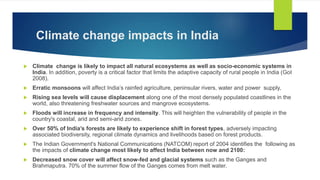
 Climate change is likely to impact all natural ecosystems as well as socio-economic systems in
India. In addition, poverty is a critical factor that limits the adaptive capacity of rural people in India (GoI
2008).
 Erratic monsoons will affect India’s rainfed agriculture, peninsular rivers, water and power supply,
 Rising sea levels will cause displacement along one of the most densely populated coastlines in the
world, also threatening freshwater sources and mangrove ecosystems.
 Floods will increase in frequency and intensity. This will heighten the vulnerability of people in the
country's coastal, arid and semi-arid zones.
 Over 50% of India’s forests are likely to experience shift in forest types, adversely impacting
associated biodiversity, regional climate dynamics and livelihoods based on forest products.
 The Indian Government's National Communications (NATCOM) report of 2004 identifies the following as
the impacts of climate change most likely to affect India between now and 2100:
 Decreased snow cover will affect snow-fed and glacial systems such as the Ganges and
Brahmaputra. 70% of the summer flow of the Ganges comes from melt water.
Contd.
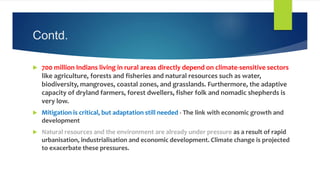
 700 million Indians living in rural areas directly depend on climate-sensitive sectors
like agriculture, forests and fisheries and natural resources such as water,
biodiversity, mangroves, coastal zones, and grasslands. Furthermore, the adaptive
capacity of dryland farmers, forest dwellers, fisher folk and nomadic shepherds is
very low.
 Mitigation is critical, but adaptation still needed - The link with economic growth and
development
 Natural resources and the environment are already under pressure as a result of rapid
urbanisation, industrialisation and economic development. Climate change is projected
to exacerbate these pressures.
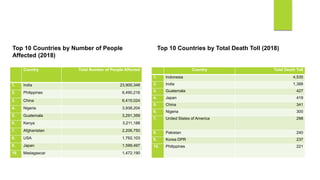
Country Total Number of People Affected
1. India 23,900,348
2. Philippines 6,490,216
3. China 6,415,024
4. Nigeria 3,938,204
5. Guatemala 3,291,359
6. Kenya 3,211,188
7. Afghanistan 2,206,750
8. USA 1,762,103
9. Japan 1,599,497
10. Madagascar 1,472,190
Country Total Death Toll
1. Indonesia 4,535
2. India 1,388
3. Guatemala 427
4. Japan 419
5. China 341
6. Nigeria 300
7. United States of America 298
8. Pakistan 240
9. Korea DPR 237
10. Philippines 221
Top 10 Countries by Total Death Toll (2018)Top 10 Countries by Number of People
Affected (2018)
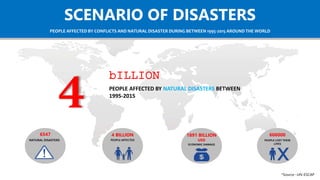
SCENARIO OF DISASTERS
PEOPLE AFFECTED BY CONFLICTS AND NATURAL DISASTER DURING BETWEEN 1995-2015 AROUND THE WORLD
bILLION
PEOPLE AFFECTED BY NATURAL DISASTERS BETWEEN
1995-20154
6547
NATURAL DISASTERS
4 BILLION
PEOPLE AFFECTED
1891 BILLION
USD
ECONOMIC DAMAGE
606000
PEOPLE LOST THEIR
LIVES
*Source –UN-ESCAP
Why we should we involve communities?
 The rationale for involving communities in disaster preparedness and mitigation activities is
based on the assumption that community is the real sufferer and the first responder and it
has developed its own coping mechanisms and strategy to reduce the impact of
disaster.
 It is imperative to appreciate this local knowledge and resources, and to build on them in
order to improve the capacity of the people to withstand the impact of disasters.
What is VDMP?
The village disaster management plan is a document which
details out the past hazard profile of the village and the present
vulnerability status on the basis of which we can prepare our
future.
 Have a clearly stated set of objectives
 Reflect a systematic sequence of activities in a logical and clear manner
 Assign specific tasks and responsibilities
 Offer a benchmark against which actual performance can be measured and reviewed
Why VDMP Is Needed ?
Development of a village disaster management plan is a process through which every unit in the village is
made aware of the various facets of disaster preparedness and response and their capacity is enhanced
to meet the exigency.
A Village Disaster Management Plan can be helpful for following reasons:
 It outlines the process by which the village should manage the disaster
 It can be used to tap human and material resources in the aftermath of a disaster
 It enlists the contact details of important administrative officials ensuring quick communication
with the administrative officials.
 It can play a vital role in helping to avoid mistakes or recognize hidden opportunities.
 to a list of activities which a village agrees to follow to prevent loss of life, livelihoods and property, in
case a disaster strikes.
 The plan strives for effective coordination of human and material resources which may facilitate a
better response thus helping in saving precious lives.
 It also identifies in advance, actions to be taken by the individuals in the community to prevent hazards
from becoming disasters.
COMPONENTS OF VDMP
 1. Situational analysis of the Village-
 2. Hazard, Vulnerability, Capacity and Risk Assessment
 3. Response Plan
 4. Mitigation and Preparedness plan
 5. Contact Details & Updation mechanism
 6. Annexure
VDMP Step 1- Situation Analysis
 1. situational analysis of the Village- population, geographical area, temperature, rainfall, agricultural land, cropping pattern, education,
economy, occupation, literacy rate, income, rivers, road, industries, hospitals, schools, temples, sex ratio, families below poverty line, livelihood
pattern, drinking water sources, critical establishments and other critical infrastructure.
 Village surrounded by in the North, South, East, and Western directions.
 Distance to the nearest village
 Hills, hillocks, elevated land, inclines, low lying areas, high tide lines
 Nearest water bodies and distance from sea
 Number of Men, women, children, disabled, elderly and Transgender population. segregated data for aged population, pregnant mothers,
those dependent upon specific medications for their survival etc. can
 also be mapped.
 Housing Type :Kutcha, Pucca, Semi-kutcha houses
 Natural resources in the village, for e.g. Lands and fields, Forests/ Trees, Tanks and ponds / Tube Wells / Wells etc
 Different livelihoods practiced in the village, for e.g. agriculture, fishing, seed collection, weaving, wage labour work and so on
 List of assets of the community, for e.g. Boats, fishing crafts, Nets, Irrigation facilities of farmers, implements, food grain stores and other
 inventories, implements of artisans etc.
 Existing safe and risk prone infrastructure in the village and their location (detailed out in resource mapping)
VDMP Step 2- Hazard, Vulnerability,
Capacity and Risk Assessment
 HAZARD ANALYSIS
 It is a rough spatial overview and sketches of the area and specific locations which are vulnerable to
various hazards or which has been hit by disasters in the past. The main feature of hazard mapping is to
facilitate discussion on issues pertinent to hazards.
 Historical Profile or Timeline: This tool is used to gather information about- what happened in the
past. It helps in getting an insight in past hazards, changes in their nature, intensity and behaviour.
 Seasonal Calendar: It involves making a calendar showing different events - primarily the time of
occurrence of hazards throughout the annual cycle. It helps to identify the periods of stress and
prepare for the specific stress in normal times before the threat of hazard looms large on the
community.
 Hazard Matrix: This tools aims at gathering comphrensive information about the past hazards. It
helps in having an insight about the future hazards on the basis of gaps and lacunae in the
management of past hazards and disasters.
Contd.
 Vulnerability Analysis- The process of vulnerability analysis aims to highlight the weakness in the existing-
scenario of the village in terms of human beings as well as infrastructure. It involves asking the participants
two major questions namely; who is vulnerable and what is vulnerable?
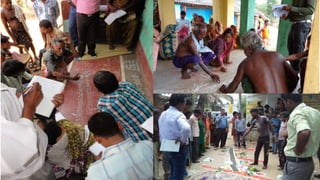
 Transect Walk: The process involves taking a systematic walk with key informants through the
community to explore spatial differences, land use zones by observing, asking, listening, informal interviews
and producing a rough sketch of the existing weaknesses in the village which would either lead to a disaster or
prevent smooth response to a disaster.
 Problem Tree: The tool involves drawing a tree which shows relationship- between different aspects of
vulnerability. It involves identifying major problems and vulnerabilities as well as root causes and their effects.
The trunk represents the problems, the root depict the causes while the leaves signify the effects.
 Livelihood Analysis: The tool focuses on the studying the vulnerability of the livelihood of the community
to various disasters. The tool analyzes the various livelihood activities that are spread over the year and the
impact of hazards on the livelihood activities. It also focuses on understanding
 Resource Analysis Resource analysis focuses on identifying locally available assets and
resources that can be utilized for building the capacities of the community during and after
disasters.-
-Resource Mapping & Resource Matrix
 Risk Analysis- Risk is a measure of the expected losses due to a hazard event of a particular
magnitude occurring in a given area over a specific time period. The tool is based on determining
the risk by analyzing the vulnerabilities and capacities of the community related to each hazard.
VDMP Step 3- Response Plan
 The response plan would include the following components:
 Disaster Management Committee: Constitution and Role
 To take village level decisions
 To coordinate the activities of the Disaster management Teams,
 To account for and to maintain the inventory of Community based Disaster
 preparedness materials
 To able to ensure a continuous monitoring of preparedness
Contd.
 DMTS
1. Warning Team
2. Evacuation and Response
3. First aid
4. sanitation
5. shelter management
6. Relief Management
7. Carcass disposal
8. Counseling
9. Damage Assessment
10. Reconstruction and Rehabilitation Team
VDMP Step 4-MITIGATION AND
PREPAREDNESS PLAN
 standard Operating Procedures of Disaster
Management Teams in
 Pre Disaster Phase
 Identifying safe Evacuation Routes
 Community level Mitigation Program
 skill training
 Mock Drills
VDMP Step 5- FINANCIAL MECHANISM
 Community Contingency Fund
• o sustain existing community based disaster reduction activities
• ● To strengthen the resilience of most vulnerable social groups
• ● To develop an ownership of disaster reduction activities
• ● To organize immediate relief and rescue activities so that lives and property can be protected
without waiting for external aid.
 Development schemes and Disaster Mitigation
 National Rural Employment Guarantee Act’ 2005 (NREGA)
 Sampoorna Grameen Rozgar Youjana (SGRY)
 Pradhan Mantri Gram Sadak Yojana (PMGSY)
 Indira Awas Yojana (IAY)
VDMP Step 6- CONTACT DETAILS AND
UPDATION MECHANISM
The key concepts would include
the following components:
Topic 1: Contact details
Topic 2: Updation Mechanism
Any Disaster Management Plan should be
 Written -Otherwise It will not be REMEMBERED
 Simple -Otherwise It will not be UNDERSTOOD
 Disseminated- Otherwise It will not REACH THE
NEEDFUL
 Tested -Otherwise It will not be PRACTICAL
 Revised- Otherwise It will not be UP TO DATE
Village disaster management plan

Village disaster management plan

  • 1.
  • 2.
    Climate change impactsin India  Climate change is likely to impact all natural ecosystems as well as socio-economic systems in India. In addition, poverty is a critical factor that limits the adaptive capacity of rural people in India (GoI 2008).  Erratic monsoons will affect India’s rainfed agriculture, peninsular rivers, water and power supply,  Rising sea levels will cause displacement along one of the most densely populated coastlines in the world, also threatening freshwater sources and mangrove ecosystems.  Floods will increase in frequency and intensity. This will heighten the vulnerability of people in the country's coastal, arid and semi-arid zones.  Over 50% of India’s forests are likely to experience shift in forest types, adversely impacting associated biodiversity, regional climate dynamics and livelihoods based on forest products.  The Indian Government's National Communications (NATCOM) report of 2004 identifies the following as the impacts of climate change most likely to affect India between now and 2100:  Decreased snow cover will affect snow-fed and glacial systems such as the Ganges and Brahmaputra. 70% of the summer flow of the Ganges comes from melt water.
  • 3.
    Contd.  700 millionIndians living in rural areas directly depend on climate-sensitive sectors like agriculture, forests and fisheries and natural resources such as water, biodiversity, mangroves, coastal zones, and grasslands. Furthermore, the adaptive capacity of dryland farmers, forest dwellers, fisher folk and nomadic shepherds is very low.  Mitigation is critical, but adaptation still needed - The link with economic growth and development  Natural resources and the environment are already under pressure as a result of rapid urbanisation, industrialisation and economic development. Climate change is projected to exacerbate these pressures.
  • 4.
    Country Total Numberof People Affected 1. India 23,900,348 2. Philippines 6,490,216 3. China 6,415,024 4. Nigeria 3,938,204 5. Guatemala 3,291,359 6. Kenya 3,211,188 7. Afghanistan 2,206,750 8. USA 1,762,103 9. Japan 1,599,497 10. Madagascar 1,472,190 Country Total Death Toll 1. Indonesia 4,535 2. India 1,388 3. Guatemala 427 4. Japan 419 5. China 341 6. Nigeria 300 7. United States of America 298 8. Pakistan 240 9. Korea DPR 237 10. Philippines 221 Top 10 Countries by Total Death Toll (2018)Top 10 Countries by Number of People Affected (2018)
  • 5.
    SCENARIO OF DISASTERS PEOPLEAFFECTED BY CONFLICTS AND NATURAL DISASTER DURING BETWEEN 1995-2015 AROUND THE WORLD bILLION PEOPLE AFFECTED BY NATURAL DISASTERS BETWEEN 1995-20154 6547 NATURAL DISASTERS 4 BILLION PEOPLE AFFECTED 1891 BILLION USD ECONOMIC DAMAGE 606000 PEOPLE LOST THEIR LIVES *Source –UN-ESCAP
  • 6.
    Why we shouldwe involve communities?  The rationale for involving communities in disaster preparedness and mitigation activities is based on the assumption that community is the real sufferer and the first responder and it has developed its own coping mechanisms and strategy to reduce the impact of disaster.  It is imperative to appreciate this local knowledge and resources, and to build on them in order to improve the capacity of the people to withstand the impact of disasters.
  • 7.
    What is VDMP? Thevillage disaster management plan is a document which details out the past hazard profile of the village and the present vulnerability status on the basis of which we can prepare our future.  Have a clearly stated set of objectives  Reflect a systematic sequence of activities in a logical and clear manner  Assign specific tasks and responsibilities  Offer a benchmark against which actual performance can be measured and reviewed
  • 8.
    Why VDMP IsNeeded ? Development of a village disaster management plan is a process through which every unit in the village is made aware of the various facets of disaster preparedness and response and their capacity is enhanced to meet the exigency. A Village Disaster Management Plan can be helpful for following reasons:  It outlines the process by which the village should manage the disaster  It can be used to tap human and material resources in the aftermath of a disaster  It enlists the contact details of important administrative officials ensuring quick communication with the administrative officials.  It can play a vital role in helping to avoid mistakes or recognize hidden opportunities.  to a list of activities which a village agrees to follow to prevent loss of life, livelihoods and property, in case a disaster strikes.  The plan strives for effective coordination of human and material resources which may facilitate a better response thus helping in saving precious lives.  It also identifies in advance, actions to be taken by the individuals in the community to prevent hazards from becoming disasters.
  • 9.
    COMPONENTS OF VDMP 1. Situational analysis of the Village-  2. Hazard, Vulnerability, Capacity and Risk Assessment  3. Response Plan  4. Mitigation and Preparedness plan  5. Contact Details & Updation mechanism  6. Annexure
  • 10.
    VDMP Step 1-Situation Analysis  1. situational analysis of the Village- population, geographical area, temperature, rainfall, agricultural land, cropping pattern, education, economy, occupation, literacy rate, income, rivers, road, industries, hospitals, schools, temples, sex ratio, families below poverty line, livelihood pattern, drinking water sources, critical establishments and other critical infrastructure.  Village surrounded by in the North, South, East, and Western directions.  Distance to the nearest village  Hills, hillocks, elevated land, inclines, low lying areas, high tide lines  Nearest water bodies and distance from sea  Number of Men, women, children, disabled, elderly and Transgender population. segregated data for aged population, pregnant mothers, those dependent upon specific medications for their survival etc. can  also be mapped.  Housing Type :Kutcha, Pucca, Semi-kutcha houses  Natural resources in the village, for e.g. Lands and fields, Forests/ Trees, Tanks and ponds / Tube Wells / Wells etc  Different livelihoods practiced in the village, for e.g. agriculture, fishing, seed collection, weaving, wage labour work and so on  List of assets of the community, for e.g. Boats, fishing crafts, Nets, Irrigation facilities of farmers, implements, food grain stores and other  inventories, implements of artisans etc.  Existing safe and risk prone infrastructure in the village and their location (detailed out in resource mapping)
  • 11.
    VDMP Step 2-Hazard, Vulnerability, Capacity and Risk Assessment  HAZARD ANALYSIS  It is a rough spatial overview and sketches of the area and specific locations which are vulnerable to various hazards or which has been hit by disasters in the past. The main feature of hazard mapping is to facilitate discussion on issues pertinent to hazards.  Historical Profile or Timeline: This tool is used to gather information about- what happened in the past. It helps in getting an insight in past hazards, changes in their nature, intensity and behaviour.  Seasonal Calendar: It involves making a calendar showing different events - primarily the time of occurrence of hazards throughout the annual cycle. It helps to identify the periods of stress and prepare for the specific stress in normal times before the threat of hazard looms large on the community.  Hazard Matrix: This tools aims at gathering comphrensive information about the past hazards. It helps in having an insight about the future hazards on the basis of gaps and lacunae in the management of past hazards and disasters.
  • 13.
    Contd.  Vulnerability Analysis-The process of vulnerability analysis aims to highlight the weakness in the existing- scenario of the village in terms of human beings as well as infrastructure. It involves asking the participants two major questions namely; who is vulnerable and what is vulnerable?  Transect Walk: The process involves taking a systematic walk with key informants through the community to explore spatial differences, land use zones by observing, asking, listening, informal interviews and producing a rough sketch of the existing weaknesses in the village which would either lead to a disaster or prevent smooth response to a disaster.  Problem Tree: The tool involves drawing a tree which shows relationship- between different aspects of vulnerability. It involves identifying major problems and vulnerabilities as well as root causes and their effects. The trunk represents the problems, the root depict the causes while the leaves signify the effects.  Livelihood Analysis: The tool focuses on the studying the vulnerability of the livelihood of the community to various disasters. The tool analyzes the various livelihood activities that are spread over the year and the impact of hazards on the livelihood activities. It also focuses on understanding
  • 14.
     Resource AnalysisResource analysis focuses on identifying locally available assets and resources that can be utilized for building the capacities of the community during and after disasters.- -Resource Mapping & Resource Matrix  Risk Analysis- Risk is a measure of the expected losses due to a hazard event of a particular magnitude occurring in a given area over a specific time period. The tool is based on determining the risk by analyzing the vulnerabilities and capacities of the community related to each hazard.
  • 15.
    VDMP Step 3-Response Plan  The response plan would include the following components:  Disaster Management Committee: Constitution and Role  To take village level decisions  To coordinate the activities of the Disaster management Teams,  To account for and to maintain the inventory of Community based Disaster  preparedness materials  To able to ensure a continuous monitoring of preparedness
  • 16.
    Contd.  DMTS 1. WarningTeam 2. Evacuation and Response 3. First aid 4. sanitation 5. shelter management 6. Relief Management 7. Carcass disposal 8. Counseling 9. Damage Assessment 10. Reconstruction and Rehabilitation Team
  • 17.
    VDMP Step 4-MITIGATIONAND PREPAREDNESS PLAN  standard Operating Procedures of Disaster Management Teams in  Pre Disaster Phase  Identifying safe Evacuation Routes  Community level Mitigation Program  skill training  Mock Drills
  • 19.
    VDMP Step 5-FINANCIAL MECHANISM  Community Contingency Fund • o sustain existing community based disaster reduction activities • ● To strengthen the resilience of most vulnerable social groups • ● To develop an ownership of disaster reduction activities • ● To organize immediate relief and rescue activities so that lives and property can be protected without waiting for external aid.  Development schemes and Disaster Mitigation  National Rural Employment Guarantee Act’ 2005 (NREGA)  Sampoorna Grameen Rozgar Youjana (SGRY)  Pradhan Mantri Gram Sadak Yojana (PMGSY)  Indira Awas Yojana (IAY)
  • 20.
    VDMP Step 6-CONTACT DETAILS AND UPDATION MECHANISM The key concepts would include the following components: Topic 1: Contact details Topic 2: Updation Mechanism
  • 21.
    Any Disaster ManagementPlan should be  Written -Otherwise It will not be REMEMBERED  Simple -Otherwise It will not be UNDERSTOOD  Disseminated- Otherwise It will not REACH THE NEEDFUL  Tested -Otherwise It will not be PRACTICAL  Revised- Otherwise It will not be UP TO DATE