CORPORATE
SOCIAL
RESPONSIBILITY
(CSR):
OPPORTUNITIES
& CHALLENGES
• What is CSR
• Genesis of CSR
• Applicability of CSR law
• CSR Committee
• CSR Law Permissible and Non permissible
• Schedule vii of Section 135
• Effective implementation of CSR projects
• Appropriate Structure for implementing CSR
• Research
• Scoping methodology
What we will cover today
What is CSR?
• Corporate Social Responsibility (CSR)
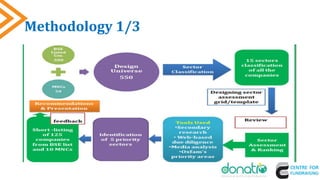
is the funding and grants process under which Non-Profit
Organisations (NGOs) can get financial and other support from the
corporate sector.
• Under the Clause 135 of Companies Act, 2013 it is a mandatory to
provide a contribution of 2 percent of the average net profits of
company
3
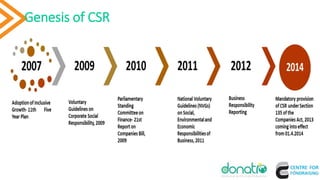
Genesis of CSR
4
Applicability of CSR law ( Section 135 of Comp. Act)
• On every Company including its holding or subsidiary having:
• Net worth of Rs. 500 Crore or more, or
• Turnover of Rs. 1000 crore or more, or
• Net Profit of Rs. 5 crore or more
• ♥ during the immediately preceding financial year
• A foreign company having its branch office or project office in India,
which fulfils the criteria specified above
• However, if a company ceases to meet the above criteria for 3
consecutive financial years then it is not required to comply with CSR
Provisions till such time it meets the specified criteria.
5
What is Section 135 of Companies Act
Section 135 of the Companies Act, 2013, provides for companies
• having net worth of Rs. 500 Crores or more
• Having a turnover of Rs. 1000 crore or more
• Having a net profit of Rs. 5 Crore or more in a financial year
to spend ATLEAST 2% of the average net profits of last 3 years for the
company’s Corporate Social Responsibility (CSR) policy.
• Shall constitute a Corporate Social Responsibility Committee
• CSR Committee shall be having consisting of three or more Board of
Directors, with at least one Independent Director.
6
CSR Committee
• Every Company on which CSR is applicable is required to constitute a
CSR Committee of the Board:
• Consisting of 3 or more directors, out of which at least one director
shall be an independent director. However, if a company is not
required to appoint an independent director, then it shall have in 2 or
more directors in the Committee.
• Consisting of 2 directors in case of a private company having only two
directors on its Board
• Consisting of at least 2 persons in case of a foreign Company of which
one person shall be its authorised person resident in India and
another nominated by the foreign company
7
Functions of CSR Committee
The CSR Committee shall—
• Formulate and recommend to the Board, a CSR Policy which shall
indicate the activities to be undertaken by the Company
• Recommend the amount of expenditure to be incurred on the
activities referred to in clause (i)
• Monitor the CSR Policy of the company from time to time
• Institute a transparent monitoring mechanism for implementation of
the CSR projects or programs or activities undertaken by the
company.
8
CSR Policy of the Company
• The CSR Policy of the company shall include the following namely :-
• A list of CSR projects or programs which a company plans to
undertake specifying modalities of execution of such project or
programs and implementation schedules for the same
• Monitoring process of such projects or programs
• A clause specifying that the surplus arising out of the CSR projects or
programs or activities shall not form part of the business profit of
the company.
9
CSR activities
• Permissible • Non Permissible
10
•Company can execute through own / group
foundation or foundation formed with other
company or through implementing agencies
•If the entity is not set up by the company
then it must be an established entity (at least
3 years old)
•Companies may collaborate / pool
resources together but companies should
be able to report separately
•Companies may spend up to 5% of CSR
expenditure on building capacity of own
personnel, implementing agencies,
administration and on salaries paid to CSR
staff
•Activities exclusively for benefit of
employees and their families shall not be
considered
•Activities undertaken in pursuance of
normal course of business of the company
shall not be considered
•Only CSR activities within India will be taken
into consideration
•Contribution directly or indirectly to
political parties shall not be considered as
CSR spend
•Expenses incurred for fulfillment of any Act
/ statute of regulations (such as Labor Laws,
Land Acquisition Act,etc.)
What’s is Schedule VII of Sec. 135
11
• Eradicate hunger, poverty and malnutrition
• Promote health, education, vocational skills, livelihood enhancement projects and sanitation
including contribution to Swach Bharat Kosh
• Equality of gender, women empowerment
• Ensure environmental sustainability, ecological balance including contribution to Clean Ganga Fund,
Swatcha Bharat Koch
• Protect Natural heritage, art & culture
• Benefits for armed force veterans, war widows and dependents
• Training to promote rural sports, nationally recognized sports, Paralympic sports and Olympic sports
• Contribute to PM’s National Relief Fund and other applicable central government funds
• Fund technology incubators located within Central universities
• Develop rural development projects
• Slum area development
Schedule VII to be interpreted liberally
Details of schedule vii
12
• The entries in Schedule VII are asfollows:
i. Eradicating hunger, poverty and malnutrition, promoting healthcare including
preventive healthcare and sanitation including contribution to the Swach
Bharat Kosh set-up by the Central Government for the promotion of sanitation
and making available safe drinking water.
ii.Promotion of education, including special education and employment
enhancing vocation skills especially among children, woman, elderly and the
differently abled and livelihood enhancement projects
iii.Promoting gender equality, empowering women, setting up homes and
hostels for women and orphans, setting up old age homes, day care centers, and
such other facilities for senior citizens and measures for reducing inequalities
faced by socially and economically backward group.
Details of schedule vii
13
iv.Ensuring environmental sustainability, ecological balance, protection of flora
and fauna, animal welfare, agroforestry, conservation of natural resources and
maintaining quality of soil, air and water including contribution to the Clean
Ganga Fund set-up by the Central Government for rejuvenation of river Ganga3
v.Protection of national heritage, art and culture including restoration of
buildings and sites of historical importance and works of art; setting up of
public libraries, promotion and development of traditional arts and handicrafts
vi.Measures for the benefit of armed forces veterans, war widows and their
dependents
vii.Training to promote rural sports, nationally recognized sports, Paralympic
sports and Olympic sports
Details of schedule vii
14
viii.Contribution to the Prime Minister's National Relief Fund or any other fund
set up by the Central Government for socio-economic development and relief
and welfare of the Scheduled Castes, the Scheduled Tribes, other backward
classes, minorities and women.
ix.Contributions or funds provided to technology incubators located within
academic institutions which are approved by the Central Government
x.Rural development projects
xi.Slum area development
Explanation – For the purpose of this item, the term ‘slum area’ shall mean any
area declared as such by the Central Government or any State Government or
any other competent authority under any law for the time being in force
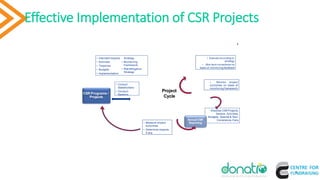
• Measure project
outcomes
• Determine impacts
if any
•Disclose CSR Projects,
Sectors, Activities,
Budgets, Spends & Non-
Compliance if any
• Monitor project
outcomes on basis of
monitoring framework
• Execute according to
strategy
• Mid-term corrections on
basis of monitoring feedback
• Intended Impacts
• Activities
• Timelines
• Budgets
• Implementation
Strategy
• Monitoring
Framework
• Risk Mitigation
Strategy
• Consult
Stakeholders
• Conduct
Baseline
Project
Cycle
Annual CSR
Reporting
CSR Programs /
Projects
15
Effective Implementation of CSR Projects
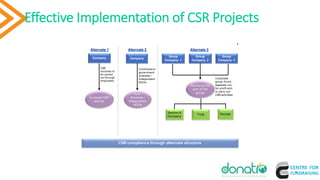
Company
Govt.
Schemes /
Independent
NGOs
Contribute to
government
schemes /
independent
NGOs
Company
In-house CSR
activity
Group
Company 1
Group
Company 2
Group
Company 3
Not-for-profit
arm of the
group
CSR
activities to
be carried
out through
employees
Alternate 1 Alternate 2 Alternate 3
Corporate
group forms
separate not-
for-profit arm
to carry out
CSR activities
Section 8
Company
Trust Society
CSR compliance through alternate structure
16
Effective Implementation of CSR Projects
• Development of a comprehensive strategy for corporate engagement to
enhance your organization’s fundraising capacity. This should include:
• Sector-analysis (15 sectors)
• Development of database of 125-150 companies considering the top 5
sectors
• Use of the results and analysis of initial screening done for 50 companies
• Run through ethical screening team, if you have such a mechanism.
Research
The analysis universe may include the following:
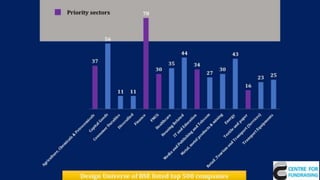
• Preparation of a list of the top 500 companies from BSE and the top 50
unlisted MNCs having operations in India
• Breakdown of 550 companies into sectors (15)
• Assessment of 15 sectors based on secondary research
• Identification of top 5 priority sectors for corporate engagement
• Preparation of list of 125 companies from the priority sectors and other
sectors, 10 MNCs based on due-diligence and brand risk analysis
• Recommendations for fundraising based on the analysis .
Scope of Study
Methodology 1/3
I. Preparing a universe of 500 companies is based on the market cap from BSE
II. Identifying 50 MNCs from Forbes Global 2000 list, with operations in India
III. Classification of the companies in sectors; some of the sectors may have to be
clubbed together based on the nature of operations, raw material
requirements and business types.
Methodology 1/3
Methodology 2/3
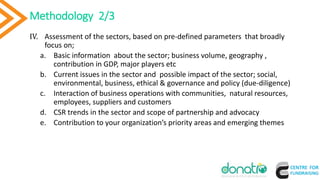
IV. Assessment of the sectors, based on pre-defined parameters that broadly
focus on;
a. Basic information about the sector; business volume, geography ,
contribution in GDP, major players etc
b. Current issues in the sector and possible impact of the sector; social,
environmental, business, ethical & governance and policy (due-diligence)
c. Interaction of business operations with communities, natural resources,
employees, suppliers and customers
d. CSR trends in the sector and scope of partnership and advocacy
e. Contribution to your organization’s priority areas and emerging themes
Methodology 3/3
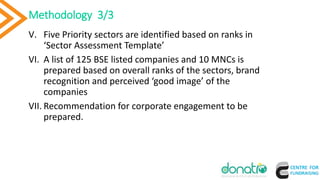
V. Five Priority sectors are identified based on ranks in
‘Sector Assessment Template’
VI. A list of 125 BSE listed companies and 10 MNCs is
prepared based on overall ranks of the sectors, brand
recognition and perceived ‘good image’ of the
companies
VII. Recommendation for corporate engagement to be
prepared.
37
56
11 11
78
30
35
44
34
27
30
43
16
23 25
Design Universe of BSE listed top 500 companies
Priority sectors
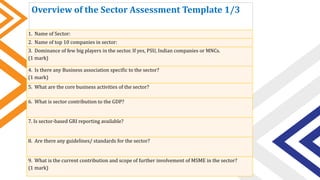
Overview of the Sector Assessment Template 1/3
1. Name of Sector:
2. Name of top 10 companies in sector:
3. Dominance of few big players in the sector. If yes, PSU, Indian companies or MNCs.
(1 mark)
4. Is there any Business association specific to the sector?
(1 mark)
5. What are the core business activities of the sector?
6. What is sector contribution to the GDP?
7. Is sector-based GRI reporting available?
8. Are there any guidelines/ standards for the sector?
9. What is the current contribution and scope of further involvement of MSME in the sector?
(1 mark)
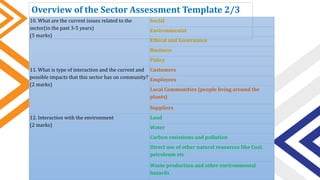
10. What are the current issues related to the
sector(in the past 3-5 years)
(5 marks)
Social
Environmental
Ethical and Governance
Business
Policy
11. What is type of interaction and the current and
possible impacts that this sector has on community?
(2 marks)
Customers
Employees
Local Communities (people living around the
plants)
Suppliers
12. Interaction with the environment
(2 marks)
Land
Water
Carbon emissions and pollution
Direct use of other natural resources like Coal,
petroleum etc
Waste production and other environmental
hazards
Overview of the Sector Assessment Template 2/3
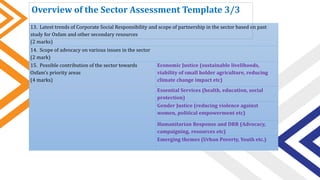
13. Latest trends of Corporate Social Responsibility and scope of partnership in the sector based on past
study for Oxfam and other secondary resources
(2 marks)
14. Scope of advocacy on various issues in the sector
(2 mark)
15. Possible contribution of the sector towards
Oxfam’s priority areas
(4 marks)
Economic Justice (sustainable livelihoods,
viability of small holder agriculture, reducing
climate change impact etc)
Essential Services (health, education, social
protection)
Gender Justice (reducing violence against
women, political empowerment etc)
Humanitarian Response and DRR (Advocacy,
campaigning, resources etc)
Emerging themes (Urban Poverty, Youth etc.)
Overview of the Sector Assessment Template 3/3
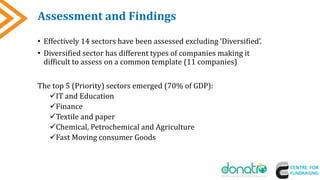
Assessment and Findings
• Effectively 14 sectors have been assessed excluding ‘Diversified’.
• Diversified sector has different types of companies making it
difficult to assess on a common template (11 companies)
The top 5 (Priority) sectors emerged (70% of GDP):
IT and Education
Finance
Textile and paper
Chemical, Petrochemical and Agriculture
Fast Moving consumer Goods
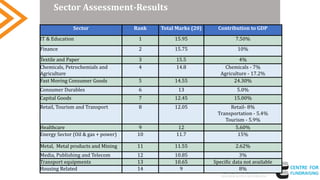
Sector Rank Total Marks (20) Contribution to GDP
IT & Education 1 15.95 7.50%
Finance 2 15.75 10%
Textile and Paper 3 15.5 4%
Chemicals, Petrochemials and
Agriculture
4 14.8 Chemicals - 7%
Agriculture - 17.2%
Fast Moving Consumer Goods 5 14.55 24.30%
Consumer Durables 6 13 5.0%
Capital Goods 7 12.45 15.00%
Retail, Tourism and Transport 8 12.05 Retail- 8%
Transportation - 5.4%
Tourism - 5.9%
Healthcare 9 12 5.60%
Energy Sector (Oil & gas + power) 10 11.7 15%
Metal, Metal products and Mining 11 11.55 2.62%
Media, Publishing and Telecom 12 10.85 3%
Transport equipments 13 10.65 Specific data not available
Housing Related 14 9 8%
Sector Assessment-Results
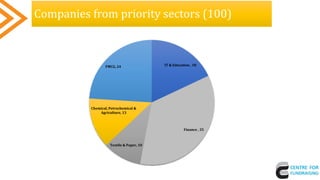
Companies from priority sectors (100)
IT & Education , 18
Finance , 35
Textile & Paper, 10
Chemical, Petrochemical &
Agriculture, 13
FMCG, 24
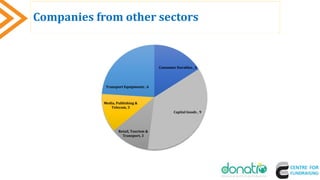
Companies from other sectors (25)
Consumer Durables , 4
Capital Goods , 9
Retail, Tourism &
Transport, 3
Media, Publishing &
Telecom, 3
Transport Equipments , 6
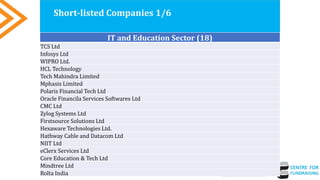
IT and Education Sector (18)
TCS Ltd
Infosys Ltd
WIPRO Ltd.
HCL Technology
Tech Mahindra Limited
Mphasis Limited
Polaris Financial Tech Ltd
Oracle Financila Services Softwares Ltd
CMC Ltd
Zylog Systems Ltd
Firstsource Solutions Ltd
Hexaware Technologies Ltd.
Hathway Cable and Datacom Ltd
NIIT Ltd
eClerx Services Ltd
Core Education & Tech Ltd
Mindtree Ltd
Rolta India
Short-listed Companies 1/6
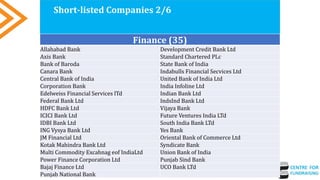
Short-listed Companies 2/6
Finance (35)
Allahabad Bank Development Credit Bank Ltd
Axis Bank Standard Chartered PLc
Bank of Baroda State Bank of India
Canara Bank Indabulls Financial Secvices Ltd
Central Bank of India United Bank of India Ltd
Corporation Bank India Infoline Ltd
Edelweiss Financial Services lTd Indian Bank Ltd
Federal Bank Ltd IndsInd Bank Ltd
HDFC Bank Ltd Vijaya Bank
ICICI Bank Ltd Future Ventures India LTd
IDBI Bank Ltd South India Bank LTd
ING Vysya Bank Ltd Yes Bank
JM Financial Ltd Oriental Bank of Commerce Ltd
Kotak Mahindra Bank Ltd Syndicate Bank
Multi Commodity Excahnag eof IndiaLtd Union Bank of India
Power Finance Corporation Ltd Punjab Sind Bank
Bajaj Finance Ltd UCO Bank LTd
Punjab National Bank
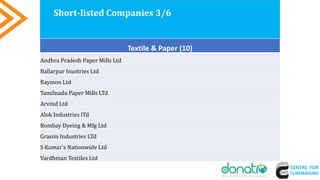
Short-listed Companies 3/6
Textile & Paper (10)
Andhra Pradesh Paper Mills Ltd
Ballarpur Inustries Ltd
Raymon Ltd
Tamilnadu Paper Mills LTd
Arvind Ltd
Alok Industries lTd
Bombay Dyeing & Mfg Ltd
Grasim Industries LTd
S Kumar's Nationwide Ltd
Vardhman Textiles Ltd
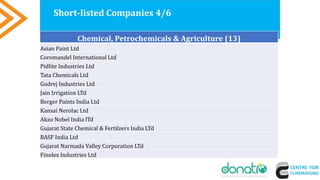
Short-listed Companies 4/6
Chemical, Petrochemicals & Agriculture (13)
Asian Paint Ltd
Coromandel International Ltd
Pidlite Industries Ltd
Tata Chemicals Ltd
Godrej Industries Ltd
Jain Irrigation LTd
Berger Paints India Ltd
Kansai Nerolac Ltd
Akzo Nobel India lTd
Gujarat State Chemical & Fertilzers India LTd
BASF India Ltd
Gujarat Narmada Valley Corporation LTd
Finolex Industries Ltd
Short-listed Companies 5/6
FMCG (24)
Trent Ltd [LAKME LTD]
Agro Tech Foods Ltd
Bajaj Corp Ltd
Bata India Ltd
Britannia Ind. Ltd
Colgate-Palmolive India Ltd
Dabur India Ltd
Emami Ltd
Gillette India LTd
Godrej Consumer Goods Ltd
Hindustan Unilever Ltd
ITC Ltd
Jubilant Foodworks Ltd
Jyothi Lab. Ltd
Kwality Dairy India Ltd
Marico Ltd
Nestle India Ltd
P & G Hygiene and Helathcare Ltd
Radic Kahitan
Tata Global Beverages Ltd
JBF Ind. Ltd
K S Oils Ltd
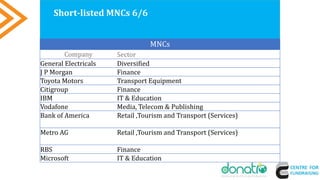
Short-listed MNCs 6/6
MNCs
Company Sector
General Electricals Diversified
J P Morgan Finance
Toyota Motors Transport Equipment
Citigroup Finance
IBM IT & Education
Vodafone Media, Telecom & Publishing
Bank of America Retail ,Tourism and Transport (Services)
Metro AG Retail ,Tourism and Transport (Services)
RBS Finance
Microsoft IT & Education
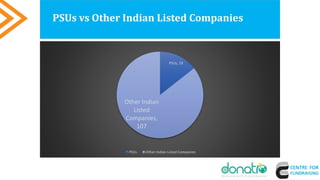
PSUs, 18
Other Indian
Listed
Companies,
107
PSUs Other Indian Listed Companies
PSUs vs Other Indian Listed Companies
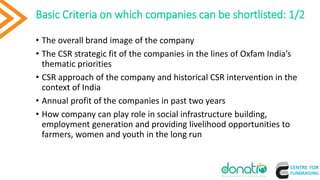
Basic Criteria on which companies can be shortlisted: 1/2
• The overall brand image of the company
• The CSR strategic fit of the companies in the lines of Oxfam India’s
thematic priorities
• CSR approach of the company and historical CSR intervention in the
context of India
• Annual profit of the companies in past two years
• How company can play role in social infrastructure building,
employment generation and providing livelihood opportunities to
farmers, women and youth in the long run
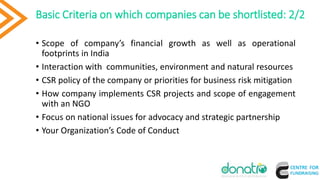
• Scope of company’s financial growth as well as operational
footprints in India
• Interaction with communities, environment and natural resources
• CSR policy of the company or priorities for business risk mitigation
• How company implements CSR projects and scope of engagement
with an NGO
• Focus on national issues for advocacy and strategic partnership
• Your Organization’s Code of Conduct
Basic Criteria on which companies can be shortlisted: 2/2
Donatio: Your online fundraising platform
(www.donatio.in)
40

CSR ; Opportunities and challenges for NGOs

  • 1.
  • 2.
    • What isCSR • Genesis of CSR • Applicability of CSR law • CSR Committee • CSR Law Permissible and Non permissible • Schedule vii of Section 135 • Effective implementation of CSR projects • Appropriate Structure for implementing CSR • Research • Scoping methodology What we will cover today
  • 3.
    What is CSR? •Corporate Social Responsibility (CSR) is the funding and grants process under which Non-Profit Organisations (NGOs) can get financial and other support from the corporate sector. • Under the Clause 135 of Companies Act, 2013 it is a mandatory to provide a contribution of 2 percent of the average net profits of company 3
  • 4.
  • 5.
    Applicability of CSRlaw ( Section 135 of Comp. Act) • On every Company including its holding or subsidiary having: • Net worth of Rs. 500 Crore or more, or • Turnover of Rs. 1000 crore or more, or • Net Profit of Rs. 5 crore or more • ♥ during the immediately preceding financial year • A foreign company having its branch office or project office in India, which fulfils the criteria specified above • However, if a company ceases to meet the above criteria for 3 consecutive financial years then it is not required to comply with CSR Provisions till such time it meets the specified criteria. 5
  • 6.
    What is Section135 of Companies Act Section 135 of the Companies Act, 2013, provides for companies • having net worth of Rs. 500 Crores or more • Having a turnover of Rs. 1000 crore or more • Having a net profit of Rs. 5 Crore or more in a financial year to spend ATLEAST 2% of the average net profits of last 3 years for the company’s Corporate Social Responsibility (CSR) policy. • Shall constitute a Corporate Social Responsibility Committee • CSR Committee shall be having consisting of three or more Board of Directors, with at least one Independent Director. 6
  • 7.
    CSR Committee • EveryCompany on which CSR is applicable is required to constitute a CSR Committee of the Board: • Consisting of 3 or more directors, out of which at least one director shall be an independent director. However, if a company is not required to appoint an independent director, then it shall have in 2 or more directors in the Committee. • Consisting of 2 directors in case of a private company having only two directors on its Board • Consisting of at least 2 persons in case of a foreign Company of which one person shall be its authorised person resident in India and another nominated by the foreign company 7
  • 8.
    Functions of CSRCommittee The CSR Committee shall— • Formulate and recommend to the Board, a CSR Policy which shall indicate the activities to be undertaken by the Company • Recommend the amount of expenditure to be incurred on the activities referred to in clause (i) • Monitor the CSR Policy of the company from time to time • Institute a transparent monitoring mechanism for implementation of the CSR projects or programs or activities undertaken by the company. 8
  • 9.
    CSR Policy ofthe Company • The CSR Policy of the company shall include the following namely :- • A list of CSR projects or programs which a company plans to undertake specifying modalities of execution of such project or programs and implementation schedules for the same • Monitoring process of such projects or programs • A clause specifying that the surplus arising out of the CSR projects or programs or activities shall not form part of the business profit of the company. 9
  • 10.
    CSR activities • Permissible• Non Permissible 10 •Company can execute through own / group foundation or foundation formed with other company or through implementing agencies •If the entity is not set up by the company then it must be an established entity (at least 3 years old) •Companies may collaborate / pool resources together but companies should be able to report separately •Companies may spend up to 5% of CSR expenditure on building capacity of own personnel, implementing agencies, administration and on salaries paid to CSR staff •Activities exclusively for benefit of employees and their families shall not be considered •Activities undertaken in pursuance of normal course of business of the company shall not be considered •Only CSR activities within India will be taken into consideration •Contribution directly or indirectly to political parties shall not be considered as CSR spend •Expenses incurred for fulfillment of any Act / statute of regulations (such as Labor Laws, Land Acquisition Act,etc.)
  • 11.
    What’s is ScheduleVII of Sec. 135 11 • Eradicate hunger, poverty and malnutrition • Promote health, education, vocational skills, livelihood enhancement projects and sanitation including contribution to Swach Bharat Kosh • Equality of gender, women empowerment • Ensure environmental sustainability, ecological balance including contribution to Clean Ganga Fund, Swatcha Bharat Koch • Protect Natural heritage, art & culture • Benefits for armed force veterans, war widows and dependents • Training to promote rural sports, nationally recognized sports, Paralympic sports and Olympic sports • Contribute to PM’s National Relief Fund and other applicable central government funds • Fund technology incubators located within Central universities • Develop rural development projects • Slum area development Schedule VII to be interpreted liberally
  • 12.
    Details of schedulevii 12 • The entries in Schedule VII are asfollows: i. Eradicating hunger, poverty and malnutrition, promoting healthcare including preventive healthcare and sanitation including contribution to the Swach Bharat Kosh set-up by the Central Government for the promotion of sanitation and making available safe drinking water. ii.Promotion of education, including special education and employment enhancing vocation skills especially among children, woman, elderly and the differently abled and livelihood enhancement projects iii.Promoting gender equality, empowering women, setting up homes and hostels for women and orphans, setting up old age homes, day care centers, and such other facilities for senior citizens and measures for reducing inequalities faced by socially and economically backward group.
  • 13.
    Details of schedulevii 13 iv.Ensuring environmental sustainability, ecological balance, protection of flora and fauna, animal welfare, agroforestry, conservation of natural resources and maintaining quality of soil, air and water including contribution to the Clean Ganga Fund set-up by the Central Government for rejuvenation of river Ganga3 v.Protection of national heritage, art and culture including restoration of buildings and sites of historical importance and works of art; setting up of public libraries, promotion and development of traditional arts and handicrafts vi.Measures for the benefit of armed forces veterans, war widows and their dependents vii.Training to promote rural sports, nationally recognized sports, Paralympic sports and Olympic sports
  • 14.
    Details of schedulevii 14 viii.Contribution to the Prime Minister's National Relief Fund or any other fund set up by the Central Government for socio-economic development and relief and welfare of the Scheduled Castes, the Scheduled Tribes, other backward classes, minorities and women. ix.Contributions or funds provided to technology incubators located within academic institutions which are approved by the Central Government x.Rural development projects xi.Slum area development Explanation – For the purpose of this item, the term ‘slum area’ shall mean any area declared as such by the Central Government or any State Government or any other competent authority under any law for the time being in force
  • 15.
    • Measure project outcomes •Determine impacts if any •Disclose CSR Projects, Sectors, Activities, Budgets, Spends & Non- Compliance if any • Monitor project outcomes on basis of monitoring framework • Execute according to strategy • Mid-term corrections on basis of monitoring feedback • Intended Impacts • Activities • Timelines • Budgets • Implementation Strategy • Monitoring Framework • Risk Mitigation Strategy • Consult Stakeholders • Conduct Baseline Project Cycle Annual CSR Reporting CSR Programs / Projects 15 Effective Implementation of CSR Projects
  • 16.
    Company Govt. Schemes / Independent NGOs Contribute to government schemes/ independent NGOs Company In-house CSR activity Group Company 1 Group Company 2 Group Company 3 Not-for-profit arm of the group CSR activities to be carried out through employees Alternate 1 Alternate 2 Alternate 3 Corporate group forms separate not- for-profit arm to carry out CSR activities Section 8 Company Trust Society CSR compliance through alternate structure 16 Effective Implementation of CSR Projects
  • 17.
    • Development ofa comprehensive strategy for corporate engagement to enhance your organization’s fundraising capacity. This should include: • Sector-analysis (15 sectors) • Development of database of 125-150 companies considering the top 5 sectors • Use of the results and analysis of initial screening done for 50 companies • Run through ethical screening team, if you have such a mechanism. Research
  • 18.
    The analysis universemay include the following: • Preparation of a list of the top 500 companies from BSE and the top 50 unlisted MNCs having operations in India • Breakdown of 550 companies into sectors (15) • Assessment of 15 sectors based on secondary research • Identification of top 5 priority sectors for corporate engagement • Preparation of list of 125 companies from the priority sectors and other sectors, 10 MNCs based on due-diligence and brand risk analysis • Recommendations for fundraising based on the analysis . Scope of Study
  • 19.
    Methodology 1/3 I. Preparinga universe of 500 companies is based on the market cap from BSE II. Identifying 50 MNCs from Forbes Global 2000 list, with operations in India III. Classification of the companies in sectors; some of the sectors may have to be clubbed together based on the nature of operations, raw material requirements and business types.
  • 20.
  • 21.
    Methodology 2/3 IV. Assessmentof the sectors, based on pre-defined parameters that broadly focus on; a. Basic information about the sector; business volume, geography , contribution in GDP, major players etc b. Current issues in the sector and possible impact of the sector; social, environmental, business, ethical & governance and policy (due-diligence) c. Interaction of business operations with communities, natural resources, employees, suppliers and customers d. CSR trends in the sector and scope of partnership and advocacy e. Contribution to your organization’s priority areas and emerging themes
  • 22.
    Methodology 3/3 V. FivePriority sectors are identified based on ranks in ‘Sector Assessment Template’ VI. A list of 125 BSE listed companies and 10 MNCs is prepared based on overall ranks of the sectors, brand recognition and perceived ‘good image’ of the companies VII. Recommendation for corporate engagement to be prepared.
  • 23.
    37 56 11 11 78 30 35 44 34 27 30 43 16 23 25 DesignUniverse of BSE listed top 500 companies Priority sectors
  • 24.
    Overview of theSector Assessment Template 1/3 1. Name of Sector: 2. Name of top 10 companies in sector: 3. Dominance of few big players in the sector. If yes, PSU, Indian companies or MNCs. (1 mark) 4. Is there any Business association specific to the sector? (1 mark) 5. What are the core business activities of the sector? 6. What is sector contribution to the GDP? 7. Is sector-based GRI reporting available? 8. Are there any guidelines/ standards for the sector? 9. What is the current contribution and scope of further involvement of MSME in the sector? (1 mark)
  • 25.
    10. What arethe current issues related to the sector(in the past 3-5 years) (5 marks) Social Environmental Ethical and Governance Business Policy 11. What is type of interaction and the current and possible impacts that this sector has on community? (2 marks) Customers Employees Local Communities (people living around the plants) Suppliers 12. Interaction with the environment (2 marks) Land Water Carbon emissions and pollution Direct use of other natural resources like Coal, petroleum etc Waste production and other environmental hazards Overview of the Sector Assessment Template 2/3
  • 26.
    13. Latest trendsof Corporate Social Responsibility and scope of partnership in the sector based on past study for Oxfam and other secondary resources (2 marks) 14. Scope of advocacy on various issues in the sector (2 mark) 15. Possible contribution of the sector towards Oxfam’s priority areas (4 marks) Economic Justice (sustainable livelihoods, viability of small holder agriculture, reducing climate change impact etc) Essential Services (health, education, social protection) Gender Justice (reducing violence against women, political empowerment etc) Humanitarian Response and DRR (Advocacy, campaigning, resources etc) Emerging themes (Urban Poverty, Youth etc.) Overview of the Sector Assessment Template 3/3
  • 27.
    Assessment and Findings •Effectively 14 sectors have been assessed excluding ‘Diversified’. • Diversified sector has different types of companies making it difficult to assess on a common template (11 companies) The top 5 (Priority) sectors emerged (70% of GDP): IT and Education Finance Textile and paper Chemical, Petrochemical and Agriculture Fast Moving consumer Goods
  • 28.
    Sector Rank TotalMarks (20) Contribution to GDP IT & Education 1 15.95 7.50% Finance 2 15.75 10% Textile and Paper 3 15.5 4% Chemicals, Petrochemials and Agriculture 4 14.8 Chemicals - 7% Agriculture - 17.2% Fast Moving Consumer Goods 5 14.55 24.30% Consumer Durables 6 13 5.0% Capital Goods 7 12.45 15.00% Retail, Tourism and Transport 8 12.05 Retail- 8% Transportation - 5.4% Tourism - 5.9% Healthcare 9 12 5.60% Energy Sector (Oil & gas + power) 10 11.7 15% Metal, Metal products and Mining 11 11.55 2.62% Media, Publishing and Telecom 12 10.85 3% Transport equipments 13 10.65 Specific data not available Housing Related 14 9 8% Sector Assessment-Results
  • 29.
    Companies from prioritysectors (100) IT & Education , 18 Finance , 35 Textile & Paper, 10 Chemical, Petrochemical & Agriculture, 13 FMCG, 24
  • 30.
    Companies from othersectors (25) Consumer Durables , 4 Capital Goods , 9 Retail, Tourism & Transport, 3 Media, Publishing & Telecom, 3 Transport Equipments , 6
  • 31.
    IT and EducationSector (18) TCS Ltd Infosys Ltd WIPRO Ltd. HCL Technology Tech Mahindra Limited Mphasis Limited Polaris Financial Tech Ltd Oracle Financila Services Softwares Ltd CMC Ltd Zylog Systems Ltd Firstsource Solutions Ltd Hexaware Technologies Ltd. Hathway Cable and Datacom Ltd NIIT Ltd eClerx Services Ltd Core Education & Tech Ltd Mindtree Ltd Rolta India Short-listed Companies 1/6
  • 32.
    Short-listed Companies 2/6 Finance(35) Allahabad Bank Development Credit Bank Ltd Axis Bank Standard Chartered PLc Bank of Baroda State Bank of India Canara Bank Indabulls Financial Secvices Ltd Central Bank of India United Bank of India Ltd Corporation Bank India Infoline Ltd Edelweiss Financial Services lTd Indian Bank Ltd Federal Bank Ltd IndsInd Bank Ltd HDFC Bank Ltd Vijaya Bank ICICI Bank Ltd Future Ventures India LTd IDBI Bank Ltd South India Bank LTd ING Vysya Bank Ltd Yes Bank JM Financial Ltd Oriental Bank of Commerce Ltd Kotak Mahindra Bank Ltd Syndicate Bank Multi Commodity Excahnag eof IndiaLtd Union Bank of India Power Finance Corporation Ltd Punjab Sind Bank Bajaj Finance Ltd UCO Bank LTd Punjab National Bank
  • 33.
    Short-listed Companies 3/6 Textile& Paper (10) Andhra Pradesh Paper Mills Ltd Ballarpur Inustries Ltd Raymon Ltd Tamilnadu Paper Mills LTd Arvind Ltd Alok Industries lTd Bombay Dyeing & Mfg Ltd Grasim Industries LTd S Kumar's Nationwide Ltd Vardhman Textiles Ltd
  • 34.
    Short-listed Companies 4/6 Chemical,Petrochemicals & Agriculture (13) Asian Paint Ltd Coromandel International Ltd Pidlite Industries Ltd Tata Chemicals Ltd Godrej Industries Ltd Jain Irrigation LTd Berger Paints India Ltd Kansai Nerolac Ltd Akzo Nobel India lTd Gujarat State Chemical & Fertilzers India LTd BASF India Ltd Gujarat Narmada Valley Corporation LTd Finolex Industries Ltd
  • 35.
    Short-listed Companies 5/6 FMCG(24) Trent Ltd [LAKME LTD] Agro Tech Foods Ltd Bajaj Corp Ltd Bata India Ltd Britannia Ind. Ltd Colgate-Palmolive India Ltd Dabur India Ltd Emami Ltd Gillette India LTd Godrej Consumer Goods Ltd Hindustan Unilever Ltd ITC Ltd Jubilant Foodworks Ltd Jyothi Lab. Ltd Kwality Dairy India Ltd Marico Ltd Nestle India Ltd P & G Hygiene and Helathcare Ltd Radic Kahitan Tata Global Beverages Ltd JBF Ind. Ltd K S Oils Ltd
  • 36.
    Short-listed MNCs 6/6 MNCs CompanySector General Electricals Diversified J P Morgan Finance Toyota Motors Transport Equipment Citigroup Finance IBM IT & Education Vodafone Media, Telecom & Publishing Bank of America Retail ,Tourism and Transport (Services) Metro AG Retail ,Tourism and Transport (Services) RBS Finance Microsoft IT & Education
  • 37.
    PSUs, 18 Other Indian Listed Companies, 107 PSUsOther Indian Listed Companies PSUs vs Other Indian Listed Companies
  • 38.
    Basic Criteria onwhich companies can be shortlisted: 1/2 • The overall brand image of the company • The CSR strategic fit of the companies in the lines of Oxfam India’s thematic priorities • CSR approach of the company and historical CSR intervention in the context of India • Annual profit of the companies in past two years • How company can play role in social infrastructure building, employment generation and providing livelihood opportunities to farmers, women and youth in the long run
  • 39.
    • Scope ofcompany’s financial growth as well as operational footprints in India • Interaction with communities, environment and natural resources • CSR policy of the company or priorities for business risk mitigation • How company implements CSR projects and scope of engagement with an NGO • Focus on national issues for advocacy and strategic partnership • Your Organization’s Code of Conduct Basic Criteria on which companies can be shortlisted: 2/2
  • 40.
    Donatio: Your onlinefundraising platform (www.donatio.in) 40