Programme Cycle Management
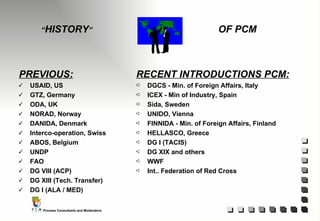
PREVIOUS: USAID, US GTZ, Germany ODA, UK NORAD, Norway DANIDA, Denmark Interco-operation, Swiss ABOS, Belgium  UNDP FAO DG VIII (ACP) DG XIII (Tech. Transfer) DG I (ALA / MED) RECENT INTRODUCTIONS PCM: DGCS - Min. of Foreign Affairs, Italy ICEX - Min of Industry, Spain Sida, Sweden UNIDO, Vienna FINNIDA - Min. of Foreign Affairs, Finland HELLASCO, Greece DG I (TACIS) DG XIX and others WWF Int.. Federation of Red Cross “ HISTORY ” OF PCM
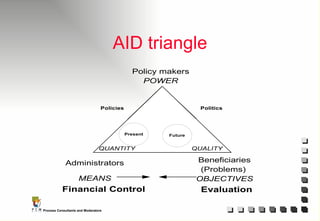
AID triangle
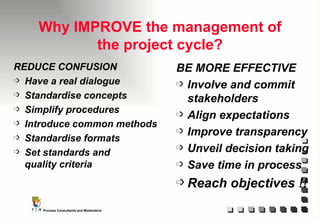
Why IMPROVE the management of the project cycle? REDUCE CONFUSION Have a real dialogue  Standardise concepts Simplify procedures Introduce common methods Standardise formats Set standards and quality criteria BE MORE EFFECTIVE Involve and commit stakeholders Align expectations Improve transparency Unveil decision taking Save time in process Reach objectives !!
 
 
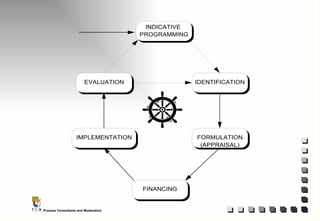
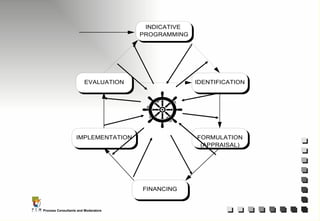
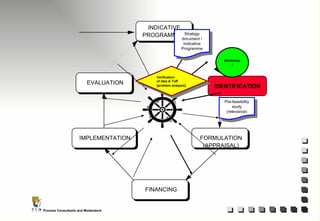
INDICATIVE  PROGRAMMING IDENTIFICATION FORMULATION  (APPRAISAL) FINANCING IMPLEMENTATION EVALUATION Pre-feasibility study (relevance) Strategy document / Indicative Programme Verification  of idea & ToR (problem analysis ) Workshop ?
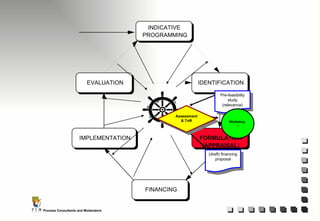
INDICATIVE  PROGRAMMING IDENTIFICATION FORMULATION  (APPRAISAL ) FINANCING IMPLEMENTATION EVALUATION Pre-feasibility study (relevance) (draft) financing proposal Assessment & ToR Workshop ?
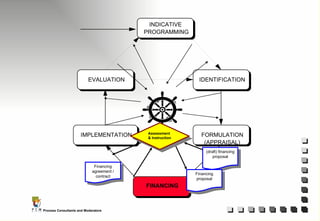
INDICATIVE  PROGRAMMING IDENTIFICATION FORMULATION  (APPRAISAL) FINANCING IMPLEMENTATION EVALUATION (draft) financing proposal Financing agreement / contract Assessment & Instruction Financing proposal
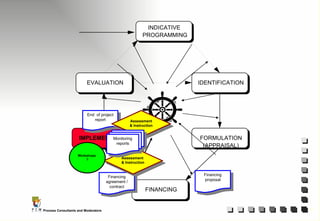
INDICATIVE  PROGRAMMING IDENTIFICATION FORMULATION  (APPRAISAL) FINANCING IMPLEMENTATION EVALUATION Financing agreement / contract End  of project report Assessment & Instruction Assessment & Instruction Monitoring reports Workshops  ? Financing proposal
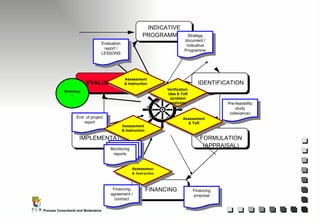
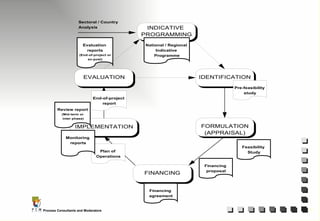
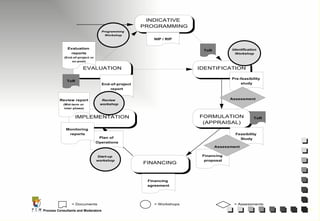
INDICATIVE  PROGRAMMING IDENTIFICATION FORMULATION  (APPRAISAL) FINANCING IMPLEMENTATION EVALUATION End  of project report Evaluation report / LESSONS Assessment & Instruction Pre-feasibility study (relevance) Financing agreement / contract Strategy document / Indicative Programme Assessment & ToR Verification  idea & ToR (problem analysis) Assessment & Instruction Assessme nt & Instruction Monitoring reports Workshop ? Financing proposal
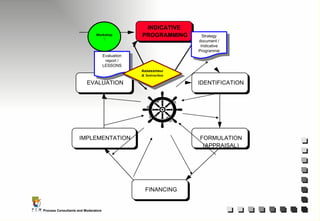
INDICATIVE   PROGRAMMING IDENTIFICATION FORMULATION  (APPRAISAL) FINANCING IMPLEMENTATION EVALUATION Evaluation report / LESSONS Assessme nt & Instruction Strategy document / Indicative Programme Workshop ?
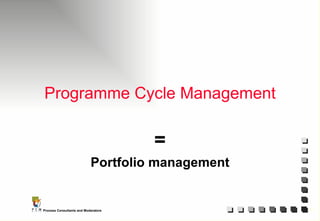
Programme Cycle Management = Portfolio management
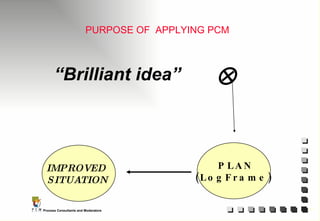
PURPOSE OF  APPLYING PCM PLAN (LogFrame) IMPROVED  SITUATION   “ Brilliant idea”
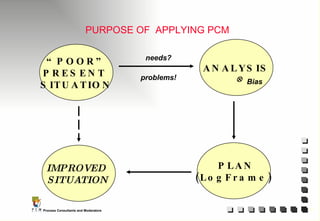
PURPOSE OF  APPLYING PCM “ POOR” PRESENT  SITUATION PLAN (LogFrame) IMPROVED  SITUATION  ANALYSIS needs? problems! Bias 
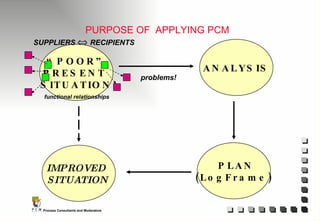
PURPOSE OF  APPLYING PCM “ POOR” PRESENT  SITUATION PLAN (LogFrame) IMPROVED  SITUATION  ANALYSIS problems! functional relationships SUPPLIERS    RECIPIENTS
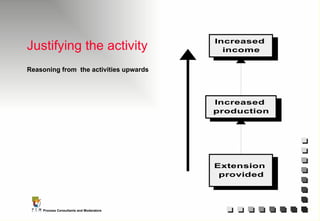
Justifying the activity Reasoning from  the activities upwards
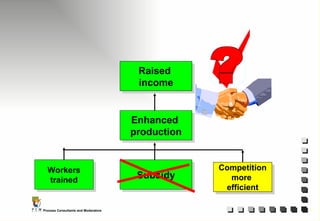
Subsidy Enhanced  production Raised  income Competition more  efficient Shortage of  skilled workers  ? Workers trained
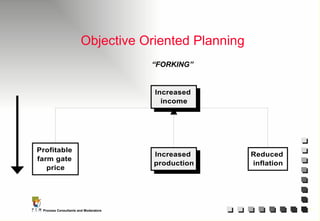
Objective Oriented Planning “ FORKING”
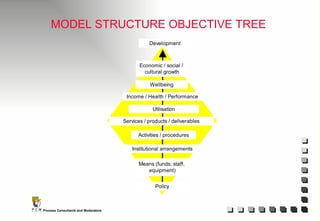
MODEL STRUCTURE OBJECTIVE TREE
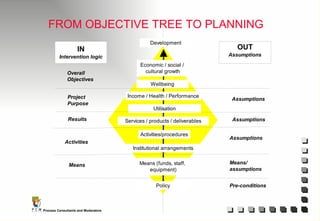
FROM OBJECTIVE TREE TO PLANNING
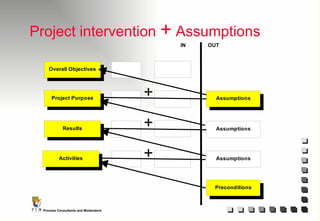
Project intervention  +  Assumptions
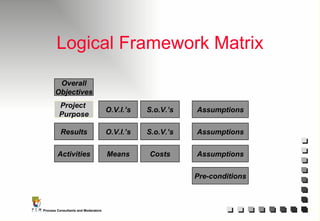
Logical Framework Matrix Overall Objectives Project  Purpose Results Activities O.V.I.’s O.V.I.’s S.o.V.’s S.o.V.’s Assumptions Assumptions Assumptions Pre-conditions Means Costs
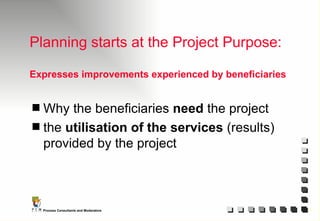
Planning starts at the Project Purpose:  Expresses improvements experienced by beneficiaries Why the beneficiaries  need  the project the  utilisation of the services  (results) provided by the project
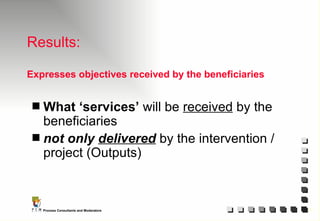
Results:  Expresses objectives received by the beneficiaries What   ‘services’  will be  received  by the beneficiaries  not   only  delivered  by the intervention / project (Outputs)
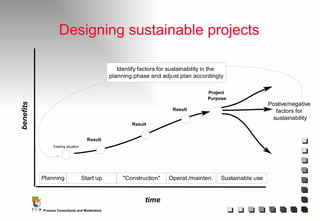
Designing sustainable projects benefits time
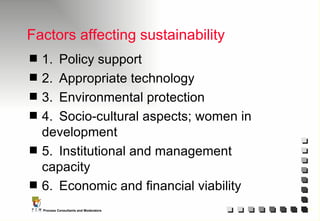
Factors affecting sustainability 1.  Policy support 2.  Appropriate technology 3.  Environmental protection 4.  Socio-cultural aspects; women in    development 5.  Institutional and management  capacity 6.  Economic and financial viability
 
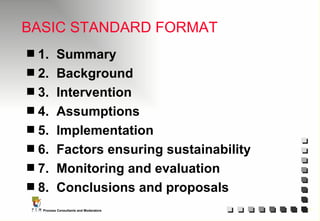
BASIC STANDARD FORMAT 1.  Summary 2.  Background 3. Intervention 4. Assumptions 5. Implementation 6. Factors ensuring sustainability 7. Monitoring and evaluation 8. Conclusions and proposals
 
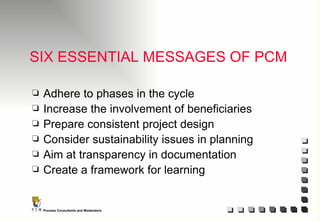
SIX ESSENTIAL MESSAGES OF PCM Adhere to phases in the cycle Increase the involvement of beneficiaries Prepare consistent project design Consider sustainability issues in planning Aim at transparency in documentation Create a framework for learning
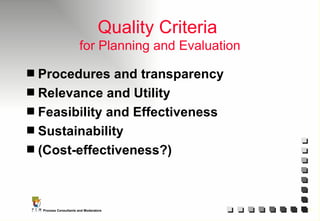
Quality Criteria  for Planning and Evaluation Procedures and transparency Relevance and Utility Feasibility and Effectiveness Sustainability (Cost-effectiveness?)
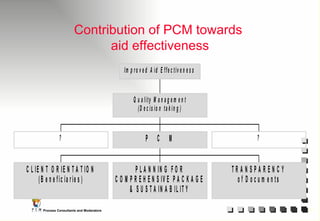
Contribution of PCM towards  aid effectiveness
May I wish you all the success with the application of these PCM concepts and tools ! Hopefully these will contribute to you becoming even a better professional !

Project Cycle Management (PCM) & Logical Framework Analysis (LFA)

  • 1.
  • 2.
    PREVIOUS: USAID, USGTZ, Germany ODA, UK NORAD, Norway DANIDA, Denmark Interco-operation, Swiss ABOS, Belgium UNDP FAO DG VIII (ACP) DG XIII (Tech. Transfer) DG I (ALA / MED) RECENT INTRODUCTIONS PCM: DGCS - Min. of Foreign Affairs, Italy ICEX - Min of Industry, Spain Sida, Sweden UNIDO, Vienna FINNIDA - Min. of Foreign Affairs, Finland HELLASCO, Greece DG I (TACIS) DG XIX and others WWF Int.. Federation of Red Cross “ HISTORY ” OF PCM
  • 3.
  • 4.
    Why IMPROVE themanagement of the project cycle? REDUCE CONFUSION Have a real dialogue Standardise concepts Simplify procedures Introduce common methods Standardise formats Set standards and quality criteria BE MORE EFFECTIVE Involve and commit stakeholders Align expectations Improve transparency Unveil decision taking Save time in process Reach objectives !!
  • 5.
  • 6.
  • 7.
    INDICATIVE PROGRAMMINGIDENTIFICATION FORMULATION (APPRAISAL) FINANCING IMPLEMENTATION EVALUATION Pre-feasibility study (relevance) Strategy document / Indicative Programme Verification of idea & ToR (problem analysis ) Workshop ?
  • 8.
    INDICATIVE PROGRAMMINGIDENTIFICATION FORMULATION (APPRAISAL ) FINANCING IMPLEMENTATION EVALUATION Pre-feasibility study (relevance) (draft) financing proposal Assessment & ToR Workshop ?
  • 9.
    INDICATIVE PROGRAMMINGIDENTIFICATION FORMULATION (APPRAISAL) FINANCING IMPLEMENTATION EVALUATION (draft) financing proposal Financing agreement / contract Assessment & Instruction Financing proposal
  • 10.
    INDICATIVE PROGRAMMINGIDENTIFICATION FORMULATION (APPRAISAL) FINANCING IMPLEMENTATION EVALUATION Financing agreement / contract End of project report Assessment & Instruction Assessment & Instruction Monitoring reports Workshops  ? Financing proposal
  • 11.
    INDICATIVE PROGRAMMINGIDENTIFICATION FORMULATION (APPRAISAL) FINANCING IMPLEMENTATION EVALUATION End of project report Evaluation report / LESSONS Assessment & Instruction Pre-feasibility study (relevance) Financing agreement / contract Strategy document / Indicative Programme Assessment & ToR Verification idea & ToR (problem analysis) Assessment & Instruction Assessme nt & Instruction Monitoring reports Workshop ? Financing proposal
  • 12.
    INDICATIVE PROGRAMMING IDENTIFICATION FORMULATION (APPRAISAL) FINANCING IMPLEMENTATION EVALUATION Evaluation report / LESSONS Assessme nt & Instruction Strategy document / Indicative Programme Workshop ?
  • 13.
    Programme Cycle Management= Portfolio management
  • 14.
    PURPOSE OF APPLYING PCM PLAN (LogFrame) IMPROVED SITUATION  “ Brilliant idea”
  • 15.
    PURPOSE OF APPLYING PCM “ POOR” PRESENT SITUATION PLAN (LogFrame) IMPROVED SITUATION ANALYSIS needs? problems! Bias 
  • 16.
    PURPOSE OF APPLYING PCM “ POOR” PRESENT SITUATION PLAN (LogFrame) IMPROVED SITUATION ANALYSIS problems! functional relationships SUPPLIERS   RECIPIENTS
  • 17.
    Justifying the activityReasoning from the activities upwards
  • 18.
    Subsidy Enhanced production Raised income Competition more efficient Shortage of skilled workers ? Workers trained
  • 19.
  • 20.
  • 21.
  • 22.
    Project intervention + Assumptions
  • 23.
    Logical Framework MatrixOverall Objectives Project Purpose Results Activities O.V.I.’s O.V.I.’s S.o.V.’s S.o.V.’s Assumptions Assumptions Assumptions Pre-conditions Means Costs
  • 24.
    Planning starts atthe Project Purpose: Expresses improvements experienced by beneficiaries Why the beneficiaries need the project the utilisation of the services (results) provided by the project
  • 25.
    Results: Expressesobjectives received by the beneficiaries What ‘services’ will be received by the beneficiaries not only delivered by the intervention / project (Outputs)
  • 26.
  • 27.
    Factors affecting sustainability1. Policy support 2. Appropriate technology 3. Environmental protection 4. Socio-cultural aspects; women in development 5. Institutional and management capacity 6. Economic and financial viability
  • 28.
  • 29.
    BASIC STANDARD FORMAT1. Summary 2. Background 3. Intervention 4. Assumptions 5. Implementation 6. Factors ensuring sustainability 7. Monitoring and evaluation 8. Conclusions and proposals
  • 30.
  • 31.
    SIX ESSENTIAL MESSAGESOF PCM Adhere to phases in the cycle Increase the involvement of beneficiaries Prepare consistent project design Consider sustainability issues in planning Aim at transparency in documentation Create a framework for learning
  • 32.
    Quality Criteria for Planning and Evaluation Procedures and transparency Relevance and Utility Feasibility and Effectiveness Sustainability (Cost-effectiveness?)
  • 33.
    Contribution of PCMtowards aid effectiveness
  • 34.
    May I wishyou all the success with the application of these PCM concepts and tools ! Hopefully these will contribute to you becoming even a better professional !