Project Management


             John Mburu

Department of Agricultural Economics,
        University of Nairobi
THE PROJECT CONCEPT
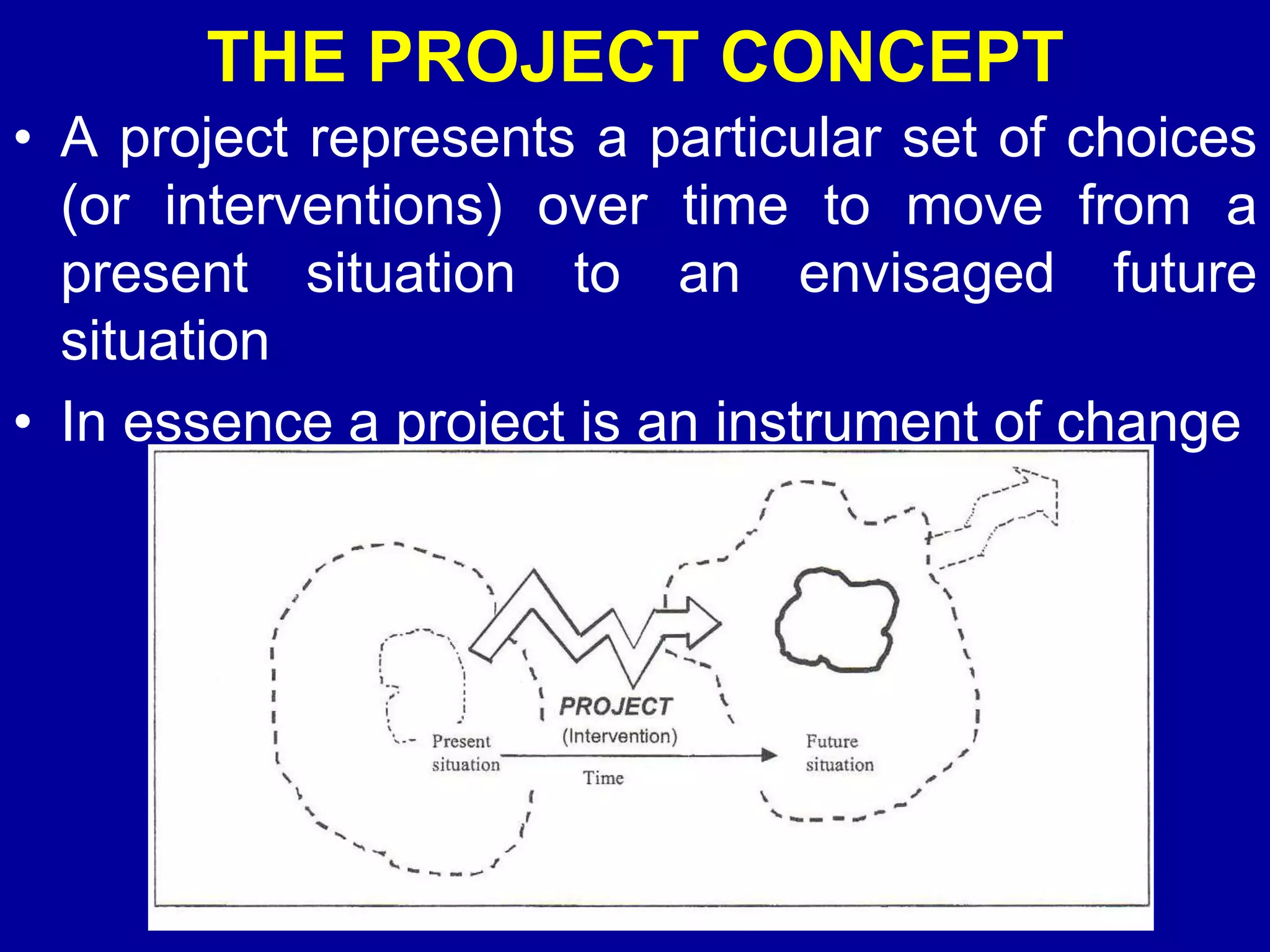
• A project represents a particular set of choices
  (or interventions) over time to move from a
  present situation to an envisaged future
  situation
• In essence a project is an instrument of change
DEFINITION OF A PROJECT
• “A proposal for capital investments where a
  cost stream results in a certain flow of
  benefits over a specified period” (FAO)
• “An investment asset from which we can
  expect to realize benefits over an extended
  period of time”- (Gittinger, 1982)
• “A proposal for capital investments to create
  opportunities for producing goods and
  services.”
GENERAL TYPES OF PROJECTS


• Privately financed projects,
  including private businesses
• Government (public) projects
  (initiatives)
CLASSIFICATION OF DEVELOPMENT PROJECTS
Functional classification:
 •Projects aimed at technical innovation
 •Expanding the natural resource base
 •Improvement in the living conditions of
  previously disadvantaged groups
 • Improved market infrastructure
 •Institutional capacity development
 •Multifunctional investment projects
 •Policy and institutional reforms
WHY DO PROJECTS FAIL?
•   A lack of ownership and responsibility
•   Problems of project design and implementation
•   The use of inappropriate technology
•   Inadequate or inappropriate infrastructure
•   Failure to appreciate the social and political
    environment
•   Administrative problems
•   Changing economic situations and market
    conditions
•   Externally driven project initiatives
•   Problems related to poor analysis
•   Unrealistic expectations
•   Unsupportive policy environment
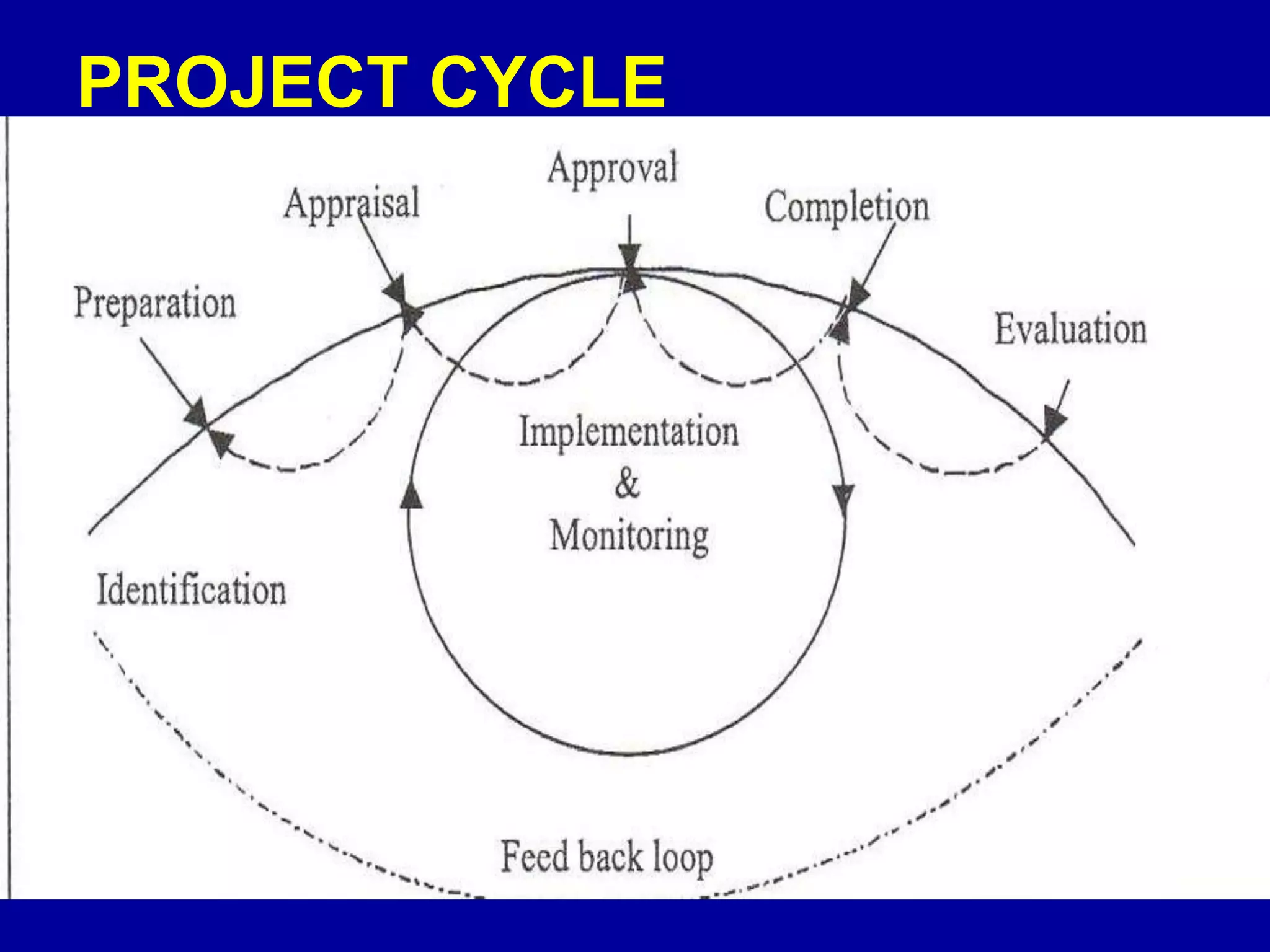
PROJECT CYCLE
Project Cycle
Identification – conceptualization
Preparation – objectives and activities required to
achieve objectives
Appraisal – evaluation of alternative options and
actions (ex-ante analysis)
Approval/rejection (decision making)
Implementation
     Investment period
     Development period
     Monitoring
     Completion
Evaluation (ex-post analysis) including impact
assessment
•
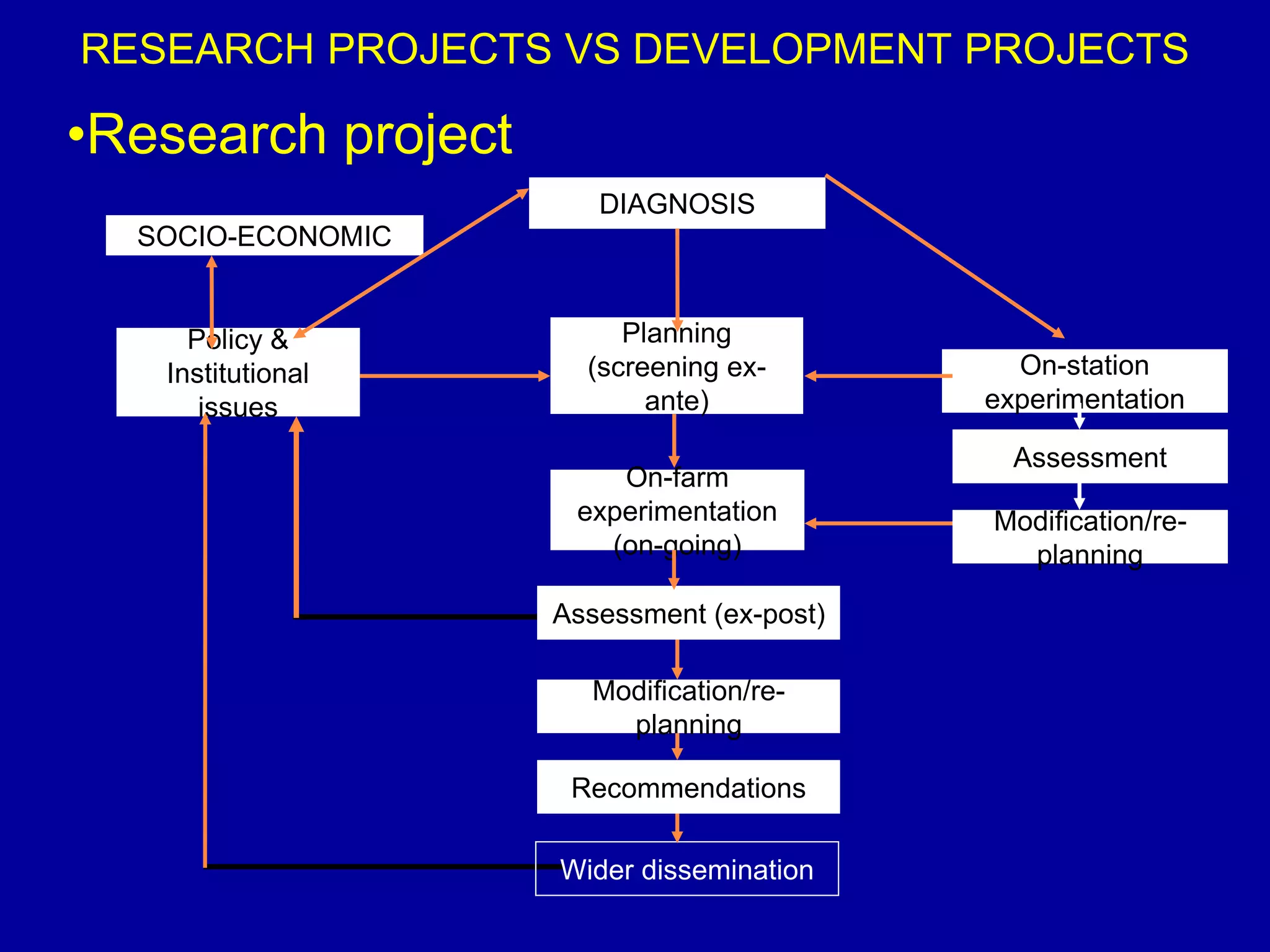
RESEARCH PROJECTS VS DEVELOPMENT PROJECTS

•Research project
                       DIAGNOSIS
  SOCIO-ECONOMIC


     Policy &            Planning
   Institutional      (screening ex-         On-station
      issues               ante)           experimentation

                                             Assessment
                        On-farm
                     experimentation       Modification/re-
                       (on-going)            planning

                    Assessment (ex-post)

                      Modification/re-
                        planning

                     Recommendations

                    Wider dissemination
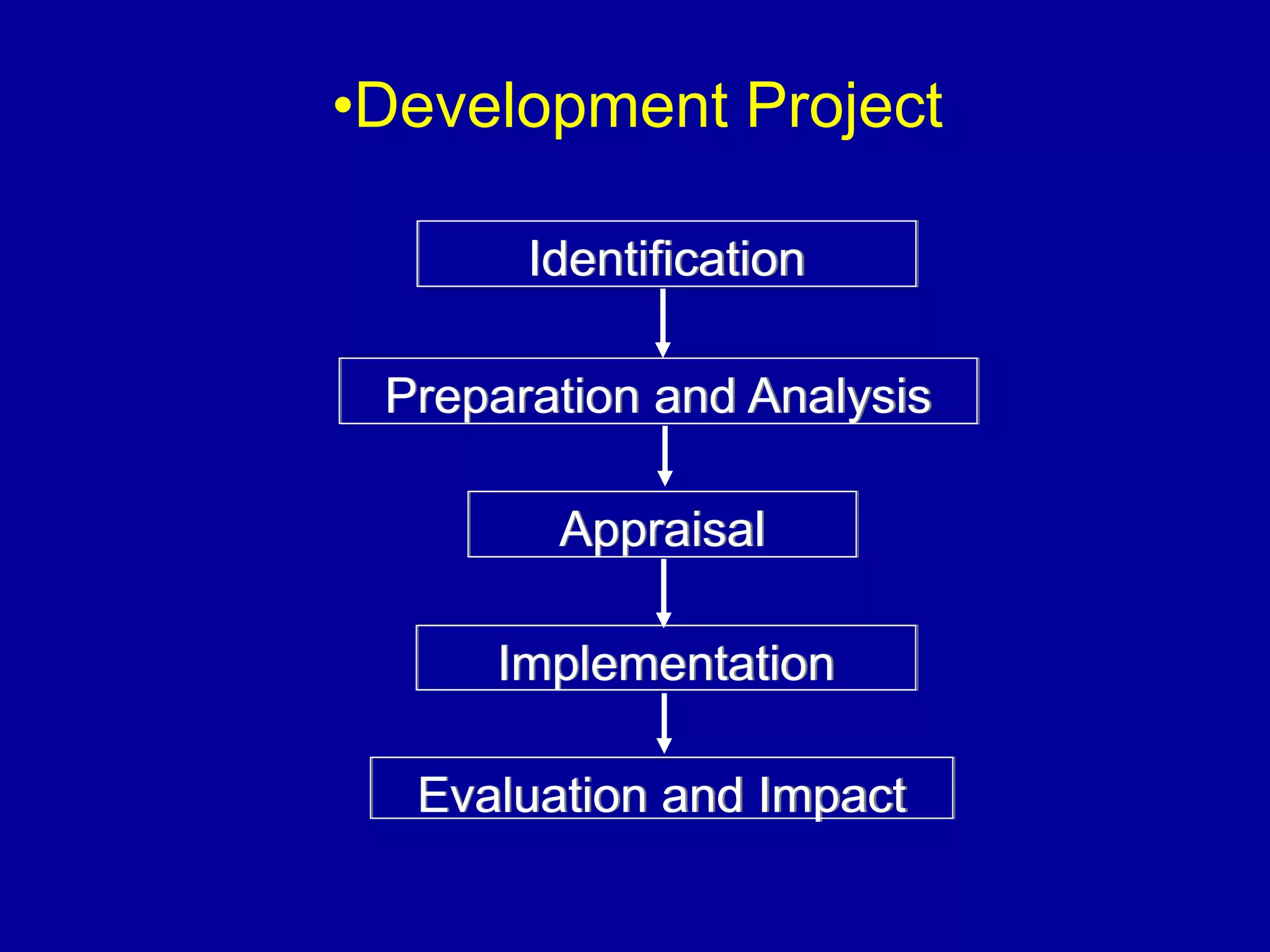
•Development Project

       Identification

 Preparation and Analysis

        Appraisal

     Implementation

  Evaluation and Impact
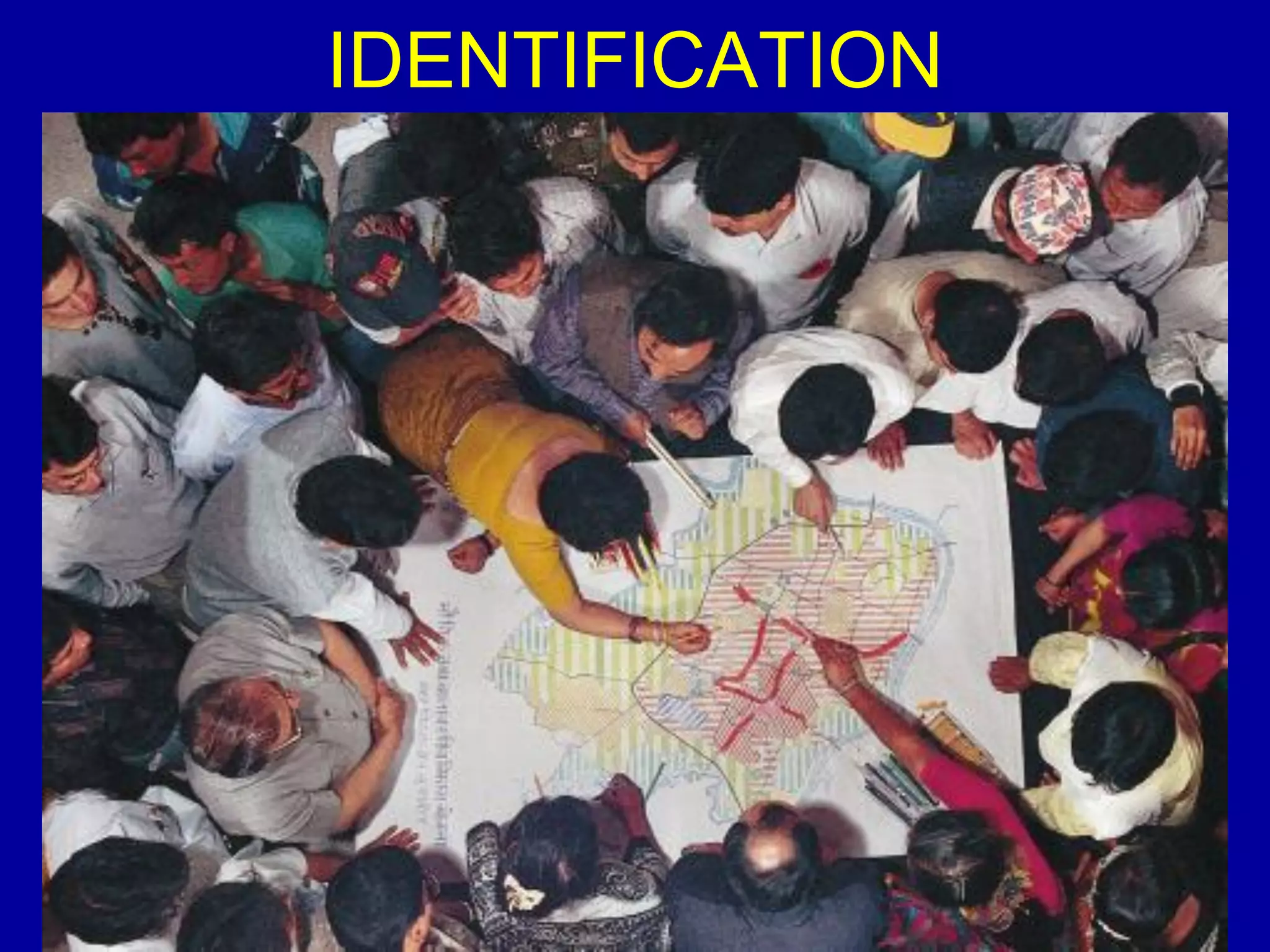
IDENTIFICATION
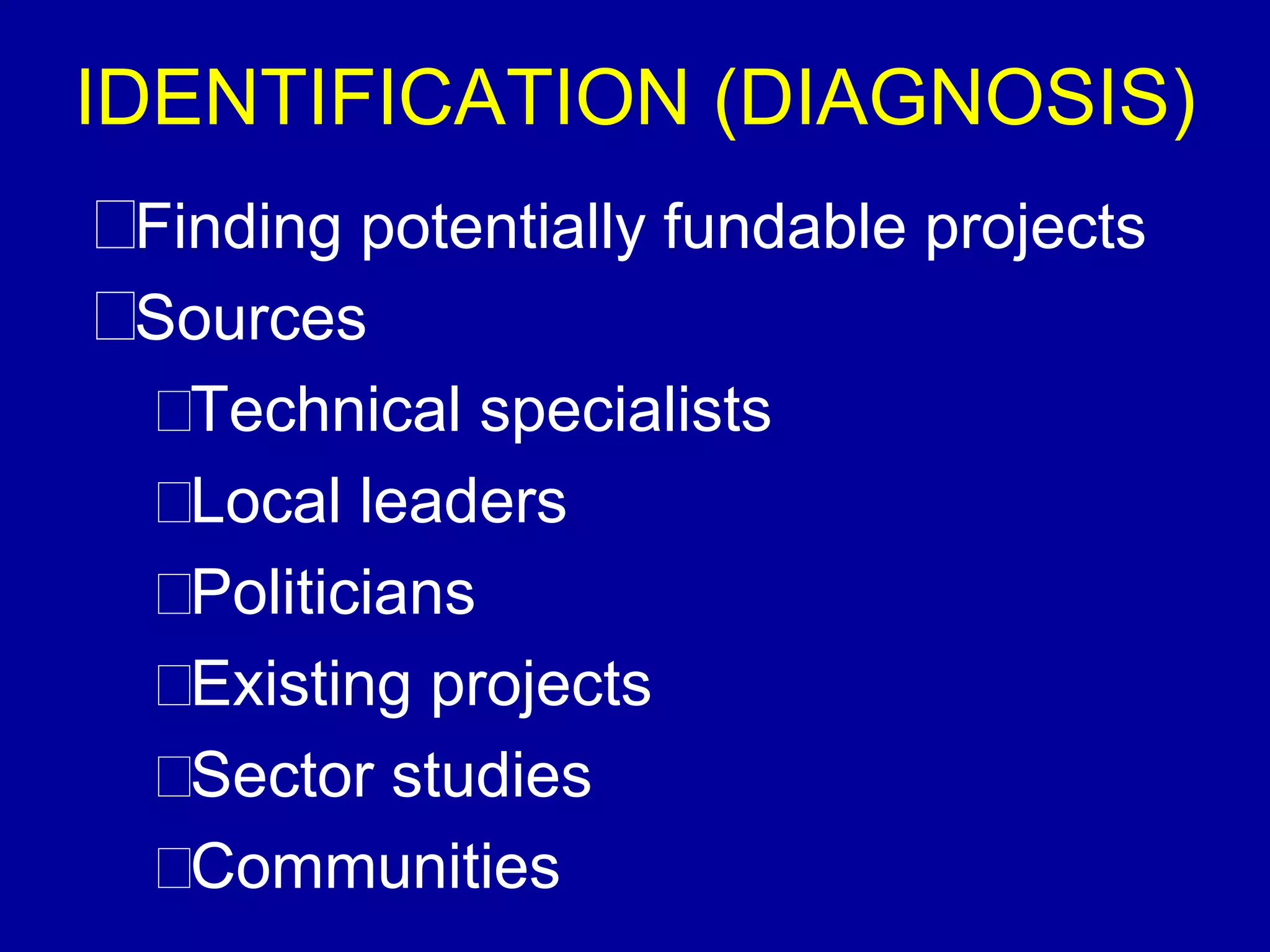
IDENTIFICATION (DIAGNOSIS)
 Finding potentially fundable projects
 Sources
   Technical specialists
   Local leaders
   Politicians
   Existing projects
   Sector studies
   Communities
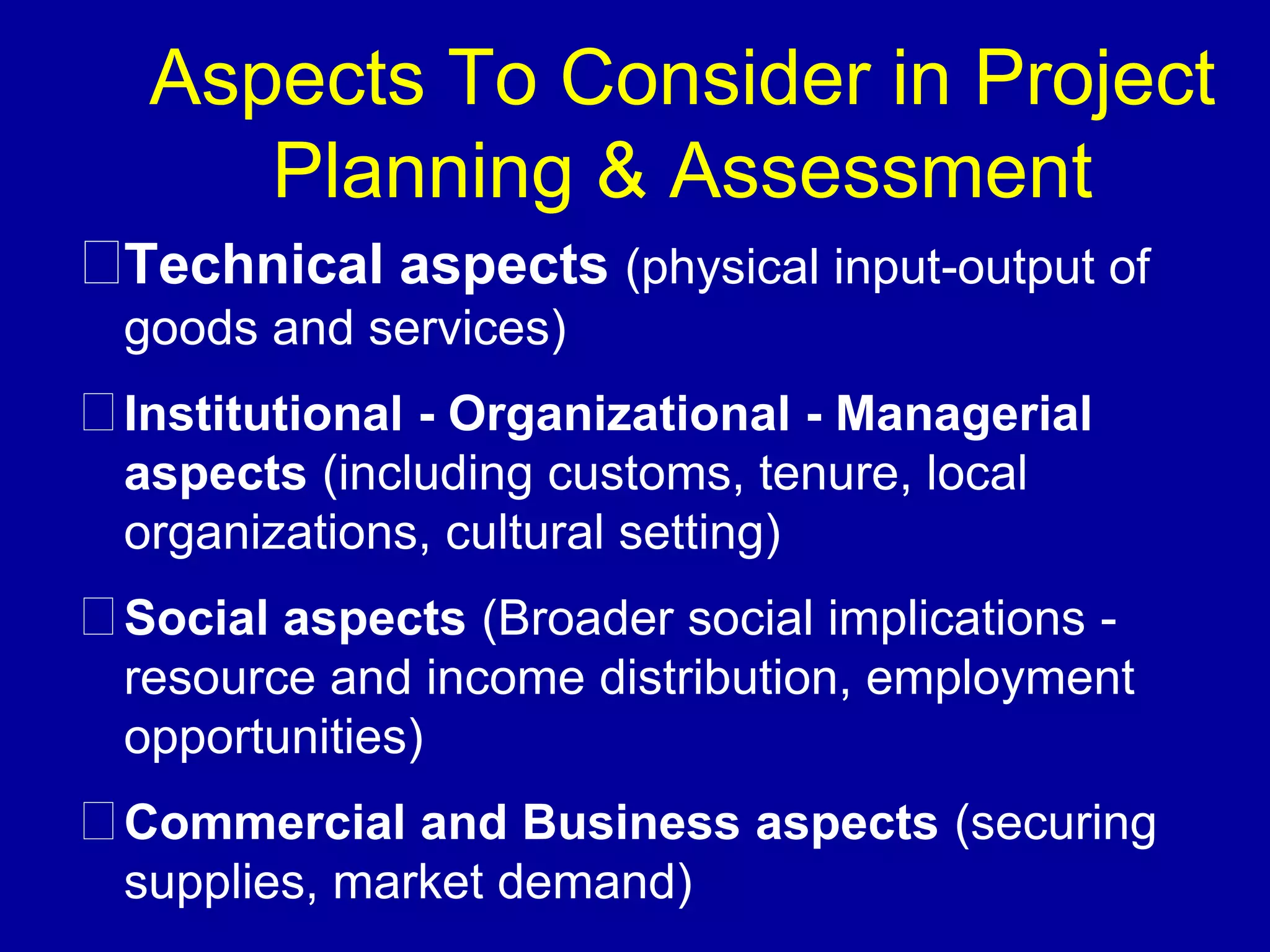
Aspects To Consider in Project
    Planning & Assessment
Technical aspects (physical input-output of
goods and services)
Institutional - Organizational - Managerial
aspects (including customs, tenure, local
organizations, cultural setting)
Social aspects (Broader social implications -
resource and income distribution, employment
opportunities)
Commercial and Business aspects (securing
supplies, market demand)
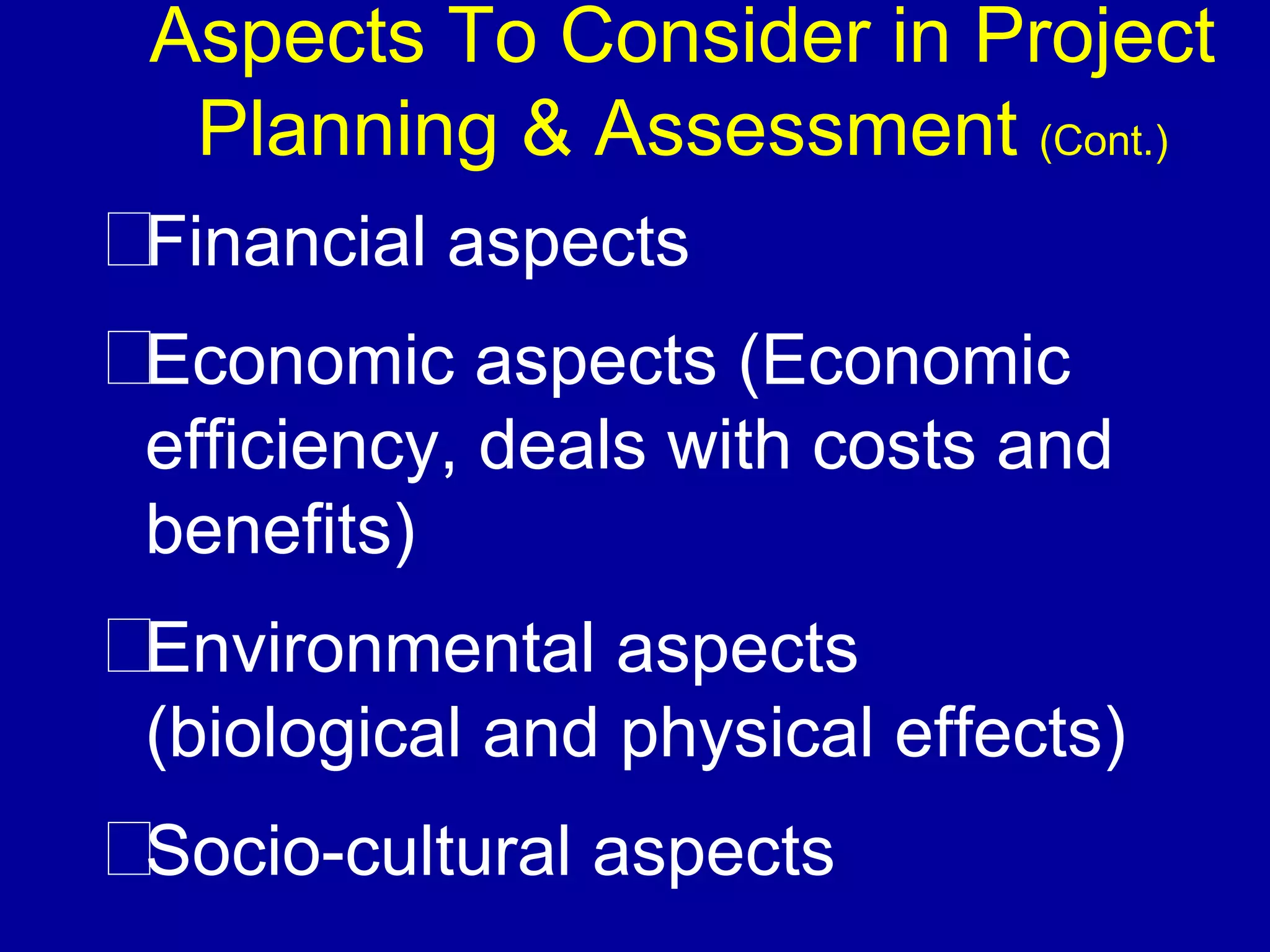
Aspects To Consider in Project
 Planning & Assessment (Cont.)
Financial aspects
Economic aspects (Economic
efficiency, deals with costs and
benefits)
Environmental aspects
(biological and physical effects)
Socio-cultural aspects
Logical Framework
     Analysis
      (LFA)
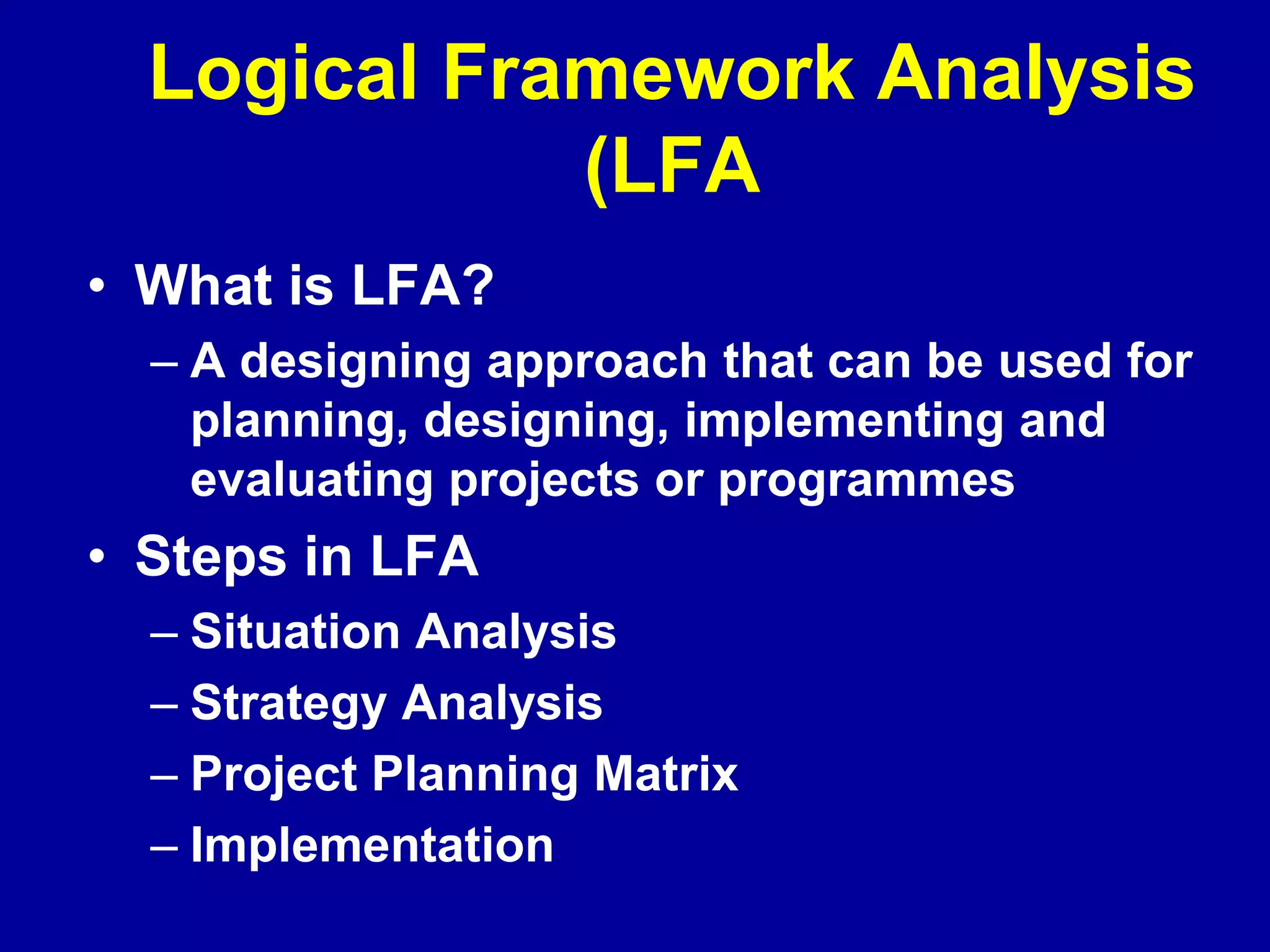
Logical Framework Analysis
             (LFA
• What is LFA?
  – A designing approach that can be used for
    planning, designing, implementing and
    evaluating projects or programmes
• Steps in LFA
  – Situation Analysis
  – Strategy Analysis
  – Project Planning Matrix
  – Implementation
Situation Analysis
(1) Stakeholder Analysis
(2 ) Problem Analysis
(3 ) Objective Analysis
1) Stakeholder Analysis
  – Who are the stakeholders involved in the
    project, and how are they affected?
• Consider the following:
  – Who will be involved in the log-frame
    development?
  – Where will the development be
    conducted?
  – Who will facilitate the development of the
    log-frame?
  – What background materials, papers and
    expertise may be needed?
  – What materials and logistics are required?
(2) Problem Analysis
Which are the problems the
project is addressing?
What are the root causes of those
problems?
What is the larger picture in
which those problems and their
root causes exist?
-What are the links between the
problems?
Problem Analysis (cont’d)
Problem Tree
• Brainstorming techniques can be used
  to identify the main problems
• After all of the problems are displayed
  they should then be clustered into
  groups of similar issues
• The problem tree is developed by:
  1. moving problems from the clusters of
     problems
  2. adding new problems that emerge
  3. problems can be moved up or down the
     tree as required
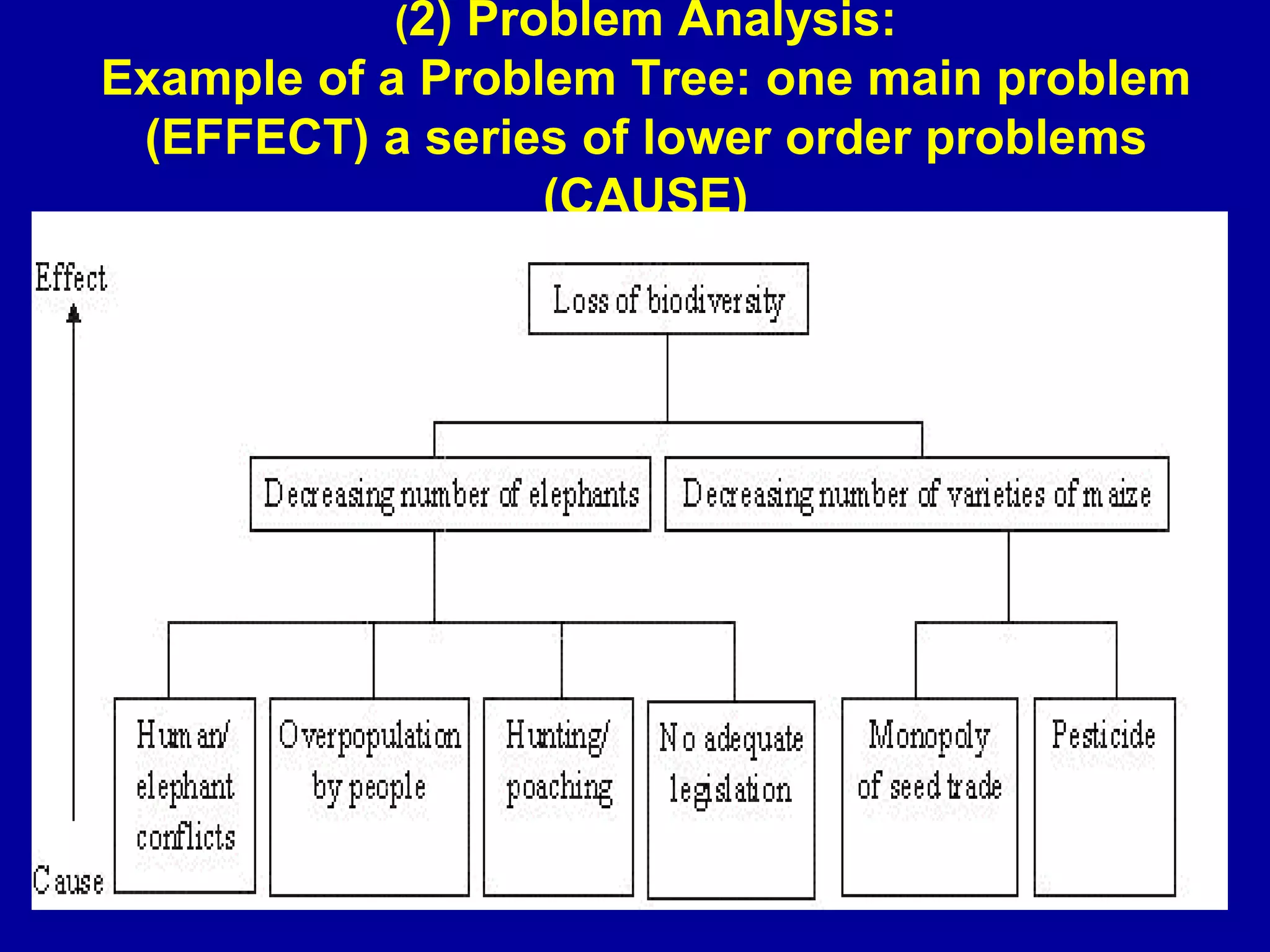
(2) Problem Analysis:
Example of a Problem Tree: one main problem
 (EFFECT) a series of lower order problems
                  (CAUSE)
3) Objectives Analysis
• ... a procedure for systematically
  – 1. identifying
  – 2. categorising
  – 3. specifying
  – 4. balancing out ...objectives of all parties
    involved in a specific situation
• Objectives Tree
  – 1. Problems are restated as objectives
  – 2. Positive mirror image of the problem
    tree
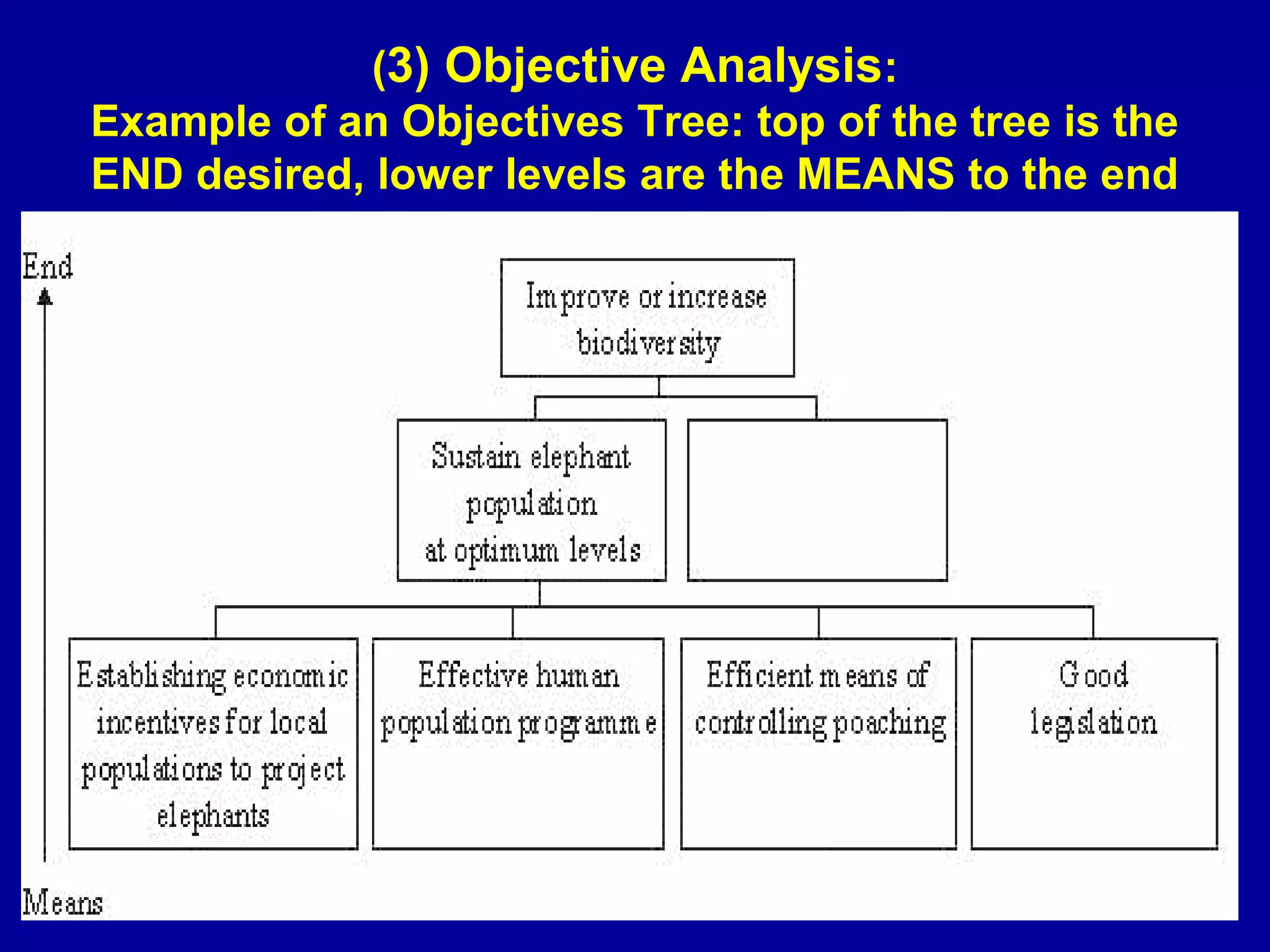
(3) Objective Analysis:
Example of an Objectives Tree: top of the tree is the
END desired, lower levels are the MEANS to the end


                    MDS 521 IRUNGU 2011
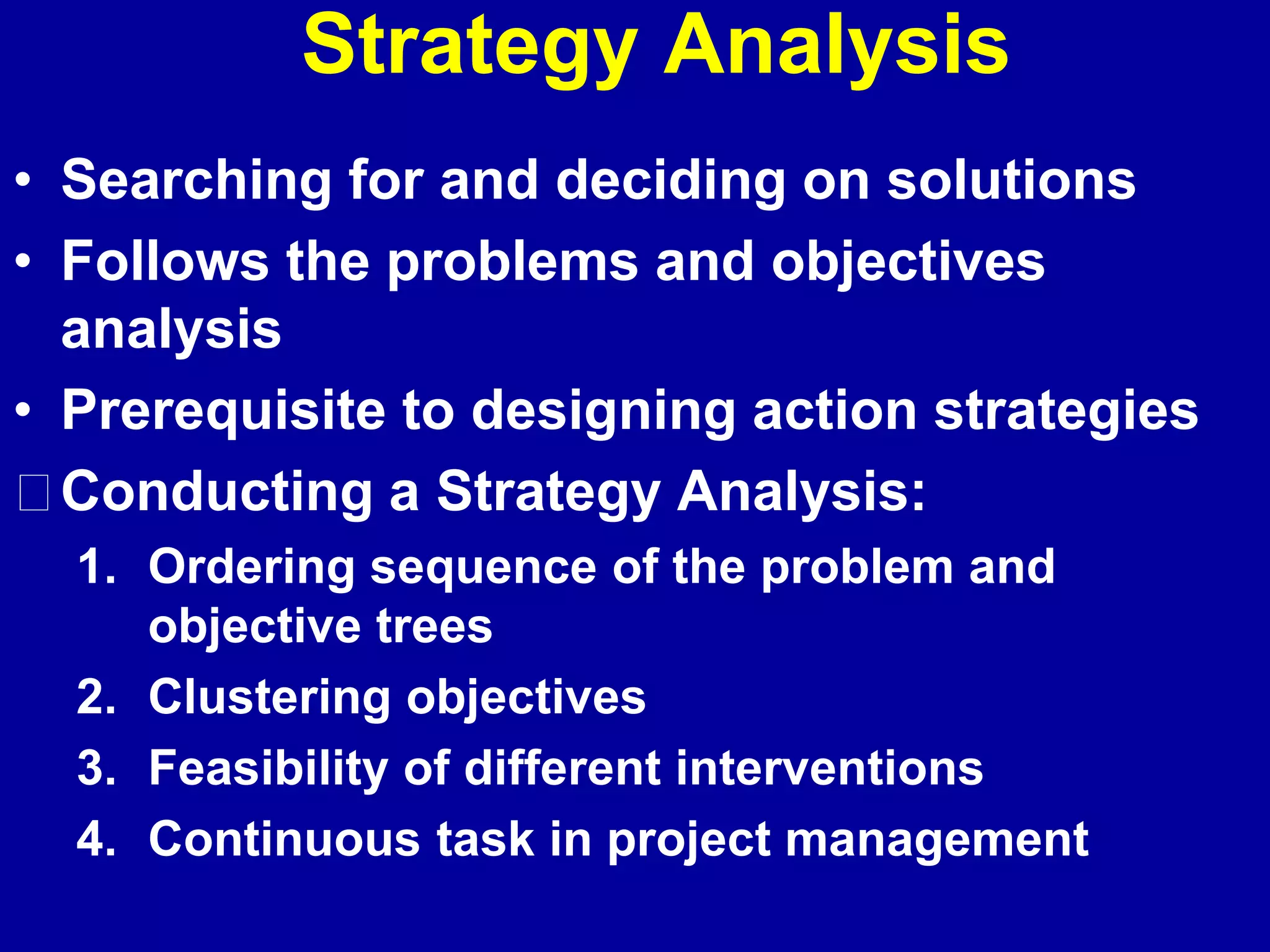
Strategy Analysis
• Searching for and deciding on solutions
• Follows the problems and objectives
  analysis
• Prerequisite to designing action strategies
  Conducting a Strategy Analysis:
  1. Ordering sequence of the problem and
     objective trees
  2. Clustering objectives
  3. Feasibility of different interventions
  4. Continuous task in project management
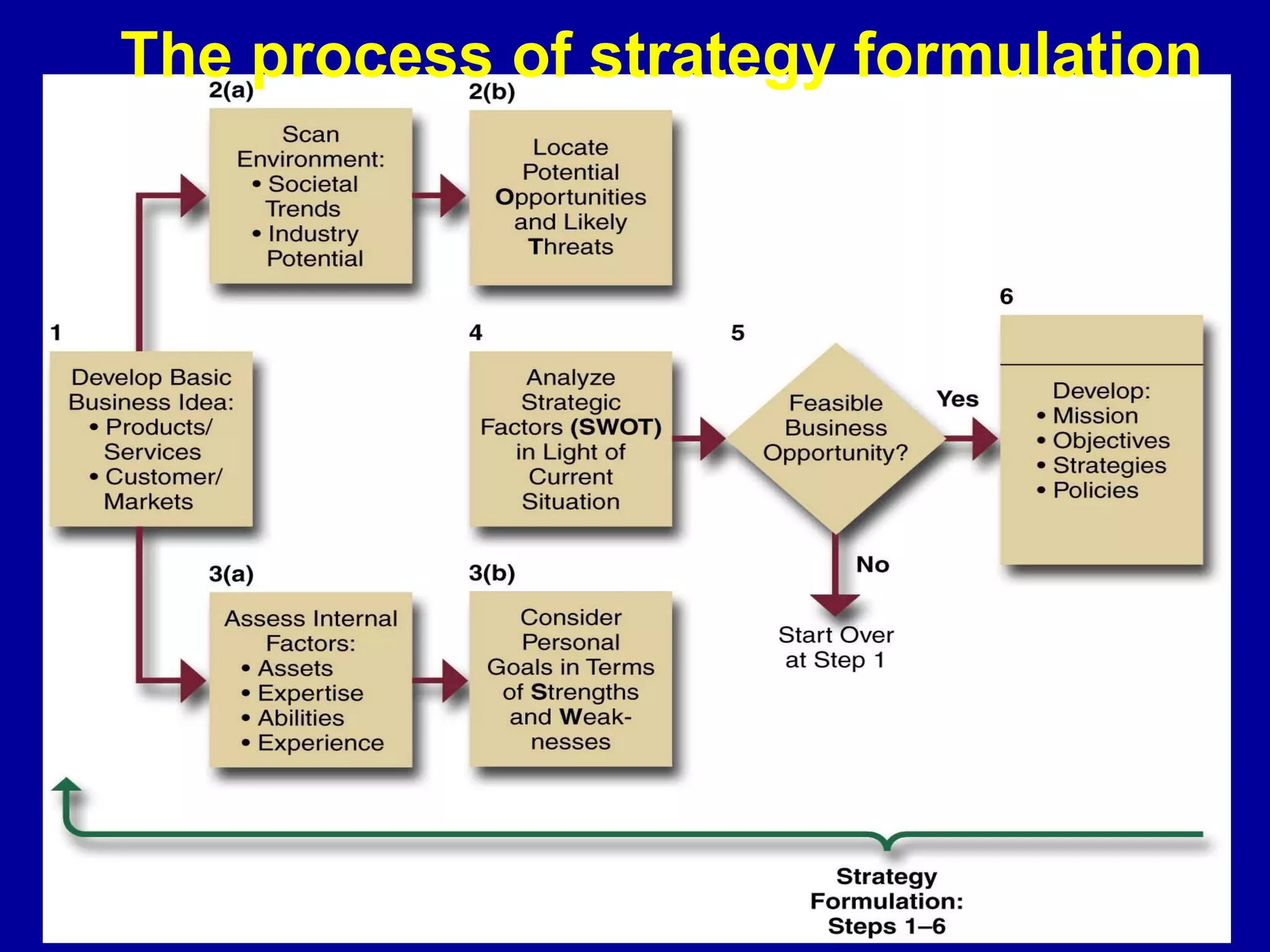
The process of strategy formulation


                                25
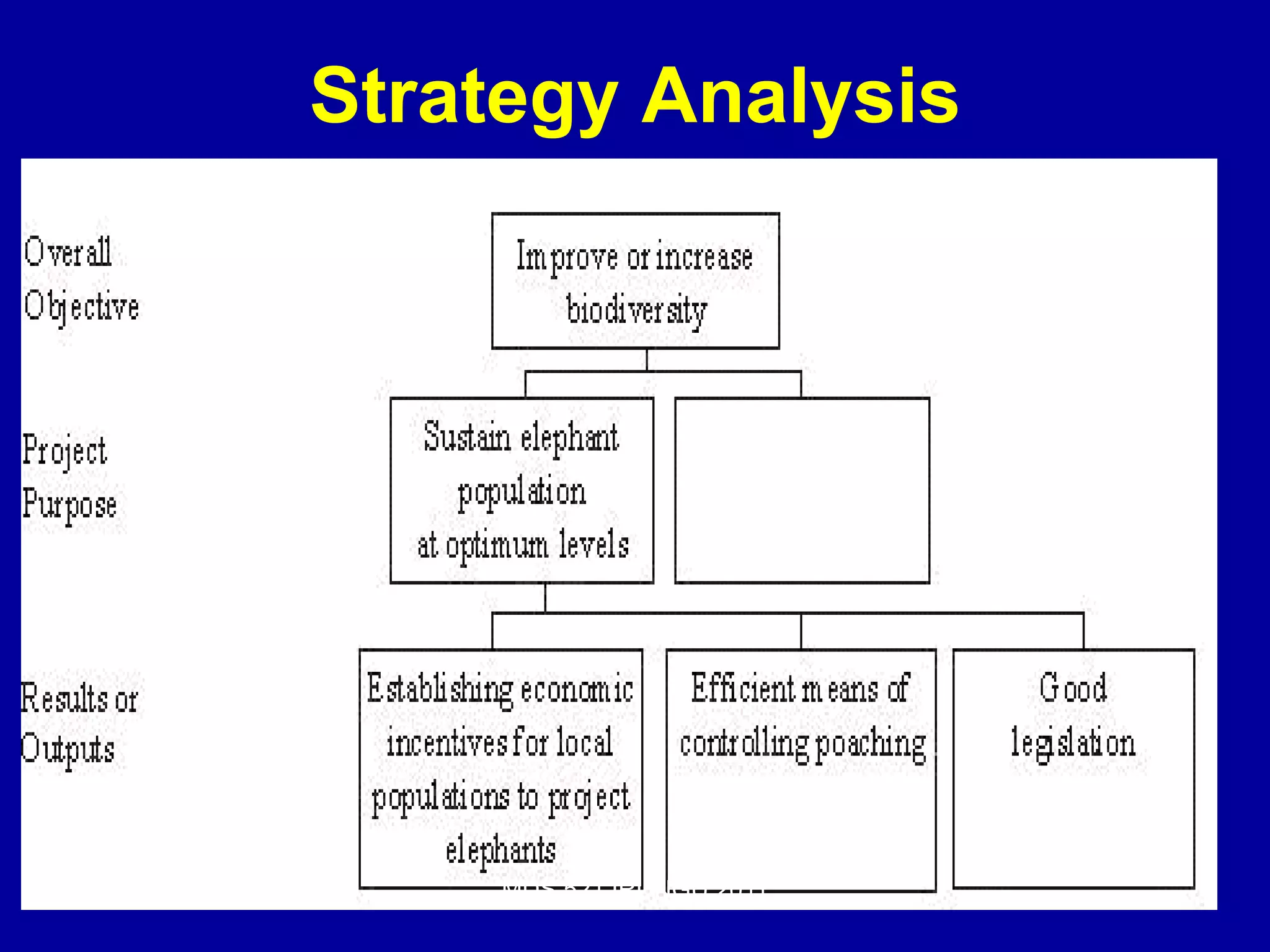
Strategy Analysis


     MDS 521 IRUNGU 2011
Project Planning Matrix
     (logframe matrix):
• Developed from the strategy analysis
  by filling in the columns of the matrix
  as shown
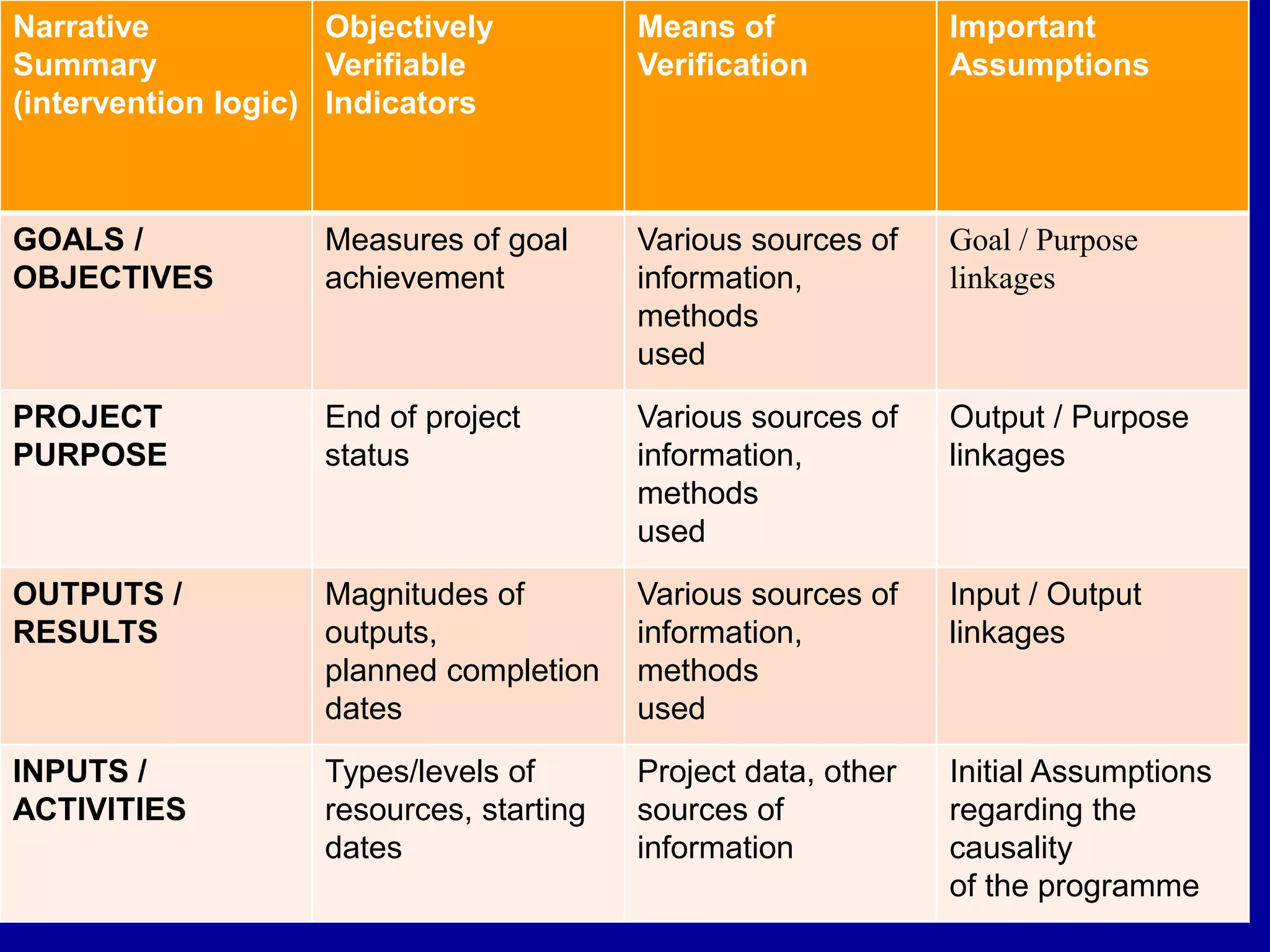
Narrative            Objectively          Means of              Important
Summary              Verifiable           Verification          Assumptions
(intervention logic) Indicators


GOALS /             Measures of goal      Various sources of    Goal / Purpose
OBJECTIVES          achievement           information,          linkages
                                          methods
                                          used
PROJECT             End of project        Various sources of    Output / Purpose
PURPOSE             status                information,          linkages
                                          methods
                                          used
OUTPUTS /           Magnitudes of         Various sources of    Input / Output
RESULTS             outputs,              information,          linkages
                    planned completion    methods
                    dates                 used
INPUTS /            Types/levels of       Project data, other   Initial Assumptions
ACTIVITIES          resources, starting   sources of            regarding the
                    dates                 information           causality
                                                                of the programme
PROJECT IMPLEMENTATION
• Operational phase of a project to
  achieve the expected outputs/results
• Plan of Operations
    work plans / work schedules
    project budget / resources plans
    personnel plans
    material and equipment plan /
    procurement plan / staff training plans
PROJECT MONITORING
 AND EVALUATION
WHAT IS MONITORING?
Day-to-day follow up of activities during
implementation to measure progress and
identify deviations
Routine follow up to ensure activities are
proceeding as planned and are on schedule
Routine assessment of activities and results
Answers the question, “what are we doing?”
TYPES OF MONITORING
• Progress
  – How much was achieved?
  – When was it achieved?
  – How was it achieved?
  – At what cost?
• Process
  – What happens?
  – Why?
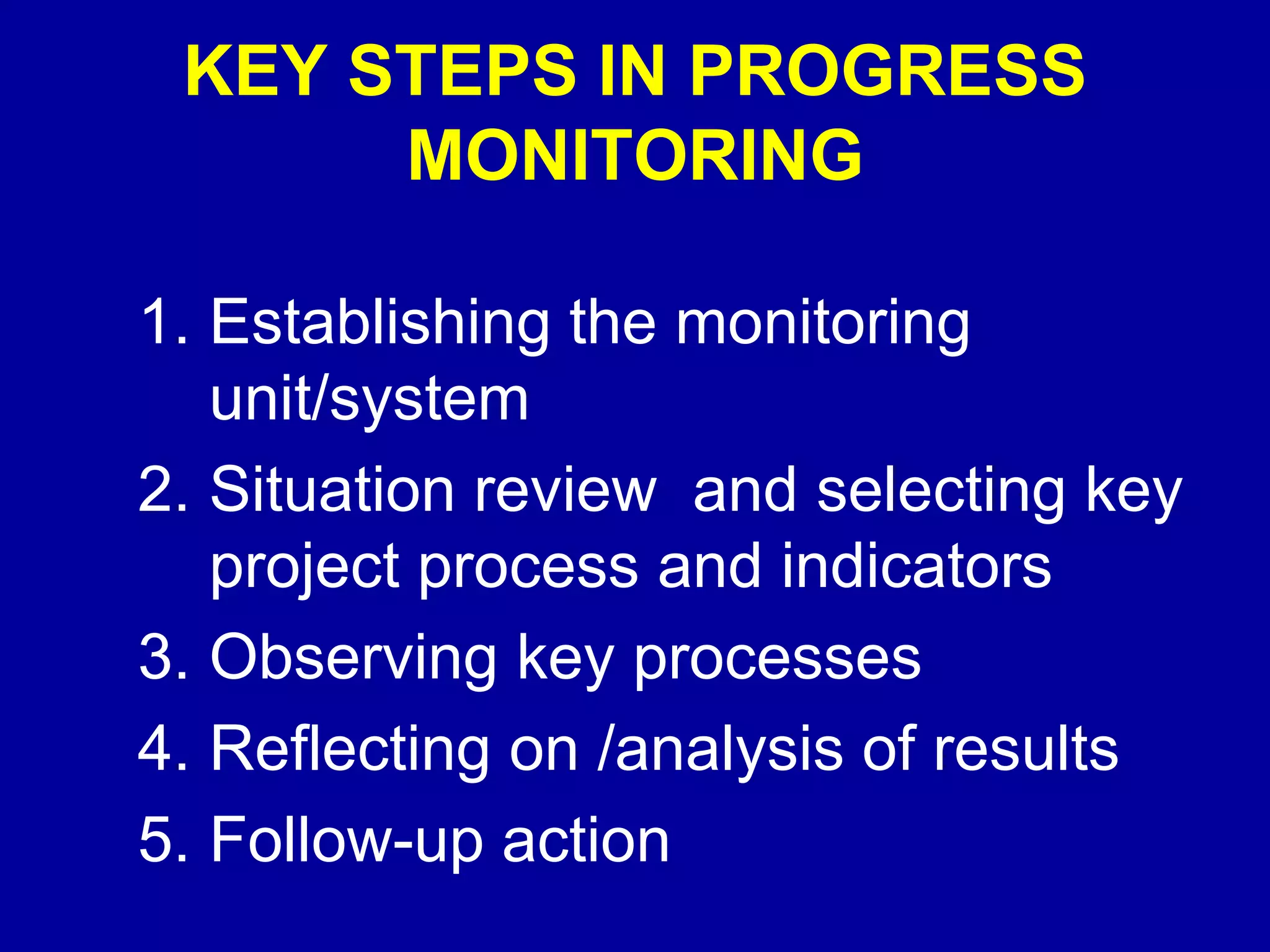
KEY STEPS IN PROGRESS
      MONITORING

1. Establishing the monitoring
   unit/system
2. Situation review and selecting key
   project process and indicators
3. Observing key processes
4. Reflecting on /analysis of results
5. Follow-up action
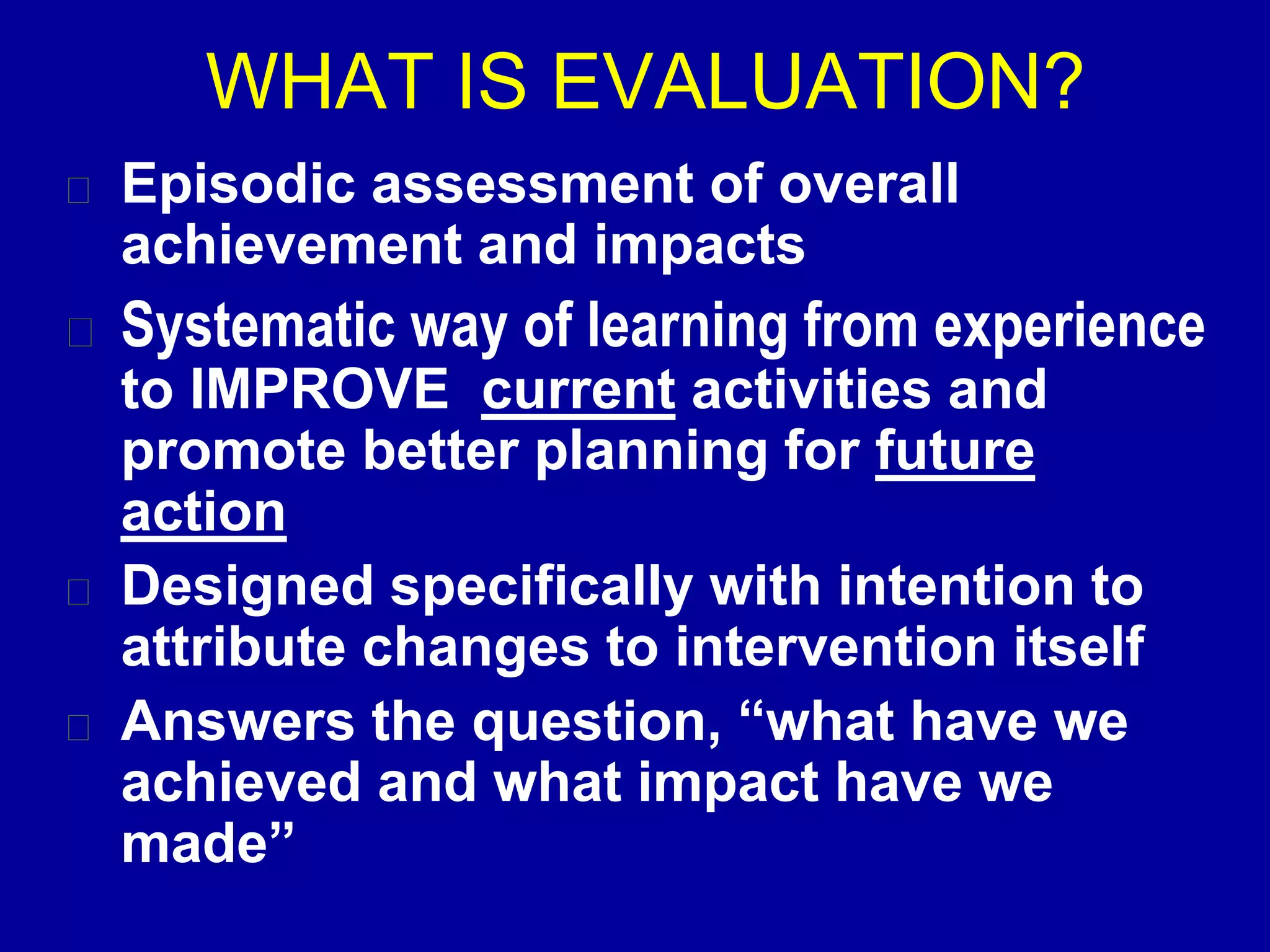
WHAT IS EVALUATION?
Episodic assessment of overall
achievement and impacts
Systematic way of learning from experience
to IMPROVE current activities and
promote better planning for future
action
Designed specifically with intention to
attribute changes to intervention itself
Answers the question, “what have we
achieved and what impact have we
made”
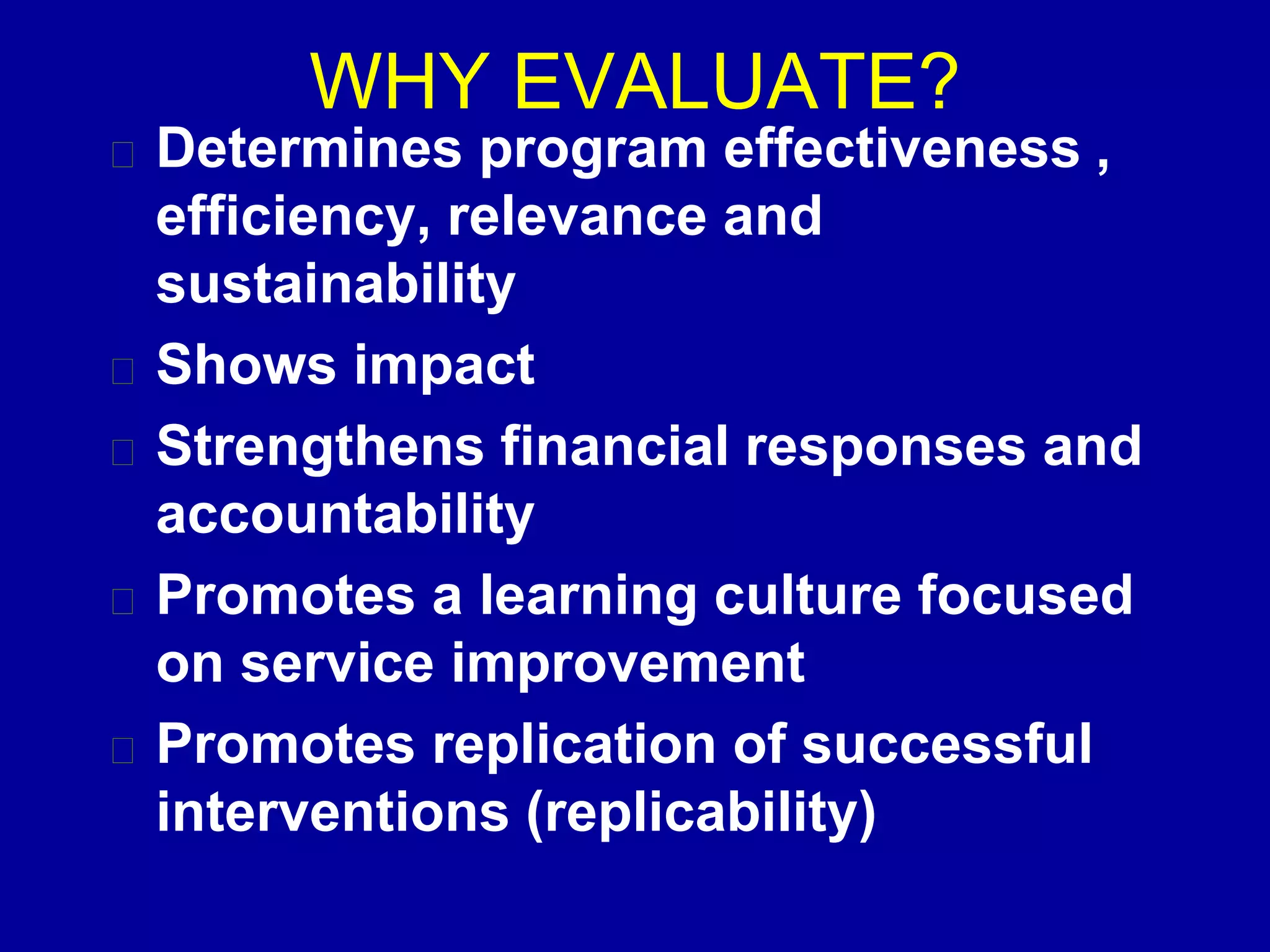
WHY EVALUATE?
Determines program effectiveness ,
efficiency, relevance and
sustainability
Shows impact
Strengthens financial responses and
accountability
Promotes a learning culture focused
on service improvement
Promotes replication of successful
interventions (replicability)
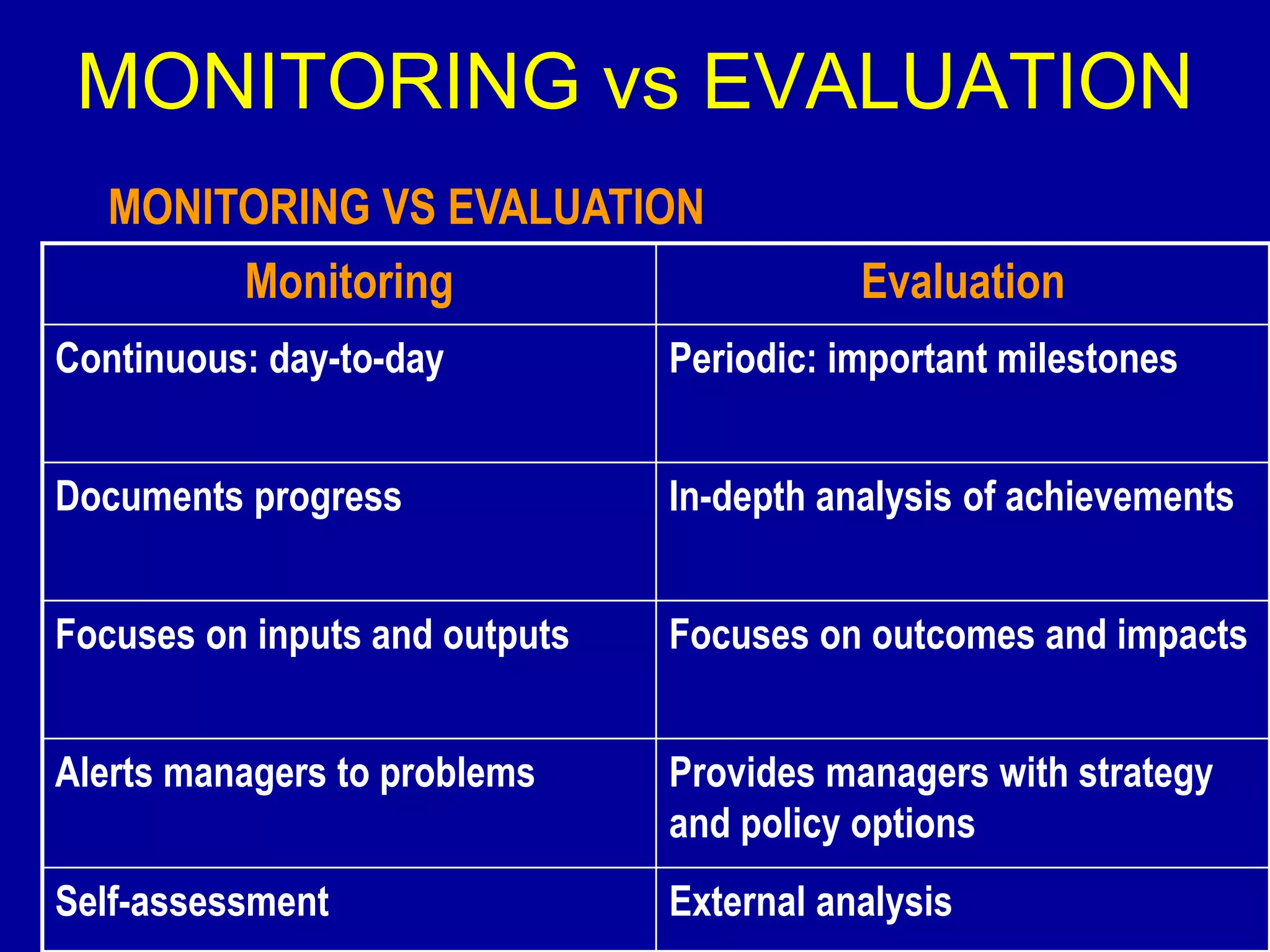
MONITORING vs EVALUATION
  MONITORING VS EVALUATION
          Monitoring                       Evaluation
Continuous: day-to-day          Periodic: important milestones


Documents progress              In-depth analysis of achievements


Focuses on inputs and outputs   Focuses on outcomes and impacts


Alerts managers to problems     Provides managers with strategy
                                and policy options
Self-assessment                 External analysis
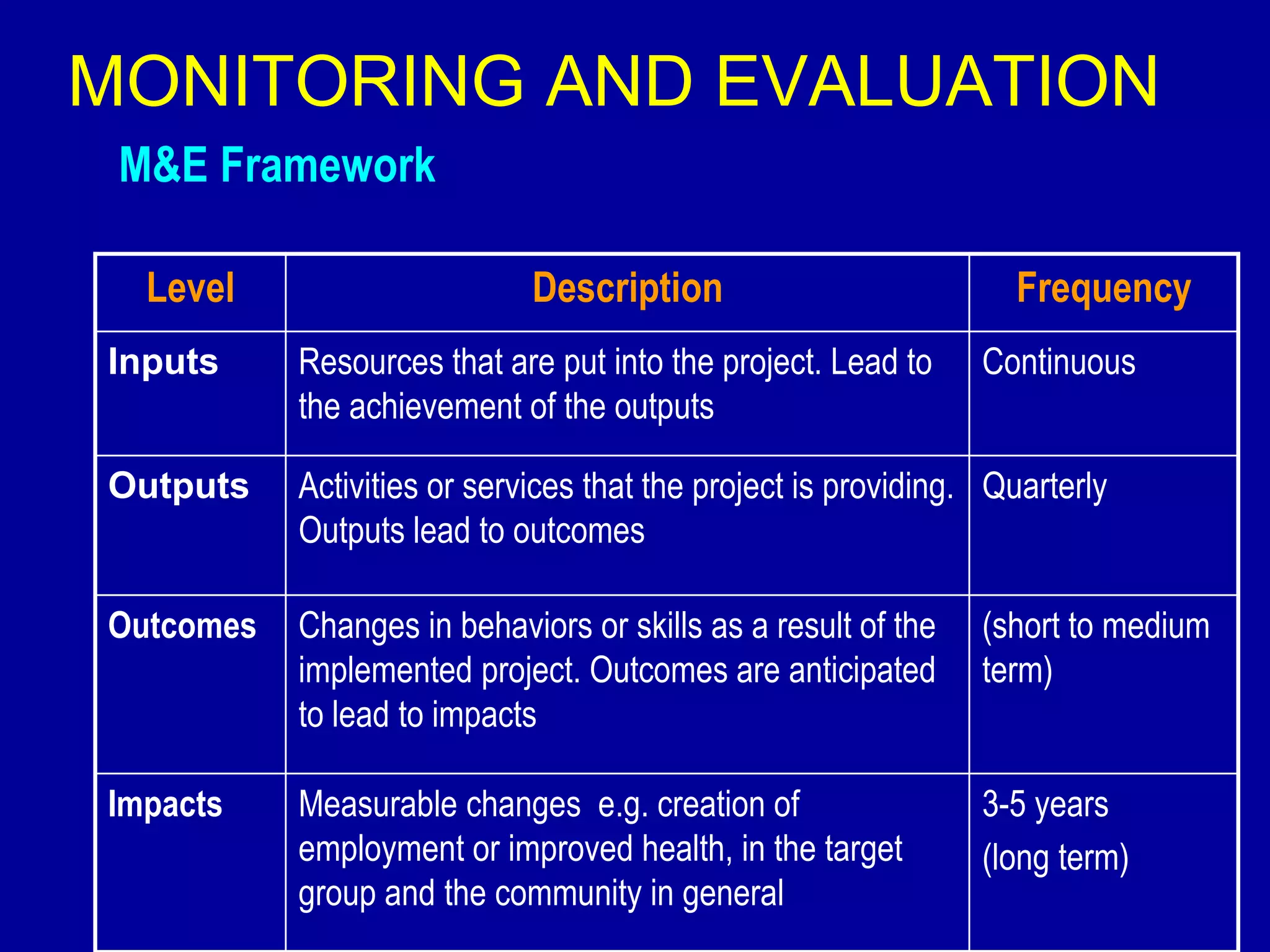
MONITORING AND EVALUATION
 M&E Framework

  Level                      Description                          Frequency
Inputs     Resources that are put into the project. Lead to     Continuous
           the achievement of the outputs

Outputs    Activities or services that the project is providing. Quarterly
           Outputs lead to outcomes

Outcomes   Changes in behaviors or skills as a result of the    (short to medium
           implemented project. Outcomes are anticipated        term)
           to lead to impacts

Impacts    Measurable changes e.g. creation of                  3-5 years
           employment or improved health, in the target         (long term)
           group and the community in general
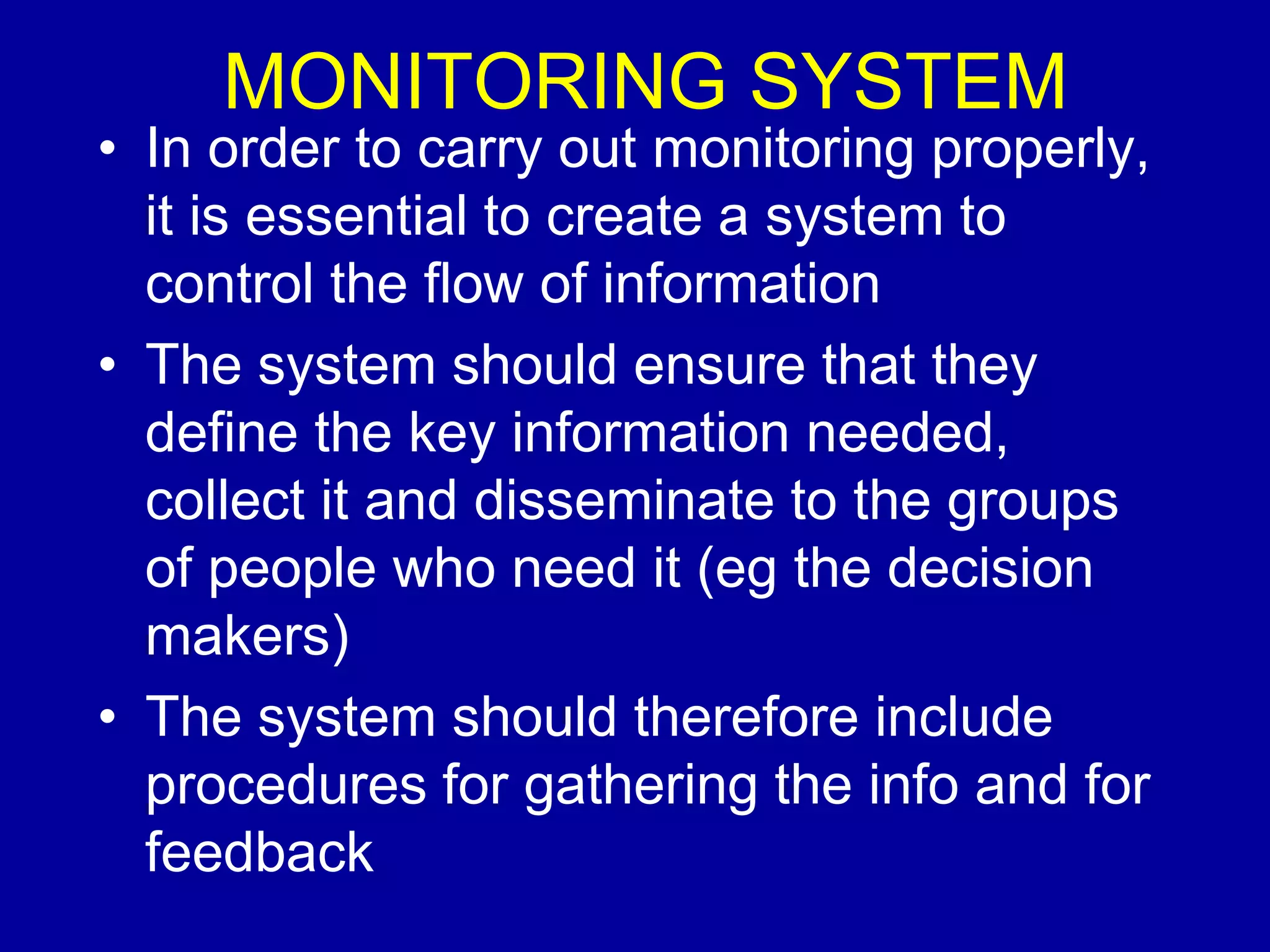
MONITORING SYSTEM
• In order to carry out monitoring properly,
  it is essential to create a system to
  control the flow of information
• The system should ensure that they
  define the key information needed,
  collect it and disseminate to the groups
  of people who need it (eg the decision
  makers)
• The system should therefore include
  procedures for gathering the info and for
  feedback
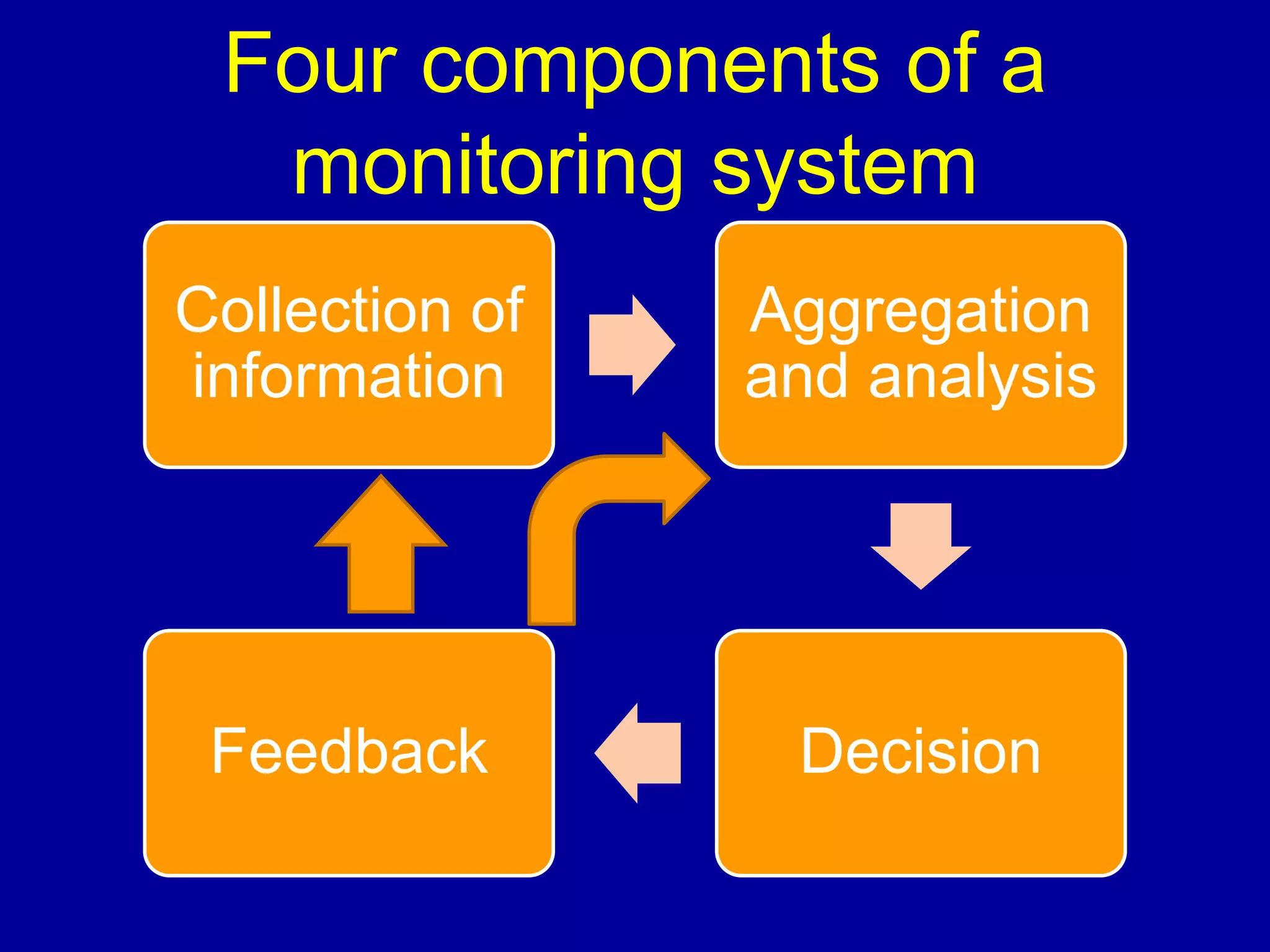
Four components of a
  monitoring system
Collection of   Aggregation
information     and analysis


 Feedback        Decision
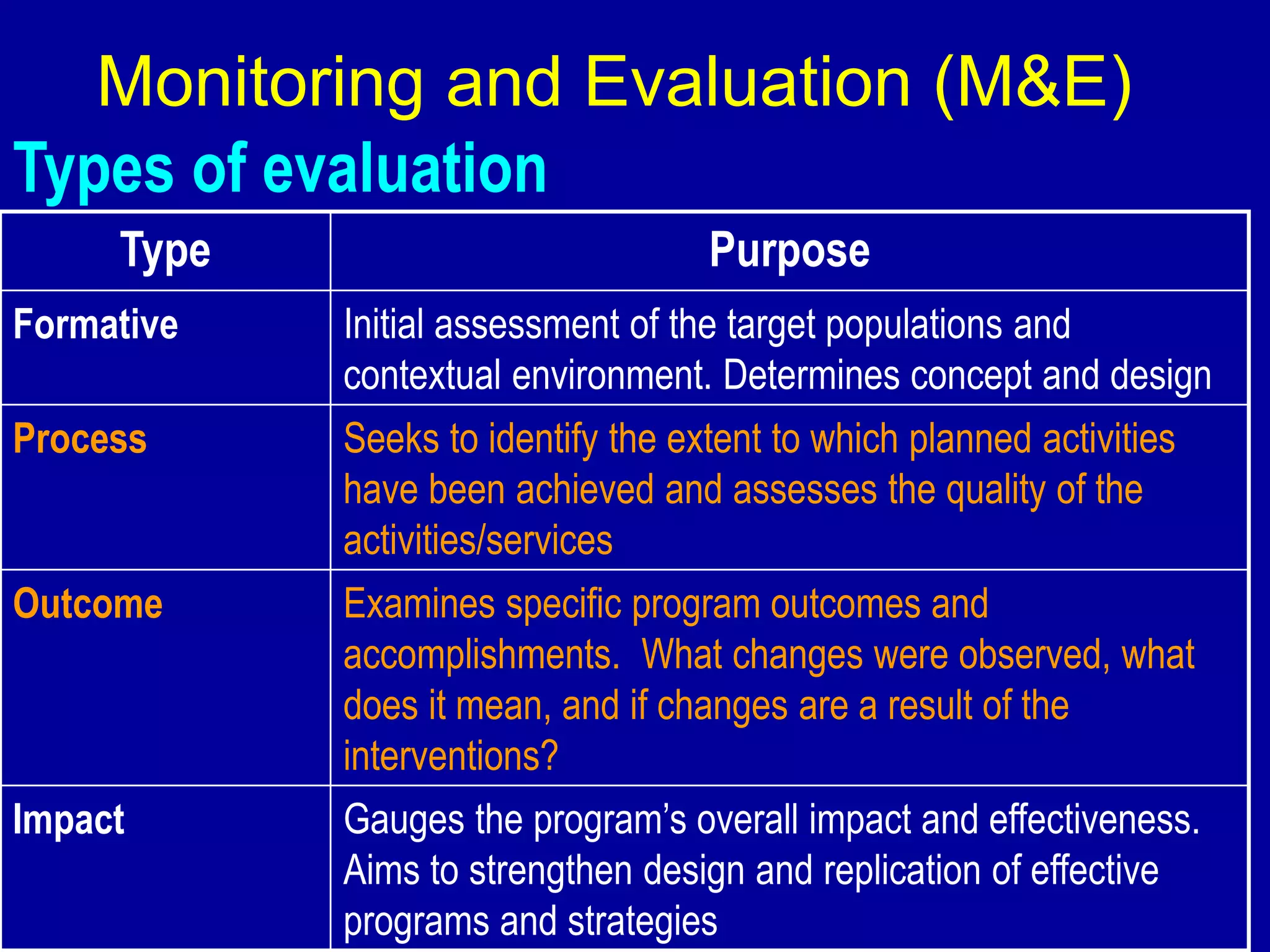
Monitoring and Evaluation (M&E)
Types of evaluation
     Type                          Purpose
Formative   Initial assessment of the target populations and
            contextual environment. Determines concept and design
Process     Seeks to identify the extent to which planned activities
            have been achieved and assesses the quality of the
            activities/services
Outcome     Examines specific program outcomes and
            accomplishments. What changes were observed, what
            does it mean, and if changes are a result of the
            interventions?
Impact      Gauges the program’s overall impact and effectiveness.
            Aims to strengthen design and replication of effective
            programs and strategies
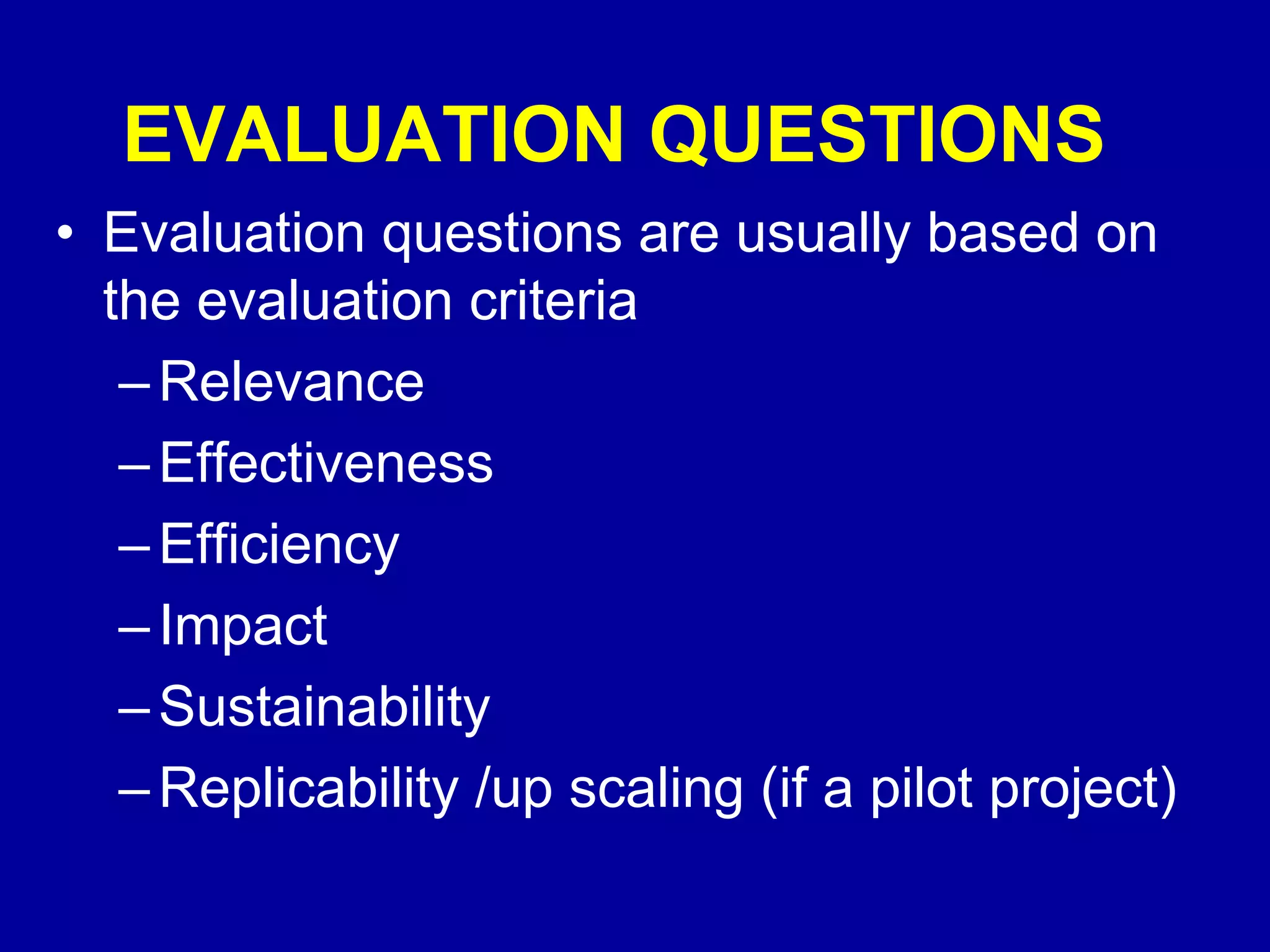
EVALUATION QUESTIONS
• Evaluation questions are usually based on
  the evaluation criteria
   – Relevance
   – Effectiveness
   – Efficiency
   – Impact
   – Sustainability
   – Replicability /up scaling (if a pilot project)
IMPACT
ANALYSIS/EVALUATION OF
DEVELOPMENT PROJECTS
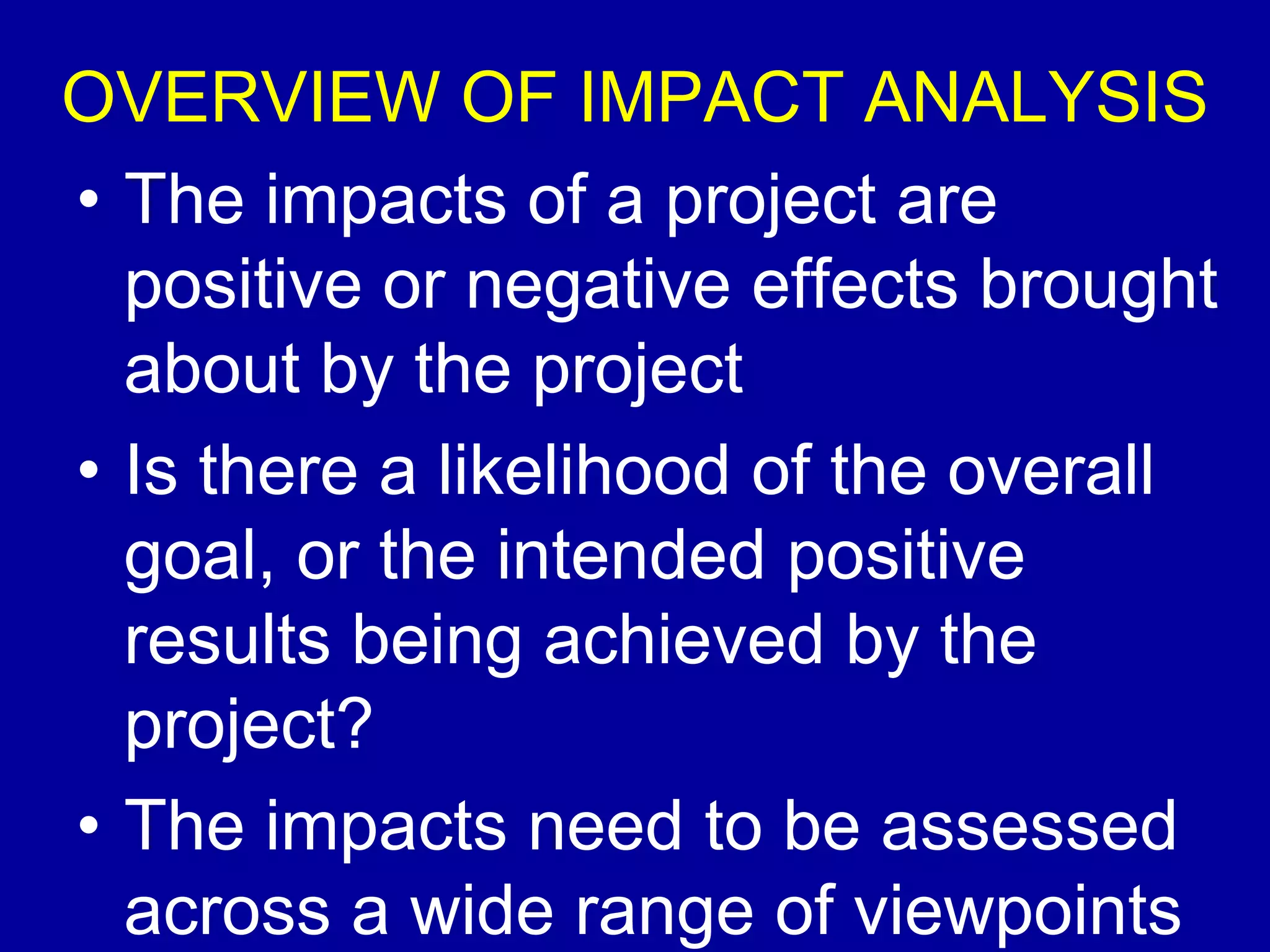
OVERVIEW OF IMPACT ANALYSIS
• The impacts of a project are
  positive or negative effects brought
  about by the project
• Is there a likelihood of the overall
  goal, or the intended positive
  results being achieved by the
  project?
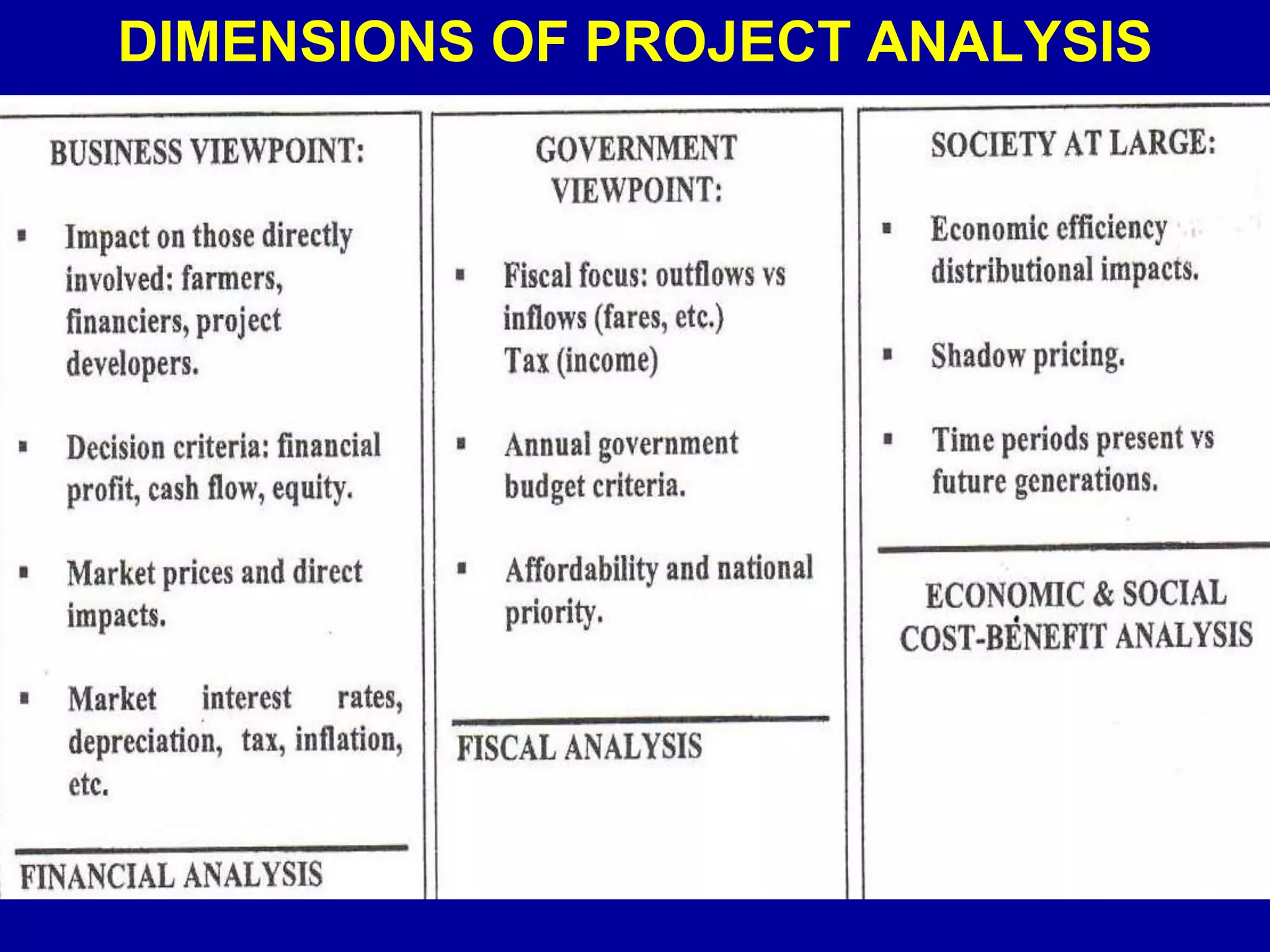
• The impacts need to be assessed
  across a wide range of viewpoints
DIMENSIONS OF PROJECT ANALYSIS
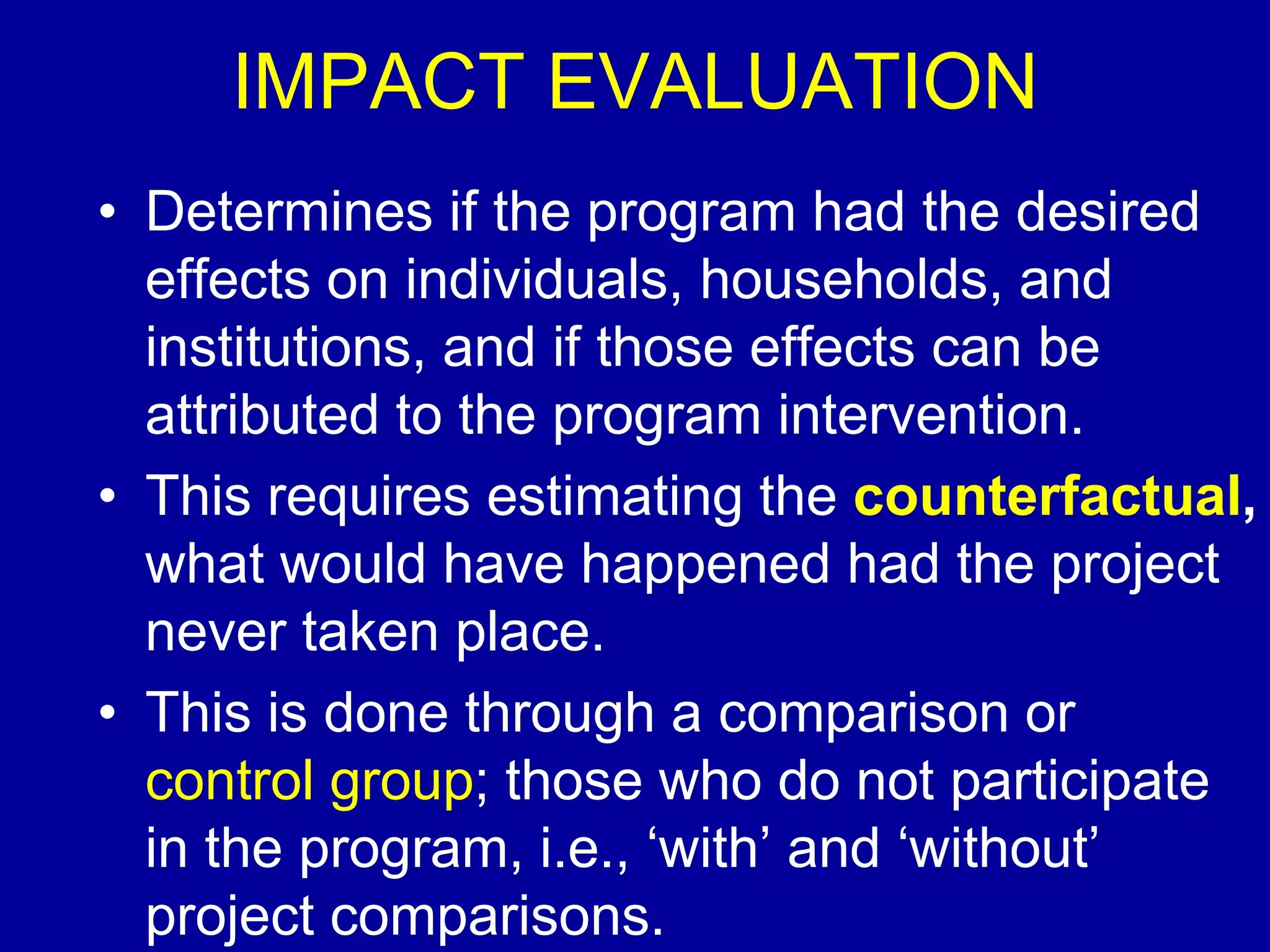
IMPACT EVALUATION
• Determines if the program had the desired
  effects on individuals, households, and
  institutions, and if those effects can be
  attributed to the program intervention.
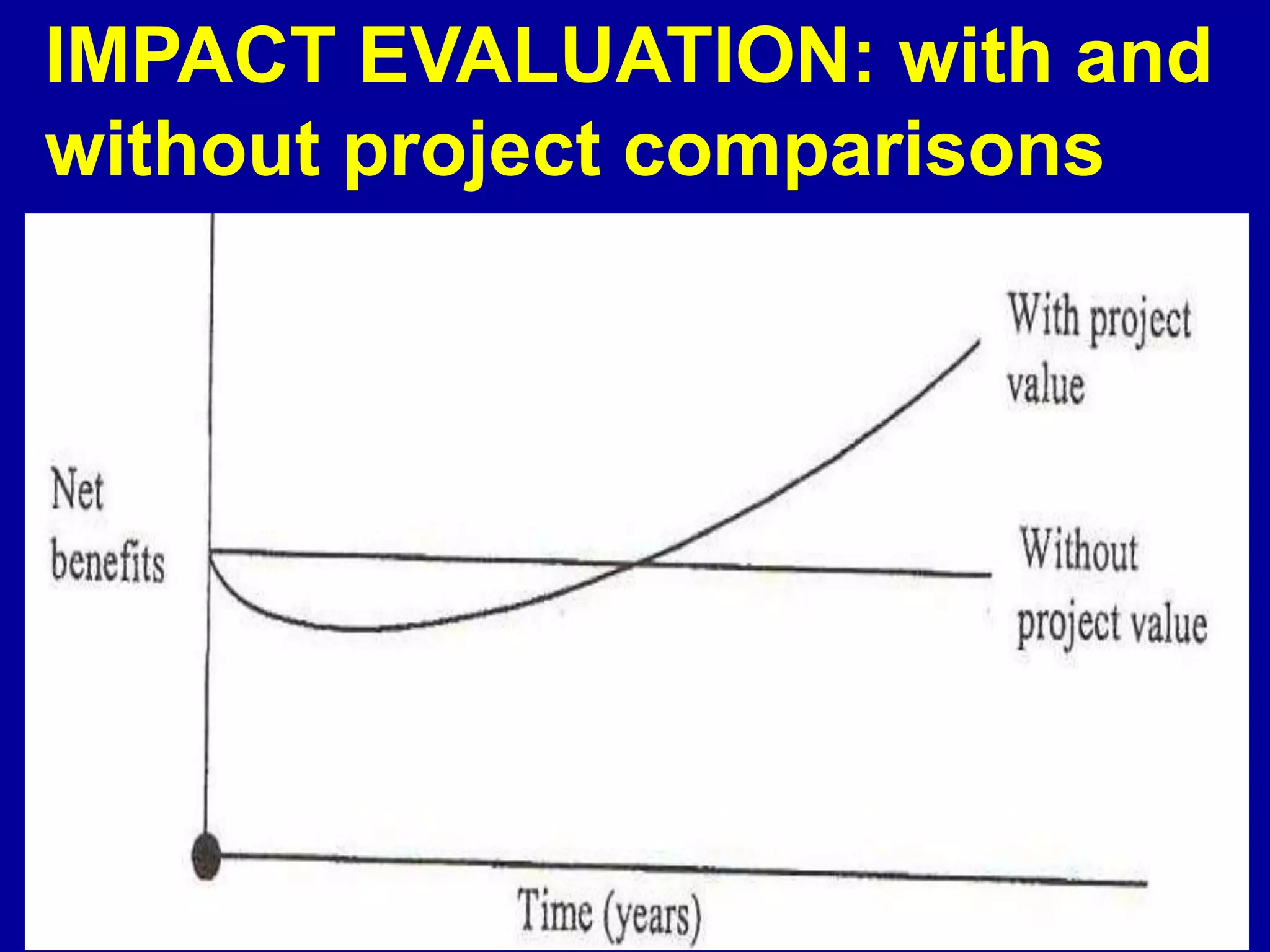
• This requires estimating the counterfactual,
  what would have happened had the project
  never taken place.
• This is done through a comparison or
  control group; those who do not participate
  in the program, i.e., ‘with’ and ‘without’
  project comparisons.
IMPACT EVALUATION: with and
without project comparisons
COST BNEFIT
 ANALYSIS (CBA) AS A
 TOOL FOR PROJECT
 APPRAISAL/EVALUATI
 ON
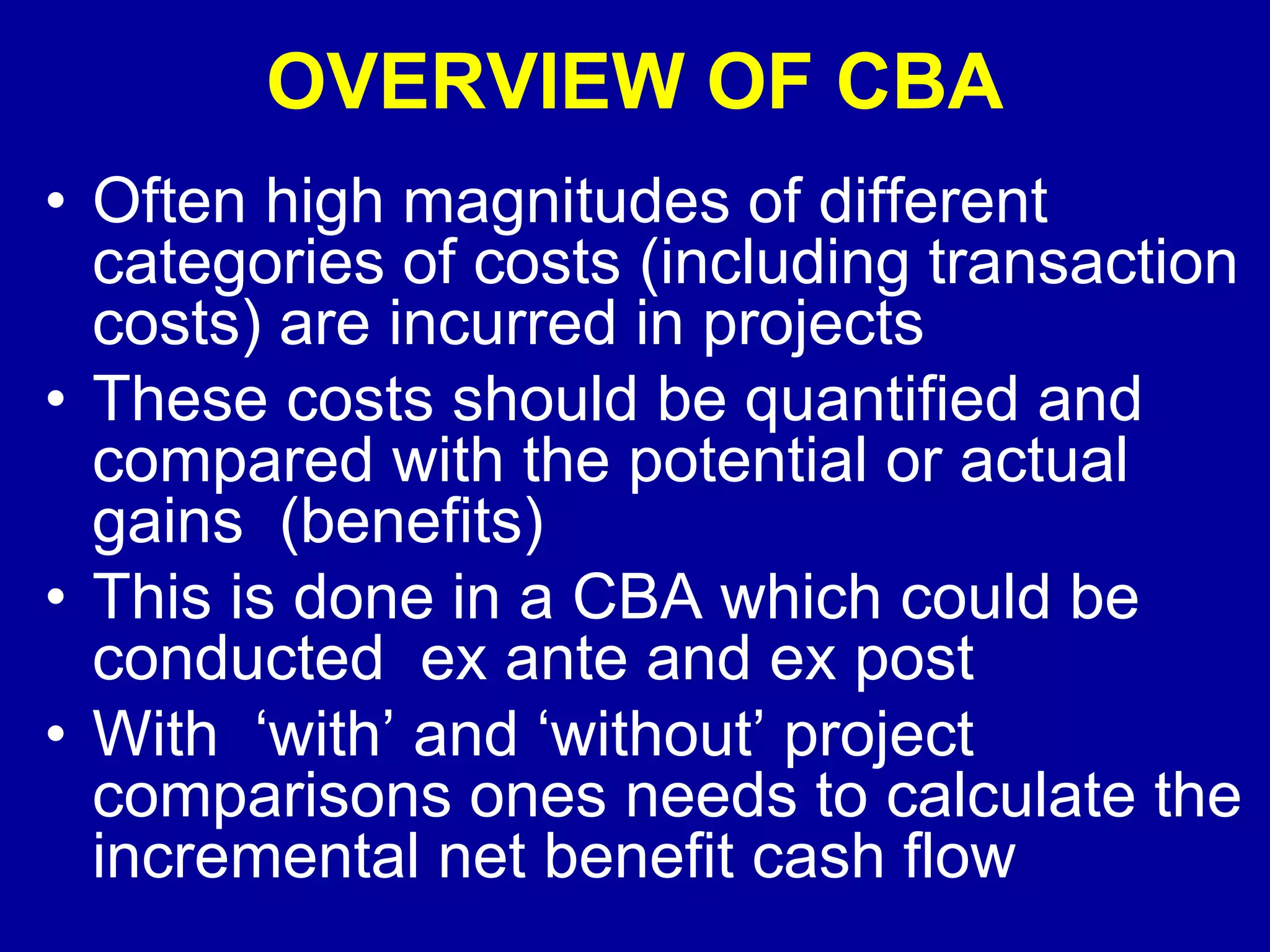
OVERVIEW OF CBA
• Often high magnitudes of different
  categories of costs (including transaction
  costs) are incurred in projects
• These costs should be quantified and
  compared with the potential or actual
  gains (benefits)
• This is done in a CBA which could be
  conducted ex ante and ex post
• With ‘with’ and ‘without’ project
  comparisons ones needs to calculate the
  incremental net benefit cash flow
STEPS (STRUCTURE) OF A CBA
1. Define the project:
  –   what kind of resources are being reallocated?
  –   Who (the population) are gainers and losers over which
      costs and benefits are to be aggregated, what is their level
      of operation?
2. Which project impacts/consequences are
   relevant or economically important, while
   considering
3. Identifying positive and negative
   impacts/consequences
  –   Include also unpriced impacts or externalities
  –   Exclude transfer payments effects- changes of indirect
      taxes, additional unemployment benefits becoming
      payable, etc. These are merely redistributed in the
      government system
  –   Determine the physical amounts of the impacts and when
      in time they occur
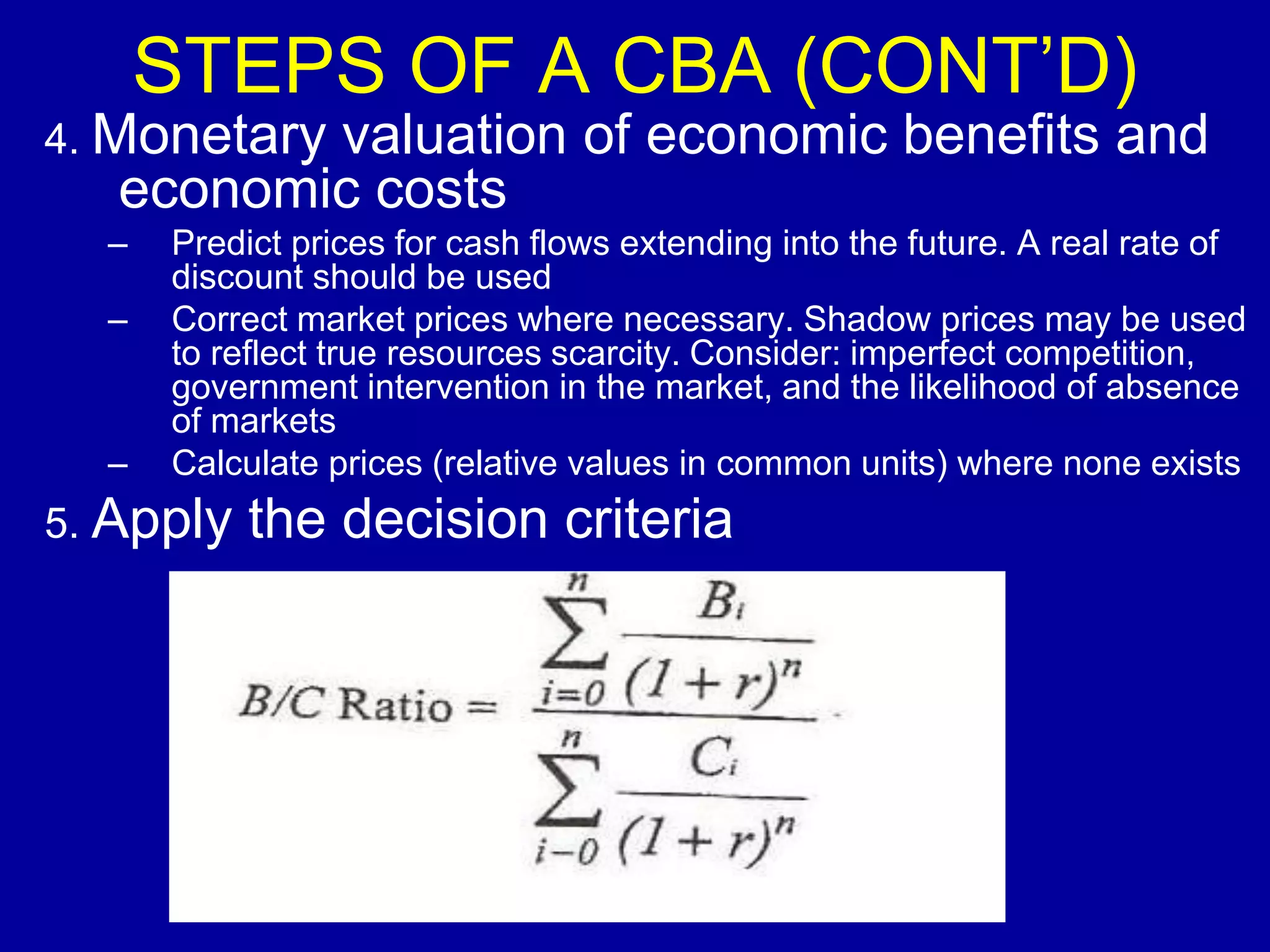
STEPS OF A CBA (CONT’D)
4. Monetary
          valuation of economic benefits and
   economic costs
  –   Predict prices for cash flows extending into the future. A real rate of
      discount should be used
  –   Correct market prices where necessary. Shadow prices may be used
      to reflect true resources scarcity. Consider: imperfect competition,
      government intervention in the market, and the likelihood of absence
      of markets
  –   Calculate prices (relative values in common units) where none exists
5. Apply   the decision criteria
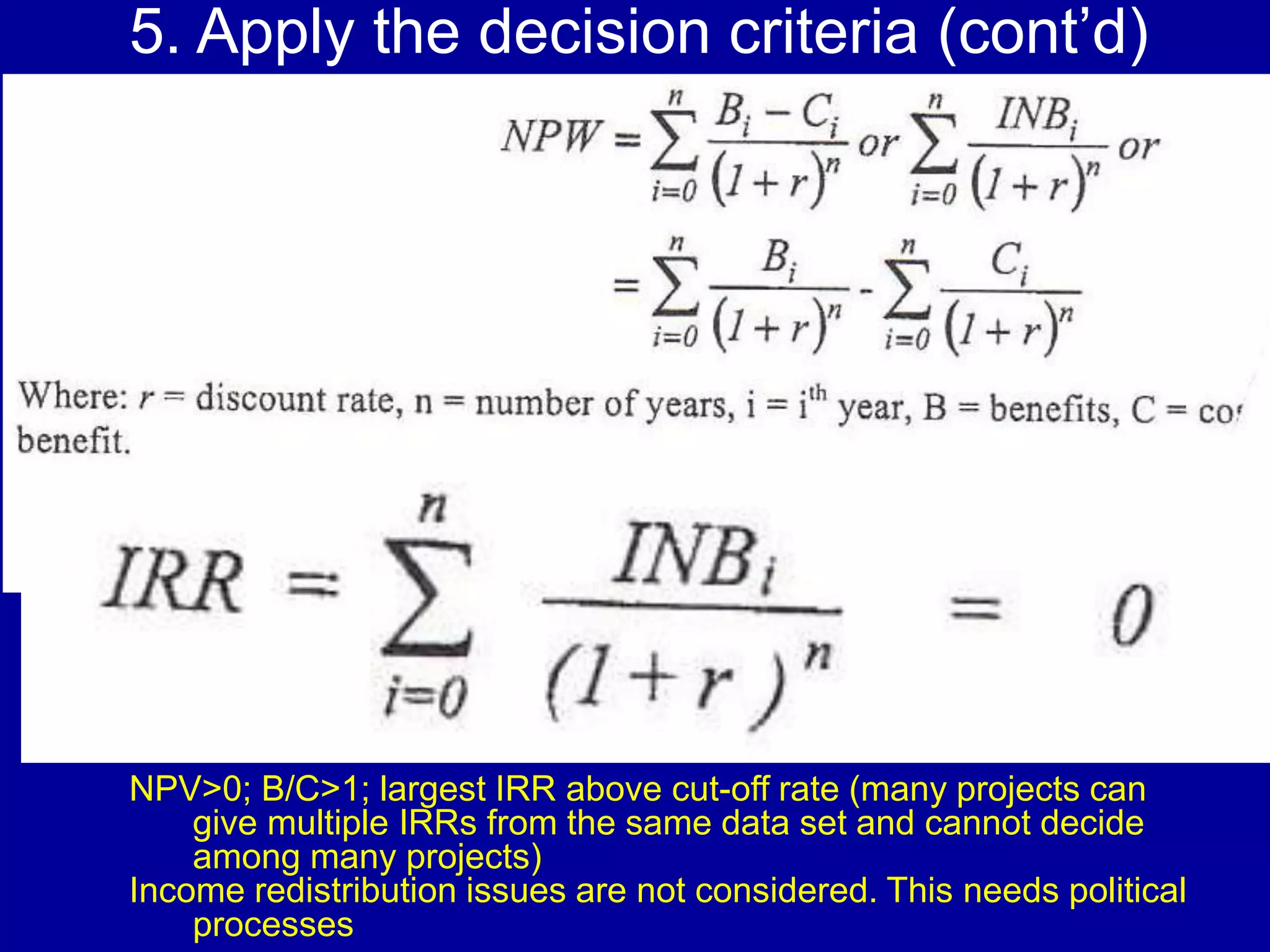
5. Apply the decision criteria (cont’d)


NPV>0; B/C>1; largest IRR above cut-off rate (many projects can
    give multiple IRRs from the same data set and cannot decide
    among many projects)
Income redistribution issues are not considered. This needs political
    processes
STEPS OF A CBA (cont’d)
6. Conduct     sensitivity analysis
  –   Mainly due to uncertainty: adjust the predictions and assumptions
      made

Re sakss presentation on project management mburu 2

  • 1.
    Project Management John Mburu Department of Agricultural Economics, University of Nairobi
  • 2.
    THE PROJECT CONCEPT •A project represents a particular set of choices (or interventions) over time to move from a present situation to an envisaged future situation • In essence a project is an instrument of change
  • 3.
    DEFINITION OF APROJECT • “A proposal for capital investments where a cost stream results in a certain flow of benefits over a specified period” (FAO) • “An investment asset from which we can expect to realize benefits over an extended period of time”- (Gittinger, 1982) • “A proposal for capital investments to create opportunities for producing goods and services.”
  • 4.
    GENERAL TYPES OFPROJECTS • Privately financed projects, including private businesses • Government (public) projects (initiatives)
  • 5.
    CLASSIFICATION OF DEVELOPMENTPROJECTS Functional classification: •Projects aimed at technical innovation •Expanding the natural resource base •Improvement in the living conditions of previously disadvantaged groups • Improved market infrastructure •Institutional capacity development •Multifunctional investment projects •Policy and institutional reforms
  • 6.
    WHY DO PROJECTSFAIL? • A lack of ownership and responsibility • Problems of project design and implementation • The use of inappropriate technology • Inadequate or inappropriate infrastructure • Failure to appreciate the social and political environment • Administrative problems • Changing economic situations and market conditions • Externally driven project initiatives • Problems related to poor analysis • Unrealistic expectations • Unsupportive policy environment
  • 7.
  • 8.
    Project Cycle Identification –conceptualization Preparation – objectives and activities required to achieve objectives Appraisal – evaluation of alternative options and actions (ex-ante analysis) Approval/rejection (decision making) Implementation Investment period Development period Monitoring Completion Evaluation (ex-post analysis) including impact assessment
  • 9.
    • RESEARCH PROJECTS VSDEVELOPMENT PROJECTS •Research project DIAGNOSIS SOCIO-ECONOMIC Policy & Planning Institutional (screening ex- On-station issues ante) experimentation Assessment On-farm experimentation Modification/re- (on-going) planning Assessment (ex-post) Modification/re- planning Recommendations Wider dissemination
  • 10.
    •Development Project Identification Preparation and Analysis Appraisal Implementation Evaluation and Impact
  • 11.
  • 12.
    IDENTIFICATION (DIAGNOSIS) Findingpotentially fundable projects Sources Technical specialists Local leaders Politicians Existing projects Sector studies Communities
  • 13.
    Aspects To Considerin Project Planning & Assessment Technical aspects (physical input-output of goods and services) Institutional - Organizational - Managerial aspects (including customs, tenure, local organizations, cultural setting) Social aspects (Broader social implications - resource and income distribution, employment opportunities) Commercial and Business aspects (securing supplies, market demand)
  • 14.
    Aspects To Considerin Project Planning & Assessment (Cont.) Financial aspects Economic aspects (Economic efficiency, deals with costs and benefits) Environmental aspects (biological and physical effects) Socio-cultural aspects
  • 15.
    Logical Framework Analysis (LFA)
  • 16.
    Logical Framework Analysis (LFA • What is LFA? – A designing approach that can be used for planning, designing, implementing and evaluating projects or programmes • Steps in LFA – Situation Analysis – Strategy Analysis – Project Planning Matrix – Implementation
  • 17.
    Situation Analysis (1) StakeholderAnalysis (2 ) Problem Analysis (3 ) Objective Analysis
  • 18.
    1) Stakeholder Analysis – Who are the stakeholders involved in the project, and how are they affected? • Consider the following: – Who will be involved in the log-frame development? – Where will the development be conducted? – Who will facilitate the development of the log-frame? – What background materials, papers and expertise may be needed? – What materials and logistics are required?
  • 19.
    (2) Problem Analysis Whichare the problems the project is addressing? What are the root causes of those problems? What is the larger picture in which those problems and their root causes exist? -What are the links between the problems?
  • 20.
    Problem Analysis (cont’d) ProblemTree • Brainstorming techniques can be used to identify the main problems • After all of the problems are displayed they should then be clustered into groups of similar issues • The problem tree is developed by: 1. moving problems from the clusters of problems 2. adding new problems that emerge 3. problems can be moved up or down the tree as required
  • 21.
    (2) Problem Analysis: Exampleof a Problem Tree: one main problem (EFFECT) a series of lower order problems (CAUSE)
  • 22.
    3) Objectives Analysis •... a procedure for systematically – 1. identifying – 2. categorising – 3. specifying – 4. balancing out ...objectives of all parties involved in a specific situation • Objectives Tree – 1. Problems are restated as objectives – 2. Positive mirror image of the problem tree
  • 23.
    (3) Objective Analysis: Exampleof an Objectives Tree: top of the tree is the END desired, lower levels are the MEANS to the end MDS 521 IRUNGU 2011
  • 24.
    Strategy Analysis • Searchingfor and deciding on solutions • Follows the problems and objectives analysis • Prerequisite to designing action strategies Conducting a Strategy Analysis: 1. Ordering sequence of the problem and objective trees 2. Clustering objectives 3. Feasibility of different interventions 4. Continuous task in project management
  • 25.
    The process ofstrategy formulation 25
  • 26.
    Strategy Analysis MDS 521 IRUNGU 2011
  • 27.
    Project Planning Matrix (logframe matrix): • Developed from the strategy analysis by filling in the columns of the matrix as shown
  • 28.
    Narrative Objectively Means of Important Summary Verifiable Verification Assumptions (intervention logic) Indicators GOALS / Measures of goal Various sources of Goal / Purpose OBJECTIVES achievement information, linkages methods used PROJECT End of project Various sources of Output / Purpose PURPOSE status information, linkages methods used OUTPUTS / Magnitudes of Various sources of Input / Output RESULTS outputs, information, linkages planned completion methods dates used INPUTS / Types/levels of Project data, other Initial Assumptions ACTIVITIES resources, starting sources of regarding the dates information causality of the programme
  • 29.
    PROJECT IMPLEMENTATION • Operationalphase of a project to achieve the expected outputs/results • Plan of Operations work plans / work schedules project budget / resources plans personnel plans material and equipment plan / procurement plan / staff training plans
  • 30.
  • 31.
    WHAT IS MONITORING? Day-to-dayfollow up of activities during implementation to measure progress and identify deviations Routine follow up to ensure activities are proceeding as planned and are on schedule Routine assessment of activities and results Answers the question, “what are we doing?”
  • 32.
    TYPES OF MONITORING •Progress – How much was achieved? – When was it achieved? – How was it achieved? – At what cost? • Process – What happens? – Why?
  • 33.
    KEY STEPS INPROGRESS MONITORING 1. Establishing the monitoring unit/system 2. Situation review and selecting key project process and indicators 3. Observing key processes 4. Reflecting on /analysis of results 5. Follow-up action
  • 34.
    WHAT IS EVALUATION? Episodicassessment of overall achievement and impacts Systematic way of learning from experience to IMPROVE current activities and promote better planning for future action Designed specifically with intention to attribute changes to intervention itself Answers the question, “what have we achieved and what impact have we made”
  • 35.
    WHY EVALUATE? Determines programeffectiveness , efficiency, relevance and sustainability Shows impact Strengthens financial responses and accountability Promotes a learning culture focused on service improvement Promotes replication of successful interventions (replicability)
  • 36.
    MONITORING vs EVALUATION MONITORING VS EVALUATION Monitoring Evaluation Continuous: day-to-day Periodic: important milestones Documents progress In-depth analysis of achievements Focuses on inputs and outputs Focuses on outcomes and impacts Alerts managers to problems Provides managers with strategy and policy options Self-assessment External analysis
  • 37.
    MONITORING AND EVALUATION M&E Framework Level Description Frequency Inputs Resources that are put into the project. Lead to Continuous the achievement of the outputs Outputs Activities or services that the project is providing. Quarterly Outputs lead to outcomes Outcomes Changes in behaviors or skills as a result of the (short to medium implemented project. Outcomes are anticipated term) to lead to impacts Impacts Measurable changes e.g. creation of 3-5 years employment or improved health, in the target (long term) group and the community in general
  • 38.
    MONITORING SYSTEM • Inorder to carry out monitoring properly, it is essential to create a system to control the flow of information • The system should ensure that they define the key information needed, collect it and disseminate to the groups of people who need it (eg the decision makers) • The system should therefore include procedures for gathering the info and for feedback
  • 39.
    Four components ofa monitoring system Collection of Aggregation information and analysis Feedback Decision
  • 40.
    Monitoring and Evaluation(M&E) Types of evaluation Type Purpose Formative Initial assessment of the target populations and contextual environment. Determines concept and design Process Seeks to identify the extent to which planned activities have been achieved and assesses the quality of the activities/services Outcome Examines specific program outcomes and accomplishments. What changes were observed, what does it mean, and if changes are a result of the interventions? Impact Gauges the program’s overall impact and effectiveness. Aims to strengthen design and replication of effective programs and strategies
  • 41.
    EVALUATION QUESTIONS • Evaluationquestions are usually based on the evaluation criteria – Relevance – Effectiveness – Efficiency – Impact – Sustainability – Replicability /up scaling (if a pilot project)
  • 42.
  • 43.
    OVERVIEW OF IMPACTANALYSIS • The impacts of a project are positive or negative effects brought about by the project • Is there a likelihood of the overall goal, or the intended positive results being achieved by the project? • The impacts need to be assessed across a wide range of viewpoints
  • 44.
  • 45.
    IMPACT EVALUATION • Determinesif the program had the desired effects on individuals, households, and institutions, and if those effects can be attributed to the program intervention. • This requires estimating the counterfactual, what would have happened had the project never taken place. • This is done through a comparison or control group; those who do not participate in the program, i.e., ‘with’ and ‘without’ project comparisons.
  • 46.
    IMPACT EVALUATION: withand without project comparisons
  • 47.
    COST BNEFIT ANALYSIS(CBA) AS A TOOL FOR PROJECT APPRAISAL/EVALUATI ON
  • 48.
    OVERVIEW OF CBA •Often high magnitudes of different categories of costs (including transaction costs) are incurred in projects • These costs should be quantified and compared with the potential or actual gains (benefits) • This is done in a CBA which could be conducted ex ante and ex post • With ‘with’ and ‘without’ project comparisons ones needs to calculate the incremental net benefit cash flow
  • 49.
    STEPS (STRUCTURE) OFA CBA 1. Define the project: – what kind of resources are being reallocated? – Who (the population) are gainers and losers over which costs and benefits are to be aggregated, what is their level of operation? 2. Which project impacts/consequences are relevant or economically important, while considering 3. Identifying positive and negative impacts/consequences – Include also unpriced impacts or externalities – Exclude transfer payments effects- changes of indirect taxes, additional unemployment benefits becoming payable, etc. These are merely redistributed in the government system – Determine the physical amounts of the impacts and when in time they occur
  • 50.
    STEPS OF ACBA (CONT’D) 4. Monetary valuation of economic benefits and economic costs – Predict prices for cash flows extending into the future. A real rate of discount should be used – Correct market prices where necessary. Shadow prices may be used to reflect true resources scarcity. Consider: imperfect competition, government intervention in the market, and the likelihood of absence of markets – Calculate prices (relative values in common units) where none exists 5. Apply the decision criteria
  • 51.
    5. Apply thedecision criteria (cont’d) NPV>0; B/C>1; largest IRR above cut-off rate (many projects can give multiple IRRs from the same data set and cannot decide among many projects) Income redistribution issues are not considered. This needs political processes
  • 52.
    STEPS OF ACBA (cont’d) 6. Conduct sensitivity analysis – Mainly due to uncertainty: adjust the predictions and assumptions made