Implementation Project
Proposal Writing
Tutors: Ronald Komata, Cisy Charity
Nakabuye, and Shourov Barua.
Module
Objectives
• To define a project and an
implementation project.
• To compare an implementation
project and a research project.
• To define and explain the
importance of an
implementation project proposal.
• To explain the components of a
good implementation project
proposal.
• To share General writing tips for
crafting a good implementation
project proposal.
What is a
project? What is
an
implementation
project?
• A project refers to a temporary
activity(ies) with specific
objectives, which is (are)
undertaken to create distinct
deliverables (product or service).
• An implementation project aims
to put an existing idea, solution,
or product into practice, often
with a specific goal or objective in
mind.
• It involves taking a proven
concept, technology, or
methodology and applying it to a
real-world situation or problem.
The focus is on execution,
deployment, and integration
rather than exploring new ideas
or hypotheses.
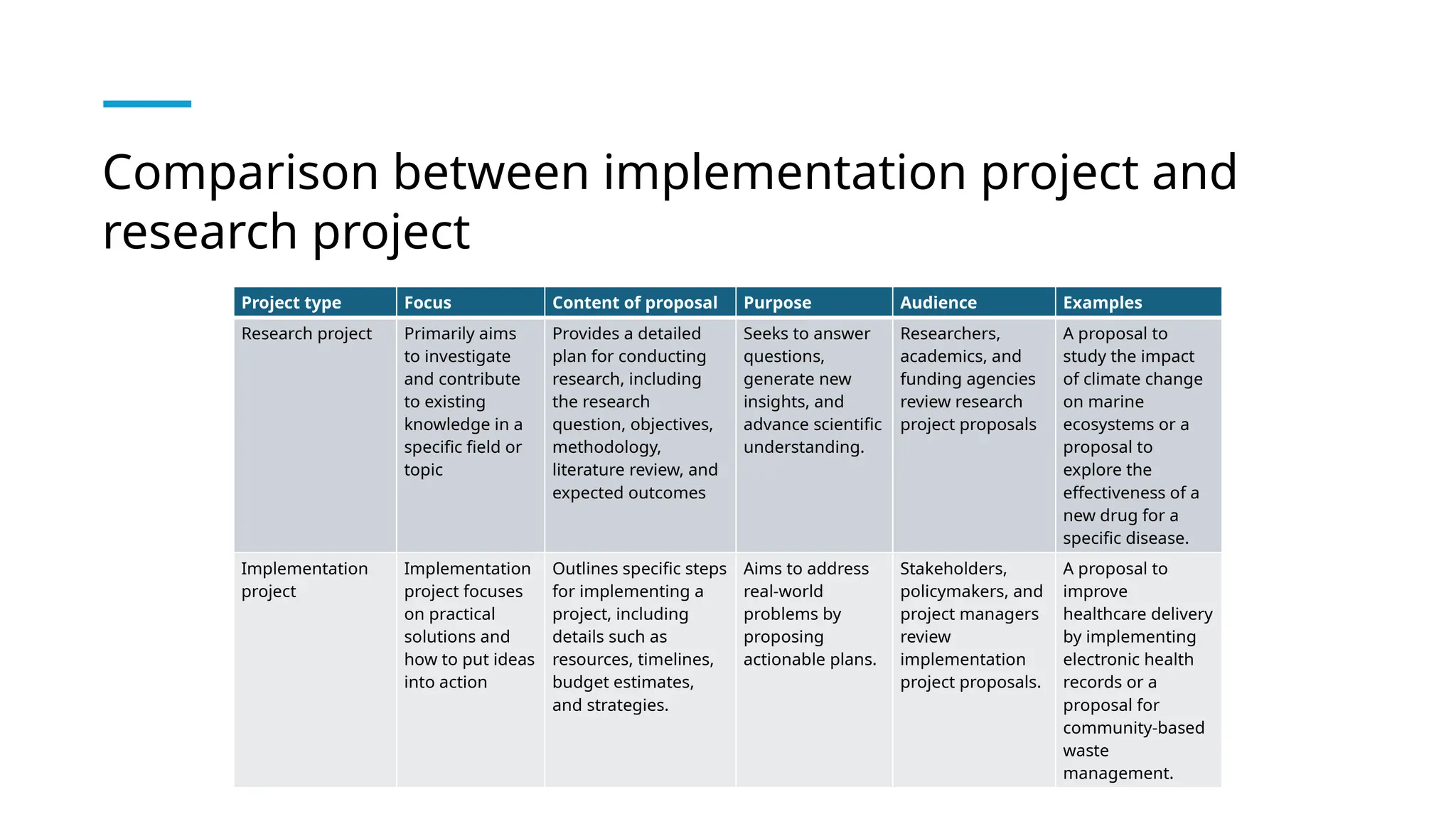
Comparison between implementation project and
research project
Project type Focus Content of proposal Purpose Audience Examples
Research project Primarily aims
to investigate
and contribute
to existing
knowledge in a
specific field or
topic
Provides a detailed
plan for conducting
research, including
the research
question, objectives,
methodology,
literature review, and
expected outcomes
Seeks to answer
questions,
generate new
insights, and
advance scientific
understanding.
Researchers,
academics, and
funding agencies
review research
project proposals
A proposal to
study the impact
of climate change
on marine
ecosystems or a
proposal to
explore the
effectiveness of a
new drug for a
specific disease.
Implementation
project
Implementation
project focuses
on practical
solutions and
how to put ideas
into action
Outlines specific steps
for implementing a
project, including
details such as
resources, timelines,
budget estimates,
and strategies.
Aims to address
real-world
problems by
proposing
actionable plans.
Stakeholders,
policymakers, and
project managers
review
implementation
project proposals.
A proposal to
improve
healthcare delivery
by implementing
electronic health
records or a
proposal for
community-based
waste
management.
What is an implementation
project proposal?
• An implementation project proposal is a
detailed document outlining a plan to
execute a specific project aimed at
implementing a solution, system, or
process.
• By creating a comprehensive
implementation project proposal, you can
ensure a well-planned, well-executed, and
successful project that meets
stakeholders’ needs and expectations.
Why is an implementation project
proposal important?
An implantation project
proposal is important for
several reasons
Clear communication: It
ensures that all stakeholders
understand the project’s
objectives, scope, timeline,
budget, and expected
outcomes.
Project approval: The proposal
serves as a formal request for
project approval and funding.
Resource allocation: It helps
allocate necessary resources,
including personnel, materials,
and equipment.
Stakeholder buy-in: The
proposal secures commitment
and support from stakeholders,
including team members,
sponsors, and customers.
Project planning: The proposal
forces thorough project
planning, identifying potential
risks, assumptions, and
dependencies.
Why is an implementation project proposal
important?
Scope management: It helps prevent scope creep by
clearly defining what is included and what is excluded
from the project
Budget and cost management: The proposal establishes
a budget and cost management plan, ensuring financial
control.
Performance measurement: It sets clear deliverables
metrics for evaluating project success.
Risk management: The proposal identifies potential risks
and outlines mitigation strategies.
Historical record: It serves as a permanent document,
providing a historical record of the project’s planning and
execution
Logical chain
• A logical chain should be
observed before writing a
project proposal to
determine the necessary
information for each step.
Strategic
planning
• Strategic Planning is the
process of determining
what an organization or a
community, intends to be in
the future and how it will
get there.
Sample
format of a
project
proposal
Components of a good implementation project proposal-A
title
1
This gives a first
impression of your
proposal. A good project
proposal title should
effectively convey the
essence of the project and
entice the reader to review
the proposal. It should be;
2
Clear (easy to understand
and concise)
3
Specific (accurately
reflects the project’s
objectives and scope)
4
Concise (Brief and to the
point, ideally no more
than 15 to 20 words)
5
Informative, attention-
grabbing, unambiguous
(avoids confusion or
misinterpretation)
6
Relevant (aligns with the
project’s objectives)
7
Unique (Differentiates the
project from others)
8
Professional (uses
appropriate language and
tone)
Accurate (Truthfully
represents the project’s
content and scope)
Examples
1. Improving students’ Outcomes through Personalized Learning
Initiatives
2. Prevention and Early Diagnosis of Non-Communicable Diseases
through health education and screening.
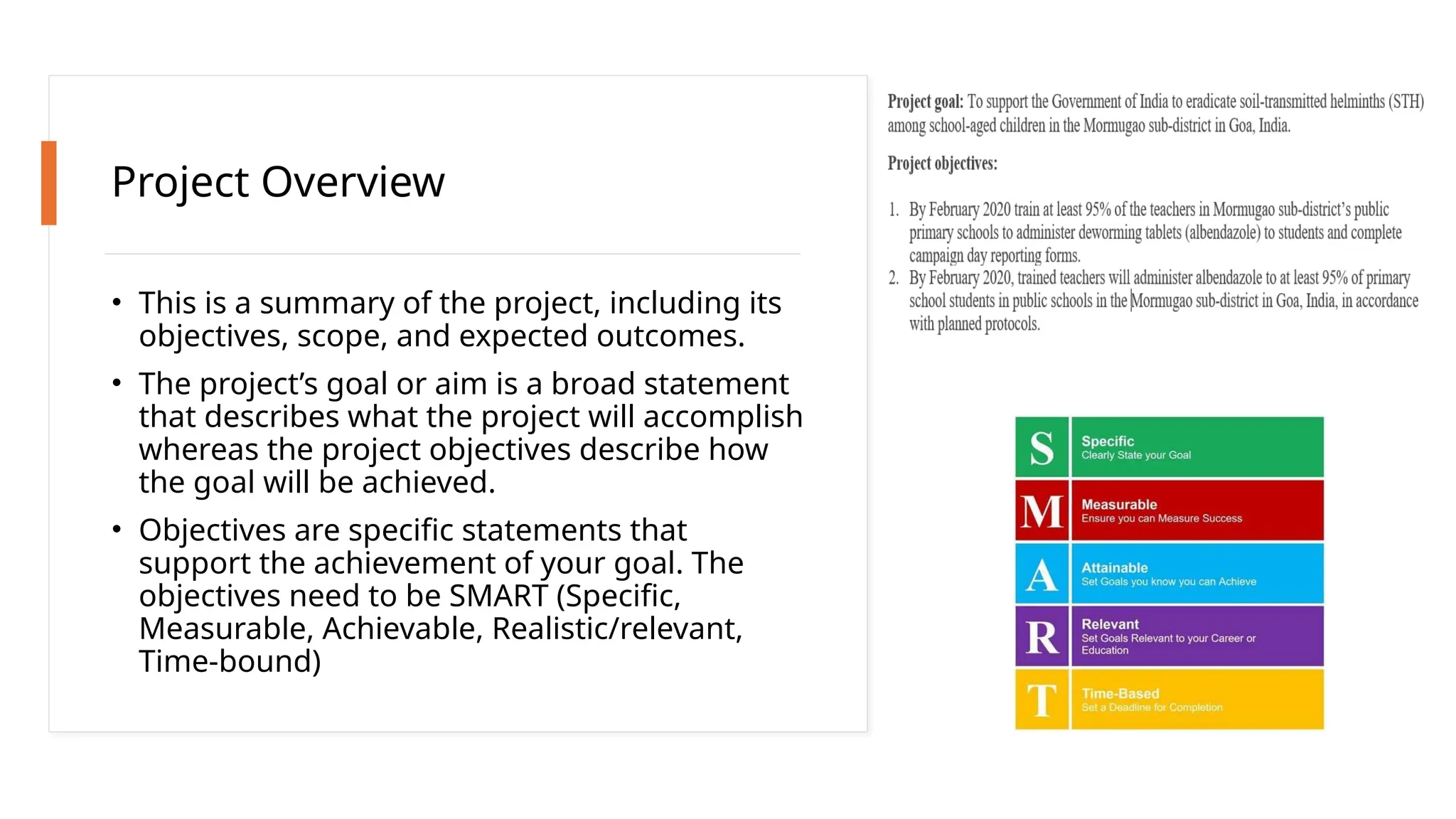
Project Overview
• This is a summary of the project, including its
objectives, scope, and expected outcomes.
• The project’s goal or aim is a broad statement
that describes what the project will accomplish
whereas the project objectives describe how
the goal will be achieved.
• Objectives are specific statements that
support the achievement of your goal. The
objectives need to be SMART (Specific,
Measurable, Achievable, Realistic/relevant,
Time-bound)
Background
• This refers to the context and justification for the
project, including the problem statement, current
situation, and goals.
• A good background depends on a reliable and
thorough conceptual framework for the project,
which usually results from a well-done needs
assessment including stakeholder identification and
analysis.
• A conceptual framework is a diagram that illustrates
the relationship between all the relevant systemic,
organizational, individual, or other relevant factors
that may influence the project operation and the
achievement of the project goals.
• It forms the basis for project development and
rationale and is a tool that will inform your project
concept paper or project charter, which leads to a
more detailed project plan or roadmap.
Problem
statement
• The problem assessment
should clearly state the gap
you have identified between
needs and resources that
will be the project’s focus.
Examples of conceptual frameworks
for problem assessment
• Logical Framework Approach (LFA)
• Problem tree analysis
• Fish bone model
•A conceptual framework for a project
to increase access to HIV testing
services and active case-finding
Conceptual
framework for
an integrated
nutrition
project
Problem
Tree Analysis
Example of
the problem
tree analysis
Illustration
Methodology
• This refers to a description of the approach
and methods to be used for
implementation.
• This section includes a description of how
you will determine whether the activities of
your project will yield the ideal outcomes.
• This can be done using a logic framework
which is a model that illustrates the linear
progression of a project.
• From inputs (resources) to processes
(project activities) to outputs (immediate
results), the logic model lays out the likely
outcomes (expected changes) and impact of
your project if it succeeds.
Project cycle and
causal hypothesis
• These help with defining project
beneficiaries and designing a
project using a causal pathway
framework
Causal
hypothesis
• The causal hypothesis is a
concise statement of the logic
behind the project. Normally,
the causal hypothesis is
written as follows:
• This set of inputs and
activities will result in these
products and services
• (outputs). These will in turn
lead to these changes in
people’s behavior (EFFECTS),
which will contribute to the
desired IMPACT
Example
Project cycle
Project Scope
• This is a detailed description of what is
included and excluded from the project.
Timeline
• This is a project schedule, including key
milestones and deadlines
Budget
• A budget describes the amount of money that a
project plans to spend over a given period of time. A
budget serves many purposes throughout the project
lifecycle.
• It is necessary during the planning phase to assure
that project managers can estimate an accurate idea
of cost. This allows project managers to determine if
there is adequate money to complete the project and
whether they are making the best use of the available
funds.
• The budget is a critical part of any negotiation with a
project donor or sponsor. The budget sets out in
detail what the project will do, including what the
money will be spent on.
• An accurate budget is needed to control the project
once it is underway. Comparing actual costs to the
budgeted costs is an important project management
tool. Project managers need budgets to oversee the
implementation of a project’s activities.
• The budget should contain a detailed breakdown of
costs, including resources, materials, labor,
equipment, and indirect costs. Use a table or Excel to
create your budget.
Other components of
the proposal
Deliverables
• A list of what the project will produce or achieve.
Monitoring and evaluation plan
• This section lays down a detailed plan for monitoring
and evaluating the project.
• Monitoring can be defined as the ongoing, routine
collection of information about a project’s activities in
order to measure progress toward results.
• Evaluation assesses the extent to which those
activities resulted in the achievement of project
outcomes.
Assumptions and dependencies
• This section identifies factors that might impact the
project’s success.
Other components
of the proposal
Risk Management Plan
• This is a plan for mitigating
potential risks, constraints, and
issues.
Conclusion (+/-)
• A summary of the proposal and the
benefits of the project
Appendices
• These are supporting documents
such as resumes, references, or
technical specifications
Tips for
writing a
compellin
g project
proposal
Things to consider
Have a plan in place. Before beginning to write, ask yourself
what you are doing, why you are doing it, and when you
plan to do it.
Ensure that you have done adequate background or
contextual research and where necessary a needs
assessment (consider collaborating with someone familiar
with the context)
Check whether your proposed project aligns with the goals
of your organization and the potential funder.
Is your proposed project relevant to the needs of the target
population? Is it feasible and or acceptable? Has it been
shown to work elsewhere? How is the political
environment? What other potential constraints and risks
are you likely to face?
Tips for
writing a
compelling
project
proposal
• Start with an Executive Summary. Summarize the key points
of your proposal, including the project’s goals, outcomes, and
estimated costs. Identify the main stakeholders and the
resources needed to execute the project
• Keep it simple. While you want to provide detail, avoid
overwhelming your audience. Aim for clarity and conciseness.
Focus on the most critical aspects of your proposal without
going into unnecessary depth.
• Describe Your proposed Solution Clearly. Explain your
proposed solution or project in a detailed manner. Address
how your solution directly tackles the problem and why it’s the
most effective approach. Include information on the methods,
strategies, or activities you’ll undertake to implement your
solution
• Know Your Audience. Understand the needs and
expectations of your stakeholders. Tailor your proposal to
resonate with their interests and concerns
• Use a Template. Templates can help structure your proposal
and ensure you cover all necessary sections. Consider using a
project proposal template to streamline the process.
General tips
for writing a
good project
proposal
Writing for the reader
• Before you start to write a proposal, you need to ask yourself the following
questions:
• Who will likely be the reviewers of the proposal? (Not the names of reviewers,
but their academic and professional backgrounds)
• Will they understand the technical details of the proposed project? If so, to what
extent?
• Then, match the technical level of the proposal to the background of the
reviewers.
• Carefully follow the instructions given by the funder, refer to any sample
proposals given by the funder, and search for and refer to other sample
proposals that may be appropriate, possibly through your institution’s grants
office.
• Try to ask a few specialists in your network to read your proposal and give you
feedback, try to ask a few non-specialists in your network to read your proposal
and give you feedback, and expand any abbreviation when you use it the first
time unless it is widely known.
• Use references, web links, etc. to provide further information if possible, and
Use an appropriate writing style.
Tips for writing a
compelling project
proposal
Readability
• When you write something, do you consider its
readability? Simply put, something that is
written well is easier to read or has good
readability.
• If your proposal is not easy to read and
understand, your chances of receiving a grant
may decrease. Conversely, a well-written grant
application makes a positive impression on the
reviewers.
• You can improve the readability of your writing
by organizing the writing carefully, presenting
overviews before details, using simple, common
wording where possible, avoiding wordy
phrases, making effective (but not excessive) use
of such devices as headings, boldface, and
italics, and including a writer or editor in your
team if possible.
Use effective writing styles
for your proposal
Clarity
Conciseness (Keep
sentences short and
complete, if you use
paragraphs in your proposal,
keep them short too, preview
or summarise main points,
for example, in the project
summary, but avoid
unnecessary repetition,
follow length or word-count
limitations given in the
proposal instructions)
Persuasiveness(A proposal
seeks to convince or
persuade the grant reviewer
that the proposed project or
activity is worthy of being
funded). You can persuade
grant reviewers by…
-Presenting a worthwhile and
SMART goal for the project
-Making the goal relevant to
the funder’s mission
-Presenting a sound
methodology or approach
Use effective
writing styles for
your proposal Persuasiveness
continued
-Conveying that the
project team is capable
of doing the work
- Giving adequate
reasons for choices (for
example, of proposed
solutions, durations,
consultants, venues)
-Describing the facilities
that will be available to
carry out the project
-Explaining why the
requested amount of
funding is appropriate or
reasonable
References and resources
1. How to use conceptual frameworks when planning your
projects
https://drive.google.com/open?id=1eDbWX8ZQJDO8hG46uUr8I4Z
p80f4grVT
2. Writing strong goals and objectives
https://drive.google.com/open?id=1RBKJJinE2eFuMSpCBG9hgHwb
5h46XU7u
3. How to write a project proposal that’s persuasive and precise
https://www.atlassian.com/blog/project-management/how-to-writ
e-project-proposal
4. Stakeholder identification, analysis, and management
templates
https://www.smartsheet.com/free-stakeholder-analysis-templates
5. Logic model templates http://templatelab.com/logic-model/

Implementation project proposal writing (1).pptx

  • 1.
    Implementation Project Proposal Writing Tutors:Ronald Komata, Cisy Charity Nakabuye, and Shourov Barua.
  • 2.
    Module Objectives • To definea project and an implementation project. • To compare an implementation project and a research project. • To define and explain the importance of an implementation project proposal. • To explain the components of a good implementation project proposal. • To share General writing tips for crafting a good implementation project proposal.
  • 3.
    What is a project?What is an implementation project? • A project refers to a temporary activity(ies) with specific objectives, which is (are) undertaken to create distinct deliverables (product or service). • An implementation project aims to put an existing idea, solution, or product into practice, often with a specific goal or objective in mind. • It involves taking a proven concept, technology, or methodology and applying it to a real-world situation or problem. The focus is on execution, deployment, and integration rather than exploring new ideas or hypotheses.
  • 4.
    Comparison between implementationproject and research project Project type Focus Content of proposal Purpose Audience Examples Research project Primarily aims to investigate and contribute to existing knowledge in a specific field or topic Provides a detailed plan for conducting research, including the research question, objectives, methodology, literature review, and expected outcomes Seeks to answer questions, generate new insights, and advance scientific understanding. Researchers, academics, and funding agencies review research project proposals A proposal to study the impact of climate change on marine ecosystems or a proposal to explore the effectiveness of a new drug for a specific disease. Implementation project Implementation project focuses on practical solutions and how to put ideas into action Outlines specific steps for implementing a project, including details such as resources, timelines, budget estimates, and strategies. Aims to address real-world problems by proposing actionable plans. Stakeholders, policymakers, and project managers review implementation project proposals. A proposal to improve healthcare delivery by implementing electronic health records or a proposal for community-based waste management.
  • 5.
    What is animplementation project proposal? • An implementation project proposal is a detailed document outlining a plan to execute a specific project aimed at implementing a solution, system, or process. • By creating a comprehensive implementation project proposal, you can ensure a well-planned, well-executed, and successful project that meets stakeholders’ needs and expectations.
  • 6.
    Why is animplementation project proposal important? An implantation project proposal is important for several reasons Clear communication: It ensures that all stakeholders understand the project’s objectives, scope, timeline, budget, and expected outcomes. Project approval: The proposal serves as a formal request for project approval and funding. Resource allocation: It helps allocate necessary resources, including personnel, materials, and equipment. Stakeholder buy-in: The proposal secures commitment and support from stakeholders, including team members, sponsors, and customers. Project planning: The proposal forces thorough project planning, identifying potential risks, assumptions, and dependencies.
  • 7.
    Why is animplementation project proposal important? Scope management: It helps prevent scope creep by clearly defining what is included and what is excluded from the project Budget and cost management: The proposal establishes a budget and cost management plan, ensuring financial control. Performance measurement: It sets clear deliverables metrics for evaluating project success. Risk management: The proposal identifies potential risks and outlines mitigation strategies. Historical record: It serves as a permanent document, providing a historical record of the project’s planning and execution
  • 8.
    Logical chain • Alogical chain should be observed before writing a project proposal to determine the necessary information for each step.
  • 9.
    Strategic planning • Strategic Planningis the process of determining what an organization or a community, intends to be in the future and how it will get there.
  • 10.
  • 11.
    Components of agood implementation project proposal-A title 1 This gives a first impression of your proposal. A good project proposal title should effectively convey the essence of the project and entice the reader to review the proposal. It should be; 2 Clear (easy to understand and concise) 3 Specific (accurately reflects the project’s objectives and scope) 4 Concise (Brief and to the point, ideally no more than 15 to 20 words) 5 Informative, attention- grabbing, unambiguous (avoids confusion or misinterpretation) 6 Relevant (aligns with the project’s objectives) 7 Unique (Differentiates the project from others) 8 Professional (uses appropriate language and tone) Accurate (Truthfully represents the project’s content and scope) Examples 1. Improving students’ Outcomes through Personalized Learning Initiatives 2. Prevention and Early Diagnosis of Non-Communicable Diseases through health education and screening.
  • 12.
    Project Overview • Thisis a summary of the project, including its objectives, scope, and expected outcomes. • The project’s goal or aim is a broad statement that describes what the project will accomplish whereas the project objectives describe how the goal will be achieved. • Objectives are specific statements that support the achievement of your goal. The objectives need to be SMART (Specific, Measurable, Achievable, Realistic/relevant, Time-bound)
  • 13.
    Background • This refersto the context and justification for the project, including the problem statement, current situation, and goals. • A good background depends on a reliable and thorough conceptual framework for the project, which usually results from a well-done needs assessment including stakeholder identification and analysis. • A conceptual framework is a diagram that illustrates the relationship between all the relevant systemic, organizational, individual, or other relevant factors that may influence the project operation and the achievement of the project goals. • It forms the basis for project development and rationale and is a tool that will inform your project concept paper or project charter, which leads to a more detailed project plan or roadmap.
  • 14.
    Problem statement • The problemassessment should clearly state the gap you have identified between needs and resources that will be the project’s focus.
  • 15.
    Examples of conceptualframeworks for problem assessment • Logical Framework Approach (LFA) • Problem tree analysis • Fish bone model
  • 16.
    •A conceptual frameworkfor a project to increase access to HIV testing services and active case-finding
  • 17.
  • 18.
  • 19.
  • 20.
  • 21.
    Methodology • This refersto a description of the approach and methods to be used for implementation. • This section includes a description of how you will determine whether the activities of your project will yield the ideal outcomes. • This can be done using a logic framework which is a model that illustrates the linear progression of a project. • From inputs (resources) to processes (project activities) to outputs (immediate results), the logic model lays out the likely outcomes (expected changes) and impact of your project if it succeeds.
  • 22.
    Project cycle and causalhypothesis • These help with defining project beneficiaries and designing a project using a causal pathway framework
  • 23.
    Causal hypothesis • The causalhypothesis is a concise statement of the logic behind the project. Normally, the causal hypothesis is written as follows: • This set of inputs and activities will result in these products and services • (outputs). These will in turn lead to these changes in people’s behavior (EFFECTS), which will contribute to the desired IMPACT
  • 24.
  • 25.
  • 26.
    Project Scope • Thisis a detailed description of what is included and excluded from the project. Timeline • This is a project schedule, including key milestones and deadlines
  • 27.
    Budget • A budgetdescribes the amount of money that a project plans to spend over a given period of time. A budget serves many purposes throughout the project lifecycle. • It is necessary during the planning phase to assure that project managers can estimate an accurate idea of cost. This allows project managers to determine if there is adequate money to complete the project and whether they are making the best use of the available funds. • The budget is a critical part of any negotiation with a project donor or sponsor. The budget sets out in detail what the project will do, including what the money will be spent on. • An accurate budget is needed to control the project once it is underway. Comparing actual costs to the budgeted costs is an important project management tool. Project managers need budgets to oversee the implementation of a project’s activities. • The budget should contain a detailed breakdown of costs, including resources, materials, labor, equipment, and indirect costs. Use a table or Excel to create your budget.
  • 28.
    Other components of theproposal Deliverables • A list of what the project will produce or achieve. Monitoring and evaluation plan • This section lays down a detailed plan for monitoring and evaluating the project. • Monitoring can be defined as the ongoing, routine collection of information about a project’s activities in order to measure progress toward results. • Evaluation assesses the extent to which those activities resulted in the achievement of project outcomes. Assumptions and dependencies • This section identifies factors that might impact the project’s success.
  • 29.
    Other components of theproposal Risk Management Plan • This is a plan for mitigating potential risks, constraints, and issues. Conclusion (+/-) • A summary of the proposal and the benefits of the project Appendices • These are supporting documents such as resumes, references, or technical specifications
  • 30.
    Tips for writing a compellin gproject proposal Things to consider Have a plan in place. Before beginning to write, ask yourself what you are doing, why you are doing it, and when you plan to do it. Ensure that you have done adequate background or contextual research and where necessary a needs assessment (consider collaborating with someone familiar with the context) Check whether your proposed project aligns with the goals of your organization and the potential funder. Is your proposed project relevant to the needs of the target population? Is it feasible and or acceptable? Has it been shown to work elsewhere? How is the political environment? What other potential constraints and risks are you likely to face?
  • 31.
    Tips for writing a compelling project proposal •Start with an Executive Summary. Summarize the key points of your proposal, including the project’s goals, outcomes, and estimated costs. Identify the main stakeholders and the resources needed to execute the project • Keep it simple. While you want to provide detail, avoid overwhelming your audience. Aim for clarity and conciseness. Focus on the most critical aspects of your proposal without going into unnecessary depth. • Describe Your proposed Solution Clearly. Explain your proposed solution or project in a detailed manner. Address how your solution directly tackles the problem and why it’s the most effective approach. Include information on the methods, strategies, or activities you’ll undertake to implement your solution • Know Your Audience. Understand the needs and expectations of your stakeholders. Tailor your proposal to resonate with their interests and concerns • Use a Template. Templates can help structure your proposal and ensure you cover all necessary sections. Consider using a project proposal template to streamline the process.
  • 32.
    General tips for writinga good project proposal Writing for the reader • Before you start to write a proposal, you need to ask yourself the following questions: • Who will likely be the reviewers of the proposal? (Not the names of reviewers, but their academic and professional backgrounds) • Will they understand the technical details of the proposed project? If so, to what extent? • Then, match the technical level of the proposal to the background of the reviewers. • Carefully follow the instructions given by the funder, refer to any sample proposals given by the funder, and search for and refer to other sample proposals that may be appropriate, possibly through your institution’s grants office. • Try to ask a few specialists in your network to read your proposal and give you feedback, try to ask a few non-specialists in your network to read your proposal and give you feedback, and expand any abbreviation when you use it the first time unless it is widely known. • Use references, web links, etc. to provide further information if possible, and Use an appropriate writing style.
  • 33.
    Tips for writinga compelling project proposal Readability • When you write something, do you consider its readability? Simply put, something that is written well is easier to read or has good readability. • If your proposal is not easy to read and understand, your chances of receiving a grant may decrease. Conversely, a well-written grant application makes a positive impression on the reviewers. • You can improve the readability of your writing by organizing the writing carefully, presenting overviews before details, using simple, common wording where possible, avoiding wordy phrases, making effective (but not excessive) use of such devices as headings, boldface, and italics, and including a writer or editor in your team if possible.
  • 34.
    Use effective writingstyles for your proposal Clarity Conciseness (Keep sentences short and complete, if you use paragraphs in your proposal, keep them short too, preview or summarise main points, for example, in the project summary, but avoid unnecessary repetition, follow length or word-count limitations given in the proposal instructions) Persuasiveness(A proposal seeks to convince or persuade the grant reviewer that the proposed project or activity is worthy of being funded). You can persuade grant reviewers by… -Presenting a worthwhile and SMART goal for the project -Making the goal relevant to the funder’s mission -Presenting a sound methodology or approach
  • 35.
    Use effective writing stylesfor your proposal Persuasiveness continued -Conveying that the project team is capable of doing the work - Giving adequate reasons for choices (for example, of proposed solutions, durations, consultants, venues) -Describing the facilities that will be available to carry out the project -Explaining why the requested amount of funding is appropriate or reasonable
  • 36.
    References and resources 1.How to use conceptual frameworks when planning your projects https://drive.google.com/open?id=1eDbWX8ZQJDO8hG46uUr8I4Z p80f4grVT 2. Writing strong goals and objectives https://drive.google.com/open?id=1RBKJJinE2eFuMSpCBG9hgHwb 5h46XU7u 3. How to write a project proposal that’s persuasive and precise https://www.atlassian.com/blog/project-management/how-to-writ e-project-proposal 4. Stakeholder identification, analysis, and management templates https://www.smartsheet.com/free-stakeholder-analysis-templates 5. Logic model templates http://templatelab.com/logic-model/

Editor's Notes

  • #1 Introductions: Please introduce yourself, including your Name, nationality, country of residence, affiliated organization, and or university. Why did you take this course? What are you hoping to get out of the course?
  • #3 Real-world examples of implementation projects can be used to stress the point.