Module 10
Project Communications
Management
Agus Suhanto
Module Overview
• Lesson 1: Key Concepts & Terms
• Lesson 2: Plan Communications Management
• Lesson 3: Manage Communications
• Lesson 4: Monitor Communications
Lesson 1: Key Concepts & Terms
• Project Communications Management
• Project Communications Management Processes
• Key Terms
• Trends & Emerging Practices
• Tailoring Considerations
• Considerations for Adaptive Environment
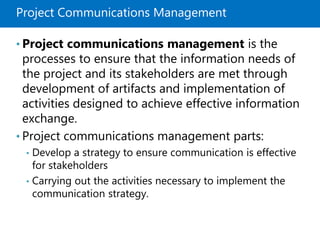
Project Communications Management
• Project communications management is the
processes to ensure that the information needs of
the project and its stakeholders are met through
development of artifacts and implementation of
activities designed to achieve effective information
exchange.
• Project communications management parts:
• Develop a strategy to ensure communication is effective
for stakeholders
• Carrying out the activities necessary to implement the
communication strategy.
Project Communications Management Processes
• Plan Communications Management
• Manage Communications
• Monitor Communications
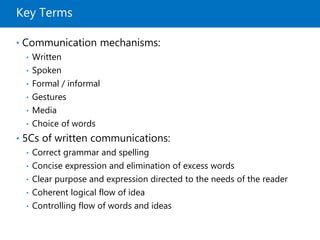
Key Terms
• Communication mechanisms:
• Written
• Spoken
• Formal / informal
• Gestures
• Media
• Choice of words
• 5Cs of written communications:
• Correct grammar and spelling
• Concise expression and elimination of excess words
• Clear purpose and expression directed to the needs of the reader
• Coherent logical flow of idea
• Controlling flow of words and ideas
Key Terms (continued)
• Communications skills:
• Listening actively
• Awareness of cultural and personal differences
• Identifying, setting, and managing stakeholder expectations
• Enhancement of skills
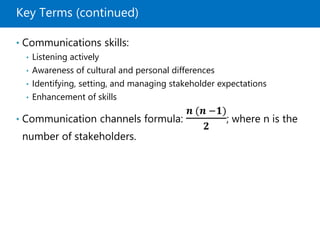
• Communication channels formula:
𝒏 (𝒏 −𝟏)
𝟐
; where n is the
number of stakeholders.
Key Terms (continued)
• Project report types:
• Status report
• Progress report
• Trend report
• Forecasting report
• Variance report
• Earned value report
• Lessons learned documentation
Trends & Emerging Practices
• Inclusion of stakeholders in project reviews
• Inclusion of stakeholders in project meetings
• Increased use of social computing
• Multifaceted approaches to communications
Tailoring Considerations
• Stakeholders
• Physical location
• Communications technology
• Language
• Knowledge management
Considerations for Adaptive Environments
• Communication occurs more frequently and
quickly.
• Streamlining team members access to
information.
• Frequent team checkpoints.
• Co-locating team members.
• Posting project artifacts in transparent fashion.
• Regular stakeholder reviews.
Lesson 2: Plan Communications Management
• Plan Communications Management Overview
• Plan Communications Management Data Flow
• Plan Communications Management Input
• Plan Communications Management Tools &
Technique
• Plan Communications Management Output
Plan Communications Management Overview
• Plan communications management is the
process of developing an appropriate approach
and plan for project communication activities
based on the information needs of each
stakeholder or group, available organizational
assets, and the needs of the project.
• Key benefit: a documented approach to effectively
and efficiently engage stakeholders by presenting
relevant information in a timely fashion.
Plan Communications Management Data Flow
Plan Communications Management Input
• Project charter
• Project management plan
• Resource management plan
• Stakeholder engagement plan
• Project documents
• Requirements documentation
• Stakeholder register
• Enterprise environmental factors
• Organizational process assets
Plan Communications Management Tools &
Techniques
• Expert judgment
• Communication
requirements analysis
• Communication technology
• Communication models
• Basic sender/receiver
• Interactive
• Communication methods
• Interactive communication
• Push communication
• Pull communication
• Interpersonal and team skills
• Communication styles
assessment
• Political awareness
• Cultural awareness
• Data representation
• Stakeholder engagement
assessment matrix
• Meetings
Plan Communications Management Output
• Project management plan
• Communications management plan
• Project management plan updates
• Stakeholder engagement plan
• Project documents updates
• Project schedule
• Stakeholder register
Lesson 3: Manage Communications
• Manage Communications Overview
• Manage Communications Data Flow
• Manage Communications Input
• Manage Communications Tools & Techniques
• Manage Communications Output
Manage Communications Overview
• Manage communications is the process of
ensuring timely and appropriate collection,
creation, distribution, storage, retrieval,
management, monitoring, and the ultimate
disposition of project information.
• Key benefit: it enables an efficient and effective
information flow between the project team and
the stakeholders.
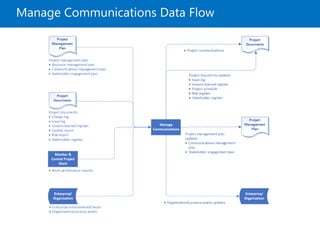
Manage Communications Data Flow
Manage Communications Input
• Project management plan
• Resource management plan
• Communications management
plan
• Stakeholder engagement plan
• Project documents
• Change log
• Issue log
• Lessons learned register
• Quality reports
• Risk report
• Stakeholder register
• Work performance reports
• Enterprise environmental
factors
• Organizational process
assets
Manage Communications Tools & Techniques
• Communication technology
• Communication methods
• Communication skills
• Project management information system
• Project reporting
• Interpersonal and team skills
• Active listening
• Conflict management
• Cultural awareness
• Meeting management
• Networking
• Political awareness
• Meetings
Manage Communications Output
• Project documents
• Project communications
• Project management plan updates
• Communications management plan
• Stakeholder engagement plan
• Project documents updates
• Issue log
• Lessons learned register
• Project schedule
• Risk register
• Stakeholder register
• Organizational process assets updates
Lesson 4: Monitor Communications
• Monitor Communications Overview
• Monitor Communications Data Flow
• Monitor Communications Input
• Monitor Communications Tools & Techniques
• Monitor Communications Output
Monitor Communications Overview
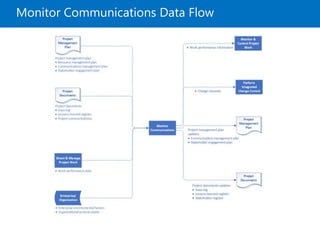
• Monitor communications is the process of
ensuring the information needs of the project and
its stakeholders are met.
• Key benefit: optimal information flow as defined in
the communications management plan and the
stakeholder engagement plan.
Monitor Communications Data Flow
Monitor Communications Input
• Project management plan
• Resource management plan
• Communications management plan
• Stakeholder engagement plan
• Project documents
• Issue log
• Lessons learned register
• Project communications
• Work performance data
• Enterprise environmental factors
• Organizational process assets
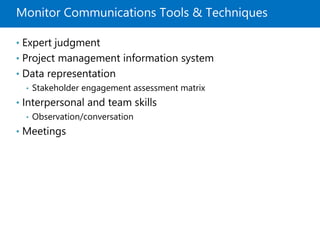
Monitor Communications Tools & Techniques
• Expert judgment
• Project management information system
• Data representation
• Stakeholder engagement assessment matrix
• Interpersonal and team skills
• Observation/conversation
• Meetings
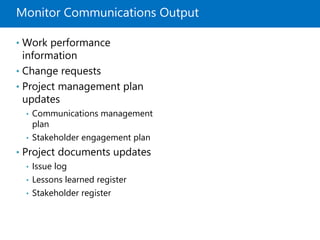
Monitor Communications Output
• Work performance
information
• Change requests
• Project management plan
updates
• Communications management
plan
• Stakeholder engagement plan
• Project documents updates
• Issue log
• Lessons learned register
• Stakeholder register
Quiz
Module Reviews
References
• [PMBOK6] – The PMBOK 6th edition from pmi.org
• [RITA9] – Rita Mulcahy’s PMP Exam Prep 9th
edition from RMC Publications™

Project Communications Management - PMBOK6

  • 1.
  • 2.
    Module Overview • Lesson1: Key Concepts & Terms • Lesson 2: Plan Communications Management • Lesson 3: Manage Communications • Lesson 4: Monitor Communications
  • 3.
    Lesson 1: KeyConcepts & Terms • Project Communications Management • Project Communications Management Processes • Key Terms • Trends & Emerging Practices • Tailoring Considerations • Considerations for Adaptive Environment
  • 4.
    Project Communications Management •Project communications management is the processes to ensure that the information needs of the project and its stakeholders are met through development of artifacts and implementation of activities designed to achieve effective information exchange. • Project communications management parts: • Develop a strategy to ensure communication is effective for stakeholders • Carrying out the activities necessary to implement the communication strategy.
  • 5.
    Project Communications ManagementProcesses • Plan Communications Management • Manage Communications • Monitor Communications
  • 6.
    Key Terms • Communicationmechanisms: • Written • Spoken • Formal / informal • Gestures • Media • Choice of words • 5Cs of written communications: • Correct grammar and spelling • Concise expression and elimination of excess words • Clear purpose and expression directed to the needs of the reader • Coherent logical flow of idea • Controlling flow of words and ideas
  • 7.
    Key Terms (continued) •Communications skills: • Listening actively • Awareness of cultural and personal differences • Identifying, setting, and managing stakeholder expectations • Enhancement of skills • Communication channels formula: 𝒏 (𝒏 −𝟏) 𝟐 ; where n is the number of stakeholders.
  • 8.
    Key Terms (continued) •Project report types: • Status report • Progress report • Trend report • Forecasting report • Variance report • Earned value report • Lessons learned documentation
  • 9.
    Trends & EmergingPractices • Inclusion of stakeholders in project reviews • Inclusion of stakeholders in project meetings • Increased use of social computing • Multifaceted approaches to communications
  • 10.
    Tailoring Considerations • Stakeholders •Physical location • Communications technology • Language • Knowledge management
  • 11.
    Considerations for AdaptiveEnvironments • Communication occurs more frequently and quickly. • Streamlining team members access to information. • Frequent team checkpoints. • Co-locating team members. • Posting project artifacts in transparent fashion. • Regular stakeholder reviews.
  • 12.
    Lesson 2: PlanCommunications Management • Plan Communications Management Overview • Plan Communications Management Data Flow • Plan Communications Management Input • Plan Communications Management Tools & Technique • Plan Communications Management Output
  • 13.
    Plan Communications ManagementOverview • Plan communications management is the process of developing an appropriate approach and plan for project communication activities based on the information needs of each stakeholder or group, available organizational assets, and the needs of the project. • Key benefit: a documented approach to effectively and efficiently engage stakeholders by presenting relevant information in a timely fashion.
  • 14.
  • 15.
    Plan Communications ManagementInput • Project charter • Project management plan • Resource management plan • Stakeholder engagement plan • Project documents • Requirements documentation • Stakeholder register • Enterprise environmental factors • Organizational process assets
  • 16.
    Plan Communications ManagementTools & Techniques • Expert judgment • Communication requirements analysis • Communication technology • Communication models • Basic sender/receiver • Interactive • Communication methods • Interactive communication • Push communication • Pull communication • Interpersonal and team skills • Communication styles assessment • Political awareness • Cultural awareness • Data representation • Stakeholder engagement assessment matrix • Meetings
  • 17.
    Plan Communications ManagementOutput • Project management plan • Communications management plan • Project management plan updates • Stakeholder engagement plan • Project documents updates • Project schedule • Stakeholder register
  • 18.
    Lesson 3: ManageCommunications • Manage Communications Overview • Manage Communications Data Flow • Manage Communications Input • Manage Communications Tools & Techniques • Manage Communications Output
  • 19.
    Manage Communications Overview •Manage communications is the process of ensuring timely and appropriate collection, creation, distribution, storage, retrieval, management, monitoring, and the ultimate disposition of project information. • Key benefit: it enables an efficient and effective information flow between the project team and the stakeholders.
  • 20.
  • 21.
    Manage Communications Input •Project management plan • Resource management plan • Communications management plan • Stakeholder engagement plan • Project documents • Change log • Issue log • Lessons learned register • Quality reports • Risk report • Stakeholder register • Work performance reports • Enterprise environmental factors • Organizational process assets
  • 22.
    Manage Communications Tools& Techniques • Communication technology • Communication methods • Communication skills • Project management information system • Project reporting • Interpersonal and team skills • Active listening • Conflict management • Cultural awareness • Meeting management • Networking • Political awareness • Meetings
  • 23.
    Manage Communications Output •Project documents • Project communications • Project management plan updates • Communications management plan • Stakeholder engagement plan • Project documents updates • Issue log • Lessons learned register • Project schedule • Risk register • Stakeholder register • Organizational process assets updates
  • 24.
    Lesson 4: MonitorCommunications • Monitor Communications Overview • Monitor Communications Data Flow • Monitor Communications Input • Monitor Communications Tools & Techniques • Monitor Communications Output
  • 25.
    Monitor Communications Overview •Monitor communications is the process of ensuring the information needs of the project and its stakeholders are met. • Key benefit: optimal information flow as defined in the communications management plan and the stakeholder engagement plan.
  • 26.
  • 27.
    Monitor Communications Input •Project management plan • Resource management plan • Communications management plan • Stakeholder engagement plan • Project documents • Issue log • Lessons learned register • Project communications • Work performance data • Enterprise environmental factors • Organizational process assets
  • 28.
    Monitor Communications Tools& Techniques • Expert judgment • Project management information system • Data representation • Stakeholder engagement assessment matrix • Interpersonal and team skills • Observation/conversation • Meetings
  • 29.
    Monitor Communications Output •Work performance information • Change requests • Project management plan updates • Communications management plan • Stakeholder engagement plan • Project documents updates • Issue log • Lessons learned register • Stakeholder register
  • 30.
  • 31.
  • 32.
    References • [PMBOK6] –The PMBOK 6th edition from pmi.org • [RITA9] – Rita Mulcahy’s PMP Exam Prep 9th edition from RMC Publications™

Editor's Notes

  • #2 Presentation: 80 minutes Lab: 90 minutes After completing this module, students will be able to: Describe the architectural features of Microsoft SharePoint 2016. Identify new, deprecated, and removed features in SharePoint 2016. Describe the editions for SharePoint 2016 on-premises and Microsoft SharePoint Online. Required materials To teach this module, you need the Microsoft PowerPoint file 20339-2A_01.pptx. Preparation tasks To prepare for this module: Read all of the materials for this module. Practice performing the demonstrations and labs. Work through the Module Review and Takeaways section, and determine how you will use the information to reinforce student learning and promote knowledge transfer to on-the-job performance. As you prepare for this class, it is imperative that you complete the labs yourself. This gives you an understanding of how the labs work and the concepts that each covers, so that you can provide meaningful hints to students who might have issues. Furthermore, it will help guide your lecture to ensure that you discuss the concepts that the labs cover. Ask the students to start 20339-2A-NYC-DC1-A at this point, as per step 1 of the Lab.