MSHU TODAY

        Svitlana O. Volkova, PhD. student


Medical Equipment and Systems Department


   Mykolaiv State Humanities University


    svetik11@kma.mk.ua       sveter11@yandex.ru
Petro Mohyla Mykolayiv
      State University

       in consortium
with “Kyiv-Mohyla Academy”
The Mykolayiv City
Mykolaiv is situated in the South of Ukraine, near the
Black Sea. For more than 200 years, it has been one of
the great centers of shipbuilding and military industry in
the world.
However, during the Soviet era it was closed to
foreigners, which accounts for the lack of knowledge of
our city abroad.
Mykolayiv landscapes


Today, there are 4 state universities and 20
branches of universities in Mykolayiv.
Mykolayiv region seaside


Five hundred thousand people live in Mykolayiv
itself and more than 1,2 million people in
Mykolayiv oblast.
Mykolaiv Petro Mohyla State Humanities University
        in consortium with “Kyiv-Mohyla Academy”
   is one of Ukrainian university in the southern region
 that uses Western educational technologies extensively.
We strive to combine them with our own national traditions.
Petro Mohyla Mykolaiv State Humanities University
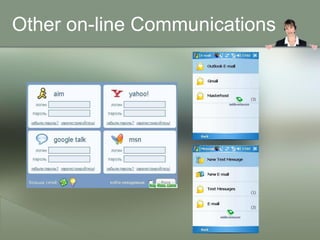
    in consortium with “Kyiv-Mohyla Academy”


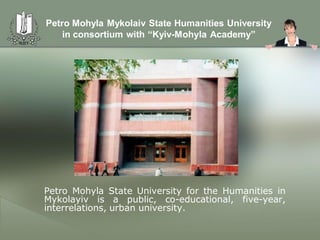
Petro Mohyla State University for the Humanities in
Mykolayiv is a public, co-educational, five-year,
interrelations, urban university.
Petro Mohyla Mykolaiv State Humanities University
    in consortium with “Kyiv-Mohyla Academy”

Giving education to about 3000 full-time
students, we are dedicated to the belief that
university education should be universal,
therefore we develop Liberal Arts Education,
which provides the foundation for intellectual,
social and professional growth of each
individual student.
MODERN TOOLS OF COMMUNICATION
FOR IT-PROJECT MANAGEMENT PROCESS:
       PRACTICE OF ADAPTATION
Agenda
• Problem Statement
      • Organization of Communication
      • Necessity of Applying Communications
      • Communication Channels an Phase
• Communication Planning
      • Communications Matrix
      • Relational Model: Project Communications
• Communications Tools
      • Phone Communication
      • E-mail Communication
      • On-line Communication
• Messengers Review
• IT Project Interactive Communications
• Conclusions and Useful Links
Problem Statement


• Today’s leading companies in the field of information
  technologies begin to create their branches in regions. They
  are specialized in software development and testing, technical
  support of software products and information consulting.

• It is mainly explained by the less cost of labors in regions,
  than in large towns, and supplying of regions by graduated
  students with higher education with the high level of
  preparation in the field of information technologies.
Problems of Communications
• One of the reasons that decrease effectiveness of work of such
  virtual, territorial distributed projects commands is a
  geographical remoteness between participants, divergence of
  zones of times, and in the case of international commands
  linguistic and social-cultural factors.

• Problems of providing an effective communications and
  firmness to the nascent conflicts in IT projects together with
  inadequacy of project information are three from six major
  reasons of failure of projects.

• That’s why the task in relation to the synthesis of organization
  of communication process in a management IT-projects by the
  modern means of business intercourse with the use of
  progressive information technologies and search of facilities of
  design of situational relations is actual.
Organization of Communications
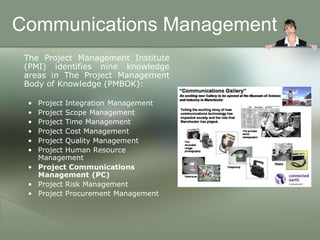
Communications Management
 The Project Management Institute
 (PMI) identifies nine knowledge
 areas in The Project Management
 Body of Knowledge (PMBOK):

 • Project Integration Management
 • Project Scope Management
 • Project Time Management
 • Project Cost Management
 • Project Quality Management
 • Project Human Resource
   Management
 • Project Communications
   Management (PC)
 • Project Risk Management
 • Project Procurement Management
Project Communications
 • Project Communications Management includes the
   processes required to ensure timely and appropriate
   generation, collection, distribution, storage, retrieval and
   ultimate disposition of project information.

 • The Project Communications Management processes
   provide the critical links among people and information
   that are necessary for successful
                       Communications. (PMBOK Third Edition, p. 340)

 • Project Communications includes:

    • Communications Planning
    • Information Distribution
    • Performance Reporting
Necessity of Applying Communications

• IT responsibilities are not consistent

• IT relationships with application
  users not always consistent

• Implementation of systems at the
  local level may require political
  approval prior to use

• Funding      issues   may      require
  significant lead time

• Change      management       can    be
  complex
Communication Channels
Communications by Phase
1. Project Initiation
   • Develop Communications
     Plan

2. Project Planning
   • Refine Communications
     Plan

3. Project Execution & Control
   • Execute Communications
     Plan

4. Project Closeout
   • Solicit Feedback
Communications Planning


  • Who?     Who needs to know?

  • What?    What do they need to know?

  • When?    How frequently?

  • Where?   Where are communications required?

  • Why?     Why is this important?

  • How?     How are they kept informed?
What?                              Who?

• Tendency to send too      • Did you think of everyone?
  much to too many -
  very easy to do with      • If you are designing an
  electronic                  application in this project,
  communications! Too         have you included the end-
  much is as bad as too       users in the early project
  little - can't read         communications?
  everything.

                            • If your end-user works for
• Target your audiences -     another organization have
  and realize you may         you also kept the IT people
  have more than one.         in those entities informed?
When?                   Why?
• How often?                • Curiosity? Good/bad?
   • Morning &              • Need to know?
     afternoon?
   • Day of week?           • Provide information

   • Day of month?
                            • Prepare end-users for
                              transition
• Different intervals for
  various teams
                            • Many reasons to share
   • Weekly for team          information
     members
   • Bi-weekly for
     Middleman
   • Monthly for
Where?                            How?
• Location for status meetings   • Emails

• Location for team meetings     • Status reports

• Locations for information:     • Phone calls
  Network drive, website,
  internal or external, e-mail   • Meetings
  attachments, e-mail text

                                 • Face to face, one on one

                                 • Press release

                                 • Other?
Tools: Communications Matrix


Audience   All, Part of Team etc.
Vehicle    Conversation, Report etc.
Frequency Monthly, Scope change etc.
Medium     Meeting, Hard Copy etc.


                            Source            PM, Weakly Report etc.
                            Delivery by       Team, PM, Customer etc.
                            Date delivered    As needed, every month etc.
                            Expected Result   Business impact of project etc.
Relational Model: Project Communications
Discussion of Communication Model

• It is expedient to describe the hierarchy of connections
  as follows:
• participants of the project
      –> technical leaders of groups
         –> leader of the project
              –> middleman
                 –> customer.

• Wide possibilities of the language of set theory allows
  to describe the presented model:
Discussion of Communication Model

• The types of possible models were explored and defined that
  relational model of organization of communications in the
  process of management of IT projects.

• It is the complete visualized state of project and contains
  consequence relation and determines dynamic changes
  between the participants of project during its motion.

• A developed model structure demonstrates the process of
  organization’s communications of workers of a company’s
  branch with guidance of main office and directly with
  customers which in the turn can be on other continent.

• The main task is providing of connection of technical leader
  (TL) of project which works in the branch of company with the
  leader of project (PM), which is in a main office and with the
  customers of software product or representatives of
  customers.
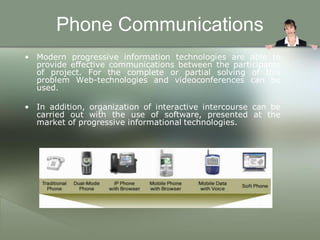
Phone Communications
• Modern progressive information technologies are able to
  provide effective communications between the participants
  of project. For the complete or partial solving of this
  problem Web-technologies and videoconferences can be
  used.

• In addition, organization of interactive intercourse can be
  carried out with the use of software, presented at the
  market of progressive informational technologies.
IP-Phone organization


• On functionality and principle of work it is possible to divide the
  programs into the network pagers, IRC-chats, Web-chats and
  combined programs on-line intercourses which allow holding
  conferences with the participants of project and communicating with
  the use of IP telephony.
E-mail Communications
E-mail Communication Tools:


     The Bat
     Evolutional Mail
     Etc.
Basic recommendations:

• Create the message
   • Timely
   • Accurate
   • As defined
• Deliver the message

• Accept feedback as input
On-line Communications


 •   Yahoo Messenger (http://messenger.yahoo.com),
 •   MSN Messenger (http://messenger.msn.com/),
 •   Mіranda. (http://mіranda-іcq.sourceforge.net),
 •   ІRC (http://www.mіrc.com/),
 •   RQ (www.rejetto.com/&RQ) and others.
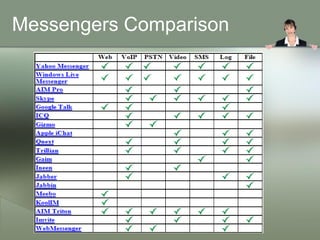
Basic Features of Messengers
• Status Indicator           • Support of video
                               communications
• Contact List                 (Web-camera)

• Chat                       • Support of usual telephone
                               calls (PSTN)
• Chat History (Log)
                             • Files transmission (File)

• Integrity with others      • Sending SMS (SMS)
  IM-networks (Int)
                             • Pictures or desktop
• Conferences organization     Translation

• IP-Phohing (VoIP)          • Support of secure
                               connection
Messengers Comparison
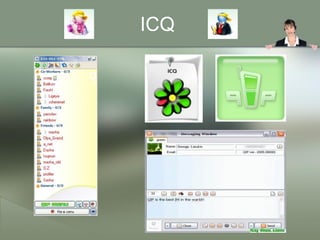
ICQ
Miranda
Skype
Skype Contact List
Yahoo Messenger
Other on-line Communications
IT Project Communications

• Interactive communication and exchange with project documents
  with data that updated dynamically is carried out with the use of
  such software:

    software testing process control system (TestLink, RUP);

    reporting system about defects (Bugzilla, Trac, Mantis);

    system of testing results accounting (ProjectLocker, QADB);

    on-line communicational systems (Skype, ICQ, Yahoo);

    system of organization of correspondence (Outlook Express,
     Bat etc.).
Comparison of Communications
Conclusions

• Developed relational model
  describes the main principles
  of   organization   continuous
  communication in the process
  of IT-project management and
  provides the use of modern IT.

• It also provides the economy
  of project’s facilities and warns
  of rising conflict situations on
  project.
For further information
Useful Links:

•   NYS Project Management Guidebook
     • www.oft.state.ny.us/pmmp/guidebook2/index. htm

•   Management's Guide to Project Success
     • www.oft.state.ny.us/pmmp/managementguide/index.htm

•   Reference The Project Management Institute (PMI) PMBOK:
     • www.pmi.org

Literature:

    • Project Management Body of Knowledge, 3 Ed. PM institute, 2004.

    • Nickson D., Siddons S. Project Disasters & How to Survive Them,
      2005

    • Kerzner H. Project Management: A Systems Approach to Planning,
      Scheduling, and Controlling, Eighth Edition. John Wiley & Sons, 2003
Useful links
•   http://www.manager.net.ua/index.php?option=com_weblinks&task=view
                                 &catid=90&id=47
    The STSC provides hands-on assistance in adopting effective technologies for
    software-intensive systems. We help organizations identify, evaluate and adopt
    technologies that improve software product quality, production efficiency and
    predictability.

•   http://www.manager.net.ua/index.php?option=com_weblinks&task=view
                                    &catid=90&id=46
    StickyMinds.com, the most comprehensive online resource for helping you produce
    better software, offers an unrivaled scope of original articles from industry experts,
    technical papers, industry news, a searchable tools and books guide, roundtables.
•
    http://www.manager.net.ua/index.php?option=com_weblinks&task=view
                                     &catid=90&id=45
    We have consulted with many Fortune 500 companies and international companies
    across a wide range of industries. This not only confirms our position as a market
    leader, but also attests to the wealth of experience we bring to any engagement.

•   http://www.manager.net.ua/index.php?option=com_weblinks&task=view
                                   &catid=90&id=44
    The Software Engineering Institute (SEI) is a federally funded research and
    development center sponsored by the U.S. Department of Defense through the
    Office of the Under Secretary of Defense for Acquisition, Technology, and Logistics
    [OUSD (AT&L)].
•
    http://www.manager.net.ua/index.php?option=com_weblinks&task=view
                                   &catid=90&id=43
    Sciforma Corporation provides advanced project and process management software
Useful links
•   http://www.manager.net.ua/index.php?option=com_weblinks&task=view&catid=90&
                                                  id=47
    The STSC provides hands-on assistance in adopting effective technologies for software-intensive
    systems. We help organizations identify, evaluate and adopt technologies that improve software
    product quality, production efficiency and predictability.

•   http://www.manager.net.ua/index.php?option=com_weblinks&task=view&catid=90&
                                                 id=46
    StickyMinds.com, the most comprehensive online resource for helping you produce better
    software, offers an unrivaled scope of original articles from industry experts, technical papers,
    industry news, a searchable tools and books guide, roundtables.

•   http://www.manager.net.ua/index.php?option=com_weblinks&task=view&catid=90&
                                                  id=45
    We have consulted with many Fortune 500 companies and international companies across a wide
    range of industries. This not only confirms our position as a market leader, but also attests to the
    wealth of experience we bring to any engagement.

•   http://www.manager.net.ua/index.php?option=com_weblinks&task=view&catid=90&
                                                 id=44
    The Software Engineering Institute (SEI) is a federally funded research and development center
    sponsored by the U.S. Department of Defense through the Office of the Under Secretary of
    Defense for Acquisition, Technology, and Logistics [OUSD (AT&L)].

•   http://www.manager.net.ua/index.php?option=com_weblinks&task=view&catid=90&
                                               id=43
    Sciforma Corporation provides advanced project and process management software solutions and
    services to a worldwide customer base.

•   http://www.manager.net.ua/index.php?option=com_weblinks&task=view&catid=90&
                                                 id=42
    ProjectsAtWork.com features project case studies, interviews and interactive discussions, new
    tools and book reviews, expert columns and much more — it is editorial that addresses the
    challenges and issues that project teams and professionals face.

Communications Ternopil

  • 1.
    MSHU TODAY Svitlana O. Volkova, PhD. student Medical Equipment and Systems Department Mykolaiv State Humanities University svetik11@kma.mk.ua sveter11@yandex.ru
  • 2.
    Petro Mohyla Mykolayiv State University in consortium with “Kyiv-Mohyla Academy”
  • 3.
    The Mykolayiv City Mykolaivis situated in the South of Ukraine, near the Black Sea. For more than 200 years, it has been one of the great centers of shipbuilding and military industry in the world. However, during the Soviet era it was closed to foreigners, which accounts for the lack of knowledge of our city abroad.
  • 4.
    Mykolayiv landscapes Today, thereare 4 state universities and 20 branches of universities in Mykolayiv.
  • 5.
    Mykolayiv region seaside Fivehundred thousand people live in Mykolayiv itself and more than 1,2 million people in Mykolayiv oblast.
  • 6.
    Mykolaiv Petro MohylaState Humanities University in consortium with “Kyiv-Mohyla Academy” is one of Ukrainian university in the southern region that uses Western educational technologies extensively. We strive to combine them with our own national traditions.
  • 7.
    Petro Mohyla MykolaivState Humanities University in consortium with “Kyiv-Mohyla Academy” Petro Mohyla State University for the Humanities in Mykolayiv is a public, co-educational, five-year, interrelations, urban university.
  • 8.
    Petro Mohyla MykolaivState Humanities University in consortium with “Kyiv-Mohyla Academy” Giving education to about 3000 full-time students, we are dedicated to the belief that university education should be universal, therefore we develop Liberal Arts Education, which provides the foundation for intellectual, social and professional growth of each individual student.
  • 9.
    MODERN TOOLS OFCOMMUNICATION FOR IT-PROJECT MANAGEMENT PROCESS: PRACTICE OF ADAPTATION
  • 10.
    Agenda • Problem Statement • Organization of Communication • Necessity of Applying Communications • Communication Channels an Phase • Communication Planning • Communications Matrix • Relational Model: Project Communications • Communications Tools • Phone Communication • E-mail Communication • On-line Communication • Messengers Review • IT Project Interactive Communications • Conclusions and Useful Links
  • 11.
    Problem Statement • Today’sleading companies in the field of information technologies begin to create their branches in regions. They are specialized in software development and testing, technical support of software products and information consulting. • It is mainly explained by the less cost of labors in regions, than in large towns, and supplying of regions by graduated students with higher education with the high level of preparation in the field of information technologies.
  • 12.
    Problems of Communications •One of the reasons that decrease effectiveness of work of such virtual, territorial distributed projects commands is a geographical remoteness between participants, divergence of zones of times, and in the case of international commands linguistic and social-cultural factors. • Problems of providing an effective communications and firmness to the nascent conflicts in IT projects together with inadequacy of project information are three from six major reasons of failure of projects. • That’s why the task in relation to the synthesis of organization of communication process in a management IT-projects by the modern means of business intercourse with the use of progressive information technologies and search of facilities of design of situational relations is actual.
  • 13.
  • 14.
    Communications Management TheProject Management Institute (PMI) identifies nine knowledge areas in The Project Management Body of Knowledge (PMBOK): • Project Integration Management • Project Scope Management • Project Time Management • Project Cost Management • Project Quality Management • Project Human Resource Management • Project Communications Management (PC) • Project Risk Management • Project Procurement Management
  • 15.
    Project Communications •Project Communications Management includes the processes required to ensure timely and appropriate generation, collection, distribution, storage, retrieval and ultimate disposition of project information. • The Project Communications Management processes provide the critical links among people and information that are necessary for successful Communications. (PMBOK Third Edition, p. 340) • Project Communications includes: • Communications Planning • Information Distribution • Performance Reporting
  • 16.
    Necessity of ApplyingCommunications • IT responsibilities are not consistent • IT relationships with application users not always consistent • Implementation of systems at the local level may require political approval prior to use • Funding issues may require significant lead time • Change management can be complex
  • 17.
  • 18.
    Communications by Phase 1.Project Initiation • Develop Communications Plan 2. Project Planning • Refine Communications Plan 3. Project Execution & Control • Execute Communications Plan 4. Project Closeout • Solicit Feedback
  • 19.
    Communications Planning • Who? Who needs to know? • What? What do they need to know? • When? How frequently? • Where? Where are communications required? • Why? Why is this important? • How? How are they kept informed?
  • 20.
    What? Who? • Tendency to send too • Did you think of everyone? much to too many - very easy to do with • If you are designing an electronic application in this project, communications! Too have you included the end- much is as bad as too users in the early project little - can't read communications? everything. • If your end-user works for • Target your audiences - another organization have and realize you may you also kept the IT people have more than one. in those entities informed?
  • 21.
    When? Why? • How often? • Curiosity? Good/bad? • Morning & • Need to know? afternoon? • Day of week? • Provide information • Day of month? • Prepare end-users for transition • Different intervals for various teams • Many reasons to share • Weekly for team information members • Bi-weekly for Middleman • Monthly for
  • 22.
    Where? How? • Location for status meetings • Emails • Location for team meetings • Status reports • Locations for information: • Phone calls Network drive, website, internal or external, e-mail • Meetings attachments, e-mail text • Face to face, one on one • Press release • Other?
  • 23.
    Tools: Communications Matrix Audience All, Part of Team etc. Vehicle Conversation, Report etc. Frequency Monthly, Scope change etc. Medium Meeting, Hard Copy etc. Source PM, Weakly Report etc. Delivery by Team, PM, Customer etc. Date delivered As needed, every month etc. Expected Result Business impact of project etc.
  • 24.
  • 25.
    Discussion of CommunicationModel • It is expedient to describe the hierarchy of connections as follows: • participants of the project –> technical leaders of groups –> leader of the project –> middleman –> customer. • Wide possibilities of the language of set theory allows to describe the presented model:
  • 26.
    Discussion of CommunicationModel • The types of possible models were explored and defined that relational model of organization of communications in the process of management of IT projects. • It is the complete visualized state of project and contains consequence relation and determines dynamic changes between the participants of project during its motion. • A developed model structure demonstrates the process of organization’s communications of workers of a company’s branch with guidance of main office and directly with customers which in the turn can be on other continent. • The main task is providing of connection of technical leader (TL) of project which works in the branch of company with the leader of project (PM), which is in a main office and with the customers of software product or representatives of customers.
  • 27.
    Phone Communications • Modernprogressive information technologies are able to provide effective communications between the participants of project. For the complete or partial solving of this problem Web-technologies and videoconferences can be used. • In addition, organization of interactive intercourse can be carried out with the use of software, presented at the market of progressive informational technologies.
  • 28.
    IP-Phone organization • Onfunctionality and principle of work it is possible to divide the programs into the network pagers, IRC-chats, Web-chats and combined programs on-line intercourses which allow holding conferences with the participants of project and communicating with the use of IP telephony.
  • 29.
    E-mail Communications E-mail CommunicationTools: The Bat Evolutional Mail Etc. Basic recommendations: • Create the message • Timely • Accurate • As defined • Deliver the message • Accept feedback as input
  • 30.
    On-line Communications • Yahoo Messenger (http://messenger.yahoo.com), • MSN Messenger (http://messenger.msn.com/), • Mіranda. (http://mіranda-іcq.sourceforge.net), • ІRC (http://www.mіrc.com/), • RQ (www.rejetto.com/&RQ) and others.
  • 31.
    Basic Features ofMessengers • Status Indicator • Support of video communications • Contact List (Web-camera) • Chat • Support of usual telephone calls (PSTN) • Chat History (Log) • Files transmission (File) • Integrity with others • Sending SMS (SMS) IM-networks (Int) • Pictures or desktop • Conferences organization Translation • IP-Phohing (VoIP) • Support of secure connection
  • 32.
  • 33.
  • 34.
  • 35.
  • 36.
  • 37.
  • 38.
  • 39.
    IT Project Communications •Interactive communication and exchange with project documents with data that updated dynamically is carried out with the use of such software:  software testing process control system (TestLink, RUP);  reporting system about defects (Bugzilla, Trac, Mantis);  system of testing results accounting (ProjectLocker, QADB);  on-line communicational systems (Skype, ICQ, Yahoo);  system of organization of correspondence (Outlook Express, Bat etc.).
  • 40.
  • 41.
    Conclusions • Developed relationalmodel describes the main principles of organization continuous communication in the process of IT-project management and provides the use of modern IT. • It also provides the economy of project’s facilities and warns of rising conflict situations on project.
  • 43.
    For further information UsefulLinks: • NYS Project Management Guidebook • www.oft.state.ny.us/pmmp/guidebook2/index. htm • Management's Guide to Project Success • www.oft.state.ny.us/pmmp/managementguide/index.htm • Reference The Project Management Institute (PMI) PMBOK: • www.pmi.org Literature: • Project Management Body of Knowledge, 3 Ed. PM institute, 2004. • Nickson D., Siddons S. Project Disasters & How to Survive Them, 2005 • Kerzner H. Project Management: A Systems Approach to Planning, Scheduling, and Controlling, Eighth Edition. John Wiley & Sons, 2003
  • 44.
    Useful links • http://www.manager.net.ua/index.php?option=com_weblinks&task=view &catid=90&id=47 The STSC provides hands-on assistance in adopting effective technologies for software-intensive systems. We help organizations identify, evaluate and adopt technologies that improve software product quality, production efficiency and predictability. • http://www.manager.net.ua/index.php?option=com_weblinks&task=view &catid=90&id=46 StickyMinds.com, the most comprehensive online resource for helping you produce better software, offers an unrivaled scope of original articles from industry experts, technical papers, industry news, a searchable tools and books guide, roundtables. • http://www.manager.net.ua/index.php?option=com_weblinks&task=view &catid=90&id=45 We have consulted with many Fortune 500 companies and international companies across a wide range of industries. This not only confirms our position as a market leader, but also attests to the wealth of experience we bring to any engagement. • http://www.manager.net.ua/index.php?option=com_weblinks&task=view &catid=90&id=44 The Software Engineering Institute (SEI) is a federally funded research and development center sponsored by the U.S. Department of Defense through the Office of the Under Secretary of Defense for Acquisition, Technology, and Logistics [OUSD (AT&L)]. • http://www.manager.net.ua/index.php?option=com_weblinks&task=view &catid=90&id=43 Sciforma Corporation provides advanced project and process management software
  • 45.
    Useful links • http://www.manager.net.ua/index.php?option=com_weblinks&task=view&catid=90& id=47 The STSC provides hands-on assistance in adopting effective technologies for software-intensive systems. We help organizations identify, evaluate and adopt technologies that improve software product quality, production efficiency and predictability. • http://www.manager.net.ua/index.php?option=com_weblinks&task=view&catid=90& id=46 StickyMinds.com, the most comprehensive online resource for helping you produce better software, offers an unrivaled scope of original articles from industry experts, technical papers, industry news, a searchable tools and books guide, roundtables. • http://www.manager.net.ua/index.php?option=com_weblinks&task=view&catid=90& id=45 We have consulted with many Fortune 500 companies and international companies across a wide range of industries. This not only confirms our position as a market leader, but also attests to the wealth of experience we bring to any engagement. • http://www.manager.net.ua/index.php?option=com_weblinks&task=view&catid=90& id=44 The Software Engineering Institute (SEI) is a federally funded research and development center sponsored by the U.S. Department of Defense through the Office of the Under Secretary of Defense for Acquisition, Technology, and Logistics [OUSD (AT&L)]. • http://www.manager.net.ua/index.php?option=com_weblinks&task=view&catid=90& id=43 Sciforma Corporation provides advanced project and process management software solutions and services to a worldwide customer base. • http://www.manager.net.ua/index.php?option=com_weblinks&task=view&catid=90& id=42 ProjectsAtWork.com features project case studies, interviews and interactive discussions, new tools and book reviews, expert columns and much more — it is editorial that addresses the challenges and issues that project teams and professionals face.