Project Management


Responsible for Project
Management
 Jan Gulliksen, ”Gulan”
 Professor in Human Computer Interaction
 Dept. For IT/HCI, Uppsala university.
 Lägerhyddsvägen 2, house 1, room 153
 E-mail: Jan.Gulliksen@it.uu.se
 Phone: 018-471 2849
 (Forwarding to my mobile)


                                           1
Your task for the assignment:
 Goal: To make a website for the group and present
 its members – a certain amount of time is allocated
 Focus on project work
 Working in 6 groups of 5 persons
 Project milestones
   Today: Form the group and identify roles, goals and subtasks.
   Next time: Project meeting: Revise goals, decide on actions
   based on identified problems and risks
   Last time: Oral presentation and discussion of your projects
   (focus on project work and not so much on the result)
 Document the project in a report (on the web site)
 Continuous time reporting


Reporting time
 30 hours per student is expected to be dedicated to
 this project.
 3 mandatory lectures (makes out 6 hours)
 Plan disposal of your time carefully
 Allocate people to different roles and responsibilities
 to deliver specific results.
 Appoint one to be project manager
 Report your time on a continuous basis and follow
 up time consumption in relationship to the results


                                                                   2
How do I design a website?
 Where to put it?
 Technical solution?
 Make sure everyone can update it?
 Who is it aimed for? What are the goals with
 it?
   Present your group and its individuals
   If it is good you might continue to use it in the
   future
 Evaluation and reflections on the design of it.


Documentation and
assessment
 Document your work in an electronic report
 Document time on a continuous basis
 Logg what everybody does in order for you to be as
 efficient as possible
 Oral presentation of your project:
   Focus on project work, experiences on cooperation,
   allocation of time and assignments, organisation and goals
   Was it a successful project?
   Everybody should play an active part in the final
   presentation of the project (15 minutes per group)


                                                                3
Project management –
  basic concepts


What is a project?
 “Series of actions to achieve a result”


                                           4
Project management: History
 Already the Egyptians… (Crucifixion raids or east
 India trips were organized as projects, but without
 any management philosophy)
 1911 Taylorism/Scientific Management: Henry L
 Gantt invents the Gantt scheme
 1931: Karol Adamiecki creates the first network
 diagram, the so called Harmonogram
 1942-45: The Manhattan project (USA). 2 billion
 dollar turnover, at most 120.000 employees. Goal
 control, parallel activities
 1950ies: Operations analysis, RAND Corporation
 1957: The Sputnik chock, initiating the Polaris project


Project management: History
 The Polaris project: 250 main suppliers and 9000
 secondary suppliers coordinated to perform ca
 70.000 different activities using PERT (Program
 Evaluation and Review Technique).
 1956-59: CPM (Critical Path Method) is created at
 DuPont, independent of PERT.
   PERT and CPM are very similar and are both examples of
   network planning of projects
 1959: The concept of ”project manager” is coined in
 Harvard Business Review.
 1960ies: Great interest in matrix organizations
 1967: INTERNET (IPMA) and PMI is established.


                                                            5
Project management: History
  1968 The Nätplan interest group is created in
  Sverige (later to be named Svenskt Projektforum).
  1980ies: Increasing interest in organizational and
  project management issues in projects. The project
  philosophy spreads to other fields, to smaller
  activities and to internal activities.
  1987: PMBOK (Project Management Body of
  Knowledge) presents its first issue by PMI. The
  ambition to create certified project management, so
  called PMPs (Project Management Professionals).
  1990ies: Management by projects (the project based
  company)


Project: Definition
”Series of actions to achieve a result”
  Single occurrence – a unique, non-repetitive
  assignment
  Time limitations – with a pre-defined date of delivery
  Clear purpose – specified from one or more goals (well
  defined, measurable and realistic), do not mix project
  goals and effect goals
  Unpredictable structure – it consists of a number of
  complex activities with mutual interdependencies
  Own organisation – e.g. Not in the original line of work
  Procurer – internal or external acquirer that has
  expectations on the result


                                                             6
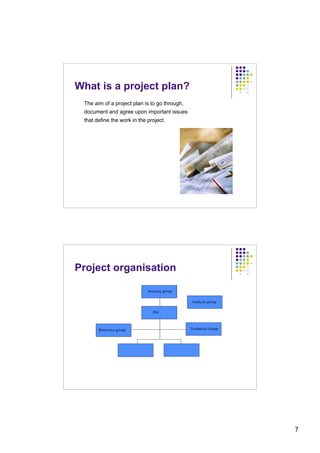
What is a project plan?
 The aim of a project plan is to go through,
 document and agree upon important issues
 that define the work in the project.


Project organisation


                                               7
Project Management: concepts
 System theory                    Time
 Project triangle


                        Cost             Quality

 Work Breakdown Structure (WBS)
 Gantt-scheme


Gantt schedule


                                                   8
Positive and negative things
 about a Gantt diagrams
                              Disadvantages
Advantages:
                                Things never turn out
                                the way we think
  Good for planning.
                                Time
  Good overview
                                Difficult to maintain
  Sequence of activities

  Easy to know who does
     what

  Better picture of project
     status


                                                        9
How do you calculate time?
 Have a good guess?
 Calculate?

    Guess at minimum (A),
    probably(B) and maximum
    (C)

    Calculate
       (A + 3B + C)/5


Information and
communication
Common problem in projects
  Lack of communication and structure is often a problem in
  projects
  Difficulty in involving the project members, the customer, the
  procurer and other stakeholders.


                                                                   10
Meeting and meeting
techniques
  To succeed it is necessary
  to have a goal with the
  meeting and an agenda.

  Meeting are necessary, but
  need to be efficient. A
  good way of organising is
  an agenda.


Different meetings
Steer group meetings
At milestones or when needed
Protocol written by PM

Project Management Meetings
Every Friday
Protocol written by PM

Project Meetings
Every second Monday
Protocol written by PM.


                               11
Information – reports at meetings
   Agenda

   Summary

   What has happened
     since last time?


   What happens next?

   Time plan

   Risks and options


Project risks


                             The only thing we
                             truly know about
                             the future is that
                             we do not know
                             anything about it.


                                                  12
Results from a risk analysis
 A list of risks in
 prioritized order
 Suggestions of how to
 eliminate, reduce or
 meet risks


Workflow in a Risk Analysis

 Use project idea and goal as starting point
   Make a list of risks and threats individually
   Make a common list
   Look for reasons for risk
   Make a risk calculation
     1) Likeliness that the risk might occur
     2) Effect of risk
   Make suggestions of ways to deal with the risk.
   Write a report
   Decide about what to do


                                                     13
Aspects not included in project
management perspective

 Motivation
 Joy to work together
 Group dynamics
 Creativity
 Spontaneity


  Standardized project
  management models


                                  14
Example 1: PROPS
 80% of Ericsson employees are involved in
 projects on a daily basis
 Three main project based processes:
 - Product development projects (Time to
 market)
 - Customer delivery projects (Time to
 customer)
 - Internal project (supporting processes)


PROPS
 Ericsson’s general model for all types of
 projects in the entire organization
 Are also used in organizations such as Saab,
 Telia, Statoil, etc.


                                                15
PROPS: A success story
 Based on best practices (internal and
 external)
 Is continuously being developed
 Has a special unit for support, development
 and training
 Information distribution among its users
 Strong management support
 3500 project managers, 150 project office
 managers, 100 PROPS coaches


And what is PROPS?
 Traditional project management method based on
 milestones/tollgates:

 TG 0. Initiating a pre study?
 TG 1. Shall a feasibility study be initiated?
 TG 2. Should the project be performed?
 TG 3. Shall the project continue with original or revised plans?
 TG 4. Shall the result be reported to the client?
 TG 5. Can the project be approved and a project summary report be
 made?


                                                                     16
Project   Work
                       model     model


PROPS
            Pre
                                         End
            study
                                         phase
            phase


            Analysis
            phase


                                              Toll
                                              gates
            Performance
            phase


                                              Mile
                                              stones


Four perspectives in PROPS
 The business perspective
 The human perspective
 The project organization perspective
 Project flow perspective

 All perspectives must be considered in all
 decision points/tollgates!


                                                       17
The business perspective

 Focus all efforts in the organization towards
 the same business goals,
 focus on the client,
 Focus on business profits
 Effective resource allocation


The human perspective

 The individuals in an organization are the
 organization’s most important resources. A
 mutual project culture with an understanding
 of team work and management, can liberate
 creativity and make use of the knowledge
 and experiences of all individuals.


                                                 18
The project organization
perspective
 Identifies the project stakeholders and participants
 and identifies their functions and roles in the project
 organization as well as each responsibilities. In
 addition to the project participants and the project
 manager PROPS identifies which role higher
 management in the line organization should have in
 a certain project.


The project flow perspective
 To be able to fulfil the project and reach the goals
 that have been set, PROPS identifies a general
 work model that defines what should be done and
 when. Different phases in the project and control
 functions, as well as advice on how the project
 manager should coach the project participants is
 described


                                                           19

Project management

  • 1.
    Project Management Responsible forProject Management Jan Gulliksen, ”Gulan” Professor in Human Computer Interaction Dept. For IT/HCI, Uppsala university. Lägerhyddsvägen 2, house 1, room 153 E-mail: Jan.Gulliksen@it.uu.se Phone: 018-471 2849 (Forwarding to my mobile) 1
  • 2.
    Your task forthe assignment: Goal: To make a website for the group and present its members – a certain amount of time is allocated Focus on project work Working in 6 groups of 5 persons Project milestones Today: Form the group and identify roles, goals and subtasks. Next time: Project meeting: Revise goals, decide on actions based on identified problems and risks Last time: Oral presentation and discussion of your projects (focus on project work and not so much on the result) Document the project in a report (on the web site) Continuous time reporting Reporting time 30 hours per student is expected to be dedicated to this project. 3 mandatory lectures (makes out 6 hours) Plan disposal of your time carefully Allocate people to different roles and responsibilities to deliver specific results. Appoint one to be project manager Report your time on a continuous basis and follow up time consumption in relationship to the results 2
  • 3.
    How do Idesign a website? Where to put it? Technical solution? Make sure everyone can update it? Who is it aimed for? What are the goals with it? Present your group and its individuals If it is good you might continue to use it in the future Evaluation and reflections on the design of it. Documentation and assessment Document your work in an electronic report Document time on a continuous basis Logg what everybody does in order for you to be as efficient as possible Oral presentation of your project: Focus on project work, experiences on cooperation, allocation of time and assignments, organisation and goals Was it a successful project? Everybody should play an active part in the final presentation of the project (15 minutes per group) 3
  • 4.
    Project management – basic concepts What is a project? “Series of actions to achieve a result” 4
  • 5.
    Project management: History Already the Egyptians… (Crucifixion raids or east India trips were organized as projects, but without any management philosophy) 1911 Taylorism/Scientific Management: Henry L Gantt invents the Gantt scheme 1931: Karol Adamiecki creates the first network diagram, the so called Harmonogram 1942-45: The Manhattan project (USA). 2 billion dollar turnover, at most 120.000 employees. Goal control, parallel activities 1950ies: Operations analysis, RAND Corporation 1957: The Sputnik chock, initiating the Polaris project Project management: History The Polaris project: 250 main suppliers and 9000 secondary suppliers coordinated to perform ca 70.000 different activities using PERT (Program Evaluation and Review Technique). 1956-59: CPM (Critical Path Method) is created at DuPont, independent of PERT. PERT and CPM are very similar and are both examples of network planning of projects 1959: The concept of ”project manager” is coined in Harvard Business Review. 1960ies: Great interest in matrix organizations 1967: INTERNET (IPMA) and PMI is established. 5
  • 6.
    Project management: History 1968 The Nätplan interest group is created in Sverige (later to be named Svenskt Projektforum). 1980ies: Increasing interest in organizational and project management issues in projects. The project philosophy spreads to other fields, to smaller activities and to internal activities. 1987: PMBOK (Project Management Body of Knowledge) presents its first issue by PMI. The ambition to create certified project management, so called PMPs (Project Management Professionals). 1990ies: Management by projects (the project based company) Project: Definition ”Series of actions to achieve a result” Single occurrence – a unique, non-repetitive assignment Time limitations – with a pre-defined date of delivery Clear purpose – specified from one or more goals (well defined, measurable and realistic), do not mix project goals and effect goals Unpredictable structure – it consists of a number of complex activities with mutual interdependencies Own organisation – e.g. Not in the original line of work Procurer – internal or external acquirer that has expectations on the result 6
  • 7.
    What is aproject plan? The aim of a project plan is to go through, document and agree upon important issues that define the work in the project. Project organisation 7
  • 8.
    Project Management: concepts System theory Time Project triangle Cost Quality Work Breakdown Structure (WBS) Gantt-scheme Gantt schedule 8
  • 9.
    Positive and negativethings about a Gantt diagrams Disadvantages Advantages: Things never turn out the way we think Good for planning. Time Good overview Difficult to maintain Sequence of activities Easy to know who does what Better picture of project status 9
  • 10.
    How do youcalculate time? Have a good guess? Calculate? Guess at minimum (A), probably(B) and maximum (C) Calculate (A + 3B + C)/5 Information and communication Common problem in projects Lack of communication and structure is often a problem in projects Difficulty in involving the project members, the customer, the procurer and other stakeholders. 10
  • 11.
    Meeting and meeting techniques To succeed it is necessary to have a goal with the meeting and an agenda. Meeting are necessary, but need to be efficient. A good way of organising is an agenda. Different meetings Steer group meetings At milestones or when needed Protocol written by PM Project Management Meetings Every Friday Protocol written by PM Project Meetings Every second Monday Protocol written by PM. 11
  • 12.
    Information – reportsat meetings Agenda Summary What has happened since last time? What happens next? Time plan Risks and options Project risks The only thing we truly know about the future is that we do not know anything about it. 12
  • 13.
    Results from arisk analysis A list of risks in prioritized order Suggestions of how to eliminate, reduce or meet risks Workflow in a Risk Analysis Use project idea and goal as starting point Make a list of risks and threats individually Make a common list Look for reasons for risk Make a risk calculation 1) Likeliness that the risk might occur 2) Effect of risk Make suggestions of ways to deal with the risk. Write a report Decide about what to do 13
  • 14.
    Aspects not includedin project management perspective Motivation Joy to work together Group dynamics Creativity Spontaneity Standardized project management models 14
  • 15.
    Example 1: PROPS 80% of Ericsson employees are involved in projects on a daily basis Three main project based processes: - Product development projects (Time to market) - Customer delivery projects (Time to customer) - Internal project (supporting processes) PROPS Ericsson’s general model for all types of projects in the entire organization Are also used in organizations such as Saab, Telia, Statoil, etc. 15
  • 16.
    PROPS: A successstory Based on best practices (internal and external) Is continuously being developed Has a special unit for support, development and training Information distribution among its users Strong management support 3500 project managers, 150 project office managers, 100 PROPS coaches And what is PROPS? Traditional project management method based on milestones/tollgates: TG 0. Initiating a pre study? TG 1. Shall a feasibility study be initiated? TG 2. Should the project be performed? TG 3. Shall the project continue with original or revised plans? TG 4. Shall the result be reported to the client? TG 5. Can the project be approved and a project summary report be made? 16
  • 17.
    Project Work model model PROPS Pre End study phase phase Analysis phase Toll gates Performance phase Mile stones Four perspectives in PROPS The business perspective The human perspective The project organization perspective Project flow perspective All perspectives must be considered in all decision points/tollgates! 17
  • 18.
    The business perspective Focus all efforts in the organization towards the same business goals, focus on the client, Focus on business profits Effective resource allocation The human perspective The individuals in an organization are the organization’s most important resources. A mutual project culture with an understanding of team work and management, can liberate creativity and make use of the knowledge and experiences of all individuals. 18
  • 19.
    The project organization perspective Identifies the project stakeholders and participants and identifies their functions and roles in the project organization as well as each responsibilities. In addition to the project participants and the project manager PROPS identifies which role higher management in the line organization should have in a certain project. The project flow perspective To be able to fulfil the project and reach the goals that have been set, PROPS identifies a general work model that defines what should be done and when. Different phases in the project and control functions, as well as advice on how the project manager should coach the project participants is described 19