www.relaxedprojectmanager.com
+
Project Charter
www.relaxedprojectmanager.com
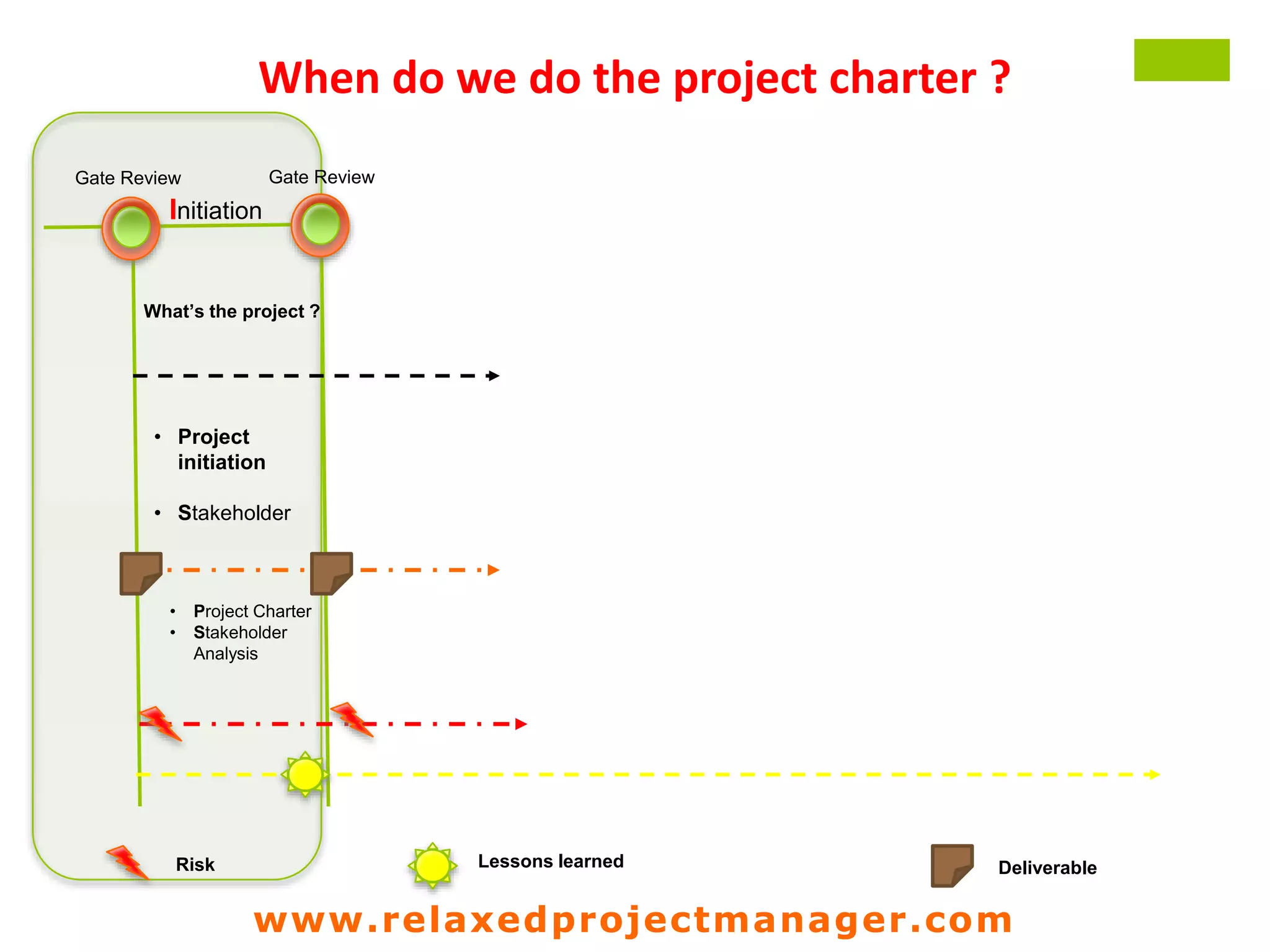
When do we do the project charter ?
www.relaxedprojectmanager.com
Initiation
DeliverableLessons learnedRisk
• Project Charter
• Stakeholder
Analysis
• Project
initiation
• Stakeholder
Gate ReviewGate Review
What’s the project ?
www.relaxedprojectmanager.com
+
Why do we do a project charter ?
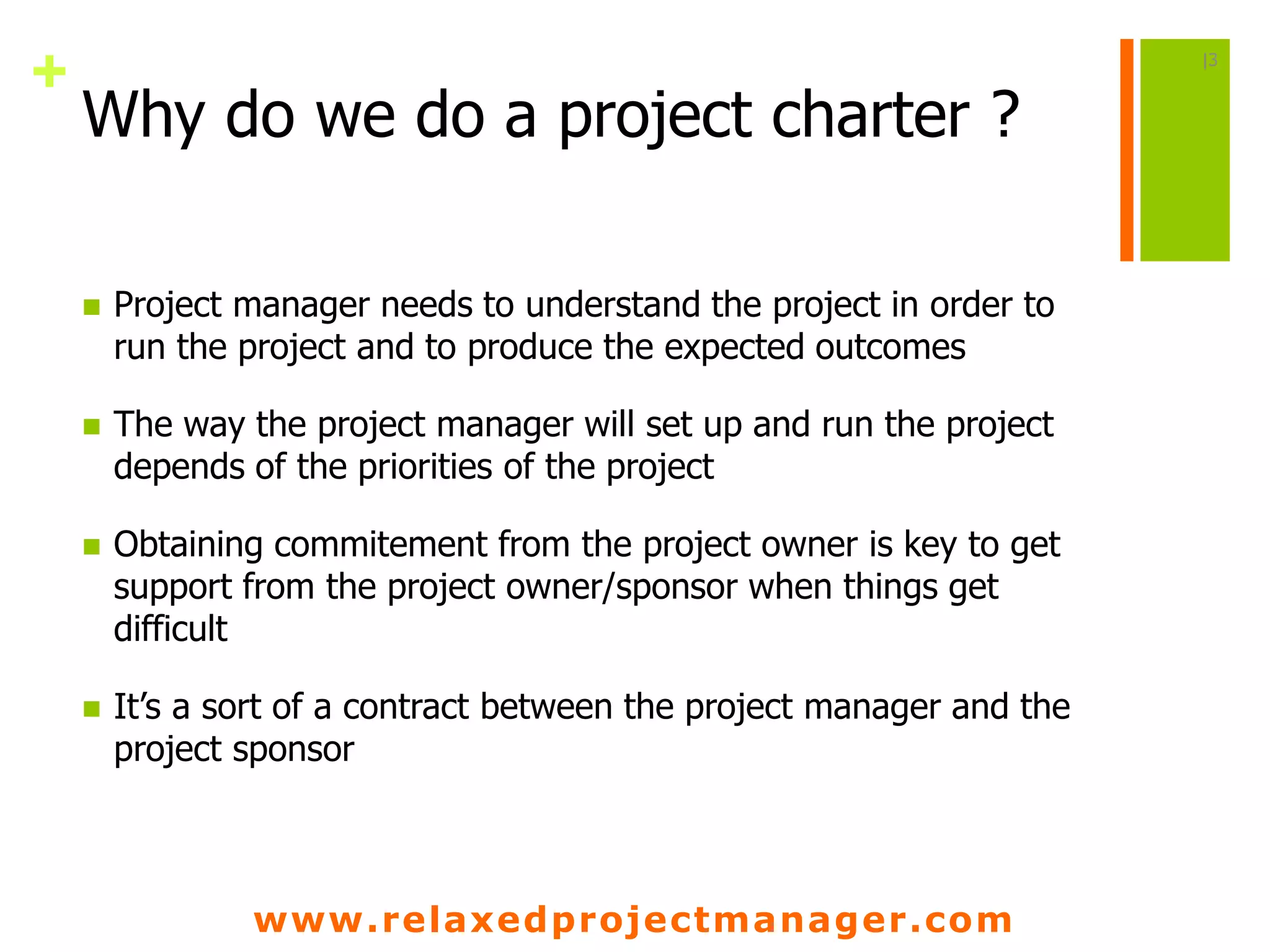
 Project manager needs to understand the project in order to
run the project and to produce the expected outcomes
 The way the project manager will set up and run the project
depends of the priorities of the project
 Obtaining commitement from the project owner is key to get
support from the project owner/sponsor when things get
difficult
 It’s a sort of a contract between the project manager and the
project sponsor
|3
www.relaxedprojectmanager.com
+
What are the key points ?
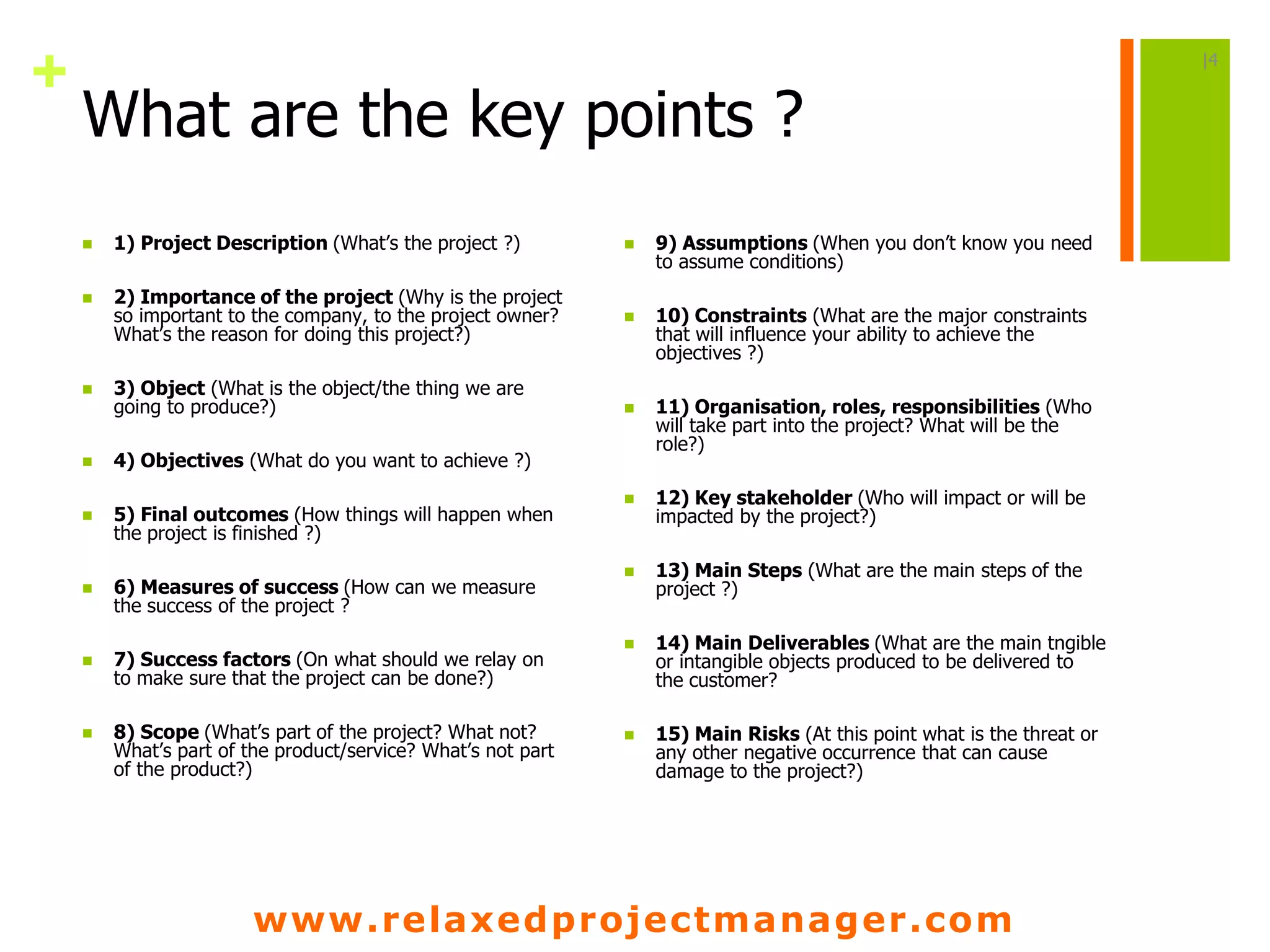
 1) Project Description (What’s the project ?)
 2) Importance of the project (Why is the project
so important to the company, to the project owner?
What’s the reason for doing this project?)
 3) Object (What is the object/the thing we are
going to produce?)
 4) Objectives (What do you want to achieve ?)
 5) Final outcomes (How things will happen when
the project is finished ?)
 6) Measures of success (How can we measure
the success of the project ?
 7) Success factors (On what should we relay on
to make sure that the project can be done?)
 8) Scope (What’s part of the project? What not?
What’s part of the product/service? What’s not part
of the product?)
 9) Assumptions (When you don’t know you need
to assume conditions)
 10) Constraints (What are the major constraints
that will influence your ability to achieve the
objectives ?)
 11) Organisation, roles, responsibilities (Who
will take part into the project? What will be the
role?)
 12) Key stakeholder (Who will impact or will be
impacted by the project?)
 13) Main Steps (What are the main steps of the
project ?)
 14) Main Deliverables (What are the main tngible
or intangible objects produced to be delivered to
the customer?
 15) Main Risks (At this point what is the threat or
any other negative occurrence that can cause
damage to the project?)
|4
www.relaxedprojectmanager.com
+
1) Project Description –
What’s the project ?
 It’s a standalone statement
 What accomplishes the project ?
 Who will benefit from the accomplishement ?
 Make it short, specific and concrete
 Use verbs in your description
 Make sure that everyone could understand and know what the
project is about without reading further
|5
www.relaxedprojectmanager.com
+
1) Project Description –
 Example : “We want to develop new environmentally friendly
working conditions (replace light bulbs, windows ...) because we
believe in happy employees (and there is much pressure from
legal constraints and governmental standards)”
 Example : “The purpose of the research project is for the
students to learn how to formulate a simple natural language
problem/task/application and to experience how to solve it using
methods, algorithms and techniques taught in class. The students
will conduct experimental evaluation on an interesting dataset and
will analyze the obtained results.”
 Example : “The Health System Measurement Project tracks
government data on critical U.S. health system indicators. The
website presents national trend data as well as detailed views
broken out by population characteristics such as age, sex, income
level, and insurance coverage status.”
www.relaxedprojectmanager.com
+
2) Importance of the project –
Why does the company the project ?
 Is the project important for the company?
 What would happen to the company if the project fails?
 Describe the importance from the viewpoint of the company,
the project sponsor/owner?
 Make it very clear, Be specific
 Project are important when there’s a good reason to do them
and when you will get hurt if you don’t !
 Shortly represent the nature of the difficulties the organisation
is facing : what’s the problem ? (or what the opportunity?)
|7
www.relaxedprojectmanager.com
+
2) Importance of the project –
Example
 Typical Reasons are often constraints or opportunities
 Business need/new opportunity
 Market demand (Apple watch, Pasta box)
 Technological advance (Self driving vehicule, quick charging long
lasting batteries, playing and living in virtual reality, low frequency
connected objects)
 Legal requirement (smoke detectors)
 Governmental standard (accounting standards, financial reporting)
 Example : “Customers expectations evolve so fast in food
industry. It is very important to understand expectations.
People are very careful about what the company is doing so it
is important to share a common understanding on how we are
respectful and transparent when we deal with food.”
|8
www.relaxedprojectmanager.com
+
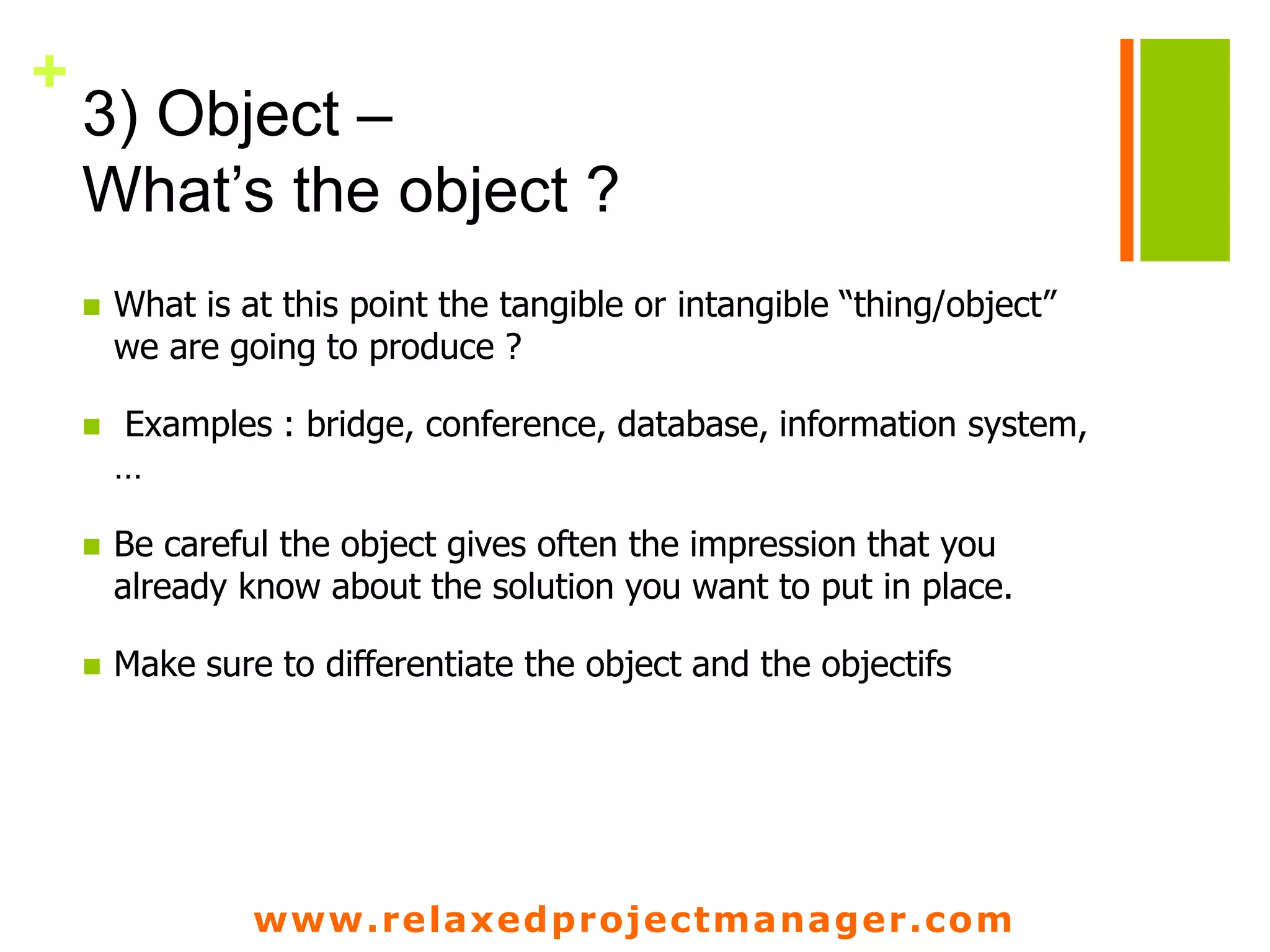
3) Object –
What’s the object ?
 What is at this point the tangible or intangible “thing/object”
we are going to produce ?
 Examples : bridge, conference, database, information system,
…
 Be careful the object gives often the impression that you
already know about the solution you want to put in place.
 Make sure to differentiate the object and the objectifs
www.relaxedprojectmanager.com
+
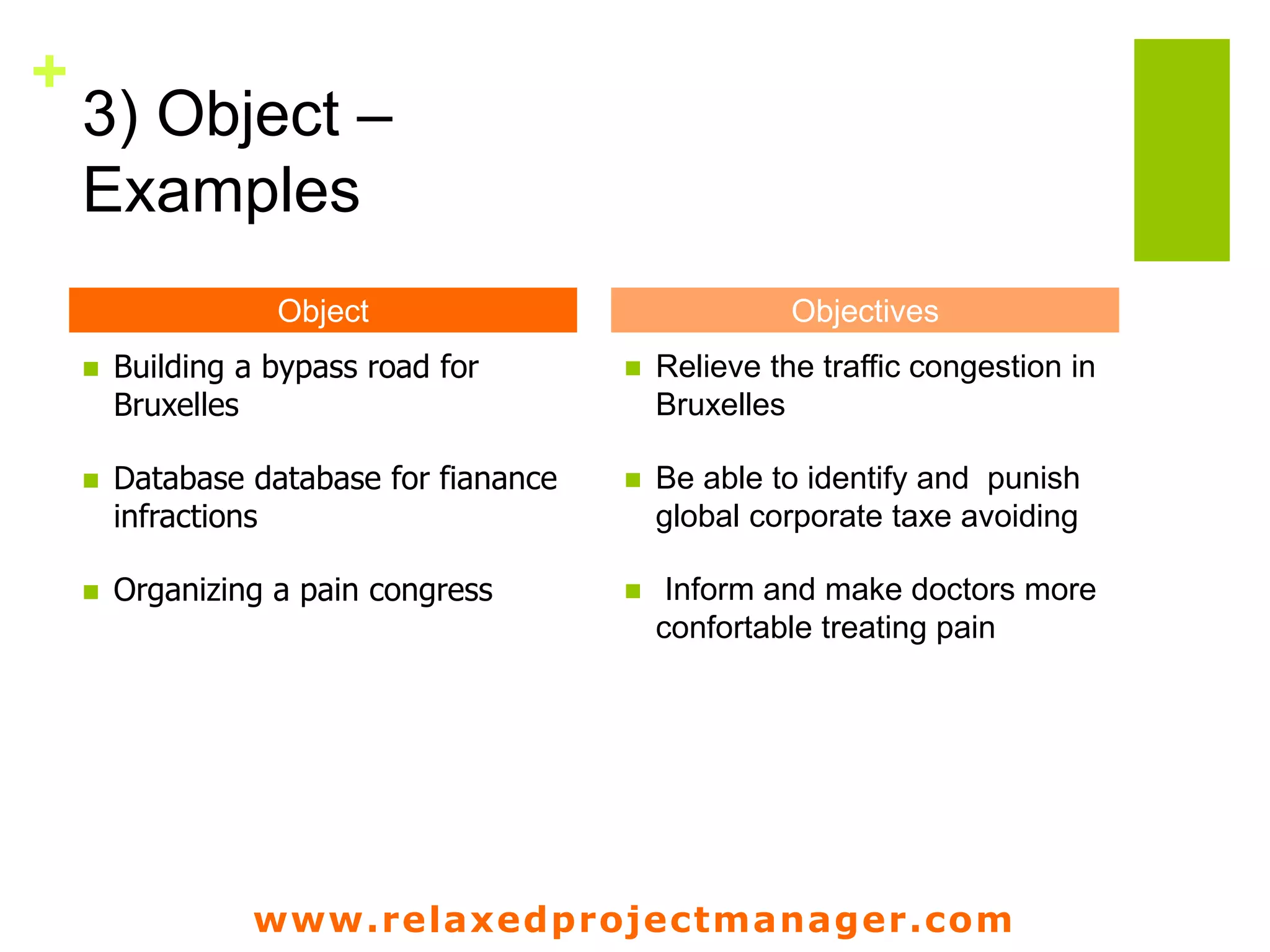
3) Object –
Examples
 Building a bypass road for
Bruxelles
 Database database for fianance
infractions
 Organizing a pain congress
 Relieve the traffic congestion in
Bruxelles
 Be able to identify and punish
global corporate taxe avoiding
 Inform and make doctors more
confortable treating pain
Object Objectives
www.relaxedprojectmanager.com
+
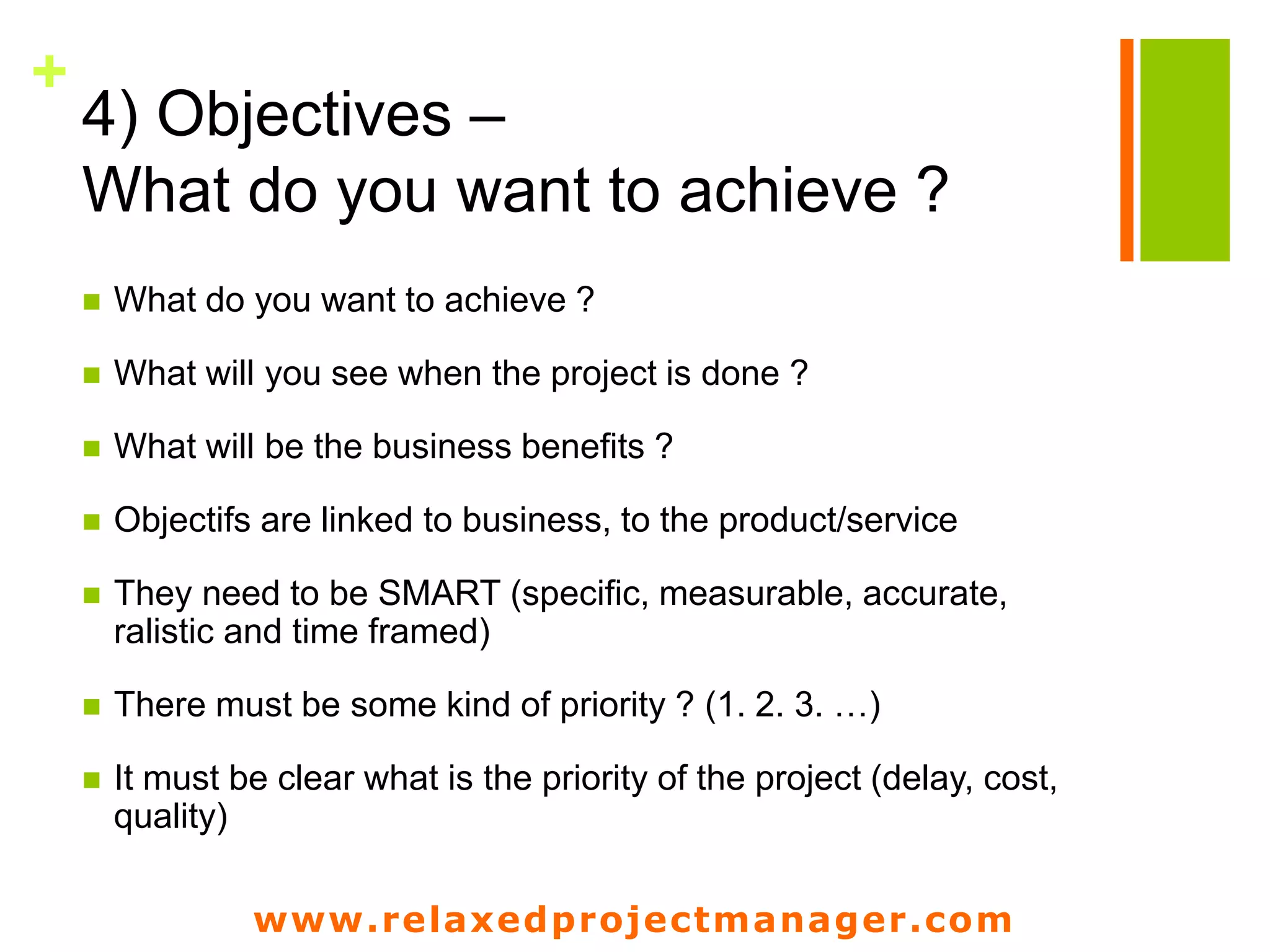
4) Objectives –
What do you want to achieve ?
 What do you want to achieve ?
 What will you see when the project is done ?
 What will be the business benefits ?
 Objectifs are linked to business, to the product/service
 They need to be SMART (specific, measurable, accurate,
ralistic and time framed)
 There must be some kind of priority ? (1. 2. 3. …)
 It must be clear what is the priority of the project (delay, cost,
quality)
www.relaxedprojectmanager.com
+
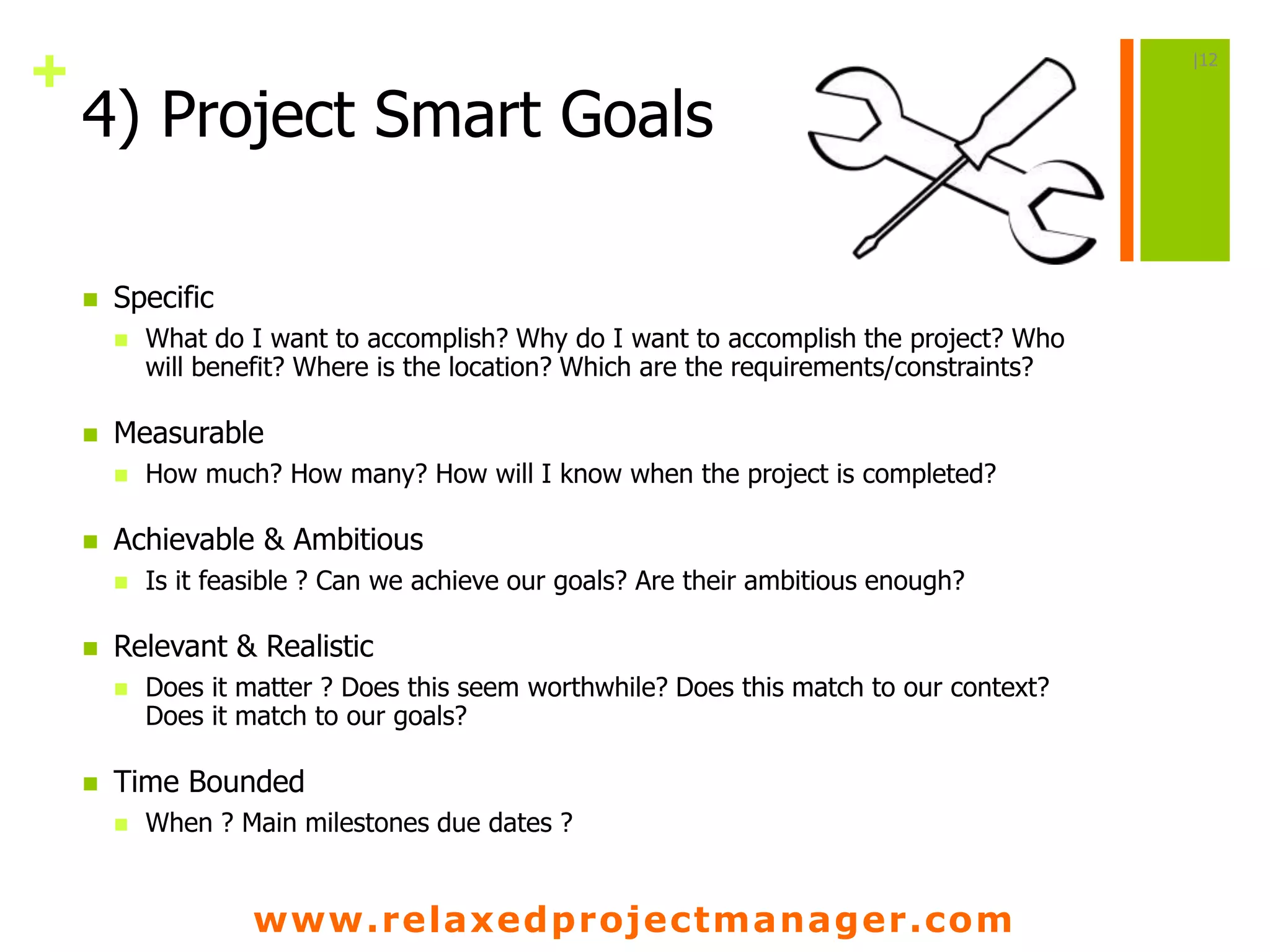
4) Project Smart Goals
 Specific
 What do I want to accomplish? Why do I want to accomplish the project? Who
will benefit? Where is the location? Which are the requirements/constraints?
 Measurable
 How much? How many? How will I know when the project is completed?
 Achievable & Ambitious
 Is it feasible ? Can we achieve our goals? Are their ambitious enough?
 Relevant & Realistic
 Does it matter ? Does this seem worthwhile? Does this match to our context?
Does it match to our goals?
 Time Bounded
 When ? Main milestones due dates ?
|12
www.relaxedprojectmanager.com
+
4) Objectives –
Examples
 1. Making 50 000 euros the first year of product launch
 2. In six month 90% of our products will be available in our
online shop
 3. 100% compliance with HTML 5 standard
www.relaxedprojectmanager.com
+
5) Final Outcome - How things will
happen when the project is finished
?
 Project Final Outcome /After project desired state
 How it will look like when the problem is solved?
 How things will be processed?
 Examples
 Database : Incoming documents are processed more quickly and accurately (and
that can be put in measurable dimensions)
 Training Project : People will be able to apply 5 management competencies in their
office
www.relaxedprojectmanager.com
+
6) Measures of success
(Success criterias)
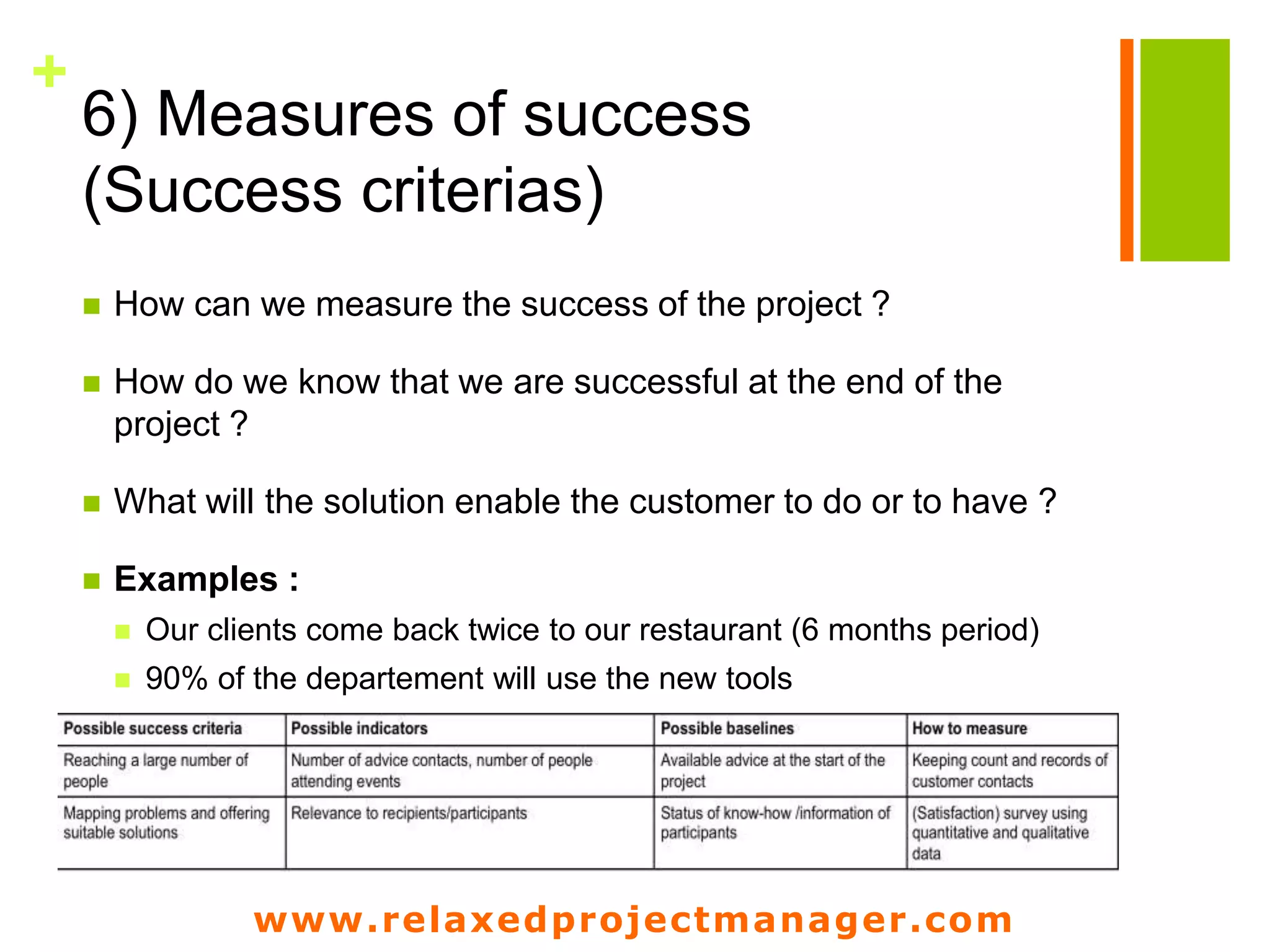
 How can we measure the success of the project ?
 How do we know that we are successful at the end of the
project ?
 What will the solution enable the customer to do or to have ?
 Examples :
 Our clients come back twice to our restaurant (6 months period)
 90% of the departement will use the new tools
www.relaxedprojectmanager.com
+
7) Success factors
 On what factors/things should we relay on to make sure that te
project can be done ?
 What’s going to help us doing the projet?
 What are the ingrediants we need to get the things the right
way?
 Examples :
 Understand customer needs
 Be sure to be able to finance the project
www.relaxedprojectmanager.com
+
8. Project Scope/Product Scope
 What is part of the project/product/service ?
 What is not part of the project/product/service?
 Clearly state what results / deliverables will or will not be
delivered.
 “The catalog will feature 100 garden products but no product
for the house” is better than “The catalog will feature many
products”
 “The new property will include the following : driveway, main
home garage, foundation but not the landscaping”
|17
www.relaxedprojectmanager.com
+
Project Scope/Product Scope
Examples
 Example : Organizing an international conference in order to
exchange on the effectiveness of the latest drugs against ebola.
We’ll invite all the countries facing ebola epedemie and all
countries developping drugs. We do not welcome the other
countries. ONG are excluded. Pharmaceutical companies are
included.
 Example : A merger between two banks is a project. What will be
part of the activities of the two banks that are merged. Are human
issues part of the merger project or not?
 Example : Delivery of solar panels on companies roofs is part of
the project. Adding a wind turbine on the site to reduce impact on
the environnement and also reduce electircity costs is not part of
the project.
www.relaxedprojectmanager.com
9. Assumptions – What are you
assumptions when you don’t have
all the information necessary?
 When you information level is too low you can make assumptions that will
guide your action
 Assumptions made about the project related to resources, scope, expectations
and schedules.
 Assumptions must be defined for :
 Effort: The estimated tasks and activities required to manage the project and produce
deliverables.
 • Schedule: The estimated tasks and events needed to complete the project, organized
into a structured sequence to meet a specified project end date.
 • Resources: The estimated staff resources needed to complete the project, according
to number, type, work hours, and skills.
 • Budget: The estimated cost of the project, allocated to tasks, resources and phases
as needed to complete the project.
 • Vendors and Procurement: The anticipated performance of contractors, vendors and
suppliers to deliver goods and services according to contracts and project requirements.
 • Management Process: Management standards can serve as a constraint on project
performance, adding quality control overhead.
www.relaxedprojectmanager.com
9. Assumptions – What are you
assumptions when you don’t have
all the information necessary?
 When you information level is too low you can make
assumptions that will guide your action
 Assumptions made about the project related to resources,
scope, expectations and schedules.
 Example : The reorganisation project of a worldwide
organization will centralize every business process: cultural
barriers will be a major obstacle to the implementation of the
huge IT system to be developed.
 Example : Organizing this sports event does not require any
unusal resource but it will need a very tight management of
the schedules because of the short timelaps left.
www.relaxedprojectmanager.com
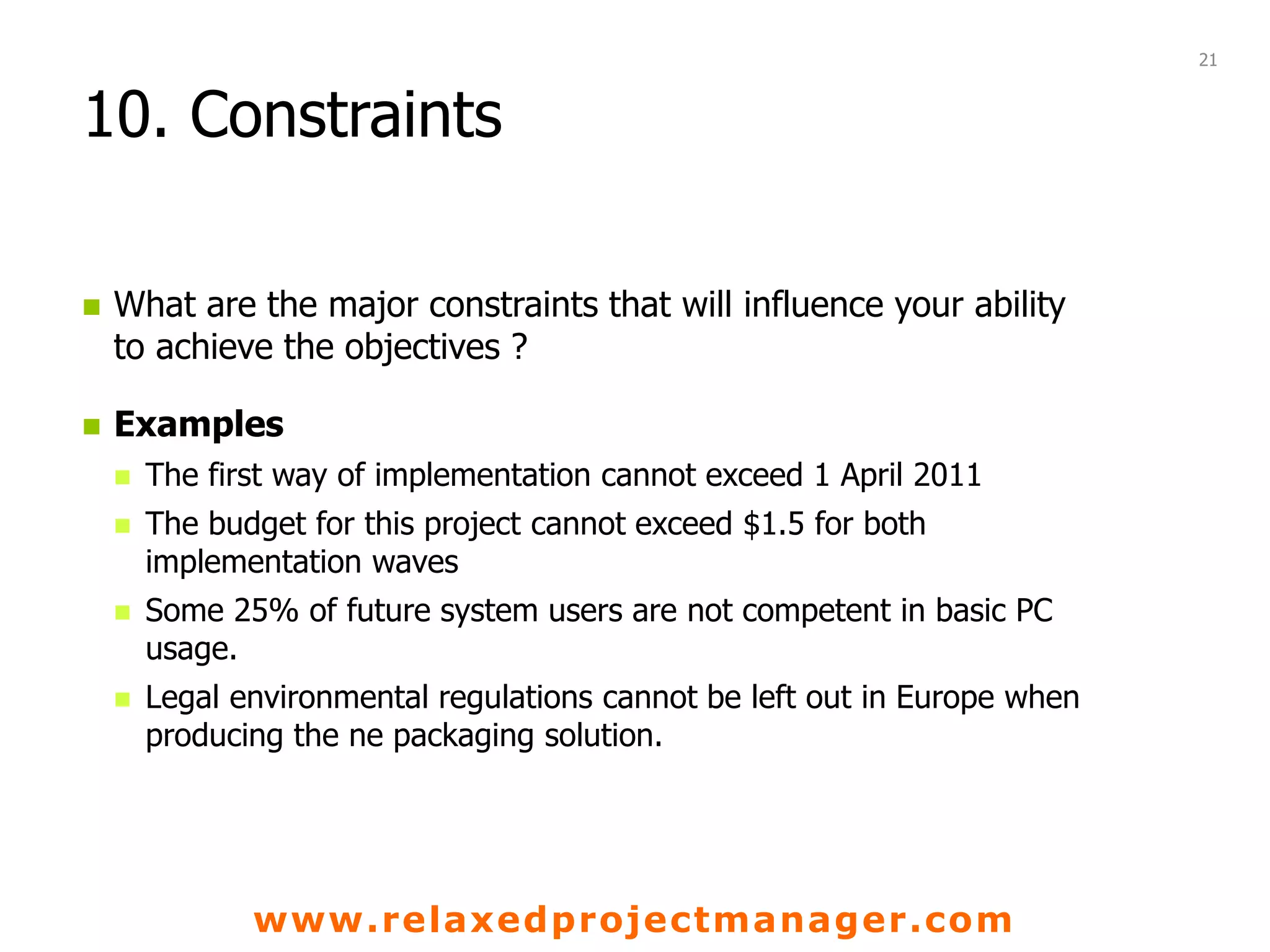
10. Constraints
 What are the major constraints that will influence your ability
to achieve the objectives ?
 Examples
 The first way of implementation cannot exceed 1 April 2011
 The budget for this project cannot exceed $1.5 for both
implementation waves
 Some 25% of future system users are not competent in basic PC
usage.
 Legal environmental regulations cannot be left out in Europe when
producing the ne packaging solution.
21
www.relaxedprojectmanager.com
+
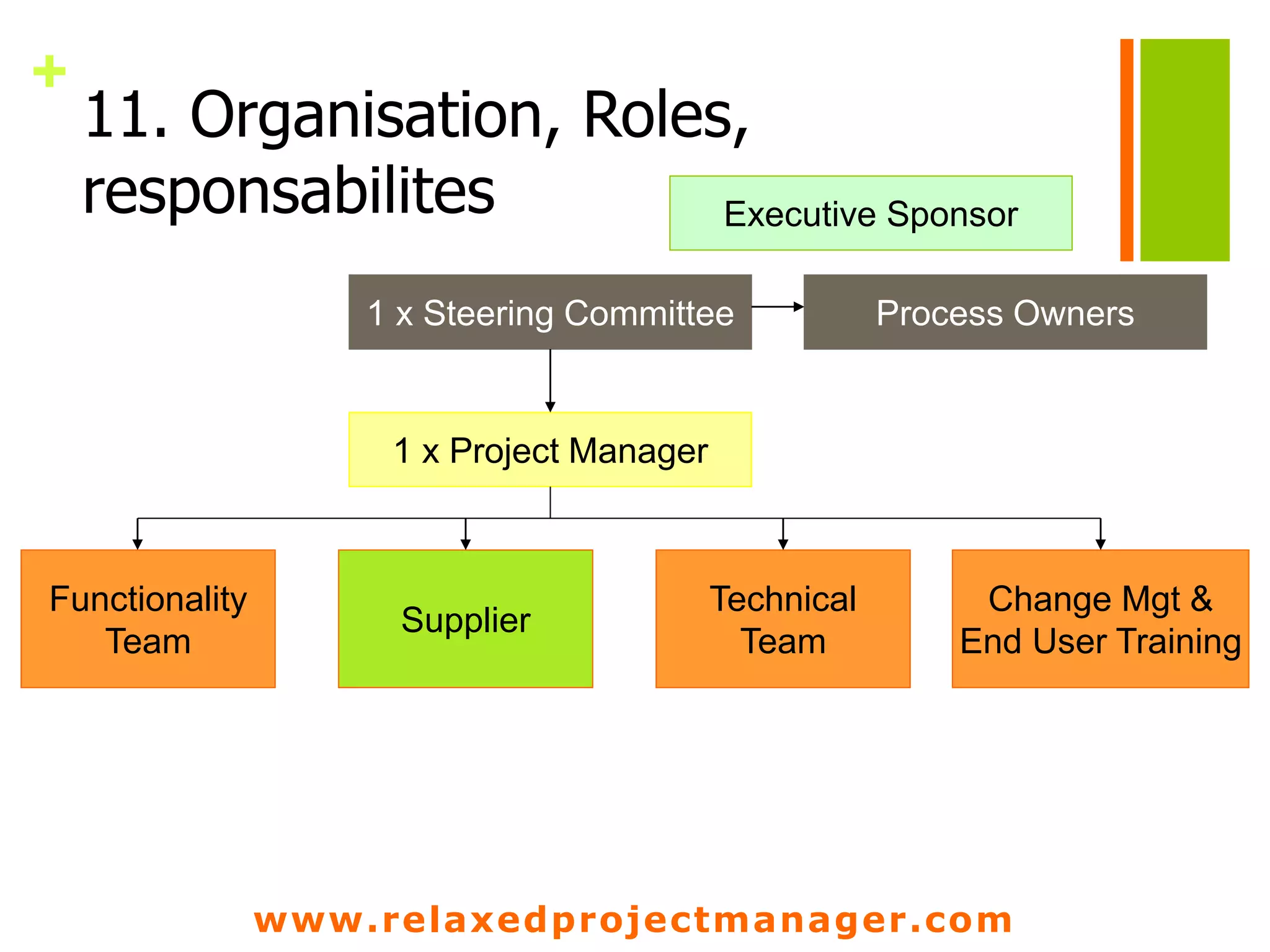
11. Organisation, Roles,
responsabilites
1 x Steering Committee
1 x Project Manager
Process Owners
Executive Sponsor
Functionality
Team
Supplier
Technical
Team
Change Mgt &
End User Training
www.relaxedprojectmanager.com
+
Key stakeholders
www.relaxedprojectmanager.com
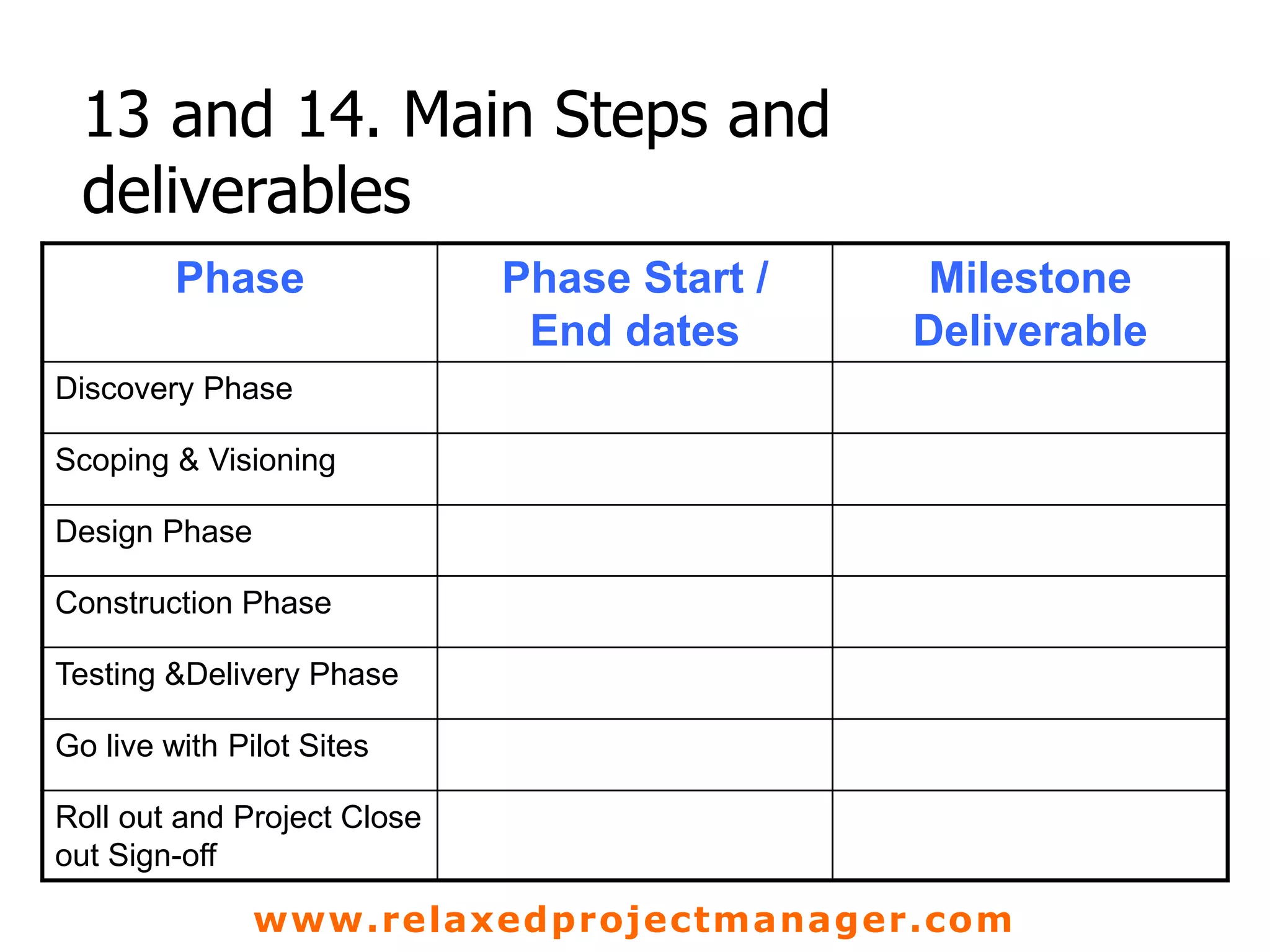
13 and 14. Main Steps and
deliverables
Phase Phase Start /
End dates
Milestone
Deliverable
Discovery Phase
Scoping & Visioning
Design Phase
Construction Phase
Testing &Delivery Phase
Go live with Pilot Sites
Roll out and Project Close
out Sign-off
www.relaxedprojectmanager.com
+
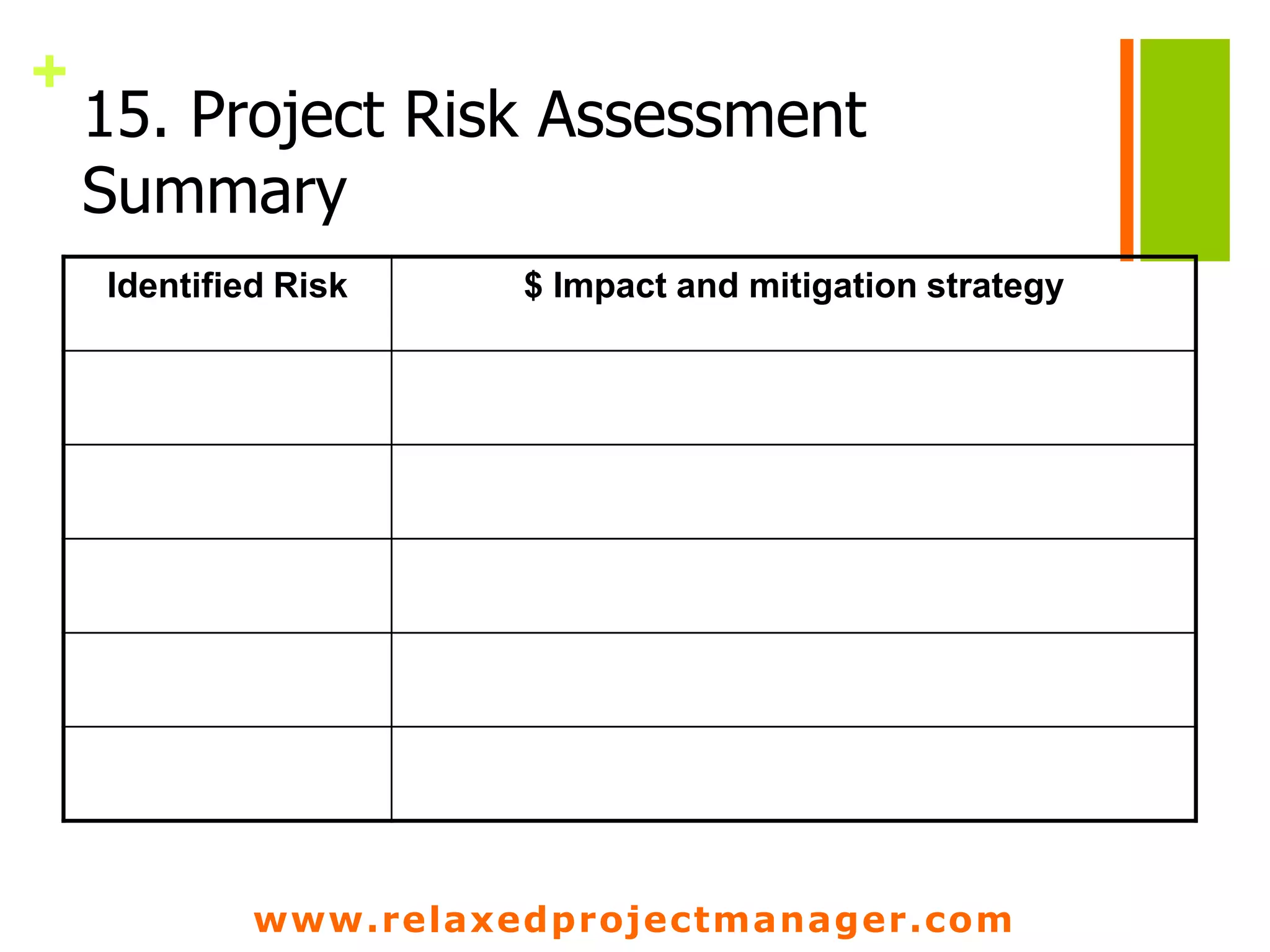
15. Project Risk Assessment
Summary
Identified Risk $ Impact and mitigation strategy

Project charter v2

  • 1.
  • 2.
    www.relaxedprojectmanager.com When do wedo the project charter ? www.relaxedprojectmanager.com Initiation DeliverableLessons learnedRisk • Project Charter • Stakeholder Analysis • Project initiation • Stakeholder Gate ReviewGate Review What’s the project ?
  • 3.
    www.relaxedprojectmanager.com + Why do wedo a project charter ?  Project manager needs to understand the project in order to run the project and to produce the expected outcomes  The way the project manager will set up and run the project depends of the priorities of the project  Obtaining commitement from the project owner is key to get support from the project owner/sponsor when things get difficult  It’s a sort of a contract between the project manager and the project sponsor |3
  • 4.
    www.relaxedprojectmanager.com + What are thekey points ?  1) Project Description (What’s the project ?)  2) Importance of the project (Why is the project so important to the company, to the project owner? What’s the reason for doing this project?)  3) Object (What is the object/the thing we are going to produce?)  4) Objectives (What do you want to achieve ?)  5) Final outcomes (How things will happen when the project is finished ?)  6) Measures of success (How can we measure the success of the project ?  7) Success factors (On what should we relay on to make sure that the project can be done?)  8) Scope (What’s part of the project? What not? What’s part of the product/service? What’s not part of the product?)  9) Assumptions (When you don’t know you need to assume conditions)  10) Constraints (What are the major constraints that will influence your ability to achieve the objectives ?)  11) Organisation, roles, responsibilities (Who will take part into the project? What will be the role?)  12) Key stakeholder (Who will impact or will be impacted by the project?)  13) Main Steps (What are the main steps of the project ?)  14) Main Deliverables (What are the main tngible or intangible objects produced to be delivered to the customer?  15) Main Risks (At this point what is the threat or any other negative occurrence that can cause damage to the project?) |4
  • 5.
    www.relaxedprojectmanager.com + 1) Project Description– What’s the project ?  It’s a standalone statement  What accomplishes the project ?  Who will benefit from the accomplishement ?  Make it short, specific and concrete  Use verbs in your description  Make sure that everyone could understand and know what the project is about without reading further |5
  • 6.
    www.relaxedprojectmanager.com + 1) Project Description–  Example : “We want to develop new environmentally friendly working conditions (replace light bulbs, windows ...) because we believe in happy employees (and there is much pressure from legal constraints and governmental standards)”  Example : “The purpose of the research project is for the students to learn how to formulate a simple natural language problem/task/application and to experience how to solve it using methods, algorithms and techniques taught in class. The students will conduct experimental evaluation on an interesting dataset and will analyze the obtained results.”  Example : “The Health System Measurement Project tracks government data on critical U.S. health system indicators. The website presents national trend data as well as detailed views broken out by population characteristics such as age, sex, income level, and insurance coverage status.”
  • 7.
    www.relaxedprojectmanager.com + 2) Importance ofthe project – Why does the company the project ?  Is the project important for the company?  What would happen to the company if the project fails?  Describe the importance from the viewpoint of the company, the project sponsor/owner?  Make it very clear, Be specific  Project are important when there’s a good reason to do them and when you will get hurt if you don’t !  Shortly represent the nature of the difficulties the organisation is facing : what’s the problem ? (or what the opportunity?) |7
  • 8.
    www.relaxedprojectmanager.com + 2) Importance ofthe project – Example  Typical Reasons are often constraints or opportunities  Business need/new opportunity  Market demand (Apple watch, Pasta box)  Technological advance (Self driving vehicule, quick charging long lasting batteries, playing and living in virtual reality, low frequency connected objects)  Legal requirement (smoke detectors)  Governmental standard (accounting standards, financial reporting)  Example : “Customers expectations evolve so fast in food industry. It is very important to understand expectations. People are very careful about what the company is doing so it is important to share a common understanding on how we are respectful and transparent when we deal with food.” |8
  • 9.
    www.relaxedprojectmanager.com + 3) Object – What’sthe object ?  What is at this point the tangible or intangible “thing/object” we are going to produce ?  Examples : bridge, conference, database, information system, …  Be careful the object gives often the impression that you already know about the solution you want to put in place.  Make sure to differentiate the object and the objectifs
  • 10.
    www.relaxedprojectmanager.com + 3) Object – Examples Building a bypass road for Bruxelles  Database database for fianance infractions  Organizing a pain congress  Relieve the traffic congestion in Bruxelles  Be able to identify and punish global corporate taxe avoiding  Inform and make doctors more confortable treating pain Object Objectives
  • 11.
    www.relaxedprojectmanager.com + 4) Objectives – Whatdo you want to achieve ?  What do you want to achieve ?  What will you see when the project is done ?  What will be the business benefits ?  Objectifs are linked to business, to the product/service  They need to be SMART (specific, measurable, accurate, ralistic and time framed)  There must be some kind of priority ? (1. 2. 3. …)  It must be clear what is the priority of the project (delay, cost, quality)
  • 12.
    www.relaxedprojectmanager.com + 4) Project SmartGoals  Specific  What do I want to accomplish? Why do I want to accomplish the project? Who will benefit? Where is the location? Which are the requirements/constraints?  Measurable  How much? How many? How will I know when the project is completed?  Achievable & Ambitious  Is it feasible ? Can we achieve our goals? Are their ambitious enough?  Relevant & Realistic  Does it matter ? Does this seem worthwhile? Does this match to our context? Does it match to our goals?  Time Bounded  When ? Main milestones due dates ? |12
  • 13.
    www.relaxedprojectmanager.com + 4) Objectives – Examples 1. Making 50 000 euros the first year of product launch  2. In six month 90% of our products will be available in our online shop  3. 100% compliance with HTML 5 standard
  • 14.
    www.relaxedprojectmanager.com + 5) Final Outcome- How things will happen when the project is finished ?  Project Final Outcome /After project desired state  How it will look like when the problem is solved?  How things will be processed?  Examples  Database : Incoming documents are processed more quickly and accurately (and that can be put in measurable dimensions)  Training Project : People will be able to apply 5 management competencies in their office
  • 15.
    www.relaxedprojectmanager.com + 6) Measures ofsuccess (Success criterias)  How can we measure the success of the project ?  How do we know that we are successful at the end of the project ?  What will the solution enable the customer to do or to have ?  Examples :  Our clients come back twice to our restaurant (6 months period)  90% of the departement will use the new tools
  • 16.
    www.relaxedprojectmanager.com + 7) Success factors On what factors/things should we relay on to make sure that te project can be done ?  What’s going to help us doing the projet?  What are the ingrediants we need to get the things the right way?  Examples :  Understand customer needs  Be sure to be able to finance the project
  • 17.
    www.relaxedprojectmanager.com + 8. Project Scope/ProductScope  What is part of the project/product/service ?  What is not part of the project/product/service?  Clearly state what results / deliverables will or will not be delivered.  “The catalog will feature 100 garden products but no product for the house” is better than “The catalog will feature many products”  “The new property will include the following : driveway, main home garage, foundation but not the landscaping” |17
  • 18.
    www.relaxedprojectmanager.com + Project Scope/Product Scope Examples Example : Organizing an international conference in order to exchange on the effectiveness of the latest drugs against ebola. We’ll invite all the countries facing ebola epedemie and all countries developping drugs. We do not welcome the other countries. ONG are excluded. Pharmaceutical companies are included.  Example : A merger between two banks is a project. What will be part of the activities of the two banks that are merged. Are human issues part of the merger project or not?  Example : Delivery of solar panels on companies roofs is part of the project. Adding a wind turbine on the site to reduce impact on the environnement and also reduce electircity costs is not part of the project.
  • 19.
    www.relaxedprojectmanager.com 9. Assumptions –What are you assumptions when you don’t have all the information necessary?  When you information level is too low you can make assumptions that will guide your action  Assumptions made about the project related to resources, scope, expectations and schedules.  Assumptions must be defined for :  Effort: The estimated tasks and activities required to manage the project and produce deliverables.  • Schedule: The estimated tasks and events needed to complete the project, organized into a structured sequence to meet a specified project end date.  • Resources: The estimated staff resources needed to complete the project, according to number, type, work hours, and skills.  • Budget: The estimated cost of the project, allocated to tasks, resources and phases as needed to complete the project.  • Vendors and Procurement: The anticipated performance of contractors, vendors and suppliers to deliver goods and services according to contracts and project requirements.  • Management Process: Management standards can serve as a constraint on project performance, adding quality control overhead.
  • 20.
    www.relaxedprojectmanager.com 9. Assumptions –What are you assumptions when you don’t have all the information necessary?  When you information level is too low you can make assumptions that will guide your action  Assumptions made about the project related to resources, scope, expectations and schedules.  Example : The reorganisation project of a worldwide organization will centralize every business process: cultural barriers will be a major obstacle to the implementation of the huge IT system to be developed.  Example : Organizing this sports event does not require any unusal resource but it will need a very tight management of the schedules because of the short timelaps left.
  • 21.
    www.relaxedprojectmanager.com 10. Constraints  Whatare the major constraints that will influence your ability to achieve the objectives ?  Examples  The first way of implementation cannot exceed 1 April 2011  The budget for this project cannot exceed $1.5 for both implementation waves  Some 25% of future system users are not competent in basic PC usage.  Legal environmental regulations cannot be left out in Europe when producing the ne packaging solution. 21
  • 22.
    www.relaxedprojectmanager.com + 11. Organisation, Roles, responsabilites 1x Steering Committee 1 x Project Manager Process Owners Executive Sponsor Functionality Team Supplier Technical Team Change Mgt & End User Training
  • 23.
  • 24.
    www.relaxedprojectmanager.com 13 and 14.Main Steps and deliverables Phase Phase Start / End dates Milestone Deliverable Discovery Phase Scoping & Visioning Design Phase Construction Phase Testing &Delivery Phase Go live with Pilot Sites Roll out and Project Close out Sign-off
  • 25.
    www.relaxedprojectmanager.com + 15. Project RiskAssessment Summary Identified Risk $ Impact and mitigation strategy