Chapter 3
Managing the
Information Systems Project
Importance of Project Management
 Project management may be the most
important aspect of systems development.
 Effective PM helps to ensure
Meeting customer expectations.
Satisfying budget and time constraints.
 PM skills are difficult and important to
learn.
Deciding on Systems Projects
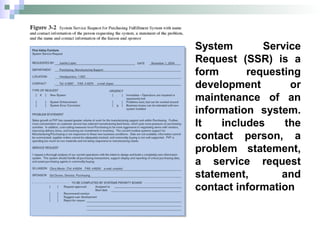
 System Service Request (SSR)
A standard form for requesting or
proposing systems development work
within an organization
System Service
Request (SSR) is a
form requesting
development or
maintenance of an
information system.
It includes the
contact person, a
problem statement,
a service request
statement, and
contact information
Deciding on Systems Projects
 Feasibility study
A study that determines whether a
requested system makes economic and
operational sense for an organization.
Managing the Information
Systems Project
 Project
A planned undertaking of related activities to
reach an objective that has a beginning and
an end.
 Project management
A controlled process of initiating, planning,
executing, and closing down a project.
 Deliverable
An end product of an SDLC phase.
Managing the Information Systems
Project (cont.)
 Project manager
Systems analyst with management and
leadership skills responsible for leading
project initiation, planning, execution, and
closedown
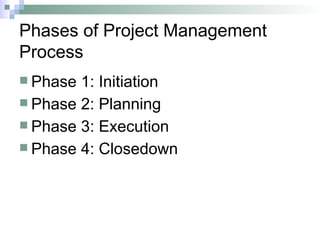
Phases of Project Management
Process
 Phase 1: Initiation
 Phase 2: Planning
 Phase 3: Execution
 Phase 4: Closedown
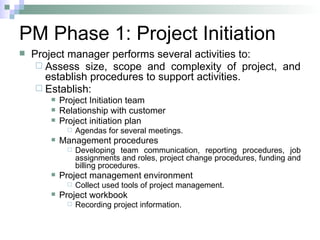
PM Phase 1: Project Initiation
 Project manager performs several activities to:
 Assess size, scope and complexity of project, and
establish procedures to support activities.
 Establish:
 Project Initiation team
 Relationship with customer
 Project initiation plan
 Agendas for several meetings.
 Management procedures
 Developing team communication, reporting procedures, job
assignments and roles, project change procedures, funding and
billing procedures.
 Project management environment
 Collect used tools of project management.
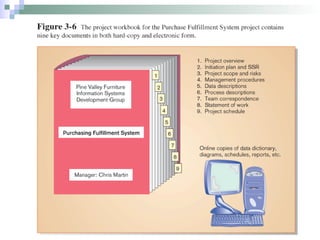
 Project workbook
 Recording project information.
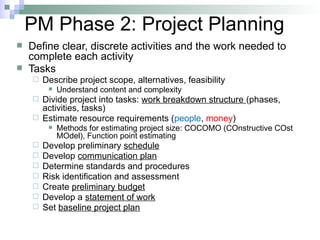
PM Phase 2: Project Planning
 Define clear, discrete activities and the work needed to
complete each activity
 Tasks
 Describe project scope, alternatives, feasibility
 Understand content and complexity
 Divide project into tasks: work breakdown structure (phases,
activities, tasks)
 Estimate resource requirements (people, money)
 Methods for estimating project size: COCOMO (COnstructive COst
MOdel), Function point estimating
 Develop preliminary schedule
 Develop communication plan
 Determine standards and procedures
 Risk identification and assessment
 Create preliminary budget
 Develop a statement of work
 Set baseline project plan
Some Components of Project
Planning
 Work Breakdown Structure (WBS)
 Division of project into manageable and logically
ordered tasks and subtasks.
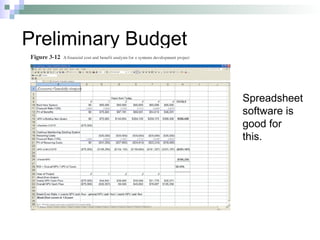
 Preliminary Budget
 Cost-benefit analysis outlining planned expenses and
revenues.
 Statement of Work (SOW)
 “Contract” between the IS staff and the customer
regarding deliverables and time estimates for a
system development project.
Some Components of Project
Planning (cont.)
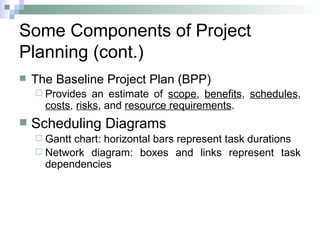
 The Baseline Project Plan (BPP)
 Provides an estimate of scope, benefits, schedules,
costs, risks, and resource requirements.
 Scheduling Diagrams
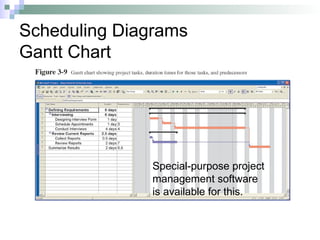
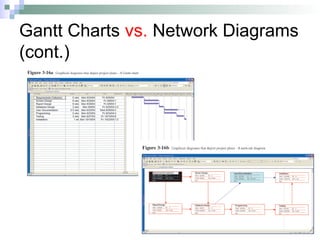
 Gantt chart: horizontal bars represent task durations
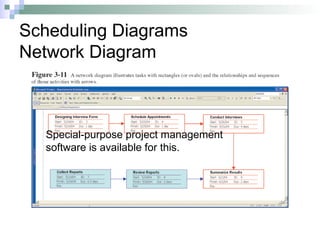
 Network diagram: boxes and links represent task
dependencies
Scheduling Diagrams
Gantt Chart
Special-purpose project
management software
is available for this.
Scheduling Diagrams
Network Diagram
Special-purpose project management
software is available for this.
Preliminary Budget
Spreadsheet
software is
good for
this.
PM Phase 3: Project Execution
 Plans created in prior phases are put into
action.
 Actions
Execute baseline project plan
Monitor progress against baseline plan
Manage changes in baseline plan
Maintain project workbook
Communicate project status
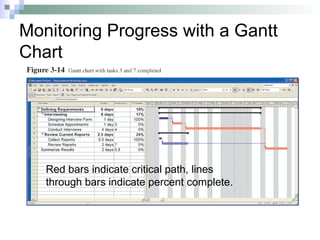
Monitoring Progress with a Gantt
Chart
Red bars indicate critical path, lines
through bars indicate percent complete.
Communication Methods
 Project workbook
 Meetings
 Seminars and workshops
 Newsletters
 Status reports
 Specification documents
 Minutes of meetings
 Bulletin boards
 Memos
 Brown bag lunches
 Hallway discussions
PM Phase 4: Project Closedown
 Bring the project to an end.
 Actions
Close down the project.
Conduct post-project reviews.
Close the customer contract.
Representing and Scheduling
Project Plans
 Gantt Charts
 Network Diagrams
 PERT Calculations
 Critical Path Scheduling
 Project Management Software
Gantt Charts vs. Network Diagrams
 Gantt charts
 Show task durations.
 Show time overlap.
 Show slack time in duration.
 Network diagrams
 Show task dependencies.
 Do not show time overlap, but show parallelism.
 Show slack time in boxes.
Gantt Charts vs. Network Diagrams
(cont.)
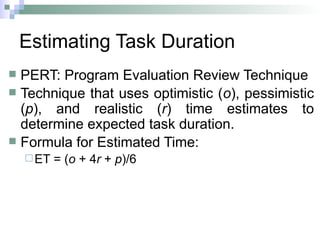
Estimating Task Duration
 PERT: Program Evaluation Review Technique
 Technique that uses optimistic (o), pessimistic
(p), and realistic (r) time estimates to
determine expected task duration.
 Formula for Estimated Time:
ET = (o + 4r + p)/6
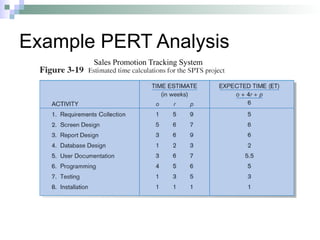
Example PERT Analysis
Sales Promotion Tracking System
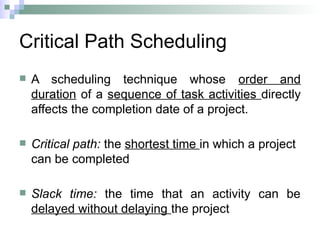
Critical Path Scheduling
 A scheduling technique whose order and
duration of a sequence of task activities directly
affects the completion date of a project.
 Critical path: the shortest time in which a project
can be completed
 Slack time: the time that an activity can be
delayed without delaying the project
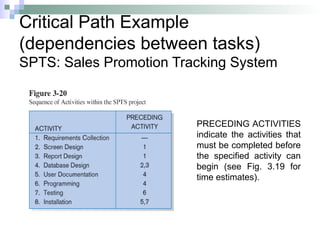
Critical Path Example
(dependencies between tasks)
SPTS: Sales Promotion Tracking System
PRECEDING ACTIVITIES
indicate the activities that
must be completed before
the specified activity can
begin (see Fig. 3.19 for
time estimates).
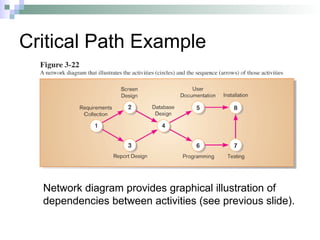
Network diagram provides graphical illustration of
dependencies between activities (see previous slide).
Critical Path Example
Determining the Critical Path
 Calculate the earliest possible completion time
for each activity by summing the expected
activity times ET in the longest path to the
activity. This gives total expected project time.
 Calculate the latest possible completion time
for each activity by subtracting the expected
activity times ET in the path following the
activity from the total expected time. This gives
slack time for activities.
 Critical path – contains no activities with slack
time.
  
Critical Path Calculation
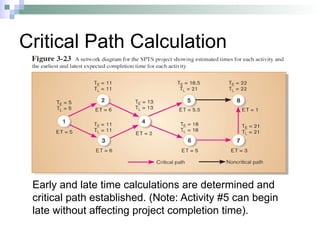
Early and late time calculations are determined and
critical path established. (Note: Activity #5 can begin
late without affecting project completion time).
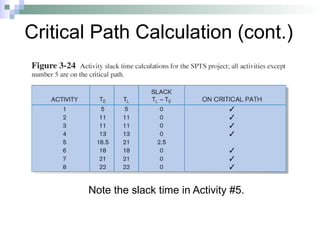
Critical Path Calculation (cont.)
Note the slack time in Activity #5.
Using Project Management Software
 Many powerful software tools exist for
assisting with project management.
 Example: Microsoft Project can help with
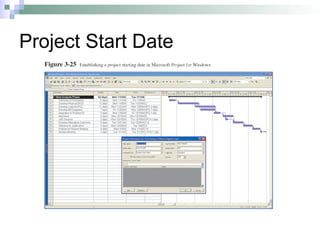
Entering project start date.
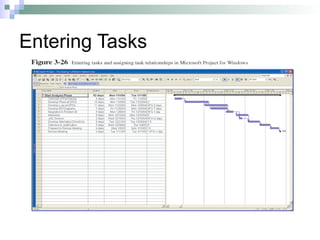
Establishing tasks and task dependencies.
Viewing project information as Gantt or
Network diagrams.
Project Start Date
Entering Tasks
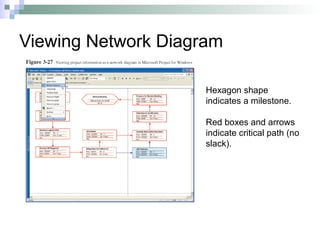
Viewing Network Diagram
Hexagon shape
indicates a milestone.
Red boxes and arrows
indicate critical path (no
slack).
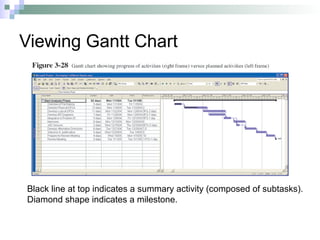
Viewing Gantt Chart
Black line at top indicates a summary activity (composed of subtasks).
Diamond shape indicates a milestone.
Discussion

Chapter 3

  • 1.
  • 2.
    Importance of ProjectManagement  Project management may be the most important aspect of systems development.  Effective PM helps to ensure Meeting customer expectations. Satisfying budget and time constraints.  PM skills are difficult and important to learn.
  • 3.
    Deciding on SystemsProjects  System Service Request (SSR) A standard form for requesting or proposing systems development work within an organization
  • 4.
    System Service Request (SSR)is a form requesting development or maintenance of an information system. It includes the contact person, a problem statement, a service request statement, and contact information
  • 5.
    Deciding on SystemsProjects  Feasibility study A study that determines whether a requested system makes economic and operational sense for an organization.
  • 6.
    Managing the Information SystemsProject  Project A planned undertaking of related activities to reach an objective that has a beginning and an end.  Project management A controlled process of initiating, planning, executing, and closing down a project.  Deliverable An end product of an SDLC phase.
  • 7.
    Managing the InformationSystems Project (cont.)  Project manager Systems analyst with management and leadership skills responsible for leading project initiation, planning, execution, and closedown
  • 8.
    Phases of ProjectManagement Process  Phase 1: Initiation  Phase 2: Planning  Phase 3: Execution  Phase 4: Closedown
  • 9.
    PM Phase 1:Project Initiation  Project manager performs several activities to:  Assess size, scope and complexity of project, and establish procedures to support activities.  Establish:  Project Initiation team  Relationship with customer  Project initiation plan  Agendas for several meetings.  Management procedures  Developing team communication, reporting procedures, job assignments and roles, project change procedures, funding and billing procedures.  Project management environment  Collect used tools of project management.  Project workbook  Recording project information.
  • 11.
    PM Phase 2:Project Planning  Define clear, discrete activities and the work needed to complete each activity  Tasks  Describe project scope, alternatives, feasibility  Understand content and complexity  Divide project into tasks: work breakdown structure (phases, activities, tasks)  Estimate resource requirements (people, money)  Methods for estimating project size: COCOMO (COnstructive COst MOdel), Function point estimating  Develop preliminary schedule  Develop communication plan  Determine standards and procedures  Risk identification and assessment  Create preliminary budget  Develop a statement of work  Set baseline project plan
  • 12.
    Some Components ofProject Planning  Work Breakdown Structure (WBS)  Division of project into manageable and logically ordered tasks and subtasks.  Preliminary Budget  Cost-benefit analysis outlining planned expenses and revenues.  Statement of Work (SOW)  “Contract” between the IS staff and the customer regarding deliverables and time estimates for a system development project.
  • 13.
    Some Components ofProject Planning (cont.)  The Baseline Project Plan (BPP)  Provides an estimate of scope, benefits, schedules, costs, risks, and resource requirements.  Scheduling Diagrams  Gantt chart: horizontal bars represent task durations  Network diagram: boxes and links represent task dependencies
  • 14.
    Scheduling Diagrams Gantt Chart Special-purposeproject management software is available for this.
  • 15.
    Scheduling Diagrams Network Diagram Special-purposeproject management software is available for this.
  • 16.
  • 17.
    PM Phase 3:Project Execution  Plans created in prior phases are put into action.  Actions Execute baseline project plan Monitor progress against baseline plan Manage changes in baseline plan Maintain project workbook Communicate project status
  • 18.
    Monitoring Progress witha Gantt Chart Red bars indicate critical path, lines through bars indicate percent complete.
  • 19.
    Communication Methods  Projectworkbook  Meetings  Seminars and workshops  Newsletters  Status reports  Specification documents  Minutes of meetings  Bulletin boards  Memos  Brown bag lunches  Hallway discussions
  • 20.
    PM Phase 4:Project Closedown  Bring the project to an end.  Actions Close down the project. Conduct post-project reviews. Close the customer contract.
  • 21.
    Representing and Scheduling ProjectPlans  Gantt Charts  Network Diagrams  PERT Calculations  Critical Path Scheduling  Project Management Software
  • 22.
    Gantt Charts vs.Network Diagrams  Gantt charts  Show task durations.  Show time overlap.  Show slack time in duration.  Network diagrams  Show task dependencies.  Do not show time overlap, but show parallelism.  Show slack time in boxes.
  • 23.
    Gantt Charts vs.Network Diagrams (cont.)
  • 24.
    Estimating Task Duration PERT: Program Evaluation Review Technique  Technique that uses optimistic (o), pessimistic (p), and realistic (r) time estimates to determine expected task duration.  Formula for Estimated Time: ET = (o + 4r + p)/6
  • 25.
    Example PERT Analysis SalesPromotion Tracking System
  • 26.
    Critical Path Scheduling A scheduling technique whose order and duration of a sequence of task activities directly affects the completion date of a project.  Critical path: the shortest time in which a project can be completed  Slack time: the time that an activity can be delayed without delaying the project
  • 27.
    Critical Path Example (dependenciesbetween tasks) SPTS: Sales Promotion Tracking System PRECEDING ACTIVITIES indicate the activities that must be completed before the specified activity can begin (see Fig. 3.19 for time estimates).
  • 28.
    Network diagram providesgraphical illustration of dependencies between activities (see previous slide). Critical Path Example
  • 29.
    Determining the CriticalPath  Calculate the earliest possible completion time for each activity by summing the expected activity times ET in the longest path to the activity. This gives total expected project time.  Calculate the latest possible completion time for each activity by subtracting the expected activity times ET in the path following the activity from the total expected time. This gives slack time for activities.  Critical path – contains no activities with slack time.   
  • 30.
    Critical Path Calculation Earlyand late time calculations are determined and critical path established. (Note: Activity #5 can begin late without affecting project completion time).
  • 31.
    Critical Path Calculation(cont.) Note the slack time in Activity #5.
  • 32.
    Using Project ManagementSoftware  Many powerful software tools exist for assisting with project management.  Example: Microsoft Project can help with Entering project start date. Establishing tasks and task dependencies. Viewing project information as Gantt or Network diagrams.
  • 33.
  • 34.
  • 35.
    Viewing Network Diagram Hexagonshape indicates a milestone. Red boxes and arrows indicate critical path (no slack).
  • 36.
    Viewing Gantt Chart Blackline at top indicates a summary activity (composed of subtasks). Diamond shape indicates a milestone.
  • 37.