x
Project Management Ready (PMR)
INTRODUCTION
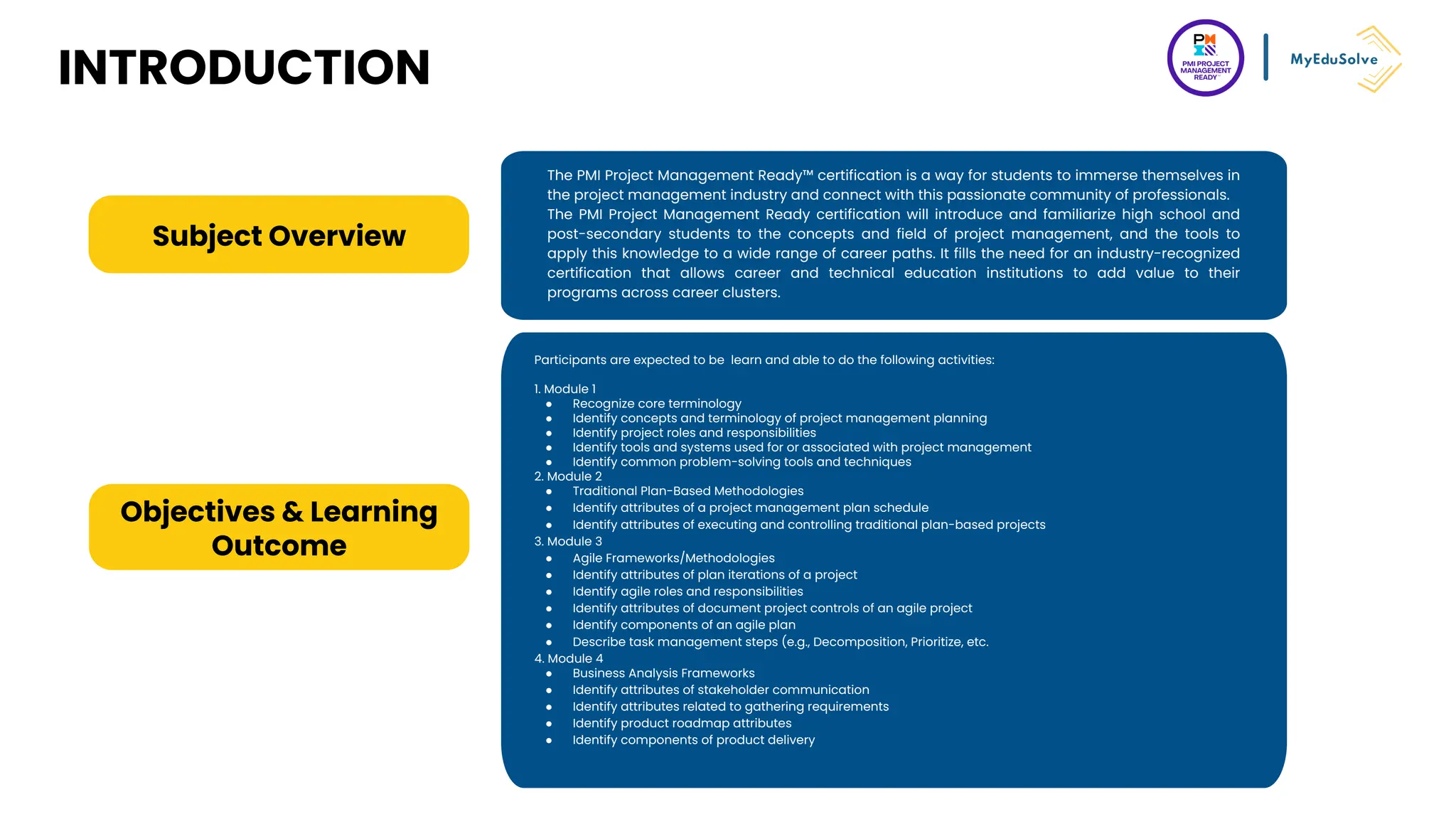
Subject Overview
Objectives & Learning
Outcome
Participants are expected to be learn and able to do the following activities:
1. Module 1
● Recognize core terminology
● Identify concepts and terminology of project management planning
● Identify project roles and responsibilities
● Identify tools and systems used for or associated with project management
● Identify common problem-solving tools and techniques
2. Module 2
● Traditional Plan-Based Methodologies
● Identify attributes of a project management plan schedule
● Identify attributes of executing and controlling traditional plan-based projects
3. Module 3
● Agile Frameworks/Methodologies
● Identify attributes of plan iterations of a project
● Identify agile roles and responsibilities
● Identify attributes of document project controls of an agile project
● Identify components of an agile plan
● Describe task management steps (e.g., Decomposition, Prioritize, etc.
4. Module 4
● Business Analysis Frameworks
● Identify attributes of stakeholder communication
● Identify attributes related to gathering requirements
● Identify product roadmap attributes
● Identify components of product delivery
The PMI Project Management Ready™ certification is a way for students to immerse themselves in
the project management industry and connect with this passionate community of professionals.
The PMI Project Management Ready certification will introduce and familiarize high school and
post-secondary students to the concepts and field of project management, and the tools to
apply this knowledge to a wide range of career paths. It fills the need for an industry-recognized
certification that allows career and technical education institutions to add value to their
programs across career clusters.
1
2
3
Objective Domains
Module 1
Module 2
Module 3
4 Module 4
Module 1
Day 1
x
1.1 Recognize Core Terminology
1.1.1 Define a project, product, program, portfolio, etc.
1.1.2 Define project management
1.1.3 Define a business case
1.1.4 Define project scope
1.1.5 Define deliverables
1.1.6 Define a milestone and task
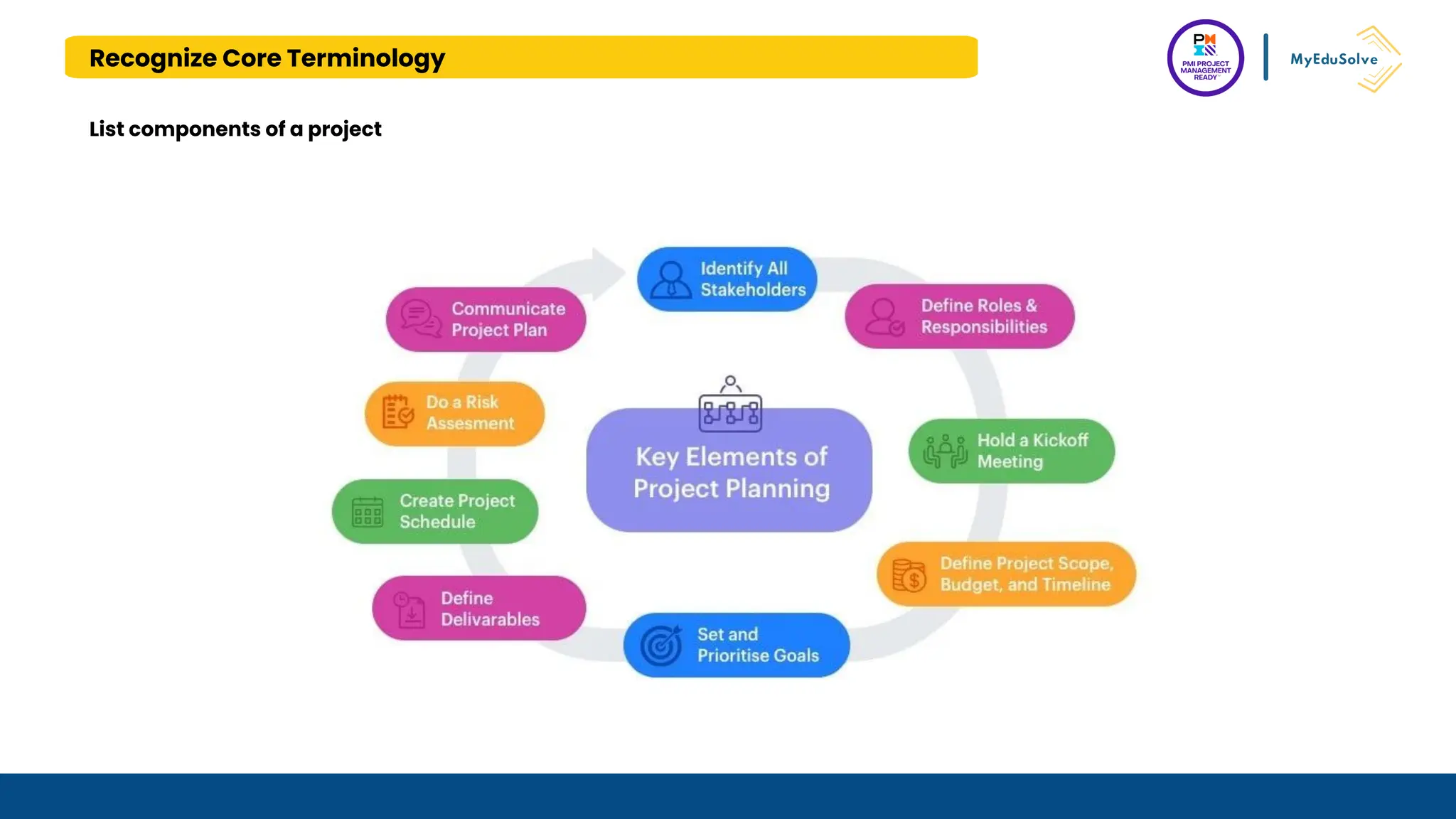
1.1.7 List components of a project
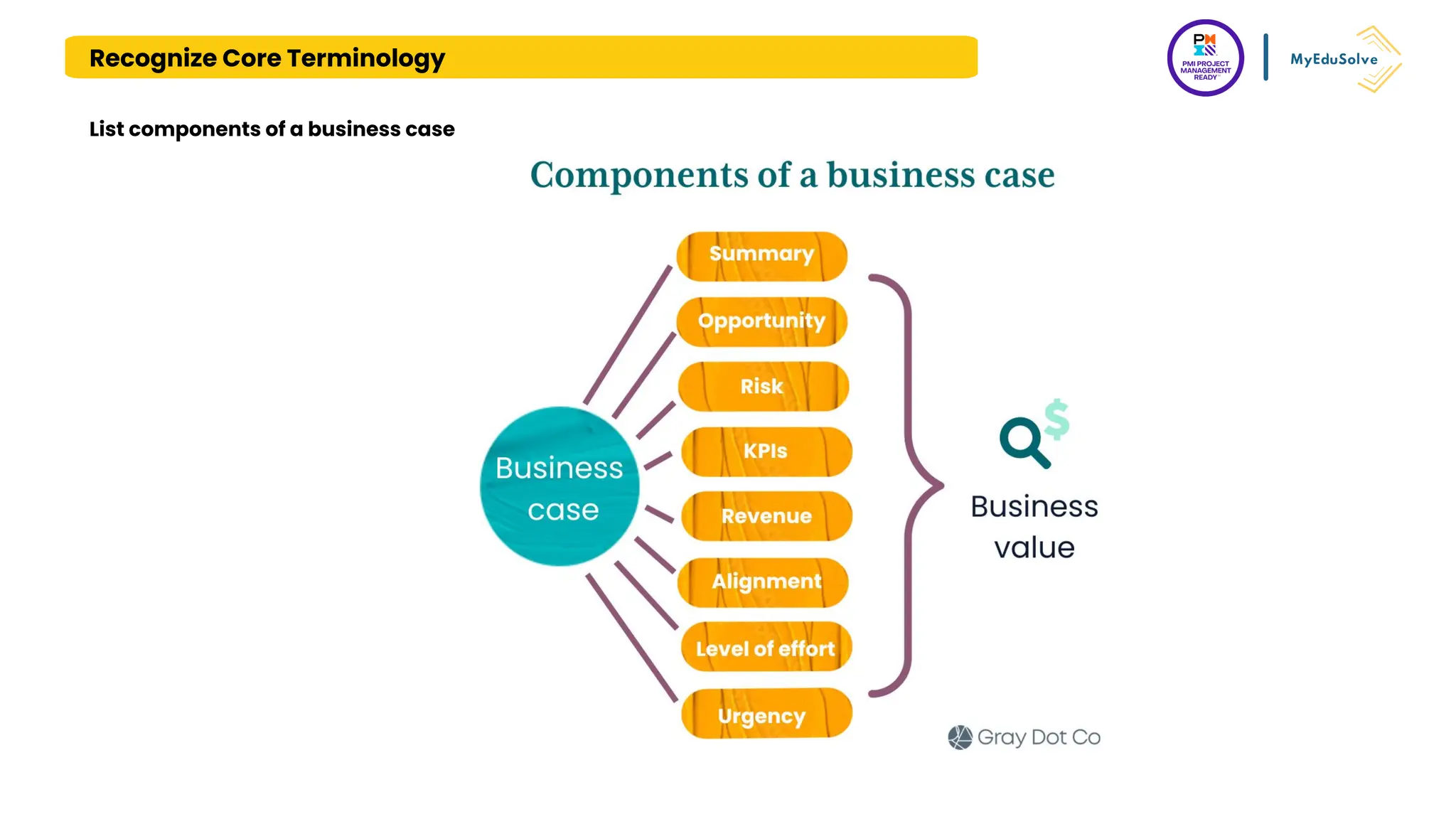
1.1.8 List components of a business case
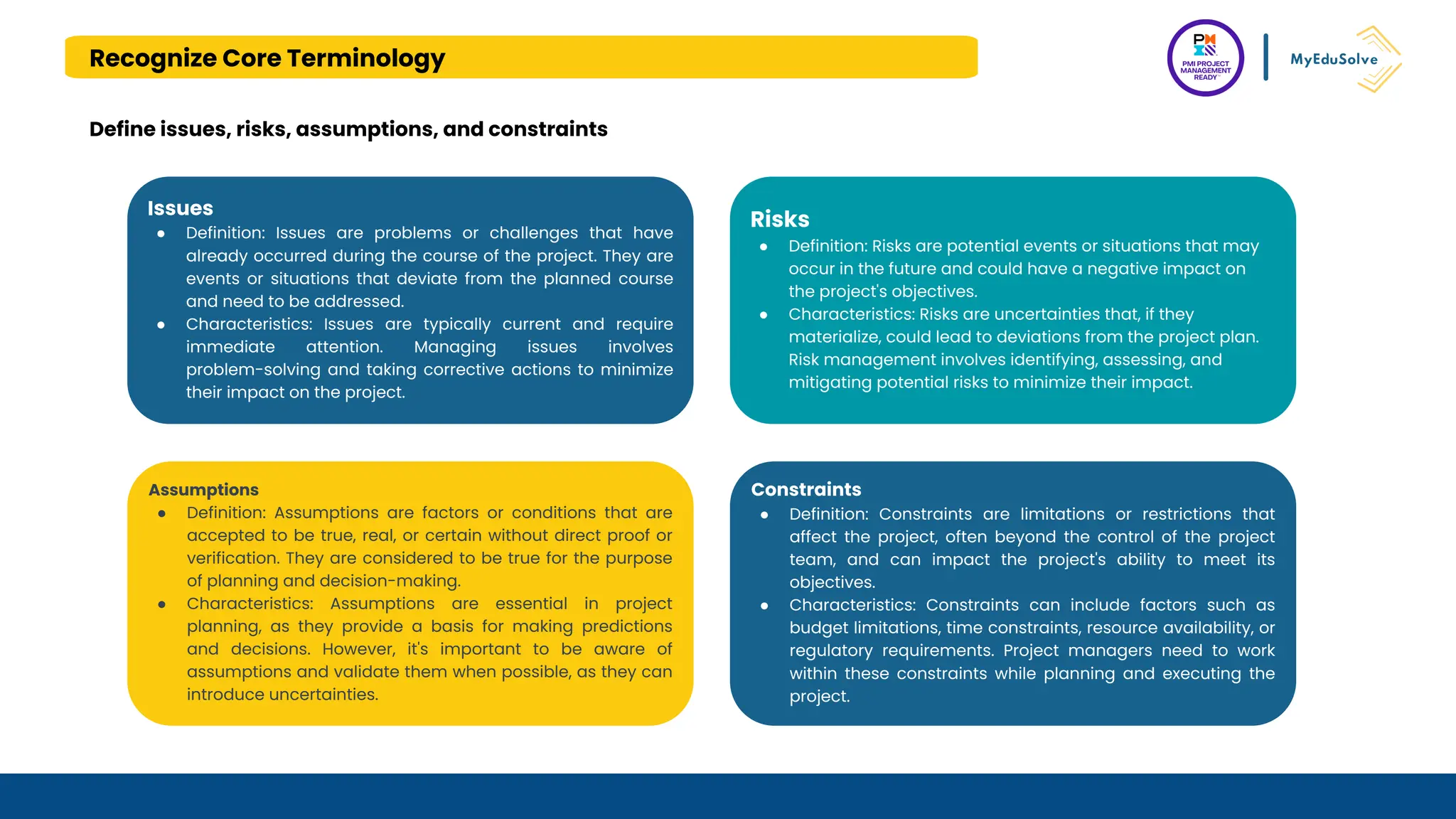
1.1.9 Define issues, risks, assumptions, and constraints
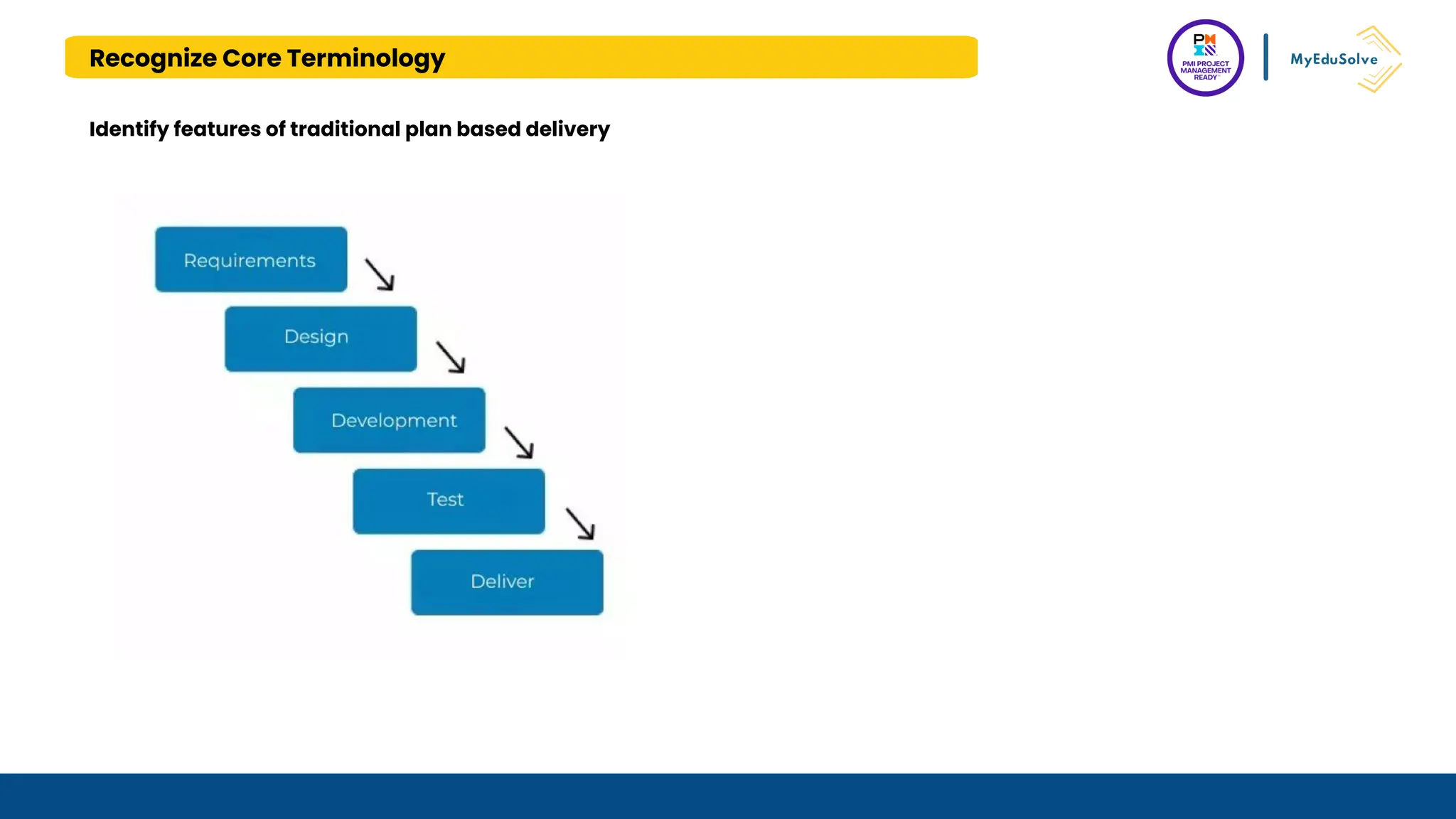
1.1.10 Identify features of traditional plan based delivery
1.1.11 Identify features of agile delivery
1.1.12 Identify project management ethics (refer to PMI code of ethics)
Recognize Core Terminology
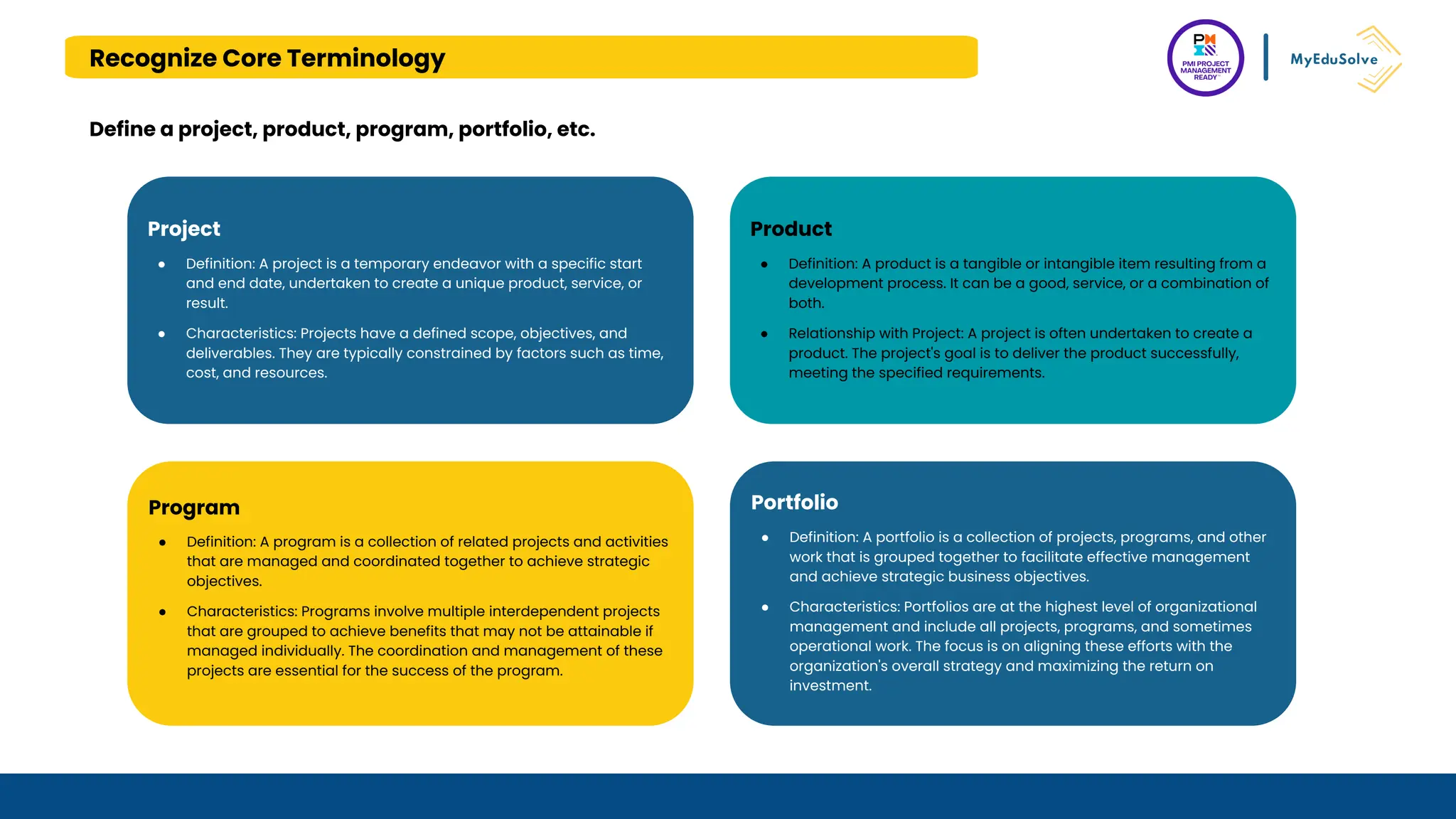
Define a project, product, program, portfolio, etc.
Project
● Definition: A project is a temporary endeavor with a specific start
and end date, undertaken to create a unique product, service, or
result.
● Characteristics: Projects have a defined scope, objectives, and
deliverables. They are typically constrained by factors such as time,
cost, and resources.
Product
● Definition: A product is a tangible or intangible item resulting from a
development process. It can be a good, service, or a combination of
both.
● Relationship with Project: A project is often undertaken to create a
product. The project's goal is to deliver the product successfully,
meeting the specified requirements.
Program
● Definition: A program is a collection of related projects and activities
that are managed and coordinated together to achieve strategic
objectives.
● Characteristics: Programs involve multiple interdependent projects
that are grouped to achieve benefits that may not be attainable if
managed individually. The coordination and management of these
projects are essential for the success of the program.
Portfolio
● Definition: A portfolio is a collection of projects, programs, and other
work that is grouped together to facilitate effective management
and achieve strategic business objectives.
● Characteristics: Portfolios are at the highest level of organizational
management and include all projects, programs, and sometimes
operational work. The focus is on aligning these efforts with the
organization's overall strategy and maximizing the return on
investment.
Recognize Core Terminology
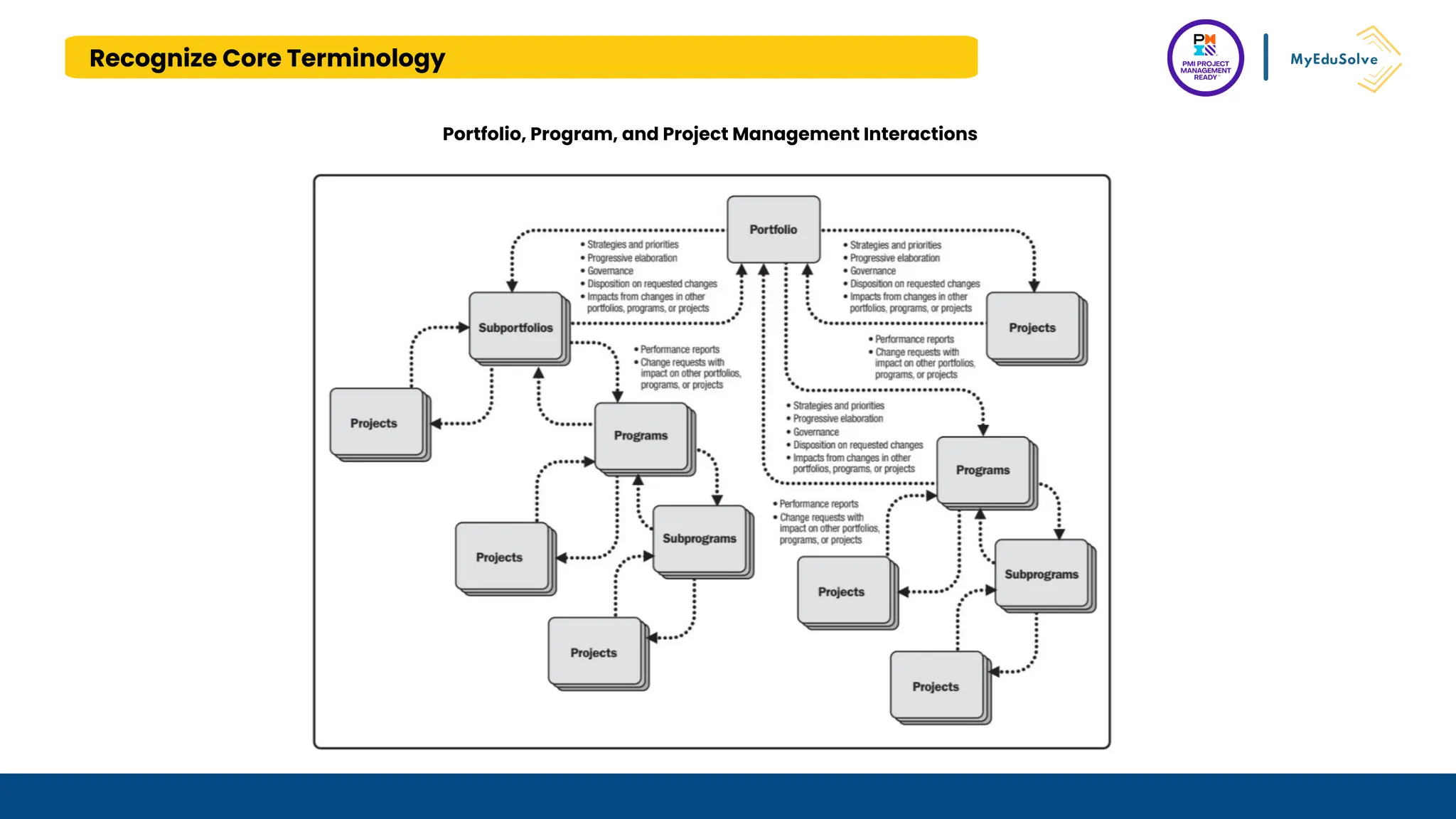
Portfolio, Program, and Project Management Interactions
Recognize Core Terminology
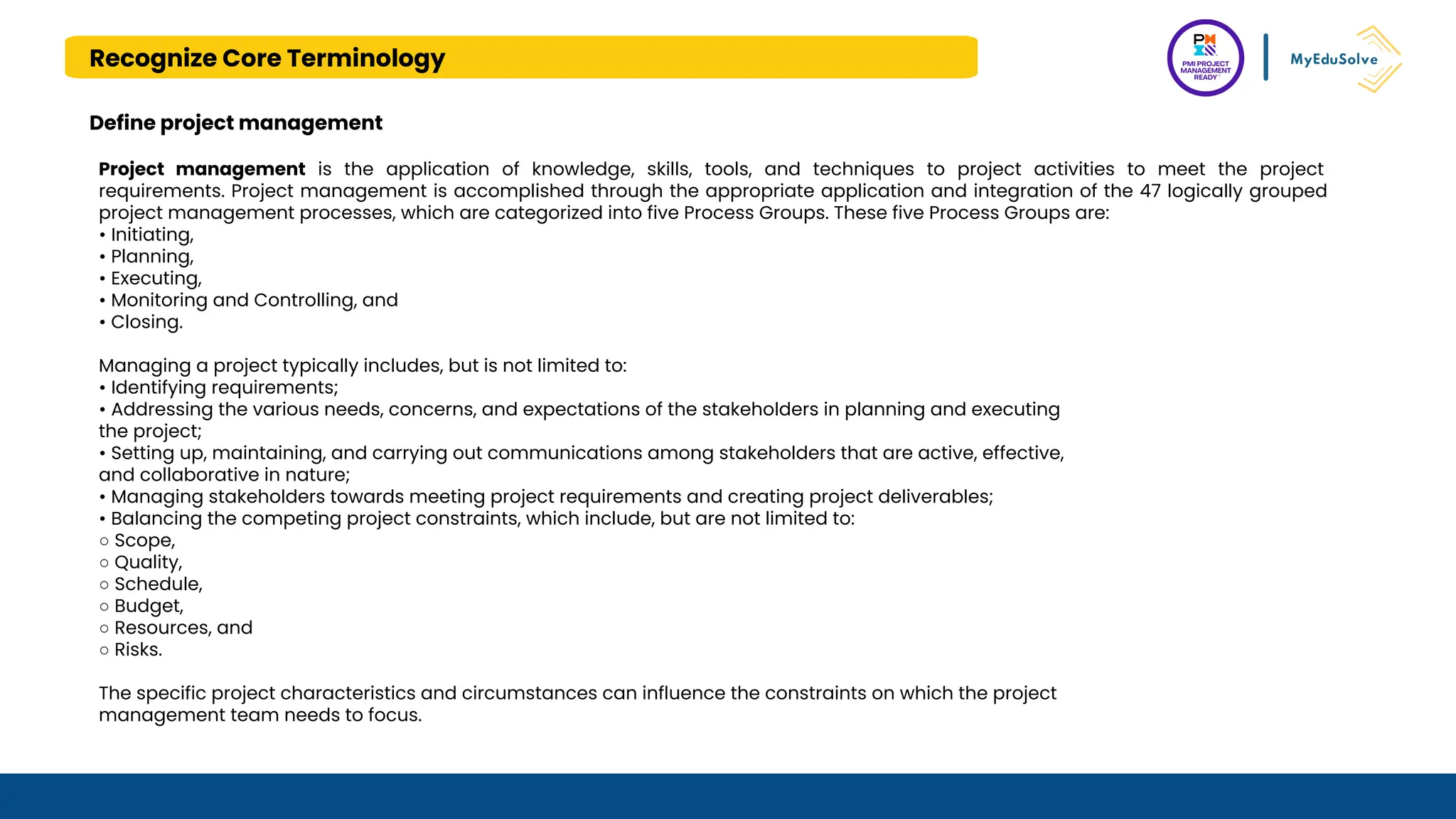
Define project management
Project management is the application of knowledge, skills, tools, and techniques to project activities to meet the project
requirements. Project management is accomplished through the appropriate application and integration of the 47 logically grouped
project management processes, which are categorized into five Process Groups. These five Process Groups are:
• Initiating,
• Planning,
• Executing,
• Monitoring and Controlling, and
• Closing.
Managing a project typically includes, but is not limited to:
• Identifying requirements;
• Addressing the various needs, concerns, and expectations of the stakeholders in planning and executing
the project;
• Setting up, maintaining, and carrying out communications among stakeholders that are active, effective,
and collaborative in nature;
• Managing stakeholders towards meeting project requirements and creating project deliverables;
• Balancing the competing project constraints, which include, but are not limited to:
○ Scope,
○ Quality,
○ Schedule,
○ Budget,
○ Resources, and
○ Risks.
The specific project characteristics and circumstances can influence the constraints on which the project
management team needs to focus.
Recognize Core Terminology
Define a business case
A business case is a document that outlines the justification for initiating a project. It provides a detailed analysis of the project's
potential benefits, costs, risks, and alternatives. The purpose of a business case is to help stakeholders, including decision-makers and
sponsors, understand the rationale behind the project and make informed decisions about whether to proceed with it.
In essence, a business case typically includes information on the project's objectives, scope, timeline, budget, expected outcomes, and
the potential return on investment. It serves as a foundation for project planning and serves as a reference point throughout the project
life cycle, helping to ensure that the project stays aligned with organizational goals and objectives.
Recognize Core Terminology
Define project scope
The project scope defines the boundaries and parameters of a project, outlining what is included and what is not.
It encompasses the project's objectives, deliverables, constraints, assumptions, and acceptance criteria.
Essentially, it sets the stage for the entire project by clarifying the work that needs to be done and the goals to be
achieved. A well-defined project scope is crucial for effective project management, helping to prevent scope
creep and ensuring that everyone involved understands the project's boundaries and objectives.
Recognize Core Terminology
Define deliverables
Deliverables in project management are tangible or intangible items, results, or outputs that are produced or
provided as a result of completing a project. These can be specific products, services, documents, or any other
measurable outcome that contributes to the achievement of the project's objectives.
For example, in a software development project, the deliverables could include the completed software application,
user manuals, and training materials. In a marketing campaign, the deliverables might be a set of promotional
materials, a social media strategy document, and the actual campaign launch.
Defining and clearly outlining deliverables is essential in project management as they help set expectations, guide
the project team's work, and provide a basis for measuring project success.
Recognize Core Terminology
Define a milestone and task
In project management, milestones and tasks are essential components that help in planning, tracking, and managing projects.
Milestone
● A milestone is a significant point or event in a project that represents a key achievement or completion of a major phase.
● Milestones are used to track progress and mark important project stages. They are typically associated with specific dates
and serve as indicators that the project is moving forward as planned.
● Examples of milestones could be completing a critical phase of development, obtaining client approval, or reaching a key
project deadline.
Task
● A task is a specific activity or unit of work that needs to be accomplished within a project.
● Tasks are smaller, manageable components that contribute to the overall completion of the project. They are often
detailed in a project plan, including information such as task description, start and end dates, dependencies, and assigned
resources.
● Examples of tasks could be coding a specific feature, conducting market research, or creating a project report.
Recognize Core Terminology
List components of a project
Recognize Core Terminology
List components of a business case
Recognize Core Terminology
Define issues, risks, assumptions, and constraints
Issues
● Definition: Issues are problems or challenges that have
already occurred during the course of the project. They are
events or situations that deviate from the planned course
and need to be addressed.
● Characteristics: Issues are typically current and require
immediate attention. Managing issues involves
problem-solving and taking corrective actions to minimize
their impact on the project.
Risks
● Definition: Risks are potential events or situations that may
occur in the future and could have a negative impact on
the project's objectives.
● Characteristics: Risks are uncertainties that, if they
materialize, could lead to deviations from the project plan.
Risk management involves identifying, assessing, and
mitigating potential risks to minimize their impact.
Assumptions
● Definition: Assumptions are factors or conditions that are
accepted to be true, real, or certain without direct proof or
verification. They are considered to be true for the purpose
of planning and decision-making.
● Characteristics: Assumptions are essential in project
planning, as they provide a basis for making predictions
and decisions. However, it's important to be aware of
assumptions and validate them when possible, as they can
introduce uncertainties.
Constraints
● Definition: Constraints are limitations or restrictions that
affect the project, often beyond the control of the project
team, and can impact the project's ability to meet its
objectives.
● Characteristics: Constraints can include factors such as
budget limitations, time constraints, resource availability, or
regulatory requirements. Project managers need to work
within these constraints while planning and executing the
project.
Recognize Core Terminology
Identify features of traditional plan based delivery
Recognize Core Terminology
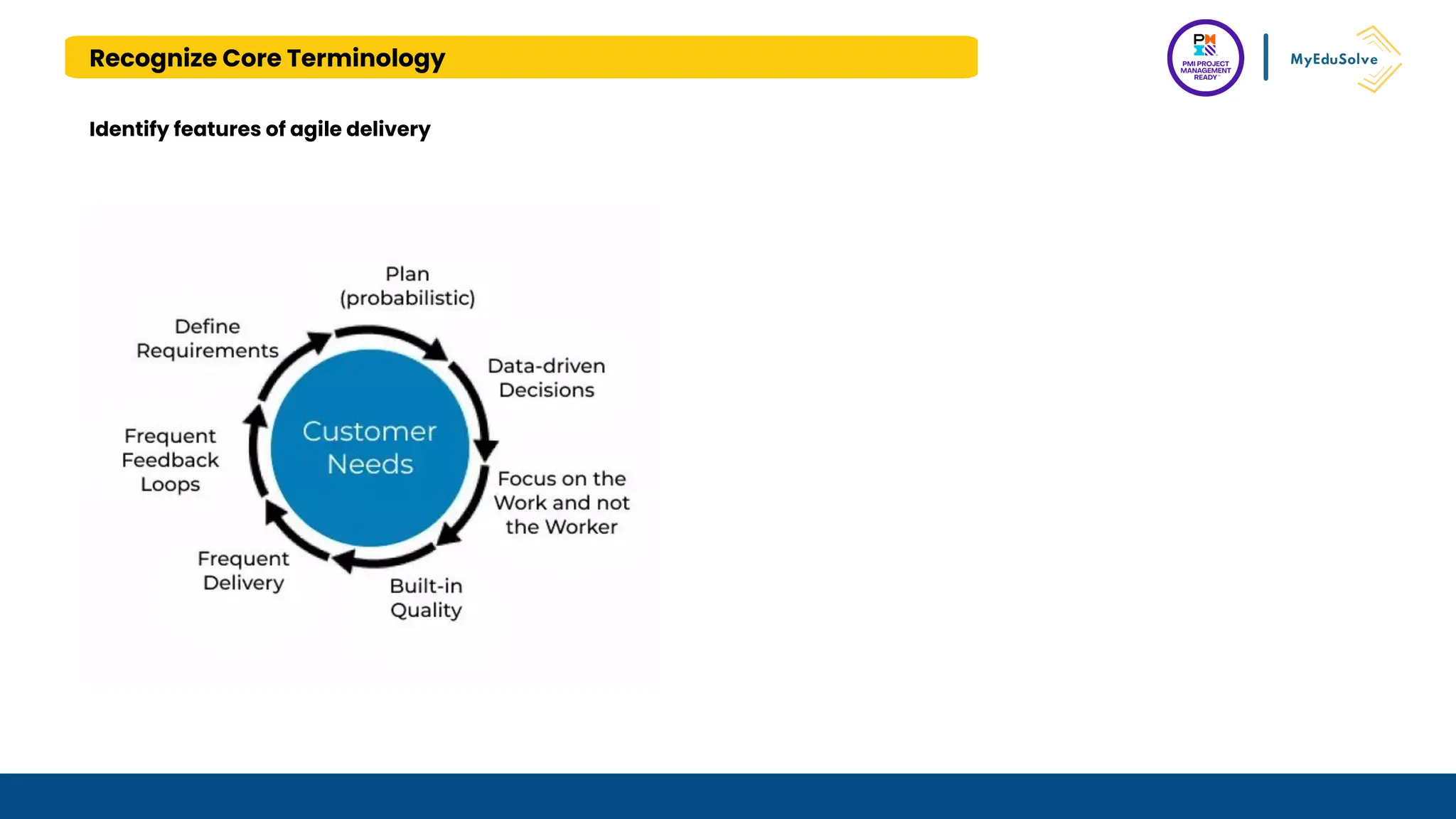
Identify features of agile delivery
Recognize Core Terminology
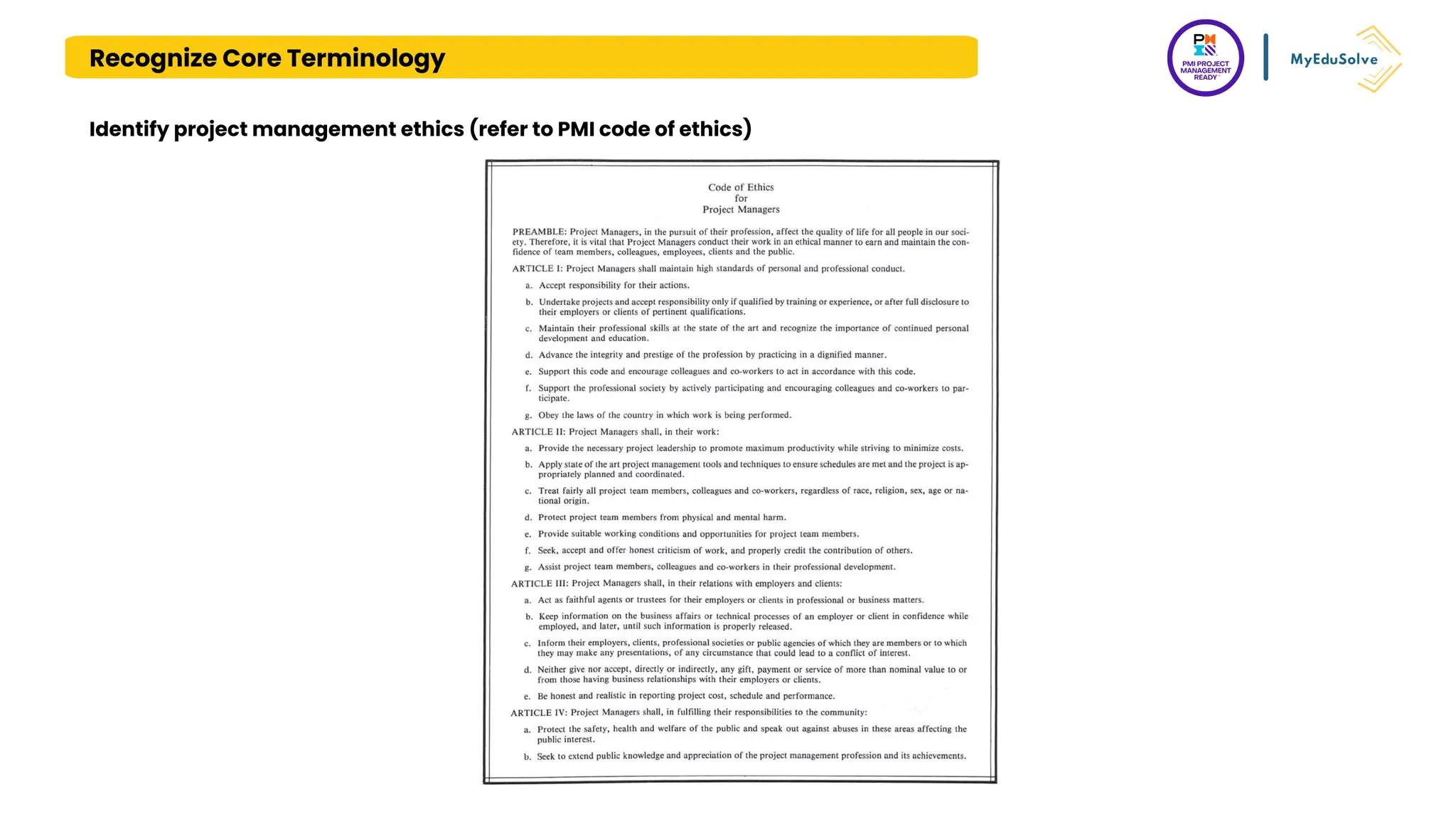
Identify project management ethics (refer to PMI code of ethics)
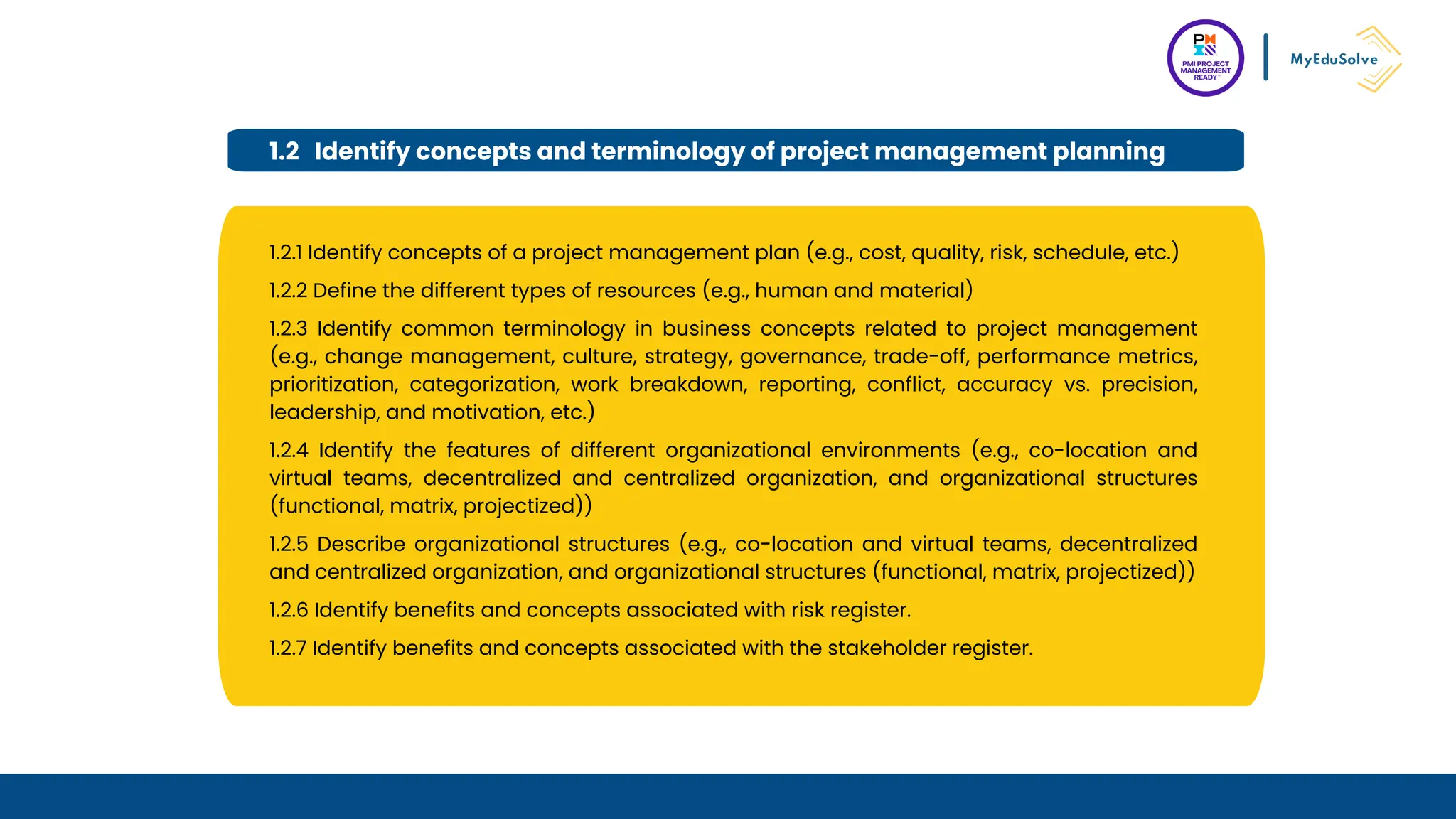
1.2 Identify concepts and terminology of project management planning
1.2.1 Identify concepts of a project management plan (e.g., cost, quality, risk, schedule, etc.)
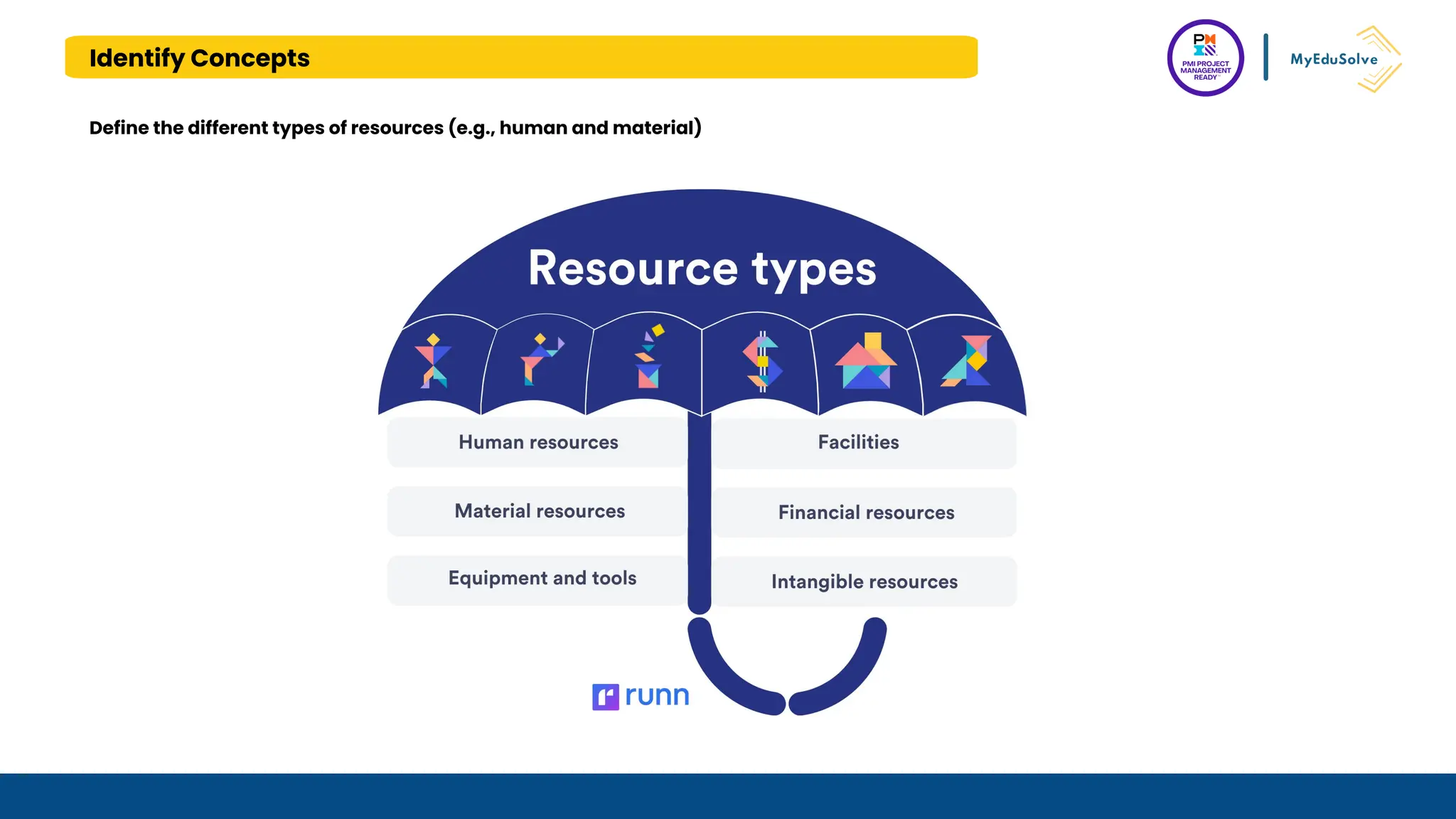
1.2.2 Define the different types of resources (e.g., human and material)
1.2.3 Identify common terminology in business concepts related to project management
(e.g., change management, culture, strategy, governance, trade-off, performance metrics,
prioritization, categorization, work breakdown, reporting, conflict, accuracy vs. precision,
leadership, and motivation, etc.)
1.2.4 Identify the features of different organizational environments (e.g., co-location and
virtual teams, decentralized and centralized organization, and organizational structures
(functional, matrix, projectized))
1.2.5 Describe organizational structures (e.g., co-location and virtual teams, decentralized
and centralized organization, and organizational structures (functional, matrix, projectized))
1.2.6 Identify benefits and concepts associated with risk register.
1.2.7 Identify benefits and concepts associated with the stakeholder register.
Identify Concepts
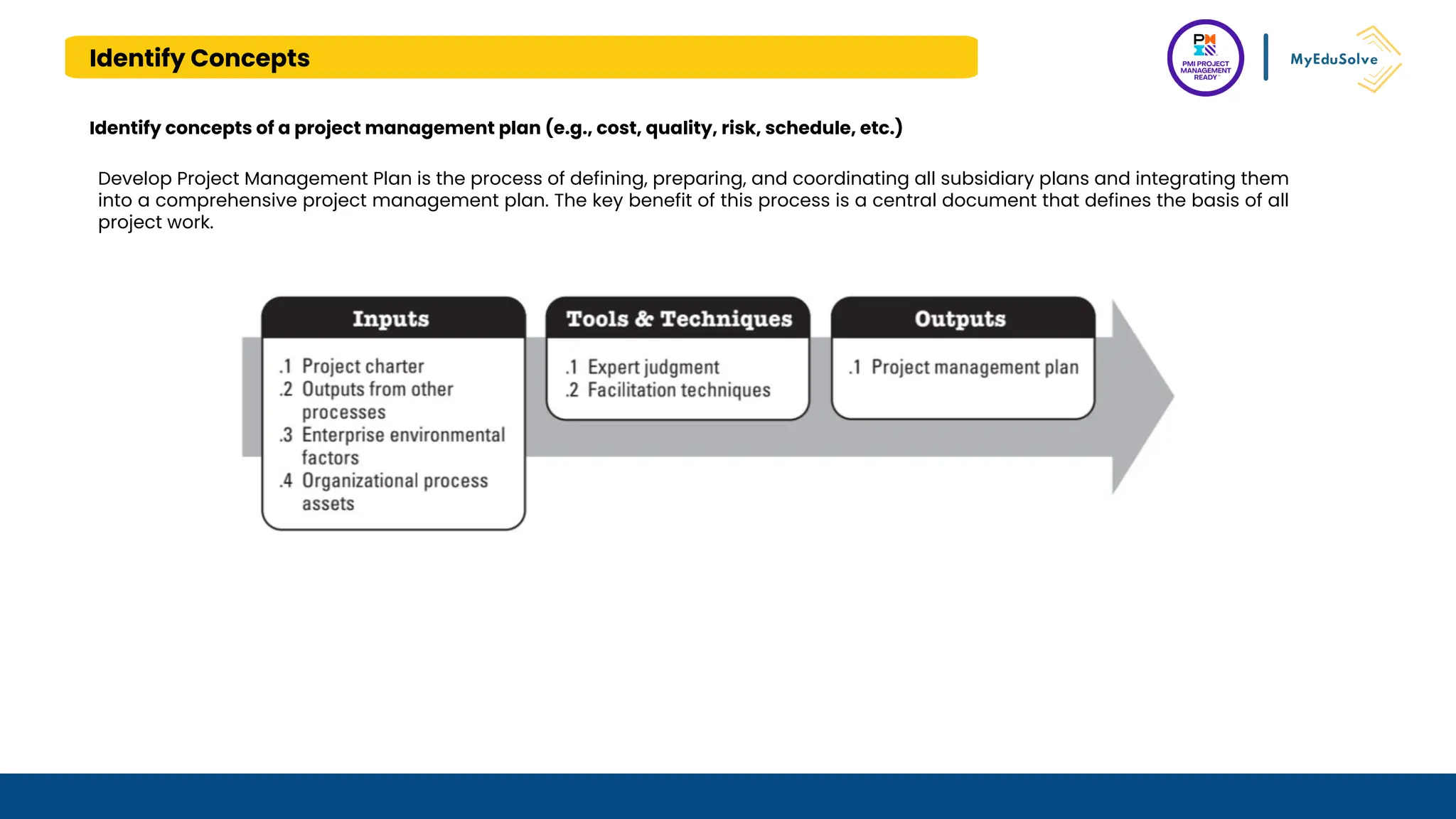
Identify concepts of a project management plan (e.g., cost, quality, risk, schedule, etc.)
Develop Project Management Plan is the process of defining, preparing, and coordinating all subsidiary plans and integrating them
into a comprehensive project management plan. The key benefit of this process is a central document that defines the basis of all
project work.
Identify Concepts
Identify concepts of a project management plan (e.g., cost, quality, risk, schedule, etc.)
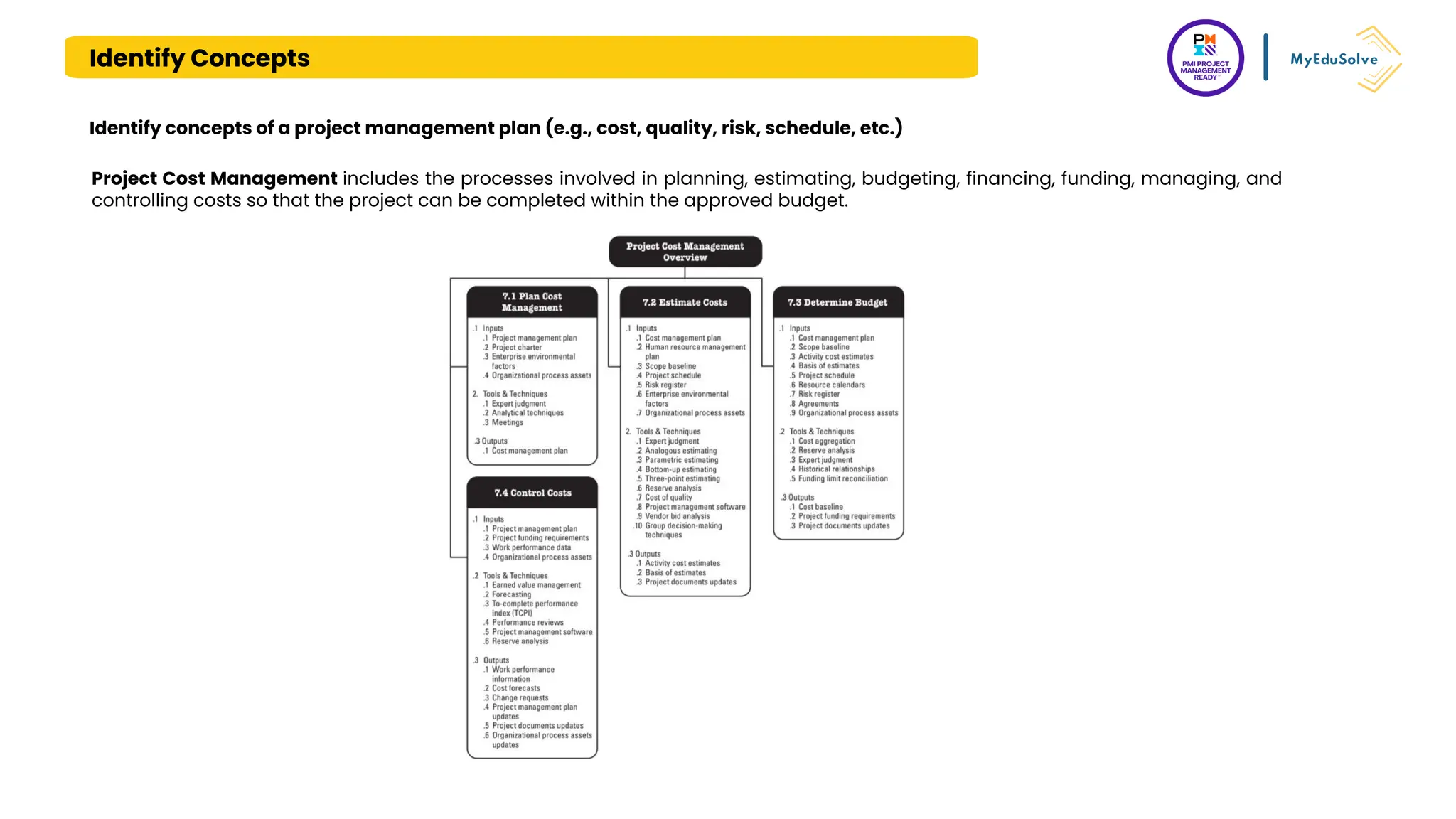
Project Cost Management includes the processes involved in planning, estimating, budgeting, financing, funding, managing, and
controlling costs so that the project can be completed within the approved budget.
Identify Concepts
Identify concepts of a project management plan (e.g., cost, quality, risk, schedule, etc.)
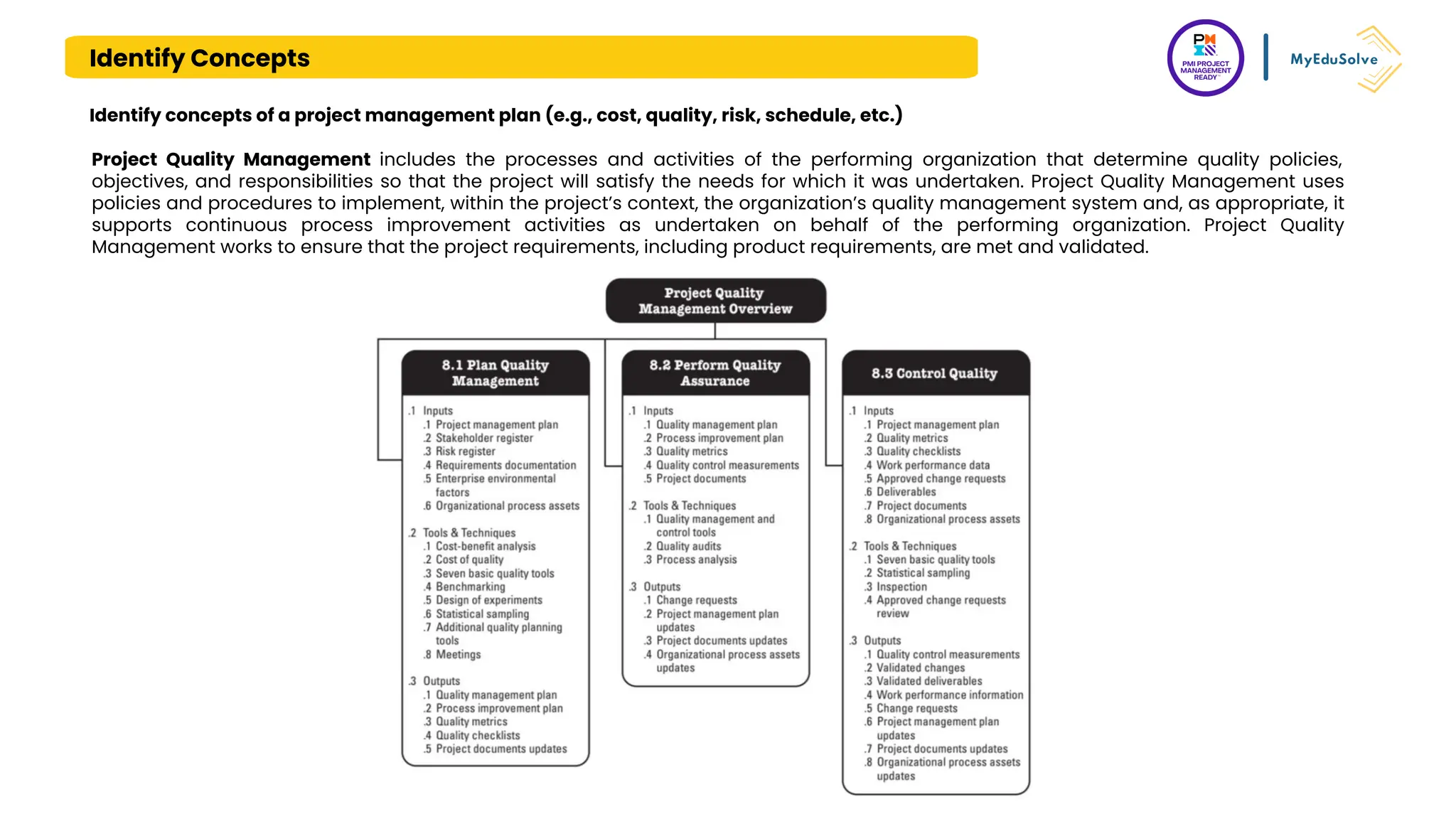
Project Quality Management includes the processes and activities of the performing organization that determine quality policies,
objectives, and responsibilities so that the project will satisfy the needs for which it was undertaken. Project Quality Management uses
policies and procedures to implement, within the project’s context, the organization’s quality management system and, as appropriate, it
supports continuous process improvement activities as undertaken on behalf of the performing organization. Project Quality
Management works to ensure that the project requirements, including product requirements, are met and validated.
Identify Concepts
Identify concepts of a project management plan (e.g., cost, quality, risk, schedule, etc.)
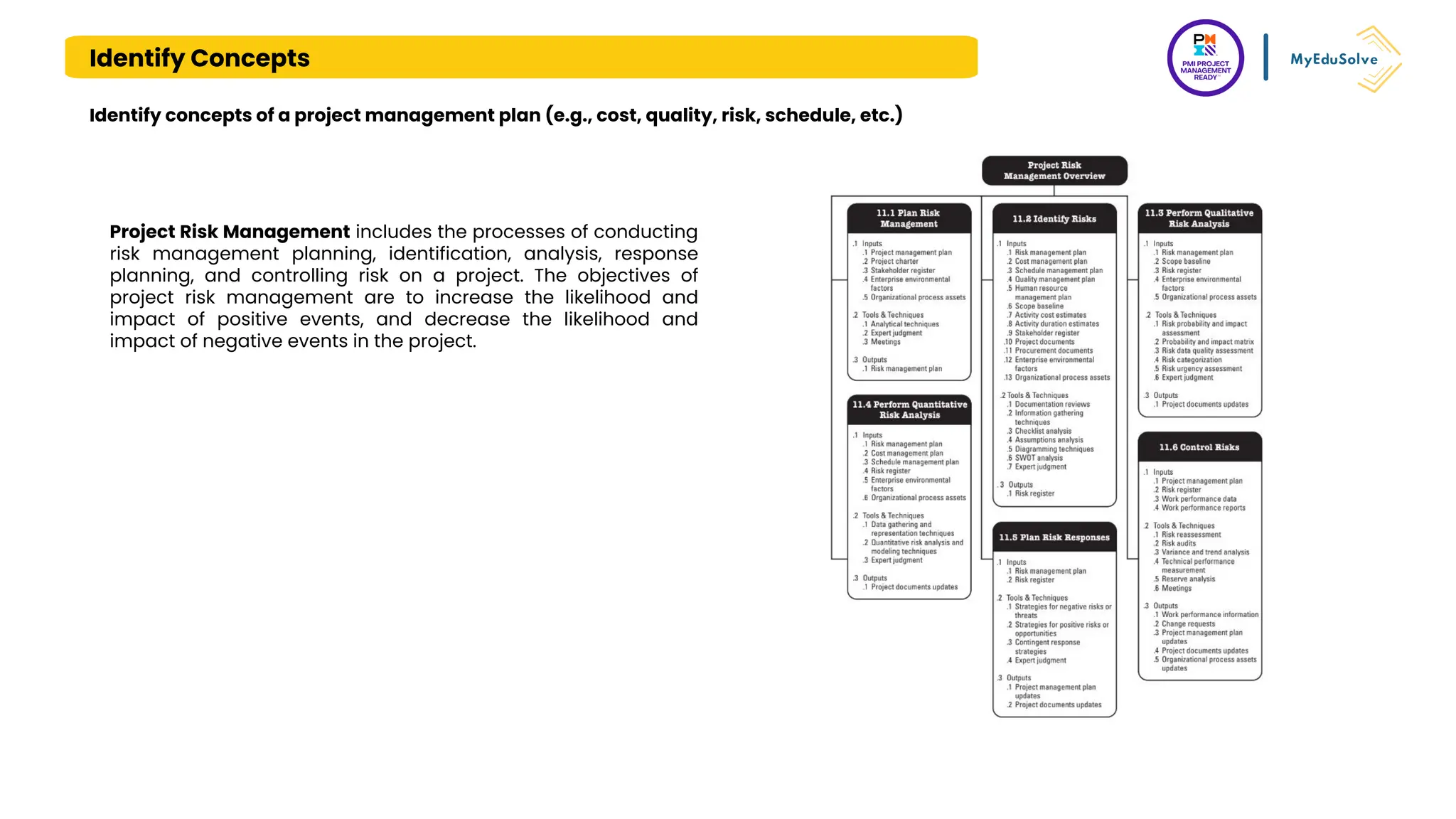
Project Risk Management includes the processes of conducting
risk management planning, identification, analysis, response
planning, and controlling risk on a project. The objectives of
project risk management are to increase the likelihood and
impact of positive events, and decrease the likelihood and
impact of negative events in the project.
Identify Concepts
Identify concepts of a project management plan (e.g., cost, quality, risk, schedule, etc.)
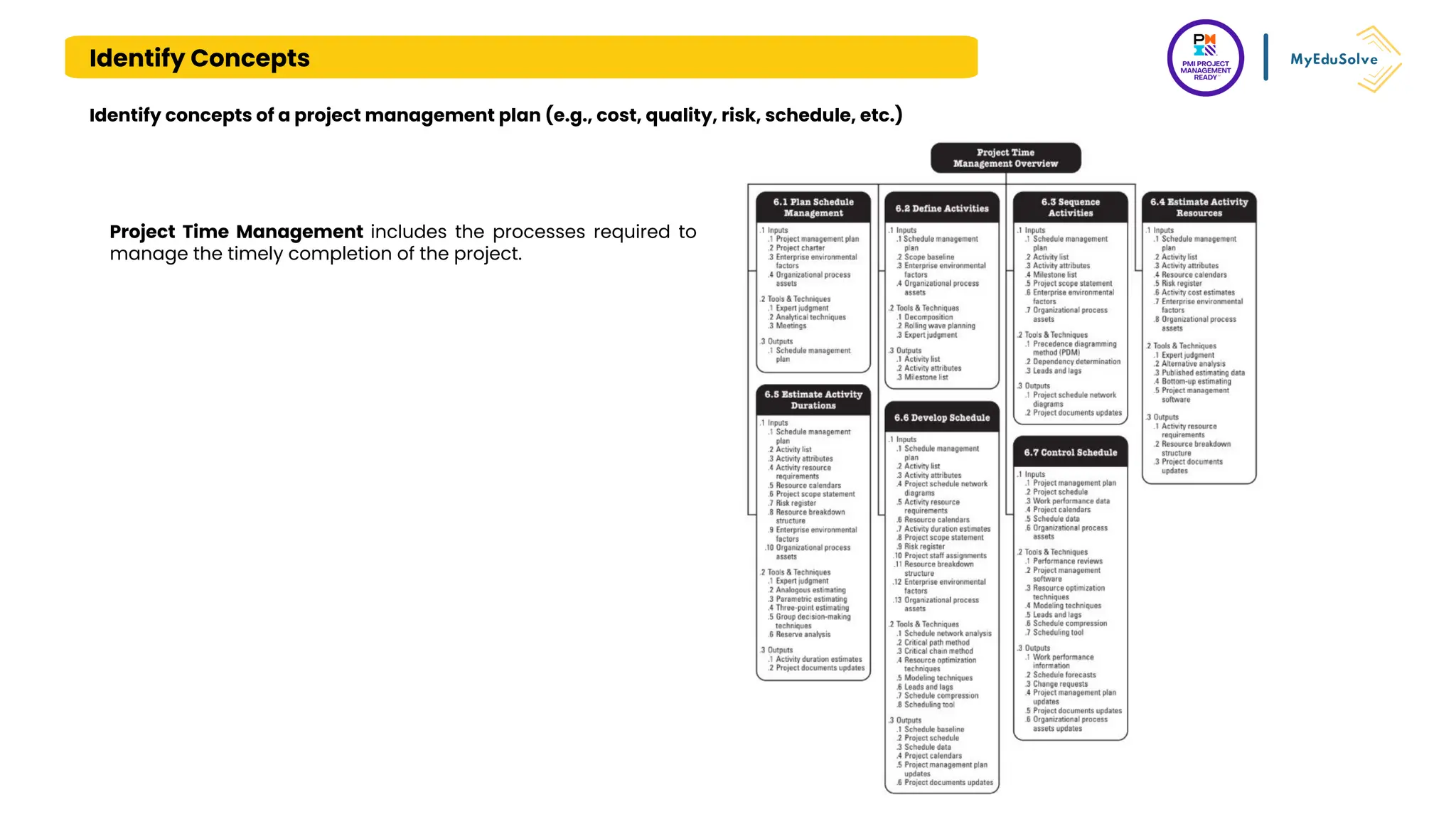
Project Time Management includes the processes required to
manage the timely completion of the project.
Identify Concepts
Define the different types of resources (e.g., human and material)
Identify Concepts
Identify common terminology in business concepts related to project management
1. Project:
● A temporary endeavor undertaken to create a unique
product, service, or result.
2. Stakeholder:
● An individual, group, or organization that may affect,
be affected by, or perceive itself to be affected by a
decision, activity, or outcome of a project.
3. Scope:
● The sum of the products, services, and results to be
provided as a project.
4. Milestone:
● A significant point or event in a project, often
representing the completion of a major phase.
5. Task:
● An individual unit of work or activity that needs to be
completed within the project.
6. Gantt Chart:
● A visual representation of a project schedule, showing
tasks, durations, and dependencies over time.
7. Critical Path:
● The sequence of stages determining the minimum
time needed for an operation.
8. Risk:
● An uncertain event or condition that, if it occurs,
can have a positive or negative effect on the
project objectives.
9. Quality:
● The degree to which a set of inherent
characteristics of a product, service, or process
fulfills requirements.
10. Cost:
● The amount of money spent on a specific project
or its components.
11. Budget:
● A financial plan that outlines the estimated costs
for project activities and resources.
12. Resource:
● People, equipment, materials, and other assets
required to complete project activities.
Identify Concepts
Identify common terminology in business concepts related to project management
13. Communication Plan:
● A document that outlines the communication
approach for the project, including stakeholders,
channels, and frequency.
14. Procurement:
● The process of acquiring goods, services, or
works from an external source.
15. Change Management:
● The process of systematically managing and
controlling changes to the project's scope,
schedule, or other components.
16. Baseline:
● A reference point that is used for comparing and
measuring progress during the project.
17. Closure:
● The formal acceptance of the project and the
completion of all project-related activities.
18. WBS (Work Breakdown Structure):
● A hierarchical decomposition of the total scope
of work to be carried out by the project team.
19. PMO (Project Management Office):
● A centralized unit within an organization that
defines and maintains project management
standards.
20. Lessons Learned:
● Insights and knowledge gained from the
process of performing the project, documented
to improve future projects.
Identify Concepts
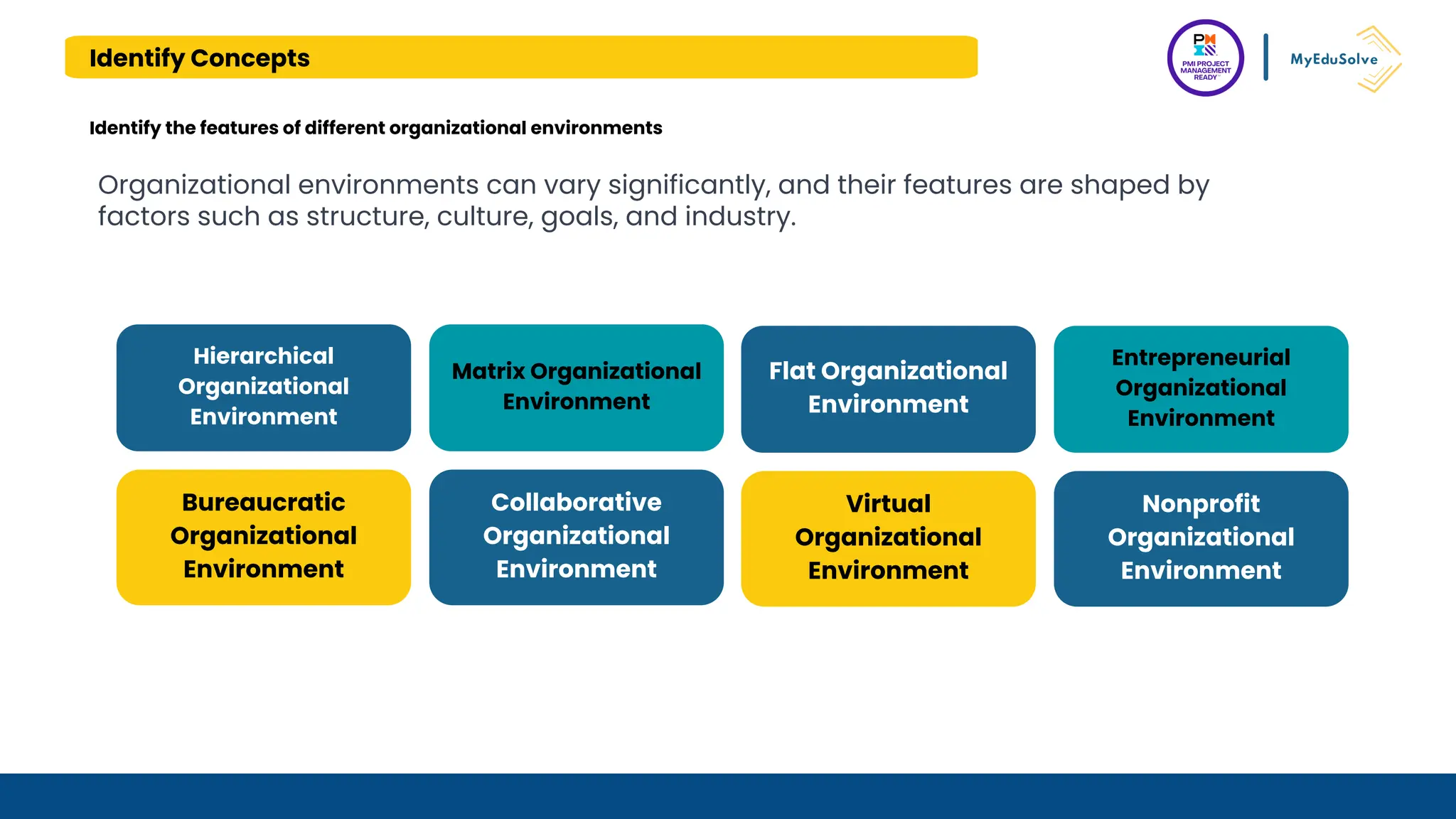
Identify the features of different organizational environments
Organizational environments can vary significantly, and their features are shaped by
factors such as structure, culture, goals, and industry.
Hierarchical
Organizational
Environment
Matrix Organizational
Environment
Bureaucratic
Organizational
Environment
Collaborative
Organizational
Environment
Flat Organizational
Environment
Entrepreneurial
Organizational
Environment
Virtual
Organizational
Environment
Nonprofit
Organizational
Environment
Identify Concepts
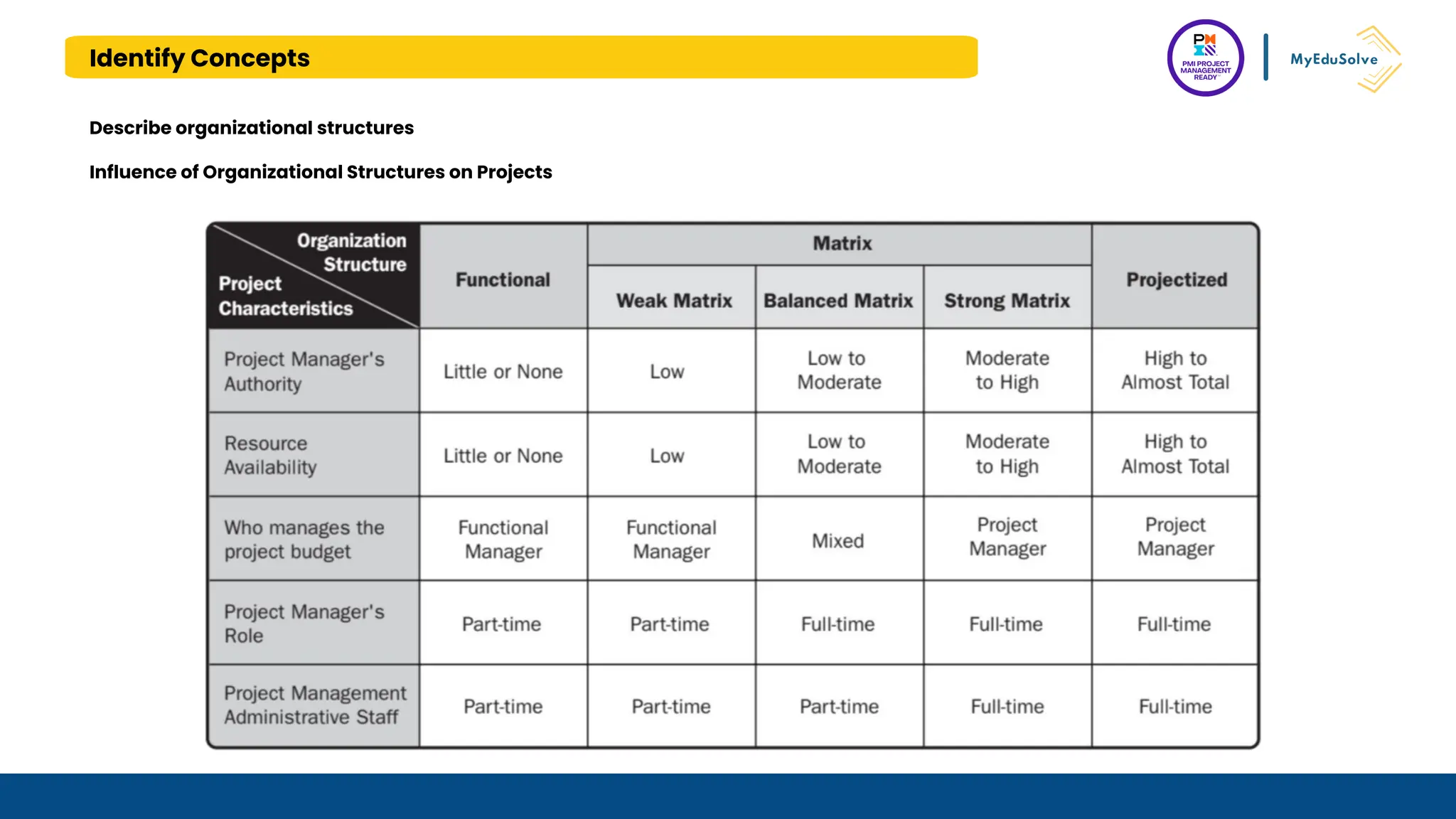
Describe organizational structures
Influence of Organizational Structures on Projects
Identify Concepts
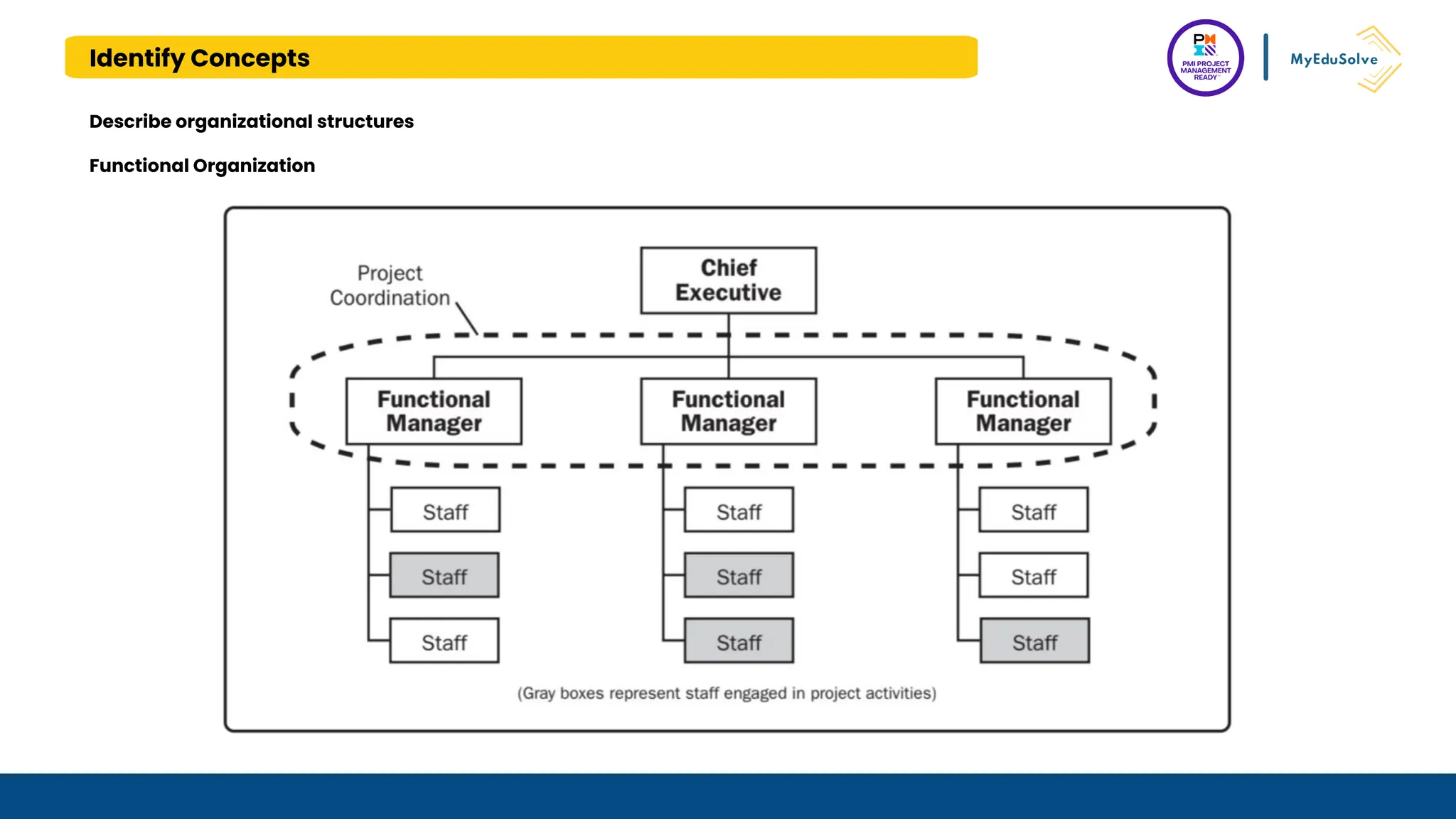
Describe organizational structures
Functional Organization
Identify Concepts
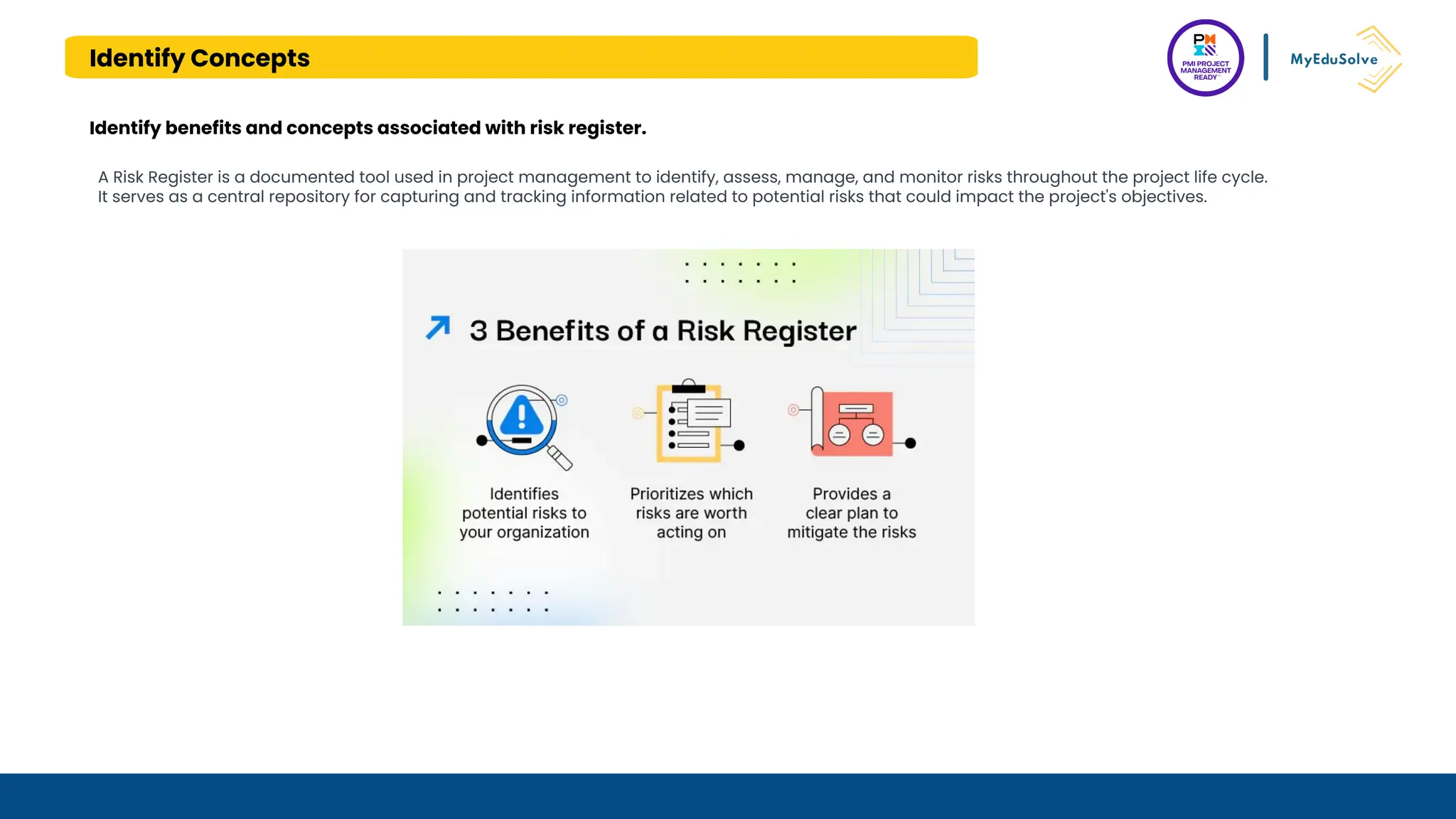
Identify benefits and concepts associated with risk register.
A Risk Register is a documented tool used in project management to identify, assess, manage, and monitor risks throughout the project life cycle.
It serves as a central repository for capturing and tracking information related to potential risks that could impact the project's objectives.
Identify Concepts
A Stakeholder Register is a document in project management that identifies and provides information about the individuals,
groups, or organizations that may be affected by or have an impact on the project. It serves as a tool to systematically gather,
analyze, and document details about stakeholders, helping project managers and teams effectively manage their relationships
and engagement throughout the project life cycle.
The Stakeholder Register in project management offers numerous benefits, including improved communication through tailored
messaging and increased stakeholder engagement. By identifying stakeholders, their interests, and communication preferences,
the register enhances relationship management and facilitates proactive issue identification and risk management. It aids in
decision-making by providing insights into stakeholder influence levels and power dynamics, enabling tailored approaches. The
register supports change management planning, ensuring that stakeholders impacted by changes have their specific needs
addressed. As a central repository for stakeholder information, it promotes adaptability to changing circumstances, facilitating
reporting and documentation of stakeholder engagement throughout the project life cycle. Overall, the Stakeholder Register is a
crucial tool for effective stakeholder management, contributing to project success by aligning with stakeholder expectations and
promoting collaborative relationships.
Identify benefits and concepts associated with the stakeholder register.
1.3 Identify project roles and responsibilities
1.3.1 Define the key stakeholder roles such as project managers, sponsors,
team leaders, team members, project clients, etc.
1.3.2 Define the key stakeholder responsibilities such as project managers,
sponsors, team leaders, team members, project clients, etc.
1.3.3 Identify leadership and management.
Identify Project Roles
Define the key stakeholder roles
1. Project Sponsor
2. Project Manager
3. Project Team
4. Clients
5. End-User
6. External Stakeholders (Govt, Agency, Vendor/Supplier)
Identify Project Roles
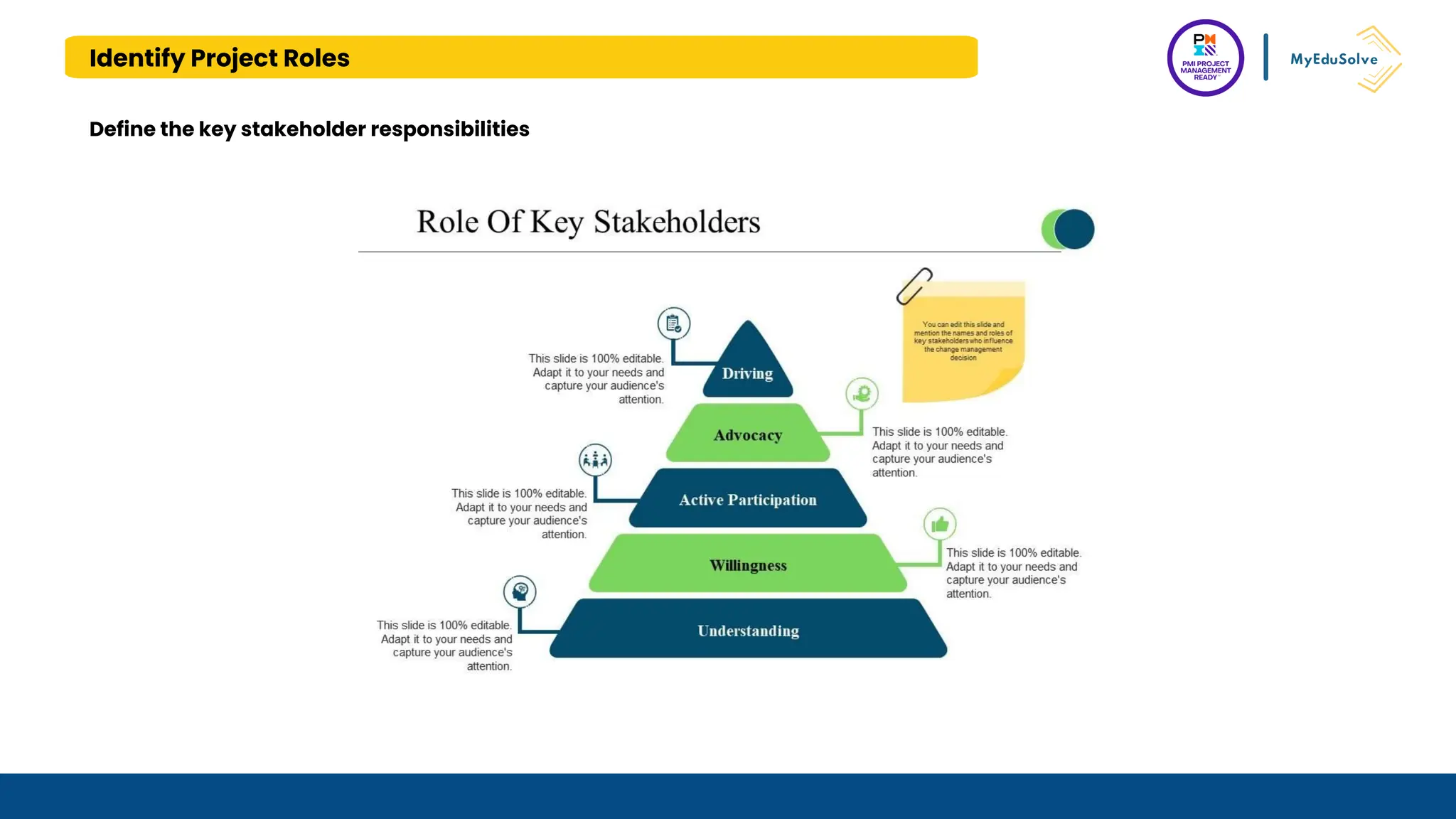
Define the key stakeholder responsibilities
Identify Project Roles
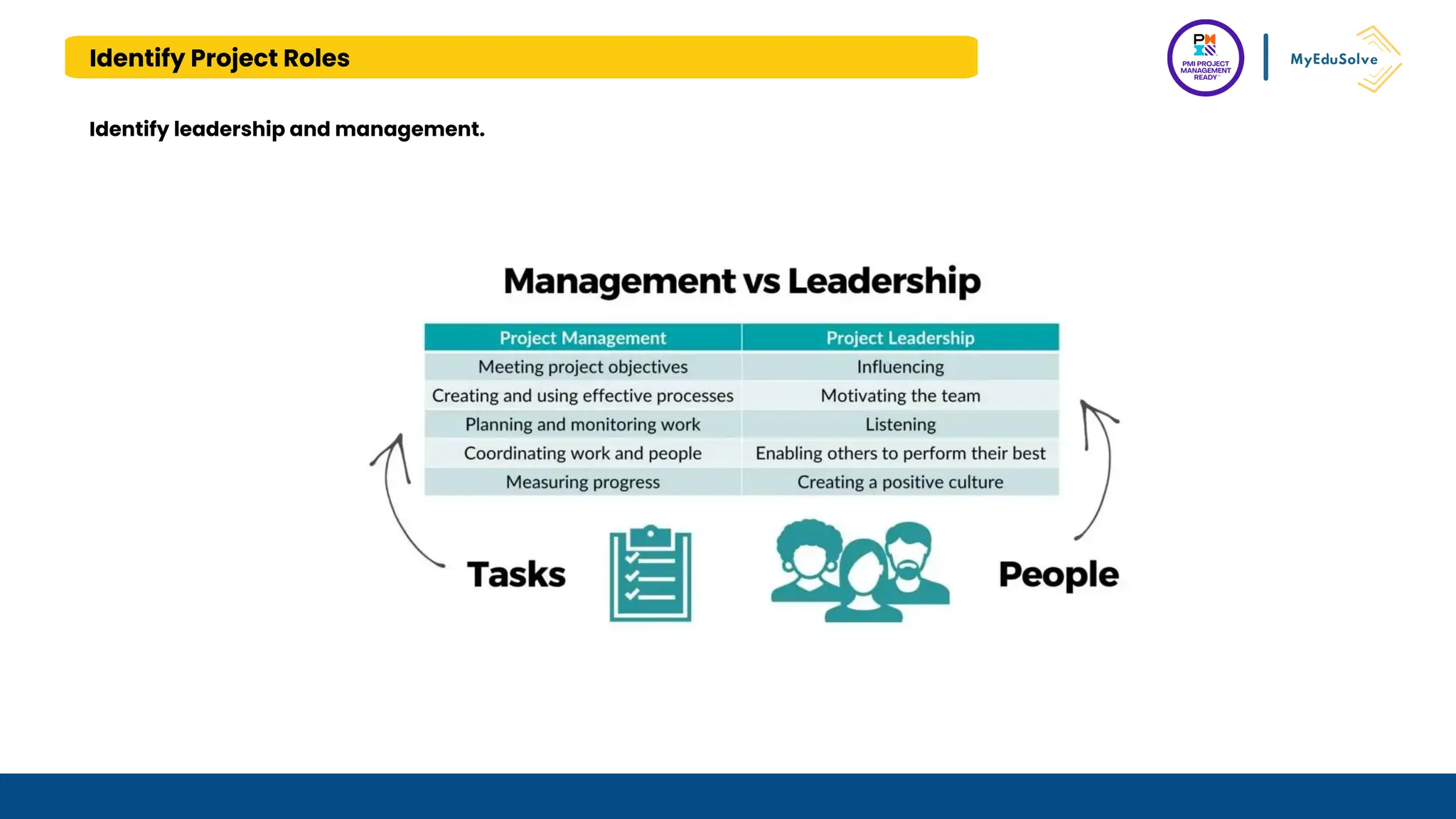
Identify leadership and management.
1.4 Identify tools and systems used for or associated with project management
1.4.1 Identify the typical tools used for creating a project schedule
1.4.2 Define the characteristics and benefits of various project
management tools5.1 Insert illustrations and text boxes
Identify Tools & Systems
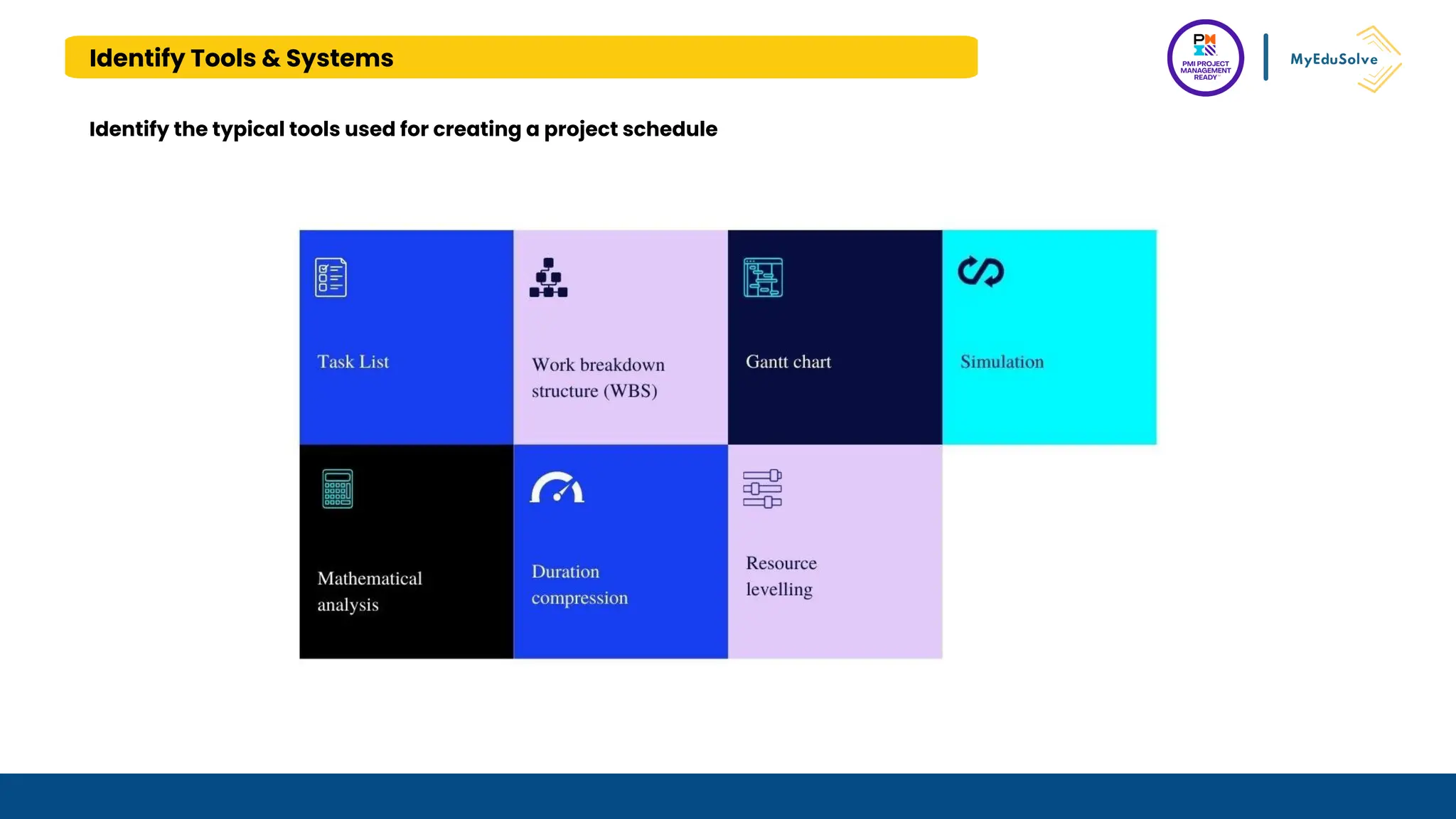
Identify the typical tools used for creating a project schedule
Identify Tools & Systems
Define the characteristics and benefits of various project management tools5.1 Insert
illustrations and text boxes
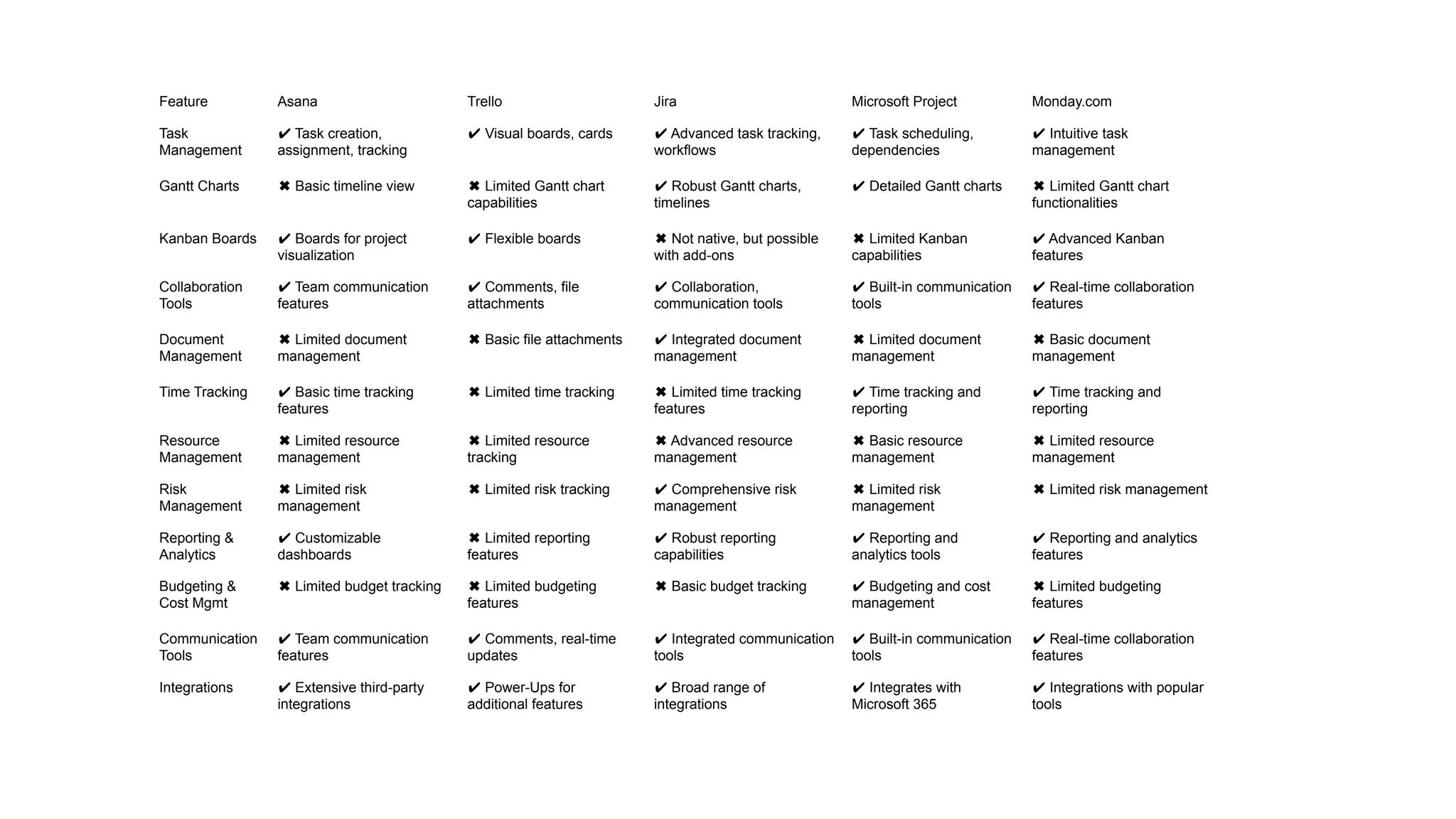
Feature Asana Trello Jira Microsoft Project Monday.com
Task
Management
✔ Task creation,
assignment, tracking
✔ Visual boards, cards ✔ Advanced task tracking,
workflows
✔ Task scheduling,
dependencies
✔ Intuitive task
management
Gantt Charts ✖ Basic timeline view ✖ Limited Gantt chart
capabilities
✔ Robust Gantt charts,
timelines
✔ Detailed Gantt charts ✖ Limited Gantt chart
functionalities
Kanban Boards ✔ Boards for project
visualization
✔ Flexible boards ✖ Not native, but possible
with add-ons
✖ Limited Kanban
capabilities
✔ Advanced Kanban
features
Collaboration
Tools
✔ Team communication
features
✔ Comments, file
attachments
✔ Collaboration,
communication tools
✔ Built-in communication
tools
✔ Real-time collaboration
features
Document
Management
✖ Limited document
management
✖ Basic file attachments ✔ Integrated document
management
✖ Limited document
management
✖ Basic document
management
Time Tracking ✔ Basic time tracking
features
✖ Limited time tracking ✖ Limited time tracking
features
✔ Time tracking and
reporting
✔ Time tracking and
reporting
Resource
Management
✖ Limited resource
management
✖ Limited resource
tracking
✖ Advanced resource
management
✖ Basic resource
management
✖ Limited resource
management
Risk
Management
✖ Limited risk
management
✖ Limited risk tracking ✔ Comprehensive risk
management
✖ Limited risk
management
✖ Limited risk management
Reporting &
Analytics
✔ Customizable
dashboards
✖ Limited reporting
features
✔ Robust reporting
capabilities
✔ Reporting and
analytics tools
✔ Reporting and analytics
features
Budgeting &
Cost Mgmt
✖ Limited budget tracking ✖ Limited budgeting
features
✖ Basic budget tracking ✔ Budgeting and cost
management
✖ Limited budgeting
features
Communication
Tools
✔ Team communication
features
✔ Comments, real-time
updates
✔ Integrated communication
tools
✔ Built-in communication
tools
✔ Real-time collaboration
features
Integrations ✔ Extensive third-party
integrations
✔ Power-Ups for
additional features
✔ Broad range of
integrations
✔ Integrates with
Microsoft 365
✔ Integrations with popular
tools
1.5 Identify common problem-solving tools and techniques
1.5.1 Define common information gathering tools or techniques
1.5.2 Describe the components of an effective meeting
Common problem-solving tools and techniques
Problem Solving
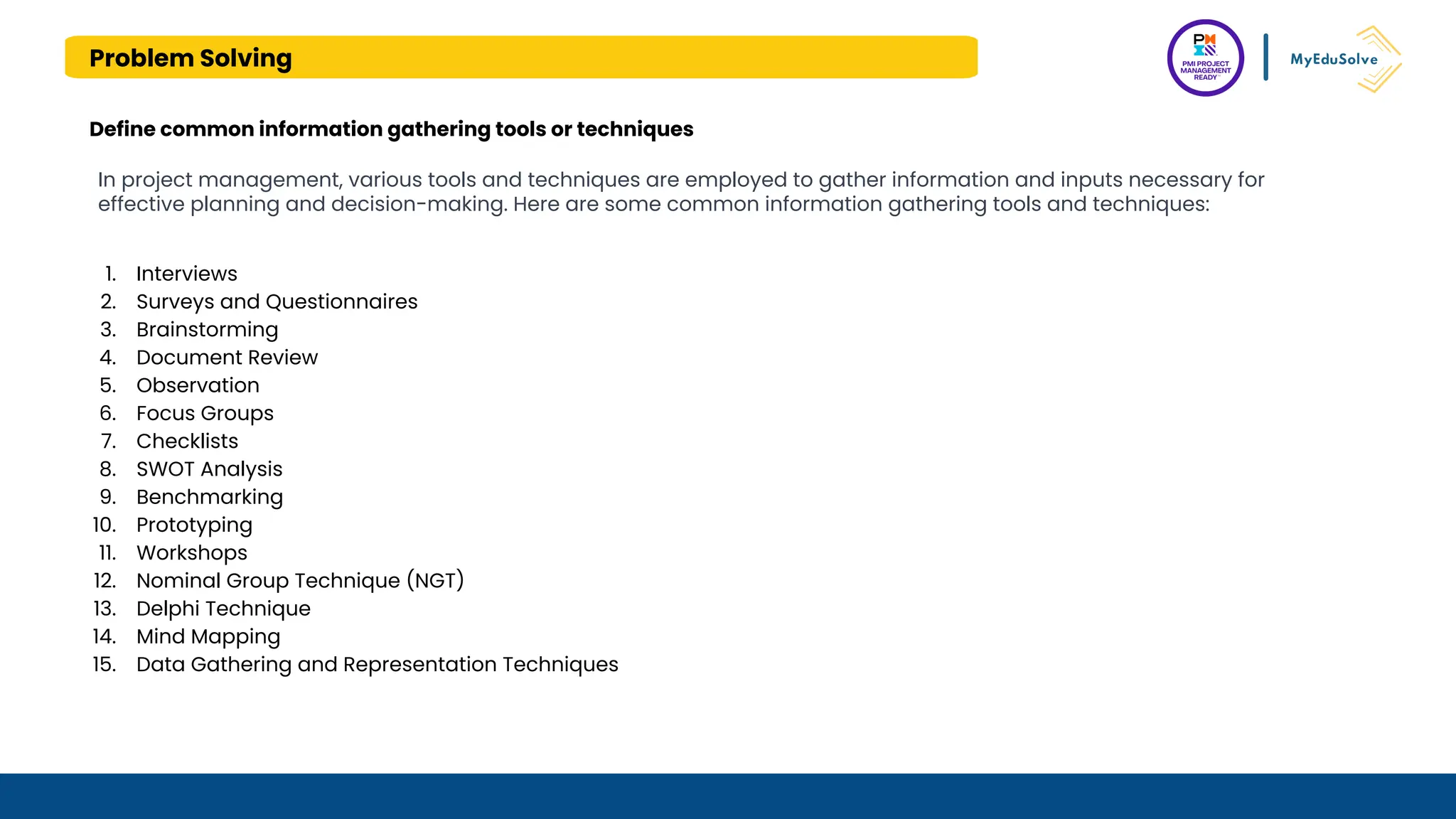
Define common information gathering tools or techniques
In project management, various tools and techniques are employed to gather information and inputs necessary for
effective planning and decision-making. Here are some common information gathering tools and techniques:
1. Interviews
2. Surveys and Questionnaires
3. Brainstorming
4. Document Review
5. Observation
6. Focus Groups
7. Checklists
8. SWOT Analysis
9. Benchmarking
10. Prototyping
11. Workshops
12. Nominal Group Technique (NGT)
13. Delphi Technique
14. Mind Mapping
15. Data Gathering and Representation Techniques
Problem Solving
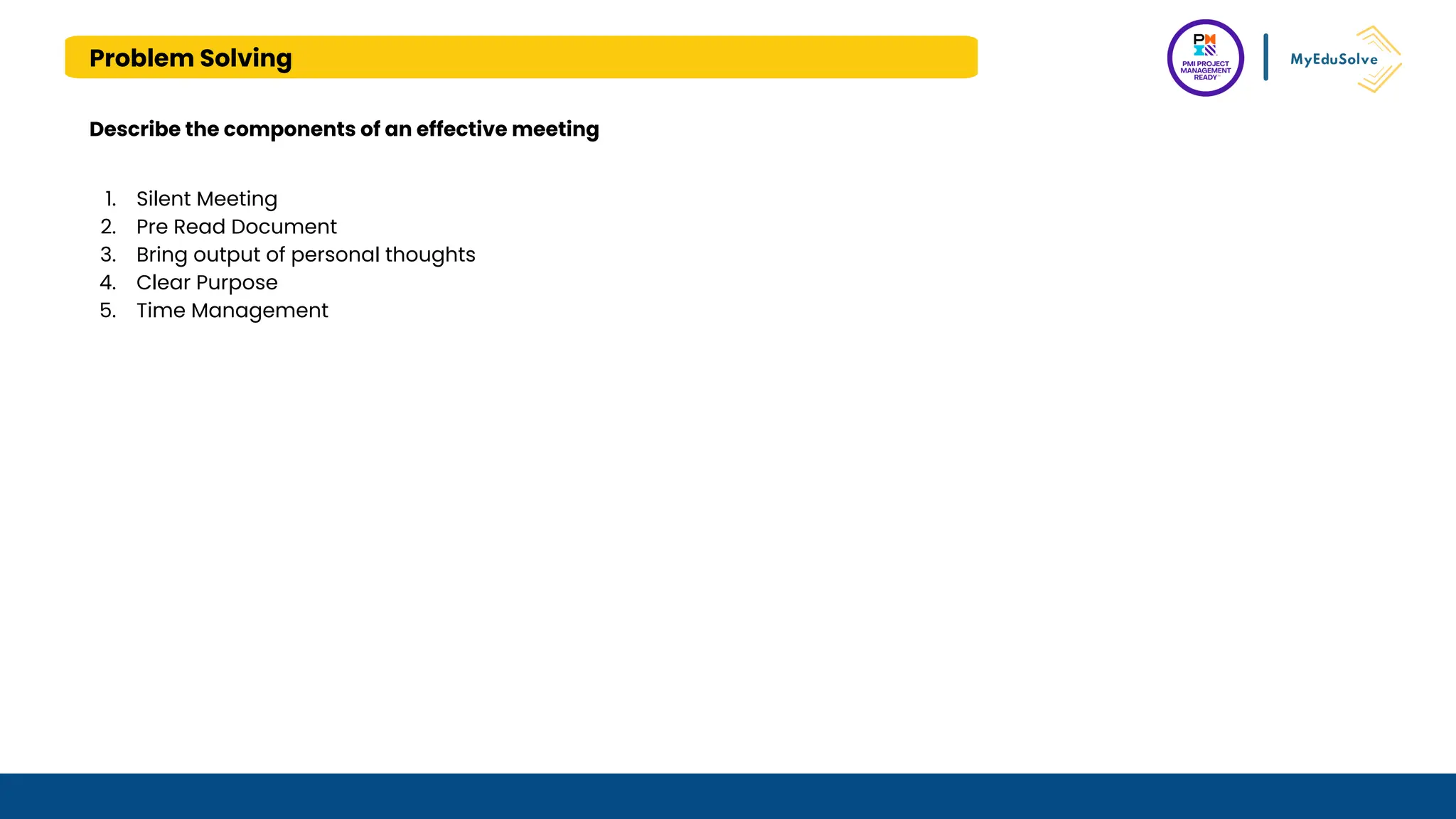
Describe the components of an effective meeting
1. Silent Meeting
2. Pre Read Document
3. Bring output of personal thoughts
4. Clear Purpose
5. Time Management
Quiz / Wrap Up Questions/Discussion
….
Discussion:
Does the project manager have to master all areas of the
project?
QnA
….

project management ready project management ready.pdf

  • 1.
  • 2.
    INTRODUCTION Subject Overview Objectives &Learning Outcome Participants are expected to be learn and able to do the following activities: 1. Module 1 ● Recognize core terminology ● Identify concepts and terminology of project management planning ● Identify project roles and responsibilities ● Identify tools and systems used for or associated with project management ● Identify common problem-solving tools and techniques 2. Module 2 ● Traditional Plan-Based Methodologies ● Identify attributes of a project management plan schedule ● Identify attributes of executing and controlling traditional plan-based projects 3. Module 3 ● Agile Frameworks/Methodologies ● Identify attributes of plan iterations of a project ● Identify agile roles and responsibilities ● Identify attributes of document project controls of an agile project ● Identify components of an agile plan ● Describe task management steps (e.g., Decomposition, Prioritize, etc. 4. Module 4 ● Business Analysis Frameworks ● Identify attributes of stakeholder communication ● Identify attributes related to gathering requirements ● Identify product roadmap attributes ● Identify components of product delivery The PMI Project Management Ready™ certification is a way for students to immerse themselves in the project management industry and connect with this passionate community of professionals. The PMI Project Management Ready certification will introduce and familiarize high school and post-secondary students to the concepts and field of project management, and the tools to apply this knowledge to a wide range of career paths. It fills the need for an industry-recognized certification that allows career and technical education institutions to add value to their programs across career clusters.
  • 3.
  • 4.
  • 5.
    1.1 Recognize CoreTerminology 1.1.1 Define a project, product, program, portfolio, etc. 1.1.2 Define project management 1.1.3 Define a business case 1.1.4 Define project scope 1.1.5 Define deliverables 1.1.6 Define a milestone and task 1.1.7 List components of a project 1.1.8 List components of a business case 1.1.9 Define issues, risks, assumptions, and constraints 1.1.10 Identify features of traditional plan based delivery 1.1.11 Identify features of agile delivery 1.1.12 Identify project management ethics (refer to PMI code of ethics)
  • 6.
    Recognize Core Terminology Definea project, product, program, portfolio, etc. Project ● Definition: A project is a temporary endeavor with a specific start and end date, undertaken to create a unique product, service, or result. ● Characteristics: Projects have a defined scope, objectives, and deliverables. They are typically constrained by factors such as time, cost, and resources. Product ● Definition: A product is a tangible or intangible item resulting from a development process. It can be a good, service, or a combination of both. ● Relationship with Project: A project is often undertaken to create a product. The project's goal is to deliver the product successfully, meeting the specified requirements. Program ● Definition: A program is a collection of related projects and activities that are managed and coordinated together to achieve strategic objectives. ● Characteristics: Programs involve multiple interdependent projects that are grouped to achieve benefits that may not be attainable if managed individually. The coordination and management of these projects are essential for the success of the program. Portfolio ● Definition: A portfolio is a collection of projects, programs, and other work that is grouped together to facilitate effective management and achieve strategic business objectives. ● Characteristics: Portfolios are at the highest level of organizational management and include all projects, programs, and sometimes operational work. The focus is on aligning these efforts with the organization's overall strategy and maximizing the return on investment.
  • 7.
    Recognize Core Terminology Portfolio,Program, and Project Management Interactions
  • 8.
    Recognize Core Terminology Defineproject management Project management is the application of knowledge, skills, tools, and techniques to project activities to meet the project requirements. Project management is accomplished through the appropriate application and integration of the 47 logically grouped project management processes, which are categorized into five Process Groups. These five Process Groups are: • Initiating, • Planning, • Executing, • Monitoring and Controlling, and • Closing. Managing a project typically includes, but is not limited to: • Identifying requirements; • Addressing the various needs, concerns, and expectations of the stakeholders in planning and executing the project; • Setting up, maintaining, and carrying out communications among stakeholders that are active, effective, and collaborative in nature; • Managing stakeholders towards meeting project requirements and creating project deliverables; • Balancing the competing project constraints, which include, but are not limited to: ○ Scope, ○ Quality, ○ Schedule, ○ Budget, ○ Resources, and ○ Risks. The specific project characteristics and circumstances can influence the constraints on which the project management team needs to focus.
  • 9.
    Recognize Core Terminology Definea business case A business case is a document that outlines the justification for initiating a project. It provides a detailed analysis of the project's potential benefits, costs, risks, and alternatives. The purpose of a business case is to help stakeholders, including decision-makers and sponsors, understand the rationale behind the project and make informed decisions about whether to proceed with it. In essence, a business case typically includes information on the project's objectives, scope, timeline, budget, expected outcomes, and the potential return on investment. It serves as a foundation for project planning and serves as a reference point throughout the project life cycle, helping to ensure that the project stays aligned with organizational goals and objectives.
  • 10.
    Recognize Core Terminology Defineproject scope The project scope defines the boundaries and parameters of a project, outlining what is included and what is not. It encompasses the project's objectives, deliverables, constraints, assumptions, and acceptance criteria. Essentially, it sets the stage for the entire project by clarifying the work that needs to be done and the goals to be achieved. A well-defined project scope is crucial for effective project management, helping to prevent scope creep and ensuring that everyone involved understands the project's boundaries and objectives.
  • 11.
    Recognize Core Terminology Definedeliverables Deliverables in project management are tangible or intangible items, results, or outputs that are produced or provided as a result of completing a project. These can be specific products, services, documents, or any other measurable outcome that contributes to the achievement of the project's objectives. For example, in a software development project, the deliverables could include the completed software application, user manuals, and training materials. In a marketing campaign, the deliverables might be a set of promotional materials, a social media strategy document, and the actual campaign launch. Defining and clearly outlining deliverables is essential in project management as they help set expectations, guide the project team's work, and provide a basis for measuring project success.
  • 12.
    Recognize Core Terminology Definea milestone and task In project management, milestones and tasks are essential components that help in planning, tracking, and managing projects. Milestone ● A milestone is a significant point or event in a project that represents a key achievement or completion of a major phase. ● Milestones are used to track progress and mark important project stages. They are typically associated with specific dates and serve as indicators that the project is moving forward as planned. ● Examples of milestones could be completing a critical phase of development, obtaining client approval, or reaching a key project deadline. Task ● A task is a specific activity or unit of work that needs to be accomplished within a project. ● Tasks are smaller, manageable components that contribute to the overall completion of the project. They are often detailed in a project plan, including information such as task description, start and end dates, dependencies, and assigned resources. ● Examples of tasks could be coding a specific feature, conducting market research, or creating a project report.
  • 13.
    Recognize Core Terminology Listcomponents of a project
  • 14.
    Recognize Core Terminology Listcomponents of a business case
  • 15.
    Recognize Core Terminology Defineissues, risks, assumptions, and constraints Issues ● Definition: Issues are problems or challenges that have already occurred during the course of the project. They are events or situations that deviate from the planned course and need to be addressed. ● Characteristics: Issues are typically current and require immediate attention. Managing issues involves problem-solving and taking corrective actions to minimize their impact on the project. Risks ● Definition: Risks are potential events or situations that may occur in the future and could have a negative impact on the project's objectives. ● Characteristics: Risks are uncertainties that, if they materialize, could lead to deviations from the project plan. Risk management involves identifying, assessing, and mitigating potential risks to minimize their impact. Assumptions ● Definition: Assumptions are factors or conditions that are accepted to be true, real, or certain without direct proof or verification. They are considered to be true for the purpose of planning and decision-making. ● Characteristics: Assumptions are essential in project planning, as they provide a basis for making predictions and decisions. However, it's important to be aware of assumptions and validate them when possible, as they can introduce uncertainties. Constraints ● Definition: Constraints are limitations or restrictions that affect the project, often beyond the control of the project team, and can impact the project's ability to meet its objectives. ● Characteristics: Constraints can include factors such as budget limitations, time constraints, resource availability, or regulatory requirements. Project managers need to work within these constraints while planning and executing the project.
  • 16.
    Recognize Core Terminology Identifyfeatures of traditional plan based delivery
  • 17.
    Recognize Core Terminology Identifyfeatures of agile delivery
  • 18.
    Recognize Core Terminology Identifyproject management ethics (refer to PMI code of ethics)
  • 19.
    1.2 Identify conceptsand terminology of project management planning 1.2.1 Identify concepts of a project management plan (e.g., cost, quality, risk, schedule, etc.) 1.2.2 Define the different types of resources (e.g., human and material) 1.2.3 Identify common terminology in business concepts related to project management (e.g., change management, culture, strategy, governance, trade-off, performance metrics, prioritization, categorization, work breakdown, reporting, conflict, accuracy vs. precision, leadership, and motivation, etc.) 1.2.4 Identify the features of different organizational environments (e.g., co-location and virtual teams, decentralized and centralized organization, and organizational structures (functional, matrix, projectized)) 1.2.5 Describe organizational structures (e.g., co-location and virtual teams, decentralized and centralized organization, and organizational structures (functional, matrix, projectized)) 1.2.6 Identify benefits and concepts associated with risk register. 1.2.7 Identify benefits and concepts associated with the stakeholder register.
  • 20.
    Identify Concepts Identify conceptsof a project management plan (e.g., cost, quality, risk, schedule, etc.) Develop Project Management Plan is the process of defining, preparing, and coordinating all subsidiary plans and integrating them into a comprehensive project management plan. The key benefit of this process is a central document that defines the basis of all project work.
  • 21.
    Identify Concepts Identify conceptsof a project management plan (e.g., cost, quality, risk, schedule, etc.) Project Cost Management includes the processes involved in planning, estimating, budgeting, financing, funding, managing, and controlling costs so that the project can be completed within the approved budget.
  • 22.
    Identify Concepts Identify conceptsof a project management plan (e.g., cost, quality, risk, schedule, etc.) Project Quality Management includes the processes and activities of the performing organization that determine quality policies, objectives, and responsibilities so that the project will satisfy the needs for which it was undertaken. Project Quality Management uses policies and procedures to implement, within the project’s context, the organization’s quality management system and, as appropriate, it supports continuous process improvement activities as undertaken on behalf of the performing organization. Project Quality Management works to ensure that the project requirements, including product requirements, are met and validated.
  • 23.
    Identify Concepts Identify conceptsof a project management plan (e.g., cost, quality, risk, schedule, etc.) Project Risk Management includes the processes of conducting risk management planning, identification, analysis, response planning, and controlling risk on a project. The objectives of project risk management are to increase the likelihood and impact of positive events, and decrease the likelihood and impact of negative events in the project.
  • 24.
    Identify Concepts Identify conceptsof a project management plan (e.g., cost, quality, risk, schedule, etc.) Project Time Management includes the processes required to manage the timely completion of the project.
  • 25.
    Identify Concepts Define thedifferent types of resources (e.g., human and material)
  • 26.
    Identify Concepts Identify commonterminology in business concepts related to project management 1. Project: ● A temporary endeavor undertaken to create a unique product, service, or result. 2. Stakeholder: ● An individual, group, or organization that may affect, be affected by, or perceive itself to be affected by a decision, activity, or outcome of a project. 3. Scope: ● The sum of the products, services, and results to be provided as a project. 4. Milestone: ● A significant point or event in a project, often representing the completion of a major phase. 5. Task: ● An individual unit of work or activity that needs to be completed within the project. 6. Gantt Chart: ● A visual representation of a project schedule, showing tasks, durations, and dependencies over time. 7. Critical Path: ● The sequence of stages determining the minimum time needed for an operation. 8. Risk: ● An uncertain event or condition that, if it occurs, can have a positive or negative effect on the project objectives. 9. Quality: ● The degree to which a set of inherent characteristics of a product, service, or process fulfills requirements. 10. Cost: ● The amount of money spent on a specific project or its components. 11. Budget: ● A financial plan that outlines the estimated costs for project activities and resources. 12. Resource: ● People, equipment, materials, and other assets required to complete project activities.
  • 27.
    Identify Concepts Identify commonterminology in business concepts related to project management 13. Communication Plan: ● A document that outlines the communication approach for the project, including stakeholders, channels, and frequency. 14. Procurement: ● The process of acquiring goods, services, or works from an external source. 15. Change Management: ● The process of systematically managing and controlling changes to the project's scope, schedule, or other components. 16. Baseline: ● A reference point that is used for comparing and measuring progress during the project. 17. Closure: ● The formal acceptance of the project and the completion of all project-related activities. 18. WBS (Work Breakdown Structure): ● A hierarchical decomposition of the total scope of work to be carried out by the project team. 19. PMO (Project Management Office): ● A centralized unit within an organization that defines and maintains project management standards. 20. Lessons Learned: ● Insights and knowledge gained from the process of performing the project, documented to improve future projects.
  • 28.
    Identify Concepts Identify thefeatures of different organizational environments Organizational environments can vary significantly, and their features are shaped by factors such as structure, culture, goals, and industry. Hierarchical Organizational Environment Matrix Organizational Environment Bureaucratic Organizational Environment Collaborative Organizational Environment Flat Organizational Environment Entrepreneurial Organizational Environment Virtual Organizational Environment Nonprofit Organizational Environment
  • 29.
    Identify Concepts Describe organizationalstructures Influence of Organizational Structures on Projects
  • 30.
    Identify Concepts Describe organizationalstructures Functional Organization
  • 31.
    Identify Concepts Identify benefitsand concepts associated with risk register. A Risk Register is a documented tool used in project management to identify, assess, manage, and monitor risks throughout the project life cycle. It serves as a central repository for capturing and tracking information related to potential risks that could impact the project's objectives.
  • 32.
    Identify Concepts A StakeholderRegister is a document in project management that identifies and provides information about the individuals, groups, or organizations that may be affected by or have an impact on the project. It serves as a tool to systematically gather, analyze, and document details about stakeholders, helping project managers and teams effectively manage their relationships and engagement throughout the project life cycle. The Stakeholder Register in project management offers numerous benefits, including improved communication through tailored messaging and increased stakeholder engagement. By identifying stakeholders, their interests, and communication preferences, the register enhances relationship management and facilitates proactive issue identification and risk management. It aids in decision-making by providing insights into stakeholder influence levels and power dynamics, enabling tailored approaches. The register supports change management planning, ensuring that stakeholders impacted by changes have their specific needs addressed. As a central repository for stakeholder information, it promotes adaptability to changing circumstances, facilitating reporting and documentation of stakeholder engagement throughout the project life cycle. Overall, the Stakeholder Register is a crucial tool for effective stakeholder management, contributing to project success by aligning with stakeholder expectations and promoting collaborative relationships. Identify benefits and concepts associated with the stakeholder register.
  • 33.
    1.3 Identify projectroles and responsibilities 1.3.1 Define the key stakeholder roles such as project managers, sponsors, team leaders, team members, project clients, etc. 1.3.2 Define the key stakeholder responsibilities such as project managers, sponsors, team leaders, team members, project clients, etc. 1.3.3 Identify leadership and management.
  • 34.
    Identify Project Roles Definethe key stakeholder roles 1. Project Sponsor 2. Project Manager 3. Project Team 4. Clients 5. End-User 6. External Stakeholders (Govt, Agency, Vendor/Supplier)
  • 35.
    Identify Project Roles Definethe key stakeholder responsibilities
  • 36.
    Identify Project Roles Identifyleadership and management.
  • 37.
    1.4 Identify toolsand systems used for or associated with project management 1.4.1 Identify the typical tools used for creating a project schedule 1.4.2 Define the characteristics and benefits of various project management tools5.1 Insert illustrations and text boxes
  • 38.
    Identify Tools &Systems Identify the typical tools used for creating a project schedule
  • 39.
    Identify Tools &Systems Define the characteristics and benefits of various project management tools5.1 Insert illustrations and text boxes
  • 40.
    Feature Asana TrelloJira Microsoft Project Monday.com Task Management ✔ Task creation, assignment, tracking ✔ Visual boards, cards ✔ Advanced task tracking, workflows ✔ Task scheduling, dependencies ✔ Intuitive task management Gantt Charts ✖ Basic timeline view ✖ Limited Gantt chart capabilities ✔ Robust Gantt charts, timelines ✔ Detailed Gantt charts ✖ Limited Gantt chart functionalities Kanban Boards ✔ Boards for project visualization ✔ Flexible boards ✖ Not native, but possible with add-ons ✖ Limited Kanban capabilities ✔ Advanced Kanban features Collaboration Tools ✔ Team communication features ✔ Comments, file attachments ✔ Collaboration, communication tools ✔ Built-in communication tools ✔ Real-time collaboration features Document Management ✖ Limited document management ✖ Basic file attachments ✔ Integrated document management ✖ Limited document management ✖ Basic document management Time Tracking ✔ Basic time tracking features ✖ Limited time tracking ✖ Limited time tracking features ✔ Time tracking and reporting ✔ Time tracking and reporting Resource Management ✖ Limited resource management ✖ Limited resource tracking ✖ Advanced resource management ✖ Basic resource management ✖ Limited resource management Risk Management ✖ Limited risk management ✖ Limited risk tracking ✔ Comprehensive risk management ✖ Limited risk management ✖ Limited risk management Reporting & Analytics ✔ Customizable dashboards ✖ Limited reporting features ✔ Robust reporting capabilities ✔ Reporting and analytics tools ✔ Reporting and analytics features Budgeting & Cost Mgmt ✖ Limited budget tracking ✖ Limited budgeting features ✖ Basic budget tracking ✔ Budgeting and cost management ✖ Limited budgeting features Communication Tools ✔ Team communication features ✔ Comments, real-time updates ✔ Integrated communication tools ✔ Built-in communication tools ✔ Real-time collaboration features Integrations ✔ Extensive third-party integrations ✔ Power-Ups for additional features ✔ Broad range of integrations ✔ Integrates with Microsoft 365 ✔ Integrations with popular tools
  • 41.
    1.5 Identify commonproblem-solving tools and techniques 1.5.1 Define common information gathering tools or techniques 1.5.2 Describe the components of an effective meeting
  • 42.
  • 43.
    Problem Solving Define commoninformation gathering tools or techniques In project management, various tools and techniques are employed to gather information and inputs necessary for effective planning and decision-making. Here are some common information gathering tools and techniques: 1. Interviews 2. Surveys and Questionnaires 3. Brainstorming 4. Document Review 5. Observation 6. Focus Groups 7. Checklists 8. SWOT Analysis 9. Benchmarking 10. Prototyping 11. Workshops 12. Nominal Group Technique (NGT) 13. Delphi Technique 14. Mind Mapping 15. Data Gathering and Representation Techniques
  • 44.
    Problem Solving Describe thecomponents of an effective meeting 1. Silent Meeting 2. Pre Read Document 3. Bring output of personal thoughts 4. Clear Purpose 5. Time Management
  • 45.
    Quiz / WrapUp Questions/Discussion …. Discussion: Does the project manager have to master all areas of the project?
  • 46.