Project Management Foundations
Course 101 – Introduction, Lifecycle & Organization
             Presented By: Think For A Change


                   © Think For A Change, LLC.   © Think For A Change, LLC.
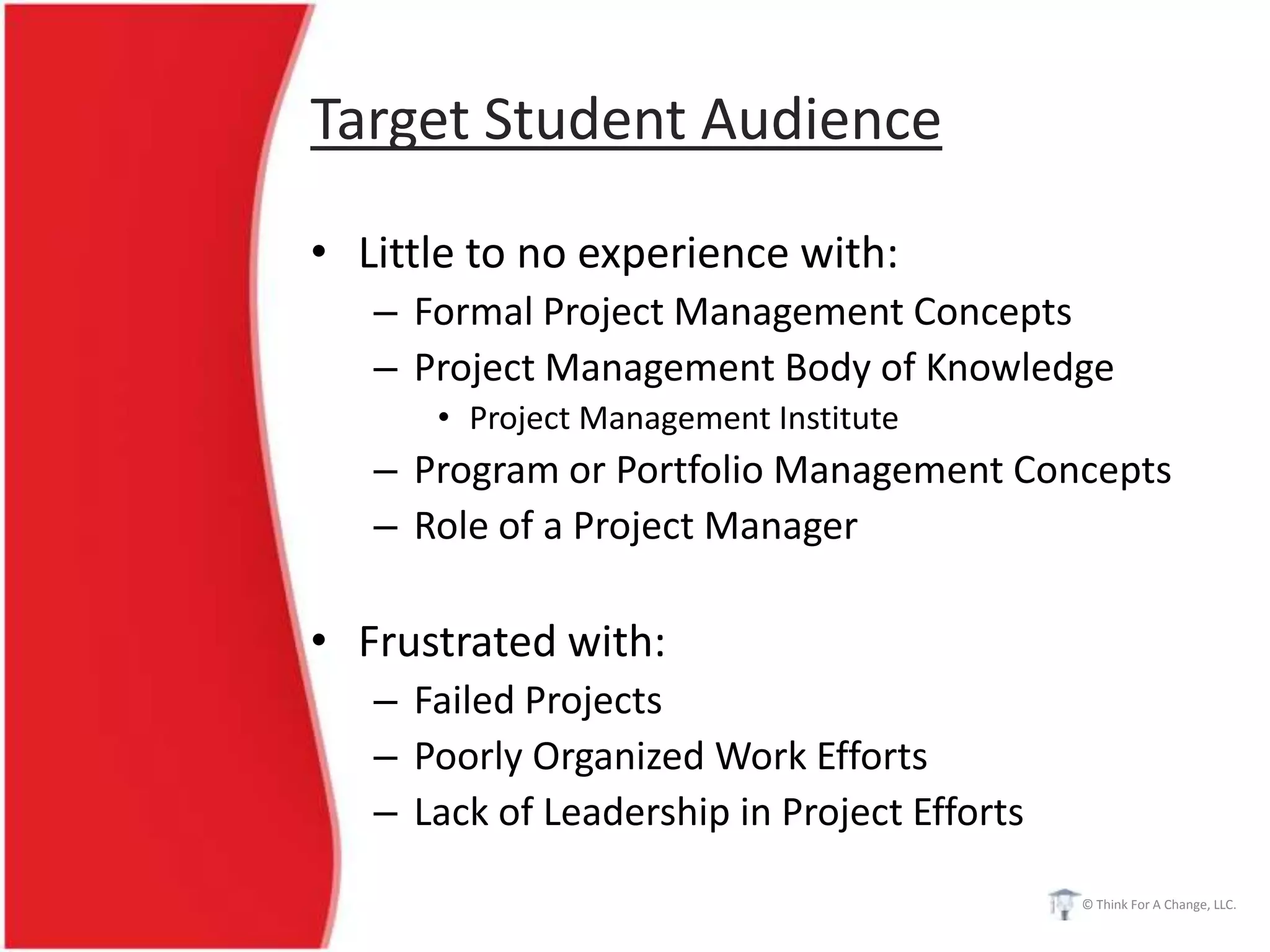
Target Student Audience

• Little to no experience with:
   – Formal Project Management Concepts
   – Project Management Body of Knowledge
      • Project Management Institute
   – Program or Portfolio Management Concepts
   – Role of a Project Manager

• Frustrated with:
   – Failed Projects
   – Poorly Organized Work Efforts
   – Lack of Leadership in Project Efforts
                                             © Think For A Change, LLC.
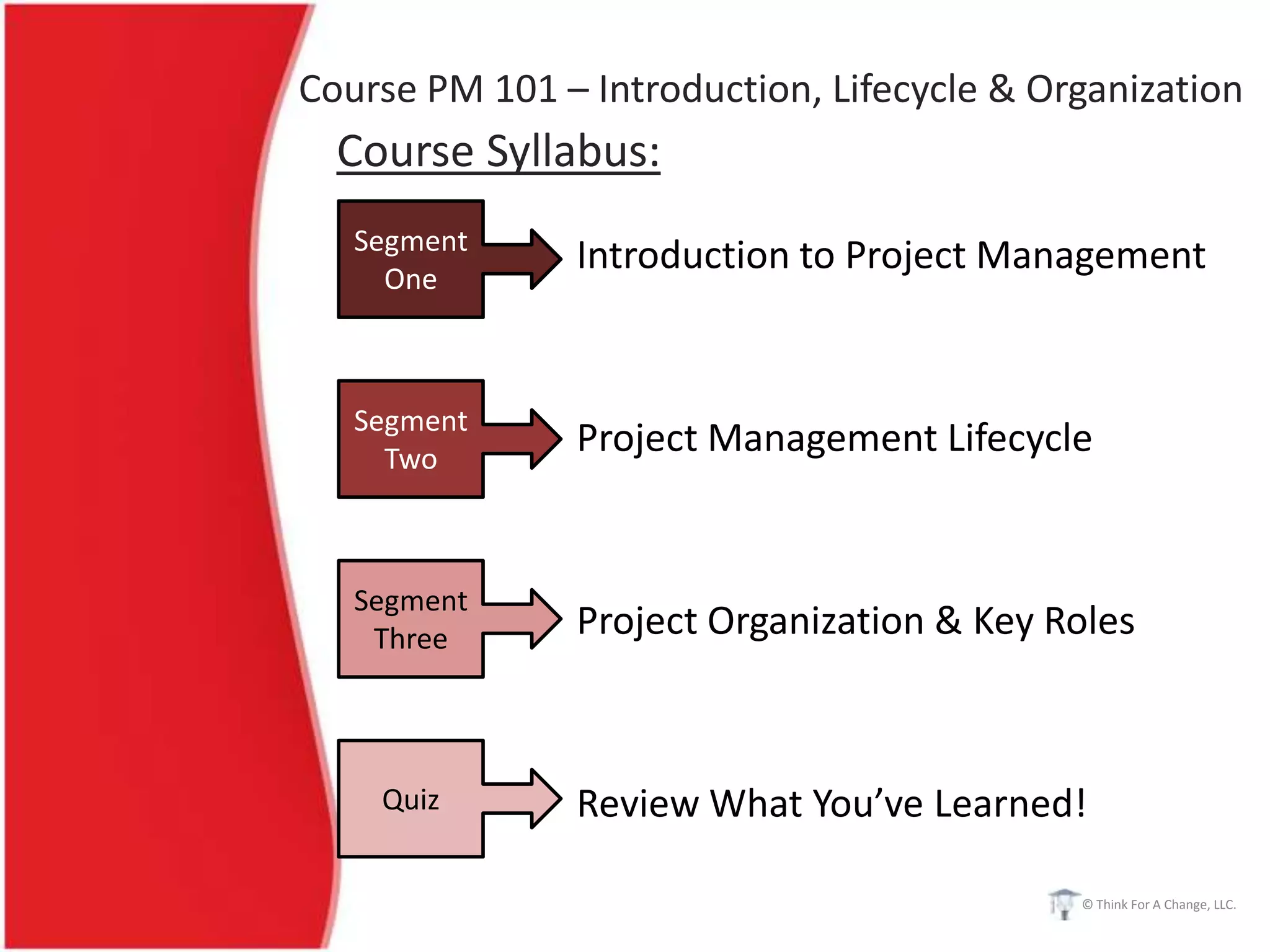
Course PM 101 – Introduction, Lifecycle & Organization
  Course Syllabus:
   Segment
     One
               Introduction to Project Management


   Segment
     Two
               Project Management Lifecycle


   Segment
    Three      Project Organization & Key Roles


    Quiz       Review What You’ve Learned!

                                            © Think For A Change, LLC.
Segment      Introduction to
  One     Project Management


                       © Think For A Change, LLC.
What is a Project?


• Definition:
  • “A project is a temporary endeavor undertaken to
    create a unique product, service or result.”


  • The temporary nature of a project means that it
    has a definite beginning and ending
     • Efforts that have no defined end date or definition of
       “done” are not projects, they are on-going operations!

                                                        © Think For A Change, LLC.
More About Projects…


• Every project creates a unique product,
  service or result
• Projects end in only one of two ways:
  1. The project’s objectives have been reached
  2. The project is terminated because its objectives
     will not or cannot be met, or when the need for
     the project no longer exists.

                                                © Think For A Change, LLC.
How Are Projects Organized?

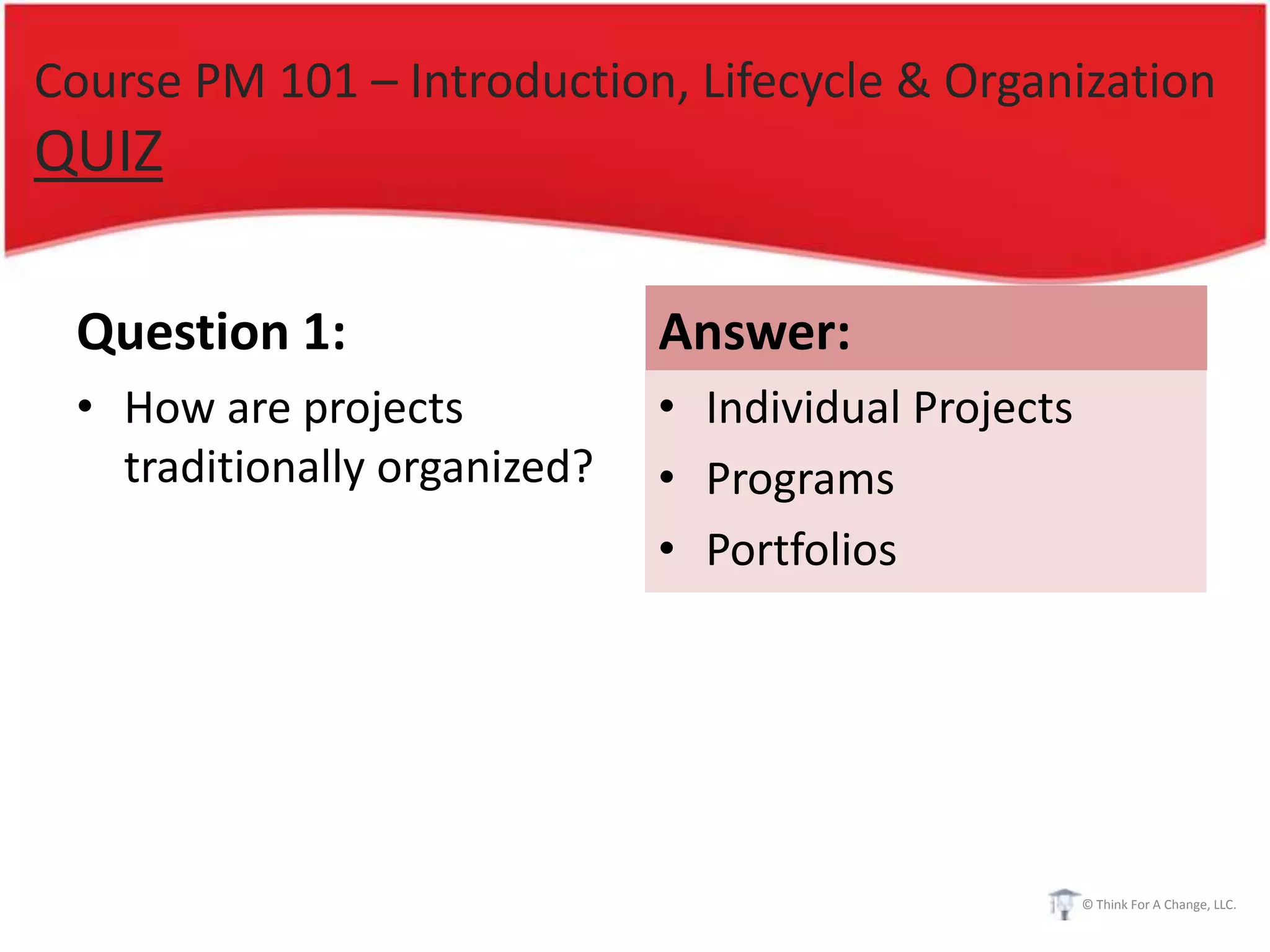
• Individual Project:
   • A temporary endeavor undertaken to create a unique
     product, service or result
• Program:
   – A collection of projects, sub-programs or other work
     that are managed in a coordinated fashion in support
     of a portfolio
• Portfolio:
   – A collection of projects, programs, sub-portfolios and
     operations managed as a group to achieve strategic
     benefits

                                                      © Think For A Change, LLC.
What is Project Management?


• Definition:
  • “The application of knowledge, skills, tools and
    techniques to project activities in order to meet
    the defined project requirements.”


                   © Think For A Change, LLC.
What is Project Management?


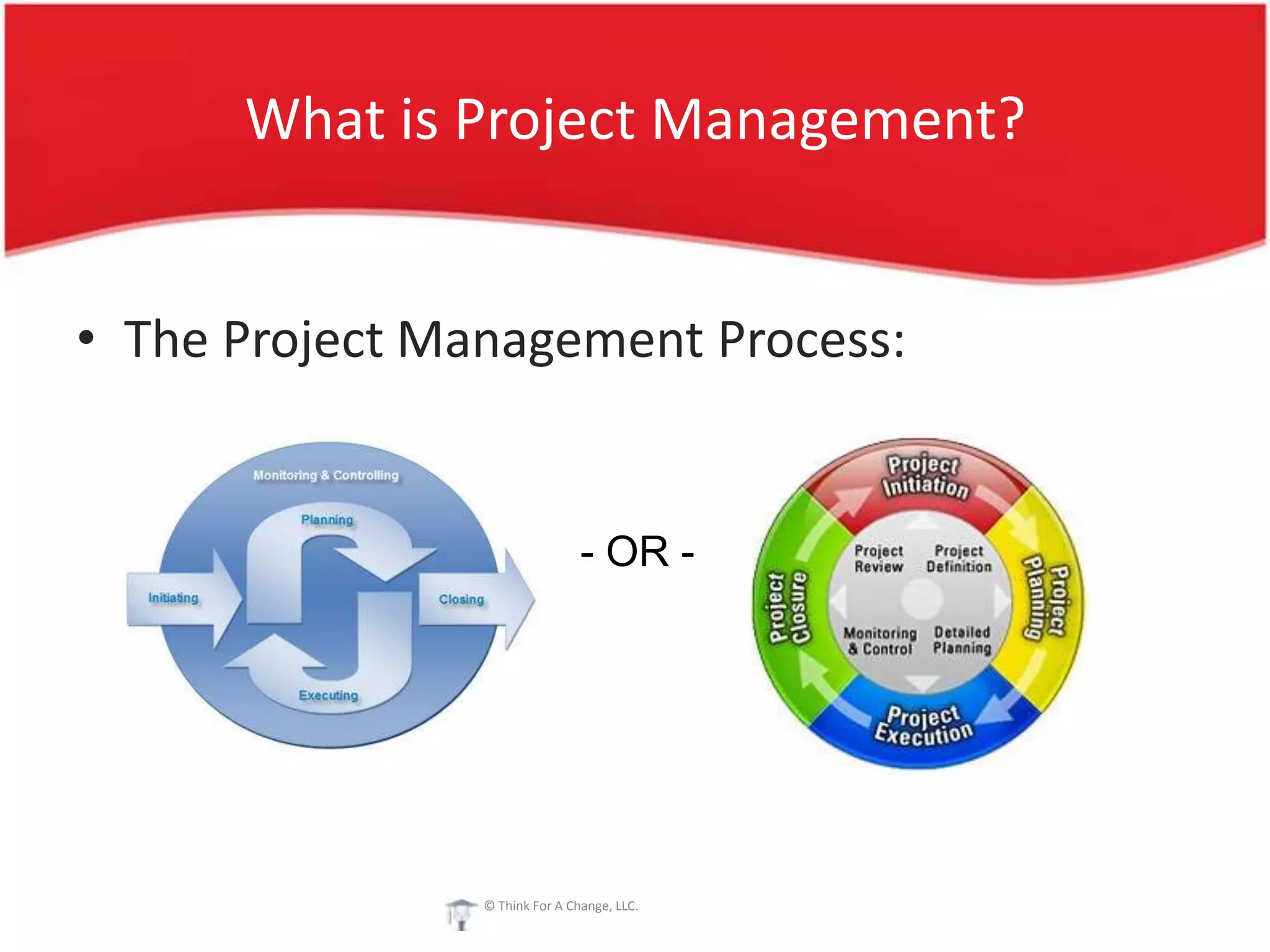
• The Project Management Process:


                                - OR -


                © Think For A Change, LLC.
How is a Project Managed?

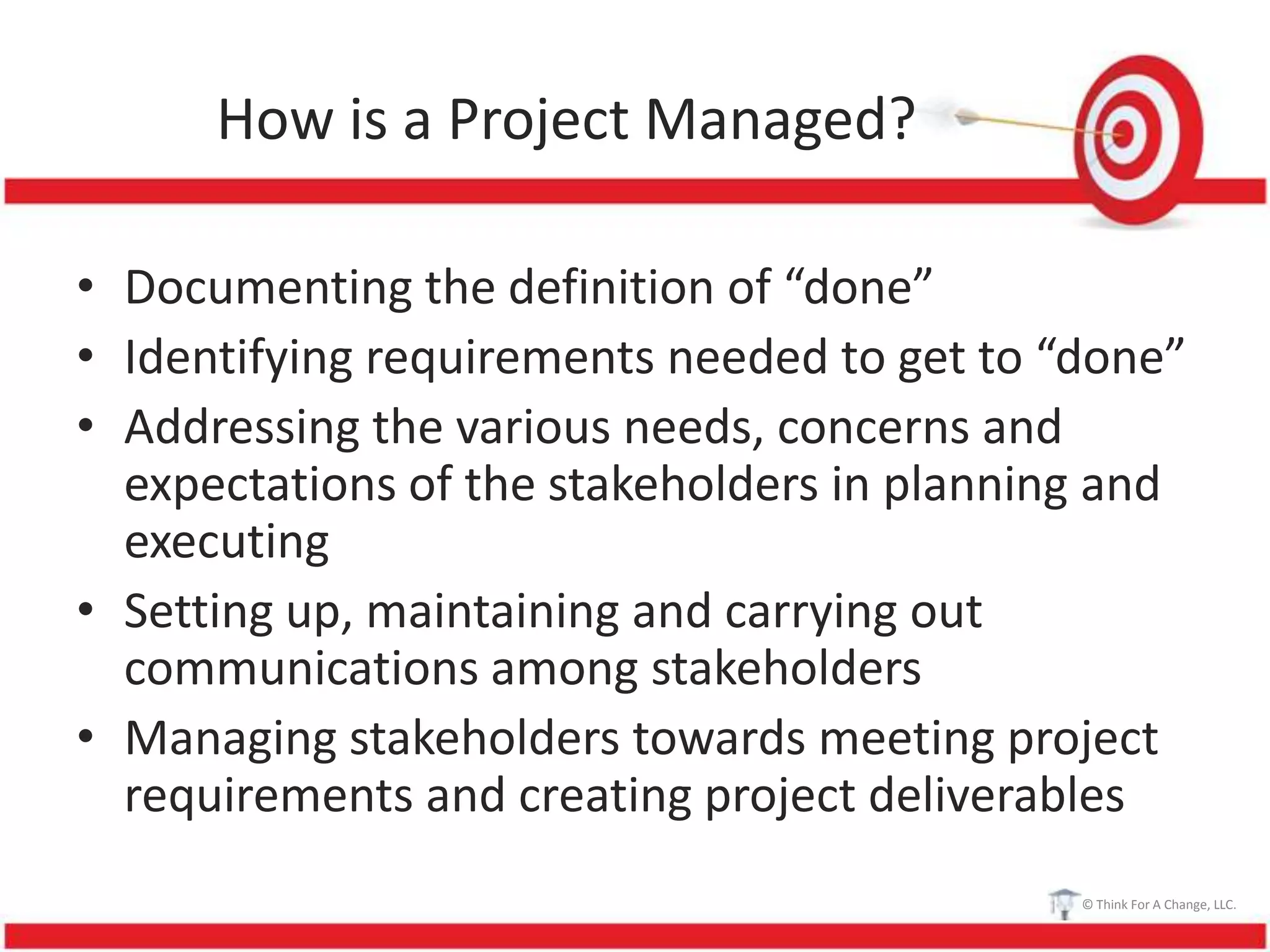
• Documenting the definition of “done”
• Identifying requirements needed to get to “done”
• Addressing the various needs, concerns and
  expectations of the stakeholders in planning and
  executing
• Setting up, maintaining and carrying out
  communications among stakeholders
• Managing stakeholders towards meeting project
  requirements and creating project deliverables
                                             © Think For A Change, LLC.
Balancing Competing Project
              Constraints

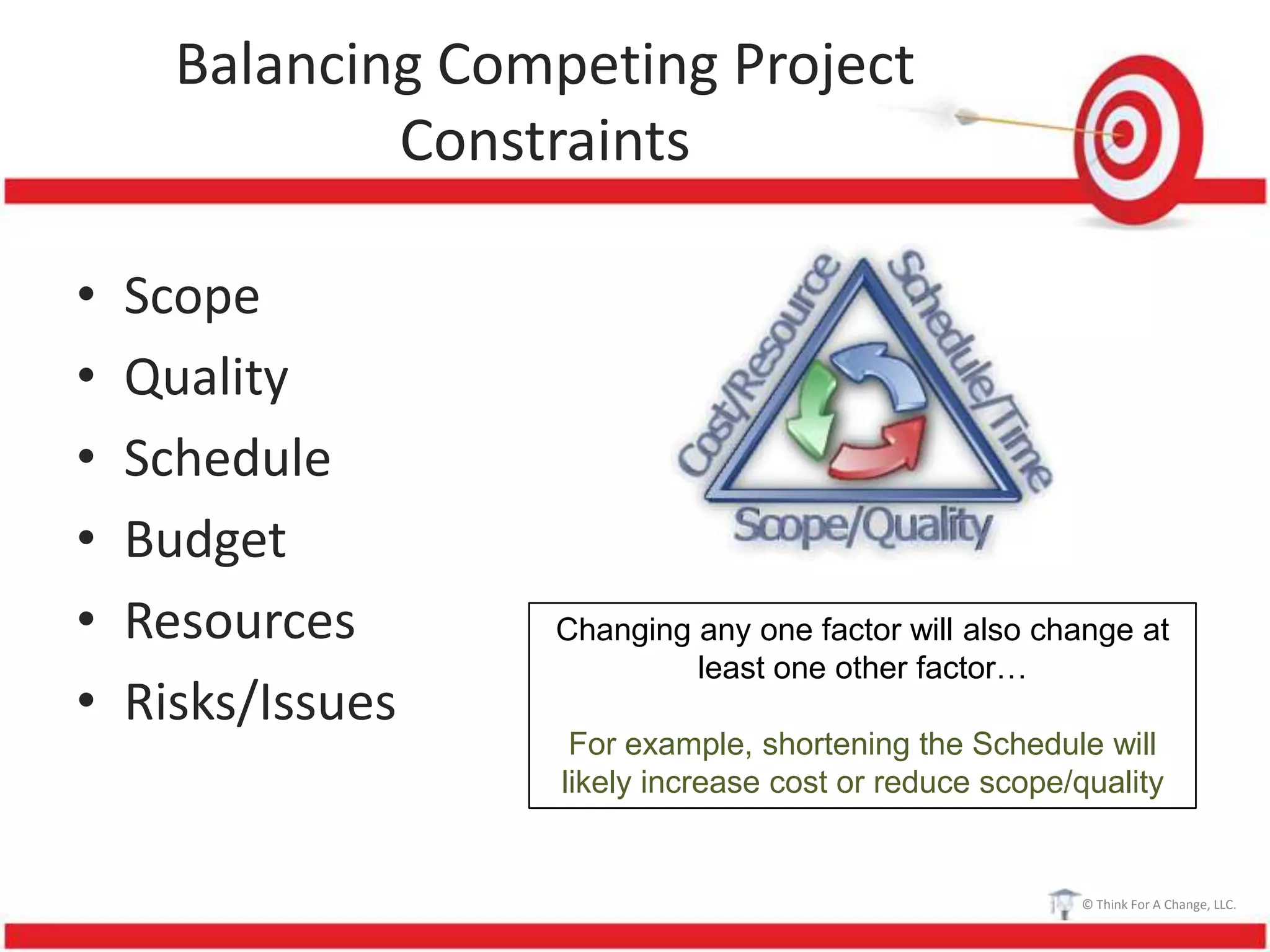
•   Scope
•   Quality
•   Schedule
•   Budget
•   Resources      Changing any one factor will also change at
                            least one other factor…
•   Risks/Issues
                     For example, shortening the Schedule will
                    likely increase cost or reduce scope/quality


                                                         © Think For A Change, LLC.
Project Management and Strategy

• Strategic plans are often drafted by organizations to respond to threats
  and/or opportunities that may occur today, tomorrow or farther into the
  future
• Based on these plans, individual projects are typically formed to address
  one or more of the following considerations:
    •   Market demand
    •   Strategic opportunity or business need
    •   Societal need
    •   Environmental considerations
    •   Customer demand
    •   Technological advances
    •   Legal or regulatory requirements
• Projects and project management discipline are typically the “tools of
  choice” leveraged by organizational leaders to deliver on strategic
  direction

                                                                     © Think For A Change, LLC.
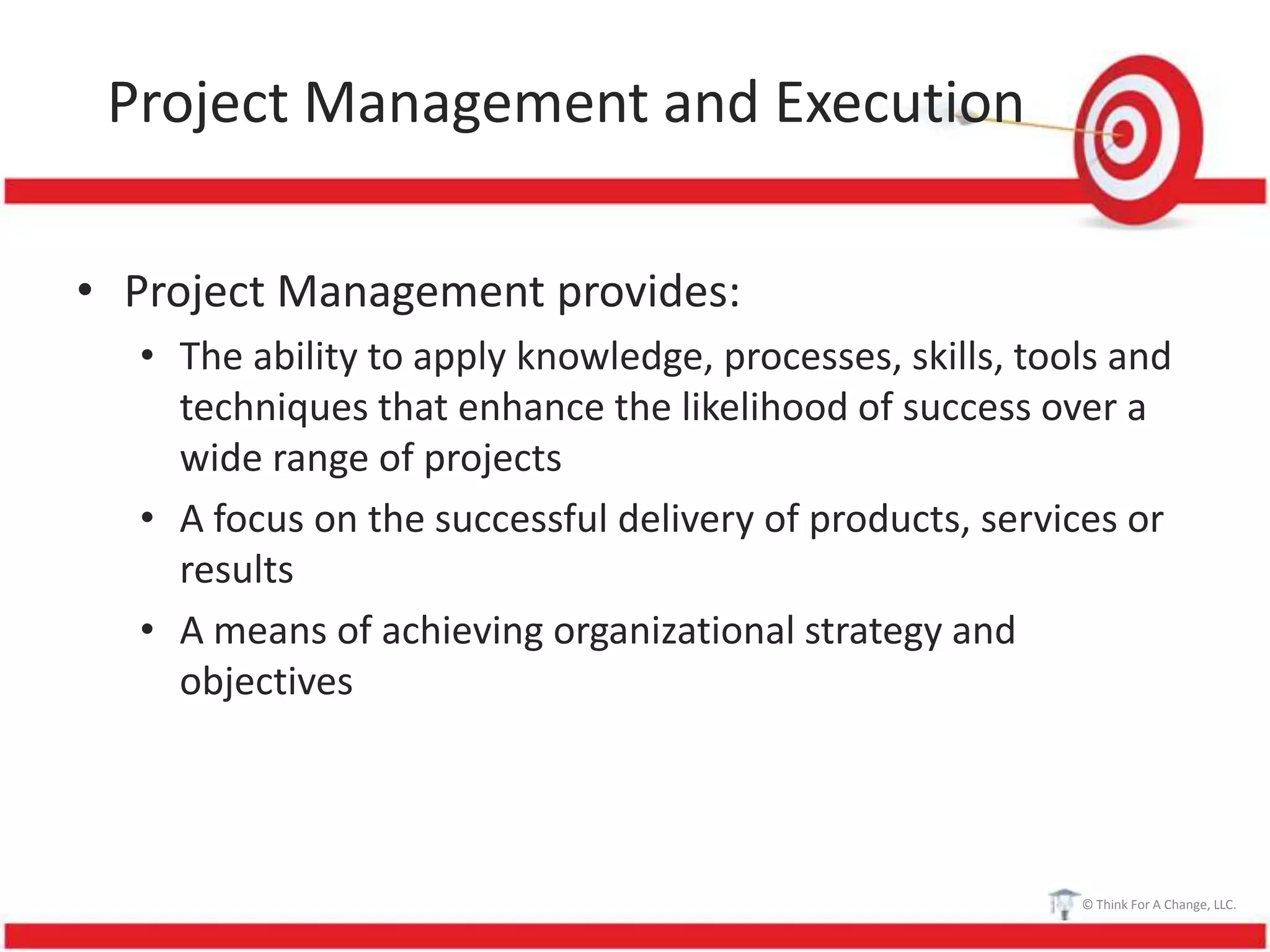
Project Management and Execution

• Project Management provides:
  • The ability to apply knowledge, processes, skills, tools and
    techniques that enhance the likelihood of success over a
    wide range of projects
  • A focus on the successful delivery of products, services or
    results
  • A means of achieving organizational strategy and
    objectives


                                                          © Think For A Change, LLC.
Segment   Project Management
  Two           Lifecycle


                        © Think For A Change, LLC.
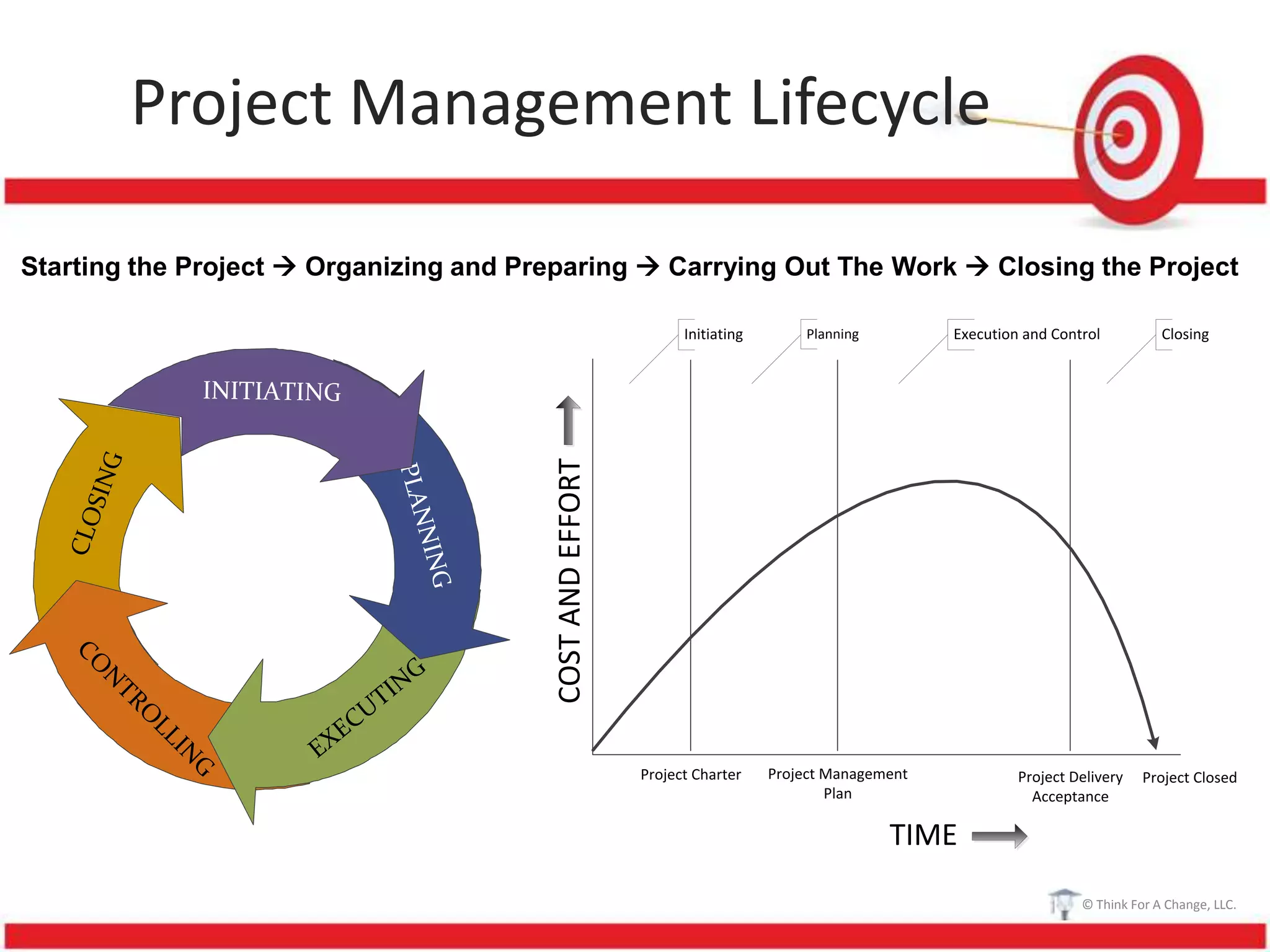
Project Management Lifecycle

Starting the Project  Organizing and Preparing  Carrying Out The Work  Closing the Project

                                                                      Initiating       Planning         Execution and Control          Closing


                     INITIATING
        G


                                              COST AND EFFORT
                                     PLAN
    SIN
   CLO


                                          N
                                        ING
   CO


                                        G
                                     IN
     N


                                   T
         TR


                                 CU
            O


                                E
              LL


                             EX
                IN
                 G


                                                                Project Charter    Project Management            Project Delivery   Project Closed
                                                                                           Plan                    Acceptance

                                                                                                  TIME
                                                                                                                          © Think For A Change, LLC.
Project Management Lifecycle

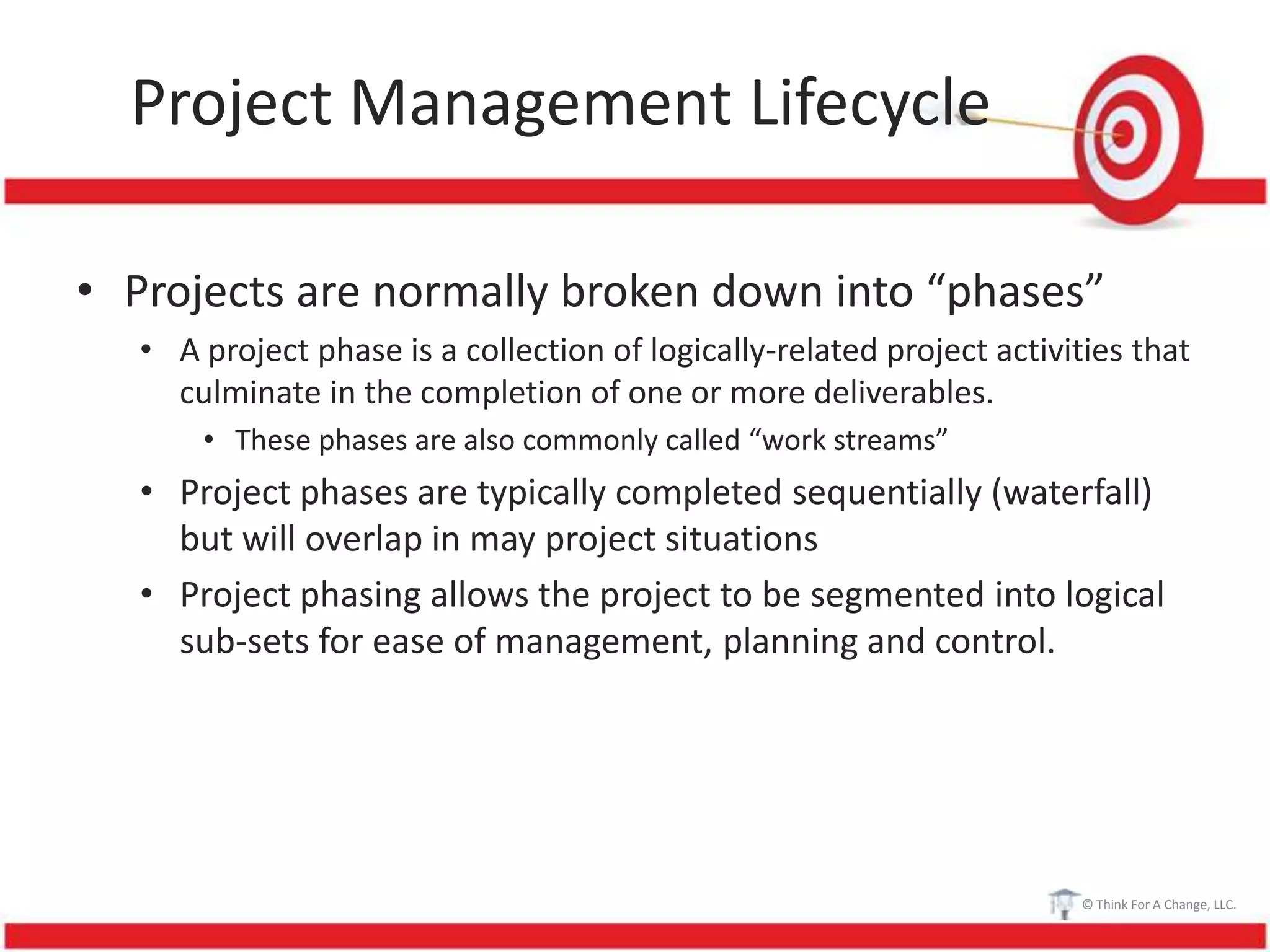
• Projects are normally broken down into “phases”
   • A project phase is a collection of logically-related project activities that
     culminate in the completion of one or more deliverables.
       • These phases are also commonly called “work streams”
   • Project phases are typically completed sequentially (waterfall)
     but will overlap in may project situations
   • Project phasing allows the project to be segmented into logical
     sub-sets for ease of management, planning and control.


                                                                        © Think For A Change, LLC.
Project Management Lifecycle

• Common Trends Along The PM Lifecycle
  • The cost of changing the project scope or final project outcome
    increase significantly over time
  • Costs and staffing levels start low during initiation, increase rapidly
    during planning and execution and tail off as the project draws to a
    close
  • The amount of risk and uncertainty will decrease over time
  • The acceptable range of budgetary uncertainty should decrease over
    time


                                                                     © Think For A Change, LLC.
Project Management Lifecycle

• Predictive Lifecycles (Plan Driven Project Mgmt)
    • The project scope, time and cost are determined early in the project
• Iterative and Incremental Lifecycles (Iterative Project Mgmt)
    • Project phases intentionally repeat one or more project activities
        • Iterations develop the final deliverable through a series of repeated cycles
        • Increments successively add to the functionality of the final deliverable
• Adaptive Lifecycles (Agile Project Mgmt)
    • Intended to identify, and rapidly respond to, high levels of change and
      ongoing stakeholder involvement


                                                                             © Think For A Change, LLC.
Segment   Project Organization
 Three        & Key Roles


                         © Think For A Change, LLC.
Project Organization

• Organizational Influences on Project Management:
   •   Vision, mission, values, belief and expectations
   •   Regulations, policies, methods and procedures
   •   Motivation, performance and reward systems
   •   Risk tolerance
   •   Failure tolerance
   •   Operating environment
   •   Leadership style
   •   Workplace culture


                                                          © Think For A Change, LLC.
Project Organization

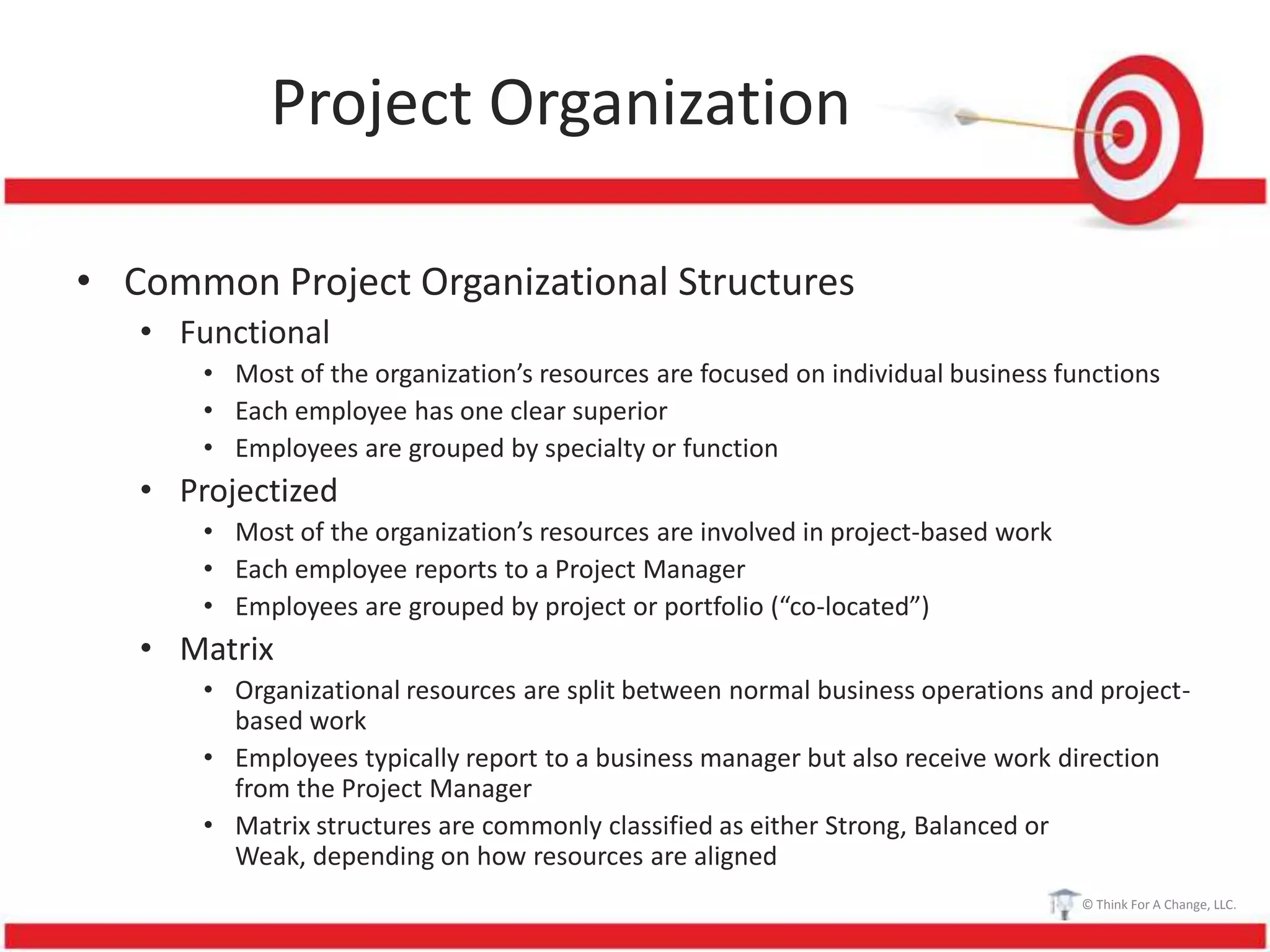
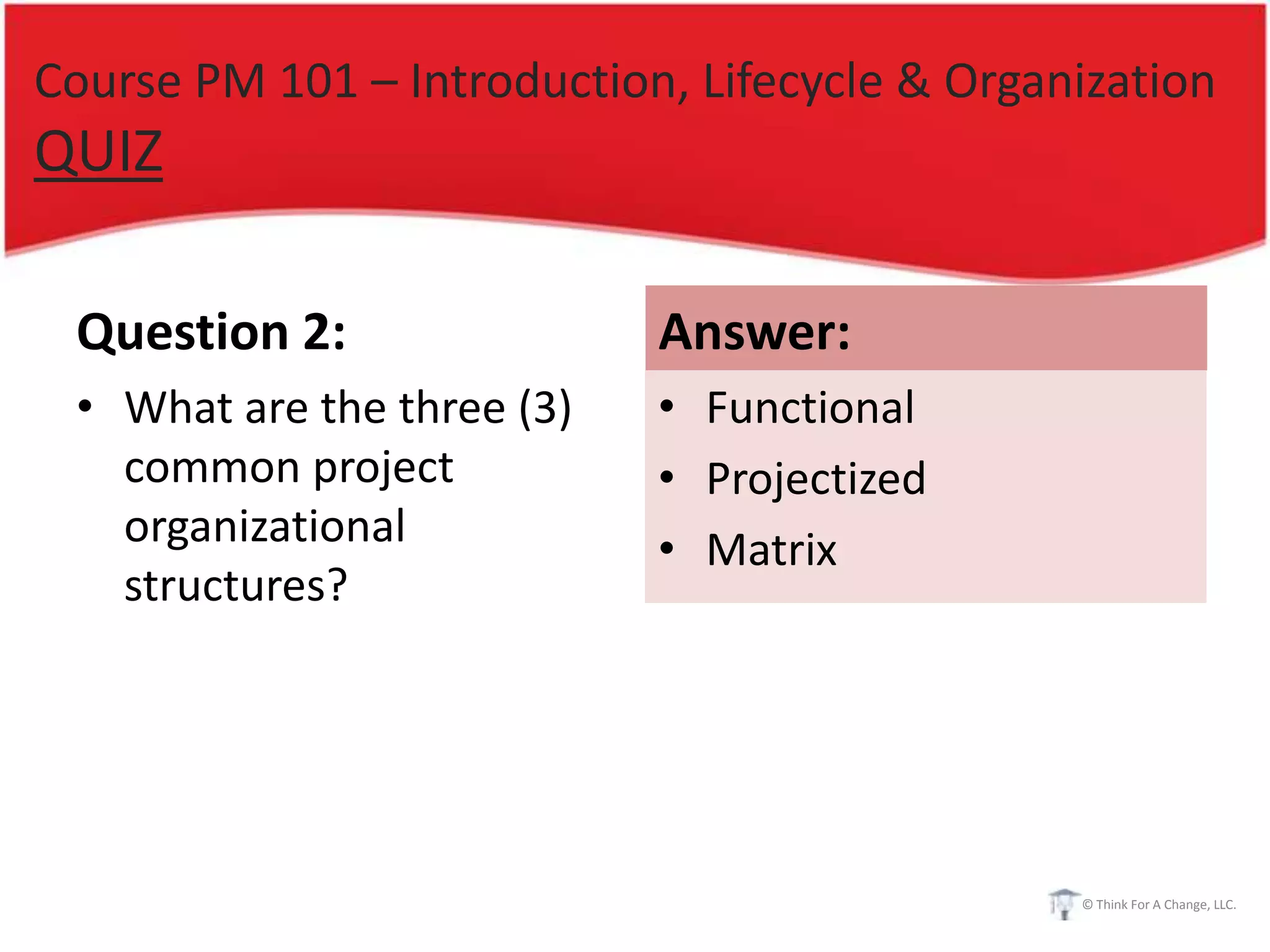
• Common Project Organizational Structures
   • Functional
       • Most of the organization’s resources are focused on individual business functions
       • Each employee has one clear superior
       • Employees are grouped by specialty or function
   • Projectized
       • Most of the organization’s resources are involved in project-based work
       • Each employee reports to a Project Manager
       • Employees are grouped by project or portfolio (“co-located”)
   • Matrix
       • Organizational resources are split between normal business operations and project-
         based work
       • Employees typically report to a business manager but also receive work direction
         from the Project Manager
       • Matrix structures are commonly classified as either Strong, Balanced or
         Weak, depending on how resources are aligned
                                                                                   © Think For A Change, LLC.
Project Organization

• Organizational Process-Based Assets
   • Processes and Procedures
       •   Templates
       •   Document Artifacts
       •   Knowledgebase
       •   Practice Guides
       •   Guidelines
       •   Work Instructions
   • Organizational Knowledgebase
       •   Configuration Management
       •   Financial Databases
       •   Historical Information (Lessons Learned Documentation)
       •   Issue and Defect Databases
       •   Project Files

                                                                    © Think For A Change, LLC.
What is the Role of a Project Manager?


• Definition:
  • “The Project Manager is the person assigned by
    the performing organization to lead the team that
    is responsible for achieving the project objectives.”


                    © Think For A Change, LLC.
Project Manager Responsibilities &
           Competencies

• Project Managers accomplish work through the project
  team and key stakeholders
• Successful Project Managers balance knowledge,
  experience, ethics and a number of interpersonal skills:
    •   Leadership        •   Political and Culture Awareness
    •   Team Building     •   Negotiation
    •   Motivation        •   Trust Building
    •   Communication     •   Conflict Management
                          •   Coaching
    •   Influencing
                          •   Leading Without Direct
    •   Decision Making       Authority
                                                         © Think For A Change, LLC.
Project Resources and Stakeholders

• Project Stakeholders
   • Individuals, groups or organizations who may affect, be affected by, or
     perceive itself to be affected by a decision, activity or outcome of a
     project
   • Stakeholders can take an active or passive role in guiding or
     influencing the scope and outcome of the project effort
   • Examples of “Stakeholders”:
       •   Project Team Resources (including leadership)
       •   Project Sponsor
       •   Customers/Users (internal and/or external)
       •   Business Partners
       •   Organizational Groups
       •   Functional Managers
       •   Government Regulators
       •   Consultants

                                                                     © Think For A Change, LLC.
Project Teams

• Project Teams
   • The Project Team typically includes the project manager and the group
     of individuals who act together in performing the work of the project
     to achieve its objectives
   • Traditional Project Team Roles:
       • Project Management Staff
            • Project Manager, Project Coordinator, PMO Staff, etc.
       • Project Staff
            • Tactical resources who identify and execute upon the tasks to be completed
       • Subject Matter Experts (SMEs)
            • Finance, Legal, HR, etc.
       • Business Partners
            • Line of business managers or individual contributors
   • Project team members can either be “dedicated” or “shared” to
     the Project
                                                                                           © Think For A Change, LLC.
Project Governance

• Project Governance
   • The oversight function aligned with the organization’s governance
     model and the project life cycle and/or process methodology
   • This framework provides the Project Team:
       •   Success and deliverable acceptance criteria
       •   Issue management and escalation protocols
       •   Communications management protocols
       •   Project decision-making processes
       •   Alignment of projects with corresponding programs or portfolios
       •   Stage-gate or phased review process management
       •   Change management review and approval protocols
       •   Internal stakeholder alignment


                                                                             © Think For A Change, LLC.
What is a Project Management Office
                  (PMO)?

• Definition:
  • “A management structure that standardizes the
    project-related governance processes and
    facilitates the sharing of
    resources, methodologies, tools and techniques”


                  © Think For A Change, LLC.
The Project Management Office (PMO)

• The primary function of a PMO is to support project
  managers:
   • Managing shared resources across all projects
   • Identifying and developing project management
     methodology, best practices and standards
   • Coaching, mentoring, training and oversight
   • Developing, managing and monitoring usage of
     policies, procedures and templates
   • Coordinating communication across the organization
     regarding project management discipline
                                                      © Think For A Change, LLC.
Final Thoughts…

• Projects are temporary initiatives that have a defined
  beginning and ending
• Project outcomes are directly affected by the “Triple
  Constraint” of Time, Scope and Cost
• Project Management is a formal discipline that applies
  knowledge, skills, tools and techniques to project activities in
  order to meet the defined project requirements
• Successful projects rely on people, processes, tools,
  techniques, oversight, structure, leadership and organization


                        © Think For A Change, LLC.
QUIZ   Review What You’ve
            Learned!


                     © Think For A Change, LLC.
Course PM 101 – Introduction, Lifecycle & Organization
QUIZ

 Question 1:
 • How are projects
   traditionally organized?


                                               © Think For A Change, LLC.
Course PM 101 – Introduction, Lifecycle & Organization
QUIZ

 Question 1:                  Answer:
 • How are projects           • Individual Projects
   traditionally organized?   • Programs
                              • Portfolios


                                                      © Think For A Change, LLC.
Course PM 101 – Introduction, Lifecycle & Organization
QUIZ

 Question 2:
 • What are the three (3)
   common project
   organizational
   structures?


                                               © Think For A Change, LLC.
Course PM 101 – Introduction, Lifecycle & Organization
QUIZ

 Question 2:                Answer:
 • What are the three (3)   • Functional
   common project           • Projectized
   organizational           • Matrix
   structures?


                                               © Think For A Change, LLC.
Course PM 101 – Introduction, Lifecycle & Organization
QUIZ

 Question 3:
 • Project team members
   can either be ______ or
   __________ to the
   project?


                                               © Think For A Change, LLC.
Course PM 101 – Introduction, Lifecycle & Organization
QUIZ

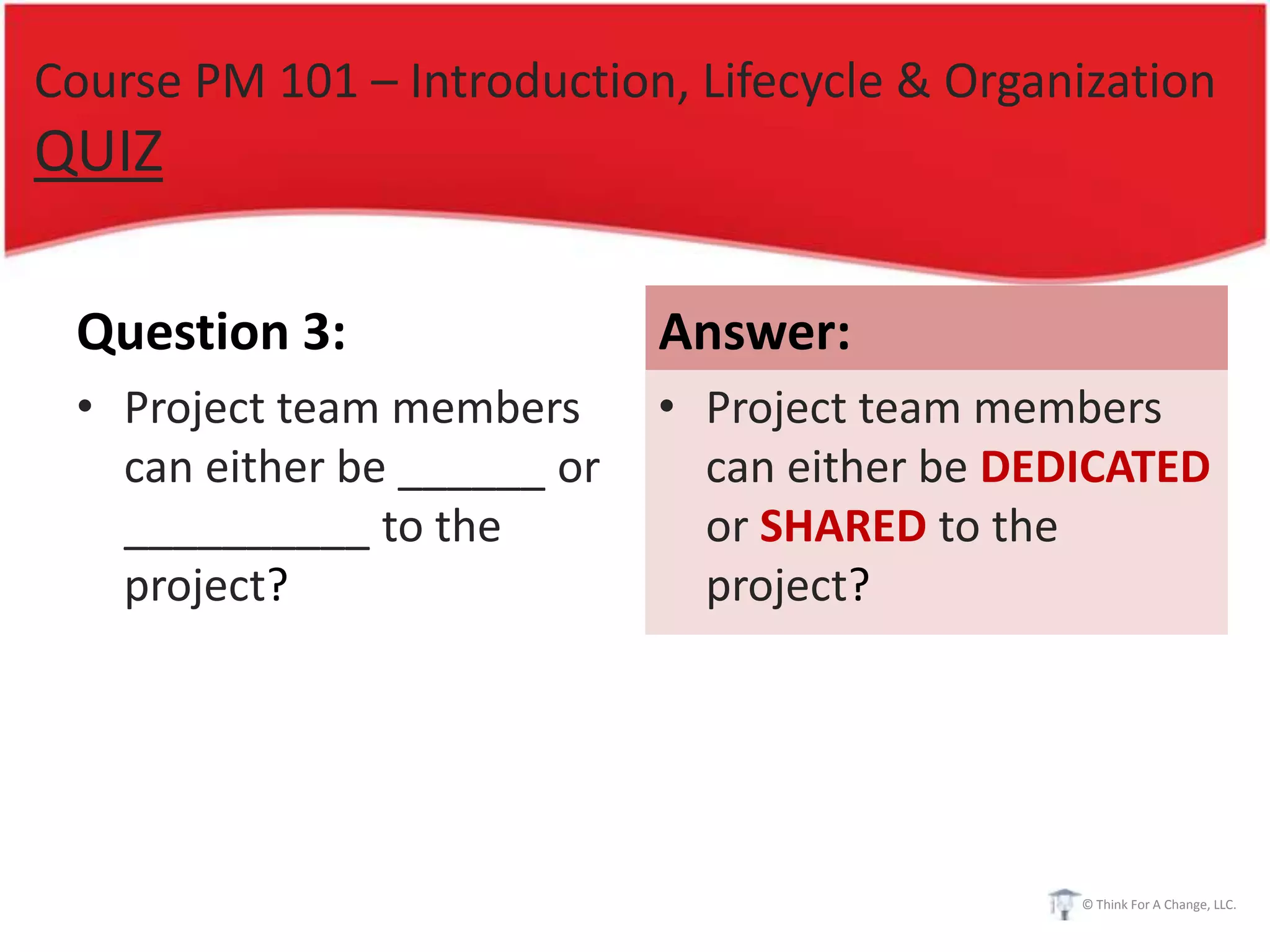
 Question 3:                 Answer:
 • Project team members      • Project team members
   can either be ______ or     can either be DEDICATED
   __________ to the           or SHARED to the
   project?                    project?


                                                © Think For A Change, LLC.
Course PM 101 – Introduction, Lifecycle & Organization
QUIZ

 Question 4:
 • True or False? Projects end in
   only one of two ways:
    1. The project’s objectives
         have been reached
    2. The project is terminated
         because its objectives will
         not or cannot be met, or
         when the need for the
         project no longer exists.


                                               © Think For A Change, LLC.
Course PM 101 – Introduction, Lifecycle & Organization
QUIZ

 Question 4:                           Answer:
 • True or False? Projects end in      • TRUE
   only one of two ways:
    1. The project’s objectives
         have been reached
    2. The project is terminated
         because its objectives will
         not or cannot be met, or
         when the need for the
         project no longer exists.


                                                 © Think For A Change, LLC.
Course PM 101 – Introduction, Lifecycle & Organization
QUIZ

 Question 5:
 • The primary function of
   a PMO is to support
   _______________?


                                               © Think For A Change, LLC.
Course PM 101 – Introduction, Lifecycle & Organization
QUIZ

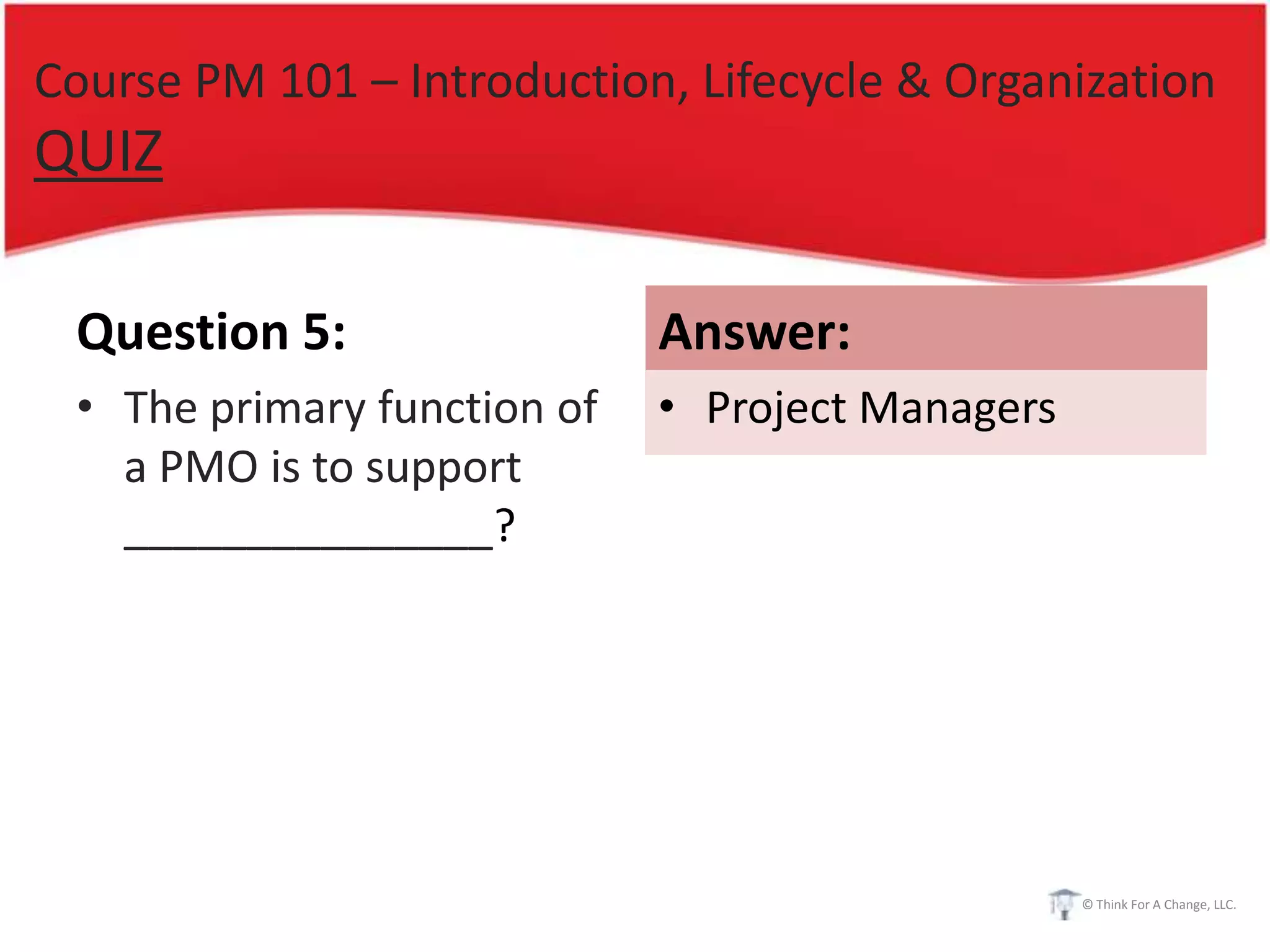
 Question 5:                 Answer:
 • The primary function of   • Project Managers
   a PMO is to support
   _______________?


                                                  © Think For A Change, LLC.
CONGRATULATIONS!
      You have successfully completed:

Project Management Foundations
Course 101 – Project Management Introduction, Lifecycle and Organization

          PRESENTED BY:
          Think For A Change, LLC.


                                                             © Think For A Change, LLC.
For more information on best/next practices,
educational training, tools, techniques and process
models for:
   –    Project Management
   –    Innovation Management
   –    Product Management
   –    Leadership


       Please visit: http://www.thinkforachange.com


                                                      © Think For A Change, LLC.

Project Management Foundations Course 101 - Project Management Concepts

  • 1.
    Project Management Foundations Course101 – Introduction, Lifecycle & Organization Presented By: Think For A Change © Think For A Change, LLC. © Think For A Change, LLC.
  • 2.
    Target Student Audience •Little to no experience with: – Formal Project Management Concepts – Project Management Body of Knowledge • Project Management Institute – Program or Portfolio Management Concepts – Role of a Project Manager • Frustrated with: – Failed Projects – Poorly Organized Work Efforts – Lack of Leadership in Project Efforts © Think For A Change, LLC.
  • 3.
    Course PM 101– Introduction, Lifecycle & Organization Course Syllabus: Segment One Introduction to Project Management Segment Two Project Management Lifecycle Segment Three Project Organization & Key Roles Quiz Review What You’ve Learned! © Think For A Change, LLC.
  • 4.
    Segment Introduction to One Project Management © Think For A Change, LLC.
  • 5.
    What is aProject? • Definition: • “A project is a temporary endeavor undertaken to create a unique product, service or result.” • The temporary nature of a project means that it has a definite beginning and ending • Efforts that have no defined end date or definition of “done” are not projects, they are on-going operations! © Think For A Change, LLC.
  • 6.
    More About Projects… •Every project creates a unique product, service or result • Projects end in only one of two ways: 1. The project’s objectives have been reached 2. The project is terminated because its objectives will not or cannot be met, or when the need for the project no longer exists. © Think For A Change, LLC.
  • 7.
    How Are ProjectsOrganized? • Individual Project: • A temporary endeavor undertaken to create a unique product, service or result • Program: – A collection of projects, sub-programs or other work that are managed in a coordinated fashion in support of a portfolio • Portfolio: – A collection of projects, programs, sub-portfolios and operations managed as a group to achieve strategic benefits © Think For A Change, LLC.
  • 8.
    What is ProjectManagement? • Definition: • “The application of knowledge, skills, tools and techniques to project activities in order to meet the defined project requirements.” © Think For A Change, LLC.
  • 9.
    What is ProjectManagement? • The Project Management Process: - OR - © Think For A Change, LLC.
  • 10.
    How is aProject Managed? • Documenting the definition of “done” • Identifying requirements needed to get to “done” • Addressing the various needs, concerns and expectations of the stakeholders in planning and executing • Setting up, maintaining and carrying out communications among stakeholders • Managing stakeholders towards meeting project requirements and creating project deliverables © Think For A Change, LLC.
  • 11.
    Balancing Competing Project Constraints • Scope • Quality • Schedule • Budget • Resources Changing any one factor will also change at least one other factor… • Risks/Issues For example, shortening the Schedule will likely increase cost or reduce scope/quality © Think For A Change, LLC.
  • 12.
    Project Management andStrategy • Strategic plans are often drafted by organizations to respond to threats and/or opportunities that may occur today, tomorrow or farther into the future • Based on these plans, individual projects are typically formed to address one or more of the following considerations: • Market demand • Strategic opportunity or business need • Societal need • Environmental considerations • Customer demand • Technological advances • Legal or regulatory requirements • Projects and project management discipline are typically the “tools of choice” leveraged by organizational leaders to deliver on strategic direction © Think For A Change, LLC.
  • 13.
    Project Management andExecution • Project Management provides: • The ability to apply knowledge, processes, skills, tools and techniques that enhance the likelihood of success over a wide range of projects • A focus on the successful delivery of products, services or results • A means of achieving organizational strategy and objectives © Think For A Change, LLC.
  • 14.
    Segment Project Management Two Lifecycle © Think For A Change, LLC.
  • 15.
    Project Management Lifecycle Startingthe Project  Organizing and Preparing  Carrying Out The Work  Closing the Project Initiating Planning Execution and Control Closing INITIATING G COST AND EFFORT PLAN SIN CLO N ING CO G IN N T TR CU O E LL EX IN G Project Charter Project Management Project Delivery Project Closed Plan Acceptance TIME © Think For A Change, LLC.
  • 16.
    Project Management Lifecycle •Projects are normally broken down into “phases” • A project phase is a collection of logically-related project activities that culminate in the completion of one or more deliverables. • These phases are also commonly called “work streams” • Project phases are typically completed sequentially (waterfall) but will overlap in may project situations • Project phasing allows the project to be segmented into logical sub-sets for ease of management, planning and control. © Think For A Change, LLC.
  • 17.
    Project Management Lifecycle •Common Trends Along The PM Lifecycle • The cost of changing the project scope or final project outcome increase significantly over time • Costs and staffing levels start low during initiation, increase rapidly during planning and execution and tail off as the project draws to a close • The amount of risk and uncertainty will decrease over time • The acceptable range of budgetary uncertainty should decrease over time © Think For A Change, LLC.
  • 18.
    Project Management Lifecycle •Predictive Lifecycles (Plan Driven Project Mgmt) • The project scope, time and cost are determined early in the project • Iterative and Incremental Lifecycles (Iterative Project Mgmt) • Project phases intentionally repeat one or more project activities • Iterations develop the final deliverable through a series of repeated cycles • Increments successively add to the functionality of the final deliverable • Adaptive Lifecycles (Agile Project Mgmt) • Intended to identify, and rapidly respond to, high levels of change and ongoing stakeholder involvement © Think For A Change, LLC.
  • 19.
    Segment Project Organization Three & Key Roles © Think For A Change, LLC.
  • 20.
    Project Organization • OrganizationalInfluences on Project Management: • Vision, mission, values, belief and expectations • Regulations, policies, methods and procedures • Motivation, performance and reward systems • Risk tolerance • Failure tolerance • Operating environment • Leadership style • Workplace culture © Think For A Change, LLC.
  • 21.
    Project Organization • CommonProject Organizational Structures • Functional • Most of the organization’s resources are focused on individual business functions • Each employee has one clear superior • Employees are grouped by specialty or function • Projectized • Most of the organization’s resources are involved in project-based work • Each employee reports to a Project Manager • Employees are grouped by project or portfolio (“co-located”) • Matrix • Organizational resources are split between normal business operations and project- based work • Employees typically report to a business manager but also receive work direction from the Project Manager • Matrix structures are commonly classified as either Strong, Balanced or Weak, depending on how resources are aligned © Think For A Change, LLC.
  • 22.
    Project Organization • OrganizationalProcess-Based Assets • Processes and Procedures • Templates • Document Artifacts • Knowledgebase • Practice Guides • Guidelines • Work Instructions • Organizational Knowledgebase • Configuration Management • Financial Databases • Historical Information (Lessons Learned Documentation) • Issue and Defect Databases • Project Files © Think For A Change, LLC.
  • 23.
    What is theRole of a Project Manager? • Definition: • “The Project Manager is the person assigned by the performing organization to lead the team that is responsible for achieving the project objectives.” © Think For A Change, LLC.
  • 24.
    Project Manager Responsibilities& Competencies • Project Managers accomplish work through the project team and key stakeholders • Successful Project Managers balance knowledge, experience, ethics and a number of interpersonal skills: • Leadership • Political and Culture Awareness • Team Building • Negotiation • Motivation • Trust Building • Communication • Conflict Management • Coaching • Influencing • Leading Without Direct • Decision Making Authority © Think For A Change, LLC.
  • 25.
    Project Resources andStakeholders • Project Stakeholders • Individuals, groups or organizations who may affect, be affected by, or perceive itself to be affected by a decision, activity or outcome of a project • Stakeholders can take an active or passive role in guiding or influencing the scope and outcome of the project effort • Examples of “Stakeholders”: • Project Team Resources (including leadership) • Project Sponsor • Customers/Users (internal and/or external) • Business Partners • Organizational Groups • Functional Managers • Government Regulators • Consultants © Think For A Change, LLC.
  • 26.
    Project Teams • ProjectTeams • The Project Team typically includes the project manager and the group of individuals who act together in performing the work of the project to achieve its objectives • Traditional Project Team Roles: • Project Management Staff • Project Manager, Project Coordinator, PMO Staff, etc. • Project Staff • Tactical resources who identify and execute upon the tasks to be completed • Subject Matter Experts (SMEs) • Finance, Legal, HR, etc. • Business Partners • Line of business managers or individual contributors • Project team members can either be “dedicated” or “shared” to the Project © Think For A Change, LLC.
  • 27.
    Project Governance • ProjectGovernance • The oversight function aligned with the organization’s governance model and the project life cycle and/or process methodology • This framework provides the Project Team: • Success and deliverable acceptance criteria • Issue management and escalation protocols • Communications management protocols • Project decision-making processes • Alignment of projects with corresponding programs or portfolios • Stage-gate or phased review process management • Change management review and approval protocols • Internal stakeholder alignment © Think For A Change, LLC.
  • 28.
    What is aProject Management Office (PMO)? • Definition: • “A management structure that standardizes the project-related governance processes and facilitates the sharing of resources, methodologies, tools and techniques” © Think For A Change, LLC.
  • 29.
    The Project ManagementOffice (PMO) • The primary function of a PMO is to support project managers: • Managing shared resources across all projects • Identifying and developing project management methodology, best practices and standards • Coaching, mentoring, training and oversight • Developing, managing and monitoring usage of policies, procedures and templates • Coordinating communication across the organization regarding project management discipline © Think For A Change, LLC.
  • 30.
    Final Thoughts… • Projectsare temporary initiatives that have a defined beginning and ending • Project outcomes are directly affected by the “Triple Constraint” of Time, Scope and Cost • Project Management is a formal discipline that applies knowledge, skills, tools and techniques to project activities in order to meet the defined project requirements • Successful projects rely on people, processes, tools, techniques, oversight, structure, leadership and organization © Think For A Change, LLC.
  • 31.
    QUIZ Review What You’ve Learned! © Think For A Change, LLC.
  • 32.
    Course PM 101– Introduction, Lifecycle & Organization QUIZ Question 1: • How are projects traditionally organized? © Think For A Change, LLC.
  • 33.
    Course PM 101– Introduction, Lifecycle & Organization QUIZ Question 1: Answer: • How are projects • Individual Projects traditionally organized? • Programs • Portfolios © Think For A Change, LLC.
  • 34.
    Course PM 101– Introduction, Lifecycle & Organization QUIZ Question 2: • What are the three (3) common project organizational structures? © Think For A Change, LLC.
  • 35.
    Course PM 101– Introduction, Lifecycle & Organization QUIZ Question 2: Answer: • What are the three (3) • Functional common project • Projectized organizational • Matrix structures? © Think For A Change, LLC.
  • 36.
    Course PM 101– Introduction, Lifecycle & Organization QUIZ Question 3: • Project team members can either be ______ or __________ to the project? © Think For A Change, LLC.
  • 37.
    Course PM 101– Introduction, Lifecycle & Organization QUIZ Question 3: Answer: • Project team members • Project team members can either be ______ or can either be DEDICATED __________ to the or SHARED to the project? project? © Think For A Change, LLC.
  • 38.
    Course PM 101– Introduction, Lifecycle & Organization QUIZ Question 4: • True or False? Projects end in only one of two ways: 1. The project’s objectives have been reached 2. The project is terminated because its objectives will not or cannot be met, or when the need for the project no longer exists. © Think For A Change, LLC.
  • 39.
    Course PM 101– Introduction, Lifecycle & Organization QUIZ Question 4: Answer: • True or False? Projects end in • TRUE only one of two ways: 1. The project’s objectives have been reached 2. The project is terminated because its objectives will not or cannot be met, or when the need for the project no longer exists. © Think For A Change, LLC.
  • 40.
    Course PM 101– Introduction, Lifecycle & Organization QUIZ Question 5: • The primary function of a PMO is to support _______________? © Think For A Change, LLC.
  • 41.
    Course PM 101– Introduction, Lifecycle & Organization QUIZ Question 5: Answer: • The primary function of • Project Managers a PMO is to support _______________? © Think For A Change, LLC.
  • 42.
    CONGRATULATIONS! You have successfully completed: Project Management Foundations Course 101 – Project Management Introduction, Lifecycle and Organization PRESENTED BY: Think For A Change, LLC. © Think For A Change, LLC.
  • 43.
    For more informationon best/next practices, educational training, tools, techniques and process models for: – Project Management – Innovation Management – Product Management – Leadership Please visit: http://www.thinkforachange.com © Think For A Change, LLC.