Dr Ian Cammack
i.j.Cammack@soton.ac.uk
MSc Project Management
MANG6310: Introduction
Road Map
• Module Overview
• Appreciating Project Management
• Project Life Cycle
• Project Management Profession
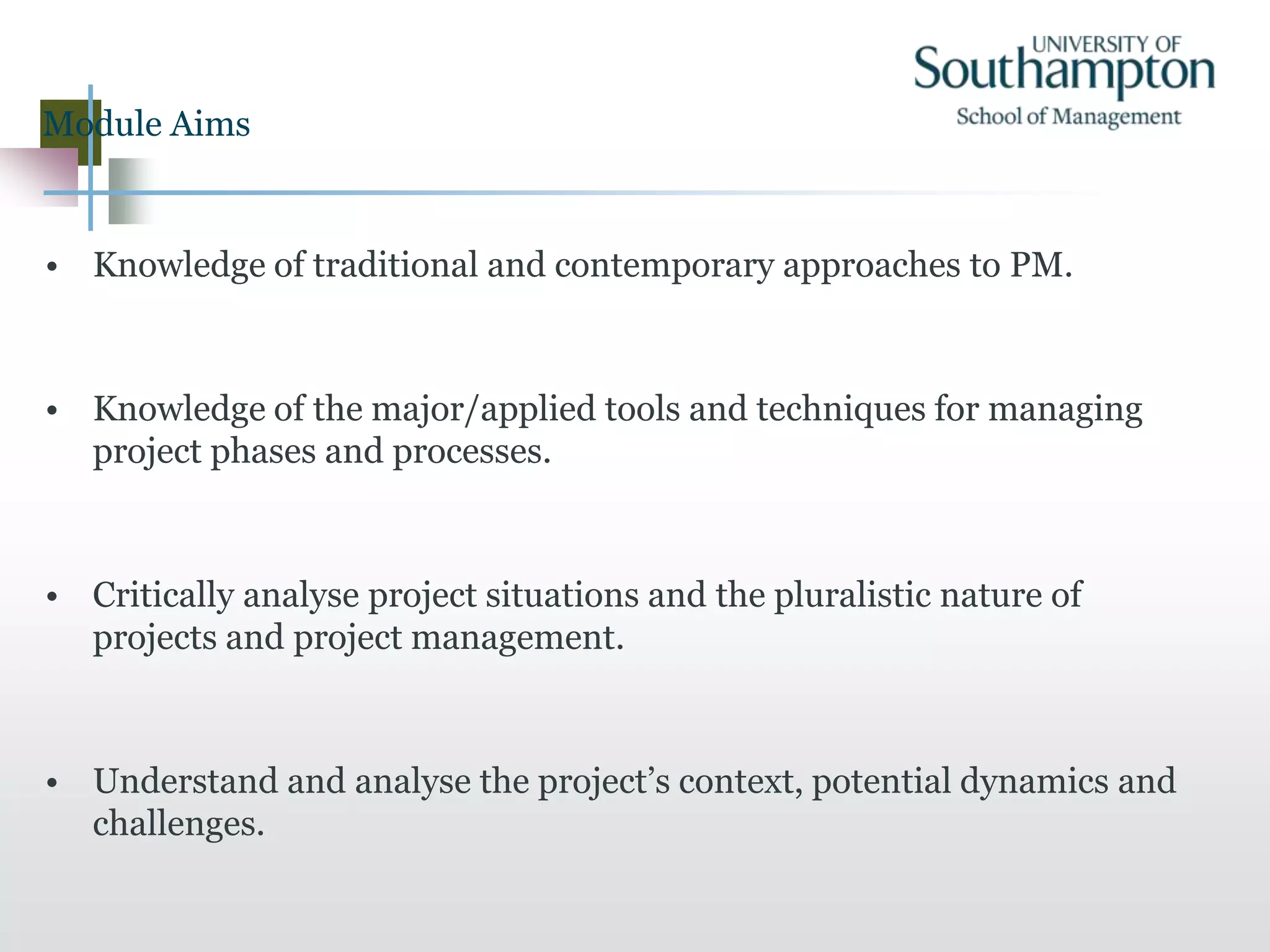
Module Aims
• Knowledge of traditional and contemporary approaches to PM.
• Knowledge of the major/applied tools and techniques for managing
project phases and processes.
• Critically analyse project situations and the pluralistic nature of
projects and project management.
• Understand and analyse the project’s context, potential dynamics and
challenges.
Appreciating Project Management
What projects have you seen (either worked on or observed)?
What challenges do project managers have to overcome?
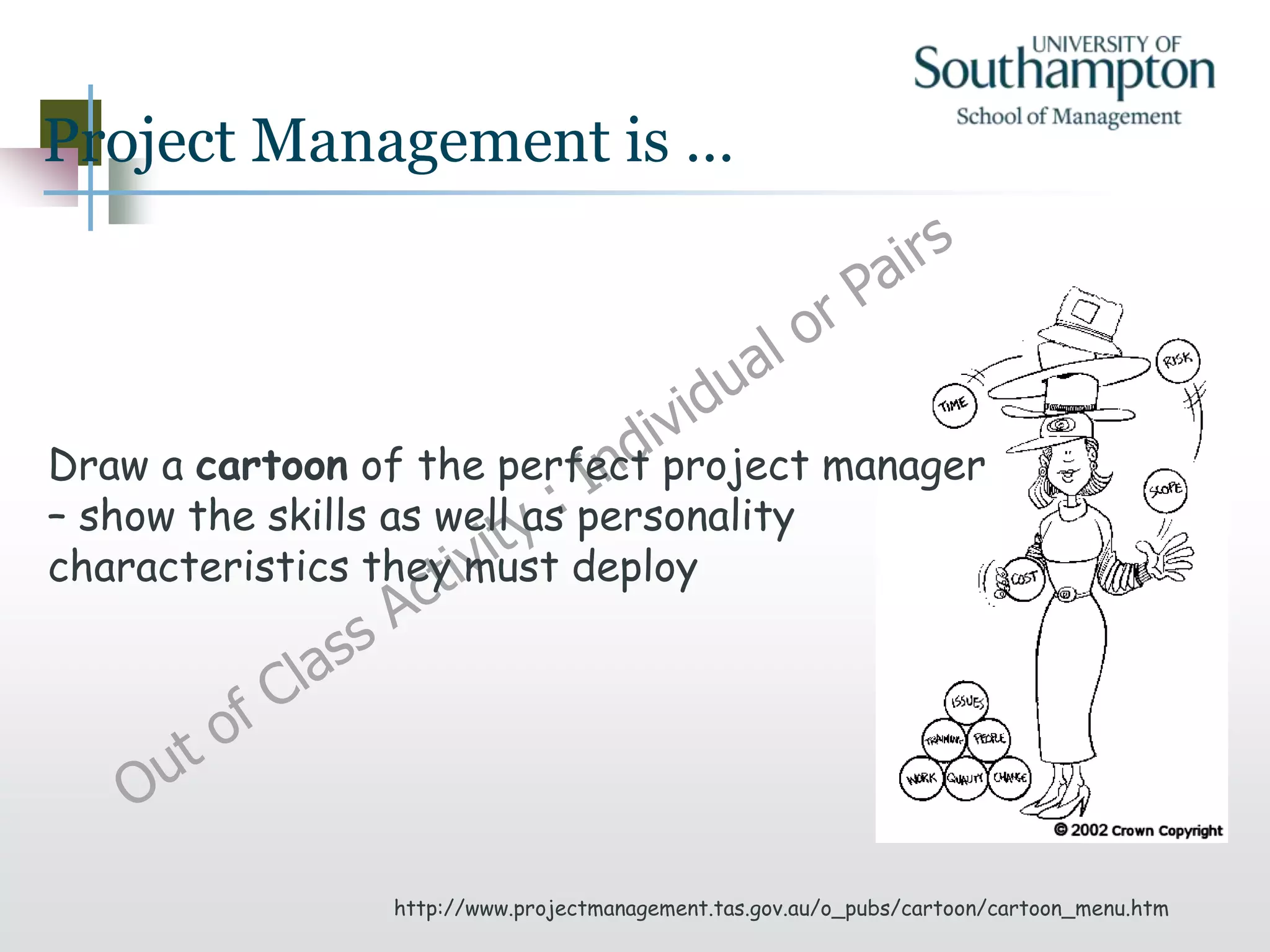
Project Management is …
http://www.projectmanagement.tas.gov.au/o_pubs/cartoon/cartoon_menu.htm
Draw a cartoon of the perfect project manager
– show the skills as well as personality
characteristics they must deploy
Characteristics of a Project
• Execute a task
• Lead to a defined outcome / deliverable
• Temporary / limited duration
• Different people / skills using resources
What is a project?
“An endeavour in which human, material and financial
resources are organised in a novel way, to undertake a
unique scope of work, of given specification, within
constraints of cost and time, so as to achieve beneficial
change defined by qualitative and quantitative
objectives.”
J Rodney Turner
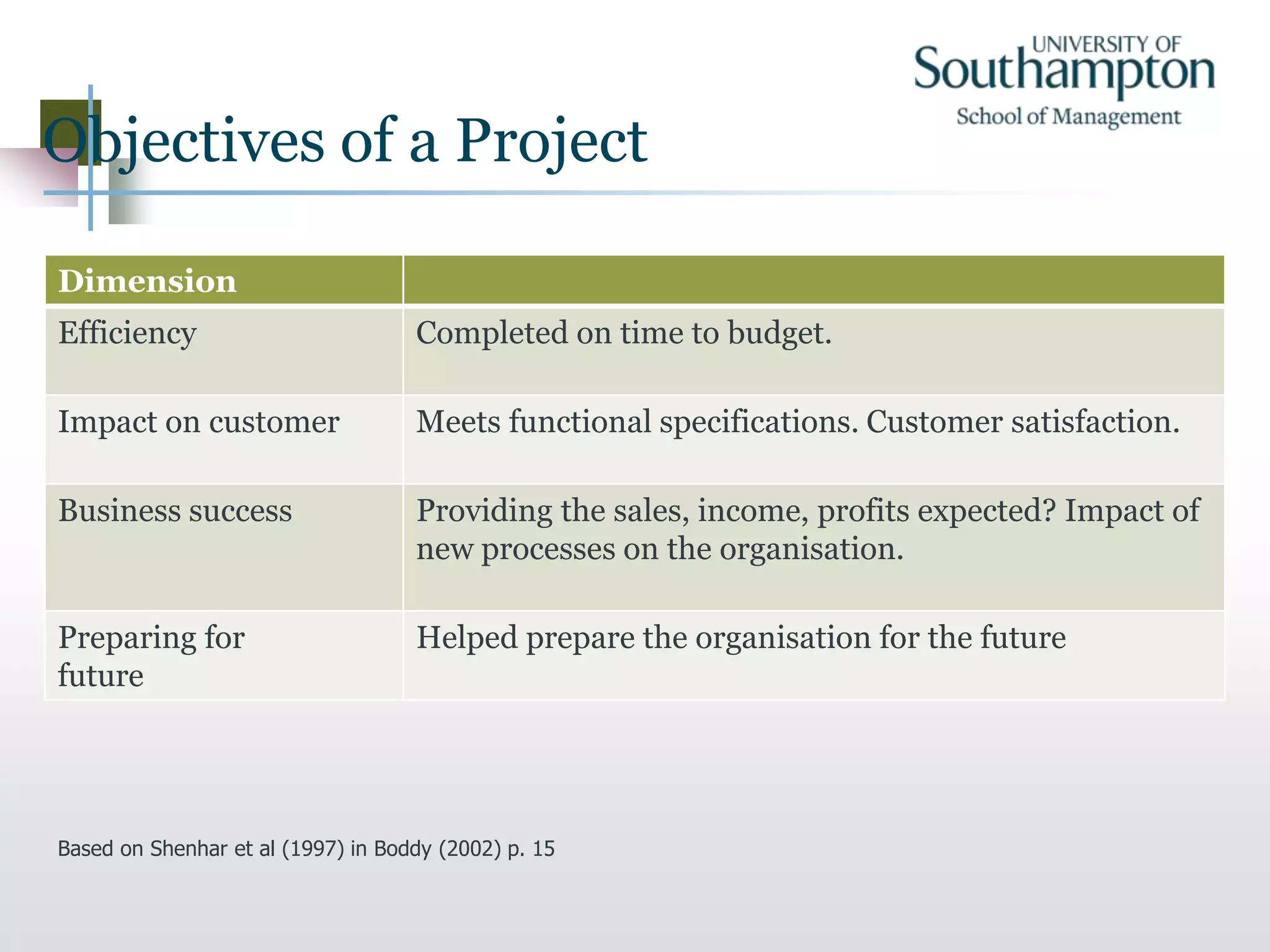
Objectives of a Project
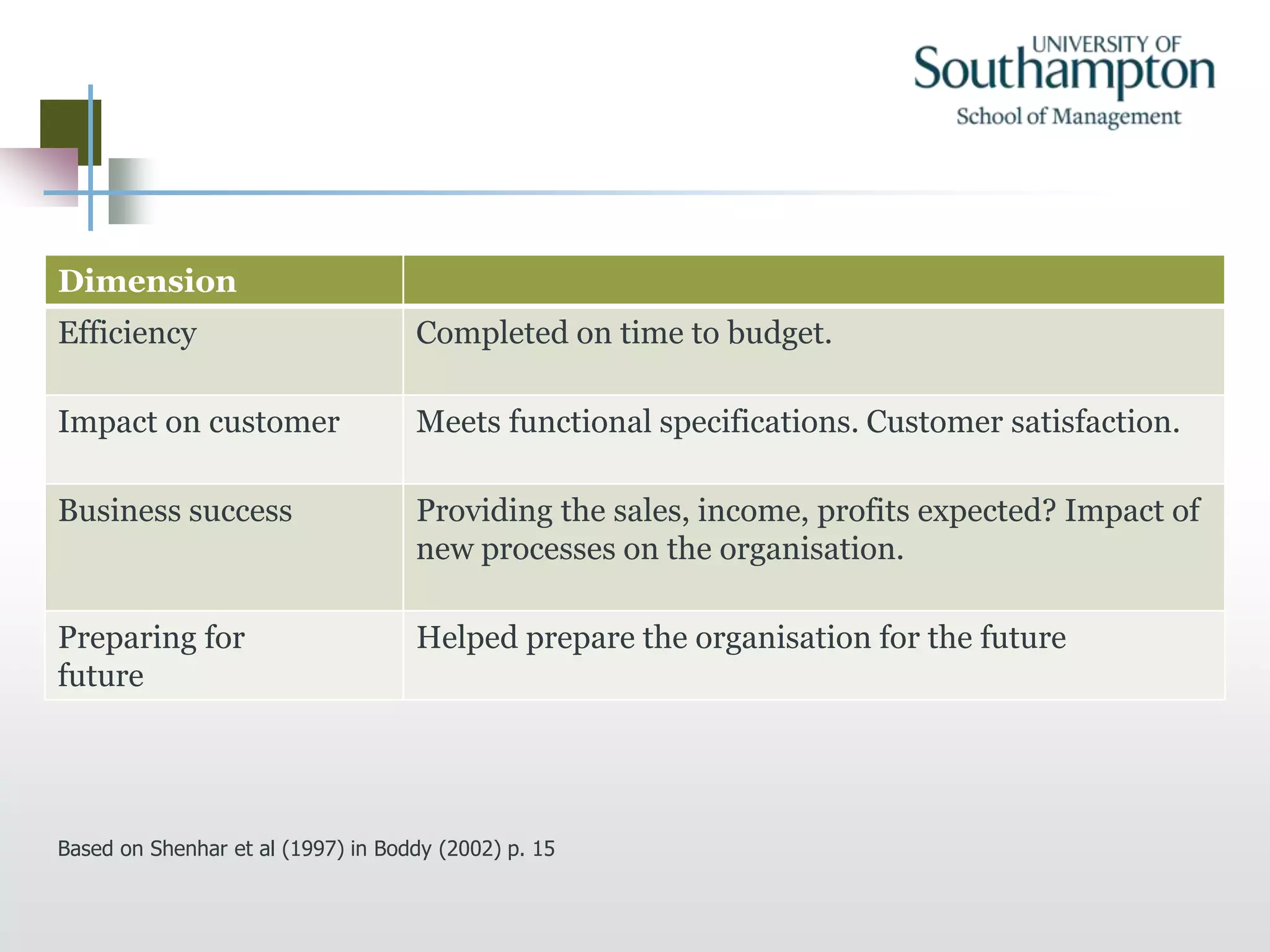
Dimension
Efficiency Completed on time to budget.
Impact on customer Meets functional specifications. Customer satisfaction.
Business success Providing the sales, income, profits expected? Impact of
new processes on the organisation.
Preparing for
future
Helped prepare the organisation for the future
Based on Shenhar et al (1997) in Boddy (2002) p. 15
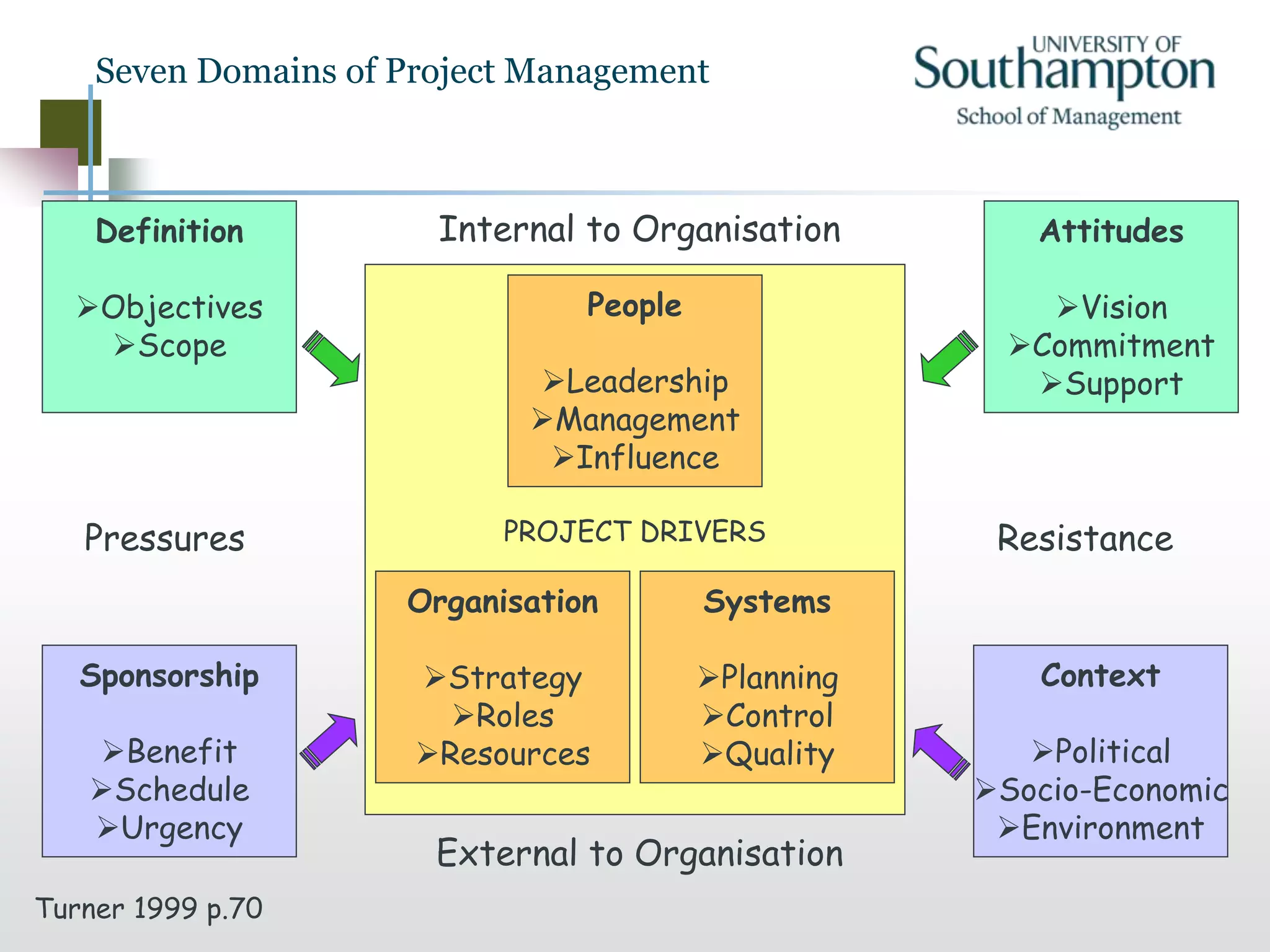
Seven Domains of Project Management
Sponsorship
Benefit
Schedule
Urgency
Context
Political
Socio-Economic
Environment
People
Leadership
Management
Influence
PROJECT DRIVERS
Organisation
Strategy
Roles
Resources
Systems
Planning
Control
Quality
Definition
Objectives
Scope
Attitudes
Vision
Commitment
Support
Pressures Resistance
Internal to Organisation
External to Organisation
Turner 1999 p.70
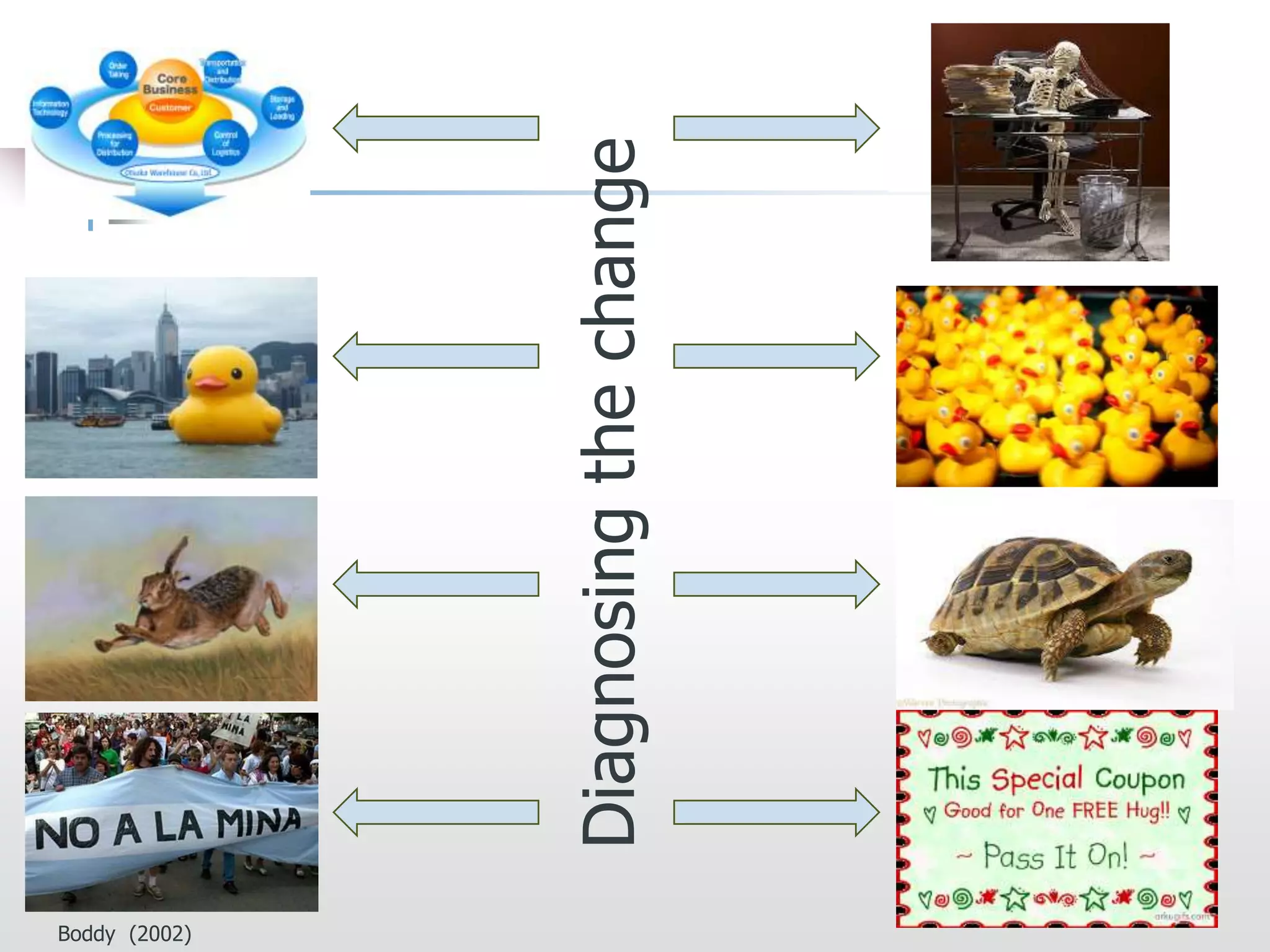
Boddy (2002)
Diagnosingthechange
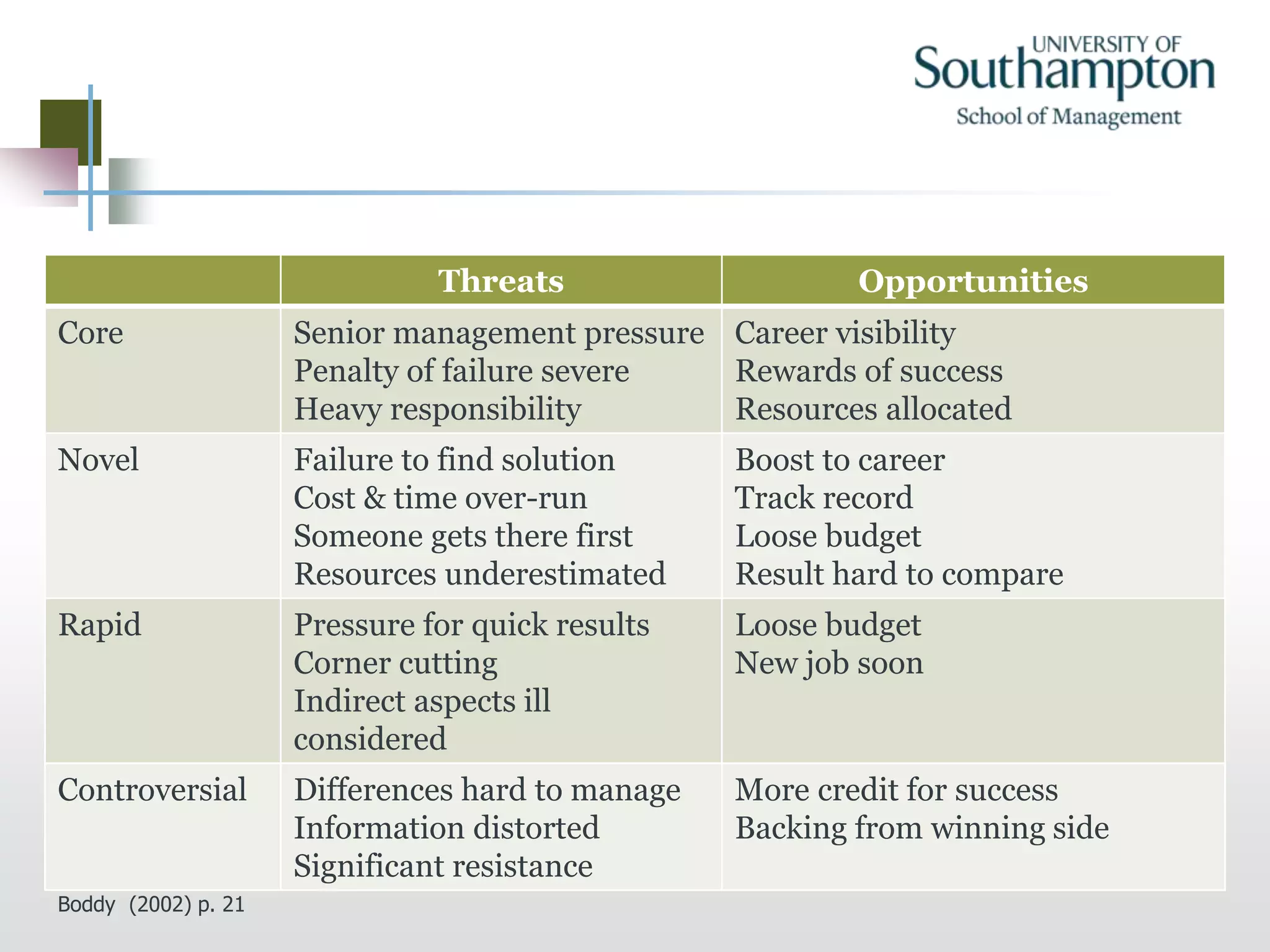
Threats Opportunities
Core Senior management pressure
Penalty of failure severe
Heavy responsibility
Career visibility
Rewards of success
Resources allocated
Novel Failure to find solution
Cost & time over-run
Someone gets there first
Resources underestimated
Boost to career
Track record
Loose budget
Result hard to compare
Rapid Pressure for quick results
Corner cutting
Indirect aspects ill
considered
Loose budget
New job soon
Controversial Differences hard to manage
Information distorted
Significant resistance
More credit for success
Backing from winning side
Boddy (2002) p. 21
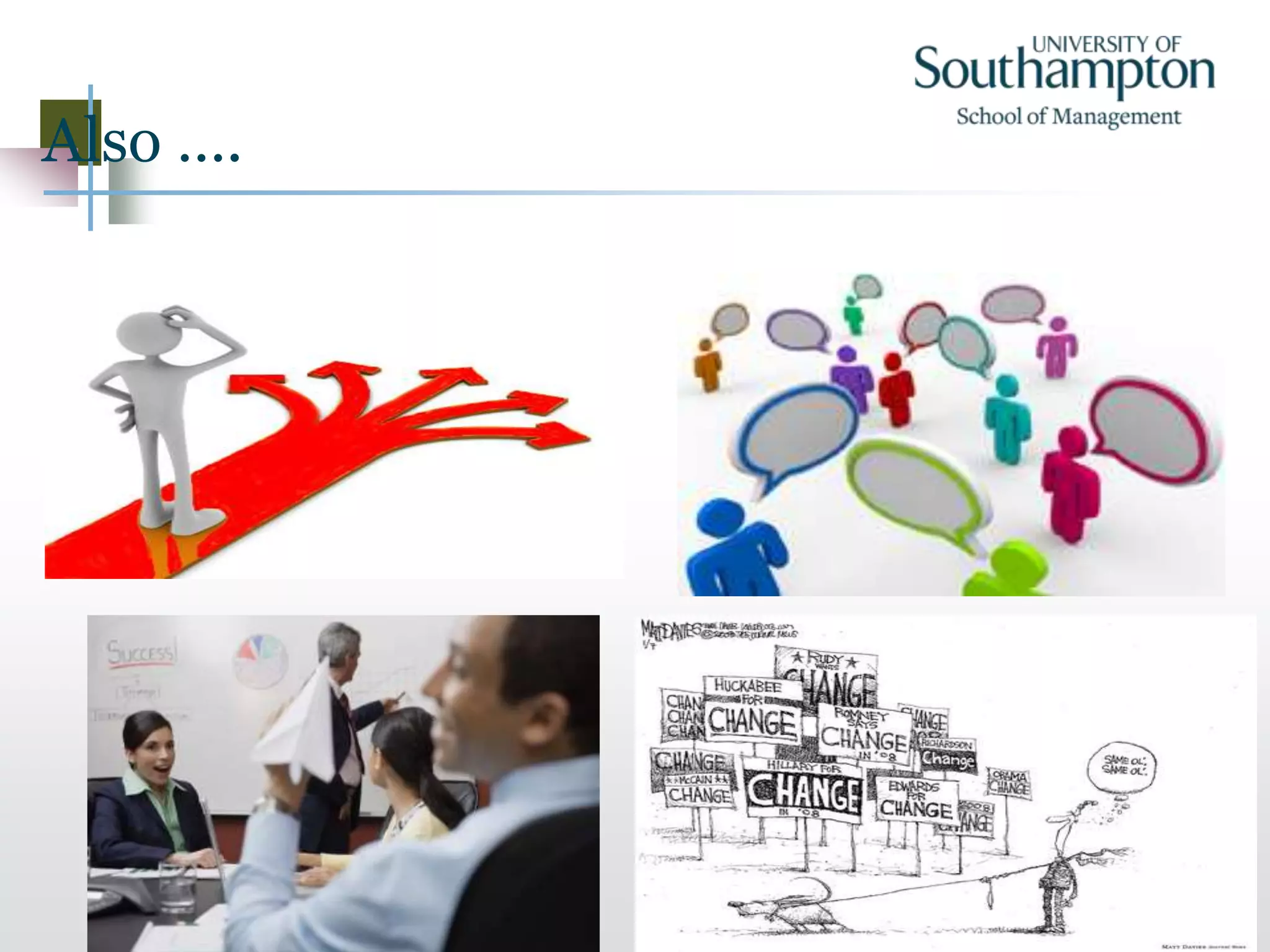
Also ….
Dimension
Efficiency Completed on time to budget.
Impact on customer Meets functional specifications. Customer satisfaction.
Business success Providing the sales, income, profits expected? Impact of
new processes on the organisation.
Preparing for
future
Helped prepare the organisation for the future
Based on Shenhar et al (1997) in Boddy (2002) p. 15
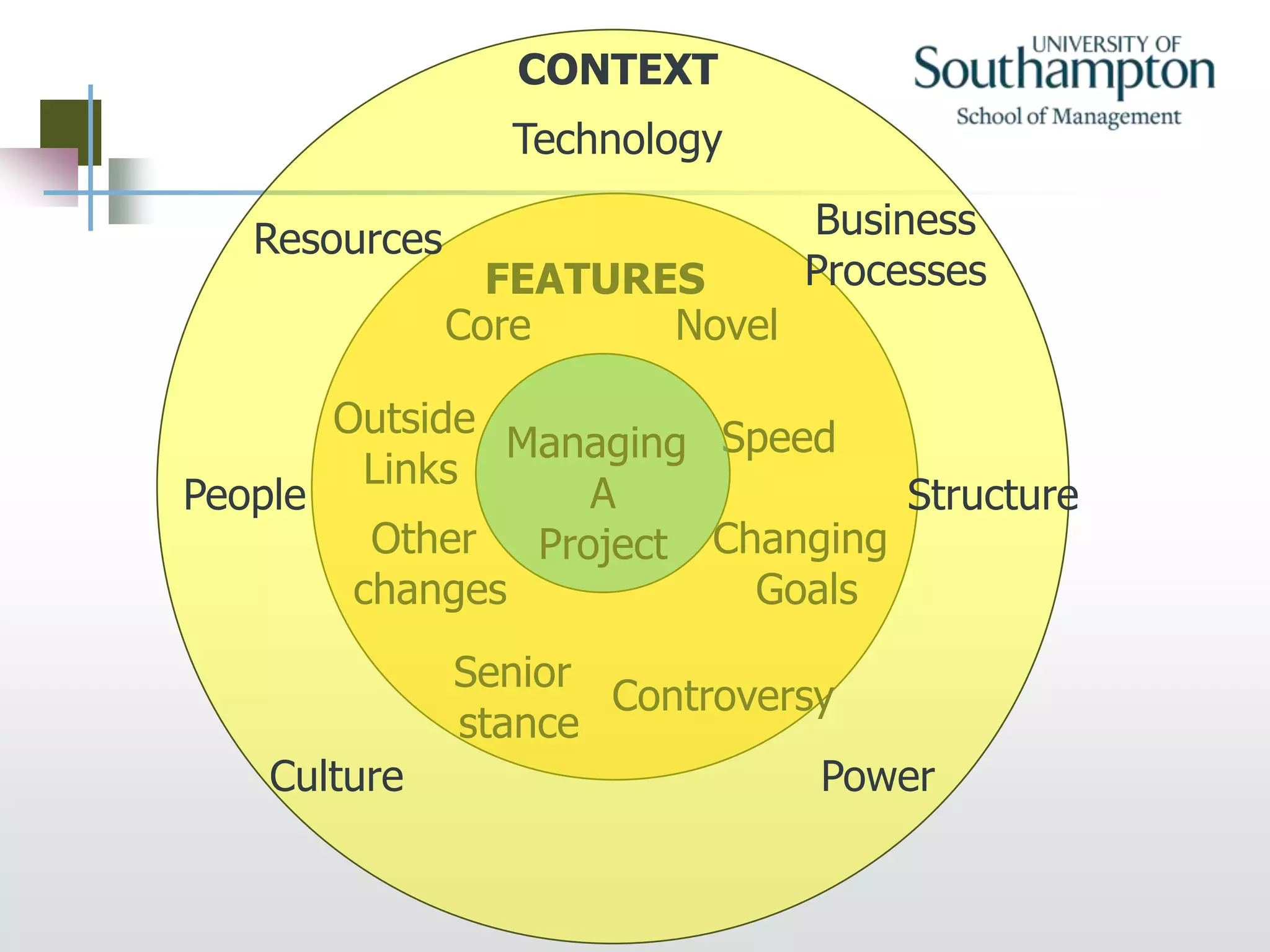
Controversy
Senior
stance
Changing
Goals
Other
changes
SpeedOutside
Links
Core Novel
FEATURES
Managing
A
Project
Technology
CONTEXT
Business
Processes
Structure
PowerCulture
People
Resources
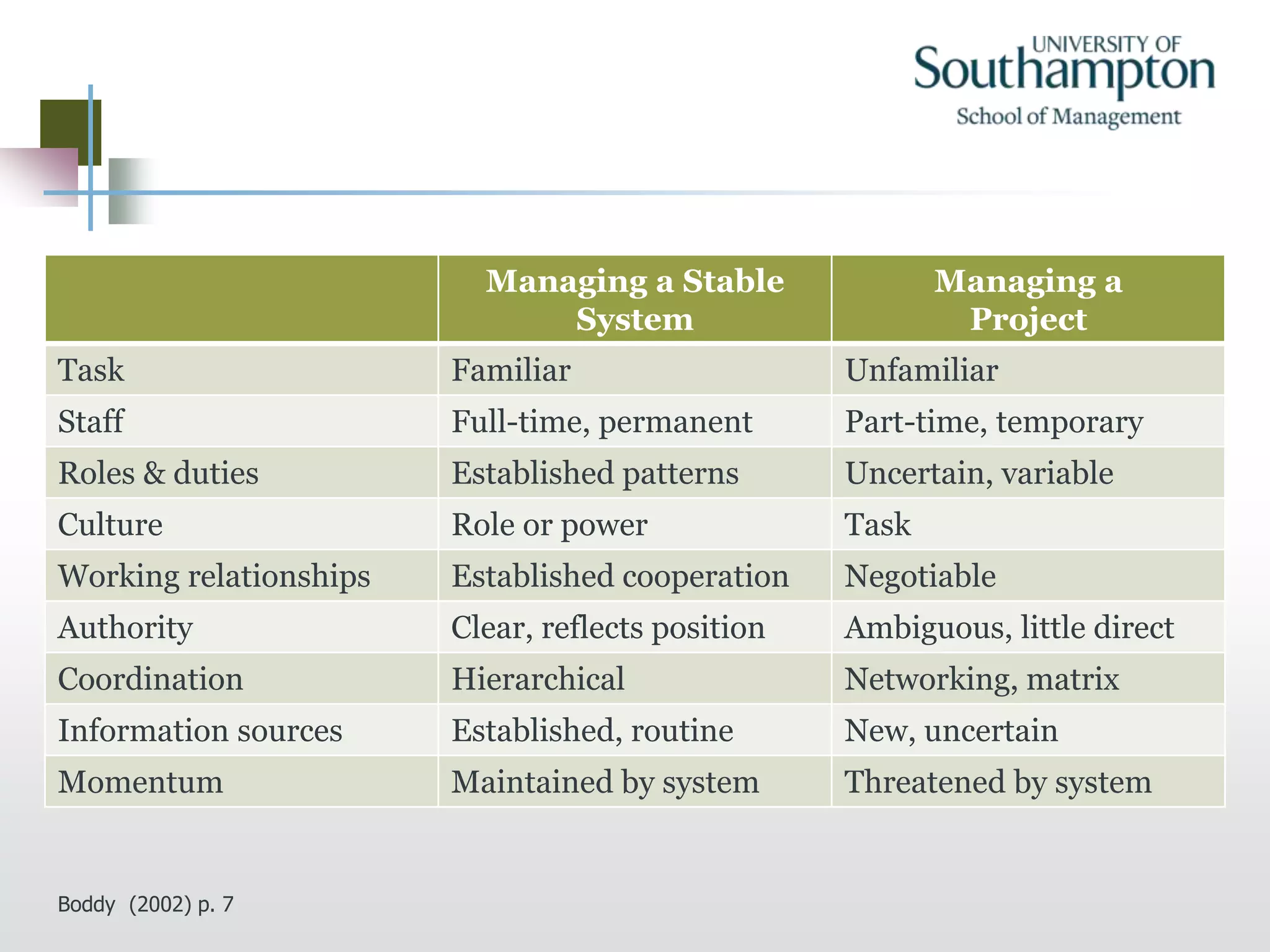
Managing a Stable
System
Managing a
Project
Task Familiar Unfamiliar
Staff Full-time, permanent Part-time, temporary
Roles & duties Established patterns Uncertain, variable
Culture Role or power Task
Working relationships Established cooperation Negotiable
Authority Clear, reflects position Ambiguous, little direct
Coordination Hierarchical Networking, matrix
Information sources Established, routine New, uncertain
Momentum Maintained by system Threatened by system
Boddy (2002) p. 7
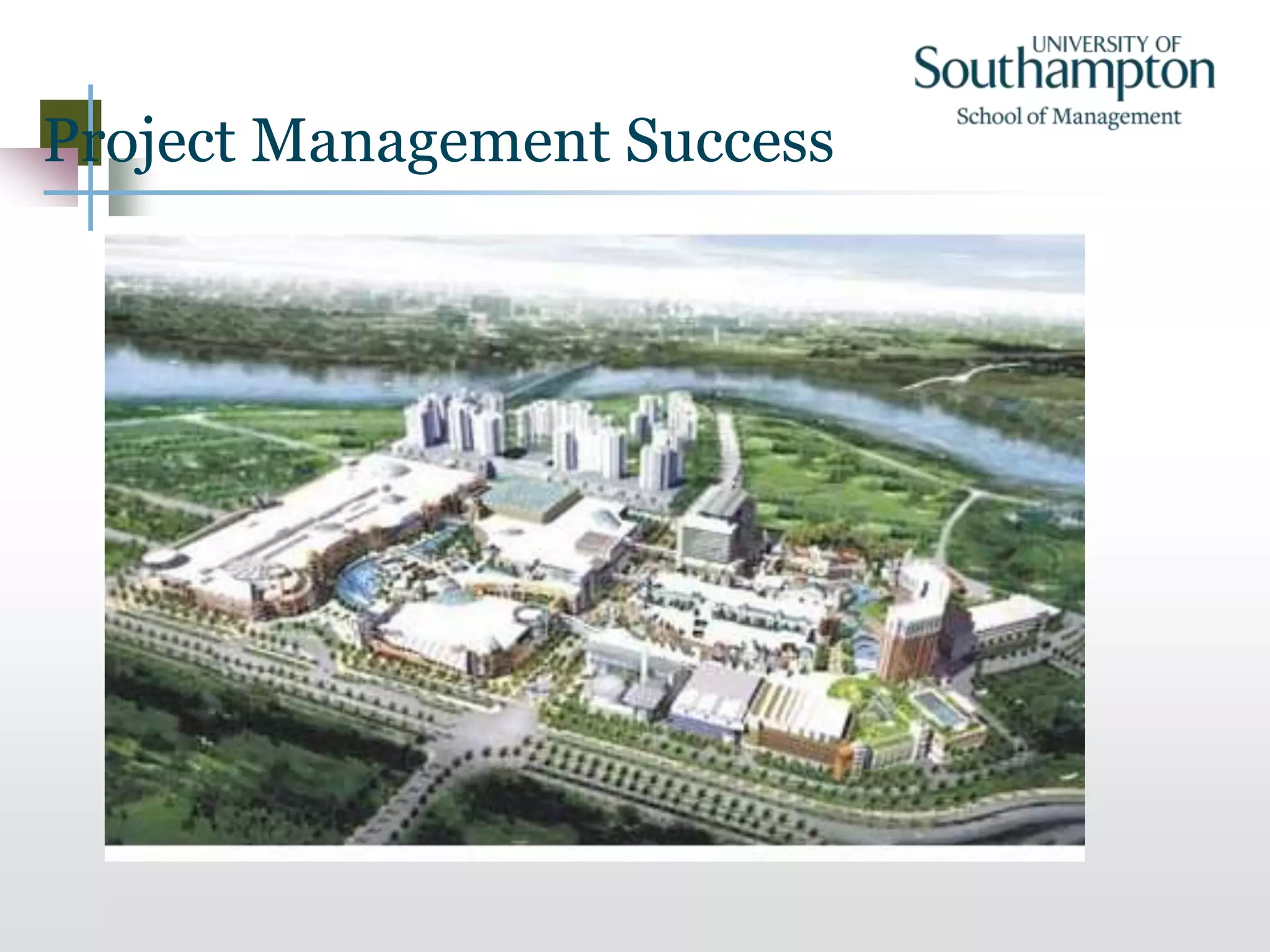
Project Management Success
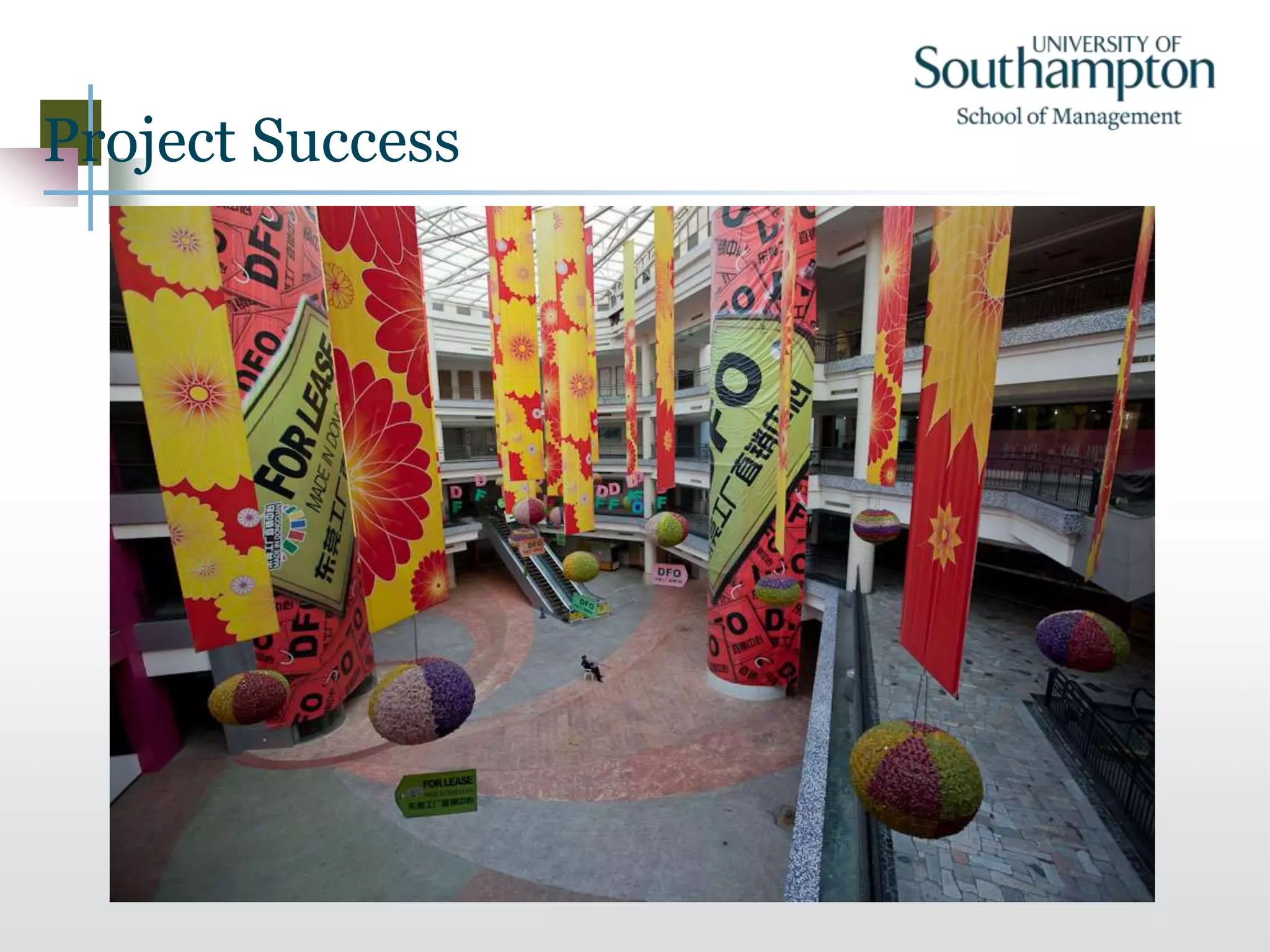
Project Success
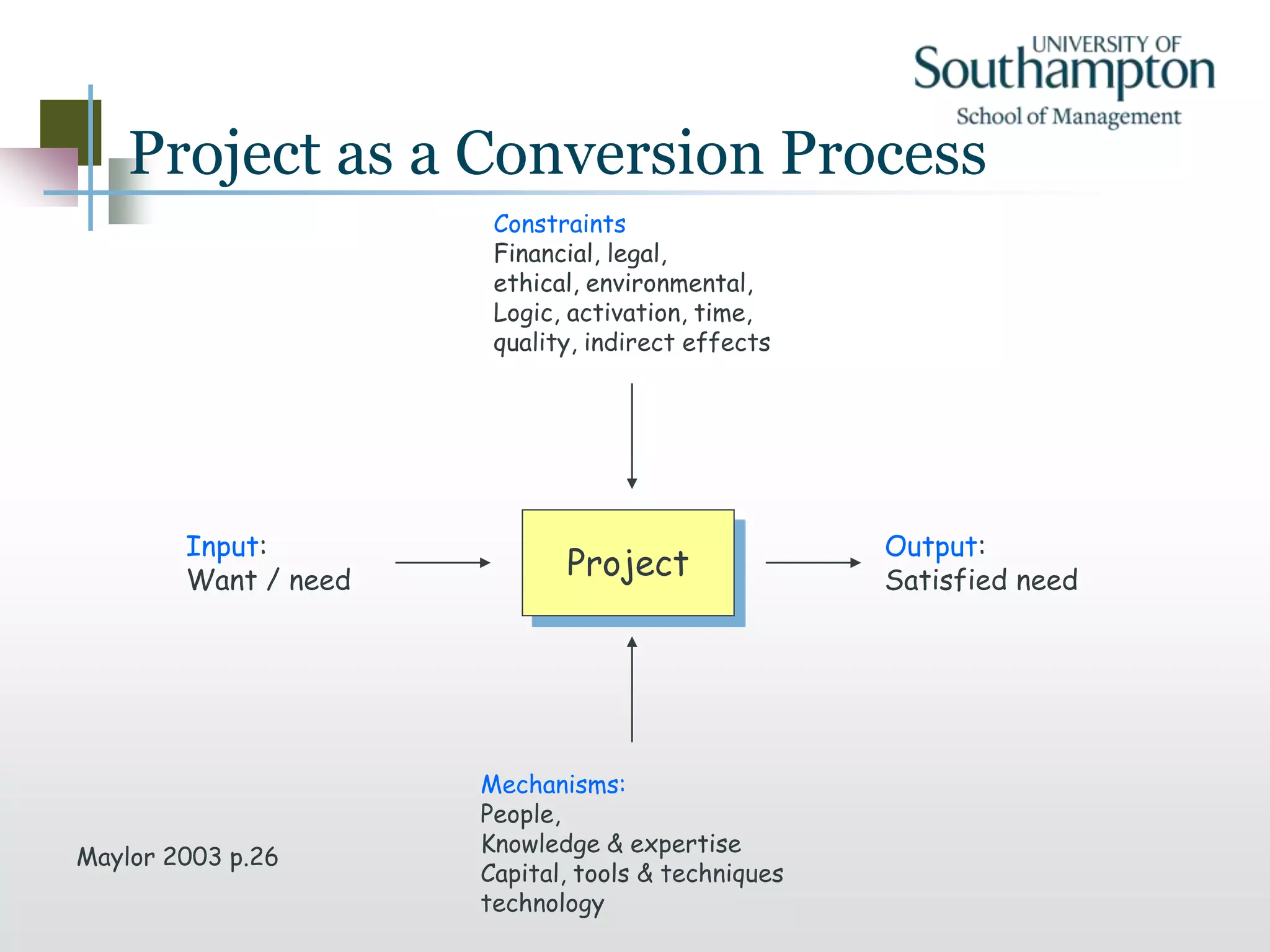
Project as a Conversion Process
Project
Output:
Satisfied need
Input:
Want / need
Constraints
Financial, legal,
ethical, environmental,
Logic, activation, time,
quality, indirect effects
Mechanisms:
People,
Knowledge & expertise
Capital, tools & techniques
technology
Maylor 2003 p.26
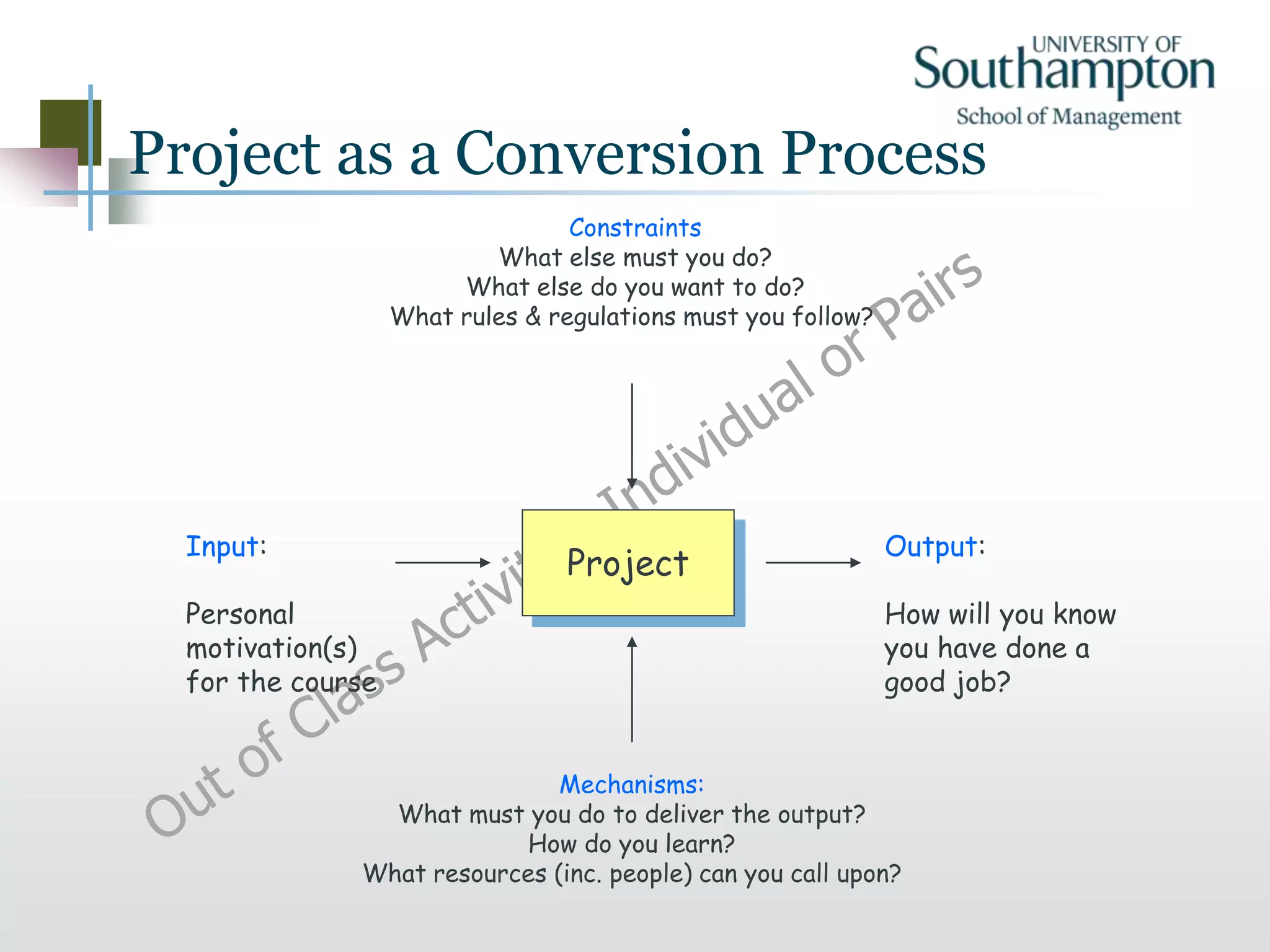
Project as a Conversion Process
Project
Output:
How will you know
you have done a
good job?
Input:
Personal
motivation(s)
for the course
Constraints
What else must you do?
What else do you want to do?
What rules & regulations must you follow?
Mechanisms:
What must you do to deliver the output?
How do you learn?
What resources (inc. people) can you call upon?
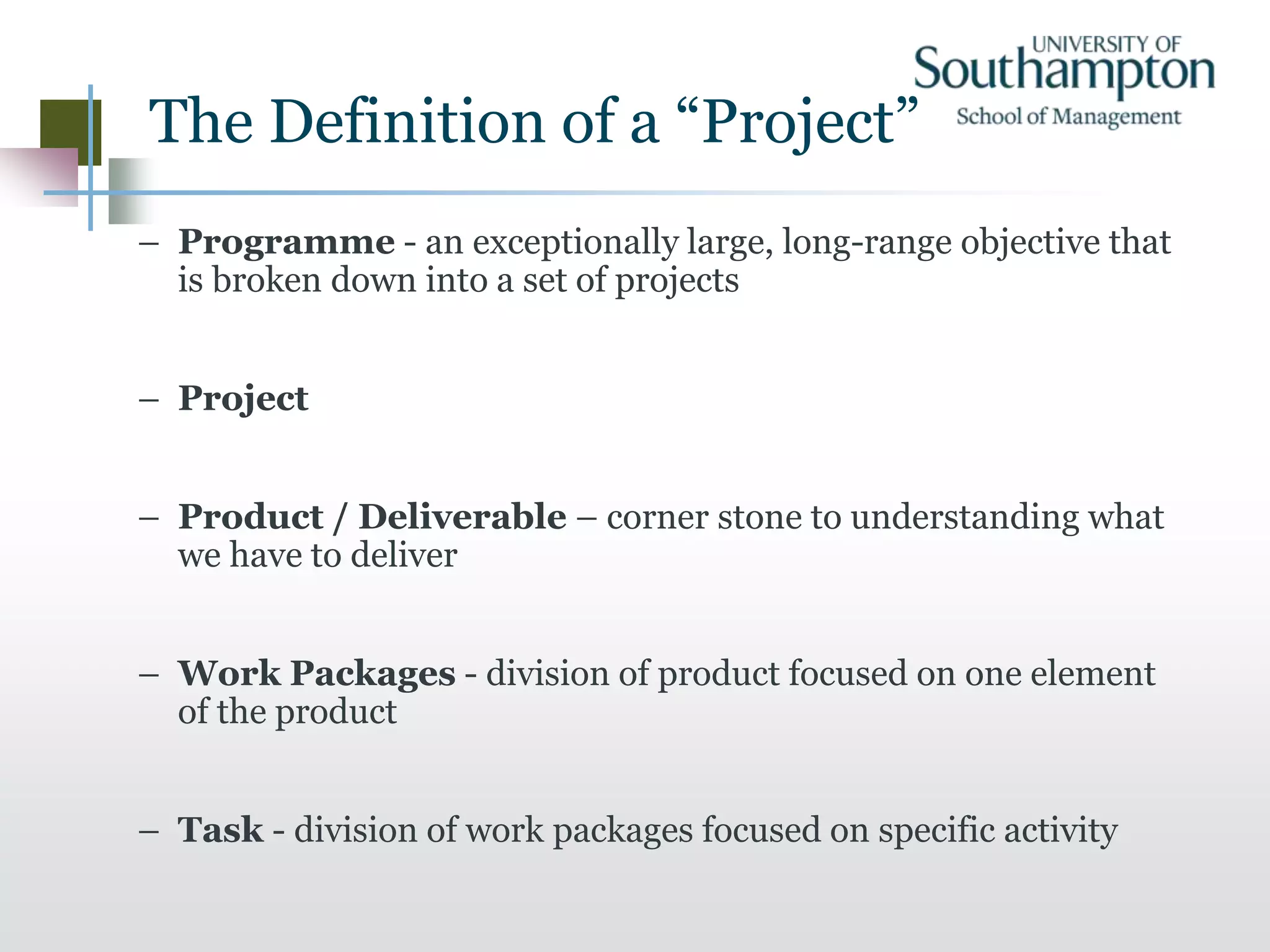
The Definition of a “Project”
– Programme - an exceptionally large, long-range objective that
is broken down into a set of projects
– Project
– Product / Deliverable – corner stone to understanding what
we have to deliver
– Work Packages - division of product focused on one element
of the product
– Task - division of work packages focused on specific activity
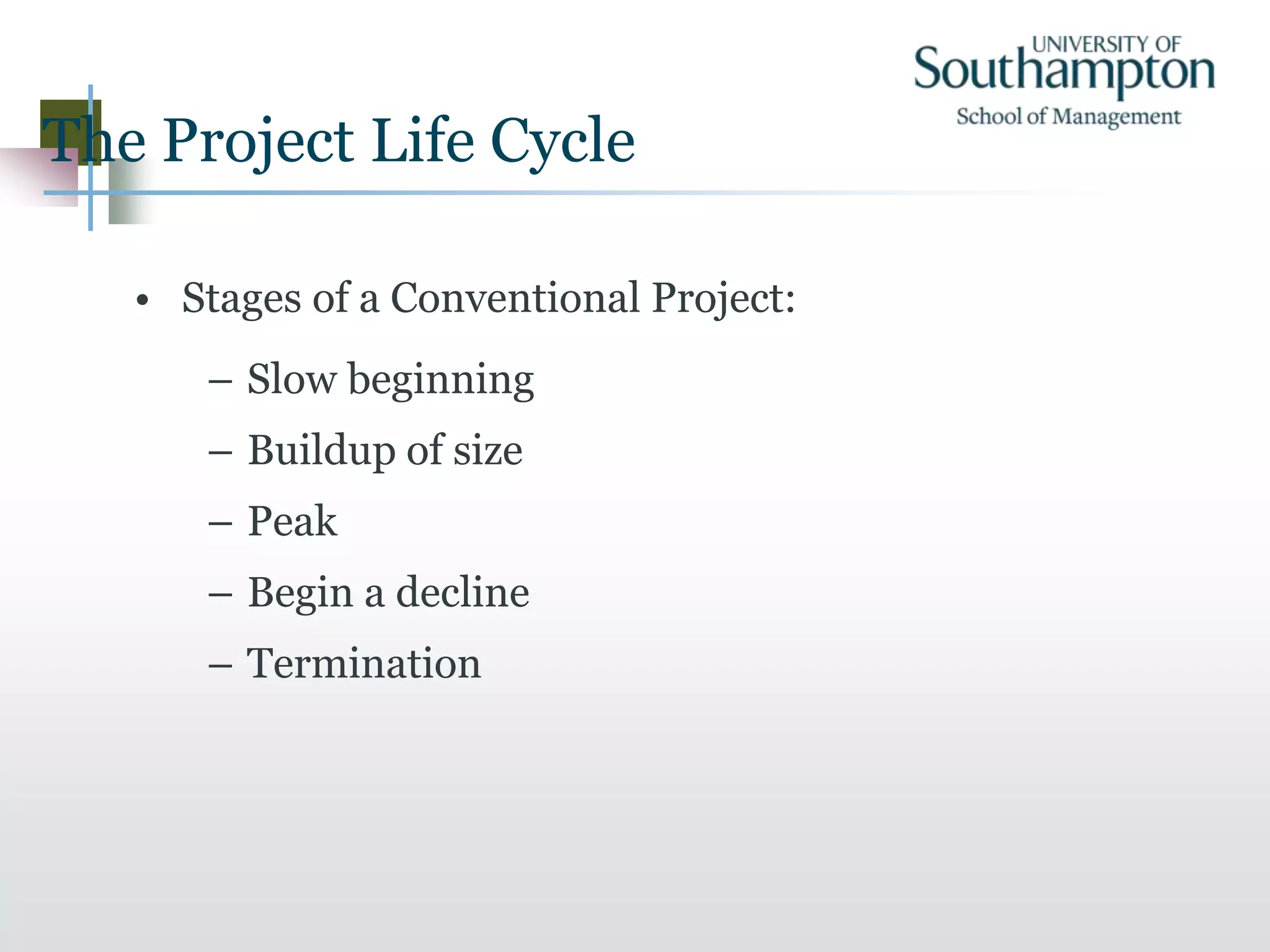
The Project Life Cycle
• Stages of a Conventional Project:
– Slow beginning
– Buildup of size
– Peak
– Begin a decline
– Termination
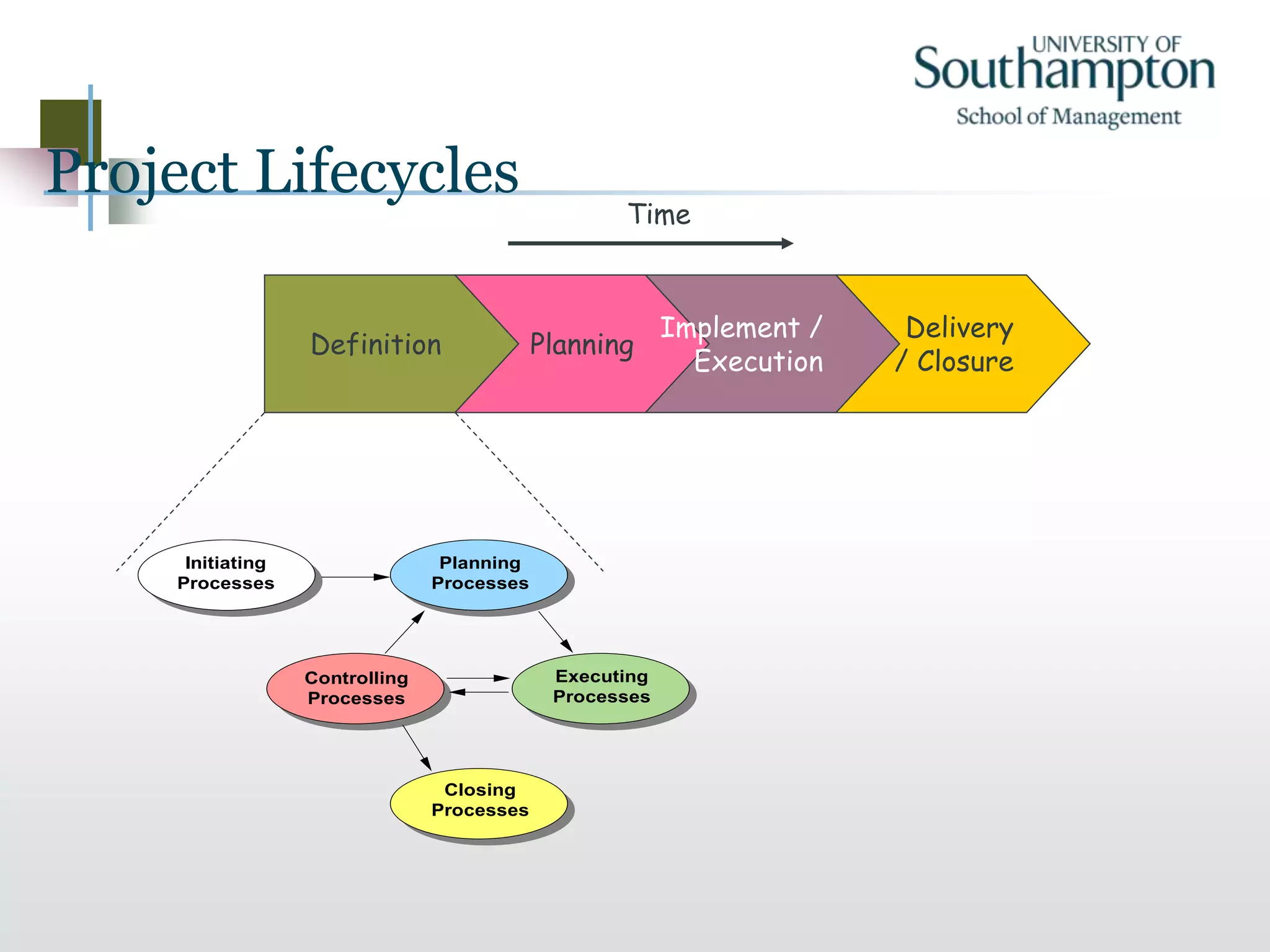
Project Lifecycles
Definition Planning
Implement /
Execution
Delivery
/ Closure
Time
Initiating
Processes
Planning
Processes
Controlling
Processes
Executing
Processes
Closing
Processes
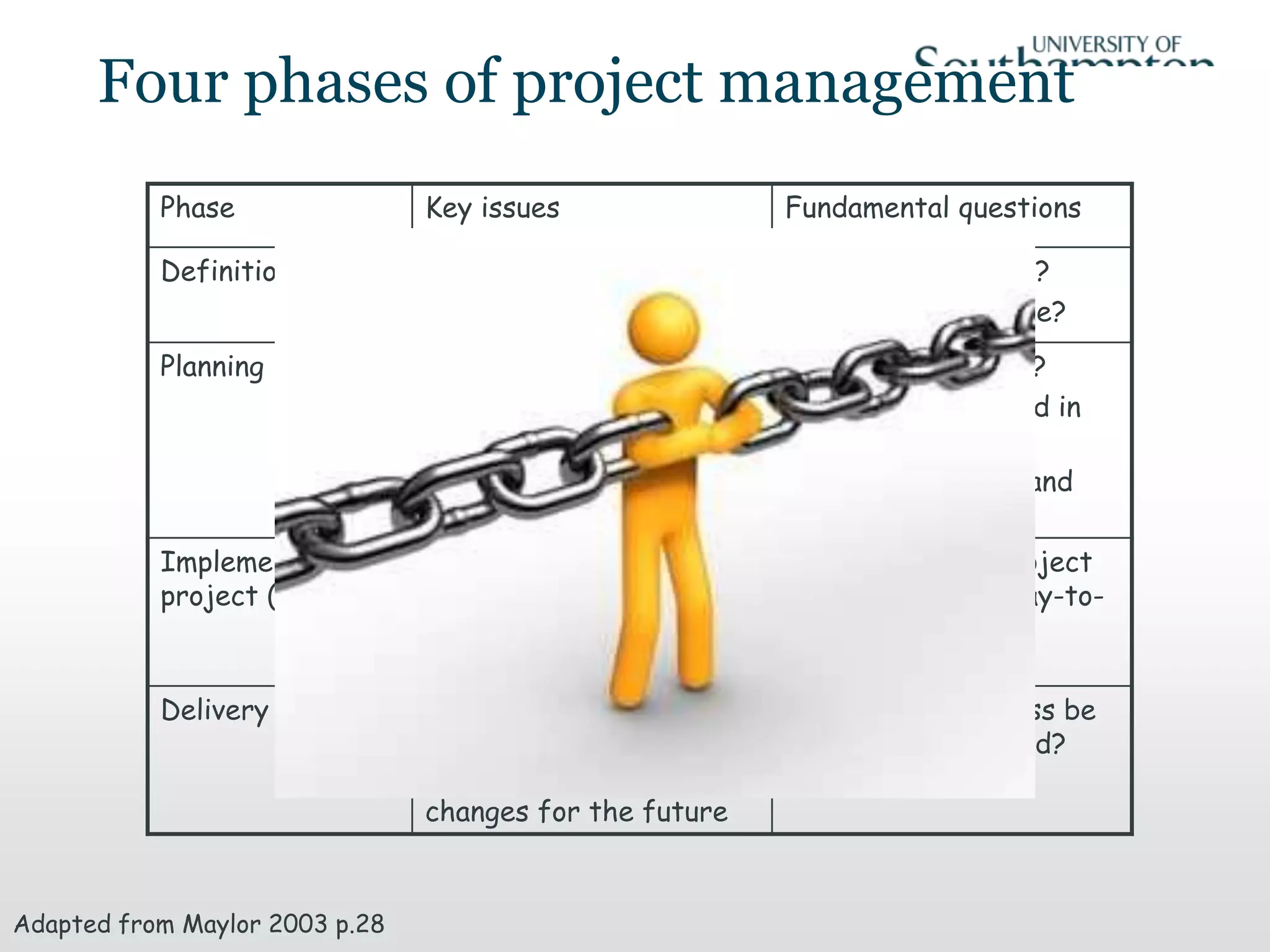
Four phases of project management
Phase Key issues Fundamental questions
Definition Project & organisational
strategy, goal definition
What is to be done?
Why is it to be done?
Planning Modelling and planning,
estimating, resource
analysis, conflict
resolution & justification
How will it be done?
Who will be involved in
each part?
When can it start and
finish?
Implement the
project (do it!)
Organisation, control,
leadership, decision
making and problem
solving
How should the project
be managed on a day-to-
day basis?
Delivery / Closure Assessment of process
and outcomes of the
project, evaluation,
changes for the future
How can the process be
continually improved?
Adapted from Maylor 2003 p.28
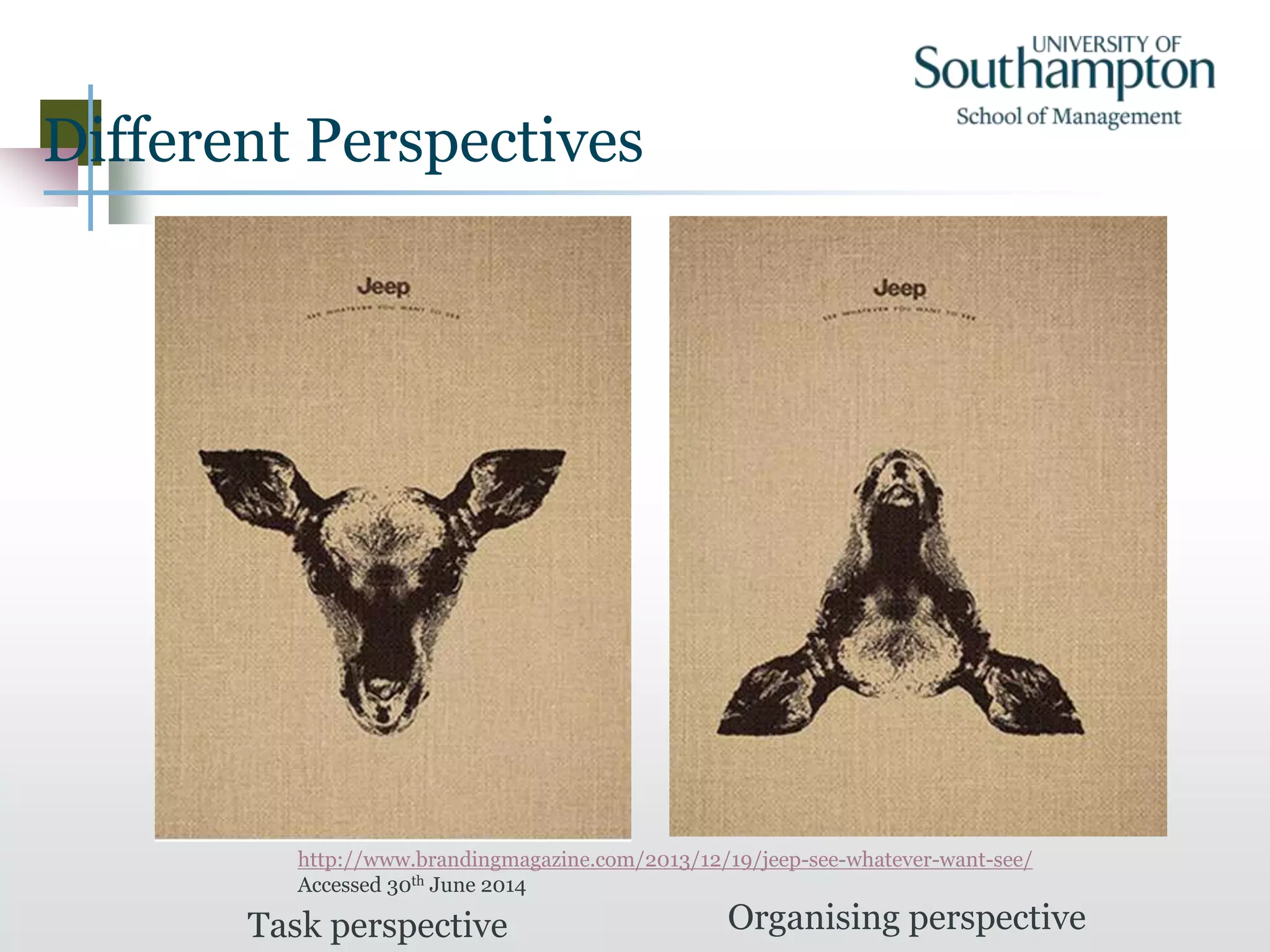
Different Perspectives
Task perspective Organising perspective
http://www.brandingmagazine.com/2013/12/19/jeep-see-whatever-want-see/
Accessed 30th June 2014
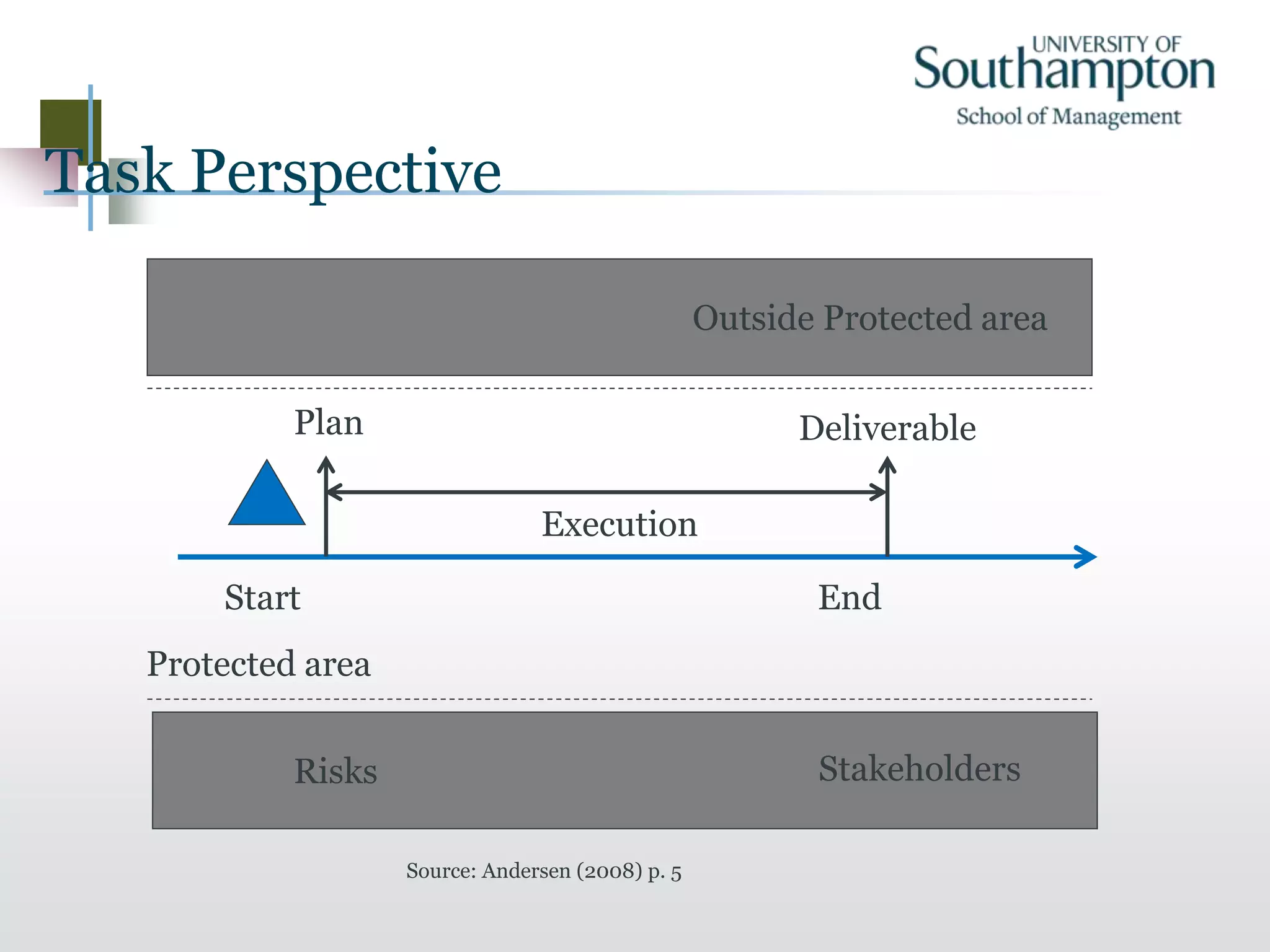
Task Perspective
Outside Protected area
Protected area
Start End
Plan Deliverable
Execution
Risks Stakeholders
Source: Andersen (2008) p. 5
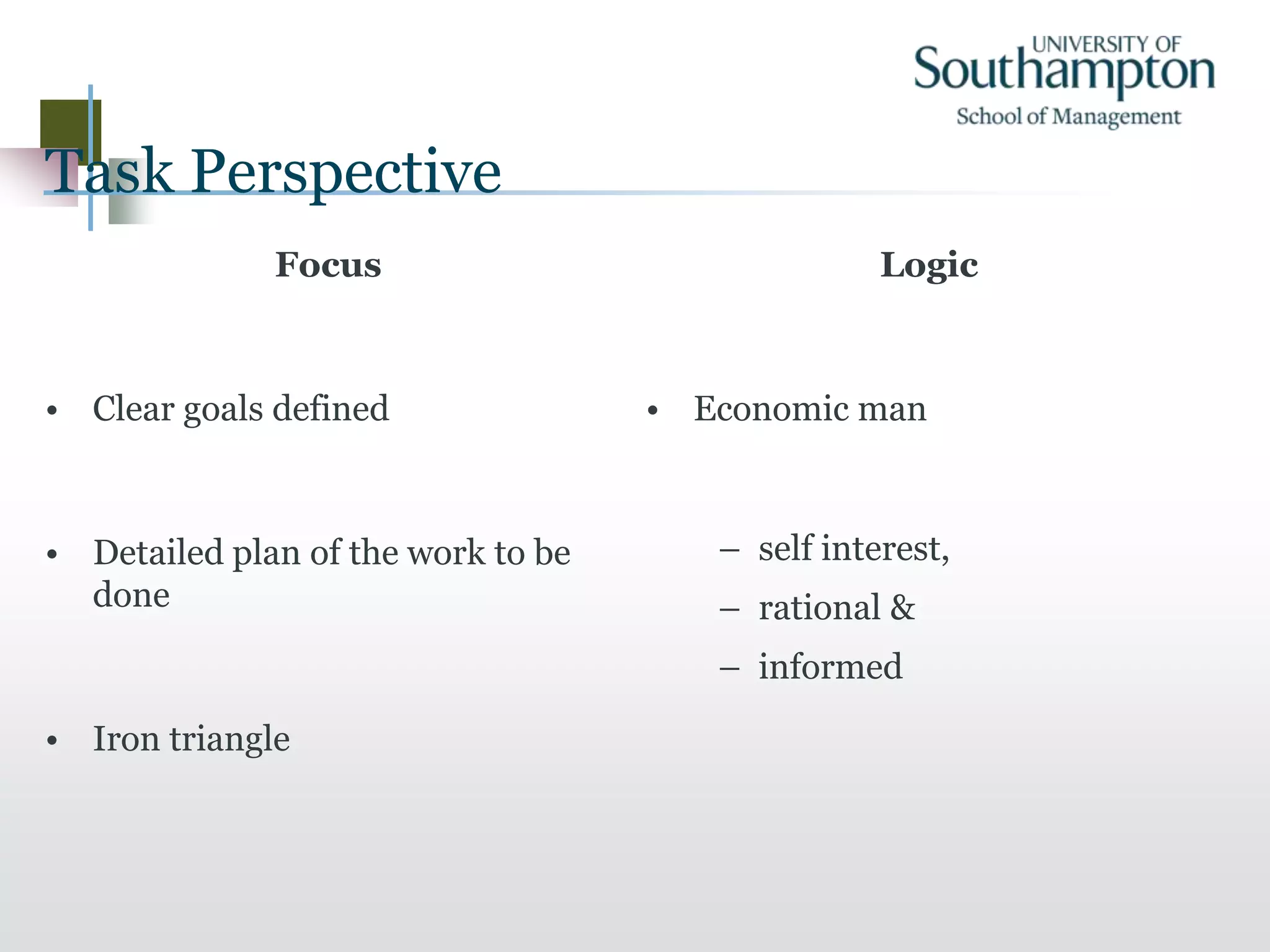
Task Perspective
Focus
• Clear goals defined
• Detailed plan of the work to be
done
• Iron triangle
Logic
• Economic man
– self interest,
– rational &
– informed
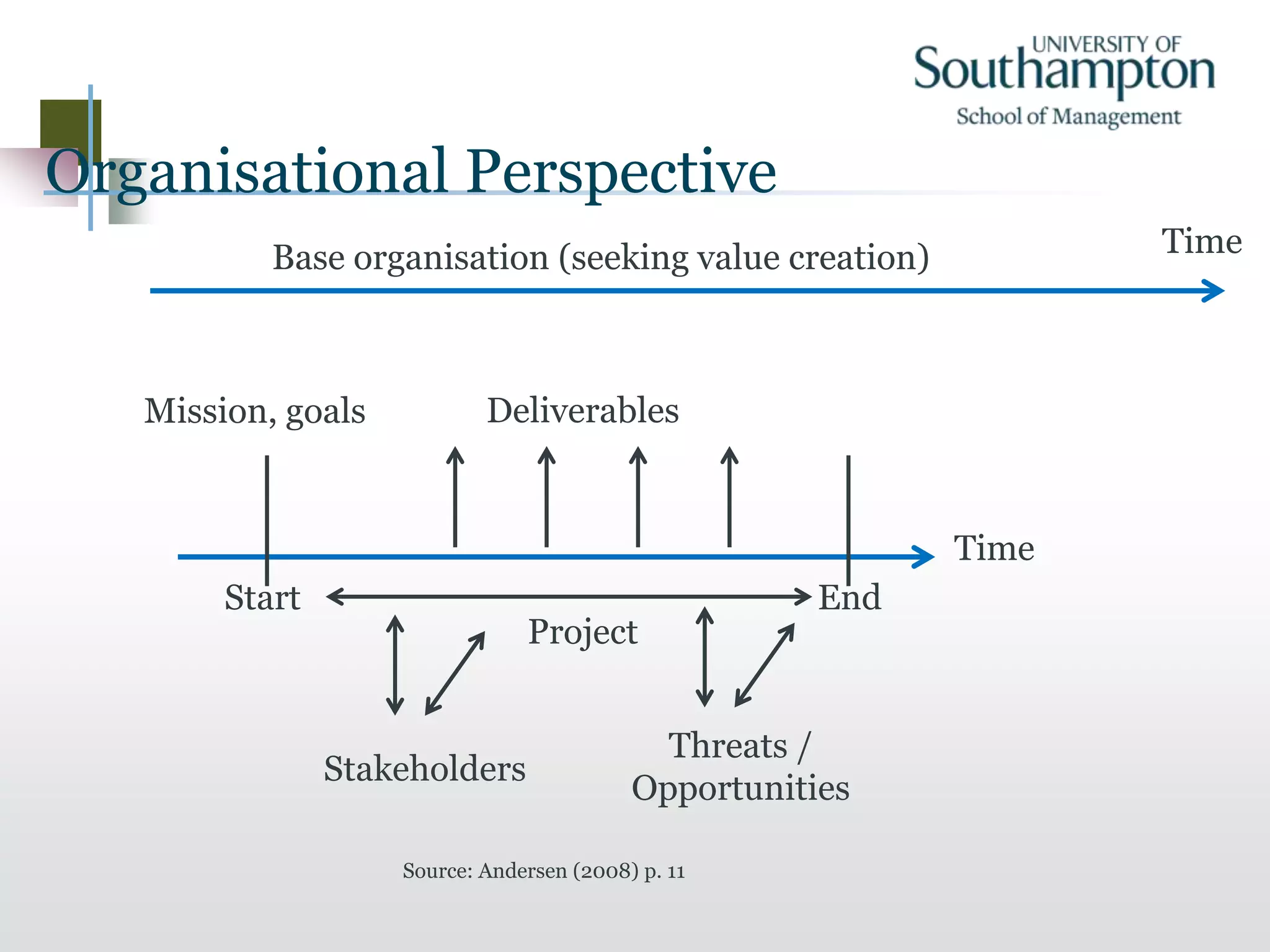
Organisational Perspective
Start End
Mission, goals Deliverables
Project
Threats /
Opportunities
Stakeholders
Base organisation (seeking value creation)
Time
Time
Source: Andersen (2008) p. 11
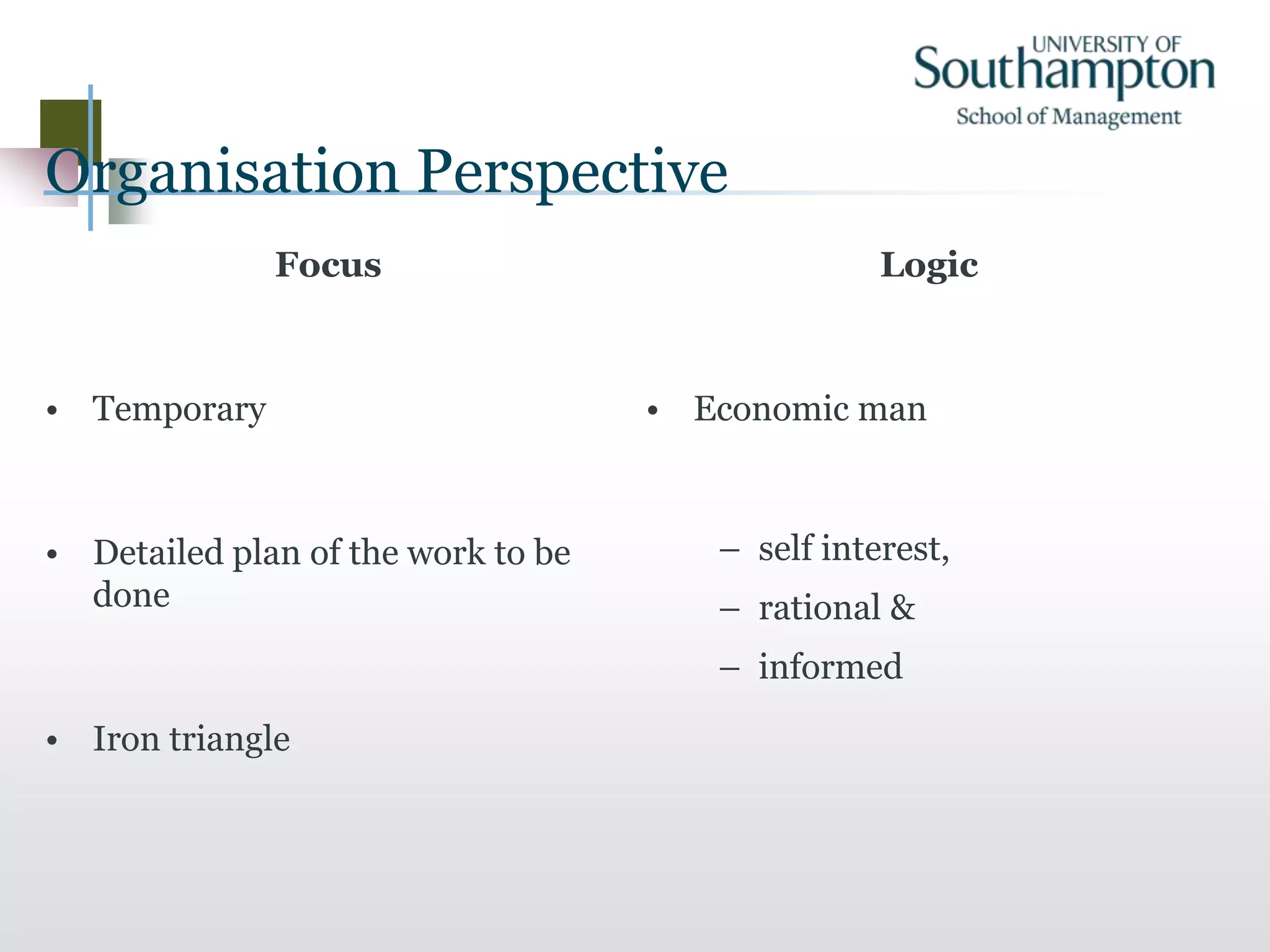
Organisation Perspective
Focus
• Temporary
• Detailed plan of the work to be
done
• Iron triangle
Logic
• Economic man
– self interest,
– rational &
– informed
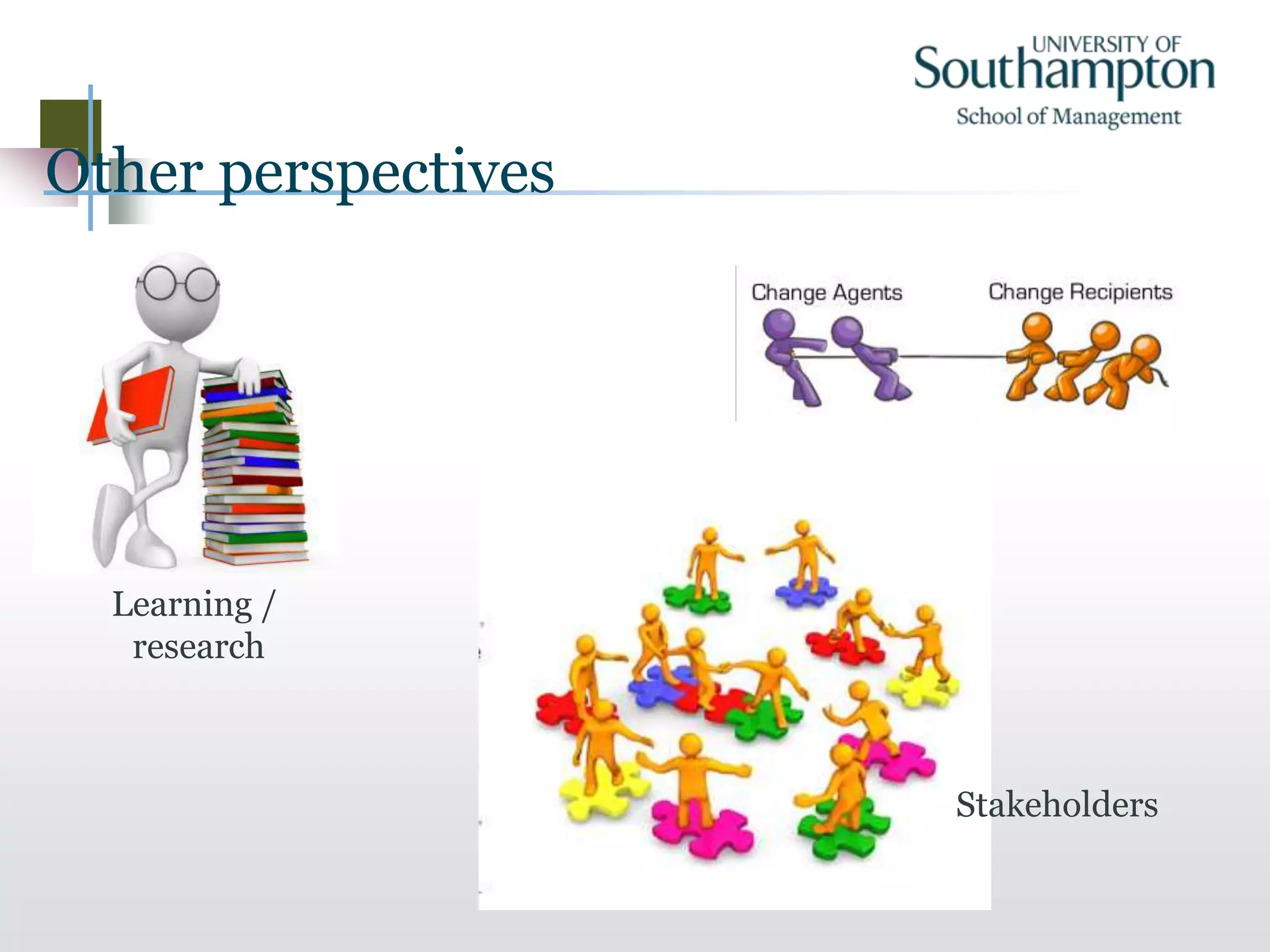
Other perspectives
Learning /
research
Stakeholders
Essential Reading
• PMI (2000) A Guide to the Project Management Institute Body of Knowledge Chapter 3
• Randolph W.A. & Posner B.Z. (1988) ‘What Every Manager Needs to Know About Project
Management’ Sloan Management Review Summer 1988

Introduction to Project Management

  • 1.
    Dr Ian Cammack i.j.Cammack@soton.ac.uk MScProject Management MANG6310: Introduction
  • 2.
    Road Map • ModuleOverview • Appreciating Project Management • Project Life Cycle • Project Management Profession
  • 3.
    Module Aims • Knowledgeof traditional and contemporary approaches to PM. • Knowledge of the major/applied tools and techniques for managing project phases and processes. • Critically analyse project situations and the pluralistic nature of projects and project management. • Understand and analyse the project’s context, potential dynamics and challenges.
  • 5.
    Appreciating Project Management Whatprojects have you seen (either worked on or observed)? What challenges do project managers have to overcome?
  • 6.
    Project Management is… http://www.projectmanagement.tas.gov.au/o_pubs/cartoon/cartoon_menu.htm Draw a cartoon of the perfect project manager – show the skills as well as personality characteristics they must deploy
  • 7.
    Characteristics of aProject • Execute a task • Lead to a defined outcome / deliverable • Temporary / limited duration • Different people / skills using resources
  • 8.
    What is aproject? “An endeavour in which human, material and financial resources are organised in a novel way, to undertake a unique scope of work, of given specification, within constraints of cost and time, so as to achieve beneficial change defined by qualitative and quantitative objectives.” J Rodney Turner
  • 9.
    Objectives of aProject Dimension Efficiency Completed on time to budget. Impact on customer Meets functional specifications. Customer satisfaction. Business success Providing the sales, income, profits expected? Impact of new processes on the organisation. Preparing for future Helped prepare the organisation for the future Based on Shenhar et al (1997) in Boddy (2002) p. 15
  • 10.
    Seven Domains ofProject Management Sponsorship Benefit Schedule Urgency Context Political Socio-Economic Environment People Leadership Management Influence PROJECT DRIVERS Organisation Strategy Roles Resources Systems Planning Control Quality Definition Objectives Scope Attitudes Vision Commitment Support Pressures Resistance Internal to Organisation External to Organisation Turner 1999 p.70
  • 11.
  • 12.
    Threats Opportunities Core Seniormanagement pressure Penalty of failure severe Heavy responsibility Career visibility Rewards of success Resources allocated Novel Failure to find solution Cost & time over-run Someone gets there first Resources underestimated Boost to career Track record Loose budget Result hard to compare Rapid Pressure for quick results Corner cutting Indirect aspects ill considered Loose budget New job soon Controversial Differences hard to manage Information distorted Significant resistance More credit for success Backing from winning side Boddy (2002) p. 21
  • 13.
  • 14.
    Dimension Efficiency Completed ontime to budget. Impact on customer Meets functional specifications. Customer satisfaction. Business success Providing the sales, income, profits expected? Impact of new processes on the organisation. Preparing for future Helped prepare the organisation for the future Based on Shenhar et al (1997) in Boddy (2002) p. 15
  • 15.
  • 16.
    Managing a Stable System Managinga Project Task Familiar Unfamiliar Staff Full-time, permanent Part-time, temporary Roles & duties Established patterns Uncertain, variable Culture Role or power Task Working relationships Established cooperation Negotiable Authority Clear, reflects position Ambiguous, little direct Coordination Hierarchical Networking, matrix Information sources Established, routine New, uncertain Momentum Maintained by system Threatened by system Boddy (2002) p. 7
  • 17.
  • 18.
  • 19.
    Project as aConversion Process Project Output: Satisfied need Input: Want / need Constraints Financial, legal, ethical, environmental, Logic, activation, time, quality, indirect effects Mechanisms: People, Knowledge & expertise Capital, tools & techniques technology Maylor 2003 p.26
  • 20.
    Project as aConversion Process Project Output: How will you know you have done a good job? Input: Personal motivation(s) for the course Constraints What else must you do? What else do you want to do? What rules & regulations must you follow? Mechanisms: What must you do to deliver the output? How do you learn? What resources (inc. people) can you call upon?
  • 21.
    The Definition ofa “Project” – Programme - an exceptionally large, long-range objective that is broken down into a set of projects – Project – Product / Deliverable – corner stone to understanding what we have to deliver – Work Packages - division of product focused on one element of the product – Task - division of work packages focused on specific activity
  • 22.
    The Project LifeCycle • Stages of a Conventional Project: – Slow beginning – Buildup of size – Peak – Begin a decline – Termination
  • 23.
    Project Lifecycles Definition Planning Implement/ Execution Delivery / Closure Time Initiating Processes Planning Processes Controlling Processes Executing Processes Closing Processes
  • 25.
    Four phases ofproject management Phase Key issues Fundamental questions Definition Project & organisational strategy, goal definition What is to be done? Why is it to be done? Planning Modelling and planning, estimating, resource analysis, conflict resolution & justification How will it be done? Who will be involved in each part? When can it start and finish? Implement the project (do it!) Organisation, control, leadership, decision making and problem solving How should the project be managed on a day-to- day basis? Delivery / Closure Assessment of process and outcomes of the project, evaluation, changes for the future How can the process be continually improved? Adapted from Maylor 2003 p.28
  • 26.
    Different Perspectives Task perspectiveOrganising perspective http://www.brandingmagazine.com/2013/12/19/jeep-see-whatever-want-see/ Accessed 30th June 2014
  • 27.
    Task Perspective Outside Protectedarea Protected area Start End Plan Deliverable Execution Risks Stakeholders Source: Andersen (2008) p. 5
  • 28.
    Task Perspective Focus • Cleargoals defined • Detailed plan of the work to be done • Iron triangle Logic • Economic man – self interest, – rational & – informed
  • 29.
    Organisational Perspective Start End Mission,goals Deliverables Project Threats / Opportunities Stakeholders Base organisation (seeking value creation) Time Time Source: Andersen (2008) p. 11
  • 30.
    Organisation Perspective Focus • Temporary •Detailed plan of the work to be done • Iron triangle Logic • Economic man – self interest, – rational & – informed
  • 31.
  • 32.
    Essential Reading • PMI(2000) A Guide to the Project Management Institute Body of Knowledge Chapter 3 • Randolph W.A. & Posner B.Z. (1988) ‘What Every Manager Needs to Know About Project Management’ Sloan Management Review Summer 1988