PMO Charter Template
Purpose

Use the PMO Charter Template to establish a clear scope, goals, metrics, decision rights,
and executive sponsorship of the Project Management Office.


Be sure to customize this template accordingly. When required, delete the sample text
provided and fill in the blanks with information that is directly related to the project.


This template has been pre-populated. Change, delete, or add to the example as required.
[Company Name]

                      Project Management Office Charter


                                              By

                                 [Enter Name Here]


                                              For

                                 [Enter Name Here]


Effective Date:
Document Owner:
Version:
Version Date Revision / Description Author:


Approval:
Approver Title:
Approval Date:
Table of Contents               Page


1. Overview                     4


2. Description                  4

  2.1 Purpose
  2.2 Background
  2.3   Scope
  2.4   Vision
  2.5   Mission
  2.6   Timeline


3. Objectives                   6

4. Structure & Governance       7

5. Process & Responsibilities   8

6. Key Success Factors          9

7. Risk Identification          10

8. Communication Plan           11

9. Decision Rights              11

10. Funding                     12

11. Approval                    12
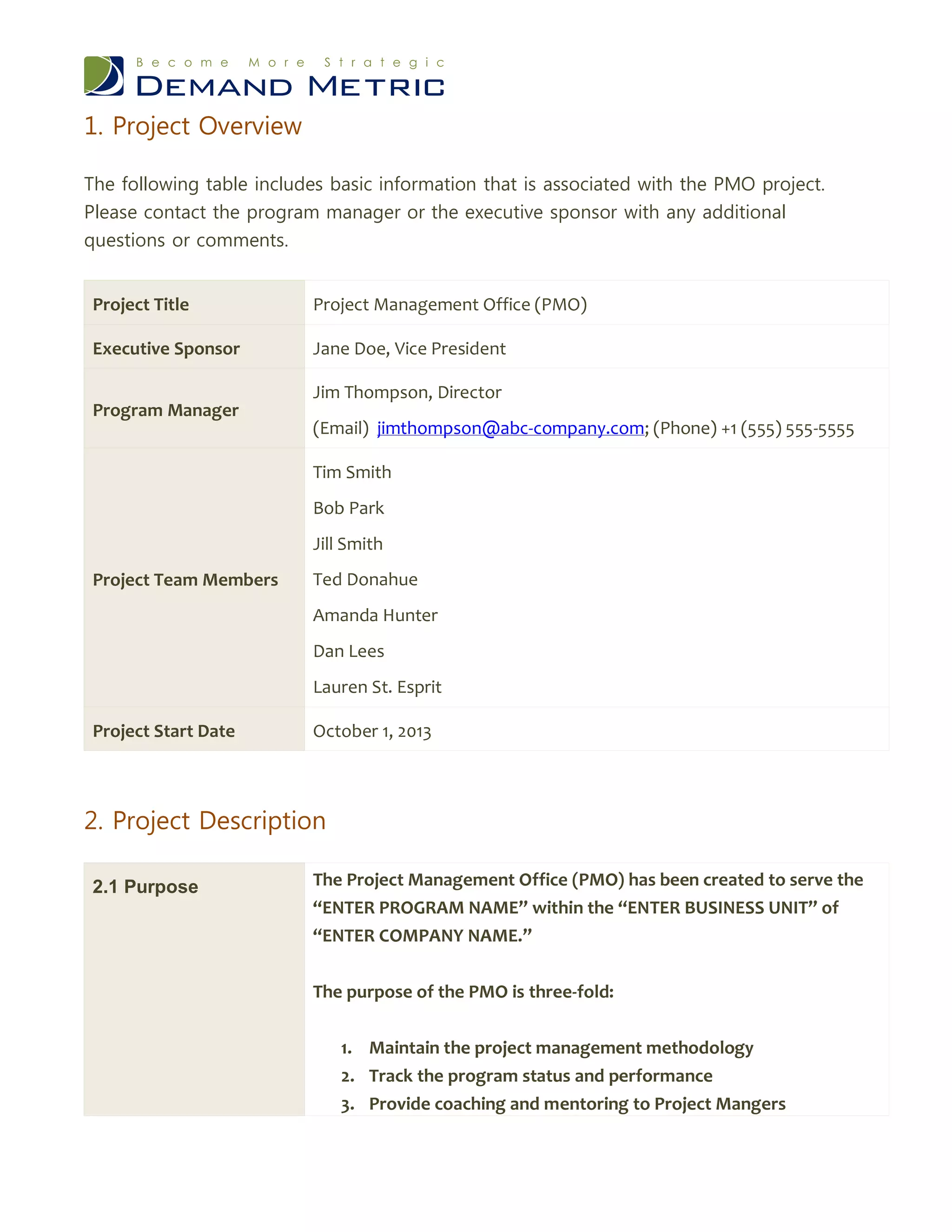
1. Project Overview

The following table includes basic information that is associated with the PMO project.
Please contact the program manager or the executive sponsor with any additional
questions or comments.


 Project Title            Project Management Office (PMO)

 Executive Sponsor        Jane Doe, Vice President

                          Jim Thompson, Director
 Program Manager
                          (Email) jimthompson@abc-company.com; (Phone) +1 (555) 555-5555

                          Tim Smith
                          Bob Park
                          Jill Smith
 Project Team Members     Ted Donahue
                          Amanda Hunter
                          Dan Lees
                          Lauren St. Esprit

 Project Start Date       October 1, 2013


2. Project Description

 2.1 Purpose              The Project Management Office (PMO) has been created to serve the
                          “ENTER PROGRAM NAME” within the “ENTER BUSINESS UNIT” of
                          “ENTER COMPANY NAME.”


                          The purpose of the PMO is three-fold:


                              1. Maintain the project management methodology
                              2. Track the program status and performance
                              3. Provide coaching and mentoring to Project Mangers
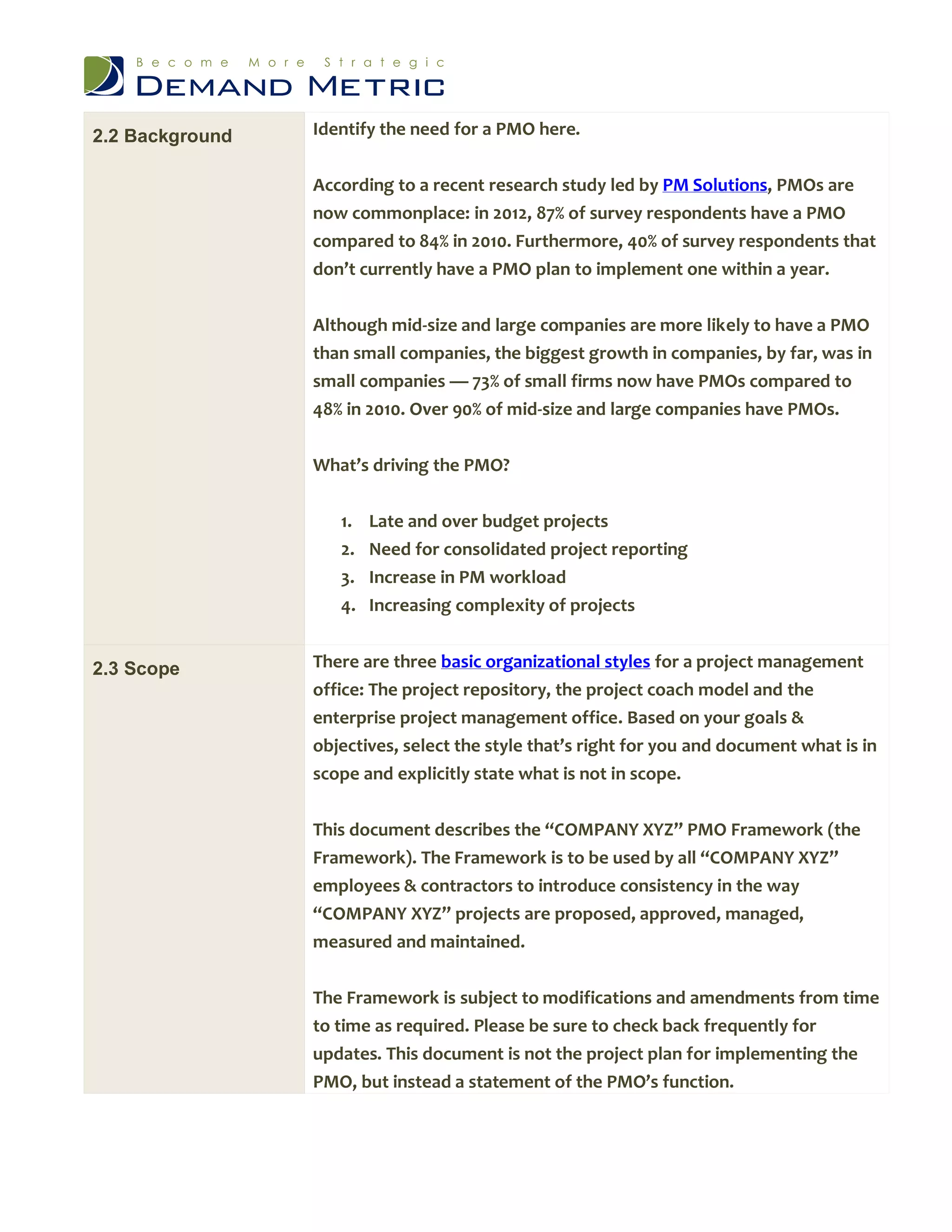
2.2 Background   Identify the need for a PMO here.


                 According to a recent research study led by PM Solutions, PMOs are
                 now commonplace: in 2012, 87% of survey respondents have a PMO
                 compared to 84% in 2010. Furthermore, 40% of survey respondents that
                 don’t currently have a PMO plan to implement one within a year.


                 Although mid-size and large companies are more likely to have a PMO
                 than small companies, the biggest growth in companies, by far, was in
                 small companies — 73% of small firms now have PMOs compared to
                 48% in 2010. Over 90% of mid-size and large companies have PMOs.


                 What’s driving the PMO?


                    1. Late and over budget projects
                    2. Need for consolidated project reporting
                    3. Increase in PM workload
                    4. Increasing complexity of projects


2.3 Scope        There are three basic organizational styles for a project management
                 office: The project repository, the project coach model and the
                 enterprise project management office. Based on your goals &
                 objectives, select the style that’s right for you and document what is in
                 scope and explicitly state what is not in scope.


                 This document describes the “COMPANY XYZ” PMO Framework (the
                 Framework). The Framework is to be used by all “COMPANY XYZ”
                 employees & contractors to introduce consistency in the way
                 “COMPANY XYZ” projects are proposed, approved, managed,
                 measured and maintained.


                 The Framework is subject to modifications and amendments from time
                 to time as required. Please be sure to check back frequently for
                 updates. This document is not the project plan for implementing the
                 PMO, but instead a statement of the PMO’s function.
2.4 Vision                Enter the vision of your PMO here.


                           Involve key stakeholders in the process if possible.


 2.5 Mission               Enter your PMO mission statement here.


                           Describes what the PMO does, how it is done, and for whom. It is a
                           very general statement, usually aligning the PMO to the value it
                           provides to the business.


 2.6 Project Timeframe     Start Date: October 1, 2013


                           End Date: This initiative is ongoing and will be evaluated quarterly.


3. Objectives

In order to ensure the success of your PMO, you will need to set S.M.A.R.T objectives
(Specific, Measurable, Attainable, Realistic and Timely).


The five main objectives of the PMO are:


   1. Create a more robust project management methodology by the end of Q4
   2. Enhance the performance measurement process by the end of Q4
   3. Improve resource planning and forecasting by the end of Q4
   4. Provide coaching and mentoring to all PMs by the end of Q4


How will success be measured? (Insert KPIs Here)


      % increase in the level of interaction and support of vision and mission
      Successful implementation and use of monitoring tools
      % decrease in schedule and budget overruns
      Increase in the quantity and quality of project planning documents
      Accuracy of time and cost estimates
      # of PMs in coaching and mentoring program
4. Structure & Governance

The Executive Sponsor is responsible for overseeing the PMO at the program level and is
responsible for ensuring that the PMO meets its objectives by providing direction, support
and resources. He/she should be considered the PMO champion and is therefore
responsible for providing an escalation remedy, approving major scope changes, and
approving the PMO Charter.


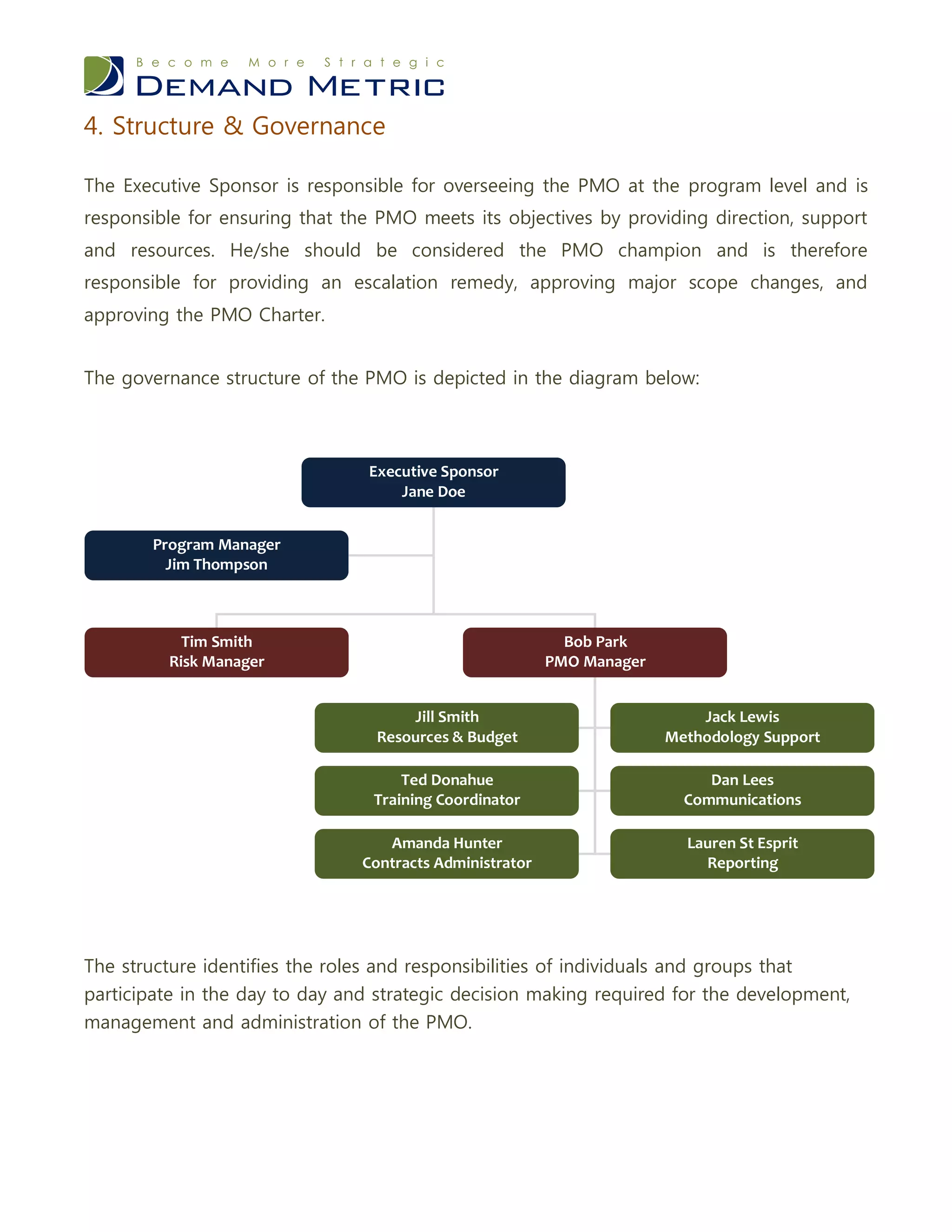
The governance structure of the PMO is depicted in the diagram below:


                                 Executive Sponsor
                                     Jane Doe


       Program Manager
         Jim Thompson


           Tim Smith                                        Bob Park
         Risk Manager                                     PMO Manager


                                      Jill Smith                            Jack Lewis
                                  Resources & Budget                    Methodology Support

                                     Ted Donahue                             Dan Lees
                                 Training Coordinator                     Communications

                                   Amanda Hunter                          Lauren St Esprit
                                Contracts Administrator                     Reporting


The structure identifies the roles and responsibilities of individuals and groups that
participate in the day to day and strategic decision making required for the development,
management and administration of the PMO.
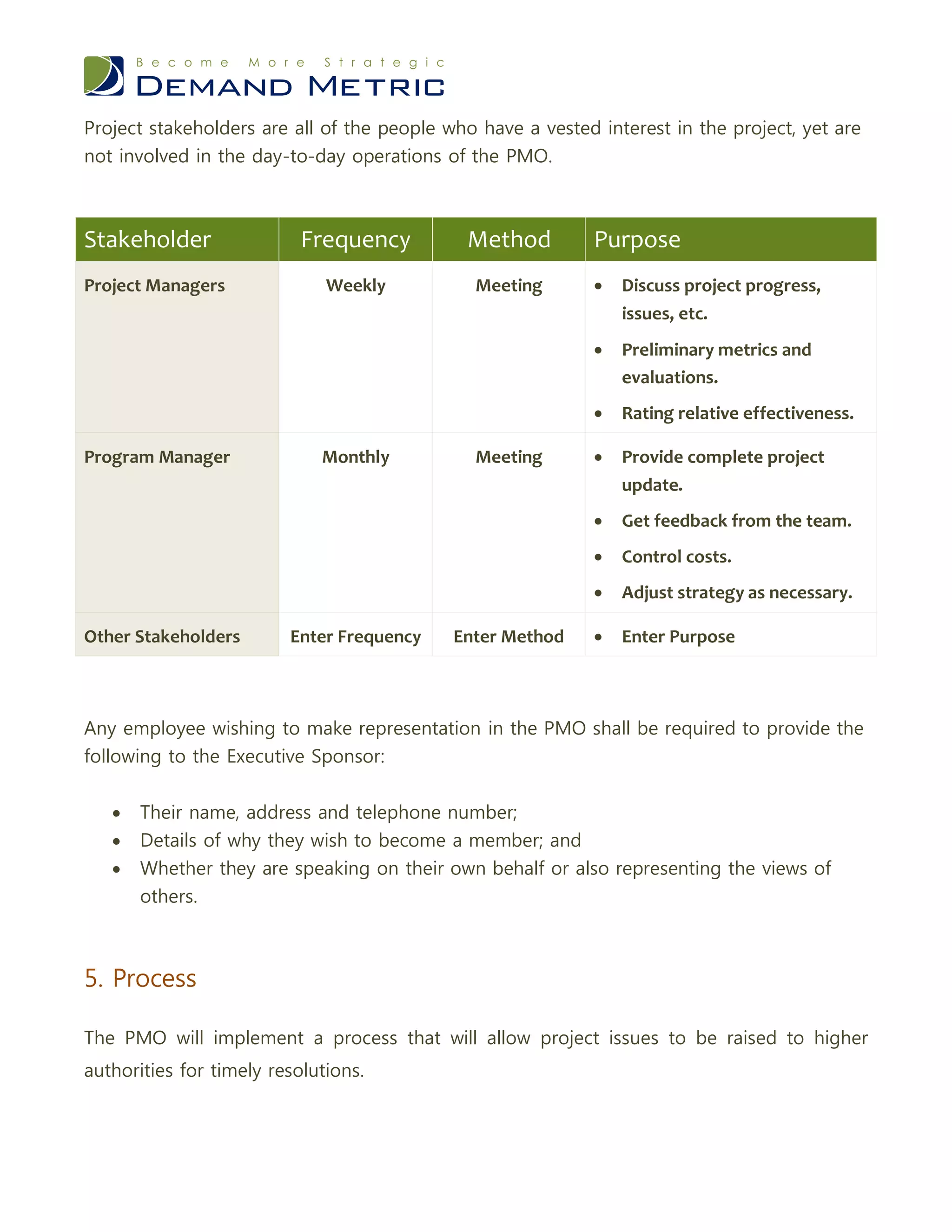
Project stakeholders are all of the people who have a vested interest in the project, yet are
not involved in the day-to-day operations of the PMO.


Stakeholder                Frequency         Method          Purpose
Project Managers              Weekly          Meeting           Discuss project progress,
                                                                 issues, etc.
                                                                Preliminary metrics and
                                                                 evaluations.
                                                                Rating relative effectiveness.

Program Manager              Monthly          Meeting           Provide complete project
                                                                 update.
                                                                Get feedback from the team.
                                                                Control costs.
                                                                Adjust strategy as necessary.

Other Stakeholders       Enter Frequency    Enter Method        Enter Purpose


Any employee wishing to make representation in the PMO shall be required to provide the
following to the Executive Sponsor:


      Their name, address and telephone number;
      Details of why they wish to become a member; and
      Whether they are speaking on their own behalf or also representing the views of
       others.


5. Process

The PMO will implement a process that will allow project issues to be raised to higher
authorities for timely resolutions.
An escalation process ensures that the next level of management is informed (within a
specific amount of time) if an issue cannot be resolved at a lower level. In this function, the
PMO will act as a third party by escalating issues based on the following criteria:


   1. PMO Standards are not being enforced (Project Management Methodologies)
   2. Request for escalation by a Project Manager
   3. The PMO identifies an adverse risk to a project


As a third party, the PMO will attempt to arbitrate issues prior to escalating to the next
level in the chain. If a remedy is not possible, the issue will be escalated and documented
by the PMO.


6. Key Success Factors

What are the key success factors for the PMO (i.e. the factors that are a necessary
condition for success of the PMO)?


      Committed team members

      Executive Buy-In

      Adequate resource allocation
      Adequate project time allowance

      Strong project management infrastructure

      Standardized project management methodology

      Ability to measure and report
7 – Risk Identification

What are some of the risks that may be encountered during the project? Indicate high
level mitigation strategies. (Note: A risk is defined as anything that could potentially affect
the success of the project).


The following are a few examples of some of the risks the project may experience. Add
and delete rows and examples as they fit to the organization.


Risk Category Probability Risk                                 Mitigation Strategy
Project Team           Medium       Project team does not         Ensure personnel have clear
Adoption                            want to use the Project        directives and are fully
                                    Management Office.             committed to the project
                                                                   before it gets underway

Lack of Executive        Low        Executive team does not       Ensure buy-in by building a
Buy-In                              support the Project            solid business case for the
                                    Management Office.             PMO.

Insufficient           Medium       The human and financial       Use the business case and
Resource                            resources that are             other templates in the
Allocation                          required to successfully       Demand Metric toolkit to
                                    launch the do not exist.       justify your decisions and to
                                                                   obtain the resources that you
                                                                   need.

Inadequate Project       Low        The Project                   Develop a process for
Management                          Management                     feedback and participation
Methodology                         Methodology is missing         amongst project managers.
                                    key components.               Encourage sharing of existing
                                                                   resources and refine existing
                                                                   tools.
8. Communication Plan

Provide an outline of the high-level communications plan. Specific dates are not required.


Process Group           Deliverables           Frequency          Recipients
                                                                     Project Manager,
Plan                   Project Schedule           Weekly              Program Manager,
                                                                      Executive Sponsor
                         Status Report
                                                                     Program Manager,
                          Change Log
Execute                                           Weekly              Project Manager
                            Risk Log
                           Issue Log
                      Performance Report                             Executive Sponsor,
Control                 Project Metrics           Weekly
                                                                      Program Manager
                          Dashboard


9. Decision Rights

To support the timeline of the PMO and respect executive time, the program manager has
decided on the following decision rights procedure:


   1. Any e-mail or voicemail sent to the executive sponsor that requires a go or no-go
      decision will specify a decision date or time within reasonable limits.


   2. A non-answer from the project sponsor by the specified date or time will imply
      approval and the project may continue.


   3. If the executive sponsor does not agree or requires further clarification, he/she must
       contact the program manager within the specified timeline.
10. Funding

Funding will generally depend on the scope of the PMO. A few considerations might
include overhead, budget allocation, self-funding, fixed allocation, charge back or fee-for
service charge and direct.


Decide on a funding model and add all relevant information to this section.


11. Approval


___________________________________                 _______________________________
     Project Approver Signature                                 Date


___________________________________                 _______________________________
      Executive Sponsor Signature                               Date


___________________________________                 _______________________________
      Program Manager Signature                                 Date

PMO Charter Template

  • 1.
    PMO Charter Template Purpose Usethe PMO Charter Template to establish a clear scope, goals, metrics, decision rights, and executive sponsorship of the Project Management Office. Be sure to customize this template accordingly. When required, delete the sample text provided and fill in the blanks with information that is directly related to the project. This template has been pre-populated. Change, delete, or add to the example as required.
  • 2.
    [Company Name] Project Management Office Charter By [Enter Name Here] For [Enter Name Here] Effective Date: Document Owner: Version: Version Date Revision / Description Author: Approval: Approver Title: Approval Date:
  • 3.
    Table of Contents Page 1. Overview 4 2. Description 4 2.1 Purpose 2.2 Background 2.3 Scope 2.4 Vision 2.5 Mission 2.6 Timeline 3. Objectives 6 4. Structure & Governance 7 5. Process & Responsibilities 8 6. Key Success Factors 9 7. Risk Identification 10 8. Communication Plan 11 9. Decision Rights 11 10. Funding 12 11. Approval 12
  • 4.
    1. Project Overview Thefollowing table includes basic information that is associated with the PMO project. Please contact the program manager or the executive sponsor with any additional questions or comments. Project Title Project Management Office (PMO) Executive Sponsor Jane Doe, Vice President Jim Thompson, Director Program Manager (Email) jimthompson@abc-company.com; (Phone) +1 (555) 555-5555 Tim Smith Bob Park Jill Smith Project Team Members Ted Donahue Amanda Hunter Dan Lees Lauren St. Esprit Project Start Date October 1, 2013 2. Project Description 2.1 Purpose The Project Management Office (PMO) has been created to serve the “ENTER PROGRAM NAME” within the “ENTER BUSINESS UNIT” of “ENTER COMPANY NAME.” The purpose of the PMO is three-fold: 1. Maintain the project management methodology 2. Track the program status and performance 3. Provide coaching and mentoring to Project Mangers
  • 5.
    2.2 Background Identify the need for a PMO here. According to a recent research study led by PM Solutions, PMOs are now commonplace: in 2012, 87% of survey respondents have a PMO compared to 84% in 2010. Furthermore, 40% of survey respondents that don’t currently have a PMO plan to implement one within a year. Although mid-size and large companies are more likely to have a PMO than small companies, the biggest growth in companies, by far, was in small companies — 73% of small firms now have PMOs compared to 48% in 2010. Over 90% of mid-size and large companies have PMOs. What’s driving the PMO? 1. Late and over budget projects 2. Need for consolidated project reporting 3. Increase in PM workload 4. Increasing complexity of projects 2.3 Scope There are three basic organizational styles for a project management office: The project repository, the project coach model and the enterprise project management office. Based on your goals & objectives, select the style that’s right for you and document what is in scope and explicitly state what is not in scope. This document describes the “COMPANY XYZ” PMO Framework (the Framework). The Framework is to be used by all “COMPANY XYZ” employees & contractors to introduce consistency in the way “COMPANY XYZ” projects are proposed, approved, managed, measured and maintained. The Framework is subject to modifications and amendments from time to time as required. Please be sure to check back frequently for updates. This document is not the project plan for implementing the PMO, but instead a statement of the PMO’s function.
  • 6.
    2.4 Vision Enter the vision of your PMO here. Involve key stakeholders in the process if possible. 2.5 Mission Enter your PMO mission statement here. Describes what the PMO does, how it is done, and for whom. It is a very general statement, usually aligning the PMO to the value it provides to the business. 2.6 Project Timeframe Start Date: October 1, 2013 End Date: This initiative is ongoing and will be evaluated quarterly. 3. Objectives In order to ensure the success of your PMO, you will need to set S.M.A.R.T objectives (Specific, Measurable, Attainable, Realistic and Timely). The five main objectives of the PMO are: 1. Create a more robust project management methodology by the end of Q4 2. Enhance the performance measurement process by the end of Q4 3. Improve resource planning and forecasting by the end of Q4 4. Provide coaching and mentoring to all PMs by the end of Q4 How will success be measured? (Insert KPIs Here)  % increase in the level of interaction and support of vision and mission  Successful implementation and use of monitoring tools  % decrease in schedule and budget overruns  Increase in the quantity and quality of project planning documents  Accuracy of time and cost estimates  # of PMs in coaching and mentoring program
  • 7.
    4. Structure &Governance The Executive Sponsor is responsible for overseeing the PMO at the program level and is responsible for ensuring that the PMO meets its objectives by providing direction, support and resources. He/she should be considered the PMO champion and is therefore responsible for providing an escalation remedy, approving major scope changes, and approving the PMO Charter. The governance structure of the PMO is depicted in the diagram below: Executive Sponsor Jane Doe Program Manager Jim Thompson Tim Smith Bob Park Risk Manager PMO Manager Jill Smith Jack Lewis Resources & Budget Methodology Support Ted Donahue Dan Lees Training Coordinator Communications Amanda Hunter Lauren St Esprit Contracts Administrator Reporting The structure identifies the roles and responsibilities of individuals and groups that participate in the day to day and strategic decision making required for the development, management and administration of the PMO.
  • 8.
    Project stakeholders areall of the people who have a vested interest in the project, yet are not involved in the day-to-day operations of the PMO. Stakeholder Frequency Method Purpose Project Managers Weekly Meeting  Discuss project progress, issues, etc.  Preliminary metrics and evaluations.  Rating relative effectiveness. Program Manager Monthly Meeting  Provide complete project update.  Get feedback from the team.  Control costs.  Adjust strategy as necessary. Other Stakeholders Enter Frequency Enter Method  Enter Purpose Any employee wishing to make representation in the PMO shall be required to provide the following to the Executive Sponsor:  Their name, address and telephone number;  Details of why they wish to become a member; and  Whether they are speaking on their own behalf or also representing the views of others. 5. Process The PMO will implement a process that will allow project issues to be raised to higher authorities for timely resolutions.
  • 9.
    An escalation processensures that the next level of management is informed (within a specific amount of time) if an issue cannot be resolved at a lower level. In this function, the PMO will act as a third party by escalating issues based on the following criteria: 1. PMO Standards are not being enforced (Project Management Methodologies) 2. Request for escalation by a Project Manager 3. The PMO identifies an adverse risk to a project As a third party, the PMO will attempt to arbitrate issues prior to escalating to the next level in the chain. If a remedy is not possible, the issue will be escalated and documented by the PMO. 6. Key Success Factors What are the key success factors for the PMO (i.e. the factors that are a necessary condition for success of the PMO)?  Committed team members  Executive Buy-In  Adequate resource allocation  Adequate project time allowance  Strong project management infrastructure  Standardized project management methodology  Ability to measure and report
  • 10.
    7 – RiskIdentification What are some of the risks that may be encountered during the project? Indicate high level mitigation strategies. (Note: A risk is defined as anything that could potentially affect the success of the project). The following are a few examples of some of the risks the project may experience. Add and delete rows and examples as they fit to the organization. Risk Category Probability Risk Mitigation Strategy Project Team Medium Project team does not  Ensure personnel have clear Adoption want to use the Project directives and are fully Management Office. committed to the project before it gets underway Lack of Executive Low Executive team does not  Ensure buy-in by building a Buy-In support the Project solid business case for the Management Office. PMO. Insufficient Medium The human and financial  Use the business case and Resource resources that are other templates in the Allocation required to successfully Demand Metric toolkit to launch the do not exist. justify your decisions and to obtain the resources that you need. Inadequate Project Low The Project  Develop a process for Management Management feedback and participation Methodology Methodology is missing amongst project managers. key components.  Encourage sharing of existing resources and refine existing tools.
  • 11.
    8. Communication Plan Providean outline of the high-level communications plan. Specific dates are not required. Process Group Deliverables Frequency Recipients  Project Manager, Plan Project Schedule Weekly Program Manager, Executive Sponsor Status Report  Program Manager, Change Log Execute Weekly Project Manager Risk Log Issue Log Performance Report  Executive Sponsor, Control Project Metrics Weekly Program Manager Dashboard 9. Decision Rights To support the timeline of the PMO and respect executive time, the program manager has decided on the following decision rights procedure: 1. Any e-mail or voicemail sent to the executive sponsor that requires a go or no-go decision will specify a decision date or time within reasonable limits. 2. A non-answer from the project sponsor by the specified date or time will imply approval and the project may continue. 3. If the executive sponsor does not agree or requires further clarification, he/she must contact the program manager within the specified timeline.
  • 12.
    10. Funding Funding willgenerally depend on the scope of the PMO. A few considerations might include overhead, budget allocation, self-funding, fixed allocation, charge back or fee-for service charge and direct. Decide on a funding model and add all relevant information to this section. 11. Approval ___________________________________ _______________________________ Project Approver Signature Date ___________________________________ _______________________________ Executive Sponsor Signature Date ___________________________________ _______________________________ Program Manager Signature Date