www.relaxedprojectmanager.com
+
Risk management
www.relaxedprojectmanager.com
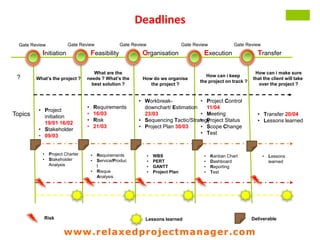
Deadlines
www.relaxedprojectmanager.com
Initiation Feasibility Organisation Execution Transfer
DeliverableLessons learnedRisk
• Project Charter
• Stakeholder
Analysis
• Requirements
• Service/Produc
t
• Risque
Analysis
• WBS
• PERT
• GANTT
• Project Plan
• Kanban Chart
• Dashboard
• Reporting
• Test
• Lessons
learned
• Workbreak-
downchart/ Estimation
23/03
• Sequencing Tactic/Strategy
• Project Plan 30/03
• Project Control
11/04
• Meeting
• Project Status
• Scope Change
• Test
• Requirements
• 16/03
• Risk
• 21/03
• Project
initiation
19/01 16/02
• Stakeholder
• 09/03
• Transfer 20/04
• Lessons learned
Gate Review Gate Review Gate Review Gate ReviewGate Review
Topics
? What’s the project ?
What are the
needs ? What’s the
best solution ?
How do we organise
the project ?
How can i keep
the project on track ?
How can i make sure
that the client will take
over the project ?
www.relaxedprojectmanager.com
+
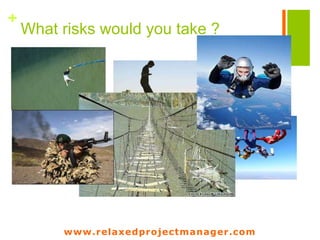
What risks would you take ?
www.relaxedprojectmanager.com
+
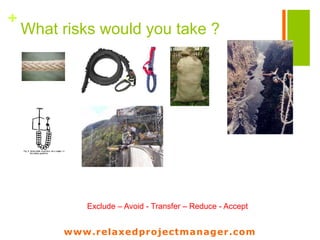
What risks would you take ?
Exclude – Avoid - Transfer – Reduce - Accept
www.relaxedprojectmanager.com
+
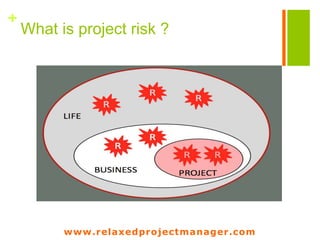
What is project risk ?
www.relaxedprojectmanager.com
+
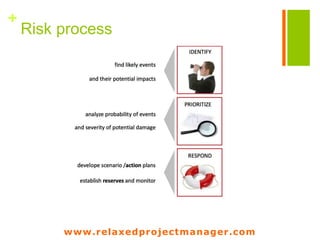
Risk process
www.relaxedprojectmanager.com
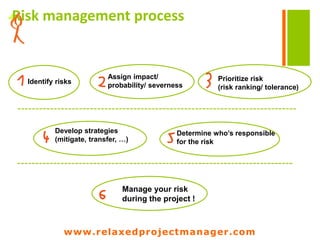
+Risk management process
Identify risks
Assign impact/
probability
Prioritize risk
(risk ranking/ tolerance)
Develop strategies
(mitigate, transfer, …)
Determine who’s responsible
for the risk
Manage your risk
during the project !
www.relaxedprojectmanager.com
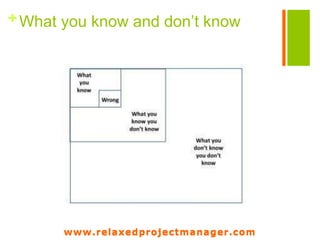
+What you know and don’t know
www.relaxedprojectmanager.com
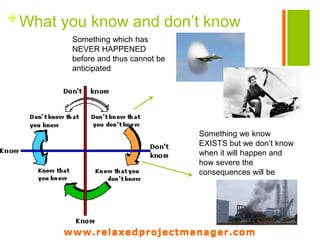
+What you know and don’t know
www.relaxedprojectmanager.com
Something which has
NEVER HAPPENED
before and thus cannot be
anticipated
Something we know
EXISTS but we don‘t know
when it will happen and
how severe the
consequences will be
www.relaxedprojectmanager.com
+
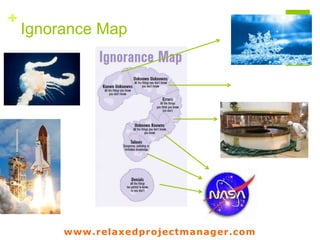
Ignorance Map
www.relaxedprojectmanager.com
+
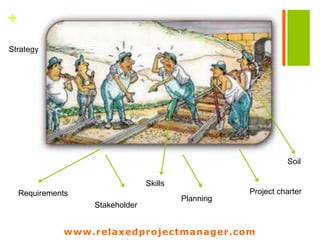
Requirements
Stakeholder
Project charter
Planning
Skills
Soil
Strategy
www.relaxedprojectmanager.com
+
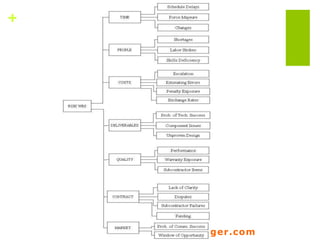
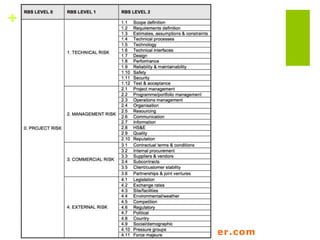
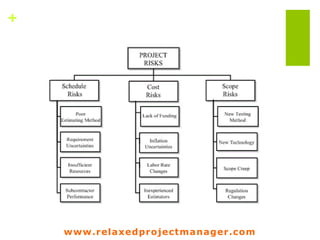
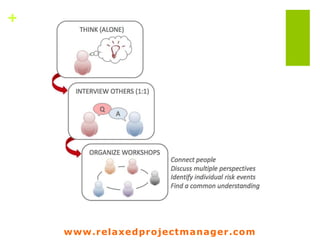
How to find the risks ?
 Uniqueness
 Project Documents
 Skills
 Organisational Culture
 Timeline before during after
www.relaxedprojectmanager.com
+ How to find risks ?
• What is unique about your project ?
• What are you not used to deal with ?
• What are typical risks linked to your business
?
• What are typical risks linked to the
product/service you want to provide ?
• What will be out of your management range ?
• What kind of risks arises from the
stakeholders ?
• What’s going to change in the next month in
your environment, your organization, your
country ?
« Project risk management is not about gathering all the possible risks,
the project manager needs to identify the risks that are linked
to the uniqueness of the project, the product and the way
of managing the project »
www.relaxedprojectmanager.com
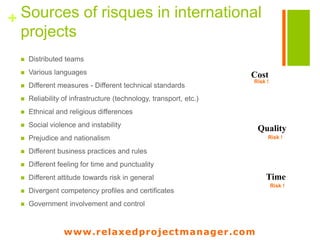
+ Sources of risques in international
projects
 Distributed teams
 Various languages
 Different measures - Different technical standards
 Reliability of infrastructure (technology, transport,
etc.)
 Ethnical and religious differences
 Social violence and instability
 Prejudice and nationalism
 Different business practices and rules
 Different feeling for time and punctuality
 Different attitude towards risk in general
 Divergent competency profiles and certificates
 Government involvement and control
Cost
Risk !
Quality
Risk !
Time
Risk !
www.relaxedprojectmanager.com
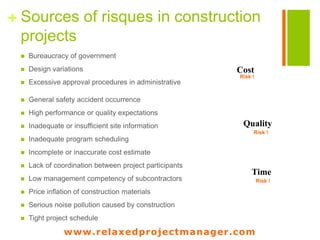
+ Sources of risques in construction
projects
 Bureaucracy of government
 Design variations
 Excessive approval procedures in administrative
 General safety accident occurrence
 High performance or quality expectations
 Inadequate or insufficient site information
 Inadequate program scheduling
 Incomplete or inaccurate cost estimate
 Lack of coordination between project participants
 Low management competency of subcontractors
 Price inflation of construction materials
 Serious noise pollution caused by construction
 Tight project schedule
Cost
Risk !
Quality
Risk !
Time
Risk !
www.relaxedprojectmanager.com
+
www.relaxedprojectmanager.com
+
www.relaxedprojectmanager.com
+
www.relaxedprojectmanager.com
+
www.relaxedprojectmanager.com
+
www.relaxedprojectmanager.com
+
Prioritize
www.relaxedprojectmanager.com
+
www.relaxedprojectmanager.com
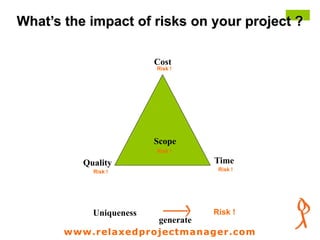
What’s the impact of risks on your project ?
Uniqueness Risk !
Cost
Risk !
Quality
Risk !
Time
Risk !
Scope
Risk !
generate
www.relaxedprojectmanager.com
+
New Tool to be introduced
 Context : You first get some knowledge of how to use it. You
then work with it using this basic knowledge. After some time
you decide you need to learn more. Over an extended time you
gain proficiency and it becomes part of your toolkit.
 Impact : Too difficult to use, find problems in the tool,
management thinks you will be more productive. Old tools are
still used. Productivity drops.
 Prevention : Requirements, training, guidelines, …
www.relaxedprojectmanager.com
+
Informal and wrong methods
 Context : falling in habits. 5% usage of functionalities of a tool.
First usage of a method slows down the work.
 Impact : Confusion – Isolation – People divide the work into
smaller chungs to avoid the « big method »
 Prevention : Train method and then find out how people adapt
the method to the culture of the organisation
www.relaxedprojectmanager.com
+
Project manager lacks experience
 Context : quick promotion after having taken a few basic
courses. Left to themselves. Failure. Standardised methods.
Lack of sharing experience.
 Impact : unrealistic and uncomplete project plan – pm does not
recognise the severity and effect of issues that arise.
 Prevention : Sharing experience – Rotate project leaders -
Mentor
www.relaxedprojectmanager.com
+
Lack of teamwork
 Context: the only time for teamwok is at a meeting – get the
work done but don’t plan the work – don’t take into account the
cultural factor – Understanding : if two people work together
work is slowed down
 Impact : Lack of knowledge and method sharing – Keep the
problem to him/her self. Manager assumes things are fine –
Last minute bad surprise
 Prevention : Reward joint working from the start – move the
ownership of an idea to the staff
www.relaxedprojectmanager.com
+
www.relaxedprojectmanager.com
+
www.relaxedprojectmanager.com
+
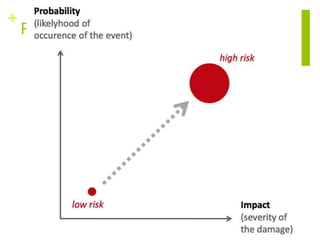
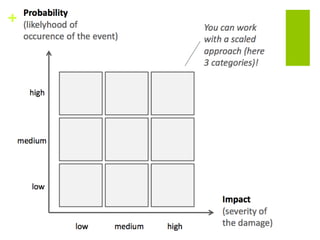
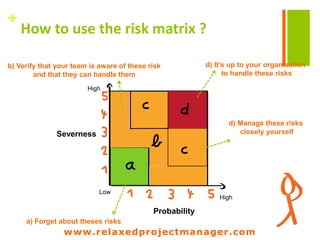
How to use the risk matrix ?
Probability
Severness
b) Verify that your team is aware of these risk
and that they can handle them
d) It’s up to your organisation
to handle these risks
d) Manage these risks
closely yourself
a) Forget about theses risks
High
High
Low
www.relaxedprojectmanager.com
+
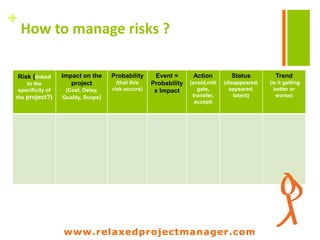
How to manage risks ?
Risk (linked
to the
specificity of
the project?)
Impact on the
project
(Cost, Delay,
Quality, Scope)
Probability
(that this risk
occurs)
Event =
Probabilit
y x Impact
Action
(avoid,miti
gate,
transfer,
accept)
Status
(disappeared,
appeared,
latent)
Trend
(is it getting
better or
worse)
www.relaxedprojectmanager.com
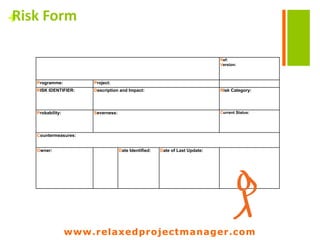
+Risk Form
Ref:
Version:
Programme: Project:
RISK IDENTIFIER: Description and Impact: Risk Category:
Probability: Severness: Current Status:
Countermeasures:
Owner: Date Identified: Date of Last Update:
www.relaxedprojectmanager.com
+
www.relaxedprojectmanager.com
+Hints for risk management ?
• Identify and qualify the risks in groups gathering people with
different backgrounds
• Risk management is an on going process, so you need to put rules
about meetings and outcomes in your project management plan
• Always check if the countermeasures you take are really working
• Risk breakdown structure is useful to build but it’s not a guarantee
for finding all the relevant risks
• Working together with your team on risk management increases
awareness and it’s a way to share responsibility
• Feedback is very important when a risk occurs your reporting
system and your management should encourage feedback
• Concentrate on relevant risk specific to the uniqueness of your
project
www.relaxedprojectmanager.com
+
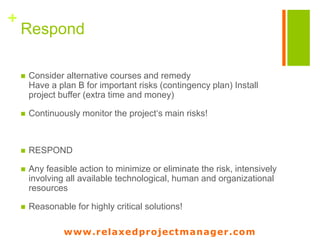
Respond
 Consider alternative courses and remedy
Have a plan B for important risks (contingency plan) Install
project buffer (extra time and money)
 Continuously monitor the project‘s main risks!
 RESPOND
 Any feasible action to minimize or eliminate the risk, intensively
involving all available technological, human and organizational
resources
 Reasonable for highly critical solutions!
www.relaxedprojectmanager.com
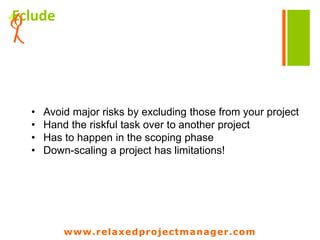
+Eclude
• Avoid major risks by excluding those from your project
• Hand the riskful task over to another project
• Has to happen in the scoping phase
• Down-scaling a project has limitations!
www.relaxedprojectmanager.com
+
www.relaxedprojectmanager.com
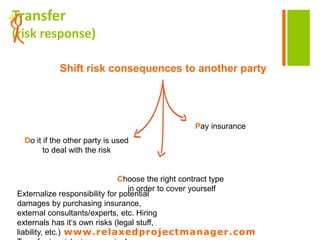
+Transfer
(risk response)
Shift risk consequences to another party
Do it if the other party
is used
to deal with the risk
Choose the right contract type
in order to cover yourself
Pay insurance
www.relaxedprojectmanager.com
Externalize responsibility for potential
damages by purchasing insurance,
external consultants/experts, etc. Hiring
externals has it‘s own risks (legal stuff,
liability, etc.)
Transferring risks is expensive!
www.relaxedprojectmanager.com
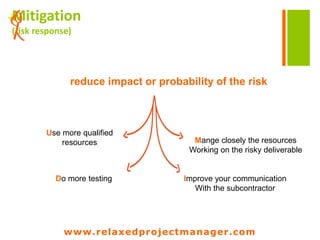
+Mitigation
(risk response)
reduce impact or probability of the risk
Do more testing
Use more qualified
resources
Improve your communication
With the subcontractor
Mange closely the resources
Working on the risky deliverable
www.relaxedprojectmanager.com
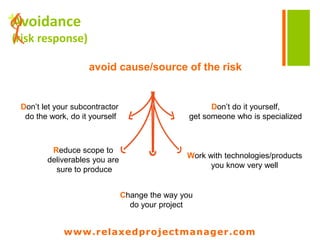
+Avoidance
(risk response)
avoid cause/source of the risk
Don’t let your subcontractor
do the work, do it yourself
Reduce scope to
deliverables you are
sure to produce
Change the way you
do your project
Work with technologies/products
you know very well
Don’t do it yourself,
get someone who is specialized
www.relaxedprojectmanager.com
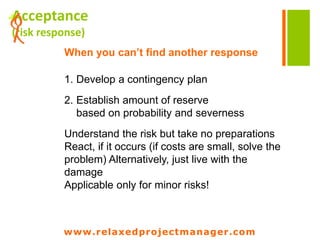
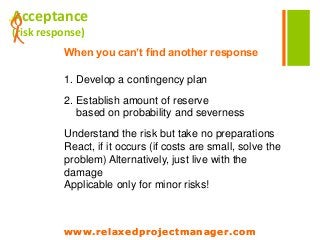
+Acceptance
(risk response)
When you can’t find another response
1. Develop a contingency plan
2. Establish amount of reserve
based on probability and severness
Understand the risk but take no preparations
React, if it occurs (if costs are small, solve the
problem) Alternatively, just live with the
damage
Applicable only for minor risks!
www.relaxedprojectmanager.com
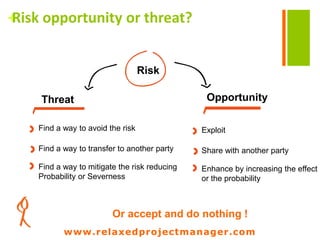
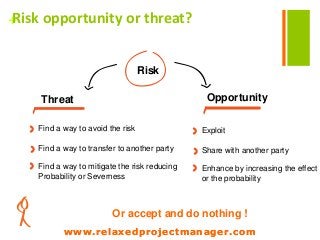
+Risk opportunity or threat?
Threat Opportunity
Find a way to avoid the risk
Find a way to transfer to another party
Find a way to mitigate the risk reducing
Probability or Severness
Exploit
Share with another party
Enhance by increasing the effect
or the probability
Or accept and do nothing !
Risk
www.relaxedprojectmanager.com
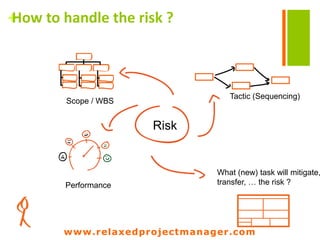
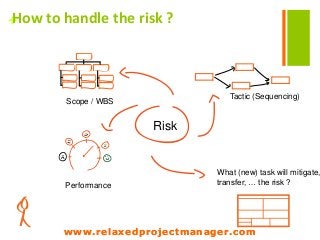
+How to handle the risk ?
Scope / WBS
Tactic (Sequencing)
What (new) task will mitigate,
transfer, … the risk ?
Risk
Performance
www.relaxedprojectmanager.com

Risk Management

  • 1.
  • 2.
    www.relaxedprojectmanager.com Deadlines www.relaxedprojectmanager.com Initiation Feasibility OrganisationExecution Transfer DeliverableLessons learnedRisk • Project Charter • Stakeholder Analysis • Requirements • Service/Produc t • Risque Analysis • WBS • PERT • GANTT • Project Plan • Kanban Chart • Dashboard • Reporting • Test • Lessons learned • Workbreak- downchart/ Estimation 23/03 • Sequencing Tactic/Strategy • Project Plan 30/03 • Project Control 11/04 • Meeting • Project Status • Scope Change • Test • Requirements • 16/03 • Risk • 21/03 • Project initiation 19/01 16/02 • Stakeholder • 09/03 • Transfer 20/04 • Lessons learned Gate Review Gate Review Gate Review Gate ReviewGate Review Topics ? What’s the project ? What are the needs ? What’s the best solution ? How do we organise the project ? How can i keep the project on track ? How can i make sure that the client will take over the project ?
  • 3.
  • 4.
    www.relaxedprojectmanager.com + What risks wouldyou take ? Exclude – Avoid - Transfer – Reduce - Accept
  • 5.
  • 6.
  • 7.
  • 8.
  • 9.
    www.relaxedprojectmanager.com +Risk management process Identifyrisks Assign impact/ probability Prioritize risk (risk ranking/ tolerance) Develop strategies (mitigate, transfer, …) Determine who’s responsible for the risk Manage your risk during the project ! www.relaxedprojectmanager.com
  • 10.
    www.relaxedprojectmanager.com +What you knowand don’t know www.relaxedprojectmanager.com
  • 11.
    www.relaxedprojectmanager.com +What you knowand don’t know www.relaxedprojectmanager.com Something which has NEVER HAPPENED before and thus cannot be anticipated Something we know EXISTS but we don‘t know when it will happen and how severe the consequences will be
  • 12.
  • 13.
  • 14.
    www.relaxedprojectmanager.com + How to findthe risks ?  Uniqueness  Project Documents  Skills  Organisational Culture  Timeline before during after
  • 15.
    www.relaxedprojectmanager.com + How tofind risks ? • What is unique about your project ? • What are you not used to deal with ? • What are typical risks linked to your business ? • What are typical risks linked to the product/service you want to provide ? • What will be out of your management range ? • What kind of risks arises from the stakeholders ? • What’s going to change in the next month in your environment, your organization, your country ? « Project risk management is not about gathering all the possible risks, the project manager needs to identify the risks that are linked to the uniqueness of the project, the product and the way of managing the project » www.relaxedprojectmanager.com
  • 16.
  • 17.
    www.relaxedprojectmanager.com + Sources ofrisques in international projects  Distributed teams  Various languages  Different measures - Different technical standards  Reliability of infrastructure (technology, transport, etc.)  Ethnical and religious differences  Social violence and instability  Prejudice and nationalism  Different business practices and rules  Different feeling for time and punctuality  Different attitude towards risk in general  Divergent competency profiles and certificates  Government involvement and control Cost Risk ! Quality Risk ! Time Risk !
  • 18.
    www.relaxedprojectmanager.com + Sources ofrisques in construction projects  Bureaucracy of government  Design variations  Excessive approval procedures in administrative  General safety accident occurrence  High performance or quality expectations  Inadequate or insufficient site information  Inadequate program scheduling  Incomplete or inaccurate cost estimate  Lack of coordination between project participants  Low management competency of subcontractors  Price inflation of construction materials  Serious noise pollution caused by construction  Tight project schedule Cost Risk ! Quality Risk ! Time Risk !
  • 19.
  • 20.
  • 21.
  • 22.
  • 23.
  • 24.
  • 25.
  • 26.
    www.relaxedprojectmanager.com What’s the impactof risks on your project ? Uniqueness Risk ! Cost Risk ! Quality Risk ! Time Risk ! Scope Risk ! generate www.relaxedprojectmanager.com
  • 27.
  • 28.
    www.relaxedprojectmanager.com + New Tool tobe introduced  Context : You first get some knowledge of how to use it. You then work with it using this basic knowledge. After some time you decide you need to learn more. Over an extended time you gain proficiency and it becomes part of your toolkit.  Impact : Too difficult to use, find problems in the tool, management thinks you will be more productive. Old tools are still used. Productivity drops.  Prevention : Requirements, training, guidelines, …
  • 29.
    www.relaxedprojectmanager.com + Informal and wrongmethods  Context : falling in habits. 5% usage of functionalities of a tool. First usage of a method slows down the work.  Impact : Confusion – Isolation – People divide the work into smaller chungs to avoid the « big method »  Prevention : Train method and then find out how people adapt the method to the culture of the organisation
  • 30.
    www.relaxedprojectmanager.com + Project manager lacksexperience  Context : quick promotion after having taken a few basic courses. Left to themselves. Failure. Standardised methods. Lack of sharing experience.  Impact : unrealistic and uncomplete project plan – pm does not recognise the severity and effect of issues that arise.  Prevention : Sharing experience – Rotate project leaders - Mentor
  • 31.
    www.relaxedprojectmanager.com + Lack of teamwork Context: the only time for teamwok is at a meeting – get the work done but don’t plan the work – don’t take into account the cultural factor – Understanding : if two people work together work is slowed down  Impact : Lack of knowledge and method sharing – Keep the problem to him/her self. Manager assumes things are fine – Last minute bad surprise  Prevention : Reward joint working from the start – move the ownership of an idea to the staff
  • 32.
  • 33.
  • 34.
    www.relaxedprojectmanager.com + How to usethe risk matrix ? Probability Severness b) Verify that your team is aware of these risk and that they can handle them d) It’s up to your organisation to handle these risks d) Manage these risks closely yourself a) Forget about theses risks High High Low www.relaxedprojectmanager.com
  • 35.
    www.relaxedprojectmanager.com + How to managerisks ? Risk (linked to the specificity of the project?) Impact on the project (Cost, Delay, Quality, Scope) Probability (that this risk occurs) Event = Probabilit y x Impact Action (avoid,miti gate, transfer, accept) Status (disappeared, appeared, latent) Trend (is it getting better or worse) www.relaxedprojectmanager.com
  • 36.
  • 37.
    www.relaxedprojectmanager.com +Risk Form Ref: Version: Programme: Project: RISKIDENTIFIER: Description and Impact: Risk Category: Probability: Severness: Current Status: Countermeasures: Owner: Date Identified: Date of Last Update: www.relaxedprojectmanager.com
  • 38.
  • 39.
    www.relaxedprojectmanager.com +Hints for riskmanagement ? • Identify and qualify the risks in groups gathering people with different backgrounds • Risk management is an on going process, so you need to put rules about meetings and outcomes in your project management plan • Always check if the countermeasures you take are really working • Risk breakdown structure is useful to build but it’s not a guarantee for finding all the relevant risks • Working together with your team on risk management increases awareness and it’s a way to share responsibility • Feedback is very important when a risk occurs your reporting system and your management should encourage feedback • Concentrate on relevant risk specific to the uniqueness of your project www.relaxedprojectmanager.com
  • 40.
    www.relaxedprojectmanager.com + Respond  Consider alternativecourses and remedy Have a plan B for important risks (contingency plan) Install project buffer (extra time and money)  Continuously monitor the project‘s main risks!  RESPOND  Any feasible action to minimize or eliminate the risk, intensively involving all available technological, human and organizational resources  Reasonable for highly critical solutions!
  • 41.
    www.relaxedprojectmanager.com +Eclude • Avoid majorrisks by excluding those from your project • Hand the riskful task over to another project • Has to happen in the scoping phase • Down-scaling a project has limitations! www.relaxedprojectmanager.com
  • 42.
  • 43.
    www.relaxedprojectmanager.com +Transfer (risk response) Shift riskconsequences to another party Do it if the other party is used to deal with the risk Choose the right contract type in order to cover yourself Pay insurance www.relaxedprojectmanager.com Externalize responsibility for potential damages by purchasing insurance, external consultants/experts, etc. Hiring externals has it‘s own risks (legal stuff, liability, etc.) Transferring risks is expensive!
  • 44.
    www.relaxedprojectmanager.com +Mitigation (risk response) reduce impactor probability of the risk Do more testing Use more qualified resources Improve your communication With the subcontractor Mange closely the resources Working on the risky deliverable www.relaxedprojectmanager.com
  • 45.
    www.relaxedprojectmanager.com +Avoidance (risk response) avoid cause/sourceof the risk Don’t let your subcontractor do the work, do it yourself Reduce scope to deliverables you are sure to produce Change the way you do your project Work with technologies/products you know very well Don’t do it yourself, get someone who is specialized www.relaxedprojectmanager.com
  • 46.
    www.relaxedprojectmanager.com +Acceptance (risk response) When youcan’t find another response 1. Develop a contingency plan 2. Establish amount of reserve based on probability and severness Understand the risk but take no preparations React, if it occurs (if costs are small, solve the problem) Alternatively, just live with the damage Applicable only for minor risks! www.relaxedprojectmanager.com
  • 47.
    www.relaxedprojectmanager.com +Risk opportunity orthreat? Threat Opportunity Find a way to avoid the risk Find a way to transfer to another party Find a way to mitigate the risk reducing Probability or Severness Exploit Share with another party Enhance by increasing the effect or the probability Or accept and do nothing ! Risk www.relaxedprojectmanager.com
  • 48.
    www.relaxedprojectmanager.com +How to handlethe risk ? Scope / WBS Tactic (Sequencing) What (new) task will mitigate, transfer, … the risk ? Risk Performance www.relaxedprojectmanager.com