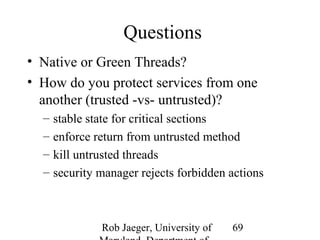
Programmable Network Devices: 
Rob Jaeger, University of 
Maryland, Department of 
1 
A Revolution! 
Robert F. Jaeger 
University of Maryland 
Department of Computer Science 
rfj@cs.umd.edu
Programmable Network Devices 
Openly Programmable devices enable 
new types of intelligence on the network 
Rob Jaeger, University of 
Maryland, Department of 
2
Rob Jaeger, University of 
Maryland, Department of 
3 
Agenda 
• Local Computation 
• New types of applications 
• Programmable and Active Networks 
• Network Services Architecture 
• Issues 
• Summary
Changing the Rules of the Game 
Rob Jaeger, University of 
Maryland, Department of 
4 
• Move Turing Machine onto 
device 
– Run non-vendor/non-bundled 
applications on network device 
while (true) { 
doLocalProcessingOnDevice() 
}
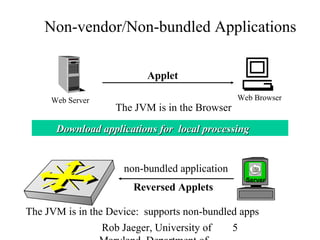
Non-vendor/Non-bundled Applications 
Applet 
Web Server Web Browser 
The JVM is in the Browser 
DDoowwnnllooaadd aapppplliiccaattiioonnss ffoorr llooccaall pprroocceessssiinngg 
non-bundled application 
Rob Jaeger, University of 
Maryland, Department of 
5 
Reversed Applets 
Server 
The JVM is in the Device: supports non-bundled apps
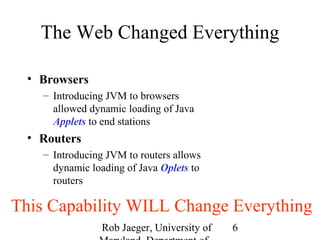
The Web Changed Everything 
Rob Jaeger, University of 
Maryland, Department of 
6 
• Browsers 
– Introducing JVM to browsers 
allowed dynamic loading of Java 
Applets to end stations 
• Routers 
– Introducing JVM to routers allows 
dynamic loading of Java Oplets to 
routers 
This Capability WILL Change Everything
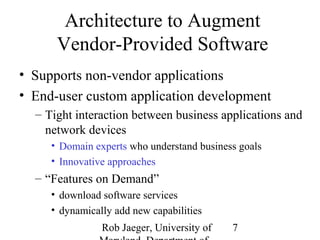
Architecture to Augment 
Vendor-Provided Software 
• Supports non-vendor applications 
• End-user custom application development 
– Tight interaction between business applications and 
network devices 
• Domain experts who understand business goals 
• Innovative approaches 
– “Features on Demand” 
Rob Jaeger, University of 
Maryland, Department of 
7 
• download software services 
• dynamically add new capabilities
Rob Jaeger, University of 
Maryland, Department of 
Java-based 
Application 
8 
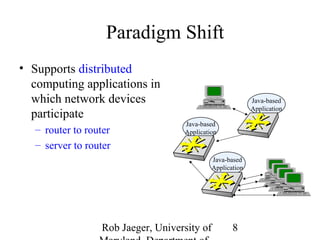
Paradigm Shift 
• Supports distributed 
computing applications in 
which network devices 
participate 
– router to router 
– server to router 
Java-based 
Application 
Java-based 
Application
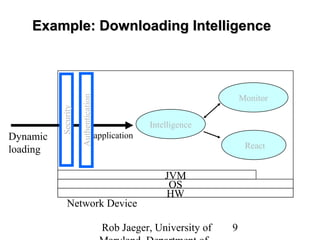
D Example: Doowwnnllooaaddiinngg IInntteelllliiggeennccee 
JVM 
OS 
Rob Jaeger, University of 
Maryland, Department of 
9 
Network Device 
Dynamic 
loading 
HW 
Monitor 
React 
Authentication 
Security 
Intelligence 
application
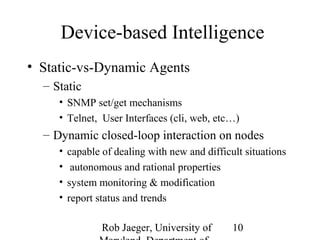
Device-based Intelligence 
Rob Jaeger, University of 
Maryland, Department of 
10 
• Static-vs-Dynamic Agents 
– Static 
• SNMP set/get mechanisms 
• Telnet, User Interfaces (cli, web, etc…) 
– Dynamic closed-loop interaction on nodes 
• capable of dealing with new and difficult situations 
• autonomous and rational properties 
• system monitoring & modification 
• report status and trends
Rob Jaeger, University of 
Maryland, Department of 
11 
Agenda 
• Local Computation 
• New types of Applications 
• Programmable and Active Networks 
• Network Services Architecture 
• Issues 
• Summary
New Types of Applications 
• Mobile Agents 
• Local Intelligence for NMS 
• Application layer collaboration among 
routers 
• Distributed computing involving network 
devices and servers 
• E-commerce 
Rob Jaeger, University of 
Maryland, Department of 
12
Rob Jaeger, University of 
Maryland, Department of 
13 
Mobile Agents 
• Intrusion Detection - Hacker Chaser 
• Traceroute for Layer 2 
• Mobile Connectivity Mapper
Local Intelligence for NMS: 
Extensive access 
to internal resources 
Rob Jaeger, University of 
Maryland, Department of 
14 
Diagnostic Agents 
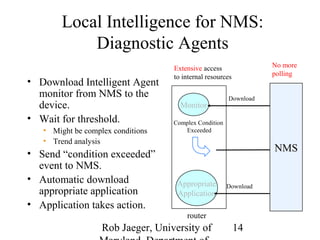
• Download Intelligent Agent 
monitor from NMS to the 
device. 
• Wait for threshold. 
• Might be complex conditions 
• Trend analysis 
• Send “condition exceeded” 
event to NMS. 
• Automatic download 
appropriate application 
• Application takes action. 
Monitor 
Appropriate 
Application 
Download 
Download 
Complex Condition 
Exceeded 
No more 
polling 
NMS 
router
Application Layer Collaboration 
Among Routers and Servers 
Rob Jaeger, University of 
Maryland, Department of 
15 
• Multicast Caching 
• Web Caching 
• Server farm load balancing 
– server state monitored 
– rerouting based on congestion/load 
• Auctioning Applications
E-Commerce Example 
Business logic based operation changes 
• Resize forwarding queues 
• Modify congestion control algorithm 
• Adjust Packet Scheduling 
• Change routing table 
Rob Jaeger, University of 
Maryland, Department of 
16
Rob Jaeger, University of 
Maryland, Department of 
17 
Agenda 
• Local Computation 
• New types of applications 
• Programmable and Active Networks 
• Architecture 
• Issues 
• Summary
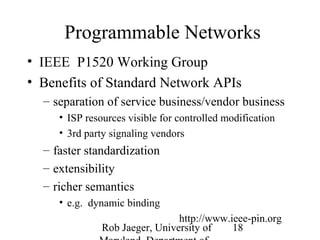
Programmable Networks 
• IEEE P1520 Working Group 
• Benefits of Standard Network APIs 
– separation of service business/vendor business 
• ISP resources visible for controlled modification 
• 3rd party signaling vendors 
– faster standardization 
– extensibility 
– richer semantics 
Rob Jaeger, University of 
Maryland, Department of 
18 
• e.g. dynamic binding 
http://www.ieee-pin.org
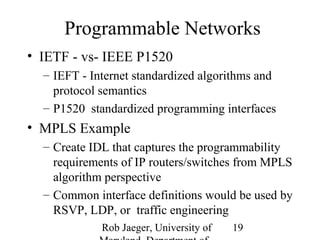
Programmable Networks 
• IETF - vs- IEEE P1520 
– IEFT - Internet standardized algorithms and 
protocol semantics 
– P1520 standardized programming interfaces 
• MPLS Example 
– Create IDL that captures the programmability 
requirements of IP routers/switches from MPLS 
algorithm perspective 
– Common interface definitions would be used by 
RSVP, LDP, or traffic engineering 
Rob Jaeger, University of 
Maryland, Department of 
19
Rob Jaeger, University of 
Maryland, Department of 
20 
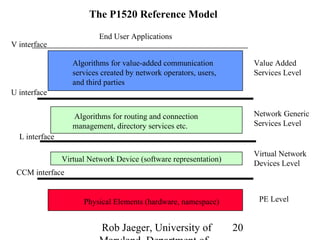
The P1520 Reference Model 
Algorithms for value-added communication 
services created by network operators, users, 
and third parties 
Algorithms for routing and connection 
management, directory services etc. 
Value Added 
Services Level 
Virtual Network Device (software representation) 
Physical Elements (hardware, namespace) 
L interface 
Network Generic 
Services Level 
Virtual Network 
Devices Level 
End User Applications 
V interface 
U interface 
CCM interface 
PE Level
Active Networking 
“The active network provides a 
platform on which network 
services can be experimented 
Rob Jaeger, University of 
Maryland, Department of 
21 
with, developed, and 
deployed” 
http://www.darpa.mil/ito/research/anets/index.html
Active Network Objectives 
Rob Jaeger, University of 
Maryland, Department of 
22 
• Minimize amount of global agreement 
– Do not require global agreement to support dynamic 
modification of the network 
• Support fast-path processing optimization 
• Scale to very large global active networks 
• Provide mechanisms to ensure security and 
robustness of nodes and of the network 
• Provide mechanisms to support different QoS/CoS
Active Network Architecture 
• NodeOS - manages resources for the node 
• Execution Environment - 
– provides an API to applications or 
– a shell interface through which end-to-end 
nework services can be accessed. 
• Active Applications - implementation of 
network services which utilize the local 
computation and access to router resources. 
Rob Jaeger, University of 
Maryland, Department of 
23
Node Operating System 
Rob Jaeger, University of 
Maryland, Department of 
24 
• Latest Specification (June 15, 1999) 
• Abstractions 
– Channels 
– Memory Pools 
– Thread Pools 
– Files 
– Flows
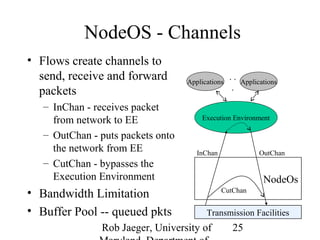
NodeOS - Channels 
Applications Applications . . 
. 
Execution Environment 
InChan OutChan 
Rob Jaeger, University of 
Maryland, Department of 
25 
• Flows create channels to 
send, receive and forward 
packets 
– InChan - receives packet 
from network to EE 
– OutChan - puts packets onto 
the network from EE 
– CutChan - bypasses the 
Execution Environment 
• Bandwidth Limitation 
• Buffer Pool -- queued pkts 
NodeOs 
CutChan 
Transmission Facilities
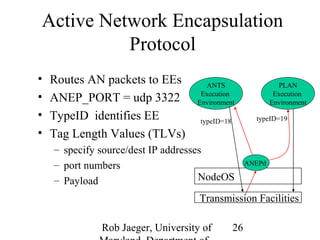
Active Network Encapsulation 
ANTS 
Execution 
Environment 
typeID=18 
Rob Jaeger, University of 
Maryland, Department of 
26 
Protocol 
• Routes AN packets to EEs 
• ANEP_PORT = udp 3322 
• TypeID identifies EE 
• Tag Length Values (TLVs) 
– specify source/dest IP addresses 
– port numbers 
– Payload NodeOS 
PLAN 
Execution 
Environment 
typeID=19 
ANEPd 
Transmission Facilities
NodeOS - Memory Pools 
• Combines memory for one or more flows 
• Shared by threads within flows 
• mmap-style interface to page allocation 
• flow in which thread runs charged for 
resource 
• EE notified when flow exceeds limits 
• Flow (and associated threads) terminated 
upon violation 
Rob Jaeger, University of 
Maryland, Department of 
27
NodeOS - Thread Pools 
• Computational Abstraction 
– Number of threads in Pool 
– Scheduler to be used (round robin, … ) 
– Max execution time between yields 
– Per thread stack size 
• No explicit operation for creation/ 
termination -- activated by events 
• Termination of flow if thread 
misbehaves 
Rob Jaeger, University of 
Maryland, Department of 
28
Rob Jaeger, University of 
Maryland, Department of 
29 
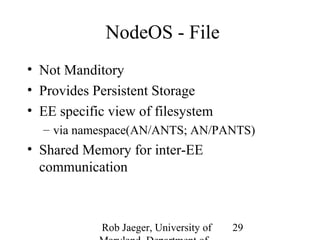
NodeOS - File 
• Not Manditory 
• Provides Persistent Storage 
• EE specific view of filesystem 
– via namespace(AN/ANTS; AN/PANTS) 
• Shared Memory for inter-EE 
communication
Applications Applications . . 
. 
Execution Environment 
InChan OutChan 
Rob Jaeger, University of 
Maryland, Department of 
30 
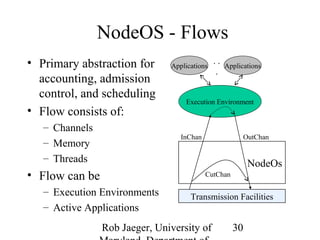
NodeOS - Flows 
• Primary abstraction for 
accounting, admission 
control, and scheduling 
• Flow consists of: 
– Channels 
– Memory 
– Threads 
• Flow can be 
– Execution Environments 
– Active Applications 
NodeOs 
CutChan 
Transmission Facilities
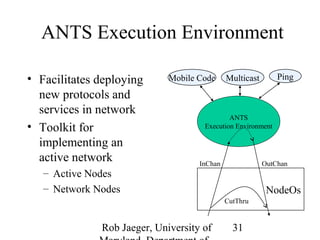
ANTS Execution Environment 
Mobile Code Multicast Ping 
Execution Environment 
InChan OutChan 
Rob Jaeger, University of 
Maryland, Department of 
ANTS 
31 
• Facilitates deploying 
new protocols and 
services in network 
• Toolkit for 
implementing an 
active network 
– Active Nodes 
– Network Nodes NodeOs 
CutThru
ANTS Execution Environment 
• Capsules are the unit of transfer for data 
and code 
– source & destination addresses 
– previous node address 
– resource limits 
– encoding and evaluation methods methods 
– Protocol/Group/Method ID access methods 
• Data Capsule 
Rob Jaeger, University of 
Maryland, Department of 
32 
– source & destination port numbers 
– identifies active application
ANTS Code Distribution 
• “Node” object is core of Runtime System 
– UDP Channels 
– Methods to Send/Receive Capsules 
– Supports numbers applications identified by 
port number 
• Consists of Built-in protocols 
• Accepts registration of new protocol 
Rob Jaeger, University of 
Maryland, Department of 
33 
– capsule code stored in code cache 
– signature (hash) computed for code
ANTS Code Distribution 
• Allows Definition of additional protocols 
– Protocol 
– Code Group (transitive closure of calls) 
• Dynamic Code Distribution via Capsules 
Rob Jaeger, University of 
Maryland, Department of 
34 
– Capsule arrives and node can’t evaluate it 
• protocol not on active node 
• must request packet from previous active node 
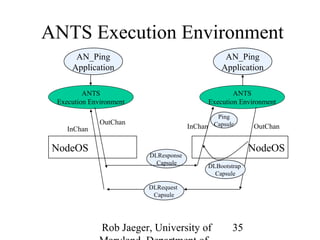
– DLBootstrap Capsule 
– DLRequest Capsule 
– DLResponse Capsule
ANTS Execution Environment 
ANTS 
Execution Environment 
InChan OutChan 
DLResponse 
Capsule 
Rob Jaeger, University of 
Maryland, Department of 
ANTS 
35 
AN_Ping 
Application 
NodeOS 
OutChan 
InChan 
AN_Ping 
Application 
Ping 
Capsule 
NodeOS 
DLBootstrap 
Capsule 
DLRequest 
Capsule
Rob Jaeger, University of 
Maryland, Department of 
36 
Agenda 
• Local Computation 
• New types of applications 
• Programmable and Active Networks 
• Architecture 
• Issues 
• Summary
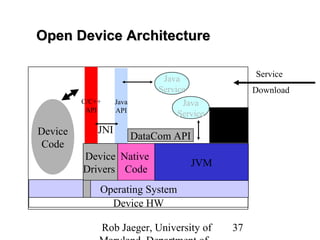
JNI 
Operating System 
Rob Jaeger, University of 
Maryland, Department of 
37 
OOppeenn DDeevviiccee AArrcchhiitteeccttuurree 
Service 
Download 
Device HW 
JVM 
Java 
Service 
Java 
Service 
Java Lib 
C/C++ 
API 
Java 
API 
Device 
Code 
DataCom API 
Native 
Code 
Device 
Drivers
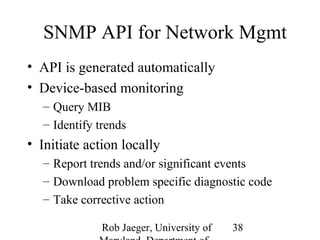
SNMP API for Network Mgmt 
• API is generated automatically 
• Device-based monitoring 
– Query MIB 
– Identify trends 
• Initiate action locally 
– Report trends and/or significant events 
– Download problem specific diagnostic code 
– Take corrective action 
Rob Jaeger, University of 
Maryland, Department of 
38
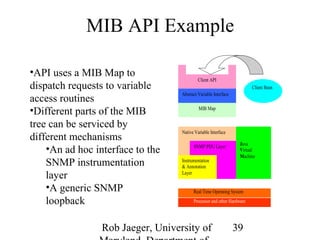
MIB API Example 
Client API 
Abstract Variable Interface 
MIB Map 
Native Variable Interface 
Rob Jaeger, University of 
Maryland, Department of 
Java 
Virtual 
Machine 
39 
SNMP PDU Layer 
Instrumentation 
& Annotation 
Layer 
Real Time Operating System 
Processor and other Hardware 
Client Bean 
•API uses a MIB Map to 
dispatch requests to variable 
access routines 
•Different parts of the MIB 
tree can be serviced by 
different mechanisms 
•An ad hoc interface to the 
SNMP instrumentation 
layer 
•A generic SNMP 
loopback
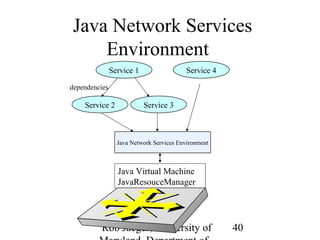
Java Network Services 
Service 3 
Service 1 
Java Network Services Environment 
Rob Jaeger, University of 
Maryland, Department of 
40 
Environment 
Service 2 
Java Virtual Machine 
JavaResouceManager 
dependencies 
Service 4
Our Prototype Java Environment 
• Present RTOS with single unified task that 
includes: 
– Java VM (JVM) 
– Java Resource Manager (JRM) 
Rob Jaeger, University of 
Maryland, Department of 
41 
• thread scheduling 
• manages CPU utilization 
– JVM time-slice is managed by the JRM preemptive 
thread scheduler 
• internal memory manager (intercepts “new”) 
• garbage collection with priority based on available 
memory
Rob Jaeger, University of 
Maryland, Department of 
42 
Why Java 
• Dynamic class loading 
• Reuse security mechanisms 
– Byte-code Verifier 
– Security Manager 
– Class Loader 
• System stability 
– Constrain applications to the Java VMs 
– Prohibit native code applications 
• Extensible, portable, & distributable 
services
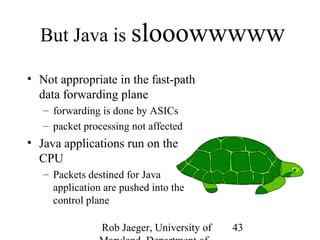
But Java is slooowwwww 
Rob Jaeger, University of 
Maryland, Department of 
43 
• Not appropriate in the fast-path 
data forwarding plane 
– forwarding is done by ASICs 
– packet processing not affected 
• Java applications run on the 
CPU 
– Packets destined for Java 
application are pushed into the 
control plane
Rob Jaeger, University of 
Maryland, Department of 
44 
Agenda 
• Openness 
• Local Computation 
• New type of applications 
• Programmable and Active Networks 
• Architecture 
• Issues & Questions 
• Summary
Architecture Issues 
Approach 1: Native Threads 
• One JVM per principle 
• One RTOS task per JVM 
• Non-interference between Java applications 
• Difficult thread-to-thread communication 
and sharing of data between threads 
• Creates a dependency on underlying RTOS 
• Multiple JVM instances consume resources 
Rob Jaeger, University of 
Maryland, Department of 
45
Architecture Issues 
Approach 2: Single JVM - Green Threads 
• Present one unified task to the RTOS 
• JVM manages CPU & memory resources 
between competing threads; 
• Propagation of component failure 
• Requires modifications to the JVM 
• Binding of resources to the JVM 
Rob Jaeger, University of 
Maryland, Department of 
46
Rob Jaeger, University of 
Maryland, Department of 
47 
Security Issues 
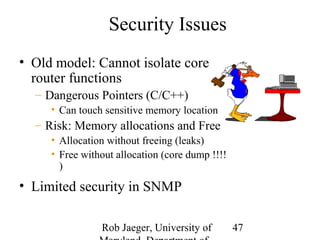
• Old model: Cannot isolate core 
router functions 
– Dangerous Pointers (C/C++) 
• Can touch sensitive memory location 
– Risk: Memory allocations and Free 
• Allocation without freeing (leaks) 
• Free without allocation (core dump !!!! 
) 
• Limited security in SNMP
Security and Stability 
• secure download of Java Applications 
• safe execution environment 
– insulate core router applications from 
Rob Jaeger, University of 
Maryland, Department of 
48 
dynamically loaded applications 
– protect services from one another
Strong Security in the new model 
• The new concept is to securely download 
3rd party code to network devices 
– Digital Signature 
– Administratively Certified Services 
– Access only to the published API 
– Verifier - only correct code is loaded 
– Class loader access list 
– No pointers that can do harm 
– No access outside the JVM space 
– JVM has run time bounds, type, and execution 
Rob Jaeger, University of 
Maryland, Department of 
49 
checking
Language Based Protection 
• Type Safety 
– Reference to Objects, not random memory 
– Inappropriate accesses to memory not allowed 
• Restricts what operations code can perform on what 
memory locations 
• operations on objects must be valid for that object 
– dynamic access control (via reference) 
– static access control (via public, private) 
Rob Jaeger, University of 
Maryland, Department of 
50
Rob Jaeger, University of 
Maryland, Department of 
51 
Access Control [6] 
class A { 
private int i; 
public int j; 
public static void method1() { 
A a1 = new A(); 
A a2 = new A(); 
B.method2(a1); } 
} 
class B 
public static void method2 (A arg) { 
arg.j++; 
arg.i++; // illegal 
} 
- method2 has access to public j 
but not to private i 
- method2 cannot forge a reference to a2 
given the a1 reference
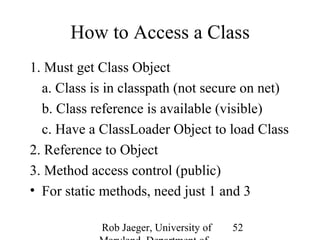
How to Access a Class 
1. Must get Class Object 
a. Class is in classpath (not secure on net) 
b. Class reference is available (visible) 
c. Have a ClassLoader Object to load Class 
2. Reference to Object 
3. Method access control (public) 
• For static methods, need just 1 and 3 
Rob Jaeger, University of 
Maryland, Department of 
52
Rob Jaeger, University of 
Maryland, Department of 
53 
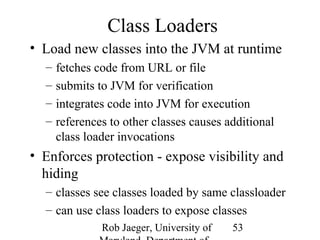
Class Loaders 
• Load new classes into the JVM at runtime 
– fetches code from URL or file 
– submits to JVM for verification 
– integrates code into JVM for execution 
– references to other classes causes additional 
class loader invocations 
• Enforces protection - expose visibility and 
hiding 
– classes see classes loaded by same classloader 
– can use class loaders to expose classes
Rob Jaeger, University of 
Maryland, Department of 
54 
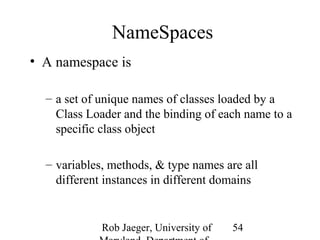
NameSpaces 
• A namespace is 
– a set of unique names of classes loaded by a 
Class Loader and the binding of each name to a 
specific class object 
– variables, methods, & type names are all 
different instances in different domains
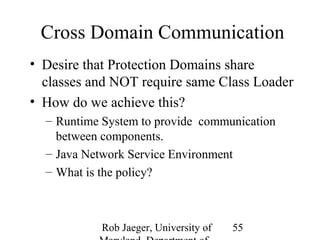
Cross Domain Communication 
• Desire that Protection Domains share 
classes and NOT require same Class Loader 
• How do we achieve this? 
– Runtime System to provide communication 
between components. 
– Java Network Service Environment 
– What is the policy? 
Rob Jaeger, University of 
Maryland, Department of 
55
Building Protection Domains 
• Use multiple namespaces 
– Variables, methods, type names are all different 
instances in different domains 
– Could use Object references for cross-domain 
communication 
Rob Jaeger, University of 
Maryland, Department of 
56 
• e.g. FileSystemInterface 
– Selective class sharing 
– Problems result
Protection Domains - Revocation 
• Access to an object reference cannot be 
revoked 
• Wrap object with revocable object that is a 
delegator to real object 
– all methods wrapped 
• Programmer may forget to wrap objects 
referenced by wrapped object (tracking 
problem) 
Rob Jaeger, University of 
Maryland, Department of 
57
Protection Domains: Revocation[6] 
Rob Jaeger, University of 
Maryland, Department of 
58 
class A { public int method1(int a1, int a2); } 
class AWrapper { 
private A a; 
private boolean revoked; 
public int method1(int a1, int a2) { 
if (!revoked) return a.meth1(a1, a2) ; 
else throw new RevokedException; 
} 
public void revoke() {revoked=true;} 
public AWrapper (A realA) { 
a = realA; revoked = false; } 
}
Protection Domains: Inter-domain 
dependencies 
• Sharing Object references between domains 
• Mutable shared objects can be changed 
• Malious attack: 
– pass byte array w/ legal bytecode to classloader 
– once verified, overwrite with illegal bytecode 
• Should copy bytecode to classloader, not 
pass reference 
Rob Jaeger, University of 
Maryland, Department of 
59
Protection Domains: 
Rob Jaeger, University of 
Maryland, Department of 
60 
Termination 
• Upon domain termination: 
– should all references obtained be released? 
• two Strings in different domains may reference the 
same byte array 
– should object be kept alive if referenced by 
other domains? 
• clients could hold onto references to objects of a 
dead server
Protection Domains: Threads 
• Method invocation for cross domain calls 
both execute in same thread 
– caller blocks until callee returns 
• how does caller back out gracefully? 
– untrusted domain calls stop() or suspend 
after calling trusted method -- 
• state left unstable and blocked 
– untrusted callee can block caller that may be 
in critical section 
Rob Jaeger, University of 
Maryland, Department of 
61
Protection Domains: Accounting 
• How do you account for resources obtained 
by a domain? 
– CPU cycles 
– Memory pages 
– Bandwidth on a channel 
Rob Jaeger, University of 
Maryland, Department of 
62
Rob Jaeger, University of 
Maryland, Department of 
63 
Safety 
• Precise definition of protection domains 
– local object 
– non-local shared objects (capability objects) 
• Define communication channels between 
protection domains 
• Support revocation capabilities 
• Define semantics for domain termination
J-Kernel Class Loaders 
• Each Classloader defines a namespace 
– must manage & secure namespace 
– can modify bytecodes 
– creates stub code for cross-domain 
communication -- use local RMI calls 
– substitutes “safe” versions of standard classes 
Rob Jaeger, University of 
Maryland, Department of 
64 
• e.g. file system access
J Kernel Concepts 
• Capabilities: 
– handles to resources in other domains 
– revoke access by setting handle to null 
– client throws an exception 
• Domain: 
– each domain has a namespace and threads 
under its control 
– shared classes 
– capabilities access is revoked upon termination 
Rob Jaeger, University of 
Maryland, Department of 
65
J Kernel Concepts 
• Cross domain calls: 
– use calls to “capability” methods using LRMI 
– special calling convention 
• pass by Reference: arguments and return values if they are 
Capability Objects--- references not shared outside domain 
• passed by Copy: if NOT Capability Objects or primitive types 
• rules are applied recursively (deep copy) 
– Stubs to methods are created at run-time 
• simulate thread switching for save method calls 
– Capabilities are shared between domains 
Rob Jaeger, University of 
Maryland, Department of 
66
Rob Jaeger, University of 
Maryland, Department of 
67 
Observations 
• Expensive 
– method invocation via stubs 
– simulated thread switching (and thread 
switching) 
• acquire/releasing of locks 
• cheaper than real thread switching (50% of cost) 
– looking up the current thread 
– argument copying is expensive
Rob Jaeger, University of 
Maryland, Department of 
68 
Questions 
• How do you insulate core router 
functionality? 
• How do you securely download code? 
• How do you do resource accounting? 
• How do you assure resource safety? 
– fair share or priority share quotas? 
• CPU 
• Memory 
• Bandwidth
Rob Jaeger, University of 
Maryland, Department of 
69 
Questions 
• Native or Green Threads? 
• How do you protect services from one 
another (trusted -vs- untrusted)? 
– stable state for critical sections 
– enforce return from untrusted method 
– kill untrusted threads 
– security manager rejects forbidden actions
Rob Jaeger, University of 
Maryland, Department of 
70 
Agenda 
• Openness 
• Local Computation 
• New type of applications 
• Programmable and Active Networks 
• Architecture 
• Issues 
• Summary
Rob Jaeger, University of 
Maryland, Department of 
71 
Summary 
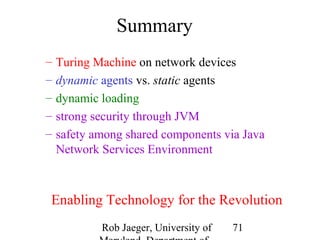
– Turing Machine on network devices 
– dynamic agents vs. static agents 
– dynamic loading 
– strong security through JVM 
– safety among shared components via Java 
Network Services Environment 
Enabling Technology for the Revolution
Rob Jaeger, University of 
Maryland, Department of 
72 
References 
[1] P.Bernadat, D. Lambright, and F. Travostino, “Towards a Resource-safe Java for Service- 
Guarantees in Uncooperative Environments,” IEEE Symposium on Programming Languages 
for Real-time Industrial Applications (PLRTIA) ‘98, Madrid, Spain, Dec. ‘98. 
[2] Active Networking Node OS Working Group, NodeOS Interface Specification", June 15, 1999 
[3] Active Networks Working Group, "Architectural Framework for Active Networks Version 0.9", 
August 31, 1999 
[4] T. Lavian, R. Jaeger, "Open Programmable Architecture for Java-enable Network Devices", 
Stanford Hot Interconnects, August 1999. 
[5] D. Wetherall et al. ANTS: A Toolkit for Building andDynamically Deploying Network Protocols. 
OPENARACH'98 
[6] C. Hawblitzel, C. Chang, G. Czajkowski, D. Hu, T. von Eicken, “Implementing Multiple 
Protection Domains in Java”, 1998 USENIX Annual Technical Conference, New Orleans, LA, 
June 1998 
[7] R. Jaeger, T. Lavian, R. Duncan, “Open Programmable Architecture for Java-enabled Network 
Devices”, To be presented at LANMAN ‘99, Sydney, Australia, November 1999

Programmable Network Devices

  • 1.
    Programmable Network Devices: Rob Jaeger, University of Maryland, Department of 1 A Revolution! Robert F. Jaeger University of Maryland Department of Computer Science rfj@cs.umd.edu
  • 2.
    Programmable Network Devices Openly Programmable devices enable new types of intelligence on the network Rob Jaeger, University of Maryland, Department of 2
  • 3.
    Rob Jaeger, Universityof Maryland, Department of 3 Agenda • Local Computation • New types of applications • Programmable and Active Networks • Network Services Architecture • Issues • Summary
  • 4.
    Changing the Rulesof the Game Rob Jaeger, University of Maryland, Department of 4 • Move Turing Machine onto device – Run non-vendor/non-bundled applications on network device while (true) { doLocalProcessingOnDevice() }
  • 5.
    Non-vendor/Non-bundled Applications Applet Web Server Web Browser The JVM is in the Browser DDoowwnnllooaadd aapppplliiccaattiioonnss ffoorr llooccaall pprroocceessssiinngg non-bundled application Rob Jaeger, University of Maryland, Department of 5 Reversed Applets Server The JVM is in the Device: supports non-bundled apps
  • 6.
    The Web ChangedEverything Rob Jaeger, University of Maryland, Department of 6 • Browsers – Introducing JVM to browsers allowed dynamic loading of Java Applets to end stations • Routers – Introducing JVM to routers allows dynamic loading of Java Oplets to routers This Capability WILL Change Everything
  • 7.
    Architecture to Augment Vendor-Provided Software • Supports non-vendor applications • End-user custom application development – Tight interaction between business applications and network devices • Domain experts who understand business goals • Innovative approaches – “Features on Demand” Rob Jaeger, University of Maryland, Department of 7 • download software services • dynamically add new capabilities
  • 8.
    Rob Jaeger, Universityof Maryland, Department of Java-based Application 8 Paradigm Shift • Supports distributed computing applications in which network devices participate – router to router – server to router Java-based Application Java-based Application
  • 9.
    D Example: DoowwnnllooaaddiinnggIInntteelllliiggeennccee JVM OS Rob Jaeger, University of Maryland, Department of 9 Network Device Dynamic loading HW Monitor React Authentication Security Intelligence application
  • 10.
    Device-based Intelligence RobJaeger, University of Maryland, Department of 10 • Static-vs-Dynamic Agents – Static • SNMP set/get mechanisms • Telnet, User Interfaces (cli, web, etc…) – Dynamic closed-loop interaction on nodes • capable of dealing with new and difficult situations • autonomous and rational properties • system monitoring & modification • report status and trends
  • 11.
    Rob Jaeger, Universityof Maryland, Department of 11 Agenda • Local Computation • New types of Applications • Programmable and Active Networks • Network Services Architecture • Issues • Summary
  • 12.
    New Types ofApplications • Mobile Agents • Local Intelligence for NMS • Application layer collaboration among routers • Distributed computing involving network devices and servers • E-commerce Rob Jaeger, University of Maryland, Department of 12
  • 13.
    Rob Jaeger, Universityof Maryland, Department of 13 Mobile Agents • Intrusion Detection - Hacker Chaser • Traceroute for Layer 2 • Mobile Connectivity Mapper
  • 14.
    Local Intelligence forNMS: Extensive access to internal resources Rob Jaeger, University of Maryland, Department of 14 Diagnostic Agents • Download Intelligent Agent monitor from NMS to the device. • Wait for threshold. • Might be complex conditions • Trend analysis • Send “condition exceeded” event to NMS. • Automatic download appropriate application • Application takes action. Monitor Appropriate Application Download Download Complex Condition Exceeded No more polling NMS router
  • 15.
    Application Layer Collaboration Among Routers and Servers Rob Jaeger, University of Maryland, Department of 15 • Multicast Caching • Web Caching • Server farm load balancing – server state monitored – rerouting based on congestion/load • Auctioning Applications
  • 16.
    E-Commerce Example Businesslogic based operation changes • Resize forwarding queues • Modify congestion control algorithm • Adjust Packet Scheduling • Change routing table Rob Jaeger, University of Maryland, Department of 16
  • 17.
    Rob Jaeger, Universityof Maryland, Department of 17 Agenda • Local Computation • New types of applications • Programmable and Active Networks • Architecture • Issues • Summary
  • 18.
    Programmable Networks •IEEE P1520 Working Group • Benefits of Standard Network APIs – separation of service business/vendor business • ISP resources visible for controlled modification • 3rd party signaling vendors – faster standardization – extensibility – richer semantics Rob Jaeger, University of Maryland, Department of 18 • e.g. dynamic binding http://www.ieee-pin.org
  • 19.
    Programmable Networks •IETF - vs- IEEE P1520 – IEFT - Internet standardized algorithms and protocol semantics – P1520 standardized programming interfaces • MPLS Example – Create IDL that captures the programmability requirements of IP routers/switches from MPLS algorithm perspective – Common interface definitions would be used by RSVP, LDP, or traffic engineering Rob Jaeger, University of Maryland, Department of 19
  • 20.
    Rob Jaeger, Universityof Maryland, Department of 20 The P1520 Reference Model Algorithms for value-added communication services created by network operators, users, and third parties Algorithms for routing and connection management, directory services etc. Value Added Services Level Virtual Network Device (software representation) Physical Elements (hardware, namespace) L interface Network Generic Services Level Virtual Network Devices Level End User Applications V interface U interface CCM interface PE Level
  • 21.
    Active Networking “Theactive network provides a platform on which network services can be experimented Rob Jaeger, University of Maryland, Department of 21 with, developed, and deployed” http://www.darpa.mil/ito/research/anets/index.html
  • 22.
    Active Network Objectives Rob Jaeger, University of Maryland, Department of 22 • Minimize amount of global agreement – Do not require global agreement to support dynamic modification of the network • Support fast-path processing optimization • Scale to very large global active networks • Provide mechanisms to ensure security and robustness of nodes and of the network • Provide mechanisms to support different QoS/CoS
  • 23.
    Active Network Architecture • NodeOS - manages resources for the node • Execution Environment - – provides an API to applications or – a shell interface through which end-to-end nework services can be accessed. • Active Applications - implementation of network services which utilize the local computation and access to router resources. Rob Jaeger, University of Maryland, Department of 23
  • 24.
    Node Operating System Rob Jaeger, University of Maryland, Department of 24 • Latest Specification (June 15, 1999) • Abstractions – Channels – Memory Pools – Thread Pools – Files – Flows
  • 25.
    NodeOS - Channels Applications Applications . . . Execution Environment InChan OutChan Rob Jaeger, University of Maryland, Department of 25 • Flows create channels to send, receive and forward packets – InChan - receives packet from network to EE – OutChan - puts packets onto the network from EE – CutChan - bypasses the Execution Environment • Bandwidth Limitation • Buffer Pool -- queued pkts NodeOs CutChan Transmission Facilities
  • 26.
    Active Network Encapsulation ANTS Execution Environment typeID=18 Rob Jaeger, University of Maryland, Department of 26 Protocol • Routes AN packets to EEs • ANEP_PORT = udp 3322 • TypeID identifies EE • Tag Length Values (TLVs) – specify source/dest IP addresses – port numbers – Payload NodeOS PLAN Execution Environment typeID=19 ANEPd Transmission Facilities
  • 27.
    NodeOS - MemoryPools • Combines memory for one or more flows • Shared by threads within flows • mmap-style interface to page allocation • flow in which thread runs charged for resource • EE notified when flow exceeds limits • Flow (and associated threads) terminated upon violation Rob Jaeger, University of Maryland, Department of 27
  • 28.
    NodeOS - ThreadPools • Computational Abstraction – Number of threads in Pool – Scheduler to be used (round robin, … ) – Max execution time between yields – Per thread stack size • No explicit operation for creation/ termination -- activated by events • Termination of flow if thread misbehaves Rob Jaeger, University of Maryland, Department of 28
  • 29.
    Rob Jaeger, Universityof Maryland, Department of 29 NodeOS - File • Not Manditory • Provides Persistent Storage • EE specific view of filesystem – via namespace(AN/ANTS; AN/PANTS) • Shared Memory for inter-EE communication
  • 30.
    Applications Applications .. . Execution Environment InChan OutChan Rob Jaeger, University of Maryland, Department of 30 NodeOS - Flows • Primary abstraction for accounting, admission control, and scheduling • Flow consists of: – Channels – Memory – Threads • Flow can be – Execution Environments – Active Applications NodeOs CutChan Transmission Facilities
  • 31.
    ANTS Execution Environment Mobile Code Multicast Ping Execution Environment InChan OutChan Rob Jaeger, University of Maryland, Department of ANTS 31 • Facilitates deploying new protocols and services in network • Toolkit for implementing an active network – Active Nodes – Network Nodes NodeOs CutThru
  • 32.
    ANTS Execution Environment • Capsules are the unit of transfer for data and code – source & destination addresses – previous node address – resource limits – encoding and evaluation methods methods – Protocol/Group/Method ID access methods • Data Capsule Rob Jaeger, University of Maryland, Department of 32 – source & destination port numbers – identifies active application
  • 33.
    ANTS Code Distribution • “Node” object is core of Runtime System – UDP Channels – Methods to Send/Receive Capsules – Supports numbers applications identified by port number • Consists of Built-in protocols • Accepts registration of new protocol Rob Jaeger, University of Maryland, Department of 33 – capsule code stored in code cache – signature (hash) computed for code
  • 34.
    ANTS Code Distribution • Allows Definition of additional protocols – Protocol – Code Group (transitive closure of calls) • Dynamic Code Distribution via Capsules Rob Jaeger, University of Maryland, Department of 34 – Capsule arrives and node can’t evaluate it • protocol not on active node • must request packet from previous active node – DLBootstrap Capsule – DLRequest Capsule – DLResponse Capsule
  • 35.
    ANTS Execution Environment ANTS Execution Environment Execution Environment InChan OutChan DLResponse Capsule Rob Jaeger, University of Maryland, Department of ANTS 35 AN_Ping Application NodeOS OutChan InChan AN_Ping Application Ping Capsule NodeOS DLBootstrap Capsule DLRequest Capsule
  • 36.
    Rob Jaeger, Universityof Maryland, Department of 36 Agenda • Local Computation • New types of applications • Programmable and Active Networks • Architecture • Issues • Summary
  • 37.
    JNI Operating System Rob Jaeger, University of Maryland, Department of 37 OOppeenn DDeevviiccee AArrcchhiitteeccttuurree Service Download Device HW JVM Java Service Java Service Java Lib C/C++ API Java API Device Code DataCom API Native Code Device Drivers
  • 38.
    SNMP API forNetwork Mgmt • API is generated automatically • Device-based monitoring – Query MIB – Identify trends • Initiate action locally – Report trends and/or significant events – Download problem specific diagnostic code – Take corrective action Rob Jaeger, University of Maryland, Department of 38
  • 39.
    MIB API Example Client API Abstract Variable Interface MIB Map Native Variable Interface Rob Jaeger, University of Maryland, Department of Java Virtual Machine 39 SNMP PDU Layer Instrumentation & Annotation Layer Real Time Operating System Processor and other Hardware Client Bean •API uses a MIB Map to dispatch requests to variable access routines •Different parts of the MIB tree can be serviced by different mechanisms •An ad hoc interface to the SNMP instrumentation layer •A generic SNMP loopback
  • 40.
    Java Network Services Service 3 Service 1 Java Network Services Environment Rob Jaeger, University of Maryland, Department of 40 Environment Service 2 Java Virtual Machine JavaResouceManager dependencies Service 4
  • 41.
    Our Prototype JavaEnvironment • Present RTOS with single unified task that includes: – Java VM (JVM) – Java Resource Manager (JRM) Rob Jaeger, University of Maryland, Department of 41 • thread scheduling • manages CPU utilization – JVM time-slice is managed by the JRM preemptive thread scheduler • internal memory manager (intercepts “new”) • garbage collection with priority based on available memory
  • 42.
    Rob Jaeger, Universityof Maryland, Department of 42 Why Java • Dynamic class loading • Reuse security mechanisms – Byte-code Verifier – Security Manager – Class Loader • System stability – Constrain applications to the Java VMs – Prohibit native code applications • Extensible, portable, & distributable services
  • 43.
    But Java isslooowwwww Rob Jaeger, University of Maryland, Department of 43 • Not appropriate in the fast-path data forwarding plane – forwarding is done by ASICs – packet processing not affected • Java applications run on the CPU – Packets destined for Java application are pushed into the control plane
  • 44.
    Rob Jaeger, Universityof Maryland, Department of 44 Agenda • Openness • Local Computation • New type of applications • Programmable and Active Networks • Architecture • Issues & Questions • Summary
  • 45.
    Architecture Issues Approach1: Native Threads • One JVM per principle • One RTOS task per JVM • Non-interference between Java applications • Difficult thread-to-thread communication and sharing of data between threads • Creates a dependency on underlying RTOS • Multiple JVM instances consume resources Rob Jaeger, University of Maryland, Department of 45
  • 46.
    Architecture Issues Approach2: Single JVM - Green Threads • Present one unified task to the RTOS • JVM manages CPU & memory resources between competing threads; • Propagation of component failure • Requires modifications to the JVM • Binding of resources to the JVM Rob Jaeger, University of Maryland, Department of 46
  • 47.
    Rob Jaeger, Universityof Maryland, Department of 47 Security Issues • Old model: Cannot isolate core router functions – Dangerous Pointers (C/C++) • Can touch sensitive memory location – Risk: Memory allocations and Free • Allocation without freeing (leaks) • Free without allocation (core dump !!!! ) • Limited security in SNMP
  • 48.
    Security and Stability • secure download of Java Applications • safe execution environment – insulate core router applications from Rob Jaeger, University of Maryland, Department of 48 dynamically loaded applications – protect services from one another
  • 49.
    Strong Security inthe new model • The new concept is to securely download 3rd party code to network devices – Digital Signature – Administratively Certified Services – Access only to the published API – Verifier - only correct code is loaded – Class loader access list – No pointers that can do harm – No access outside the JVM space – JVM has run time bounds, type, and execution Rob Jaeger, University of Maryland, Department of 49 checking
  • 50.
    Language Based Protection • Type Safety – Reference to Objects, not random memory – Inappropriate accesses to memory not allowed • Restricts what operations code can perform on what memory locations • operations on objects must be valid for that object – dynamic access control (via reference) – static access control (via public, private) Rob Jaeger, University of Maryland, Department of 50
  • 51.
    Rob Jaeger, Universityof Maryland, Department of 51 Access Control [6] class A { private int i; public int j; public static void method1() { A a1 = new A(); A a2 = new A(); B.method2(a1); } } class B public static void method2 (A arg) { arg.j++; arg.i++; // illegal } - method2 has access to public j but not to private i - method2 cannot forge a reference to a2 given the a1 reference
  • 52.
    How to Accessa Class 1. Must get Class Object a. Class is in classpath (not secure on net) b. Class reference is available (visible) c. Have a ClassLoader Object to load Class 2. Reference to Object 3. Method access control (public) • For static methods, need just 1 and 3 Rob Jaeger, University of Maryland, Department of 52
  • 53.
    Rob Jaeger, Universityof Maryland, Department of 53 Class Loaders • Load new classes into the JVM at runtime – fetches code from URL or file – submits to JVM for verification – integrates code into JVM for execution – references to other classes causes additional class loader invocations • Enforces protection - expose visibility and hiding – classes see classes loaded by same classloader – can use class loaders to expose classes
  • 54.
    Rob Jaeger, Universityof Maryland, Department of 54 NameSpaces • A namespace is – a set of unique names of classes loaded by a Class Loader and the binding of each name to a specific class object – variables, methods, & type names are all different instances in different domains
  • 55.
    Cross Domain Communication • Desire that Protection Domains share classes and NOT require same Class Loader • How do we achieve this? – Runtime System to provide communication between components. – Java Network Service Environment – What is the policy? Rob Jaeger, University of Maryland, Department of 55
  • 56.
    Building Protection Domains • Use multiple namespaces – Variables, methods, type names are all different instances in different domains – Could use Object references for cross-domain communication Rob Jaeger, University of Maryland, Department of 56 • e.g. FileSystemInterface – Selective class sharing – Problems result
  • 57.
    Protection Domains -Revocation • Access to an object reference cannot be revoked • Wrap object with revocable object that is a delegator to real object – all methods wrapped • Programmer may forget to wrap objects referenced by wrapped object (tracking problem) Rob Jaeger, University of Maryland, Department of 57
  • 58.
    Protection Domains: Revocation[6] Rob Jaeger, University of Maryland, Department of 58 class A { public int method1(int a1, int a2); } class AWrapper { private A a; private boolean revoked; public int method1(int a1, int a2) { if (!revoked) return a.meth1(a1, a2) ; else throw new RevokedException; } public void revoke() {revoked=true;} public AWrapper (A realA) { a = realA; revoked = false; } }
  • 59.
    Protection Domains: Inter-domain dependencies • Sharing Object references between domains • Mutable shared objects can be changed • Malious attack: – pass byte array w/ legal bytecode to classloader – once verified, overwrite with illegal bytecode • Should copy bytecode to classloader, not pass reference Rob Jaeger, University of Maryland, Department of 59
  • 60.
    Protection Domains: RobJaeger, University of Maryland, Department of 60 Termination • Upon domain termination: – should all references obtained be released? • two Strings in different domains may reference the same byte array – should object be kept alive if referenced by other domains? • clients could hold onto references to objects of a dead server
  • 61.
    Protection Domains: Threads • Method invocation for cross domain calls both execute in same thread – caller blocks until callee returns • how does caller back out gracefully? – untrusted domain calls stop() or suspend after calling trusted method -- • state left unstable and blocked – untrusted callee can block caller that may be in critical section Rob Jaeger, University of Maryland, Department of 61
  • 62.
    Protection Domains: Accounting • How do you account for resources obtained by a domain? – CPU cycles – Memory pages – Bandwidth on a channel Rob Jaeger, University of Maryland, Department of 62
  • 63.
    Rob Jaeger, Universityof Maryland, Department of 63 Safety • Precise definition of protection domains – local object – non-local shared objects (capability objects) • Define communication channels between protection domains • Support revocation capabilities • Define semantics for domain termination
  • 64.
    J-Kernel Class Loaders • Each Classloader defines a namespace – must manage & secure namespace – can modify bytecodes – creates stub code for cross-domain communication -- use local RMI calls – substitutes “safe” versions of standard classes Rob Jaeger, University of Maryland, Department of 64 • e.g. file system access
  • 65.
    J Kernel Concepts • Capabilities: – handles to resources in other domains – revoke access by setting handle to null – client throws an exception • Domain: – each domain has a namespace and threads under its control – shared classes – capabilities access is revoked upon termination Rob Jaeger, University of Maryland, Department of 65
  • 66.
    J Kernel Concepts • Cross domain calls: – use calls to “capability” methods using LRMI – special calling convention • pass by Reference: arguments and return values if they are Capability Objects--- references not shared outside domain • passed by Copy: if NOT Capability Objects or primitive types • rules are applied recursively (deep copy) – Stubs to methods are created at run-time • simulate thread switching for save method calls – Capabilities are shared between domains Rob Jaeger, University of Maryland, Department of 66
  • 67.
    Rob Jaeger, Universityof Maryland, Department of 67 Observations • Expensive – method invocation via stubs – simulated thread switching (and thread switching) • acquire/releasing of locks • cheaper than real thread switching (50% of cost) – looking up the current thread – argument copying is expensive
  • 68.
    Rob Jaeger, Universityof Maryland, Department of 68 Questions • How do you insulate core router functionality? • How do you securely download code? • How do you do resource accounting? • How do you assure resource safety? – fair share or priority share quotas? • CPU • Memory • Bandwidth
  • 69.
    Rob Jaeger, Universityof Maryland, Department of 69 Questions • Native or Green Threads? • How do you protect services from one another (trusted -vs- untrusted)? – stable state for critical sections – enforce return from untrusted method – kill untrusted threads – security manager rejects forbidden actions
  • 70.
    Rob Jaeger, Universityof Maryland, Department of 70 Agenda • Openness • Local Computation • New type of applications • Programmable and Active Networks • Architecture • Issues • Summary
  • 71.
    Rob Jaeger, Universityof Maryland, Department of 71 Summary – Turing Machine on network devices – dynamic agents vs. static agents – dynamic loading – strong security through JVM – safety among shared components via Java Network Services Environment Enabling Technology for the Revolution
  • 72.
    Rob Jaeger, Universityof Maryland, Department of 72 References [1] P.Bernadat, D. Lambright, and F. Travostino, “Towards a Resource-safe Java for Service- Guarantees in Uncooperative Environments,” IEEE Symposium on Programming Languages for Real-time Industrial Applications (PLRTIA) ‘98, Madrid, Spain, Dec. ‘98. [2] Active Networking Node OS Working Group, NodeOS Interface Specification", June 15, 1999 [3] Active Networks Working Group, "Architectural Framework for Active Networks Version 0.9", August 31, 1999 [4] T. Lavian, R. Jaeger, "Open Programmable Architecture for Java-enable Network Devices", Stanford Hot Interconnects, August 1999. [5] D. Wetherall et al. ANTS: A Toolkit for Building andDynamically Deploying Network Protocols. OPENARACH'98 [6] C. Hawblitzel, C. Chang, G. Czajkowski, D. Hu, T. von Eicken, “Implementing Multiple Protection Domains in Java”, 1998 USENIX Annual Technical Conference, New Orleans, LA, June 1998 [7] R. Jaeger, T. Lavian, R. Duncan, “Open Programmable Architecture for Java-enabled Network Devices”, To be presented at LANMAN ‘99, Sydney, Australia, November 1999

Editor's Notes

  • #6 <number>
  • #10 <number> Authentication: You are who you say you are --- digital signatures digital certificate & certificate authority Security:: authorized to get onto device access levels no pointers where do we accept code from … which types of code
  • #14 <number>
  • #15 <number>
  • #16 <number>
  • #17 <number>
  • #19 a. separation of services business -- state of netwrok is now visible to external entities and may be manipulated in controlled ways. - allows for 3rd party software to be employed that can access resources - b. separation of vendor business -- signalling sofware and system vendors can emerge … not tightly integrated with underlying hardware vendors e.g. QoS signalling vendors c. faster standardization process
  • #20 a. separation of services business -- state of netwrok is now visible to external entities and may be manipulated in controlled ways. - allows for 3rd party software to be employed that can access resources - b. separation of vendor business -- signalling sofware and system vendors can emerge … not tightly integrated with underlying hardware vendors e.g. QoS signalling vendors c. faster standardization process Label Distribution Protocol
  • #21 U interface -- provides a means for creating a representation of specific services (DIFF SERV or INT SERV).
  • #33 Ping Capsule routines for getting protocol ID method ID Multicast Capsule
  • #38 <number>
  • #40 <number>
  • #41 <number>
  • #46 each one is in a separate thread
  • #48 <number>
  • #50 <number>
  • #53 1. Security Manager can still deny access to a resource if all three items are satisfied e.g. ClassLoader
  • #72 <number>