Trayan Iliev
CEO of IPT – Intellectual
Products & Technologies
tiliev@iproduct.org
http://iproduct.org
jPrime Conference
May 26-27 ‘16, Sofia
Reactive Java
Robotics and IoT
IPT – Intellectual Products &
Technologies: IT Education Evolved
2
Since 2003 we SHARE practical tech knowledge and
skills in Java SE/ EE/ Web/ JS/ Angular / React / TS:
Java EE/Web, JSF 2, Portlets, Portals: Liferay, GateIn
Reactive IoT with Reactor / RxJava / RxJS
Angular 2 + Ionic 2+ TypeScript web/mobile client MV*
frameworks
REST HATEOAS – Distributed Hypermedia APIs
Domain Driven Design, Reactive Microservices and
Event Sourcing
Oracle® & Java™ are (registered) trademarks of Oracle and/or its affiliates. Liferay® is
registered trademark of Liferay, Inc. Other names may be trademarks of their respective owners.
Tales of JAVA Robotics
3
There are so many tales to share:
Tale of Robotics, IoT and Complexity
Tale of Common Sense: DDD
Tale of Segregation between Queries and Commands,
and ultimate Event Sourcing
 Tale of two cities - Imperative and Reactive
 Tale of two brave robots: LeJaRo and IPTPI
 And a lot of real reactive Java +
TypeScript / Angular 2 / WebSocket code 
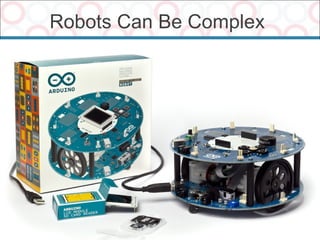
Robots Can Be Complex
4
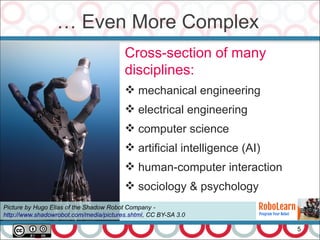
… Even More Complex
5
Cross-section of many
disciplines:
 mechanical engineering
 electrical engineering
 computer science
 artificial intelligence (AI)
 human-computer interaction
 sociology & psychology
Picture by Hugo Elias of the Shadow Robot Company -
http://www.shadowrobot.com/media/pictures.shtml, CC BY-SA 3.0
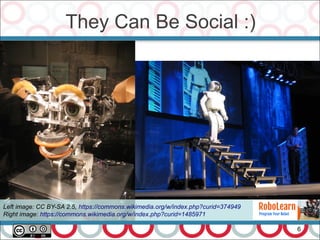
They Can Be Social :)
6
Left image: CC BY-SA 2.5, https://commons.wikimedia.org/w/index.php?curid=374949
Right image: https://commons.wikimedia.org/w/index.php?curid=1485971
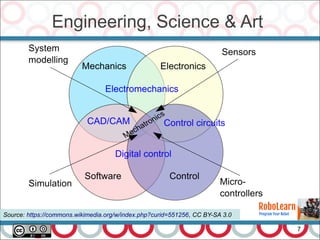
Engineering, Science & Art
7
Source: https://commons.wikimedia.org/w/index.php?curid=551256, CC BY-SA 3.0
Lonely Riders Driving By Their Own
8
Source: https://commons.wikimedia.org/w/index.php?curid=1822443, CC BY-SA 3.0
and How Can We Forget
9
Source: https://commons.wikimedia.org/
w/index.php?curid=234900, CC BY-SA 3.0
Source: Korea Institute of Industrial Technology,
http://news.naver.com/main/read.nhn?
mode=LSD&mid=sec&sid1=102&oid=020&aid=0000371339
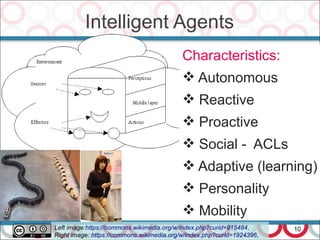
Intelligent Agents
10
Characteristics:
 Autonomous
 Reactive
 Proactive
 Social - ACLs
 Adaptive (learning)
 Personality
 Mobility
Left image:https://commons.wikimedia.org/w/index.php?curid=915484,
Right image: https://commons.wikimedia.org/w/index.php?curid=1924396,
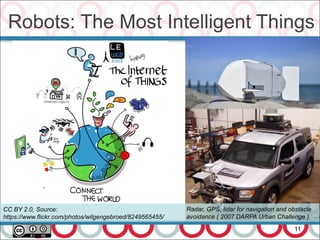
Robots: The Most Intelligent Things
11
CC BY 2.0, Source:
https://www.flickr.com/photos/wilgengebroed/8249565455/
Radar, GPS, lidar for navigation and obstacle
avoidance ( 2007 DARPA Urban Challenge )
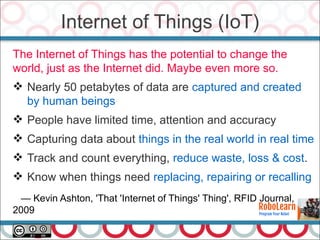
The Internet of Things has the potential to change the
world, just as the Internet did. Maybe even more so.
 Nearly 50 petabytes of data are captured and created
by human beings
 People have limited time, attention and accuracy
 Capturing data about things in the real world in real time
 Track and count everything, reduce waste, loss & cost.
 Know when things need replacing, repairing or recalling
— Kevin Ashton, 'That 'Internet of Things' Thing', RFID Journal,
2009
Internet of Things (IoT)
 There will be nearly 26 billion devices on the Internet of
Things by 2020.
[Gartner]
 More than 30 billion devices will be wirelessly
connected to the Internet of Things by 2020
[ABI Research]
 It's expected to be a 19 Trillion USD market
[John Chambers, Cisco CEO]
IoT Perspectives
"Basket of remotes" problem – we'll have hundreds of
applications to interface with hundreds of devices that
don't share protocols for speaking with one another
[Jean-Louis Gassée, Apple initial team, and BeOS co-founder]
Only IPv6 addresses are not enough – IoT devices
should be also easily and directly accessible for users
and [their] agents
In read/write mode
Preferably using a standard web browser
Even behind firewalls
IoT - Need for Standards
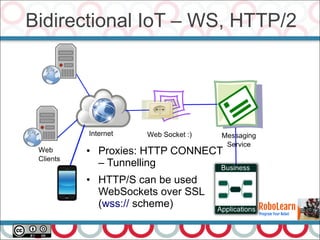
• Proxies: HTTP CONNECT
– Tunnelling
• HTTP/S can be used
WebSockets over SSL
(wss:// scheme)
Bidirectional IoT – WS, HTTP/2
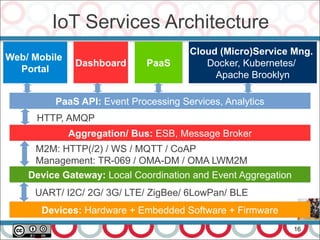
IoT Services Architecture
16
Devices: Hardware + Embedded Software + Firmware
UART/ I2C/ 2G/ 3G/ LTE/ ZigBee/ 6LowPan/ BLE
Aggregation/ Bus: ESB, Message Broker
Device Gateway: Local Coordination and Event Aggregation
M2M: HTTP(/2) / WS / MQTT / CoAP
Management: TR-069 / OMA-DM / OMA LWM2M
HTTP, AMQP
Cloud (Micro)Service Mng.
Docker, Kubernetes/
Apache Brooklyn
Web/ Mobile
Portal
PaaSDashboard
PaaS API: Event Processing Services, Analytics
Tracking Complexity
17
We need tools to cope with all that complexity inherent in
robotics and IoT domains.
Simple solutions are needed – cope with problems through
divide and concur on different levels of abstraction:
Domain Driven Design (DDD) – back to basics:
domain objects, data and logic.
Described by Eric Evans in his book:
Domain Driven Design: Tackling Complexity in the Heart of
Software, 2004
Common Sense: DDD
18
Actually DDD require additional efforts (as most other
divide and concur modeling approaches :)
 Ubiquitous language and Bounded Contexts
 DDD Application Layers:
Infrastructure, Domain, Application, Presentation
 Hexagonal architecture :
OUTSIDE <-> transformer <-> ( application <-> domain )
[A. Cockburn]
Common Sense: DDD
19
Main concepts:
 Entities, value objects and modules
 Aggregates and Aggregate Roots [Haywood]:
value < entity < aggregate < module < BC
 Repositories, Factories and Services:
application services <-> domain services
 Separating interface from implementation
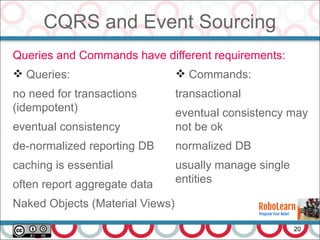
CQRS and Event Sourcing
20
Queries and Commands have different requirements:
 Queries:
no need for transactions
(idempotent)
eventual consistency
de-normalized reporting DB
caching is essential
often report aggregate data
Naked Objects (Material Views)
 Commands:
transactional
eventual consistency may
not be ok
normalized DB
usually manage single
entities
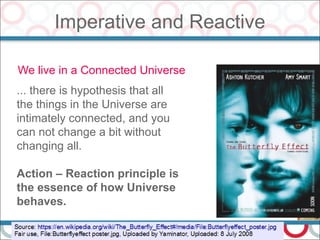
Imperative and Reactive
21
We live in a Connected Universe
... there is hypothesis that all
the things in the Universe are
intimately connected, and you
can not change a bit without
changing all.
Action – Reaction principle is
the essence of how Universe
behaves.
Imperative and Reactive
 Reactive Programming: using static or dynamic data
flows and propagation of change
Example: a := b + c
 Functional Programming: evaluation of mathematical
functions,
➢ Avoids changing-state and mutable data, declarative
programming
➢ Side effects free => much easier to understand and
predict the program behavior.
Example: books.stream().filter(book -> book.getYear() > 2010)
.forEach( System.out::println )
Functional Reactive (FRP)
23
According to Connal Elliot's (ground-breaking paper @
Conference on Functional Programming, 1997), FRP is:
(a) Denotative
(b) Temporally continuous
Reactive Manifesto
24
[http://www.reactivemanifesto.org]
Reactive Programming
25
 Microsoft®
opens source polyglot project ReactiveX
(Reactive Extensions) [http://reactivex.io]:
Rx = Observables + LINQ + Schedulers :)
Java: RxJava, JavaScript: RxJS, C#: Rx.NET, Scala: RxScala,
Clojure: RxClojure, C++: RxCpp, Ruby: Rx.rb, Python: RxPY,
Groovy: RxGroovy, JRuby: RxJRuby, Kotlin: RxKotlin ...
 Reactive Streams Specification
[http://www.reactive-streams.org/] used by
 (Spring) Project Reactor
[http://projectreactor.io/]
Reactive Streams Spec.
26
 Reactive Streams – provides standard for
asynchronous stream processing with non-blocking
back pressure.
 Minimal set of interfaces, methods and protocols for
asynchronous data streams
 April 30, 2015: has been released version 1.0.0 of
Reactive Streams for the JVM (Java API,
Specification, TCK and implementation examples)
 Java 9: java.util.concurrent.Flow
Reactive Streams Spec.
27
 Publisher – provider of potentially unbounded number
of sequenced elements, according to Subscriber(s)
demand.
Publisher.subscribe(Subscriber) => onSubscribe onNext*
(onError | onComplete)?
 Subscriber – calls Subscription.request(long) to
receive notifications
 Subscription – one-to-one Subscriber ↔ Publisher,
request data and cancel demand (allow cleanup).
 Processor = Subscriber + Publisher
FRP = Async Data Streams
28
 FRP is asynchronous data-flow programming using the
building blocks of functional programming (e.g. map,
reduce, filter) and explicitly modeling time
 Used for GUIs, robotics, and music. Example (RxJava):
Observable.from(new String[]{"Reactive",
"Extensions", "Java"})
.take(2).map(s -> s + " : on " + new Date())
.subscribe(s -> System.out.println(s));
Result:
Reactive : on Wed Jun 17 21:54:02 GMT+02:00 2015
Extensions : on Wed Jun 17 21:54:02 GMT+02:00 2015
Project Reactor
29
 Reactor project allows building high-performance (low
latency high throughput) non-blocking asynchronous
applications on JVM.
 Reactor is designed to be extraordinarily fast and can
sustain throughput rates on order of 10's of millions of
operations per second.
 Reactor has powerful API for declaring data
transformations and functional composition.
 Makes use of the concept of Mechanical Sympathy
built on top of Disruptor / RingBuffer.
Project Reactor
30
 Pre-allocation at startup-time
 Message-passing structures are bounded
 Using Reactive and Event-Driven Architecture patterns
=> non-blocking end-to-end flows, replies
 Implement Reactive Streams Specification – efficient
bounded structures requesting no more than capacity
 Applies above features to IPC and provides non-
blocking IO drivers that are flow-control aware
 Expose a Functional API – organize their code in a
side-effect free way, which helps you determine you are
thread-safe and fault-tolerant
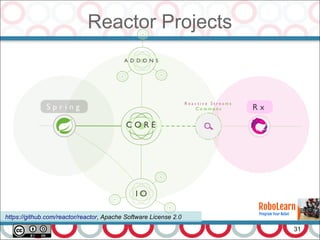
Reactor Projects
31
https://github.com/reactor/reactor, Apache Software License 2.0
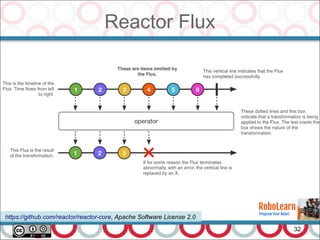
Reactor Flux
32
https://github.com/reactor/reactor-core, Apache Software License 2.0
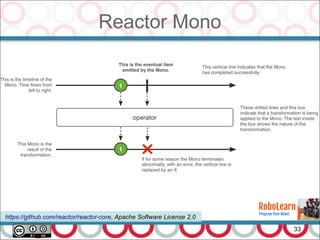
Reactor Mono
33
https://github.com/reactor/reactor-core, Apache Software License 2.0
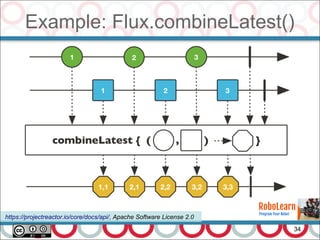
Example: Flux.combineLatest()
34
https://projectreactor.io/core/docs/api/, Apache Software License 2.0
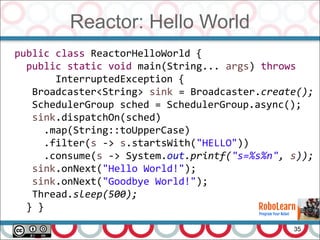
Reactor: Hello World
35
public class ReactorHelloWorld {
public static void main(String... args) throws
InterruptedException {
Broadcaster<String> sink = Broadcaster.create();
SchedulerGroup sched = SchedulerGroup.async();
sink.dispatchOn(sched)
.map(String::toUpperCase)
.filter(s -> s.startsWith("HELLO"))
.consume(s -> System.out.printf("s=%s%n", s));
sink.onNext("Hello World!");
sink.onNext("Goodbye World!");
Thread.sleep(500);
} }
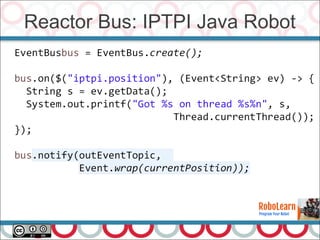
Reactor Bus: IPTPI Java Robot
36
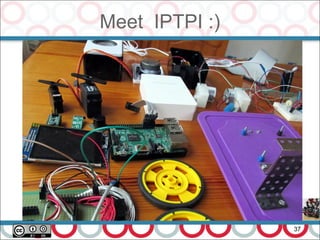
37
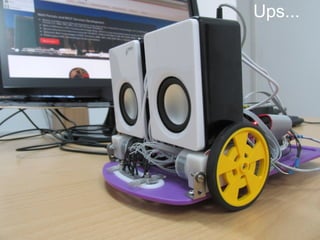
Meet IPTPI :)
38
Ups...
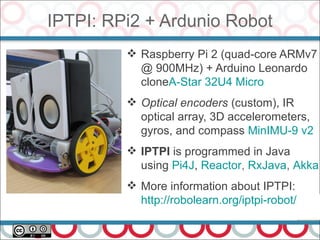
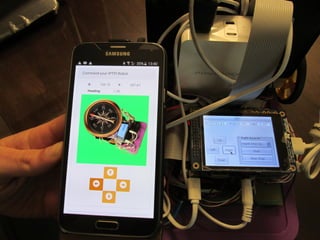
IPTPI: RPi2 + Ardunio Robot
39
 Raspberry Pi 2 (quad-core ARMv7
@ 900MHz) + Arduino Leonardo
cloneA-Star 32U4 Micro
 Optical encoders (custom), IR
optical array, 3D accelerometers,
gyros, and compass MinIMU-9 v2
 IPTPI is programmed in Java
using Pi4J, Reactor, RxJava, Akka
 More information about IPTPI:
http://robolearn.org/iptpi-robot/
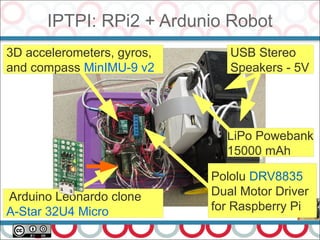
IPTPI: RPi2 + Ardunio Robot
40
3D accelerometers, gyros,
and compass MinIMU-9 v2
Pololu DRV8835
Dual Motor Driver
for Raspberry Pi
Arduino Leonardo clone
A-Star 32U4 Micro
USB Stereo
Speakers - 5V
LiPo Powebank
15000 mAh
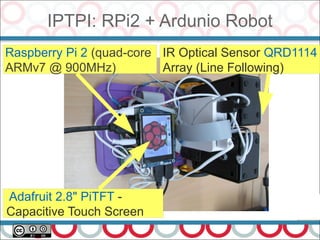
IPTPI: RPi2 + Ardunio Robot
41
Raspberry Pi 2 (quad-core
ARMv7 @ 900MHz)
IR Optical Sensor QRD1114
Array (Line Following)
Adafruit 2.8" PiTFT -
Capacitive Touch Screen
42
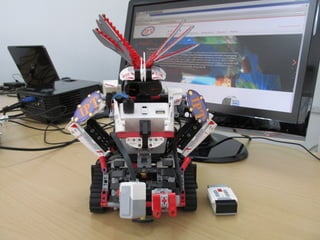
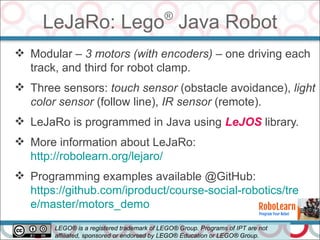
LeJaRo: Lego®
Java Robot
43
 Modular – 3 motors (with encoders) – one driving each
track, and third for robot clamp.
 Three sensors: touch sensor (obstacle avoidance), light
color sensor (follow line), IR sensor (remote).
 LeJaRo is programmed in Java using LeJOS library.
 More information about LeJaRo:
http://robolearn.org/lejaro/
 Programming examples available @GitHub:
https://github.com/iproduct/course-social-robotics/tre
e/master/motors_demo
LEGO® is a registered trademark of LEGO® Group. Programs of IPT are not
affiliated, sponsored or endorsed by LEGO® Education or LEGO® Group.
Tale of Simplicity: DDD
44
Let's See Some Real Code 
45
jPrime Demo code is available @ GitHub:
https://github.com/iproduct/jprime-demo
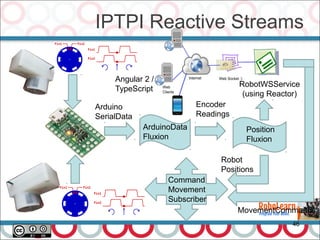
IPTPI Reactive Streams
46
Encoder
Readings
ArduinoData
Fluxion
Arduino
SerialData
Position
Fluxion
Robot
Positions
Command
Movement
Subscriber
RobotWSService
(using Reactor)
Angular 2 /
TypeScript
MovementCommands
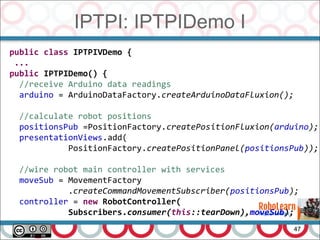
IPTPI: IPTPIDemo I
47
public class IPTPIVDemo {
...
public IPTPIDemo() {
//receive Arduino data readings
arduino = ArduinoDataFactory.createArduinoDataFluxion();
//calculate robot positions
positionsPub =PositionFactory.createPositionFluxion(arduino);
presentationViews.add(
PositionFactory.createPositionPanel(positionsPub));
//wire robot main controller with services
moveSub = MovementFactory
.createCommandMovementSubscriber(positionsPub);
controller = new RobotController(
Subscribers.consumer(this::tearDown),moveSub);
IPTPI: IPTPIDemo II
48
//create view with controller and delegate material views
//from query services
view = new RobotView("IPTPI Reactive Robotics Demo",
controller, presentationViews);
//expose as WS service
movementSub2 = MovementFactory
.createCommandMovementSubscriber(positionsPub);
positionsService =
new RobotWSService(positionsPub, movementSub2);
}
public static void main(String[] args) {
IPTPIVoxxedDemo demo = new IPTPIVoxxedDemo();
}
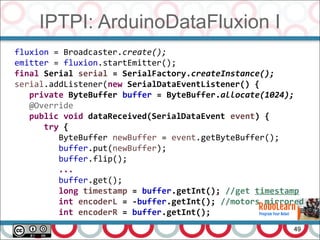
IPTPI: ArduinoDataFluxion I
49
fluxion = Broadcaster.create();
emitter = fluxion.startEmitter();
final Serial serial = SerialFactory.createInstance();
serial.addListener(new SerialDataEventListener() {
private ByteBuffer buffer = ByteBuffer.allocate(1024);
@Override
public void dataReceived(SerialDataEvent event) {
try {
ByteBuffer newBuffer = event.getByteBuffer();
buffer.put(newBuffer);
buffer.flip();
...
buffer.get();
long timestamp = buffer.getInt(); //get timestamp
int encoderL = -buffer.getInt(); //motors mirrored
int encoderR = buffer.getInt();
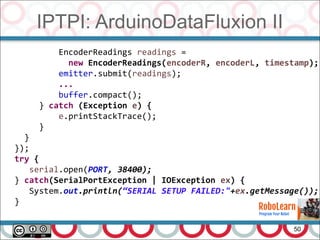
IPTPI: ArduinoDataFluxion II
50
EncoderReadings readings =
new EncoderReadings(encoderR, encoderL, timestamp);
emitter.submit(readings);
...
buffer.compact();
} catch (Exception e) {
e.printStackTrace();
}
}
});
try {
serial.open(PORT, 38400);
} catch(SerialPortException | IOException ex) {
System.out.println(“SERIAL SETUP FAILED:"+ex.getMessage());
}
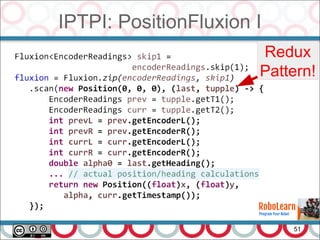
IPTPI: PositionFluxion I
51
Redux
Pattern!
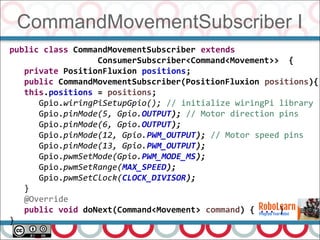
CommandMovementSubscriber I
52
public class CommandMovementSubscriber extends
ConsumerSubscriber<Command<Movement>> {
private PositionFluxion positions;
public CommandMovementSubscriber(PositionFluxion positions){
this.positions = positions;
Gpio.wiringPiSetupGpio(); // initialize wiringPi library
Gpio.pinMode(5, Gpio.OUTPUT); // Motor direction pins
Gpio.pinMode(6, Gpio.OUTPUT);
Gpio.pinMode(12, Gpio.PWM_OUTPUT); // Motor speed pins
Gpio.pinMode(13, Gpio.PWM_OUTPUT);
Gpio.pwmSetMode(Gpio.PWM_MODE_MS);
Gpio.pwmSetRange(MAX_SPEED);
Gpio.pwmSetClock(CLOCK_DIVISOR);
}
@Override
public void doNext(Command<Movement> command) { ... }
}
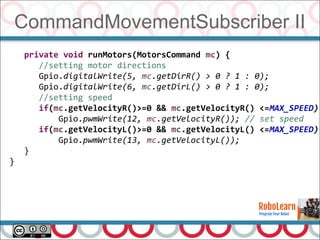
CommandMovementSubscriber II
53
private void runMotors(MotorsCommand mc) {
//setting motor directions
Gpio.digitalWrite(5, mc.getDirR() > 0 ? 1 : 0);
Gpio.digitalWrite(6, mc.getDirL() > 0 ? 1 : 0);
//setting speed
if(mc.getVelocityR()>=0 && mc.getVelocityR() <=MAX_SPEED)
Gpio.pwmWrite(12, mc.getVelocityR()); // set speed
if(mc.getVelocityL()>=0 && mc.getVelocityL() <=MAX_SPEED)
Gpio.pwmWrite(13, mc.getVelocityL());
}
}
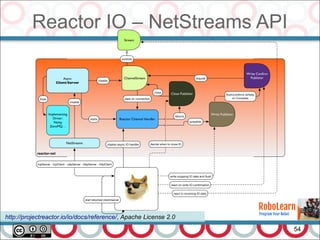
Reactor IO – NetStreams API
54
http://projectreactor.io/io/docs/reference/, Apache License 2.0
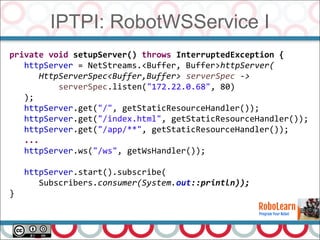
IPTPI: RobotWSService I
55
private void setupServer() throws InterruptedException {
httpServer = NetStreams.<Buffer, Buffer>httpServer(
HttpServerSpec<Buffer,Buffer> serverSpec ->
serverSpec.listen("172.22.0.68", 80)
);
httpServer.get("/", getStaticResourceHandler());
httpServer.get("/index.html", getStaticResourceHandler());
httpServer.get("/app/**", getStaticResourceHandler());
...
httpServer.ws("/ws", getWsHandler());
httpServer.start().subscribe(
Subscribers.consumer(System.out::println));
}
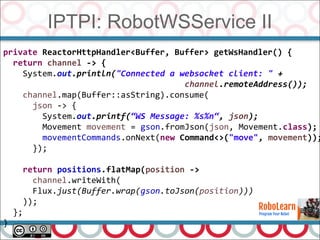
IPTPI: RobotWSService II
56
private ReactorHttpHandler<Buffer, Buffer> getWsHandler() {
return channel -> {
System.out.println("Connected a websocket client: " +
channel.remoteAddress());
channel.map(Buffer::asString).consume(
json -> {
System.out.printf(“WS Message: %s%n“, json);
Movement movement = gson.fromJson(json, Movement.class);
movementCommands.onNext(new Command<>("move", movement));
});
return positions.flatMap(position ->
channel.writeWith(
Flux.just(Buffer.wrap(gson.toJson(position)))
));
};
}
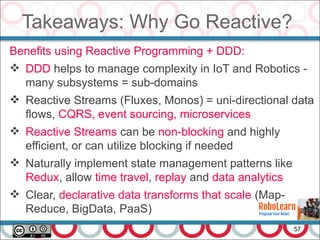
Takeaways: Why Go Reactive?
57
Benefits using Reactive Programming + DDD:
 DDD helps to manage complexity in IoT and Robotics -
many subsystems = sub-domains
 Reactive Streams (Fluxes, Monos) = uni-directional data
flows, CQRS, event sourcing, microservices
 Reactive Streams can be non-blocking and highly
efficient, or can utilize blocking if needed
 Naturally implement state management patterns like
Redux, allow time travel, replay and data analytics
 Clear, declarative data transforms that scale (Map-
Reduce, BigData, PaaS)
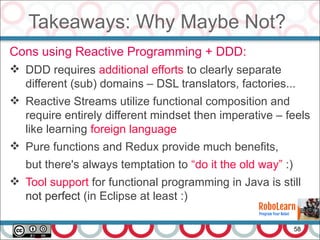
Takeaways: Why Maybe Not?
58
Cons using Reactive Programming + DDD:
 DDD requires additional efforts to clearly separate
different (sub) domains – DSL translators, factories...
 Reactive Streams utilize functional composition and
require entirely different mindset then imperative – feels
like learning foreign language
 Pure functions and Redux provide much benefits,
but there's always temptation to “do it the old way” :)
 Tool support for functional programming in Java is still
not perfect (in Eclipse at least :)
Additional Resources
59
IPT Reactive Java/JS/Typescript and Angular 2 courses:
http://iproduct.org
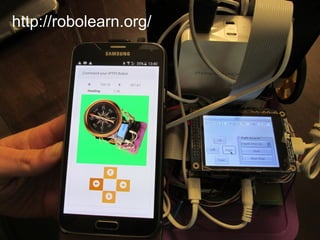
More information about robots @RoboLearn:
http://robolearn.org/
Lots of Java robotics and IoT resources @Social Robotics
Course GitHub Wiki:
https://github.com/iproduct/course-social-
robotics/wiki/Lectures
Tale of Simplicity: DDD
60
http://robolearn.org/
Interested in Reactive Java?
61
Meet Us @ Java & FOSS Conferences:
 BG Oracle®
User Group Conference –
3-5 June in Hotel Rila, Borovetz
[http://www.bgoug.org/bg/events/details/96.html]
 TuxCon – 9-10 July, Plovdiv
[http://tuxcon.mobi/]
Thank’s for Your Attention!
62
Trayan Iliev
CEO of IPT – Intellectual Products
& Technologies
http://iproduct.org/
http://robolearn.org/
https://github.com/iproduct
https://twitter.com/trayaniliev
https://www.facebook.com/IPT.EACAD
https://plus.google.com/+IproductOrg

Reactive Java Robotics IoT - jPrime 2016

  • 1.
    Trayan Iliev CEO ofIPT – Intellectual Products & Technologies tiliev@iproduct.org http://iproduct.org jPrime Conference May 26-27 ‘16, Sofia Reactive Java Robotics and IoT
  • 2.
    IPT – IntellectualProducts & Technologies: IT Education Evolved 2 Since 2003 we SHARE practical tech knowledge and skills in Java SE/ EE/ Web/ JS/ Angular / React / TS: Java EE/Web, JSF 2, Portlets, Portals: Liferay, GateIn Reactive IoT with Reactor / RxJava / RxJS Angular 2 + Ionic 2+ TypeScript web/mobile client MV* frameworks REST HATEOAS – Distributed Hypermedia APIs Domain Driven Design, Reactive Microservices and Event Sourcing Oracle® & Java™ are (registered) trademarks of Oracle and/or its affiliates. Liferay® is registered trademark of Liferay, Inc. Other names may be trademarks of their respective owners.
  • 3.
    Tales of JAVARobotics 3 There are so many tales to share: Tale of Robotics, IoT and Complexity Tale of Common Sense: DDD Tale of Segregation between Queries and Commands, and ultimate Event Sourcing  Tale of two cities - Imperative and Reactive  Tale of two brave robots: LeJaRo and IPTPI  And a lot of real reactive Java + TypeScript / Angular 2 / WebSocket code 
  • 4.
    Robots Can BeComplex 4
  • 5.
    … Even MoreComplex 5 Cross-section of many disciplines:  mechanical engineering  electrical engineering  computer science  artificial intelligence (AI)  human-computer interaction  sociology & psychology Picture by Hugo Elias of the Shadow Robot Company - http://www.shadowrobot.com/media/pictures.shtml, CC BY-SA 3.0
  • 6.
    They Can BeSocial :) 6 Left image: CC BY-SA 2.5, https://commons.wikimedia.org/w/index.php?curid=374949 Right image: https://commons.wikimedia.org/w/index.php?curid=1485971
  • 7.
    Engineering, Science &Art 7 Source: https://commons.wikimedia.org/w/index.php?curid=551256, CC BY-SA 3.0
  • 8.
    Lonely Riders DrivingBy Their Own 8 Source: https://commons.wikimedia.org/w/index.php?curid=1822443, CC BY-SA 3.0
  • 9.
    and How CanWe Forget 9 Source: https://commons.wikimedia.org/ w/index.php?curid=234900, CC BY-SA 3.0 Source: Korea Institute of Industrial Technology, http://news.naver.com/main/read.nhn? mode=LSD&mid=sec&sid1=102&oid=020&aid=0000371339
  • 10.
    Intelligent Agents 10 Characteristics:  Autonomous Reactive  Proactive  Social - ACLs  Adaptive (learning)  Personality  Mobility Left image:https://commons.wikimedia.org/w/index.php?curid=915484, Right image: https://commons.wikimedia.org/w/index.php?curid=1924396,
  • 11.
    Robots: The MostIntelligent Things 11 CC BY 2.0, Source: https://www.flickr.com/photos/wilgengebroed/8249565455/ Radar, GPS, lidar for navigation and obstacle avoidance ( 2007 DARPA Urban Challenge )
  • 12.
    The Internet ofThings has the potential to change the world, just as the Internet did. Maybe even more so.  Nearly 50 petabytes of data are captured and created by human beings  People have limited time, attention and accuracy  Capturing data about things in the real world in real time  Track and count everything, reduce waste, loss & cost.  Know when things need replacing, repairing or recalling — Kevin Ashton, 'That 'Internet of Things' Thing', RFID Journal, 2009 Internet of Things (IoT)
  • 13.
     There willbe nearly 26 billion devices on the Internet of Things by 2020. [Gartner]  More than 30 billion devices will be wirelessly connected to the Internet of Things by 2020 [ABI Research]  It's expected to be a 19 Trillion USD market [John Chambers, Cisco CEO] IoT Perspectives
  • 14.
    "Basket of remotes"problem – we'll have hundreds of applications to interface with hundreds of devices that don't share protocols for speaking with one another [Jean-Louis Gassée, Apple initial team, and BeOS co-founder] Only IPv6 addresses are not enough – IoT devices should be also easily and directly accessible for users and [their] agents In read/write mode Preferably using a standard web browser Even behind firewalls IoT - Need for Standards
  • 15.
    • Proxies: HTTPCONNECT – Tunnelling • HTTP/S can be used WebSockets over SSL (wss:// scheme) Bidirectional IoT – WS, HTTP/2
  • 16.
    IoT Services Architecture 16 Devices:Hardware + Embedded Software + Firmware UART/ I2C/ 2G/ 3G/ LTE/ ZigBee/ 6LowPan/ BLE Aggregation/ Bus: ESB, Message Broker Device Gateway: Local Coordination and Event Aggregation M2M: HTTP(/2) / WS / MQTT / CoAP Management: TR-069 / OMA-DM / OMA LWM2M HTTP, AMQP Cloud (Micro)Service Mng. Docker, Kubernetes/ Apache Brooklyn Web/ Mobile Portal PaaSDashboard PaaS API: Event Processing Services, Analytics
  • 17.
    Tracking Complexity 17 We needtools to cope with all that complexity inherent in robotics and IoT domains. Simple solutions are needed – cope with problems through divide and concur on different levels of abstraction: Domain Driven Design (DDD) – back to basics: domain objects, data and logic. Described by Eric Evans in his book: Domain Driven Design: Tackling Complexity in the Heart of Software, 2004
  • 18.
    Common Sense: DDD 18 ActuallyDDD require additional efforts (as most other divide and concur modeling approaches :)  Ubiquitous language and Bounded Contexts  DDD Application Layers: Infrastructure, Domain, Application, Presentation  Hexagonal architecture : OUTSIDE <-> transformer <-> ( application <-> domain ) [A. Cockburn]
  • 19.
    Common Sense: DDD 19 Mainconcepts:  Entities, value objects and modules  Aggregates and Aggregate Roots [Haywood]: value < entity < aggregate < module < BC  Repositories, Factories and Services: application services <-> domain services  Separating interface from implementation
  • 20.
    CQRS and EventSourcing 20 Queries and Commands have different requirements:  Queries: no need for transactions (idempotent) eventual consistency de-normalized reporting DB caching is essential often report aggregate data Naked Objects (Material Views)  Commands: transactional eventual consistency may not be ok normalized DB usually manage single entities
  • 21.
    Imperative and Reactive 21 Welive in a Connected Universe ... there is hypothesis that all the things in the Universe are intimately connected, and you can not change a bit without changing all. Action – Reaction principle is the essence of how Universe behaves.
  • 22.
    Imperative and Reactive Reactive Programming: using static or dynamic data flows and propagation of change Example: a := b + c  Functional Programming: evaluation of mathematical functions, ➢ Avoids changing-state and mutable data, declarative programming ➢ Side effects free => much easier to understand and predict the program behavior. Example: books.stream().filter(book -> book.getYear() > 2010) .forEach( System.out::println )
  • 23.
    Functional Reactive (FRP) 23 Accordingto Connal Elliot's (ground-breaking paper @ Conference on Functional Programming, 1997), FRP is: (a) Denotative (b) Temporally continuous
  • 24.
  • 25.
    Reactive Programming 25  Microsoft® openssource polyglot project ReactiveX (Reactive Extensions) [http://reactivex.io]: Rx = Observables + LINQ + Schedulers :) Java: RxJava, JavaScript: RxJS, C#: Rx.NET, Scala: RxScala, Clojure: RxClojure, C++: RxCpp, Ruby: Rx.rb, Python: RxPY, Groovy: RxGroovy, JRuby: RxJRuby, Kotlin: RxKotlin ...  Reactive Streams Specification [http://www.reactive-streams.org/] used by  (Spring) Project Reactor [http://projectreactor.io/]
  • 26.
    Reactive Streams Spec. 26 Reactive Streams – provides standard for asynchronous stream processing with non-blocking back pressure.  Minimal set of interfaces, methods and protocols for asynchronous data streams  April 30, 2015: has been released version 1.0.0 of Reactive Streams for the JVM (Java API, Specification, TCK and implementation examples)  Java 9: java.util.concurrent.Flow
  • 27.
    Reactive Streams Spec. 27 Publisher – provider of potentially unbounded number of sequenced elements, according to Subscriber(s) demand. Publisher.subscribe(Subscriber) => onSubscribe onNext* (onError | onComplete)?  Subscriber – calls Subscription.request(long) to receive notifications  Subscription – one-to-one Subscriber ↔ Publisher, request data and cancel demand (allow cleanup).  Processor = Subscriber + Publisher
  • 28.
    FRP = AsyncData Streams 28  FRP is asynchronous data-flow programming using the building blocks of functional programming (e.g. map, reduce, filter) and explicitly modeling time  Used for GUIs, robotics, and music. Example (RxJava): Observable.from(new String[]{"Reactive", "Extensions", "Java"}) .take(2).map(s -> s + " : on " + new Date()) .subscribe(s -> System.out.println(s)); Result: Reactive : on Wed Jun 17 21:54:02 GMT+02:00 2015 Extensions : on Wed Jun 17 21:54:02 GMT+02:00 2015
  • 29.
    Project Reactor 29  Reactorproject allows building high-performance (low latency high throughput) non-blocking asynchronous applications on JVM.  Reactor is designed to be extraordinarily fast and can sustain throughput rates on order of 10's of millions of operations per second.  Reactor has powerful API for declaring data transformations and functional composition.  Makes use of the concept of Mechanical Sympathy built on top of Disruptor / RingBuffer.
  • 30.
    Project Reactor 30  Pre-allocationat startup-time  Message-passing structures are bounded  Using Reactive and Event-Driven Architecture patterns => non-blocking end-to-end flows, replies  Implement Reactive Streams Specification – efficient bounded structures requesting no more than capacity  Applies above features to IPC and provides non- blocking IO drivers that are flow-control aware  Expose a Functional API – organize their code in a side-effect free way, which helps you determine you are thread-safe and fault-tolerant
  • 31.
  • 32.
  • 33.
  • 34.
  • 35.
    Reactor: Hello World 35 publicclass ReactorHelloWorld { public static void main(String... args) throws InterruptedException { Broadcaster<String> sink = Broadcaster.create(); SchedulerGroup sched = SchedulerGroup.async(); sink.dispatchOn(sched) .map(String::toUpperCase) .filter(s -> s.startsWith("HELLO")) .consume(s -> System.out.printf("s=%s%n", s)); sink.onNext("Hello World!"); sink.onNext("Goodbye World!"); Thread.sleep(500); } }
  • 36.
    Reactor Bus: IPTPIJava Robot 36
  • 37.
  • 38.
  • 39.
    IPTPI: RPi2 +Ardunio Robot 39  Raspberry Pi 2 (quad-core ARMv7 @ 900MHz) + Arduino Leonardo cloneA-Star 32U4 Micro  Optical encoders (custom), IR optical array, 3D accelerometers, gyros, and compass MinIMU-9 v2  IPTPI is programmed in Java using Pi4J, Reactor, RxJava, Akka  More information about IPTPI: http://robolearn.org/iptpi-robot/
  • 40.
    IPTPI: RPi2 +Ardunio Robot 40 3D accelerometers, gyros, and compass MinIMU-9 v2 Pololu DRV8835 Dual Motor Driver for Raspberry Pi Arduino Leonardo clone A-Star 32U4 Micro USB Stereo Speakers - 5V LiPo Powebank 15000 mAh
  • 41.
    IPTPI: RPi2 +Ardunio Robot 41 Raspberry Pi 2 (quad-core ARMv7 @ 900MHz) IR Optical Sensor QRD1114 Array (Line Following) Adafruit 2.8" PiTFT - Capacitive Touch Screen
  • 42.
  • 43.
    LeJaRo: Lego® Java Robot 43 Modular – 3 motors (with encoders) – one driving each track, and third for robot clamp.  Three sensors: touch sensor (obstacle avoidance), light color sensor (follow line), IR sensor (remote).  LeJaRo is programmed in Java using LeJOS library.  More information about LeJaRo: http://robolearn.org/lejaro/  Programming examples available @GitHub: https://github.com/iproduct/course-social-robotics/tre e/master/motors_demo LEGO® is a registered trademark of LEGO® Group. Programs of IPT are not affiliated, sponsored or endorsed by LEGO® Education or LEGO® Group.
  • 44.
  • 45.
    Let's See SomeReal Code  45 jPrime Demo code is available @ GitHub: https://github.com/iproduct/jprime-demo
  • 46.
  • 47.
    IPTPI: IPTPIDemo I 47 publicclass IPTPIVDemo { ... public IPTPIDemo() { //receive Arduino data readings arduino = ArduinoDataFactory.createArduinoDataFluxion(); //calculate robot positions positionsPub =PositionFactory.createPositionFluxion(arduino); presentationViews.add( PositionFactory.createPositionPanel(positionsPub)); //wire robot main controller with services moveSub = MovementFactory .createCommandMovementSubscriber(positionsPub); controller = new RobotController( Subscribers.consumer(this::tearDown),moveSub);
  • 48.
    IPTPI: IPTPIDemo II 48 //createview with controller and delegate material views //from query services view = new RobotView("IPTPI Reactive Robotics Demo", controller, presentationViews); //expose as WS service movementSub2 = MovementFactory .createCommandMovementSubscriber(positionsPub); positionsService = new RobotWSService(positionsPub, movementSub2); } public static void main(String[] args) { IPTPIVoxxedDemo demo = new IPTPIVoxxedDemo(); }
  • 49.
    IPTPI: ArduinoDataFluxion I 49 fluxion= Broadcaster.create(); emitter = fluxion.startEmitter(); final Serial serial = SerialFactory.createInstance(); serial.addListener(new SerialDataEventListener() { private ByteBuffer buffer = ByteBuffer.allocate(1024); @Override public void dataReceived(SerialDataEvent event) { try { ByteBuffer newBuffer = event.getByteBuffer(); buffer.put(newBuffer); buffer.flip(); ... buffer.get(); long timestamp = buffer.getInt(); //get timestamp int encoderL = -buffer.getInt(); //motors mirrored int encoderR = buffer.getInt();
  • 50.
    IPTPI: ArduinoDataFluxion II 50 EncoderReadingsreadings = new EncoderReadings(encoderR, encoderL, timestamp); emitter.submit(readings); ... buffer.compact(); } catch (Exception e) { e.printStackTrace(); } } }); try { serial.open(PORT, 38400); } catch(SerialPortException | IOException ex) { System.out.println(“SERIAL SETUP FAILED:"+ex.getMessage()); }
  • 51.
  • 52.
    CommandMovementSubscriber I 52 public classCommandMovementSubscriber extends ConsumerSubscriber<Command<Movement>> { private PositionFluxion positions; public CommandMovementSubscriber(PositionFluxion positions){ this.positions = positions; Gpio.wiringPiSetupGpio(); // initialize wiringPi library Gpio.pinMode(5, Gpio.OUTPUT); // Motor direction pins Gpio.pinMode(6, Gpio.OUTPUT); Gpio.pinMode(12, Gpio.PWM_OUTPUT); // Motor speed pins Gpio.pinMode(13, Gpio.PWM_OUTPUT); Gpio.pwmSetMode(Gpio.PWM_MODE_MS); Gpio.pwmSetRange(MAX_SPEED); Gpio.pwmSetClock(CLOCK_DIVISOR); } @Override public void doNext(Command<Movement> command) { ... } }
  • 53.
    CommandMovementSubscriber II 53 private voidrunMotors(MotorsCommand mc) { //setting motor directions Gpio.digitalWrite(5, mc.getDirR() > 0 ? 1 : 0); Gpio.digitalWrite(6, mc.getDirL() > 0 ? 1 : 0); //setting speed if(mc.getVelocityR()>=0 && mc.getVelocityR() <=MAX_SPEED) Gpio.pwmWrite(12, mc.getVelocityR()); // set speed if(mc.getVelocityL()>=0 && mc.getVelocityL() <=MAX_SPEED) Gpio.pwmWrite(13, mc.getVelocityL()); } }
  • 54.
    Reactor IO –NetStreams API 54 http://projectreactor.io/io/docs/reference/, Apache License 2.0
  • 55.
    IPTPI: RobotWSService I 55 privatevoid setupServer() throws InterruptedException { httpServer = NetStreams.<Buffer, Buffer>httpServer( HttpServerSpec<Buffer,Buffer> serverSpec -> serverSpec.listen("172.22.0.68", 80) ); httpServer.get("/", getStaticResourceHandler()); httpServer.get("/index.html", getStaticResourceHandler()); httpServer.get("/app/**", getStaticResourceHandler()); ... httpServer.ws("/ws", getWsHandler()); httpServer.start().subscribe( Subscribers.consumer(System.out::println)); }
  • 56.
    IPTPI: RobotWSService II 56 privateReactorHttpHandler<Buffer, Buffer> getWsHandler() { return channel -> { System.out.println("Connected a websocket client: " + channel.remoteAddress()); channel.map(Buffer::asString).consume( json -> { System.out.printf(“WS Message: %s%n“, json); Movement movement = gson.fromJson(json, Movement.class); movementCommands.onNext(new Command<>("move", movement)); }); return positions.flatMap(position -> channel.writeWith( Flux.just(Buffer.wrap(gson.toJson(position))) )); }; }
  • 57.
    Takeaways: Why GoReactive? 57 Benefits using Reactive Programming + DDD:  DDD helps to manage complexity in IoT and Robotics - many subsystems = sub-domains  Reactive Streams (Fluxes, Monos) = uni-directional data flows, CQRS, event sourcing, microservices  Reactive Streams can be non-blocking and highly efficient, or can utilize blocking if needed  Naturally implement state management patterns like Redux, allow time travel, replay and data analytics  Clear, declarative data transforms that scale (Map- Reduce, BigData, PaaS)
  • 58.
    Takeaways: Why MaybeNot? 58 Cons using Reactive Programming + DDD:  DDD requires additional efforts to clearly separate different (sub) domains – DSL translators, factories...  Reactive Streams utilize functional composition and require entirely different mindset then imperative – feels like learning foreign language  Pure functions and Redux provide much benefits, but there's always temptation to “do it the old way” :)  Tool support for functional programming in Java is still not perfect (in Eclipse at least :)
  • 59.
    Additional Resources 59 IPT ReactiveJava/JS/Typescript and Angular 2 courses: http://iproduct.org More information about robots @RoboLearn: http://robolearn.org/ Lots of Java robotics and IoT resources @Social Robotics Course GitHub Wiki: https://github.com/iproduct/course-social- robotics/wiki/Lectures
  • 60.
    Tale of Simplicity:DDD 60 http://robolearn.org/
  • 61.
    Interested in ReactiveJava? 61 Meet Us @ Java & FOSS Conferences:  BG Oracle® User Group Conference – 3-5 June in Hotel Rila, Borovetz [http://www.bgoug.org/bg/events/details/96.html]  TuxCon – 9-10 July, Plovdiv [http://tuxcon.mobi/]
  • 62.
    Thank’s for YourAttention! 62 Trayan Iliev CEO of IPT – Intellectual Products & Technologies http://iproduct.org/ http://robolearn.org/ https://github.com/iproduct https://twitter.com/trayaniliev https://www.facebook.com/IPT.EACAD https://plus.google.com/+IproductOrg