MINOR TRAINING REPORT
ON
PRODUCTION TECHNOLOGY
SUBMITTED TO :- SUBMITTED BY:-
Mr GYAAN RATAN HIRKANE Milind Waikar
Rajnish gavhade
MECH DEPT.
CONTENTS
 WHAT IS CIPET?
 SUB DIVSIONS OF PRODUCTION
UNIT CELL
 - MATERIAL SELECTION CELL
 - TESTING DEPARTMENT
 - DESIGNING DEPARTMENT
 - MANUFACTURING DEPARTMENT
ACKNOWLEDGEMENT
I express my sincere gratitude to your
honorable HOD Mr. Prabhash Jain sir, under
whose inspiration and valuable guidance I
could undertake this project. I am equally
grateful to our teacher Mr. Gyaan Sir under
whose proficient and able supervision this
project could be brought to maturity. He
made me realize that things can be done in
limited resources and time.
Last but not the least my
sincere thanks goes to my parents and all my
colleagues and well wishes whose Constant
encouragement kept me busy throughout this
job.
INTRODUCTION
 PRODUCTION TECHNOLOGY, is a process unit cell.
 It is a main base of any industry.
 In it analytical study of a product is done so as to find
its merits and demerits and then permit it to the mass
production.
 A production unit cell is sub divided into 4 sections
as
 MATERIAL SELECTION DEPARTMENT
 TESTING DEPARTMENT
 DESIGNING DEPARTMENT
 PRODUCTION CELL
MATERIAL SELECTION
DEPARTMENT
 The commonly used engineering materials for manufacturing are:-
1} METALS AND ALLOYS
2} PLASTICS
 1} METALS AND ALLOYS- The metals and alloys are further
classified as:-
A} Ferrous metals and alloys
B} Nonferrous metals and alloys
 2} PLASTICS- Plastics are organic substances or resins, usually
containing oxygen, carbon, hydrogen, nitrogen and some other
elements. These organic compounds are called polymers. A plastic
is usually divided into two groups.
1} Thermoplastic
2} Thermosetting plastic
TESTING DEPARTMENT
 In the TESTING CELL different types of tests is
performed on the material so as to check its
mechanical properties such as-strength, elasticity,
stiffness, plasticity, ductility, malleability,
resilience, toughness, hardness, hardenability,
brittleness, machinability, creep, fatigue etc.
 In industries, testing of a material is classified into
two groups :-
1} Destructive testing
2} Non-destructive testing
DESTRUCTIVE TESTING
 In a destructive testing, the material
undergoes to tensile test,
compression test, hardness test,
impact test, fatigue test, creep test,
etc so as to check the strength and
mechanical properties of a material
in better way.
TENSILE TEST
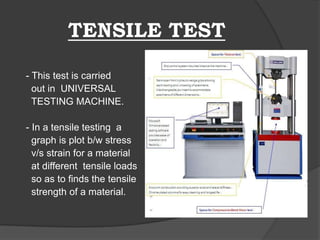
- This test is carried
out in UNIVERSAL
TESTING MACHINE.
- In a tensile testing a
graph is plot b/w stress
v/s strain for a material
at different tensile loads
so as to finds the tensile
strength of a material.
TENSILE TEST
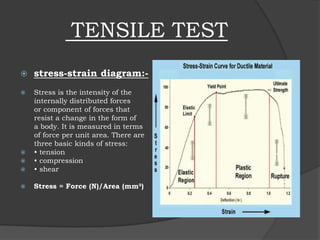
 stress-strain diagram:-
 Stress is the intensity of the
internally distributed forces
or component of forces that
resist a change in the form of
a body. It is measured in terms
of force per unit area. There are
three basic kinds of stress:
 • tension
 • compression
 • shear
 Stress = Force (N)/Area (mm²)
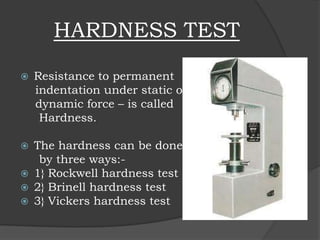
HARDNESS TEST
 Resistance to permanent
indentation under static or
dynamic force – is called
Hardness.
 The hardness can be done
by three ways:-
 1} Rockwell hardness test
 2} Brinell hardness test
 3} Vickers hardness test
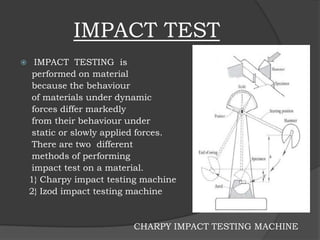
IMPACT TEST
 IMPACT TESTING is
performed on material
because the behaviour
of materials under dynamic
forces differ markedly
from their behaviour under
static or slowly applied forces.
There are two different
methods of performing
impact test on a material.
1} Charpy impact testing machine
2} Izod impact testing machine
CHARPY IMPACT TESTING MACHINE
NON-DESTRUCTIVE TESTING
 There are inherent flaws in materials due to crystal lattice
imperfections and dislocations. Manufacturing processes such
as welding, casting, forging, surface treatment, etc. may cause
further flaws or defects. Materials are used under various
conditions of stress, fatigue and corrosion, which may create
additional defects or aggravate present ones. There is, therefore,
a need to detect these flaws and evaluate them in terms of their
nature, size and location .These are done through inspection
and testing. One method of inspection is to subject the material
or weld to destructive tests, which would provide information
about the performance of that test object. The disadvantage of
destructive testing is that, as the name implies, the test object is
destroyed in the process. Therefore, testing methods have been
developed to provide the information required for the test object
without rendering it unfit for service.
These methods are referred to as non-destructive
tests because they permit evaluation of the material or
component without destroying it.
NON- DESTRUCTIVE TESTING
 Various NDT methods have been developed
so as to get the desired result as per
requirement. These methods are.
 (A) Visual inspection
 (B) Liquid penetrant inspection
 (C) Magnetic particle testing
 (D) Radiographic inspection
 (E) Ultrasonic testing
 (F) Eddy current testing
DESIGNING DEPARTMENT
 The commonly used designing software by the engineers for
designing a product or job are:-
 CAD { COMPUTER AIDED DRAFTING}
 CAM {COMPUTER AIDED MANUFACTURING}
 CAD {COMPUTER AIDED DRAFTING}
 CAD was developed in year 1971 by Dr . P . J . Hanratty
 Computer-aided drafting (CAD),also known as computer-
aided design (CAD) use the computer systems to assist in the
creation, modification, analysis, or optimization of a design.
 CAD output is often use in the form of electronic files for
print or machining operations.
 CAD may be used to design curves and figures in two-
dimensional (2D) space; or curves, surfaces, and solids in
three-dimensional (3D) space. Moreover , it can also convert
a design in 2D into 3D CAD or vice versa.
DESIGNING DEPARTMENT
 Computer-aided design is used by engineers
and designers and in many ways depending on
the profession of the user and the type of
software in question.
 Computer-aided engineering (CAE)
 Finite element analysis (FEA)
 Computer-aided manufacturing (CAM), a
software which gives instructions to Computer
Numerical Control (CNC) machines
.
DESIGNING DEPARTMENT
 CAM {COMPUTER AIDED MANUFACTURING}
 Computer-aided manufacturing (CAM) is the use of
computer software to control machine tools and related
machinery in the manufacturing of workpieces.
 It is a subsequent process , after model is generated in
CAD and verified in CAE , it can input in the CAM
software, which then control the machine tool.
 CAM has been considered as a numerical control (NC)
programming tool, where in two-dimensional (2-D) or
three-dimensional (3-D) models of components generated
in CAD software are used to generate G-code to drive
computer numerically controlled (CNC) machine tools.
 The evolution CNC was taken in 1947
when numerical control (NC) was born.
 After designing a product in CAD or
CAM software, the design is used to
generate G-code so as to drive a CNC
machine to manufacture a product.
 Numerical control (NC) is a method
of automatically operating a
manufacturing machine based on a
code letters, numbers and special
characters.
MANUFACTURING DEPARTMENT
 TYPES OF CNC MACHINES
 1} CNC LATHE MACHINE
 2} CNC MILLING MACHINE
 3} CNC DRILLING MACHINE
- BENCH DRILL
- PILLAR DRILL
 4} CNC BORING MACHINE
 5} CNC GRINDING MACHINE
 6} ELECTRONIC DISCHARGE MACHINE [EDM]
 7} LASER CUTTING MACHINE
MANUFACTURING DEPARTMENT
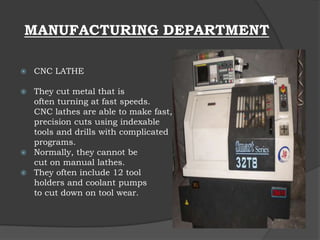
 CNC LATHE
 They cut metal that is
often turning at fast speeds.
CNC lathes are able to make fast,
precision cuts using indexable
tools and drills with complicated
programs.
 Normally, they cannot be
cut on manual lathes.
 They often include 12 tool
holders and coolant pumps
to cut down on tool wear.
MANUFACTURING DEPARTMENT
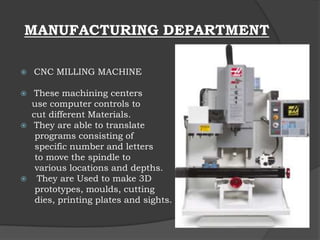
 CNC MILLING MACHINE
 These machining centers
use computer controls to
cut different Materials.
 They are able to translate
programs consisting of
specific number and letters
to move the spindle to
various locations and depths.
 They are Used to make 3D
prototypes, moulds, cutting
dies, printing plates and sights.
MANUFACTURING DEPARTMENT
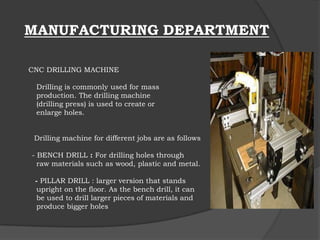
CNC DRILLING MACHINE
Drilling is commonly used for mass
production. The drilling machine
(drilling press) is used to create or
enlarge holes.
Drilling machine for different jobs are as follows
- BENCH DRILL : For drilling holes through
raw materials such as wood, plastic and metal.
- PILLAR DRILL : larger version that stands
upright on the floor. As the bench drill, it can
be used to drill larger pieces of materials and
produce bigger holes
MANUFACTURING DEPARTMENT
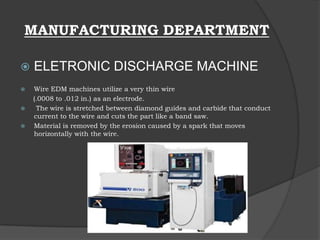
 ELETRONIC DISCHARGE MACHINE
 Wire EDM machines utilize a very thin wire
(.0008 to .012 in.) as an electrode.
 The wire is stretched between diamond guides and carbide that conduct
current to the wire and cuts the part like a band saw.
 Material is removed by the erosion caused by a spark that moves
horizontally with the wire.
BIBLIOGRAPHY
 Wikipedia- free encyclopedia
 Google book
 http://www.ehow.com
 http://www.cnc-machining-center-
yida.com
 http://www.cncci.com
THANK YOU …….

Production technology ppt

  • 1.
    MINOR TRAINING REPORT ON PRODUCTIONTECHNOLOGY SUBMITTED TO :- SUBMITTED BY:- Mr GYAAN RATAN HIRKANE Milind Waikar Rajnish gavhade MECH DEPT.
  • 2.
    CONTENTS  WHAT ISCIPET?  SUB DIVSIONS OF PRODUCTION UNIT CELL  - MATERIAL SELECTION CELL  - TESTING DEPARTMENT  - DESIGNING DEPARTMENT  - MANUFACTURING DEPARTMENT
  • 3.
    ACKNOWLEDGEMENT I express mysincere gratitude to your honorable HOD Mr. Prabhash Jain sir, under whose inspiration and valuable guidance I could undertake this project. I am equally grateful to our teacher Mr. Gyaan Sir under whose proficient and able supervision this project could be brought to maturity. He made me realize that things can be done in limited resources and time. Last but not the least my sincere thanks goes to my parents and all my colleagues and well wishes whose Constant encouragement kept me busy throughout this job.
  • 4.
    INTRODUCTION  PRODUCTION TECHNOLOGY,is a process unit cell.  It is a main base of any industry.  In it analytical study of a product is done so as to find its merits and demerits and then permit it to the mass production.  A production unit cell is sub divided into 4 sections as  MATERIAL SELECTION DEPARTMENT  TESTING DEPARTMENT  DESIGNING DEPARTMENT  PRODUCTION CELL
  • 5.
    MATERIAL SELECTION DEPARTMENT  Thecommonly used engineering materials for manufacturing are:- 1} METALS AND ALLOYS 2} PLASTICS  1} METALS AND ALLOYS- The metals and alloys are further classified as:- A} Ferrous metals and alloys B} Nonferrous metals and alloys  2} PLASTICS- Plastics are organic substances or resins, usually containing oxygen, carbon, hydrogen, nitrogen and some other elements. These organic compounds are called polymers. A plastic is usually divided into two groups. 1} Thermoplastic 2} Thermosetting plastic
  • 6.
    TESTING DEPARTMENT  Inthe TESTING CELL different types of tests is performed on the material so as to check its mechanical properties such as-strength, elasticity, stiffness, plasticity, ductility, malleability, resilience, toughness, hardness, hardenability, brittleness, machinability, creep, fatigue etc.  In industries, testing of a material is classified into two groups :- 1} Destructive testing 2} Non-destructive testing
  • 7.
    DESTRUCTIVE TESTING  Ina destructive testing, the material undergoes to tensile test, compression test, hardness test, impact test, fatigue test, creep test, etc so as to check the strength and mechanical properties of a material in better way.
  • 8.
    TENSILE TEST - Thistest is carried out in UNIVERSAL TESTING MACHINE. - In a tensile testing a graph is plot b/w stress v/s strain for a material at different tensile loads so as to finds the tensile strength of a material.
  • 9.
    TENSILE TEST  stress-straindiagram:-  Stress is the intensity of the internally distributed forces or component of forces that resist a change in the form of a body. It is measured in terms of force per unit area. There are three basic kinds of stress:  • tension  • compression  • shear  Stress = Force (N)/Area (mm²)
  • 10.
    HARDNESS TEST  Resistanceto permanent indentation under static or dynamic force – is called Hardness.  The hardness can be done by three ways:-  1} Rockwell hardness test  2} Brinell hardness test  3} Vickers hardness test
  • 11.
    IMPACT TEST  IMPACTTESTING is performed on material because the behaviour of materials under dynamic forces differ markedly from their behaviour under static or slowly applied forces. There are two different methods of performing impact test on a material. 1} Charpy impact testing machine 2} Izod impact testing machine CHARPY IMPACT TESTING MACHINE
  • 12.
    NON-DESTRUCTIVE TESTING  Thereare inherent flaws in materials due to crystal lattice imperfections and dislocations. Manufacturing processes such as welding, casting, forging, surface treatment, etc. may cause further flaws or defects. Materials are used under various conditions of stress, fatigue and corrosion, which may create additional defects or aggravate present ones. There is, therefore, a need to detect these flaws and evaluate them in terms of their nature, size and location .These are done through inspection and testing. One method of inspection is to subject the material or weld to destructive tests, which would provide information about the performance of that test object. The disadvantage of destructive testing is that, as the name implies, the test object is destroyed in the process. Therefore, testing methods have been developed to provide the information required for the test object without rendering it unfit for service. These methods are referred to as non-destructive tests because they permit evaluation of the material or component without destroying it.
  • 13.
    NON- DESTRUCTIVE TESTING Various NDT methods have been developed so as to get the desired result as per requirement. These methods are.  (A) Visual inspection  (B) Liquid penetrant inspection  (C) Magnetic particle testing  (D) Radiographic inspection  (E) Ultrasonic testing  (F) Eddy current testing
  • 14.
    DESIGNING DEPARTMENT  Thecommonly used designing software by the engineers for designing a product or job are:-  CAD { COMPUTER AIDED DRAFTING}  CAM {COMPUTER AIDED MANUFACTURING}  CAD {COMPUTER AIDED DRAFTING}  CAD was developed in year 1971 by Dr . P . J . Hanratty  Computer-aided drafting (CAD),also known as computer- aided design (CAD) use the computer systems to assist in the creation, modification, analysis, or optimization of a design.  CAD output is often use in the form of electronic files for print or machining operations.  CAD may be used to design curves and figures in two- dimensional (2D) space; or curves, surfaces, and solids in three-dimensional (3D) space. Moreover , it can also convert a design in 2D into 3D CAD or vice versa.
  • 15.
    DESIGNING DEPARTMENT  Computer-aideddesign is used by engineers and designers and in many ways depending on the profession of the user and the type of software in question.  Computer-aided engineering (CAE)  Finite element analysis (FEA)  Computer-aided manufacturing (CAM), a software which gives instructions to Computer Numerical Control (CNC) machines .
  • 16.
    DESIGNING DEPARTMENT  CAM{COMPUTER AIDED MANUFACTURING}  Computer-aided manufacturing (CAM) is the use of computer software to control machine tools and related machinery in the manufacturing of workpieces.  It is a subsequent process , after model is generated in CAD and verified in CAE , it can input in the CAM software, which then control the machine tool.  CAM has been considered as a numerical control (NC) programming tool, where in two-dimensional (2-D) or three-dimensional (3-D) models of components generated in CAD software are used to generate G-code to drive computer numerically controlled (CNC) machine tools.
  • 17.
     The evolutionCNC was taken in 1947 when numerical control (NC) was born.  After designing a product in CAD or CAM software, the design is used to generate G-code so as to drive a CNC machine to manufacture a product.  Numerical control (NC) is a method of automatically operating a manufacturing machine based on a code letters, numbers and special characters. MANUFACTURING DEPARTMENT
  • 18.
    MANUFACTURING DEPARTMENT  TYPESOF CNC MACHINES  1} CNC LATHE MACHINE  2} CNC MILLING MACHINE  3} CNC DRILLING MACHINE - BENCH DRILL - PILLAR DRILL  4} CNC BORING MACHINE  5} CNC GRINDING MACHINE  6} ELECTRONIC DISCHARGE MACHINE [EDM]  7} LASER CUTTING MACHINE
  • 19.
    MANUFACTURING DEPARTMENT  CNCLATHE  They cut metal that is often turning at fast speeds. CNC lathes are able to make fast, precision cuts using indexable tools and drills with complicated programs.  Normally, they cannot be cut on manual lathes.  They often include 12 tool holders and coolant pumps to cut down on tool wear.
  • 20.
    MANUFACTURING DEPARTMENT  CNCMILLING MACHINE  These machining centers use computer controls to cut different Materials.  They are able to translate programs consisting of specific number and letters to move the spindle to various locations and depths.  They are Used to make 3D prototypes, moulds, cutting dies, printing plates and sights.
  • 21.
    MANUFACTURING DEPARTMENT CNC DRILLINGMACHINE Drilling is commonly used for mass production. The drilling machine (drilling press) is used to create or enlarge holes. Drilling machine for different jobs are as follows - BENCH DRILL : For drilling holes through raw materials such as wood, plastic and metal. - PILLAR DRILL : larger version that stands upright on the floor. As the bench drill, it can be used to drill larger pieces of materials and produce bigger holes
  • 22.
    MANUFACTURING DEPARTMENT  ELETRONICDISCHARGE MACHINE  Wire EDM machines utilize a very thin wire (.0008 to .012 in.) as an electrode.  The wire is stretched between diamond guides and carbide that conduct current to the wire and cuts the part like a band saw.  Material is removed by the erosion caused by a spark that moves horizontally with the wire.
  • 23.
    BIBLIOGRAPHY  Wikipedia- freeencyclopedia  Google book  http://www.ehow.com  http://www.cnc-machining-center- yida.com  http://www.cncci.com
  • 24.