ADDITIVE MANUFACTURING
PRASANNA S G
177ME15033
5th SEM ME
G P T SIDDAPUR
( U.K)
CONTENTS
 INTRODUCTION
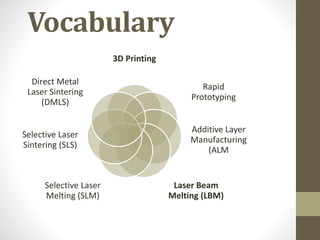
 Vocabulary
 The benefits of AM technology
 Market perspectives
 3D printing
 Specific defects in materials obtained with
additive manufacturing process
Advantages and disadvantages
INTRODUCTION
 Additive manufacturing, also known as 3D printing, rapid
prototyping or freeform fabrication, is ‘the process of joining
materials to make objects from 3D model data, usually layer
upon layer, as opposed to subtractive manufacturing
methodologies’ such as machining.
 The use of Additive Manufacturing (AM) with metal powders is
a new and growing industry sector with many of its leading
companies based in Europe. It became a suitable process to
produce complex metal net shape parts, and not only
prototypes, as before.
 Additive manufacturing now enables both a design and
industrial revolution, in various industrial sectors such as
aerospace, energy, automotive, medical, tooling and consumer
goods.
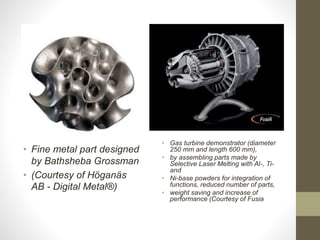
• Fine metal part designed
by Bathsheba Grossman
• (Courtesy of Höganäs
AB - Digital Metal®)
• Gas turbine demonstrator (diameter
250 mm and length 600 mm),
• by assembling parts made by
Selective Laser Melting with Al-, Ti-
and
• Ni-base powders for integration of
functions, reduced number of parts,
• weight saving and increase of
performance (Courtesy of Fusia
Vocabulary
3D Printing
Rapid
Prototyping
Additive Layer
Manufacturing
(ALM
Laser Beam
Melting (LBM)
Selective Laser
Melting (SLM)
Selective Laser
Sintering (SLS)
Direct Metal
Laser Sintering
(DMLS)
The benefits of AM
technology
Increased design freedom versus conventional casting
and machining
Light weight structures, made possible either by the use
of lattice design or by designing parts where material is
only where it needs to be, without other constraints
New functions such as complex internal channels or
several parts built in one
No tools needed, unlike other conventional metallurgy
processes which require molds and metal forming or
removal tools
Market perspectives
aerospace
energy
medical, in particular in surgical
implants and dental applications
tooling in particular for plastics
processing
automotive and transportation
consumer goods
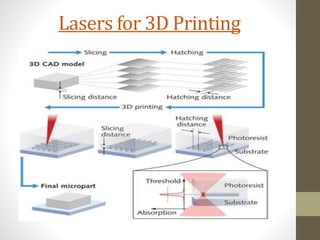
Lasers for 3D Printing
3D printing
The 3D printing process is an indirect process in two
steps.
After applying a powder layer on the build platform, the
powder is agglomerated thanks to a binder fed through
the printer nozzle.
The operation is repeated until parts are produced,
which shall be then removed carefully from the powder
bed, as they are in a « green » stage.
The metal part solicitation takes place in a second step,
during a debinding and sintering operation, sometimes
followed by an infiltration step.
Specific defects in materialsobtainedwith
additive manufacturingprocess
In case of incorrect process parameters, build
strategy, part orientation or unsufficient
powder quality, some typical defectscan be
observed:
 Unmolten powder particles
 Lacks of fusion
 Pores
 Cracks
 Inclusions
 Residual stresses
 Poor surface roughness
Additive  manufacturing

Additive manufacturing

  • 1.
    ADDITIVE MANUFACTURING PRASANNA SG 177ME15033 5th SEM ME G P T SIDDAPUR ( U.K)
  • 2.
    CONTENTS  INTRODUCTION  Vocabulary The benefits of AM technology  Market perspectives  3D printing  Specific defects in materials obtained with additive manufacturing process Advantages and disadvantages
  • 3.
    INTRODUCTION  Additive manufacturing,also known as 3D printing, rapid prototyping or freeform fabrication, is ‘the process of joining materials to make objects from 3D model data, usually layer upon layer, as opposed to subtractive manufacturing methodologies’ such as machining.  The use of Additive Manufacturing (AM) with metal powders is a new and growing industry sector with many of its leading companies based in Europe. It became a suitable process to produce complex metal net shape parts, and not only prototypes, as before.  Additive manufacturing now enables both a design and industrial revolution, in various industrial sectors such as aerospace, energy, automotive, medical, tooling and consumer goods.
  • 4.
    • Fine metalpart designed by Bathsheba Grossman • (Courtesy of Höganäs AB - Digital Metal®) • Gas turbine demonstrator (diameter 250 mm and length 600 mm), • by assembling parts made by Selective Laser Melting with Al-, Ti- and • Ni-base powders for integration of functions, reduced number of parts, • weight saving and increase of performance (Courtesy of Fusia
  • 5.
    Vocabulary 3D Printing Rapid Prototyping Additive Layer Manufacturing (ALM LaserBeam Melting (LBM) Selective Laser Melting (SLM) Selective Laser Sintering (SLS) Direct Metal Laser Sintering (DMLS)
  • 6.
    The benefits ofAM technology Increased design freedom versus conventional casting and machining Light weight structures, made possible either by the use of lattice design or by designing parts where material is only where it needs to be, without other constraints New functions such as complex internal channels or several parts built in one No tools needed, unlike other conventional metallurgy processes which require molds and metal forming or removal tools
  • 7.
    Market perspectives aerospace energy medical, inparticular in surgical implants and dental applications tooling in particular for plastics processing automotive and transportation consumer goods
  • 8.
    Lasers for 3DPrinting
  • 9.
    3D printing The 3Dprinting process is an indirect process in two steps. After applying a powder layer on the build platform, the powder is agglomerated thanks to a binder fed through the printer nozzle. The operation is repeated until parts are produced, which shall be then removed carefully from the powder bed, as they are in a « green » stage. The metal part solicitation takes place in a second step, during a debinding and sintering operation, sometimes followed by an infiltration step.
  • 10.
    Specific defects inmaterialsobtainedwith additive manufacturingprocess In case of incorrect process parameters, build strategy, part orientation or unsufficient powder quality, some typical defectscan be observed:  Unmolten powder particles  Lacks of fusion  Pores  Cracks  Inclusions  Residual stresses  Poor surface roughness