(2020-2021)
SCHOOL OF ENGINEERING AND TECHNOLOGY, SANDIP UNIVERSITY,
NASHIK, MAHARASHTRA
GUIDED BY-
DR. A.S.RELKAR
SUBMITED BY-
NILESH BHARAT KHONA
TE-B-19
PRN No- 190101092035
CONTENT
 WHAT IS FUSED DEPOSITION MODELLING ?
 WORKING OF FDM.
 WHAT ARE THE MOST COMMON MATERIALS USED IN FDM
PRINTERS ?
 PRICE OF FDM PRINTER.
 ADVANTAGES OF FDM 3D PRINTERS.
 DISADVANTAGE OF FDM 3D PRINTERS.
 FDM 3D PRINTERS FIND APPLICATION IN ?
 CONCLUSION.
 REFERENCES.
WHAT IS FUSED DEPOSITION MODELLING ?
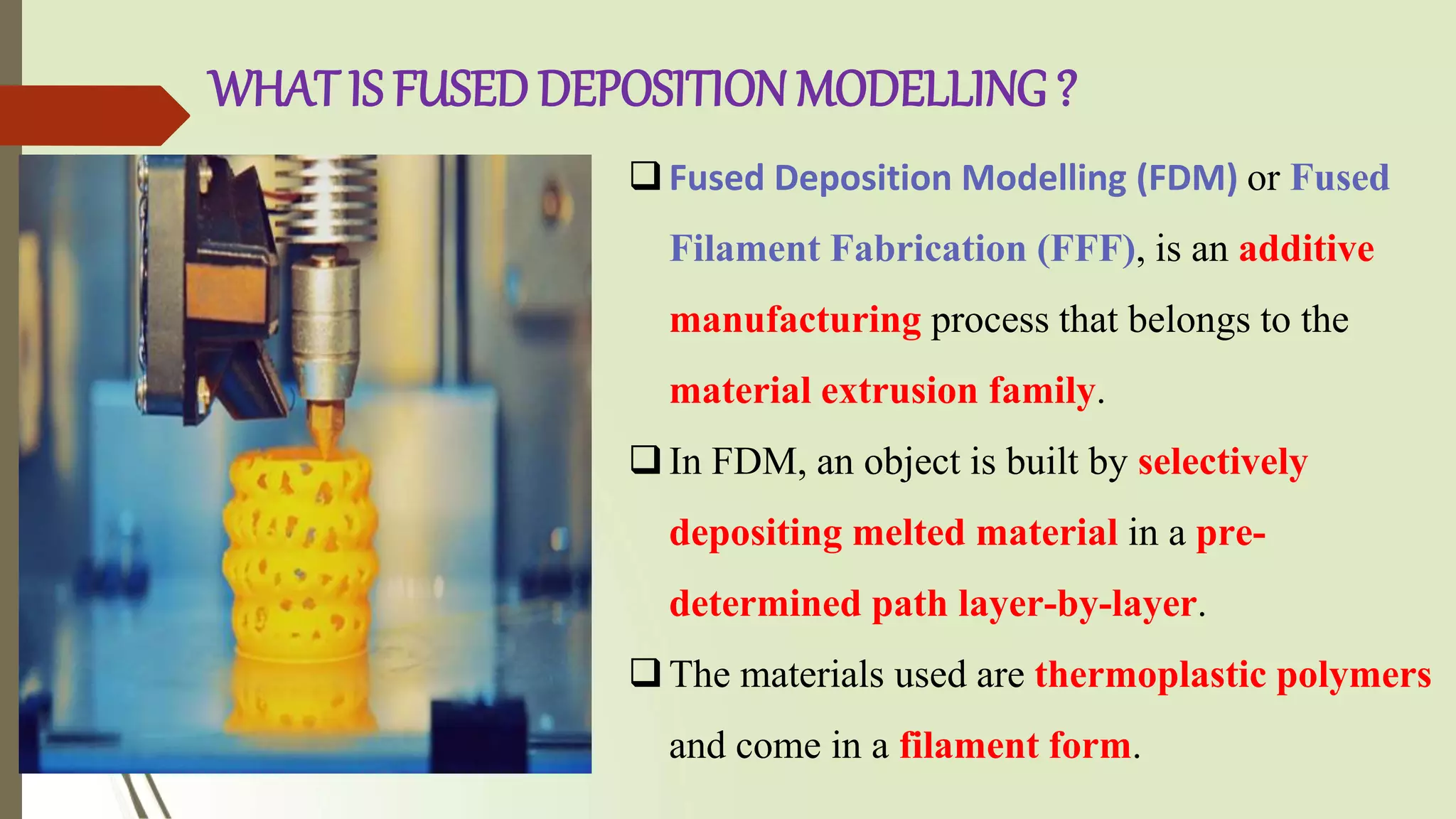
Fused Deposition Modelling (FDM) or Fused
Filament Fabrication (FFF), is an additive
manufacturing process that belongs to the
material extrusion family.
In FDM, an object is built by selectively
depositing melted material in a pre-
determined path layer-by-layer.
The materials used are thermoplastic polymers
and come in a filament form.
FUSED DEPOSITION MODELLING
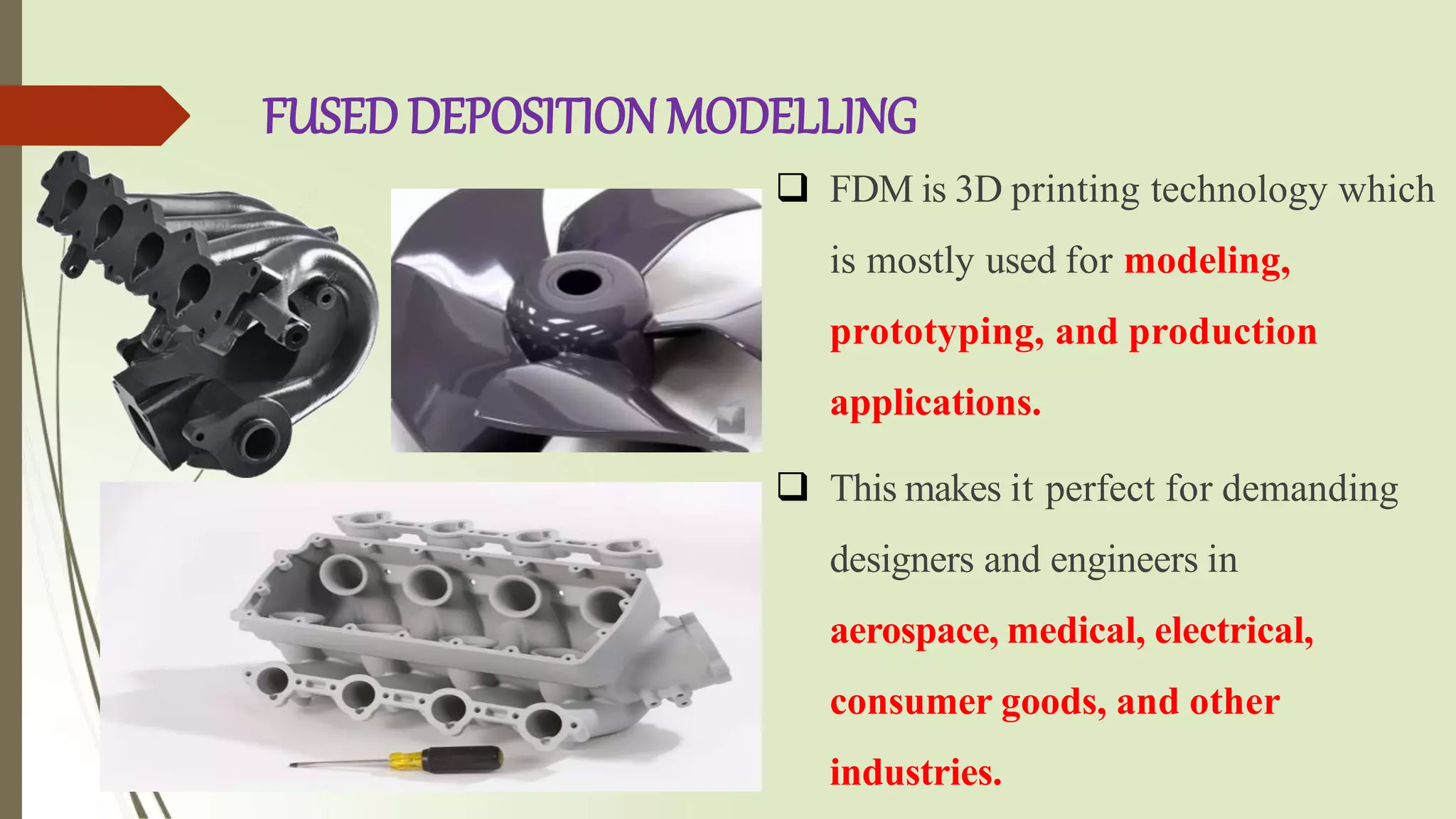
 FDM is 3D printing technology which
is mostly used for modeling,
prototyping, and production
applications.
 This makes it perfect for demanding
designers and engineers in
aerospace, medical, electrical,
consumer goods, and other
industries.
WORKING OF FDM
 STEPS TO MANUFACTURE PRODUCT WITH FDM 3D
PRINTING
1. The process begins with a 3D CAD (computer-aided design) model.
2. Slicing software divides the digital model into numerous slices (layers)
and outputs a G-code file for the printer.
3. The FDM printer heats solid plastic filament, and melts and extrudes it
from a nozzle — layer upon layer — onto a build tray to form the 3D
object.
4. This process is repeated until the part is completed.
What are the most common materials used in FDMprinters ?
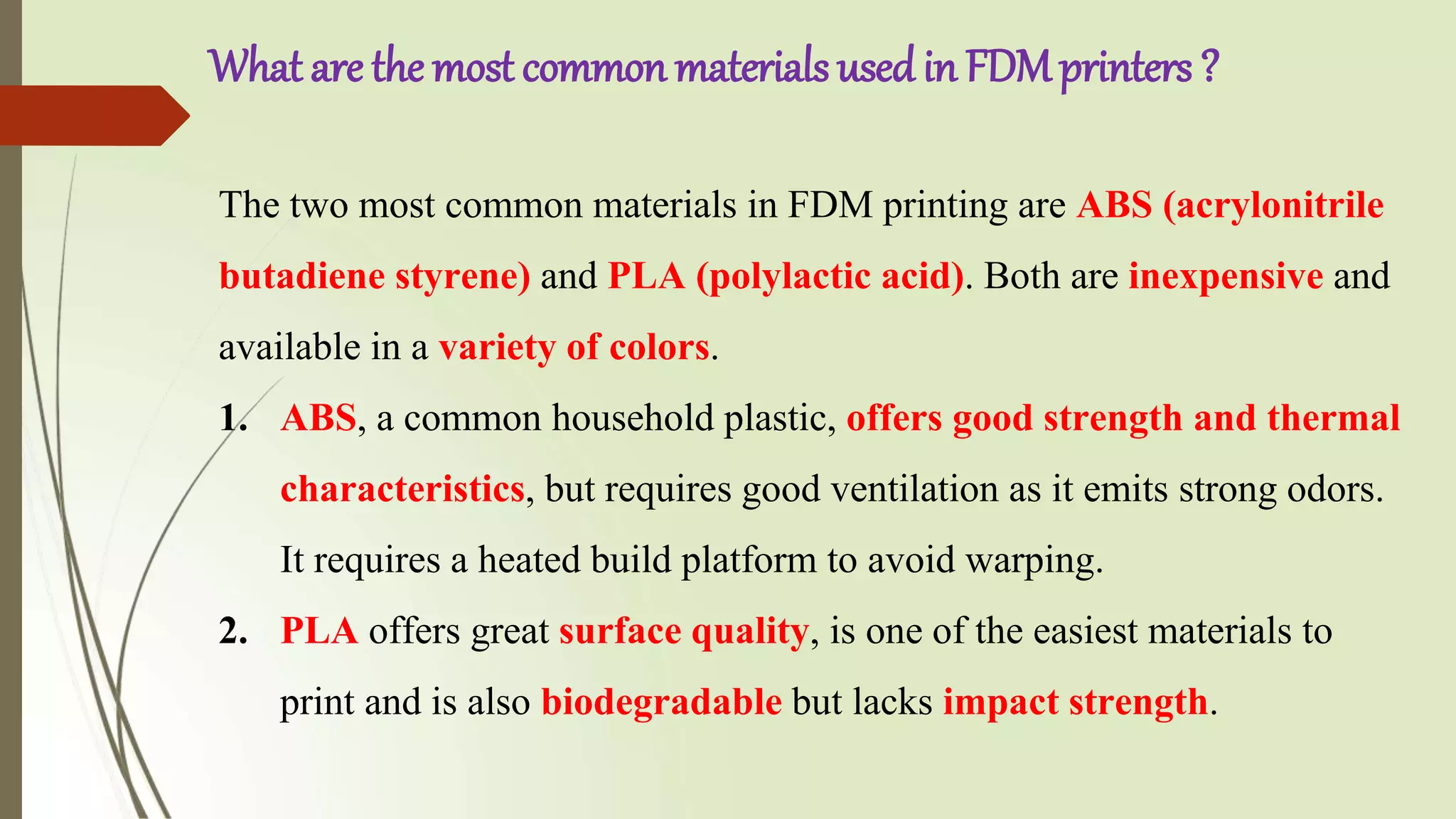
The two most common materials in FDM printing are ABS (acrylonitrile
butadiene styrene) and PLA (polylactic acid). Both are inexpensive and
available in a variety of colors.
1. ABS, a common household plastic, offers good strength and thermal
characteristics, but requires good ventilation as it emits strong odors.
It requires a heated build platform to avoid warping.
2. PLA offers great surface quality, is one of the easiest materials to
print and is also biodegradable but lacks impact strength.
PRICE OF FDM PRINTER
 The Cube is among the most affordable desktop FDM printers on the market
at $1,299.
 MakerBot's machines are even more expensive, ranging in price from $2,549
to $3,299.
 And Stratasys' Mojo costs just under $10,000.
 However, this popular technology is becoming less expensive as 3D Printing
Startup, like the California-based Pirate3D, seek to bring 3D technology into
the homes of average consumers.
 Pirate3D's Buccaneer, which is due out in December 2013 sells for just $347.
ADVANTAGES OF FDM 3D PRINTERS.
1. A wide range of FDM printers are available in the market
today.
2. The raw material is inexpensive.
3. Durable and maintains dimensional integrity.
4. Wide choice of raw material.
5. Affordable.
DISADVANTAGES OF FDM3D PRINTERS.
1. FDM printers do not offer the high quality, dimensional
accuracy or reliable operation that some other 3D printers offer.
2. Reliability can be an issue with failed parts or clogs in flowing
plastic.
3. FDM is not the best choice for printing parts that need to be
“close to perfection.”
APPLICATIONS OF FDM 3D PRINTERS.
 Creating prototypes for Fit, Form and Function testing rapid tooling
patterns and mould inserts creating and testing any parts that work under
thermal loads production of precise and complex end-use parts e.g. jigs &
fixtures.
 Sectors that use FDM 3D Printers include:
 Automotive
 Aerospace
 Manufacturing
 Industrial
 Medical
 Architecture
 Consumer Goods
 Education & Research
 Automotive and aviation industries use 3D printers to make body
parts.
 Urbee the first prototype car 2011 was presented. This is the first
car ever to have its entire body printed out on giant 3D printer.
 It has three wheels, and two seats.
AUTOMOTIVEANDAVIATION INDUSTRIES
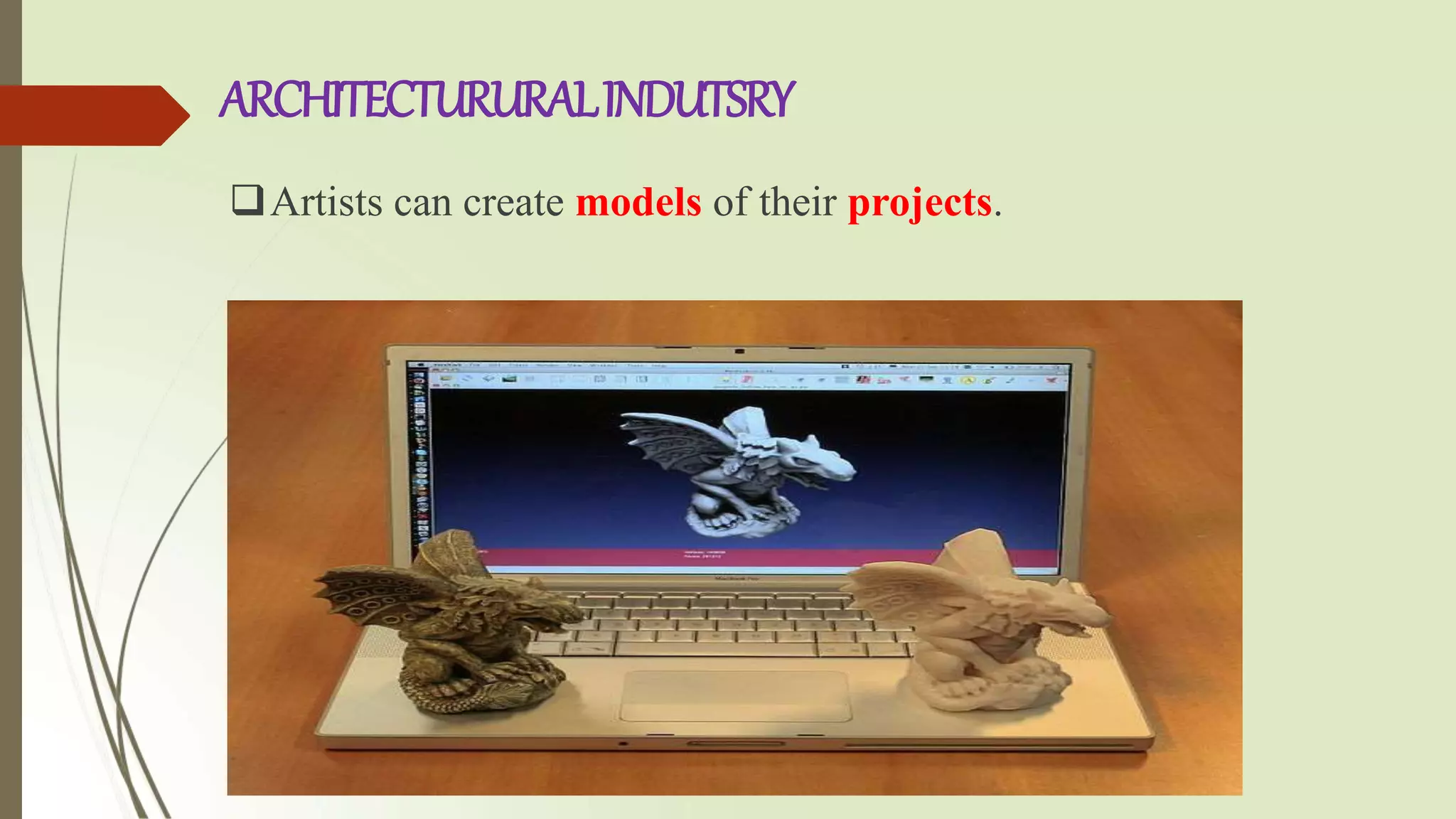
Artists can create models of their projects.
ARCHITECTURURALINDUTSRY
In food preparation, to apply items in liquid orpaste form
such ascheese, icing, and chocolate.
FOOD INDUSTRY
MEDICALINDUSTRY
 PROSTHETIC LEG
 ARTIFICIAL TEETHS
Education & Research
Sculpture called “Jhada” was installed at Mumbai’s Airport, 8-feet high and 6 feet wide
structure.
CONCLUSION
 It concludes that 3D printing is technology which is easy and much
more suitable for manufacturing of less strength products
which can be used as prototyping or any toys etc.
 Manufacturing cost is less.
REFRENCES
1. https://www.medicaldesignandoutsourcing.com/what-is-an-fdm-
printer-and-how-does-it-work/
2. https://www.designtechproducts.com/articles/working-fdm-3d-
printers
3. R & D IIT Kanpur (FDM).
4. What is 3D Printing – YouTube College With Knowledge-
https://youtu.be/9VsHG2ETB1Y
THANK YOU

FDM FUSED DEPOSITION MODELLING

  • 1.
    (2020-2021) SCHOOL OF ENGINEERINGAND TECHNOLOGY, SANDIP UNIVERSITY, NASHIK, MAHARASHTRA GUIDED BY- DR. A.S.RELKAR SUBMITED BY- NILESH BHARAT KHONA TE-B-19 PRN No- 190101092035
  • 2.
    CONTENT  WHAT ISFUSED DEPOSITION MODELLING ?  WORKING OF FDM.  WHAT ARE THE MOST COMMON MATERIALS USED IN FDM PRINTERS ?  PRICE OF FDM PRINTER.  ADVANTAGES OF FDM 3D PRINTERS.  DISADVANTAGE OF FDM 3D PRINTERS.  FDM 3D PRINTERS FIND APPLICATION IN ?  CONCLUSION.  REFERENCES.
  • 3.
    WHAT IS FUSEDDEPOSITION MODELLING ? Fused Deposition Modelling (FDM) or Fused Filament Fabrication (FFF), is an additive manufacturing process that belongs to the material extrusion family. In FDM, an object is built by selectively depositing melted material in a pre- determined path layer-by-layer. The materials used are thermoplastic polymers and come in a filament form.
  • 4.
    FUSED DEPOSITION MODELLING FDM is 3D printing technology which is mostly used for modeling, prototyping, and production applications.  This makes it perfect for demanding designers and engineers in aerospace, medical, electrical, consumer goods, and other industries.
  • 5.
    WORKING OF FDM STEPS TO MANUFACTURE PRODUCT WITH FDM 3D PRINTING 1. The process begins with a 3D CAD (computer-aided design) model. 2. Slicing software divides the digital model into numerous slices (layers) and outputs a G-code file for the printer. 3. The FDM printer heats solid plastic filament, and melts and extrudes it from a nozzle — layer upon layer — onto a build tray to form the 3D object. 4. This process is repeated until the part is completed.
  • 6.
    What are themost common materials used in FDMprinters ? The two most common materials in FDM printing are ABS (acrylonitrile butadiene styrene) and PLA (polylactic acid). Both are inexpensive and available in a variety of colors. 1. ABS, a common household plastic, offers good strength and thermal characteristics, but requires good ventilation as it emits strong odors. It requires a heated build platform to avoid warping. 2. PLA offers great surface quality, is one of the easiest materials to print and is also biodegradable but lacks impact strength.
  • 7.
    PRICE OF FDMPRINTER  The Cube is among the most affordable desktop FDM printers on the market at $1,299.  MakerBot's machines are even more expensive, ranging in price from $2,549 to $3,299.  And Stratasys' Mojo costs just under $10,000.  However, this popular technology is becoming less expensive as 3D Printing Startup, like the California-based Pirate3D, seek to bring 3D technology into the homes of average consumers.  Pirate3D's Buccaneer, which is due out in December 2013 sells for just $347.
  • 8.
    ADVANTAGES OF FDM3D PRINTERS. 1. A wide range of FDM printers are available in the market today. 2. The raw material is inexpensive. 3. Durable and maintains dimensional integrity. 4. Wide choice of raw material. 5. Affordable.
  • 9.
    DISADVANTAGES OF FDM3DPRINTERS. 1. FDM printers do not offer the high quality, dimensional accuracy or reliable operation that some other 3D printers offer. 2. Reliability can be an issue with failed parts or clogs in flowing plastic. 3. FDM is not the best choice for printing parts that need to be “close to perfection.”
  • 10.
    APPLICATIONS OF FDM3D PRINTERS.  Creating prototypes for Fit, Form and Function testing rapid tooling patterns and mould inserts creating and testing any parts that work under thermal loads production of precise and complex end-use parts e.g. jigs & fixtures.  Sectors that use FDM 3D Printers include:  Automotive  Aerospace  Manufacturing  Industrial  Medical  Architecture  Consumer Goods  Education & Research
  • 11.
     Automotive andaviation industries use 3D printers to make body parts.  Urbee the first prototype car 2011 was presented. This is the first car ever to have its entire body printed out on giant 3D printer.  It has three wheels, and two seats. AUTOMOTIVEANDAVIATION INDUSTRIES
  • 12.
    Artists can createmodels of their projects. ARCHITECTURURALINDUTSRY
  • 13.
    In food preparation,to apply items in liquid orpaste form such ascheese, icing, and chocolate. FOOD INDUSTRY
  • 14.
  • 15.
  • 16.
    Sculpture called “Jhada”was installed at Mumbai’s Airport, 8-feet high and 6 feet wide structure.
  • 17.
    CONCLUSION  It concludesthat 3D printing is technology which is easy and much more suitable for manufacturing of less strength products which can be used as prototyping or any toys etc.  Manufacturing cost is less.
  • 18.
  • 19.