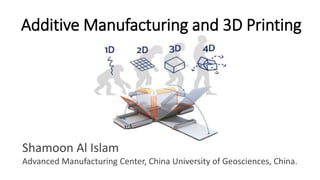

Additive Manufacturing and 3D Printing
Shamoon Al Islam
Advanced Manufacturing Center, China University of Geosciences, China.
Contents
• Additive Manufacturing: 3D printing
• 3D Printing VS Traditional Manufacturing
• Major 3D Printing Technologies
• Applications of 3D Printing Technology
• Evolution of Additive Manufacturing
• Important Aspects of 4D Printing
• Comparison Between Materials
• Smart Metal
• Development of Self healing polymers
• What’s Next? 4DPrinting
• Overview
• Required Considerations
• Challenges
• Goals
• Oppertunities
Additive Manufacturing: 3D printing
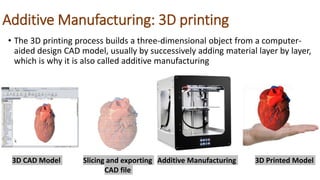
• The 3D printing process builds a three-dimensional object from a computer-
aided design CAD model, usually by successively adding material layer by layer,
which is why it is also called additive manufacturing
3D CAD Model Slicing and exporting
CAD file
3D Printed ModelAdditive Manufacturing
3D Printing VS Traditional Manufacturing
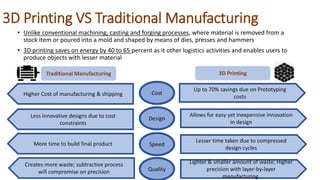
• Unlike conventional machining, casting and forging processes, where material is removed from a
stock item or poured into a mold and shaped by means of dies, presses and hammers
• 3D printing saves on energy by 40 to 65 percent as it other logistics activities and enables users to
produce objects with lesser material
Cost
Design
Speed
Quality
Up to 70% savings due on Prototyping
costs
Allows for easy yet inexpensive innovation
in design
Lesser time taken due to compressed
design cycles
Lighter & smaller amount of waste; Higher
precision with layer-by-layer
manufacturing.
Higher Cost of manufacturing & shipping
Traditional Manufacturing 3D Printing
Less innovative designs due to cost
constraints
More time to build final product
Creates more waste; subtractive process
will compromise on precision
Major 3D Printing Technologies
• Stereolithography (SLA)
• Fused deposition Modeling (FDM)
• Selective Laser Sintering (SLS)
• Selective Laser Melting (SLM)
Stereolithography (SLA) Technology
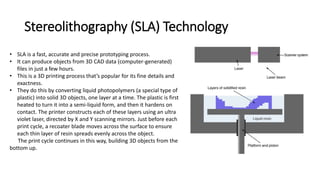
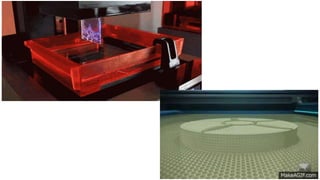
• SLA is a fast, accurate and precise prototyping process.
• It can produce objects from 3D CAD data (computer-generated)
files in just a few hours.
• This is a 3D printing process that’s popular for its fine details and
exactness.
• They do this by converting liquid photopolymers (a special type of
plastic) into solid 3D objects, one layer at a time. The plastic is first
heated to turn it into a semi-liquid form, and then it hardens on
contact. The printer constructs each of these layers using an ultra
violet laser, directed by X and Y scanning mirrors. Just before each
print cycle, a recoater blade moves across the surface to ensure
each thin layer of resin spreads evenly across the object.
The print cycle continues in this way, building 3D objects from the
bottom up.
Fused Deposition Modeling (FDM) Technology
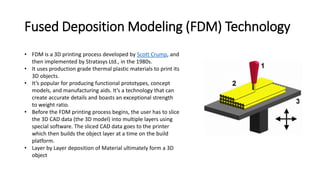
• FDM is a 3D printing process developed by Scott Crump, and
then implemented by Stratasys Ltd., in the 1980s.
• It uses production grade thermal plastic materials to print its
3D objects.
• It’s popular for producing functional prototypes, concept
models, and manufacturing aids. It’s a technology that can
create accurate details and boasts an exceptional strength
to weight ratio.
• Before the FDM printing process begins, the user has to slice
the 3D CAD data (the 3D model) into multiple layers using
special software. The sliced CAD data goes to the printer
which then builds the object layer at a time on the build
platform.
• Layer by Layer deposition of Material ultimately form a 3D
object
Selective Laser Sintering (SLS)
Technology
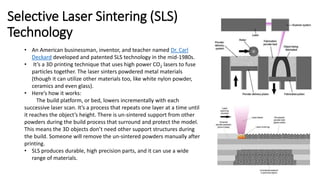
• An American businessman, inventor, and teacher named Dr. Carl
Deckard developed and patented SLS technology in the mid-1980s.
• It’s a 3D printing technique that uses high power CO2 lasers to fuse
particles together. The laser sinters powdered metal materials
(though it can utilize other materials too, like white nylon powder,
ceramics and even glass).
• Here’s how it works:
The build platform, or bed, lowers incrementally with each
successive laser scan. It’s a process that repeats one layer at a time until
it reaches the object’s height. There is un-sintered support from other
powders during the build process that surround and protect the model.
This means the 3D objects don’t need other support structures during
the build. Someone will remove the un-sintered powders manually after
printing.
• SLS produces durable, high precision parts, and it can use a wide
range of materials.
Selective Laser Melting (SLM) Technology
• SLM made its debut appearance back in 1995.
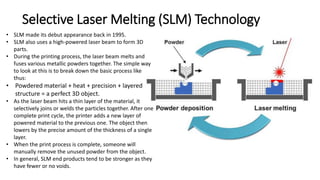
• SLM also uses a high-powered laser beam to form 3D
parts.
• During the printing process, the laser beam melts and
fuses various metallic powders together. The simple way
to look at this is to break down the basic process like
thus:
• Powdered material + heat + precision + layered
structure = a perfect 3D object.
• As the laser beam hits a thin layer of the material, it
selectively joins or welds the particles together. After one
complete print cycle, the printer adds a new layer of
powered material to the previous one. The object then
lowers by the precise amount of the thickness of a single
layer.
• When the print process is complete, someone will
manually remove the unused powder from the object.
• In general, SLM end products tend to be stronger as they
have fewer or no voids.
SLS vs SLM
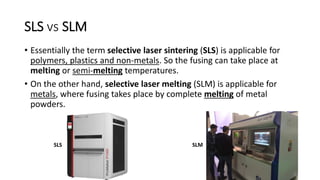
• Essentially the term selective laser sintering (SLS) is applicable for
polymers, plastics and non-metals. So the fusing can take place at
melting or semi-melting temperatures.
• On the other hand, selective laser melting (SLM) is applicable for
metals, where fusing takes place by complete melting of metal
powders.
SLMSLS
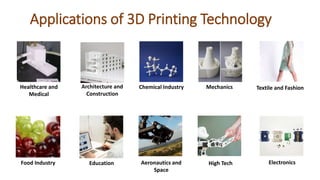
Applications of 3D Printing Technology
Healthcare and
Medical
Architecture and
Construction
Chemical Industry Mechanics
Food Industry Education Aeronautics and
Space
High Tech
Textile and Fashion
Electronics
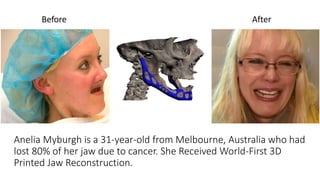
Anelia Myburgh is a 31-year-old from Melbourne, Australia who had
lost 80% of her jaw due to cancer. She Received World-First 3D
Printed Jaw Reconstruction.
Before After
• Chinese baby became first person in the world to have her entire skull
reconstructed by 3D printers, known as the 'big-head baby
• fluid filled 85 per cent of her brain - making her skull three-four times larger than
it should have been, measuring around 20cmx20cm
• used CT scans and 3D data to create three titanium mesh skull implants which
combined, would replace the entire top portion of the toddler’s skull
• surgeons used 3D printing technology to create a titanium alloy skull and
successfully set it into Han-Han's head during a 17-hour operation
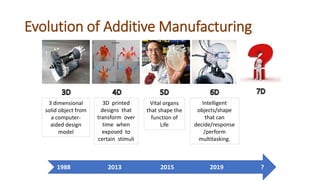
Evolution of Additive Manufacturing
1988 2013 2015 2019 ?
3 dimensional
solid object from
a computer-
aided design
model
3D printed
designs that
transform over
time when
exposed to
certain stimuli
Vital organs
that shape the
function of
Life
Intelligent
objects/shape
that can
decide/response
/perform
multitasking.
4D Printing
4D printing refers to 3D printing of designs that transform over
time when exposed to certain stimuli.
SMART
Material
Purpose
To make things self-assemble when exposed to air, water or heat due to the chemical interaction of the materials
3D Printer 4D Object
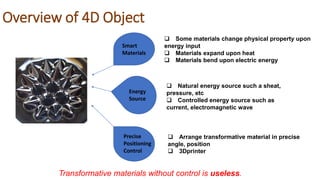
Overview of 4D Object
Smart
Materials
Energy
Source
Precise
Positioning
Control
 Some materials change physical property upon
energy input
 Materials expand upon heat
 Materials bend upon electric energy
 Natural energy source such a sheat,
pressure, etc
 Controlled energy source such as
current, electromagnetic wave
 Arrange transformative material in precise
angle, position
 3Dprinter
Transformative materials without control is useless.
Important Aspects of 4D Printing
4D Printing
Simulation
Software
Multi materials
printer
SMART
materials
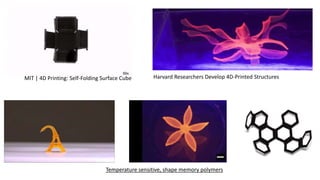
MIT | 4D Printing: Self-Folding Surface Cube Harvard Researchers Develop 4D-Printed Structures
Temperature sensitive, shape memory polymers
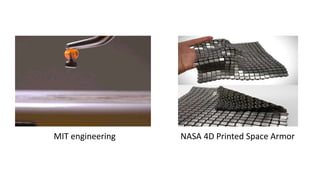
MIT engineering NASA 4D Printed Space Armor
Comparison Between Materials
List of Smart Metal Alloys
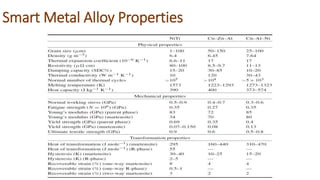
Smart Metal Alloy Properties
Development of Self healing polymers
• The material is a co-polymer made from a mix of methyl methacrylate and n-butyl acrylate.
The co-polymer’s molecular arrangement and composition are critical to achieving self-healing, says Marek
Urban, a Clemson University polymer chemist who led the research project.
The van der Waals forces—attractive and repulsive forces between molecules caused by temporary
dipoles—heal the polymer by forcing its components to interdigitate, like fingers on clasping hands.
To achieve this interaction, the monomers must both alternate positions and be present in approximately
equal proportions (Science 2018, DOI: 10.1126/science.aat2975)
What’s Next? 4DPrinting
Physical programming ofmacro-sized3Dmaterials to self-assemble themselves into predetermined structures and shapes
Print
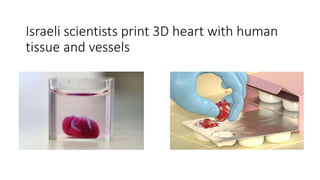
Israeli scientists print 3D heart with human
tissue and vessels
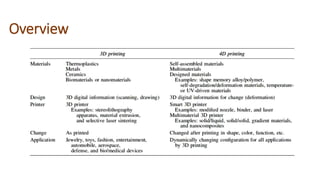
Overview
Required Considerations
• Guide: Driven by major application need and aimed at innovative research.
• Design: The function requirements and application requirements design
promote each other’s development in the spiral way.
• Material Science: R&D of 4D printing metals, polymers, ceramics and their
composites.
• Technology: Focus on the development of new technology and equipment
that can preset drive signals.
• Verification: Carry out in combination with the application unit, and
gradually establish various evaluation units.
• Application: Soft robot, variant UAV, deformed engine etc.
Challenges
• Shape recovery
• Material denature after several cycles
• Performance changes after cycle
• Material stability
• Efficiency
Goals
Material should be
• Light weight
• Multifunctional composites
• Energy loaded and photomaterial structures
• Develop materials and structures for addition or replacement of
damage body parts.
Opportunities
 The trend of 4D printing is mostly toward introducing and improving
mechanical characteristics of object.
 There is still a gap to deal with other physical properties, such as
when we apply heat, current, pressure or magnetic field, it give
response by glowing, color changing, cooling or making sound, rather
then bending or moving only.
Thank You…

Additive manufacturing and 3 d printing

  • 1.
    Additive Manufacturing and3D Printing Shamoon Al Islam Advanced Manufacturing Center, China University of Geosciences, China.
  • 2.
    Contents • Additive Manufacturing:3D printing • 3D Printing VS Traditional Manufacturing • Major 3D Printing Technologies • Applications of 3D Printing Technology • Evolution of Additive Manufacturing • Important Aspects of 4D Printing • Comparison Between Materials • Smart Metal • Development of Self healing polymers • What’s Next? 4DPrinting • Overview • Required Considerations • Challenges • Goals • Oppertunities
  • 3.
    Additive Manufacturing: 3Dprinting • The 3D printing process builds a three-dimensional object from a computer- aided design CAD model, usually by successively adding material layer by layer, which is why it is also called additive manufacturing 3D CAD Model Slicing and exporting CAD file 3D Printed ModelAdditive Manufacturing
  • 4.
    3D Printing VSTraditional Manufacturing • Unlike conventional machining, casting and forging processes, where material is removed from a stock item or poured into a mold and shaped by means of dies, presses and hammers • 3D printing saves on energy by 40 to 65 percent as it other logistics activities and enables users to produce objects with lesser material Cost Design Speed Quality Up to 70% savings due on Prototyping costs Allows for easy yet inexpensive innovation in design Lesser time taken due to compressed design cycles Lighter & smaller amount of waste; Higher precision with layer-by-layer manufacturing. Higher Cost of manufacturing & shipping Traditional Manufacturing 3D Printing Less innovative designs due to cost constraints More time to build final product Creates more waste; subtractive process will compromise on precision
  • 5.
    Major 3D PrintingTechnologies • Stereolithography (SLA) • Fused deposition Modeling (FDM) • Selective Laser Sintering (SLS) • Selective Laser Melting (SLM)
  • 6.
    Stereolithography (SLA) Technology •SLA is a fast, accurate and precise prototyping process. • It can produce objects from 3D CAD data (computer-generated) files in just a few hours. • This is a 3D printing process that’s popular for its fine details and exactness. • They do this by converting liquid photopolymers (a special type of plastic) into solid 3D objects, one layer at a time. The plastic is first heated to turn it into a semi-liquid form, and then it hardens on contact. The printer constructs each of these layers using an ultra violet laser, directed by X and Y scanning mirrors. Just before each print cycle, a recoater blade moves across the surface to ensure each thin layer of resin spreads evenly across the object. The print cycle continues in this way, building 3D objects from the bottom up.
  • 8.
    Fused Deposition Modeling(FDM) Technology • FDM is a 3D printing process developed by Scott Crump, and then implemented by Stratasys Ltd., in the 1980s. • It uses production grade thermal plastic materials to print its 3D objects. • It’s popular for producing functional prototypes, concept models, and manufacturing aids. It’s a technology that can create accurate details and boasts an exceptional strength to weight ratio. • Before the FDM printing process begins, the user has to slice the 3D CAD data (the 3D model) into multiple layers using special software. The sliced CAD data goes to the printer which then builds the object layer at a time on the build platform. • Layer by Layer deposition of Material ultimately form a 3D object
  • 10.
    Selective Laser Sintering(SLS) Technology • An American businessman, inventor, and teacher named Dr. Carl Deckard developed and patented SLS technology in the mid-1980s. • It’s a 3D printing technique that uses high power CO2 lasers to fuse particles together. The laser sinters powdered metal materials (though it can utilize other materials too, like white nylon powder, ceramics and even glass). • Here’s how it works: The build platform, or bed, lowers incrementally with each successive laser scan. It’s a process that repeats one layer at a time until it reaches the object’s height. There is un-sintered support from other powders during the build process that surround and protect the model. This means the 3D objects don’t need other support structures during the build. Someone will remove the un-sintered powders manually after printing. • SLS produces durable, high precision parts, and it can use a wide range of materials.
  • 12.
    Selective Laser Melting(SLM) Technology • SLM made its debut appearance back in 1995. • SLM also uses a high-powered laser beam to form 3D parts. • During the printing process, the laser beam melts and fuses various metallic powders together. The simple way to look at this is to break down the basic process like thus: • Powdered material + heat + precision + layered structure = a perfect 3D object. • As the laser beam hits a thin layer of the material, it selectively joins or welds the particles together. After one complete print cycle, the printer adds a new layer of powered material to the previous one. The object then lowers by the precise amount of the thickness of a single layer. • When the print process is complete, someone will manually remove the unused powder from the object. • In general, SLM end products tend to be stronger as they have fewer or no voids.
  • 14.
    SLS vs SLM •Essentially the term selective laser sintering (SLS) is applicable for polymers, plastics and non-metals. So the fusing can take place at melting or semi-melting temperatures. • On the other hand, selective laser melting (SLM) is applicable for metals, where fusing takes place by complete melting of metal powders. SLMSLS
  • 15.
    Applications of 3DPrinting Technology Healthcare and Medical Architecture and Construction Chemical Industry Mechanics Food Industry Education Aeronautics and Space High Tech Textile and Fashion Electronics
  • 16.
    Anelia Myburgh isa 31-year-old from Melbourne, Australia who had lost 80% of her jaw due to cancer. She Received World-First 3D Printed Jaw Reconstruction. Before After
  • 17.
    • Chinese babybecame first person in the world to have her entire skull reconstructed by 3D printers, known as the 'big-head baby • fluid filled 85 per cent of her brain - making her skull three-four times larger than it should have been, measuring around 20cmx20cm • used CT scans and 3D data to create three titanium mesh skull implants which combined, would replace the entire top portion of the toddler’s skull • surgeons used 3D printing technology to create a titanium alloy skull and successfully set it into Han-Han's head during a 17-hour operation
  • 18.
    Evolution of AdditiveManufacturing 1988 2013 2015 2019 ? 3 dimensional solid object from a computer- aided design model 3D printed designs that transform over time when exposed to certain stimuli Vital organs that shape the function of Life Intelligent objects/shape that can decide/response /perform multitasking.
  • 19.
    4D Printing 4D printingrefers to 3D printing of designs that transform over time when exposed to certain stimuli. SMART Material Purpose To make things self-assemble when exposed to air, water or heat due to the chemical interaction of the materials 3D Printer 4D Object
  • 20.
    Overview of 4DObject Smart Materials Energy Source Precise Positioning Control  Some materials change physical property upon energy input  Materials expand upon heat  Materials bend upon electric energy  Natural energy source such a sheat, pressure, etc  Controlled energy source such as current, electromagnetic wave  Arrange transformative material in precise angle, position  3Dprinter Transformative materials without control is useless.
  • 21.
    Important Aspects of4D Printing 4D Printing Simulation Software Multi materials printer SMART materials
  • 22.
    MIT | 4DPrinting: Self-Folding Surface Cube Harvard Researchers Develop 4D-Printed Structures Temperature sensitive, shape memory polymers
  • 23.
    MIT engineering NASA4D Printed Space Armor
  • 24.
  • 25.
    List of SmartMetal Alloys
  • 26.
  • 27.
    Development of Selfhealing polymers
  • 28.
    • The materialis a co-polymer made from a mix of methyl methacrylate and n-butyl acrylate. The co-polymer’s molecular arrangement and composition are critical to achieving self-healing, says Marek Urban, a Clemson University polymer chemist who led the research project. The van der Waals forces—attractive and repulsive forces between molecules caused by temporary dipoles—heal the polymer by forcing its components to interdigitate, like fingers on clasping hands. To achieve this interaction, the monomers must both alternate positions and be present in approximately equal proportions (Science 2018, DOI: 10.1126/science.aat2975)
  • 29.
    What’s Next? 4DPrinting Physicalprogramming ofmacro-sized3Dmaterials to self-assemble themselves into predetermined structures and shapes
  • 30.
  • 31.
    Israeli scientists print3D heart with human tissue and vessels
  • 32.
  • 33.
    Required Considerations • Guide:Driven by major application need and aimed at innovative research. • Design: The function requirements and application requirements design promote each other’s development in the spiral way. • Material Science: R&D of 4D printing metals, polymers, ceramics and their composites. • Technology: Focus on the development of new technology and equipment that can preset drive signals. • Verification: Carry out in combination with the application unit, and gradually establish various evaluation units. • Application: Soft robot, variant UAV, deformed engine etc.
  • 34.
    Challenges • Shape recovery •Material denature after several cycles • Performance changes after cycle • Material stability • Efficiency
  • 35.
    Goals Material should be •Light weight • Multifunctional composites • Energy loaded and photomaterial structures • Develop materials and structures for addition or replacement of damage body parts.
  • 36.
    Opportunities  The trendof 4D printing is mostly toward introducing and improving mechanical characteristics of object.  There is still a gap to deal with other physical properties, such as when we apply heat, current, pressure or magnetic field, it give response by glowing, color changing, cooling or making sound, rather then bending or moving only.
  • 37.