PRODUCTION OF 
COMPOSITES 
By: 
Gulfam Hussain 
Megan McNeill 1
Introduction 
There are two general divisions of composites 
manufacturing processes: 
 Open molding 
 Closed molding 
With open molding, the gel coat and laminate are 
exposed to the atmosphere during the fabrication 
process. 
In closed molding, the composite is processed in a two-sided 
mold set, or within a vacuum bag. 
2
There are a variety of processing methods within the open 
and closed molding categories: 
 Open molding 
 Hand Lay-Up 
 Spray-up 
 Filament Winding 
3 
 Closed molding 
 Compression molding 
 Pultrusion 
 Vacuum Bag Molding 
 Vacuum Infusion Processing 
 Resin Transfer Molding (RTM) 
 Reinforced Reaction Injection Molding (RRIM) 
 Centrifugal Casting
 Hand Lay-Up 
Open mold shaping method in which successive layers of 
resin and reinforcement are manually applied to an 
open mold to build the laminated FRP composite 
structure. 
Process Description - Gel coat is first applied to the mold 
using a spray gun for a high-quality surface. When the 
gel coat has cured sufficiently, roll stock fiberglass 
reinforcement is manually placed on the mold. The 
laminating resin is applied by pouring, brushing, 
spraying, or using a paint roller. FRP rollers, paint 
rollers, or squeegees are used to consolidate the 
laminate, thoroughly wetting the reinforcement, and 
removing entrapped air. Subsequent layers of fiberglass 
reinforcement are added to build laminate thickness. 
4
Molds - Simple, single-cavity molds of fiberglass 
composites construction are generally used. Molds can 
range from very small to very large and are low cost in 
the spectrum of composites molds. 
Major Advantages - Simplest method offering low-cost 
tooling, simple processing, and a wide range of part 
sizes. Design changes are readily made. There is a 
minimum investment in equipment. With skilled 
operators, good production rates and consistent quality 
are obtainable. 
5
6 
Products: 
 Boats 
 Boat hulls 
 Swimming pools 
 Large container tanks 
 Movie and stage props 
 Other formed sheets 
 The largest molding ever made was ship hulls for the 
British Royal Navy: 85 m (280 ft) long. 
Production volume per mold is low; however, it is feasible to 
produce substantial production quantities using multiple 
molds.
7 
 Spray-Up (Chopping) 
In the spray-up process the operator controls thickness and 
consistency, therefore the process is more operator 
dependent than hand lay-up. 
Process Description - As with hand lay-up, gel coat is first 
applied to the mold prior to spray-up of the substrate 
laminate. Continuous strand glass roving and catalyzed 
resin are fed through a chopper gun, which deposits the 
resin-saturated "chop" on the mold. The laminate is then 
rolled thoroughly to saturate the glass strands and 
compact the chop. Additional layers of chop laminate are 
added as required for thickness. Roll stock 
reinforcements, such as woven roving or knitted fabrics, 
can be used in conjunction with the chopped laminates..
Molds - These are the same molds as in hand lay-up 
simple, single-cavity, molds of fiberglass composites 
construction. Molds can range from very small to very 
large and are low cost in the spectrum of composites 
molds. 
Major Advantages - Simple, low-cost tooling, simple 
processing; portable equipment permits on-site 
fabrication; virtually no part size limitations. The process 
may be automated. 
8
9 
Products: 
 Boats 
 Tanks 
 Transportation components and 
 Tub/Shower in a large variety of shapes and sizes. 
Since products made by spray-up have randomly 
oriented short fibers, they are not as strong as those 
made by lay-up, in which the fibers are continuous and 
directed. 
Although production volume per mold is low, it is feasible 
to produce substantial production quantities using 
multiple molds.
 Filament Winding 
Filament winding is an automated open molding process 
that uses a rotating mandrel as the mold. The male mold 
configuration produces a finished inner surface and a 
laminate surface on the outside diameter of the product. 
Process Description - Continuous strand roving is fed 
through a resin bath and wound onto a rotating mandrel. 
The filament is laid down in a predetermined geometric 
pattern to provide maximum strength in the directions 
required. When sufficient layers have been applied, the 
laminate is cured on the mandrel. The molded part is 
then stripped from the mandrel. Equipment is available 
for filament winding on a continuous basis and two axis 
winding for pressure cylinders. Filament winding can be 
combined with the chopping process and is known as 
the hoop chop process. 
10
Molds - Mandrels of suitable size and shape, made of 
steel or aluminum form the inner surface of the hollow 
part. Some mandrels are collapsible to facilitate part 
removal. 
Major Advantages - The process makes the high strength-to- 
weight ratio laminates and provides a high degree of 
control over uniformity and fiber orientation. The filament 
winding process can be used to make structures which 
are highly engineered and meet strict tolerances. 
Because filament winding is automated, the labor factor 
for filament winding is lower than other open molding 
processes. 
11
12 
Products: 
Filament winding results in a high degree of fiber 
loading, which provides high tensile strengths in the 
manufacture of hollow, generally cylindrical products 
such as 
 Chemical and fuel storage tanks 
 Pipes 
 Stacks 
 pressure vessels and 
 rocket motor cases.
 Compression Molding 
Compression molding is a high-volume, high-pressure 
method suitable for molding complex, fiberglass-reinforced 
plastic parts on a rapid cycle time. 
Compression molding tooling consists of heated metal 
molds mounted in large presses. 
Process Description - The mold set is mounted in a 
hydraulic or mechanical molding press. The molds are 
heated to 2500 to 4000 F. A weighed charge of molding 
compound is placed in the open mold. The two halves of 
the mold are closed and pressure is applied. Depending 
on thickness, size, and shape of the part, curing cycles 
range from less than a minute to about five minutes. The 
mold is opened and the finished part is removed. 
13
Molds - Tooling is usually machined steel or cast alloy 
molds that can be in either single or multiple-cavity 
configurations. Steel molds are hardened and 
sometimes chrome plated for enhanced durability. Mold 
materials include cast of forged steel, cast iron, and cast 
aluminum. 
Major Advantages - Compression molding produces fast 
molding cycles and high part uniformity. The process can 
be automated. Good part design flexibility and features 
and attachments can be molded in. Good surface 
finishes are obtainable, contributing to lower part 
finishing cost. Subsequent trimming and machining 
operations are minimized in compression molding. Labor 
costs are low. 
14
Products: 
Typical parts include: 
 Automobile components 
 Appliance housings 
 Structural components, 
 Electrical components 
15
16 
 Pultrusion 
Pultrusion is a continuous process for the manufacture of 
products having a constant cross section, such as rod 
stock, beam etc. 
Process Description - Continuous strand fiberglass roving, 
or surfacing veil is impregnated in a resin bath, then 
pulled (pul-trusion) through a steel die, by a powerful 
tractor mechanism. The steel die consolidates the 
saturated reinforcement, sets the shape of the stock, and 
controls the fiber/resin ratio. The die is heated to rapidly 
cure the resin. Many creels (balls) of roving are 
positioned on a rack, and a complex series of tensioning 
devices and roving guides direct the roving into the die.
Molds - Hardened steel dies are machined and include a 
preform area to do the initial shaping of the resin-saturated 
roving. The dies include heating which can be 
electric or hot oil. The latest pultrusion technology uses 
direct injection dies, in which the resin is introduced 
inside the die, rather than through an external resin bath. 
Major Advantages - The process is a continuous operation 
that can be readily automated. It is adaptable to both 
simple and complex cross-sectional shapes. Very high 
strengths are possible due to the fiber loading and labor 
costs are low. 
17
18 
Products: 
 solid rods 
 long flat sheets 
 structural sections (such as channels, angled and 
flanged beams).
 Vacuum Bag Molding 
The mechanical properties of open-mold laminates can be 
improved with vacuum bagging. By reducing the 
pressure inside the vacuum bag, external atmospheric 
pressure exerts force on the bag. The pressure on the 
laminate removes entrapped air, excess resin, and 
compacts the laminate. A higher percentage of fiber 
reinforcement is the result. 
Process Description - In the simplest form of vacuum 
bagging, a flexible film (PVA, nylon, mylar, or 
polyethylene) is placed over the wet lay-up, the edges 
sealed, and a vacuum drawn. Pulling a vacuum from 
within the bag uses atmospheric pressure to eliminate 
voids and force excess resin from the laminate. The 
addition of pressure further results in high fiber 
concentration and provides better adhesion between 
layers of sandwich construction. 19
Molds - Molds are similar to those used for conventional 
open-mold processes. 
Major Advantages - Vacuum bag processing can produce 
laminates with a uniform degree of consolidation, while 
at the same time removing entrapped air, thus reducing 
the finished void content. 
20
 Vacuum Infusion Processing 
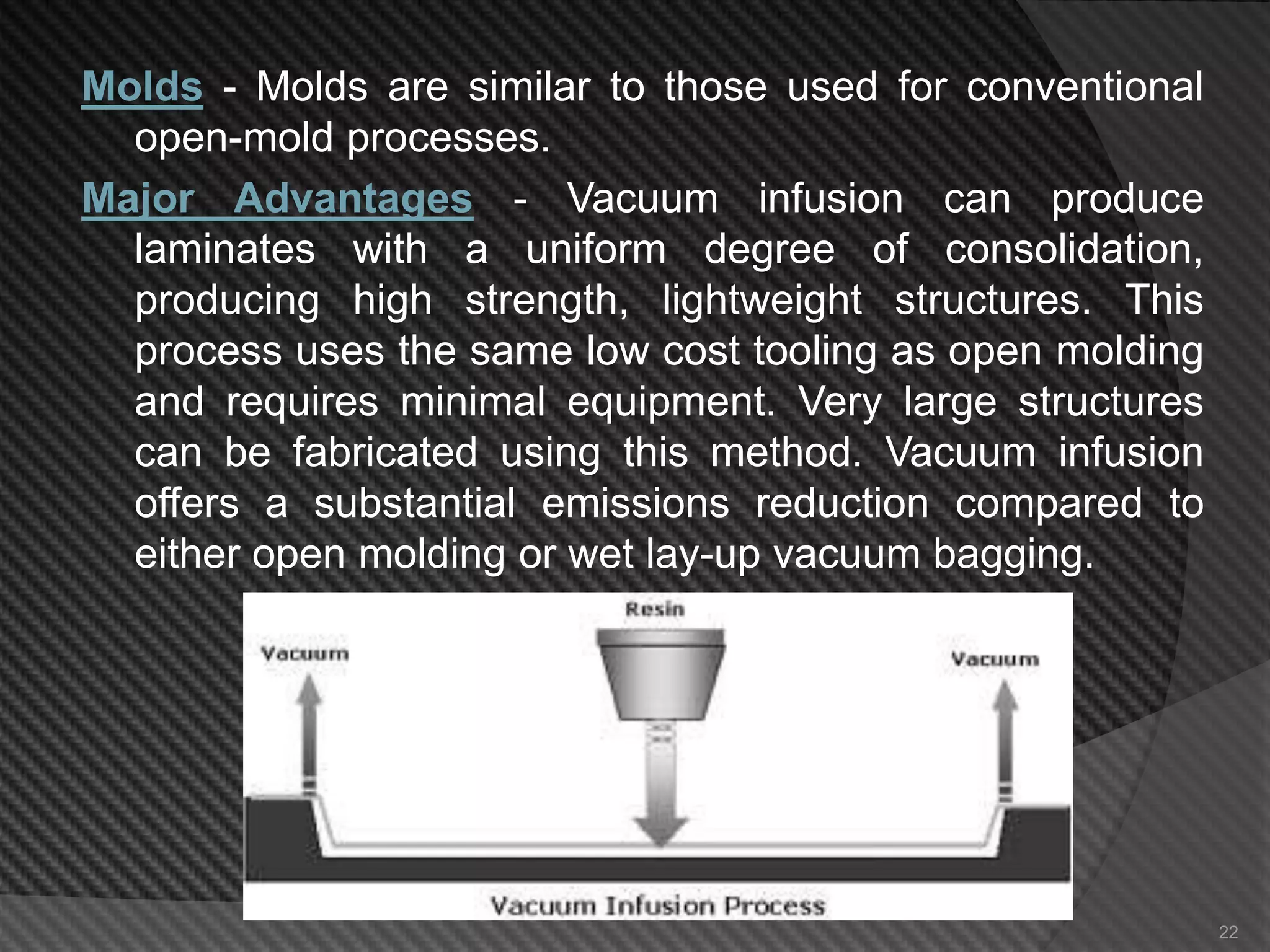
Vacuum infusion is a variation of vacuum bagging where 
the resin is introduced into the mold after the vacuum 
has pulled the bag down and compacted the laminate. 
The method is defined as having lower than 
atmospheric pressure in the mold cavity. The 
reinforcement and core material are laid-up dry in the 
mold. This is done by hand and provides the 
opportunity to precisely position the reinforcement. 
When the resin is pulled into the mold the laminate is 
already compacted; therefore, there is no room for 
excess resin. Very high resin to glass ratios are 
possible with vacuum infusion and the mechanical 
properties of the laminate are superior. Vacuum 
infusion is suitable to mold very large structures and is 
considered a low volume molding process. 
21
Molds - Molds are similar to those used for conventional 
open-mold processes. 
Major Advantages - Vacuum infusion can produce 
laminates with a uniform degree of consolidation, 
producing high strength, lightweight structures. This 
process uses the same low cost tooling as open molding 
and requires minimal equipment. Very large structures 
can be fabricated using this method. Vacuum infusion 
offers a substantial emissions reduction compared to 
either open molding or wet lay-up vacuum bagging. 
22
 Resin Transfer Molding 
Resin transfer molding is an intermediate volume molding 
process for producing composites. The RTM process is 
to inject resin under pressure into a mold cavity. This 
process can be automated and is capable of producing 
rapid cycle times. Vacuum assist can be used to 
enhance resin flow in the mold cavity. 
Process Description - The mold set is gel coated 
conventionally, if required. The reinforcement (and core 
material) is positioned in the mold and the mold is 
closed and clamped. The resin is injected under 
pressure, using mix/meter injection equipment, and the 
part is cured in the mold. The reinforcement can be 
either a preform or pattern cut roll from stock material. 
Preforms are reinforcement that is pre-formed in a 
separate process and can be quickly positioned in the 
mold. 23
RTM can be done at room temperature; however, heated 
molds are required to achieve fast cycle times and 
product consistency. Clamping can be accomplished 
with perimeter clamping or press clamping. 
Molds - RTM can utilize either "hard" or "soft" tooling. Soft 
tooling would be either polyester or epoxy molds, while 
hard tooling may consist of cast machined aluminum, 
electroformed nickel shell, or machined steel molds. 
Major Advantages - This closed molding process 
produces parts with two finished surfaces. By laying up 
reinforcement material dry inside the mold, any 
combination of materials and orientation can be used, 
including 3-D reinforcements. Part thickness is 
determined by the tool cavity. Fast cycle times can be 
achieved in temperature controlled tooling and the 
process can range from simple to highly automated. 
24
25
26

Production of composites

  • 1.
    PRODUCTION OF COMPOSITES By: Gulfam Hussain Megan McNeill 1
  • 2.
    Introduction There aretwo general divisions of composites manufacturing processes:  Open molding  Closed molding With open molding, the gel coat and laminate are exposed to the atmosphere during the fabrication process. In closed molding, the composite is processed in a two-sided mold set, or within a vacuum bag. 2
  • 3.
    There are avariety of processing methods within the open and closed molding categories:  Open molding  Hand Lay-Up  Spray-up  Filament Winding 3  Closed molding  Compression molding  Pultrusion  Vacuum Bag Molding  Vacuum Infusion Processing  Resin Transfer Molding (RTM)  Reinforced Reaction Injection Molding (RRIM)  Centrifugal Casting
  • 4.
     Hand Lay-Up Open mold shaping method in which successive layers of resin and reinforcement are manually applied to an open mold to build the laminated FRP composite structure. Process Description - Gel coat is first applied to the mold using a spray gun for a high-quality surface. When the gel coat has cured sufficiently, roll stock fiberglass reinforcement is manually placed on the mold. The laminating resin is applied by pouring, brushing, spraying, or using a paint roller. FRP rollers, paint rollers, or squeegees are used to consolidate the laminate, thoroughly wetting the reinforcement, and removing entrapped air. Subsequent layers of fiberglass reinforcement are added to build laminate thickness. 4
  • 5.
    Molds - Simple,single-cavity molds of fiberglass composites construction are generally used. Molds can range from very small to very large and are low cost in the spectrum of composites molds. Major Advantages - Simplest method offering low-cost tooling, simple processing, and a wide range of part sizes. Design changes are readily made. There is a minimum investment in equipment. With skilled operators, good production rates and consistent quality are obtainable. 5
  • 6.
    6 Products: Boats  Boat hulls  Swimming pools  Large container tanks  Movie and stage props  Other formed sheets  The largest molding ever made was ship hulls for the British Royal Navy: 85 m (280 ft) long. Production volume per mold is low; however, it is feasible to produce substantial production quantities using multiple molds.
  • 7.
    7  Spray-Up(Chopping) In the spray-up process the operator controls thickness and consistency, therefore the process is more operator dependent than hand lay-up. Process Description - As with hand lay-up, gel coat is first applied to the mold prior to spray-up of the substrate laminate. Continuous strand glass roving and catalyzed resin are fed through a chopper gun, which deposits the resin-saturated "chop" on the mold. The laminate is then rolled thoroughly to saturate the glass strands and compact the chop. Additional layers of chop laminate are added as required for thickness. Roll stock reinforcements, such as woven roving or knitted fabrics, can be used in conjunction with the chopped laminates..
  • 8.
    Molds - Theseare the same molds as in hand lay-up simple, single-cavity, molds of fiberglass composites construction. Molds can range from very small to very large and are low cost in the spectrum of composites molds. Major Advantages - Simple, low-cost tooling, simple processing; portable equipment permits on-site fabrication; virtually no part size limitations. The process may be automated. 8
  • 9.
    9 Products: Boats  Tanks  Transportation components and  Tub/Shower in a large variety of shapes and sizes. Since products made by spray-up have randomly oriented short fibers, they are not as strong as those made by lay-up, in which the fibers are continuous and directed. Although production volume per mold is low, it is feasible to produce substantial production quantities using multiple molds.
  • 10.
     Filament Winding Filament winding is an automated open molding process that uses a rotating mandrel as the mold. The male mold configuration produces a finished inner surface and a laminate surface on the outside diameter of the product. Process Description - Continuous strand roving is fed through a resin bath and wound onto a rotating mandrel. The filament is laid down in a predetermined geometric pattern to provide maximum strength in the directions required. When sufficient layers have been applied, the laminate is cured on the mandrel. The molded part is then stripped from the mandrel. Equipment is available for filament winding on a continuous basis and two axis winding for pressure cylinders. Filament winding can be combined with the chopping process and is known as the hoop chop process. 10
  • 11.
    Molds - Mandrelsof suitable size and shape, made of steel or aluminum form the inner surface of the hollow part. Some mandrels are collapsible to facilitate part removal. Major Advantages - The process makes the high strength-to- weight ratio laminates and provides a high degree of control over uniformity and fiber orientation. The filament winding process can be used to make structures which are highly engineered and meet strict tolerances. Because filament winding is automated, the labor factor for filament winding is lower than other open molding processes. 11
  • 12.
    12 Products: Filamentwinding results in a high degree of fiber loading, which provides high tensile strengths in the manufacture of hollow, generally cylindrical products such as  Chemical and fuel storage tanks  Pipes  Stacks  pressure vessels and  rocket motor cases.
  • 13.
     Compression Molding Compression molding is a high-volume, high-pressure method suitable for molding complex, fiberglass-reinforced plastic parts on a rapid cycle time. Compression molding tooling consists of heated metal molds mounted in large presses. Process Description - The mold set is mounted in a hydraulic or mechanical molding press. The molds are heated to 2500 to 4000 F. A weighed charge of molding compound is placed in the open mold. The two halves of the mold are closed and pressure is applied. Depending on thickness, size, and shape of the part, curing cycles range from less than a minute to about five minutes. The mold is opened and the finished part is removed. 13
  • 14.
    Molds - Toolingis usually machined steel or cast alloy molds that can be in either single or multiple-cavity configurations. Steel molds are hardened and sometimes chrome plated for enhanced durability. Mold materials include cast of forged steel, cast iron, and cast aluminum. Major Advantages - Compression molding produces fast molding cycles and high part uniformity. The process can be automated. Good part design flexibility and features and attachments can be molded in. Good surface finishes are obtainable, contributing to lower part finishing cost. Subsequent trimming and machining operations are minimized in compression molding. Labor costs are low. 14
  • 15.
    Products: Typical partsinclude:  Automobile components  Appliance housings  Structural components,  Electrical components 15
  • 16.
    16  Pultrusion Pultrusion is a continuous process for the manufacture of products having a constant cross section, such as rod stock, beam etc. Process Description - Continuous strand fiberglass roving, or surfacing veil is impregnated in a resin bath, then pulled (pul-trusion) through a steel die, by a powerful tractor mechanism. The steel die consolidates the saturated reinforcement, sets the shape of the stock, and controls the fiber/resin ratio. The die is heated to rapidly cure the resin. Many creels (balls) of roving are positioned on a rack, and a complex series of tensioning devices and roving guides direct the roving into the die.
  • 17.
    Molds - Hardenedsteel dies are machined and include a preform area to do the initial shaping of the resin-saturated roving. The dies include heating which can be electric or hot oil. The latest pultrusion technology uses direct injection dies, in which the resin is introduced inside the die, rather than through an external resin bath. Major Advantages - The process is a continuous operation that can be readily automated. It is adaptable to both simple and complex cross-sectional shapes. Very high strengths are possible due to the fiber loading and labor costs are low. 17
  • 18.
    18 Products: solid rods  long flat sheets  structural sections (such as channels, angled and flanged beams).
  • 19.
     Vacuum BagMolding The mechanical properties of open-mold laminates can be improved with vacuum bagging. By reducing the pressure inside the vacuum bag, external atmospheric pressure exerts force on the bag. The pressure on the laminate removes entrapped air, excess resin, and compacts the laminate. A higher percentage of fiber reinforcement is the result. Process Description - In the simplest form of vacuum bagging, a flexible film (PVA, nylon, mylar, or polyethylene) is placed over the wet lay-up, the edges sealed, and a vacuum drawn. Pulling a vacuum from within the bag uses atmospheric pressure to eliminate voids and force excess resin from the laminate. The addition of pressure further results in high fiber concentration and provides better adhesion between layers of sandwich construction. 19
  • 20.
    Molds - Moldsare similar to those used for conventional open-mold processes. Major Advantages - Vacuum bag processing can produce laminates with a uniform degree of consolidation, while at the same time removing entrapped air, thus reducing the finished void content. 20
  • 21.
     Vacuum InfusionProcessing Vacuum infusion is a variation of vacuum bagging where the resin is introduced into the mold after the vacuum has pulled the bag down and compacted the laminate. The method is defined as having lower than atmospheric pressure in the mold cavity. The reinforcement and core material are laid-up dry in the mold. This is done by hand and provides the opportunity to precisely position the reinforcement. When the resin is pulled into the mold the laminate is already compacted; therefore, there is no room for excess resin. Very high resin to glass ratios are possible with vacuum infusion and the mechanical properties of the laminate are superior. Vacuum infusion is suitable to mold very large structures and is considered a low volume molding process. 21
  • 22.
    Molds - Moldsare similar to those used for conventional open-mold processes. Major Advantages - Vacuum infusion can produce laminates with a uniform degree of consolidation, producing high strength, lightweight structures. This process uses the same low cost tooling as open molding and requires minimal equipment. Very large structures can be fabricated using this method. Vacuum infusion offers a substantial emissions reduction compared to either open molding or wet lay-up vacuum bagging. 22
  • 23.
     Resin TransferMolding Resin transfer molding is an intermediate volume molding process for producing composites. The RTM process is to inject resin under pressure into a mold cavity. This process can be automated and is capable of producing rapid cycle times. Vacuum assist can be used to enhance resin flow in the mold cavity. Process Description - The mold set is gel coated conventionally, if required. The reinforcement (and core material) is positioned in the mold and the mold is closed and clamped. The resin is injected under pressure, using mix/meter injection equipment, and the part is cured in the mold. The reinforcement can be either a preform or pattern cut roll from stock material. Preforms are reinforcement that is pre-formed in a separate process and can be quickly positioned in the mold. 23
  • 24.
    RTM can bedone at room temperature; however, heated molds are required to achieve fast cycle times and product consistency. Clamping can be accomplished with perimeter clamping or press clamping. Molds - RTM can utilize either "hard" or "soft" tooling. Soft tooling would be either polyester or epoxy molds, while hard tooling may consist of cast machined aluminum, electroformed nickel shell, or machined steel molds. Major Advantages - This closed molding process produces parts with two finished surfaces. By laying up reinforcement material dry inside the mold, any combination of materials and orientation can be used, including 3-D reinforcements. Part thickness is determined by the tool cavity. Fast cycle times can be achieved in temperature controlled tooling and the process can range from simple to highly automated. 24
  • 25.
  • 26.

Editor's Notes