Ch # 15 Shaping Processes for Polymer Matrix
Composites
International Islamic University
Islamabad
Shaping processes for polymer
matrix composites
 Starting Materials for PMCs
 Open Mold Processes
 Closed Mold Processes
 Filament Winding
 Pultrusion Processes
 Other PMC Shaping Processes
Overview of PMC
Technology
A polymer matrix composite (PMC) is a
composite material consisting of a polymer
imbedded with a reinforcing phase
 The importance of PMC processes derive
from the growing use of this class of material,
especially fiber-reinforced polymers (FRPs)
 FRP composites can be designed with very high
strength-to-weight and modulus-to-weight ratios
 These features make them attractive in aircraft,
cars, trucks, boats, and sports equipment
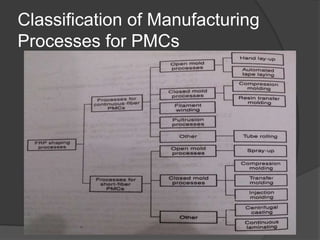
Classification of Manufacturing
Processes for PMCs
Starting Materials for PMCs
 In PMCs starting materials are polymers
and reinforcing phase.
 They are processed separately before
becoming phases in the composites.
Polymer Matrix
 The basic polymer types used are
Thermoplastics, Thermosets &
Elastomers.
 Thermosetting (TS) polymers are most
common matrix composites.
 The principal TS are Phenolics,
Unsaturated Polyesters and Epoxies.
Reinforcing Agent
 The Reinforcing phase can be any of the
several geometric and materials.
 The Shapes include Fibers, Particals
and Flakes & materials are ceramics,
metals & other plymers or elemetns
such as carbon or boron.
Combining Matrix &
Reinforcement
 Combining process of the reinforcing agent
into the polymer matrix either occurs during
the shaping process or beforehand.
 In first case both materials arrive at the
fabrication operation separately & are
combined into the composites during
shaping, e.g filament winding & Pultrusion.
 In second case both are combined into
some preliminary form that is convenient for
use in shaping process.
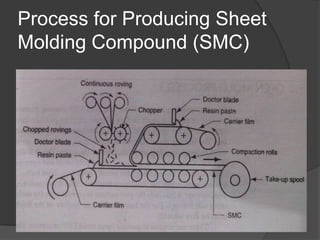
Process for Producing Sheet
Molding Compound (SMC)
Fibers as the Reinforcing Phase in
FRPs
 Common fiber materials: glass, carbon, and
Kevlar (a polymer)
 In some fabrication processes, the
filaments are continuous, while in others,
they are chopped into short lengths
 In continuous form, individual filaments are
usually available as rovings –(collections of
untwisted continuous strands)
 By contrast, a yarn is a twisted collection of
filaments
Fibers as the Reinforcing
Phase continued
 The most familiar form of continuous fiber
is a cloth - a fabric of woven yarns
 Similar to a cloth is a woven roving, a fabric
consisting of untwisted filaments rather
than yarns
 Woven rovings can be produced with unequal
numbers of strands in the two directions so that
they possess greater strength in one direction
 Such unidirectional woven rovings are often
preferred in laminated FRP composites
Molding Compounds
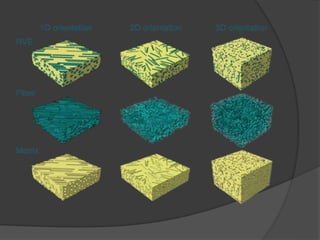
FRP composite molding compounds consist of the
resin matrix with short randomly dispersed fibers
 Similar to those used in plastic molding
 Most molding compounds for composite
processing are thermosetting polymers
 Since they are designed for molding operations,
they must be capable of flowing
 Accordingly, they have not been cured prior to
shape processing
 Curing is done during and/or after final shaping
Open Mold Processes
Family of FRP shaping processes that use a
single positive or negative mold surface to
produce laminated FRP structures
 The starting materials (resins, fibers, mats, and
woven rovings) are applied to the mold in
layers, building up to the desired thickness
 This is followed by curing and part removal
 Common resins are unsaturated polyesters and
epoxies, using fiberglass as the reinforcement
Open Mold FRP Processes
1. Hand lay-up
2. Spray-up
3. Automated tape-laying machines
 The differences are in the methods of
applying the laminations to the mold,
and alternative curing techniques.
Hand Lay-Up Method
Open mold shaping method in which successive
layers of resin and reinforcement are manually
applied to an open mold to build the laminated
FRP composite structure
 Labor-intensive
 Finished molding must usually be trimmed with
a power saw to size outside edges
 Oldest open mold method for FRP laminates,
dating to the 1940s when it was first used for
boat hulls
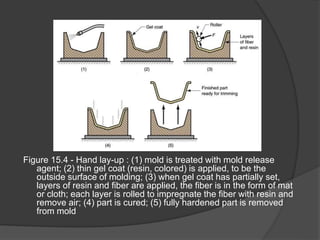
Figure 15.4 - Hand lay-up : (1) mold is treated with mold release
agent; (2) thin gel coat (resin, colored) is applied, to be the
outside surface of molding; (3) when gel coat has partially set,
layers of resin and fiber are applied, the fiber is in the form of mat
or cloth; each layer is rolled to impregnate the fiber with resin and
remove air; (4) part is cured; (5) fully hardened part is removed
from mold
Products Made by Hand
Lay-Up
 Generally large in size but low in production
quantity - not economical for high production
 In addition to boat hulls, other applications
include: large container tanks, radomes, and
other formed sheets
 The largest moldings ever made were ship
hulls for the British Royal Navy: 85 m (280 ft)
long
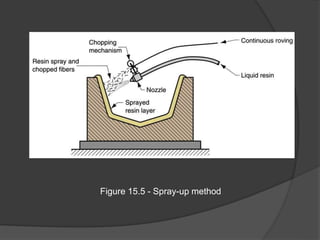
Spray-Up Method
Liquid resin and chopped fibers are sprayed
onto an open mold to build successive FRP
laminations
 It is an attempt to mechanize application of
resin-fiber layers and reduce lay-up time
 It is an alternative for step (3) in the hand
lay-up procedure
Figure 15.5 - Spray-up method
Curing in Open Mold Processes
 Curing is required of all thermosetting resins
used in FRP laminated composites
 Curing cross-links the polymer, transforming
it from its liquid or highly plastic condition into
a hardened product
 Three principal process parameters in curing:
1. Time
2. Temperature
3. Pressure
Curing at Room
Temperature
 Curing normally occurs at room temperature
for the TS resins used in hand lay-up and
spray-up procedures
 Moldings made by these processes are often large
(e.g., boat hulls), and heating would be difficult
 In some cases, days are required before room
temperature curing is sufficiently complete to
remove the part
Curing Methods that Use
Heating
 Oven curing provides heat at closely controlled
temperatures; some curing ovens are equipped
to draw a partial vacuum
 Infrared heating can be used in applications
where it is impractical to place the molding in an
oven
 Curing in an autoclave provides control over
both temperature and pressure
 Autoclave - an enclosed chamber equipped to apply
heat and/or pressure at controlled levels
 In FRP composites processing, it is usually a large
horizontal cylinder with doors at either end
Closed Mold Processes
 Performed in molds consisting of two sections
that open and close each molding cycle
 Tooling cost is more that twice the cost of a
comparable open mold due to the more
complex equipment required
 Advantages of a closed mold are: (1) good
finish on all part surfaces, (2) higher
production rates, (3) closer control over
tolerances, and (4) more complex
three-dimensional shapes are possible
Closed Mold Processes
 Compression Molding PMC Process
 Transfer Molding PMC Process
 Injection Molding PMC Process
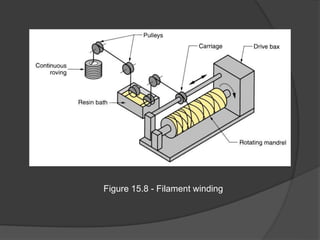
Filament Winding
Resin-impregnated continuous fibers are
wrapped around a rotating mandrel that has the
internal shape of the desired FRP product; the
resin is then cured and the mandrel removed
 The fiber rovings are pulled through a resin
bath immediately before being wound in a
helical pattern onto the mandrel
 The operation is repeated to form additional
layers, each having a criss-cross pattern with
the previous, until the desired part thickness
has been obtained
Figure 15.8 - Filament winding
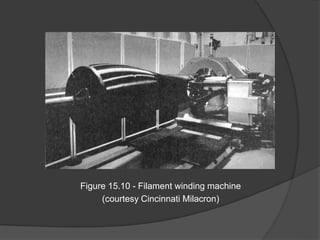
Figure 15.10 - Filament winding machine
(courtesy Cincinnati Milacron)
Pultrusion Processes
Similar to extrusion (hence the name similarity)
but workpiece is pulled through die (so prefix
"pul-" in place of "ex-")
 Like extrusion, pultrusion produces continuous
straight sections of constant cross-section
 A related process, called pulforming, is used
to make parts that are curved and which may
have variations in cross-section throughout
their lengths
Pultrusion
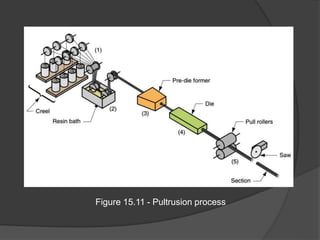
Continuous fiber rovings are dipped into a resin
bath and pulled through a shaping die where the
impregnated resin cures
 The sections produced are reinforced
throughout their length by continuous fibers
 Like extrusion, the pieces have a constant
cross-section, whose profile is determined by
the shape of the die opening
 The cured product is cut into long straight
sections
Figure 15.11 - Pultrusion process
Materials and Products in Pultrusion
 Common resins: unsaturated polyesters,
epoxies, and silicones, all thermosetting
polymers
 Reinforcing phase: E-glass is most widely, in
proportions from 30% to 70%
 Products: solid rods, tubing, long flat sheets,
channels, angled and flanged beams
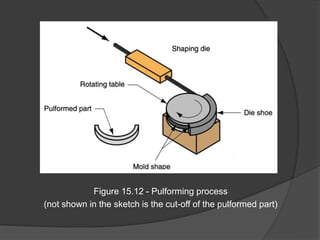
Pulforming
Pultrusion with additional steps to form the
length into a semicircular contour and alter the
cross-sections is known as pulforming
 Pultrusion is limited to straight sections of
constant cross-section
 There is a need for long parts with
continuous fiber reinforcement that are
curved and may vary in geometry throughout
length
 Pulforming is suited to such less regular shapes
Figure 15.12 - Pulforming process
(not shown in the sketch is the cut-off of the pulformed part)
Other PMC Shaping Processes
 Centrifugal casting
 Continuous laminating
 In addition, many of the traditional
thermoplastic shaping processes are
applicable to FRPs (with short fibers)
based on TP polymers; these include
 Blow molding
 Thermoforming
 Extrusion
End of Lecture
Ch 15_SHAPING PROCESSES FOR POLYMER MATRIX COMPOSITES.ppt

Ch 15_SHAPING PROCESSES FOR POLYMER MATRIX COMPOSITES.ppt

  • 1.
    Ch # 15Shaping Processes for Polymer Matrix Composites International Islamic University Islamabad
  • 2.
    Shaping processes forpolymer matrix composites  Starting Materials for PMCs  Open Mold Processes  Closed Mold Processes  Filament Winding  Pultrusion Processes  Other PMC Shaping Processes
  • 3.
    Overview of PMC Technology Apolymer matrix composite (PMC) is a composite material consisting of a polymer imbedded with a reinforcing phase  The importance of PMC processes derive from the growing use of this class of material, especially fiber-reinforced polymers (FRPs)  FRP composites can be designed with very high strength-to-weight and modulus-to-weight ratios  These features make them attractive in aircraft, cars, trucks, boats, and sports equipment
  • 4.
  • 5.
    Starting Materials forPMCs  In PMCs starting materials are polymers and reinforcing phase.  They are processed separately before becoming phases in the composites.
  • 6.
    Polymer Matrix  Thebasic polymer types used are Thermoplastics, Thermosets & Elastomers.  Thermosetting (TS) polymers are most common matrix composites.  The principal TS are Phenolics, Unsaturated Polyesters and Epoxies.
  • 7.
    Reinforcing Agent  TheReinforcing phase can be any of the several geometric and materials.  The Shapes include Fibers, Particals and Flakes & materials are ceramics, metals & other plymers or elemetns such as carbon or boron.
  • 8.
    Combining Matrix & Reinforcement Combining process of the reinforcing agent into the polymer matrix either occurs during the shaping process or beforehand.  In first case both materials arrive at the fabrication operation separately & are combined into the composites during shaping, e.g filament winding & Pultrusion.  In second case both are combined into some preliminary form that is convenient for use in shaping process.
  • 9.
    Process for ProducingSheet Molding Compound (SMC)
  • 10.
    Fibers as theReinforcing Phase in FRPs  Common fiber materials: glass, carbon, and Kevlar (a polymer)  In some fabrication processes, the filaments are continuous, while in others, they are chopped into short lengths  In continuous form, individual filaments are usually available as rovings –(collections of untwisted continuous strands)  By contrast, a yarn is a twisted collection of filaments
  • 11.
    Fibers as theReinforcing Phase continued  The most familiar form of continuous fiber is a cloth - a fabric of woven yarns  Similar to a cloth is a woven roving, a fabric consisting of untwisted filaments rather than yarns  Woven rovings can be produced with unequal numbers of strands in the two directions so that they possess greater strength in one direction  Such unidirectional woven rovings are often preferred in laminated FRP composites
  • 12.
    Molding Compounds FRP compositemolding compounds consist of the resin matrix with short randomly dispersed fibers  Similar to those used in plastic molding  Most molding compounds for composite processing are thermosetting polymers  Since they are designed for molding operations, they must be capable of flowing  Accordingly, they have not been cured prior to shape processing  Curing is done during and/or after final shaping
  • 14.
    Open Mold Processes Familyof FRP shaping processes that use a single positive or negative mold surface to produce laminated FRP structures  The starting materials (resins, fibers, mats, and woven rovings) are applied to the mold in layers, building up to the desired thickness  This is followed by curing and part removal  Common resins are unsaturated polyesters and epoxies, using fiberglass as the reinforcement
  • 15.
    Open Mold FRPProcesses 1. Hand lay-up 2. Spray-up 3. Automated tape-laying machines  The differences are in the methods of applying the laminations to the mold, and alternative curing techniques.
  • 16.
    Hand Lay-Up Method Openmold shaping method in which successive layers of resin and reinforcement are manually applied to an open mold to build the laminated FRP composite structure  Labor-intensive  Finished molding must usually be trimmed with a power saw to size outside edges  Oldest open mold method for FRP laminates, dating to the 1940s when it was first used for boat hulls
  • 17.
    Figure 15.4 -Hand lay-up : (1) mold is treated with mold release agent; (2) thin gel coat (resin, colored) is applied, to be the outside surface of molding; (3) when gel coat has partially set, layers of resin and fiber are applied, the fiber is in the form of mat or cloth; each layer is rolled to impregnate the fiber with resin and remove air; (4) part is cured; (5) fully hardened part is removed from mold
  • 18.
    Products Made byHand Lay-Up  Generally large in size but low in production quantity - not economical for high production  In addition to boat hulls, other applications include: large container tanks, radomes, and other formed sheets  The largest moldings ever made were ship hulls for the British Royal Navy: 85 m (280 ft) long
  • 19.
    Spray-Up Method Liquid resinand chopped fibers are sprayed onto an open mold to build successive FRP laminations  It is an attempt to mechanize application of resin-fiber layers and reduce lay-up time  It is an alternative for step (3) in the hand lay-up procedure
  • 20.
    Figure 15.5 -Spray-up method
  • 21.
    Curing in OpenMold Processes  Curing is required of all thermosetting resins used in FRP laminated composites  Curing cross-links the polymer, transforming it from its liquid or highly plastic condition into a hardened product  Three principal process parameters in curing: 1. Time 2. Temperature 3. Pressure
  • 22.
    Curing at Room Temperature Curing normally occurs at room temperature for the TS resins used in hand lay-up and spray-up procedures  Moldings made by these processes are often large (e.g., boat hulls), and heating would be difficult  In some cases, days are required before room temperature curing is sufficiently complete to remove the part
  • 23.
    Curing Methods thatUse Heating  Oven curing provides heat at closely controlled temperatures; some curing ovens are equipped to draw a partial vacuum  Infrared heating can be used in applications where it is impractical to place the molding in an oven  Curing in an autoclave provides control over both temperature and pressure  Autoclave - an enclosed chamber equipped to apply heat and/or pressure at controlled levels  In FRP composites processing, it is usually a large horizontal cylinder with doors at either end
  • 24.
    Closed Mold Processes Performed in molds consisting of two sections that open and close each molding cycle  Tooling cost is more that twice the cost of a comparable open mold due to the more complex equipment required  Advantages of a closed mold are: (1) good finish on all part surfaces, (2) higher production rates, (3) closer control over tolerances, and (4) more complex three-dimensional shapes are possible
  • 25.
    Closed Mold Processes Compression Molding PMC Process  Transfer Molding PMC Process  Injection Molding PMC Process
  • 26.
    Filament Winding Resin-impregnated continuousfibers are wrapped around a rotating mandrel that has the internal shape of the desired FRP product; the resin is then cured and the mandrel removed  The fiber rovings are pulled through a resin bath immediately before being wound in a helical pattern onto the mandrel  The operation is repeated to form additional layers, each having a criss-cross pattern with the previous, until the desired part thickness has been obtained
  • 27.
    Figure 15.8 -Filament winding
  • 28.
    Figure 15.10 -Filament winding machine (courtesy Cincinnati Milacron)
  • 29.
    Pultrusion Processes Similar toextrusion (hence the name similarity) but workpiece is pulled through die (so prefix "pul-" in place of "ex-")  Like extrusion, pultrusion produces continuous straight sections of constant cross-section  A related process, called pulforming, is used to make parts that are curved and which may have variations in cross-section throughout their lengths
  • 30.
    Pultrusion Continuous fiber rovingsare dipped into a resin bath and pulled through a shaping die where the impregnated resin cures  The sections produced are reinforced throughout their length by continuous fibers  Like extrusion, the pieces have a constant cross-section, whose profile is determined by the shape of the die opening  The cured product is cut into long straight sections
  • 31.
    Figure 15.11 -Pultrusion process
  • 32.
    Materials and Productsin Pultrusion  Common resins: unsaturated polyesters, epoxies, and silicones, all thermosetting polymers  Reinforcing phase: E-glass is most widely, in proportions from 30% to 70%  Products: solid rods, tubing, long flat sheets, channels, angled and flanged beams
  • 33.
    Pulforming Pultrusion with additionalsteps to form the length into a semicircular contour and alter the cross-sections is known as pulforming  Pultrusion is limited to straight sections of constant cross-section  There is a need for long parts with continuous fiber reinforcement that are curved and may vary in geometry throughout length  Pulforming is suited to such less regular shapes
  • 34.
    Figure 15.12 -Pulforming process (not shown in the sketch is the cut-off of the pulformed part)
  • 35.
    Other PMC ShapingProcesses  Centrifugal casting  Continuous laminating  In addition, many of the traditional thermoplastic shaping processes are applicable to FRPs (with short fibers) based on TP polymers; these include  Blow molding  Thermoforming  Extrusion
  • 36.