Resin Transfer Molding (RTM)
And
Resin Infusion Molding
Adnan Askani
Ahsen Ali
Jamila Mustafa
Maaz Shoaib
Hina Ibrahim
Group Members
(GROUP # 08)
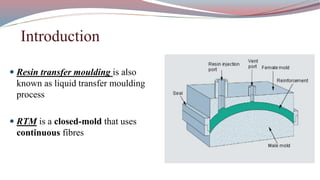
 Resin transfer moulding is also
known as liquid transfer moulding
process
 RTM is a closed-mold that uses
continuous fibres
Introduction
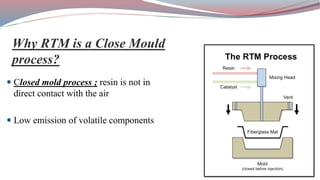
 Closed mold process ; resin is not in
direct contact with the air
 Low emission of volatile components
Why RTM is a Close Mould
process?
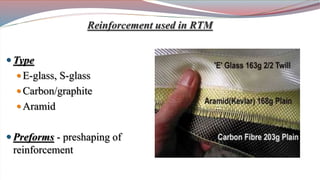
 Type
 E-glass, S-glass
 Carbon/graphite
 Aramid
 Preforms - preshaping of
reinforcement
Reinforcement used in RTM
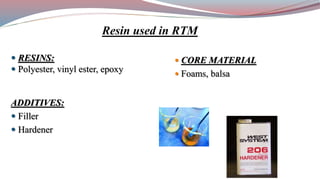
 RESINS:
 Polyester, vinyl ester, epoxy
ADDITIVES:
 Filler
 Hardener
 CORE MATERIAL
 Foams, balsa
Resin used in RTM
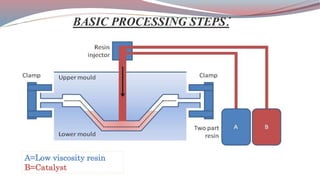
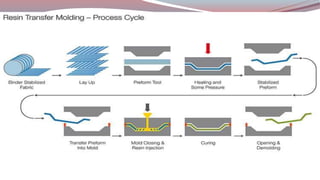
BASIC PROCESSING STEPS:
A=Low viscosity resin
B=Catalyst
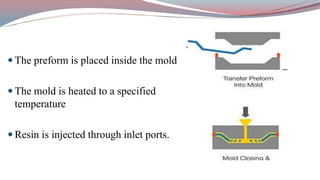
 The preform is placed inside the mold
 The mold is heated to a specified
temperature
 Resin is injected through inlet ports.
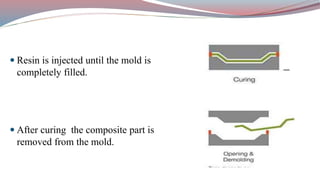
 Resin is injected until the mold is
completely filled.
 After curing the composite part is
removed from the mold.
 Overview
 Brainstorming objectives
 Rules
 Brainstorming activities
 Summarize
 Next steps
Agenda
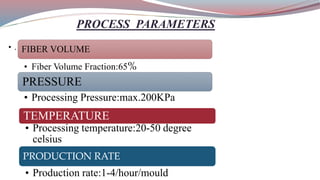
PROCESS PARAMETERS
• . FIBER VOLUME
• Fiber Volume Fraction:65%
PRESSURE
• Processing Pressure:max.200KPa
TEMPERATURE
• Processing temperature:20-50 degree
celsius
PRODUCTION RATE
• Production rate:1-4/hour/mould
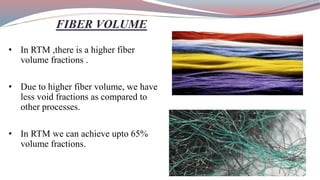
FIBER VOLUME
• In RTM ,there is a higher fiber
volume fractions .
• Due to higher fiber volume, we have
less void fractions as compared to
other processes.
• In RTM we can achieve upto 65%
volume fractions.
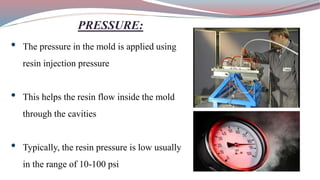
PRESSURE:
• The pressure in the mold is applied using
resin injection pressure
• This helps the resin flow inside the mold
through the cavities
• Typically, the resin pressure is low usually
in the range of 10-100 psi
TEMPERATURE
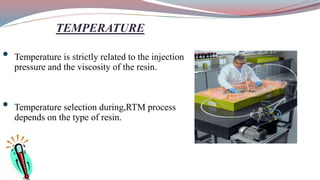
• Temperature is strictly related to the injection
pressure and the viscosity of the resin.
• Temperature selection during,RTM process
depends on the type of resin.
PRODUCTION RATE
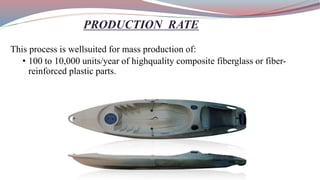
This process is wellsuited for mass production of:
• 100 to 10,000 units/year of highquality composite fiberglass or fiber-
reinforced plastic parts.
● Production cost: Low Initial investment and less operating expenses makes its
production cost moderate
● Material cost: Fiber and resin cost is high due to the use of continuous fiber and
thermoset resin
● Tooling cost: simple and inexpensive tool are used hence low tool cost
● Equipment cost: Low cost equipments .
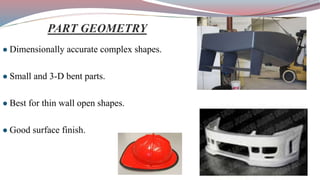
● Dimensionally accurate complex shapes.
● Small and 3-D bent parts.
● Best for thin wall open shapes.
● Good surface finish.
PART GEOMETRY
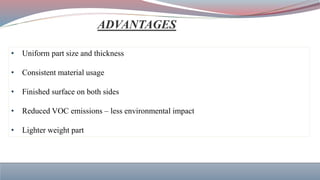
• Uniform part size and thickness
• Consistent material usage
• Finished surface on both sides
• Reduced VOC emissions – less environmental impact
• Lighter weight part
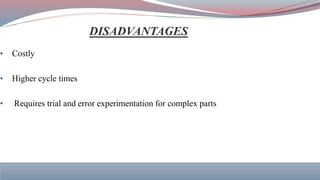
• Costly
• Higher cycle times
• Requires trial and error experimentation for complex parts
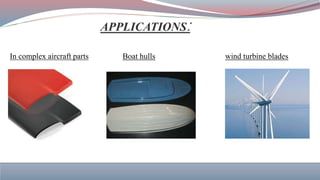
In complex aircraft parts Boat hulls wind turbine blades
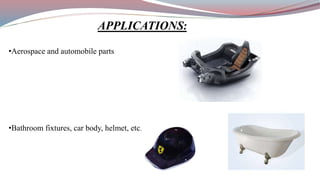
•Aerospace and automobile parts
•Bathroom fixtures, car body, helmet, etc.
APPLICATIONS:
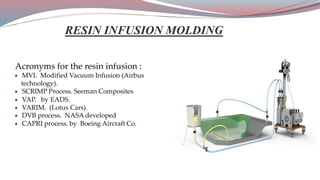
Acronyms for the resin infusion :
 MVI. Modified Vacuum Infusion (Airbus
technology).
 SCRIMP Process. Seeman Composites
 VAP. by EADS.
 VARIM. (Lotus Cars).
 DVB process. NASA developed
 CAPRI process. by Boeing Aircraft Co.
RESIN INFUSION MOLDING
MAJOR DIFFERENCES
RTM Resin Infusion
Two rigid tools One rigid and one flexible
Positive pressure Negative pressure
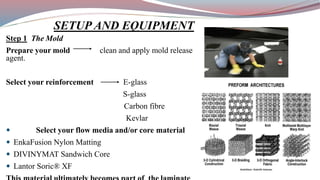
Step 1 The Mold
Prepare your mold clean and apply mold release
agent.
Select your reinforcement E-glass
S-glass
Carbon fibre
Kevlar
 Select your flow media and/or core material
 EnkaFusion Nylon Matting
 DIVINYMAT Sandwich Core
 Lantor Soric® XF
SETUP AND EQUIPMENT
Step 2
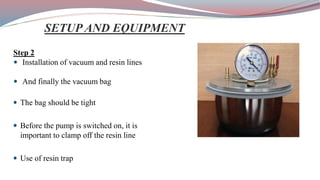
 Installation of vacuum and resin lines
 And finally the vacuum bag
 The bag should be tight
 Before the pump is switched on, it is
important to clamp off the resin line
 Use of resin trap
SETUP AND EQUIPMENT
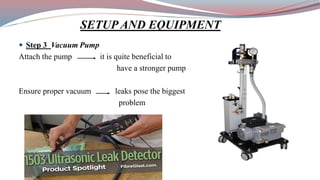
 Step 3 Vacuum Pump
Attach the pump it is quite beneficial to
have a stronger pump
Ensure proper vacuum leaks pose the biggest
problem
SETUP AND EQUIPMENT
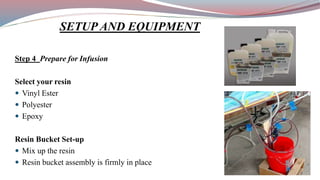
Step 4 Prepare for Infusion
Select your resin
 Vinyl Ester
 Polyester
 Epoxy
Resin Bucket Set-up
 Mix up the resin
 Resin bucket assembly is firmly in place
SETUP AND EQUIPMENT
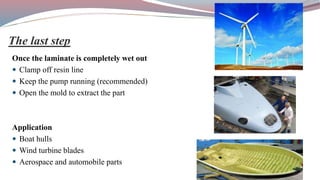
Once the laminate is completely wet out
 Clamp off resin line
 Keep the pump running (recommended)
 Open the mold to extract the part
Application
 Boat hulls
 Wind turbine blades
 Aerospace and automobile parts
The last step
ADVANTAGES
 Cost effective
 High quality and high strength
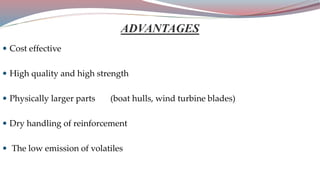
 Physically larger parts (boat hulls, wind turbine blades)
 Dry handling of reinforcement
 The low emission of volatiles
Limitations
Slow manufacturing process
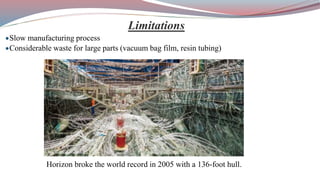
Considerable waste for large parts (vacuum bag film, resin tubing)
Horizon broke the world record in 2005 with a 136-foot hull.
Resin Transfer Molding

Resin Transfer Molding

  • 1.
    Resin Transfer Molding(RTM) And Resin Infusion Molding
  • 2.
    Adnan Askani Ahsen Ali JamilaMustafa Maaz Shoaib Hina Ibrahim Group Members (GROUP # 08)
  • 3.
     Resin transfermoulding is also known as liquid transfer moulding process  RTM is a closed-mold that uses continuous fibres Introduction
  • 4.
     Closed moldprocess ; resin is not in direct contact with the air  Low emission of volatile components Why RTM is a Close Mould process?
  • 5.
     Type  E-glass,S-glass  Carbon/graphite  Aramid  Preforms - preshaping of reinforcement Reinforcement used in RTM
  • 6.
     RESINS:  Polyester,vinyl ester, epoxy ADDITIVES:  Filler  Hardener  CORE MATERIAL  Foams, balsa Resin used in RTM
  • 7.
    BASIC PROCESSING STEPS: A=Lowviscosity resin B=Catalyst
  • 8.
     The preformis placed inside the mold  The mold is heated to a specified temperature  Resin is injected through inlet ports.
  • 9.
     Resin isinjected until the mold is completely filled.  After curing the composite part is removed from the mold.
  • 10.
     Overview  Brainstormingobjectives  Rules  Brainstorming activities  Summarize  Next steps Agenda
  • 11.
    PROCESS PARAMETERS • .FIBER VOLUME • Fiber Volume Fraction:65% PRESSURE • Processing Pressure:max.200KPa TEMPERATURE • Processing temperature:20-50 degree celsius PRODUCTION RATE • Production rate:1-4/hour/mould
  • 12.
    FIBER VOLUME • InRTM ,there is a higher fiber volume fractions . • Due to higher fiber volume, we have less void fractions as compared to other processes. • In RTM we can achieve upto 65% volume fractions.
  • 13.
    PRESSURE: • The pressurein the mold is applied using resin injection pressure • This helps the resin flow inside the mold through the cavities • Typically, the resin pressure is low usually in the range of 10-100 psi
  • 14.
    TEMPERATURE • Temperature isstrictly related to the injection pressure and the viscosity of the resin. • Temperature selection during,RTM process depends on the type of resin.
  • 15.
    PRODUCTION RATE This processis wellsuited for mass production of: • 100 to 10,000 units/year of highquality composite fiberglass or fiber- reinforced plastic parts.
  • 16.
    ● Production cost:Low Initial investment and less operating expenses makes its production cost moderate ● Material cost: Fiber and resin cost is high due to the use of continuous fiber and thermoset resin ● Tooling cost: simple and inexpensive tool are used hence low tool cost ● Equipment cost: Low cost equipments .
  • 17.
    ● Dimensionally accuratecomplex shapes. ● Small and 3-D bent parts. ● Best for thin wall open shapes. ● Good surface finish. PART GEOMETRY
  • 18.
    • Uniform partsize and thickness • Consistent material usage • Finished surface on both sides • Reduced VOC emissions – less environmental impact • Lighter weight part
  • 19.
    • Costly • Highercycle times • Requires trial and error experimentation for complex parts
  • 20.
    In complex aircraftparts Boat hulls wind turbine blades
  • 21.
    •Aerospace and automobileparts •Bathroom fixtures, car body, helmet, etc. APPLICATIONS:
  • 22.
    Acronyms for theresin infusion :  MVI. Modified Vacuum Infusion (Airbus technology).  SCRIMP Process. Seeman Composites  VAP. by EADS.  VARIM. (Lotus Cars).  DVB process. NASA developed  CAPRI process. by Boeing Aircraft Co. RESIN INFUSION MOLDING
  • 23.
    MAJOR DIFFERENCES RTM ResinInfusion Two rigid tools One rigid and one flexible Positive pressure Negative pressure
  • 24.
    Step 1 TheMold Prepare your mold clean and apply mold release agent. Select your reinforcement E-glass S-glass Carbon fibre Kevlar  Select your flow media and/or core material  EnkaFusion Nylon Matting  DIVINYMAT Sandwich Core  Lantor Soric® XF SETUP AND EQUIPMENT
  • 25.
    Step 2  Installationof vacuum and resin lines  And finally the vacuum bag  The bag should be tight  Before the pump is switched on, it is important to clamp off the resin line  Use of resin trap SETUP AND EQUIPMENT
  • 26.
     Step 3Vacuum Pump Attach the pump it is quite beneficial to have a stronger pump Ensure proper vacuum leaks pose the biggest problem SETUP AND EQUIPMENT
  • 27.
    Step 4 Preparefor Infusion Select your resin  Vinyl Ester  Polyester  Epoxy Resin Bucket Set-up  Mix up the resin  Resin bucket assembly is firmly in place SETUP AND EQUIPMENT
  • 28.
    Once the laminateis completely wet out  Clamp off resin line  Keep the pump running (recommended)  Open the mold to extract the part Application  Boat hulls  Wind turbine blades  Aerospace and automobile parts The last step
  • 29.
    ADVANTAGES  Cost effective High quality and high strength  Physically larger parts (boat hulls, wind turbine blades)  Dry handling of reinforcement  The low emission of volatiles
  • 30.
    Limitations Slow manufacturing process Considerablewaste for large parts (vacuum bag film, resin tubing) Horizon broke the world record in 2005 with a 136-foot hull.

Editor's Notes