Department of Metallurgical Engineering and Materials Science
Indian Institute of Technology Bombay
Siddharth Sankar Jena
Roll no-163110023
1
Outline
• Introduction
• Materials for CMCs
• Processing of CMCs
Chemical vapour infiltration
Polymer infiltration & pyrolysis
Melt infiltration
Slurry Impregnation
• Mechanical Properties
• Some Important CMCs
 Fabrication
 Mechanical Properties
• Conclusion
2
Introduction
• A composite material is a structural material made up of two or more
than two constituents.
• Ceramic Matrix + Reinforcement = Ceramic Matrix Composite
• What happened to ceramics?
Ceramics have:
High elastic modulus But Toughness is very low,
Low density that is why CMCs are focused
Stability at high temperatures
Good wear resistance
3
Materials For CMCs:
Matrix materials:
• e.g. Al2O3, ZrO2, SiO2, SiC,
Si3N4, MgO, TiC, etc.
Reinforcement materials:
• Particulates (e.g. SiC, Al2O3,
SiO2, ZrO2, B4C)
• Whiskers (e.g. SiC)
• Fibers (e.g.SiC, Al2O3)
4
Processing of CMCs
Most popular methods for manufacturing CMCs
are:
• Chemical Vapour Infiltration (CVI)
• Polymer Infiltration and Pyrolysis (PIP)
• Melt Infiltration (MI)
• Slurry Infiltration Process.
5
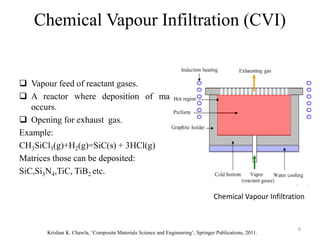
Chemical Vapour Infiltration (CVI)
 Vapour feed of reactant gases.
 A reactor where deposition of matrix
occurs.
 Opening for exhaust gas.
Example:
CH3SiCl3(g)+H2(g)=SiC(s) + 3HCl(g)
Matrices those can be deposited:
SiC,Si3N4,TiC, TiB2 etc.
6
Chemical Vapour Infiltration
Krishan K. Chawla, ‘Composite Materials Science and Engineering’, Springer Publications, 2011.
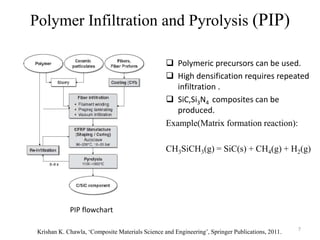
Polymer Infiltration and Pyrolysis (PIP)
 Polymeric precursors can be used.
 High densification requires repeated
infiltration .
 SiC,Si3N4 composites can be
produced.
Example(Matrix formation reaction):
CH3SiCH3(g) = SiC(s) + CH4(g) + H2(g)
7
PIP flowchart
Krishan K. Chawla, ‘Composite Materials Science and Engineering’, Springer Publications, 2011.
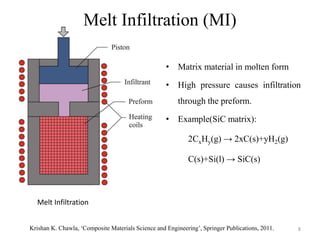
Melt Infiltration (MI)
• Matrix material in molten form
• High pressure causes infiltration
through the preform.
• Example(SiC matrix):
2CxHy(g) → 2xC(s)+yH2(g)
C(s)+Si(l) → SiC(s)
8
Melt Infiltration
Krishan K. Chawla, ‘Composite Materials Science and Engineering’, Springer Publications, 2011.
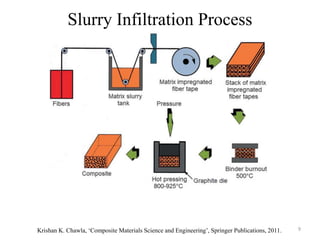
Slurry Infiltration Process
9Krishan K. Chawla, ‘Composite Materials Science and Engineering’, Springer Publications, 2011.
Mechanical Properties
• There are few specific properties should be considered before
using in structural and high temperature applications.
• From them fracture toughness is the most important property
to be considered because catastrophic failure is not acceptable
during application.
10
Fracture Toughness
The basic toughening mechanisms facture
toughness depend on:
• Crack bowing
• Crack deflection
• Debonding & Pull-out
• Fiber bridging
11
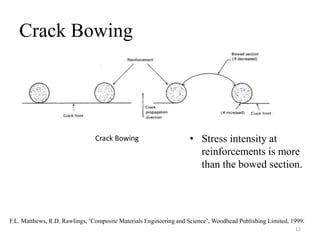
Crack Bowing
• Stress intensity at
reinforcements is more
than the bowed section.
12
Crack Bowing
F.L. Matthews, R.D. Rawlings, ‘Composite Materials Engineering and Science’, Woodhead Publishing Limited, 1999.
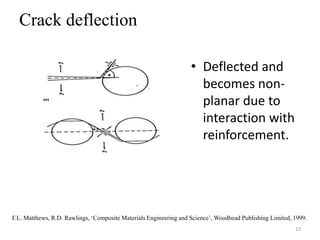
Crack deflection
• Deflected and
becomes non-
planar due to
interaction with
reinforcement.
13
F.L. Matthews, R.D. Rawlings, ‘Composite Materials Engineering and Science’, Woodhead Publishing Limited, 1999.
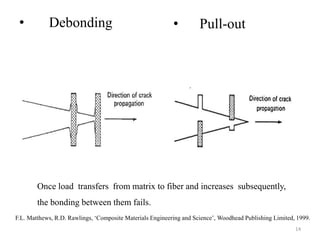
• Debonding • Pull-out
14
Once load transfers from matrix to fiber and increases subsequently,
the bonding between them fails.
F.L. Matthews, R.D. Rawlings, ‘Composite Materials Engineering and Science’, Woodhead Publishing Limited, 1999.
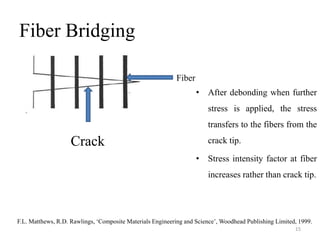
Fiber Bridging
Fiber
• After debonding when further
stress is applied, the stress
transfers to the fibers from the
crack tip.
• Stress intensity factor at fiber
increases rather than crack tip.
Crack
15
F.L. Matthews, R.D. Rawlings, ‘Composite Materials Engineering and Science’, Woodhead Publishing Limited, 1999.
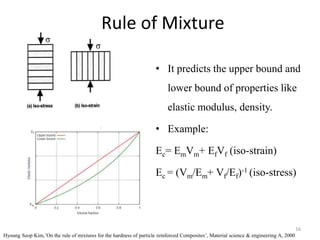
Rule of Mixture
• It predicts the upper bound and
lower bound of properties like
elastic modulus, density.
• Example:
Ec= EmVm+ EfVf (iso-strain)
Ec = (Vm/Em+ Vf/Ef)-1 (iso-stress)
16
Hyoung Seop Kim,’On the rule of mixtures for the hardness of particle reinforced Composites’, Material science & engineering A, 2000
Some Important CMCs
SiC-SiC Composites:
Processing:
• CVI-Chemical Vapour Infiltration
• Melt Infiltration
• Slurry Impregnation
Reactions take place:
CH3SiCl3(g)+H2(g) → SiC(s) + 3HCl(g)
2CxHy(g) → 2xC(s)+yH2(g)
BX3(g) + NH3(g) → BNx(s) + 3HX (g)
C(s)+Si(l) → SiC(s) (Melt or Liquid Infiltration)
17
Mechanical Properties of
SiC-SiC Composite:
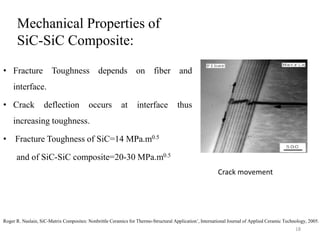
• Fracture Toughness depends on fiber and
interface.
• Crack deflection occurs at interface thus
increasing toughness.
• Fracture Toughness of SiC=14 MPa.m0.5
and of SiC-SiC composite=20-30 MPa.m0.5
18
Crack movement
Roger R. Naslain, SiC-Matrix Composites: Nonbrittle Ceramics for Thermo-Structural Application’, International Journal of Applied Ceramic Technology, 2005.
ZrB2-SiC composite:
• ZrB2 has:
 High melting point
 High hardness
 Good chemical inertness
• But low fracture toughness limits its use for wider applications.
• To improve the fracture toughness reinforcement is used preferably SiC
whiskers.
19
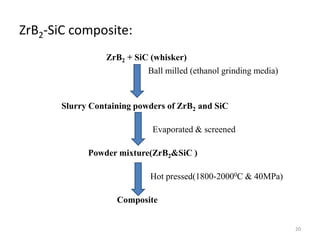
ZrB2-SiC composite:
20
ZrB2 + SiC (whisker)
Ball milled (ethanol grinding media)
Slurry Containing powders of ZrB2 and SiC
Evaporated & screened
Powder mixture(ZrB2&SiC )
Hot pressed(1800-20000C & 40MPa)
Composite
Mechanical Properties of ZrB2-SiC
Composite:
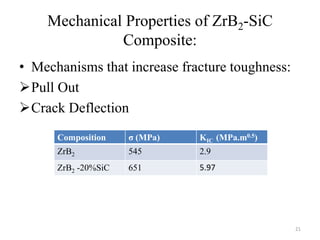
• Mechanisms that increase fracture toughness:
Pull Out
Crack Deflection
21
Composition σ (MPa) KIC (MPa.m0.5)
ZrB2 545 2.9
ZrB2 -20%SiC 651 5.97
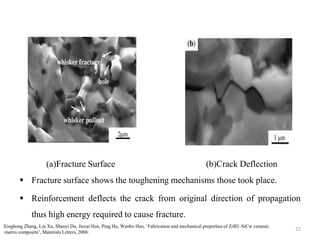
(a)Fracture Surface (b)Crack Deflection
 Fracture surface shows the toughening mechanisms those took place.
 Reinforcement deflects the crack from original direction of propagation
thus high energy required to cause fracture.
22
Xinghong Zhang, Lin Xu, Shanyi Du, Jiecai Han, Ping Hu, Wenbo Han, ‘Fabrication and mechanical properties of ZrB2–SiCw ceramic
matrix composite’, Materials Letters, 2008.
TiB2-SiC Composites:
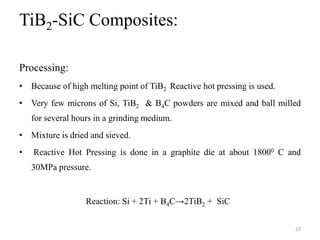
Processing:
• Because of high melting point of TiB2 Reactive hot pressing is used.
• Very few microns of Si, TiB2 & B4C powders are mixed and ball milled
for several hours in a grinding medium.
• Mixture is dried and sieved.
• Reactive Hot Pressing is done in a graphite die at about 18000 C and
30MPa pressure.
Reaction: Si + 2Ti + B4C→2TiB2 + SiC
23
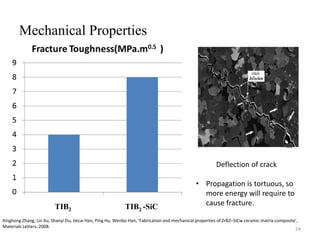
Mechanical Properties
24
Deflection of crack
• Propagation is tortuous, so
more energy will require to
cause fracture.
Xinghong Zhang, Lin Xu, Shanyi Du, Jiecai Han, Ping Hu, Wenbo Han, ‘Fabrication and mechanical properties of ZrB2–SiCw ceramic matrix composite’,
Materials Letters, 2008.
TIB2 TIB2 -SiC
Al2O3-SiC Composite
• Processing:
• Al2O3&SiC powders are ball milled.
• Agglomeration should be avoided.
• After milling powder is dried and sieved.
• Hot pressed at high temperature(16500C) and pressure(25MPa) to get the
composite.
25
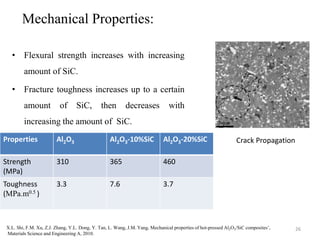
Mechanical Properties:
• Flexural strength increases with increasing
amount of SiC.
• Fracture toughness increases up to a certain
amount of SiC, then decreases with
increasing the amount of SiC.
26
Properties Al2O3 Al2O3-10%SiC Al2O3-20%SiC
Strength
(MPa)
310 365 460
Toughness
(MPa.m0.5 )
3.3 7.6 3.7
Crack Propagation
X.L. Shi, F.M. Xu, Z.J. Zhang, Y.L. Dong, Y. Tan, L. Wang, J.M. Yang, Mechanical properties of hot-pressed Al2O3/SiC composites’,
Materials Science and Engineering A, 2010.
Conclusion
• CMCs are the emerging players in field of composites.
• Because of improved fracture toughness these can be used in
various structural applications as well as high temperature
applications.
27
References:
• 1. Krishan K. Chawla, ‘Composite Materials Science and Engineering’, Springer Publications, 2011.
• 2. F.L. Matthews, R.D. Rawlings, ‘Composite Materials Engineering and Science’, Woodhead Publishing
Limited, 1999.
• 3. R. Naslain, ‘Design, preparation and properties of non-oxide CMCs for application in engines and
nuclear reactors: an overview’, Composites Science and Technology, 2004.
• 4. Roger R. Naslain, SiC-Matrix Composites: Nonbrittle Ceramics for Thermo-Structural Application’,
International Journal of Applied Ceramic Technology, 2005.
• 5. Hyoung Seop Kim, ‘On the rule of mixtures for the hardness of particle reinforced composites’, Material
Science & Engineering A, 2000.
• 6. Qiang Liu , Wenbo Han, Xinghong Zhang, Shuo Wang, Jiecai Han, ‘Microstructure and mechanical
properties of ZrB2-SiC composites’, Materials Letters, 2009.
• 7. Xinghong Zhang, Lin Xu, Shanyi Du, Jiecai Han, Ping Hu, Wenbo Han, ‘Fabrication and mechanical
properties of ZrB2–SiCw ceramic matrix composite’, Materials Letters, 2008.
• 8. Guolong Zhao, Chuanzhen Huang , Hanlian Liu, Bin Zou, Hongtao Zhu, Jun Wang,‘Microstructure and
mechanical properties of TiB2–SiC ceramic composites by Reactive Hot Pressing’, Int. Journal of
Refractory Metals and Hard Materials, 2014.
• 9. Y.L. Donga, F.M. Xua, X.L. Shia, C. Zhanga, Z.J. Zhanga, J.M. Yangb, Y. Tana, ‘Fabrication and
mechanical properties of nano-/micro-sized Al2O3/SiC composites’, Materials Science and Engineering A,
2009.
• 10. X.L. Shi, F.M. Xu, Z.J. Zhang, Y.L. Dong, Y. Tan, L. Wang, J.M. Yang, Mechanical properties of hot-
pressed Al2O3/SiC composites’, Materials Science and Engineering A, 2010.
28
THANK YOU!!
29

Ceramics matrix composites

  • 1.
    Department of MetallurgicalEngineering and Materials Science Indian Institute of Technology Bombay Siddharth Sankar Jena Roll no-163110023 1
  • 2.
    Outline • Introduction • Materialsfor CMCs • Processing of CMCs Chemical vapour infiltration Polymer infiltration & pyrolysis Melt infiltration Slurry Impregnation • Mechanical Properties • Some Important CMCs  Fabrication  Mechanical Properties • Conclusion 2
  • 3.
    Introduction • A compositematerial is a structural material made up of two or more than two constituents. • Ceramic Matrix + Reinforcement = Ceramic Matrix Composite • What happened to ceramics? Ceramics have: High elastic modulus But Toughness is very low, Low density that is why CMCs are focused Stability at high temperatures Good wear resistance 3
  • 4.
    Materials For CMCs: Matrixmaterials: • e.g. Al2O3, ZrO2, SiO2, SiC, Si3N4, MgO, TiC, etc. Reinforcement materials: • Particulates (e.g. SiC, Al2O3, SiO2, ZrO2, B4C) • Whiskers (e.g. SiC) • Fibers (e.g.SiC, Al2O3) 4
  • 5.
    Processing of CMCs Mostpopular methods for manufacturing CMCs are: • Chemical Vapour Infiltration (CVI) • Polymer Infiltration and Pyrolysis (PIP) • Melt Infiltration (MI) • Slurry Infiltration Process. 5
  • 6.
    Chemical Vapour Infiltration(CVI)  Vapour feed of reactant gases.  A reactor where deposition of matrix occurs.  Opening for exhaust gas. Example: CH3SiCl3(g)+H2(g)=SiC(s) + 3HCl(g) Matrices those can be deposited: SiC,Si3N4,TiC, TiB2 etc. 6 Chemical Vapour Infiltration Krishan K. Chawla, ‘Composite Materials Science and Engineering’, Springer Publications, 2011.
  • 7.
    Polymer Infiltration andPyrolysis (PIP)  Polymeric precursors can be used.  High densification requires repeated infiltration .  SiC,Si3N4 composites can be produced. Example(Matrix formation reaction): CH3SiCH3(g) = SiC(s) + CH4(g) + H2(g) 7 PIP flowchart Krishan K. Chawla, ‘Composite Materials Science and Engineering’, Springer Publications, 2011.
  • 8.
    Melt Infiltration (MI) •Matrix material in molten form • High pressure causes infiltration through the preform. • Example(SiC matrix): 2CxHy(g) → 2xC(s)+yH2(g) C(s)+Si(l) → SiC(s) 8 Melt Infiltration Krishan K. Chawla, ‘Composite Materials Science and Engineering’, Springer Publications, 2011.
  • 9.
    Slurry Infiltration Process 9KrishanK. Chawla, ‘Composite Materials Science and Engineering’, Springer Publications, 2011.
  • 10.
    Mechanical Properties • Thereare few specific properties should be considered before using in structural and high temperature applications. • From them fracture toughness is the most important property to be considered because catastrophic failure is not acceptable during application. 10
  • 11.
    Fracture Toughness The basictoughening mechanisms facture toughness depend on: • Crack bowing • Crack deflection • Debonding & Pull-out • Fiber bridging 11
  • 12.
    Crack Bowing • Stressintensity at reinforcements is more than the bowed section. 12 Crack Bowing F.L. Matthews, R.D. Rawlings, ‘Composite Materials Engineering and Science’, Woodhead Publishing Limited, 1999.
  • 13.
    Crack deflection • Deflectedand becomes non- planar due to interaction with reinforcement. 13 F.L. Matthews, R.D. Rawlings, ‘Composite Materials Engineering and Science’, Woodhead Publishing Limited, 1999.
  • 14.
    • Debonding •Pull-out 14 Once load transfers from matrix to fiber and increases subsequently, the bonding between them fails. F.L. Matthews, R.D. Rawlings, ‘Composite Materials Engineering and Science’, Woodhead Publishing Limited, 1999.
  • 15.
    Fiber Bridging Fiber • Afterdebonding when further stress is applied, the stress transfers to the fibers from the crack tip. • Stress intensity factor at fiber increases rather than crack tip. Crack 15 F.L. Matthews, R.D. Rawlings, ‘Composite Materials Engineering and Science’, Woodhead Publishing Limited, 1999.
  • 16.
    Rule of Mixture •It predicts the upper bound and lower bound of properties like elastic modulus, density. • Example: Ec= EmVm+ EfVf (iso-strain) Ec = (Vm/Em+ Vf/Ef)-1 (iso-stress) 16 Hyoung Seop Kim,’On the rule of mixtures for the hardness of particle reinforced Composites’, Material science & engineering A, 2000
  • 17.
    Some Important CMCs SiC-SiCComposites: Processing: • CVI-Chemical Vapour Infiltration • Melt Infiltration • Slurry Impregnation Reactions take place: CH3SiCl3(g)+H2(g) → SiC(s) + 3HCl(g) 2CxHy(g) → 2xC(s)+yH2(g) BX3(g) + NH3(g) → BNx(s) + 3HX (g) C(s)+Si(l) → SiC(s) (Melt or Liquid Infiltration) 17
  • 18.
    Mechanical Properties of SiC-SiCComposite: • Fracture Toughness depends on fiber and interface. • Crack deflection occurs at interface thus increasing toughness. • Fracture Toughness of SiC=14 MPa.m0.5 and of SiC-SiC composite=20-30 MPa.m0.5 18 Crack movement Roger R. Naslain, SiC-Matrix Composites: Nonbrittle Ceramics for Thermo-Structural Application’, International Journal of Applied Ceramic Technology, 2005.
  • 19.
    ZrB2-SiC composite: • ZrB2has:  High melting point  High hardness  Good chemical inertness • But low fracture toughness limits its use for wider applications. • To improve the fracture toughness reinforcement is used preferably SiC whiskers. 19
  • 20.
    ZrB2-SiC composite: 20 ZrB2 +SiC (whisker) Ball milled (ethanol grinding media) Slurry Containing powders of ZrB2 and SiC Evaporated & screened Powder mixture(ZrB2&SiC ) Hot pressed(1800-20000C & 40MPa) Composite
  • 21.
    Mechanical Properties ofZrB2-SiC Composite: • Mechanisms that increase fracture toughness: Pull Out Crack Deflection 21 Composition σ (MPa) KIC (MPa.m0.5) ZrB2 545 2.9 ZrB2 -20%SiC 651 5.97
  • 22.
    (a)Fracture Surface (b)CrackDeflection  Fracture surface shows the toughening mechanisms those took place.  Reinforcement deflects the crack from original direction of propagation thus high energy required to cause fracture. 22 Xinghong Zhang, Lin Xu, Shanyi Du, Jiecai Han, Ping Hu, Wenbo Han, ‘Fabrication and mechanical properties of ZrB2–SiCw ceramic matrix composite’, Materials Letters, 2008.
  • 23.
    TiB2-SiC Composites: Processing: • Becauseof high melting point of TiB2 Reactive hot pressing is used. • Very few microns of Si, TiB2 & B4C powders are mixed and ball milled for several hours in a grinding medium. • Mixture is dried and sieved. • Reactive Hot Pressing is done in a graphite die at about 18000 C and 30MPa pressure. Reaction: Si + 2Ti + B4C→2TiB2 + SiC 23
  • 24.
    Mechanical Properties 24 Deflection ofcrack • Propagation is tortuous, so more energy will require to cause fracture. Xinghong Zhang, Lin Xu, Shanyi Du, Jiecai Han, Ping Hu, Wenbo Han, ‘Fabrication and mechanical properties of ZrB2–SiCw ceramic matrix composite’, Materials Letters, 2008. TIB2 TIB2 -SiC
  • 25.
    Al2O3-SiC Composite • Processing: •Al2O3&SiC powders are ball milled. • Agglomeration should be avoided. • After milling powder is dried and sieved. • Hot pressed at high temperature(16500C) and pressure(25MPa) to get the composite. 25
  • 26.
    Mechanical Properties: • Flexuralstrength increases with increasing amount of SiC. • Fracture toughness increases up to a certain amount of SiC, then decreases with increasing the amount of SiC. 26 Properties Al2O3 Al2O3-10%SiC Al2O3-20%SiC Strength (MPa) 310 365 460 Toughness (MPa.m0.5 ) 3.3 7.6 3.7 Crack Propagation X.L. Shi, F.M. Xu, Z.J. Zhang, Y.L. Dong, Y. Tan, L. Wang, J.M. Yang, Mechanical properties of hot-pressed Al2O3/SiC composites’, Materials Science and Engineering A, 2010.
  • 27.
    Conclusion • CMCs arethe emerging players in field of composites. • Because of improved fracture toughness these can be used in various structural applications as well as high temperature applications. 27

  • 28.
    References: • 1. KrishanK. Chawla, ‘Composite Materials Science and Engineering’, Springer Publications, 2011. • 2. F.L. Matthews, R.D. Rawlings, ‘Composite Materials Engineering and Science’, Woodhead Publishing Limited, 1999. • 3. R. Naslain, ‘Design, preparation and properties of non-oxide CMCs for application in engines and nuclear reactors: an overview’, Composites Science and Technology, 2004. • 4. Roger R. Naslain, SiC-Matrix Composites: Nonbrittle Ceramics for Thermo-Structural Application’, International Journal of Applied Ceramic Technology, 2005. • 5. Hyoung Seop Kim, ‘On the rule of mixtures for the hardness of particle reinforced composites’, Material Science & Engineering A, 2000. • 6. Qiang Liu , Wenbo Han, Xinghong Zhang, Shuo Wang, Jiecai Han, ‘Microstructure and mechanical properties of ZrB2-SiC composites’, Materials Letters, 2009. • 7. Xinghong Zhang, Lin Xu, Shanyi Du, Jiecai Han, Ping Hu, Wenbo Han, ‘Fabrication and mechanical properties of ZrB2–SiCw ceramic matrix composite’, Materials Letters, 2008. • 8. Guolong Zhao, Chuanzhen Huang , Hanlian Liu, Bin Zou, Hongtao Zhu, Jun Wang,‘Microstructure and mechanical properties of TiB2–SiC ceramic composites by Reactive Hot Pressing’, Int. Journal of Refractory Metals and Hard Materials, 2014. • 9. Y.L. Donga, F.M. Xua, X.L. Shia, C. Zhanga, Z.J. Zhanga, J.M. Yangb, Y. Tana, ‘Fabrication and mechanical properties of nano-/micro-sized Al2O3/SiC composites’, Materials Science and Engineering A, 2009. • 10. X.L. Shi, F.M. Xu, Z.J. Zhang, Y.L. Dong, Y. Tan, L. Wang, J.M. Yang, Mechanical properties of hot- pressed Al2O3/SiC composites’, Materials Science and Engineering A, 2010. 28
  • 29.