CIPET-IPT,AHMEDABAD
Seminar Topic – Sheet Moulding Compounds
Presented By-
Shravan Kumar Pathak
E.N.(180520123045)
Course - B.E.-7th Sem
(Plastic Technology)
Definition
 SMC is a combination of long chopped glass strands,minerals fillers
and liquid thermosetting resin in the form of a malleable sheet
material.
 Sheet Molding Compound (SMC) is a compression molding compound
often used for larger parts where higher mechanical strength is
needed.
 SMC is a fiber reinforced thermoset material. Glass reinforcement is
between 10% and 60%, and glass length is slightly longer than Bulk
Molding Compound (BMC) - between 1/2-inch and 1-inch (25mm).
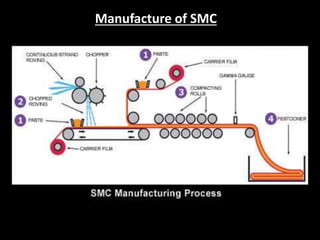
Manufacture of SMC
 A continuous polyethylene or Cellophane film is coated with a
suitably formulated polyester resin system into which is deposited a
layer of either chopped strand mat (450 g/m2) or chopped rovings.
 A second layer of polyethylene film,similarly coated with resin
system,is placed over the reinforcement and the sandwich thus formed
is passed through a series of rollers to press the glass fibres into the
resin and ensure thorough wetting of the reinforcement by the resin.
 The sandwich is then wound into a roll and allowed to stand while the
resin thickens.
 SMC is cut to the required shape and both layers of polyethylene film
are removed and SMC placed in the mould and pressed.
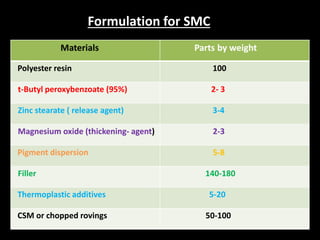
Formulation for SMC
Materials Parts by weight
Polyester resin 100
t-Butyl peroxybenzoate (95%) 2- 3
Zinc stearate ( release agent) 3-4
Magnesium oxide (thickening- agent) 2-3
Pigment dispersion 5-8
Filler 140-180
Thermoplastic additives 5-20
CSM or chopped rovings 50-100
Properties of SMC
 High strength to weight ratio.
 Excellent corrosion resistance.
 Superior electrical insulation properties.
 Good aesthetics and colorability.
 Good flame retardance and easy cleanability.
Advantages of SMC
 Very high volume production ability.
 Excellent part reproducibility.
 It is a cost- effective process.
 scrap is reduced substantially.
 It is light in weight.
Disadvantages of SMC
 Low level of stiffness and strength.
 High Investment cost
 Large cycle time
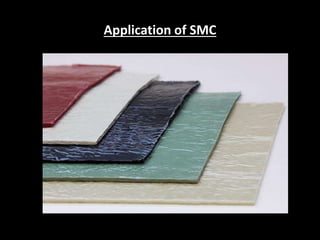
Application of SMC
Application of SMC
 Instrumentation bases.
 X-ray film container.
 Electrical parts.
 Bio hazardous trash containers.
 Dental equipment housing.
.

Sheet Moulding Compounds

  • 1.
    CIPET-IPT,AHMEDABAD Seminar Topic –Sheet Moulding Compounds Presented By- Shravan Kumar Pathak E.N.(180520123045) Course - B.E.-7th Sem (Plastic Technology)
  • 2.
    Definition  SMC isa combination of long chopped glass strands,minerals fillers and liquid thermosetting resin in the form of a malleable sheet material.  Sheet Molding Compound (SMC) is a compression molding compound often used for larger parts where higher mechanical strength is needed.  SMC is a fiber reinforced thermoset material. Glass reinforcement is between 10% and 60%, and glass length is slightly longer than Bulk Molding Compound (BMC) - between 1/2-inch and 1-inch (25mm).
  • 3.
  • 4.
     A continuouspolyethylene or Cellophane film is coated with a suitably formulated polyester resin system into which is deposited a layer of either chopped strand mat (450 g/m2) or chopped rovings.  A second layer of polyethylene film,similarly coated with resin system,is placed over the reinforcement and the sandwich thus formed is passed through a series of rollers to press the glass fibres into the resin and ensure thorough wetting of the reinforcement by the resin.  The sandwich is then wound into a roll and allowed to stand while the resin thickens.  SMC is cut to the required shape and both layers of polyethylene film are removed and SMC placed in the mould and pressed.
  • 5.
    Formulation for SMC MaterialsParts by weight Polyester resin 100 t-Butyl peroxybenzoate (95%) 2- 3 Zinc stearate ( release agent) 3-4 Magnesium oxide (thickening- agent) 2-3 Pigment dispersion 5-8 Filler 140-180 Thermoplastic additives 5-20 CSM or chopped rovings 50-100
  • 6.
    Properties of SMC High strength to weight ratio.  Excellent corrosion resistance.  Superior electrical insulation properties.  Good aesthetics and colorability.  Good flame retardance and easy cleanability.
  • 7.
    Advantages of SMC Very high volume production ability.  Excellent part reproducibility.  It is a cost- effective process.  scrap is reduced substantially.  It is light in weight.
  • 8.
    Disadvantages of SMC Low level of stiffness and strength.  High Investment cost  Large cycle time
  • 9.
  • 10.
    Application of SMC Instrumentation bases.  X-ray film container.  Electrical parts.  Bio hazardous trash containers.  Dental equipment housing.
  • 11.